BENEFITS OF EXERCISE TRAINING
WITH NINTENDO
®WII FOR HEALTHY ELDERLY
POPULATION: LITERATURE REVIEW
Benefícios do treinamento de exercícios com o Nintendo
®Wii
na população de idosos saudáveis: revisão de literatura
Edna Yukimi Itakussu(1), Paola Janeiro Valenciano(1), Celita Salmaso Trelha(1),
Luciana Lozza de Moraes Marchiori(2)
among the elderly and the risks are increased with the presence of factors such as poor balance, difi
-culty to walk, lower limbs deicits and the use of
sedatives4. Adding to these, the experience of aging
is different for different populations, even between men and women5.
Programs of physical exercises that signii
-cantly enhance muscle power, maintaining body weight and composition, and improving balance,
INTRODUCTION
The population aging is a world phenomenon and Brazil withholds almost 13 million elderlies, which stands for about 7.4% of the total Brazilian
population1. With aging, the systems responsible
for balance are altered, causing elderlies to be vulnerable to functional deicits2, so much that falls
ABSTRACT
The present study aims to evaluate possible beneits of exercises performance by elderly population using Nintendo® Wii. The literature was reviewed through the indexed databases: Medical Literature Analysis and Retrieval System Online, PubMed, SciELO, The Cochrane Library, and Physiotherapy Evidence Database. Between 2010 and 2013 ten articles were selected: ive articles methodologically classiied as semi-experimental or interventional type and the other ive as a randomized controlled trial. After literature review, we could identify six categories related to the outcomes investigated, which were static balance, dynamic balance, subjective measures of balance, functional capacity, muscle strength and motivation and/or fun. These results suggest that the Nintendo® Wii is a valuable tool for physical therapy practice, bringing potential beneits to the elderly population. Further research is needed to deine a more appropriate protocol regarding games chosen, supervision, monitoring and that the duration and frequency of therapy would be more beneicial for these patients to better clinical applicability.
Evidence Database (PEDro), without any restric
-tions as to its publishing year and language, and using the descriptors “Nintendo® Wii”, “balance”
and “elderly” with the Boolean operator “and”. The
inclusion criteria taken into account were: electroni
-cally available complete articles; papers whose target population was the elderly (60 to 95 years old) of both genders and healthy; experimental or semi-experimental studies; quantitative and/ or qualitative studies; studies that used Nintendo®
Wii as a means of treatment or intervention. As for the exclusion criteria, they were: papers in which the studied individuals had any disease that could inluence their balance (such as Parkinson’s disease, cerebrovascular accident, vestibulopa
-thies); individuals of either male or female gender, alone; individuals whose age was under 60; obser
-vational studies; case reports or series; and studies whose objectives were not to assess the use of Wii as a therapeutic resource, but as a tool to evaluate balance.
LITERATURE REVIEW
Fifty-nine articles were found, of which twenty were on MEDLINE, thirty-three on PubMed, three
on SciELO, one on The Cochrane Library and two
on PEDro. Of the total, twenty-one articles were in
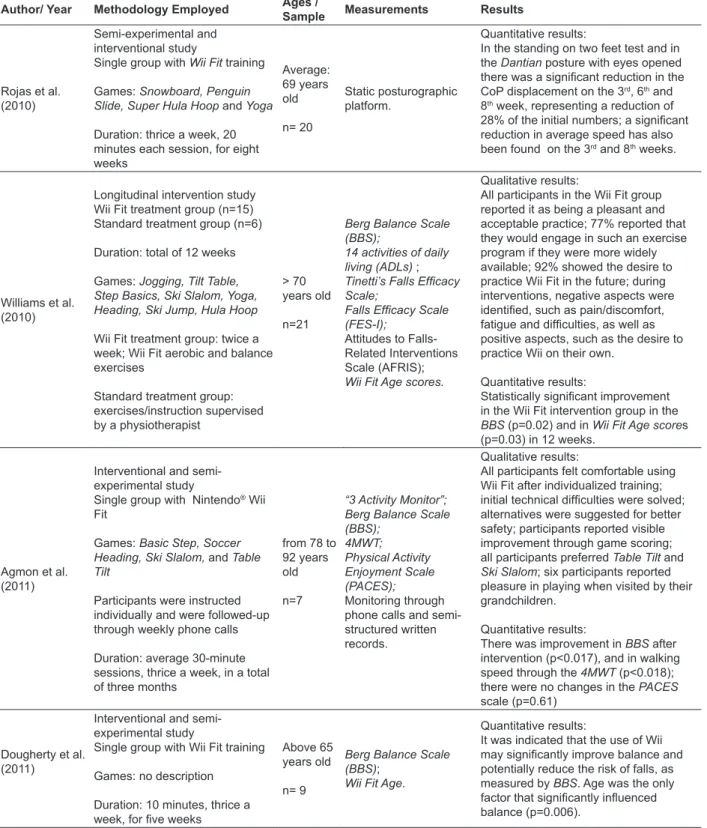
agreement with the inclusion and exclusion criteria, but eleven were in duplicity, that is, in more than one of the databases. Therefore, ten articles were included in the present study, which are represented in Table 1.
the entry element, aiming at a higher caloric expen -diture9. In addition, the virtual environment has
been showing to be a promising technology, since, through games, it promotes interaction and favors the use of balance-oriented reactions as it creates sensations resulting from experiencing a different
reality10.
The beneits of using Nintendo® Wii in rehabili
-tation science as a therapeutic tool in literature include correction of the body’s posture, balance training, enhancement of locomotion ability and higher and lower limbs movement extent, besides motivating patients towards the practice of exercises11. Thus, the relation between virtual
practice of physical activities and the true gain of motor skills is being studied, since interfaces such
as Nintendo® Wii demand abilities necessary to
perform everyday activities12.
Based on these considerations, regarding the virtual practice of physical activities, the objective of the present research was to evaluate the beneits for healthy elderly populations of training with
Nintendo® Wii.
METHODS
A bibliographic review was carried out through the analysis and integration of the literature regarding the possible beneits of the usage of Nintendo® Wii
games for healthy elderly population. The biblio
-graphic survey was done in January, 2014, in the indexed databases: Medical Literature Analysis and Retrieval System Online (MEDLINE), PubMed,
Table 1 – Description of studies that used Nintendo® Wii for balance improvement among healthy
elderly.
Author/ Year Methodology Employed Ages /
Sample Measurements Results
Rojas et al. (2010)
Semi-experimental and interventional study
Single group with Wii Fit training
Games: Snowboard, Penguin Slide, Super Hula Hoop and Yoga
Duration: thrice a week, 20 minutes each session, for eight weeks Average: 69 years old n= 20 Static posturographic platform. Quantitative results:
In the standing on two feet test and in the Dantian posture with eyes opened
there was a signiicant reduction in the CoP displacement on the 3rd, 6th and 8th week, representing a reduction of 28% of the initial numbers; a signiicant reduction in average speed has also been found on the 3rd and 8th weeks.
Williams et al. (2010)
Longitudinal intervention study Wii Fit treatment group (n=15) Standard treatment group (n=6) Duration: total of 12 weeks
Games: Jogging, Tilt Table, Step Basics, Ski Slalom, Yoga, Heading, Ski Jump, Hula Hoop
Wii Fit treatment group: twice a week; Wii Fit aerobic and balance exercises
Standard treatment group: exercises/instruction supervised by a physiotherapist
> 70 years old n=21
Berg Balance Scale (BBS);
14 activities of daily living (ADLs) ; Tinetti’s Falls Eficacy
Scale;
Falls Eficacy Scale
(FES-I);
Attitudes to Falls-Related Interventions Scale (AFRIS);
Wii Fit Age scores.
Qualitative results:
All participants in the Wii Fit group reported it as being a pleasant and acceptable practice; 77% reported that they would engage in such an exercise program if they were more widely available; 92% showed the desire to practice Wii Fit in the future; during interventions, negative aspects were identiied, such as pain/discomfort, fatigue and dificulties, as well as positive aspects, such as the desire to practice Wii on their own.
Quantitative results:
Statistically signiicant improvement in the Wii Fit intervention group in the
BBS (p=0.02) and in Wii Fit Age scores (p=0.03) in 12 weeks.
Agmon et al. (2011)
Interventional and semi-experimental study
Single group with Nintendo® Wii Fit
Games: Basic Step, Soccer Heading, Ski Slalom, and Table Tilt
Participants were instructed individually and were followed-up through weekly phone calls
Duration: average 30-minute sessions, thrice a week, in a total of three months
from 78 to 92 years old n=7
“3 Activity Monitor”; Berg Balance Scale (BBS); 4MWT; Physical Activity Enjoyment Scale (PACES); Monitoring through phone calls and semi-structured written records.
Qualitative results:
All participants felt comfortable using Wii Fit after individualized training; initial technical dificulties were solved; alternatives were suggested for better safety; participants reported visible improvement through game scoring; all participants preferred Table Tilt and
Ski Slalom; six participants reported
pleasure in playing when visited by their grandchildren.
Quantitative results:
There was improvement in BBS after
intervention (p<0.017), and in walking speed through the 4MWT (p<0.018); there were no changes in the PACES
scale (p=0.61)
Dougherty et al. (2011)
Interventional and semi-experimental study
Single group with Wii Fit training
Games: no description
Above 65
years old Berg Balance Scale
(BBS);
Quantitative results:
Author/ Year Methodology Employed Ages /
Sample Measurements Results
Young et al. (2011)
Interventional and semi-experimental study
Single group with Nintendo® Wii Games: Catch apples falling off the tree; handle a character moving inside a bubble
Duration: 10 sessions of 20 minutes each, through a period of 4 weeks.
from 79 to 91 years old n= 6
Static balance test on a Wii platform;
Tinetti’s Falls Eficacy
Scale.
Qualitative aspects:
All participants said they would accept to continue training for a longer period of time, and all of them reported to be satisied with the game experience.
Quantitative results:
Though the average oscillation had been reduced after the test, both in the anteroposterior and in the mid-lateral variations, in opened and closed eyes condition, only in anteroposterior stability with eyes closed was signiicance found (p=0.03);
Through the Tinetti’s Falls Eficacy
Scale there was an 11% improvement,
which relected greater conidence in performing functional tasks.
Franco et al. (2012)
Randomized controlled trial G1 – Wii Fit Group (supervised Nintendo® Wii + home exercising) G2 – Matter of Balance group G3 – Control group (without interventions)
Games: Soccer Heading, Ski Jumping, Ski Slalom, Tightrope, Table Tilt, Balance Bubble
Duration:
G1 – 10 to 15 minutes playing, twice a week, in a total of three weeks
G2 – 30 to 45-minute group sessions, twice a week, for three weeks, with exercises provided by an exercise physiologist (protocol); they were not instructed as to home activities.
from 63 to 90 years old n= 32
Berg Balance Scale
(BBS);
Tinetti’s Falls Eficacy
Scale;
SF-36.
Qualitative results:
The results of a self-report demonstrated that Wii Fit is a pleasant form of exercise for the elderly population.
Quantitative results:
There were no statistically signiicant results
BBS (p=0.837)
Tinetti’s Falls Eficacy Scale (p=0.913)
SF-36 (p=0.256)
Rendon et al. (2012)
Randomized controlled trial G1 – Virtual Reality Group (Nintendo® Wii Fit)
G2 – Control group (without interventions)
Games: Lunges, Single Leg Extensions and Twists (a physiotherapist was present during training sessions) Duration: G1 – three times a week for six weeks; G2 – without interventions
from 60 to 95 years old n= 40
Eight-foot Up and Go Test (8ft UG);
Activities-speciic Balance Conidence
scale (ABC); Geriatric Depression Scale (GDS).
Quantitative results:
Signiicant improvement in the 8ft UG
and ABC tests for G1, when compared
Author/ Year Methodology Employed Ages /
Sample Measurements Results
Toulotte, Toursel and Olivier (2012)
Randomized controlled trial G1 – Adapted physical activities program
G2 – Wii Fit® training G3 – a combination of both (physical activities + Wii Fit®)
Games: Heading Soccer, Ski Jumping, Yoga,
Downhill Skiing, Game Balls and
Tightrope Walker (Supervised exercises)
Duration: one hour, once a week, for 20 weeks
from 65 to 85 years old n= 36
Tinetti’s Falls Eficacy
Scale;
Timed unipedal stance test;
Tests on Wii Fit®
Quantitative results:
After training, the scoring on Tinetti’s Scale was signiicantly reduced
(p<0.05) for G1, G2 and G3 in the static conditions and for G1 and G3 in dynamic conditions; after training, performances in the unipedal test signiicantly decreased (p<0.05) for G1 and G3; the position of the center of mass was signiicantly changed (p<0.05) for G2 and G3.
Bieryla and Dold (2013)
Randomized controlled trial G1 – Experimental group (Nintendo® Wii)
G2 – Control group (continue with usual activities)
Games: Half-moon, Chair, Warrior, Torso Twists, Soccer Heading, Ski Jump
Duration: 35 to 45-minutes session, thrice a week, for three weeks
from 70 to 92 years old n=9
Berg Balance Scale (BBS);
Fullerton Advanced Balance (FAB); Functional Reach (FR); Timed Up and Go (TUG).
Quantitative results:
Improvement in the intervention group only in BBS (p=0.037);
There was no signiicant increase in the scores of FAB, FR and TUG
Jorgensen et al. (2013)
Randomized controlled trial Training group with Nintendo® Wii (n=28)
Control group (n=30) – use of ethylene-vinyl acetate copolymer insoles
Games: Leaning, Ski Slalom, Penguin Slide, Tightrope, Squatting – all sessions were supervised by a trained physiotherapist
Duration of Wii training: about 70 minutes, twice a week, in a total of 10 weeks
Duration of the use of insoles by the control group: daily use for 10 weeks
75.9 +5.7 years old n= 58
Muscle power through leg press;
force platform;
Rapid Force Development (RFD); Timed Up and Go
(TUG); Falls Eficacy
Scale-International (short FES-I);
a test consisted of repeatedly standing up and sitting back again on a chair, taken for thirty seconds;
5-point Likert scale with
three structured phases regarding Wii;
the participants were questioned regarding adverse effects
Qualitative results:
No adverse effects were reported among participants; those of the Wii group strongly agreed with the statement that the training was fun and motivating, also demonstrating interest in continuing with training.
Quantitative results:
The Wii group presented greater maximum voluntary contraction force (18%) than the control group (p=0.001); the pressure center movement speed didn’t differ (1%) between the groups (p=0.92).
Results were better for Wii group in RFD
(p=0.03), TUG (p=0.01), short FES-I
instrument. In a four-week period training with Wii, totaling ten sessions of twenty minutes each, it was possible to achieve an important improvement in anteroposterior corporal balance in closed-eyes condition after training17.
Another randomized clinical trial study used as an evaluation tool the timed unipedal stance test and tests in Wii Fit. This study took twenty weeks of training, with sessions that lasted one hour and occurred once a week. After the training, there was an improvement in the performances in the unipedal stance test for the adapted physical activity group and for the Wii group. In addition, the position of the center of mass was signiicantly changed in the Wii training groups and in the adapted physical activity group combined with Wii20.
Dynamic balance:
The objective evaluation of the dynamic balance was taken into account in seven studies, in which the evaluation instrument was the Berg Balance Scale (BBS)14-16,18,21;Tinetti’s Falls Eficacy Scale14,17,18,20;
scores achieved at Wii Fit Age14,16; Fullerton
Advanced Balance (FAB)21scale; Functional Reach
(FR)21.
Statistically signiicant improvement was achieved in the Wii Fit intervention group in the
BBS (p=0.02) and in the Wii Fit scores (p=0.03),
when compared to the standard treatment group, in twelve weeks of training being performed twice a week; improvement in the BBS began already in the
fourth week14.
In the studies carried out by Agmon et al.15, with
a three-month Wii training program, consisting of three sessions a week, each one lasting an average of thirty minutes, and in Dougherty et al.16, with a
ive-week training program, which consisted of three ten-minute sessions a week, there was a signiicant improvement in the evaluation of the dynamic balance by means of BBS after the training15,16.
Only two studies reported important improvement in balance evaluation through the Tinetti’s Falls
Eficacy Scale. One of these had only one Wii
group, which performed ten sessions of twenty minutes each for the period of four weeks, obtaining an improvement of 11% in the total score17. The
other one was a randomized controlled trial, which consisted of twenty weeks of training, with one session a week, each lasting one hour; this trial The articles included in the study criteria summed
up to ten and were published between the years of 2010 and 2013. Of these, ive were methodologically classiied as semi-experimental or interventional with pre- and post-training analysis but without the methodological strictness of a randomized clinical
trial13-17, and the other ive as randomized controlled
trials18-22.
Among the studies, interventions varied from a total of three to twenty weeks, the training frequency ranged from one to three times a week, and the training or session duration with Wii lasted from ten to seventy minutes. In relation to the types of games used, the studies oscillated from two to eight different games for training; in one of the studies there was no description. In six studies there was a protocol in order to perform the training with Wii
Fit13,14,16,17,21,22 and there was supervision throughout
all sessions in four of the studies17,19,20,22.
In the literature analysis and integration, it was possible to identify six categories related to the outcome which was investigated by means of the exercise training with Nintendo® Wii of the healthy
elderly population; these were: static balance, dynamic balance, subjective balance measure
-ments, functional capacity, muscle power and motivation and/or recreation.
Static balance:
In a study that used posturographic platform as an evaluation instrument, before and after eight weeks of training with Wii Fit, with twenty-minute sessions performed three times a week, it was possible to identify a signiicant improvement in the static balance of the participating elderly individuals, in which there was signiicant reduction both in the center of pressure (CoP) displacement area and in average speed from the third week on13. Such
results points to the hypothesis that training with virtual reality can be used as a useful health strategy for the elderly13.
In a randomized clinical trial, with the treatment group training twice a week with Wii in sessions that averaged seventy minutes long, during ten weeks, when compared to the control group, which only made daily use of insoles, there weren’t found signif
controlled trial, with a six-week Wii training, performed thrice a week, there was improvement in
the 8ft UG Test19.
Muscle power:
As part of the evaluation procedure, a randomized controlled trial assessed the muscle power, by means of maximum voluntary contraction on the leg press (Leg Force, Newtest, Finland) and
Rapid Force Development (RFD)22. In this study, the
results were better for the Wii group, after ten weeks of training, with two weekly sessions, averaging seventy minutes each, in the maximum voluntary contraction force and in the RFD evaluation.
Motivation and recreation:
Finally, some questionnaires were used to complement the indings of some articles, such
as the Attitudes to Falls-Related Interventions
Scale (AFRIS) associated with a qualitative
interview14; Physical Activity Enjoyment Scale
(PACES) along with frequency, time duration, safety,
dificulties in the games15; SF-36 for quality of life18;
Geriatric Depression Scale (GDS)19; 5-point Likert
scale with three structured phases regarding Wii
along with a questionnaire about adverse effects22.
In the great range found among the question
-naires, no change in the outcome of any of the studies was obtained. On the other hand, when the qualitative aspects were investigated, the indings were positive for training with Wii Fit, with reports referring to it as a pleasant, recreational and motivating activity14,15,17,18,22.
General aspects:
Virtual reality has had an important role in health
and, in the ield of physiotherapy, Nintendo® Wii Fit
has been used as a therapeutic resource for different populations, such as in the improvement in balance among hemiparetic patients23, in the rehabilitation of
children with cerebral palsy24, and among cerebro
-vascular accident patients25,26. Recent studies have
adopted Nintendo® technology with the intention of
promoting health among healthy elderly people13-22,
specially as it represents a relatively low cost commercially available resource
week that lasted from ten to ifteen minutes each, no statistically signiicant results were found in any of the evaluated items; in this case, the authors conjec
-tured that the intervention period may have been too short in order to detect changes in balance18.
On the other hand, another randomized controlled trial carried out through a period of three weeks, but with each session lasting from thirty-ive to forty-ive minutes and a frequency of three sessions a week, obtained improvement in the Wii intervention group
through the BBS, though there were no signiicant
changes in the FAB and FR scores21.
Subjective balance measurements:
Subjective measurements for the analysis of balance were taken into account in some articles
through the Falls Eficacy Scale-International
(FES-I)14 and its shorter version, Short FES-I22,
and also the Activities-speciic Balance Conidence
Scale (ABC)19.
In the study that made use of FES-I, no important
changes occurred for the Wii intervention group from the beginning until the end of the study14. On
the other hand, in a randomized clinical trial, which made use of the Short FES-I, statistically signiicant
change was found for the Wii group in relation to the control group; the post-intervention difference between the Wii group and the control group was of 4.9%22. In addition, in the randomized controlled trial
study that used the ABC Scale there was signiicant
improvement for the Wii group when compared to the control group.
Functional capacity:
In addition to the balance measurements mentioned above, other aspects were taken into account. Among these, was the functional capacity measurement, taken by means of several tests, including Timed Up and Go Test – TUG21,22;
Four-Minute Walk Test (4MWT)15; a test consisted
of repeatedly standing up and sitting back again on a chair, taken for thirty seconds22; the eight-foot
Up and Go Test (8ft UG)19; the fourteen Activities of
Daily Living (ADLs)14; Three Activity Monitor15.
There was signiicant improvement in TUG
FINAL CONSIDERATIONS
The results of this research suggest that Nintendo®
Wii is a valuable instrument for physiotherapy practices, bringing about potential beneits for the elderly population. On the other hand, because of the great variance found in methodologies used in the studies and their suggested results, it’s not yet possible to come to a clear conclusion regarding Wii for this population.
Thus, more studies are made necessary that propose to deine a more adequate protocol comprehending selected games, supervision, monitoring and the most beneicial therapy duration and frequency for the healthy elderly population, as a means of promoting their health.
need of an adequate postural control in order to perform the required tasks, besides understanding the notices, planning for strategies for better perfor
-mance and responding adequately to stimuli24,25.
Joo et al.25 highlight that the use of Nintendo® Wii
should not substitute conventional treatment, but that it favors motivation towards the treatment and adds an entertainment aspect to it, creating an opportunity for socializing and leisure when used with a partner or in group.
In spite of the possible beneits of Wii for healthy
elderly populations, the analyzed studies present
methodological differences, both in evaluating the results and in the training protocol, which makes dificult to standardize and better compare the outcomes.
REFERENCES
1. IBGE. Peril dos idosos responsáveis pelos domicílios. [Acessado em 15 fev2013] Disponível em: http://www.ibge.gov.br/home/presidencia/ noticias/25072002pidoso.shtm.
4. Hu MH, Woollacott MH. Balance evaluation, training and rehabilitation of frail fallers. Rev Clin
Gerontol. 1996;6(1):85-99.
5. Berman P, O’Reily SC. Clinical aspects of gait disturbance in the elderly. Rev Clin Gerontol.
1995;5:83-8.
RESUMO
Este estudo tem como tema os exercícios realizados por meio do Nintendo® Wii e seus possíveis
benefícios para população de idosos saudáveis. Foi realizada revisão bibliográica por meio das bases de dados indexadas: Medical Literature Analysis and Retrieval System Online, PubMed, Scielo, The Cochrane Library, e Physiotherapy Evidence Database. Entraram no presente estudo 10 artigos, publicados entre os anos de 2010 a 2013, sendo cinco artigos classiicados metodologicamente como semi-experimentais ou do tipo intervencional e os outros cinco como ensaio clínico controlado rando
-mizado. Após a análise e integração da literatura, foi possível identiicar seis categorias relacionadas aos desfechos investigados, sendo elas o equilíbrio estático, equilíbrio dinâmico, medidas subjeti
-vas de equilíbrio, capacidade funcional, força muscular e motivação e/ou diversão. Os resultados desta pesquisa sugerem que o Nintendo® Wii é um valioso instrumento para a prática isioterapêutica,
trazendo potenciais benefícios para a população de idosos. São necessários mais estudos com a proposta de deinir um protocolo mais adequado em relação aos jogos escolhidos, supervisão, moni
-torização e qual a duração e frequência de terapia seria mais vantajosa para esses pacientes, para melhor aplicabilidade clínica.
DESCRITORES: Terapia de Exposição à Realidade Virtual; Equilíbrio Postural; Saúde do Idoso;
balance and quality of life in community dwelling elders. Technol Health Care. 2012;20(2):95-115. 19. Rendon AA, Lohman EB, Thorpe D, Johnson EG, Medina E, Brandly B. The effect of virtual reality gaming on dynamic balance in older adults. Age
Ageing. 2012;41(4):549-52.
20. ToulotteC,Toursel C, Olivier N. Wii Fit training
versus adapted physical activities: which one is the most appropriate to improve the balance of independent senior subjects? A randomized controlled study. Clin Rehabil. 2012;26(9):827-35. 21. Bieryla KA, Dold NM. Feasibility of Wii Fit training to improve clinical measures of balance in older adults. Clinical Interventions in Aging.
2013;8:775-81.
22. Jorgensen MG, Laessoe U, Hendriksen C, Nielsen OBF, Aagaard P. Eficacy of Nintendo Wii Training on Mechanical Leg Muscle Function and Postural Balance in Community-Swelling Older
Adults: A Randomized Controlled Trial. J Gerontol A
Biol Sci. 2013;68(7):845-52.
23. Barcala L, Colella F, Araujo MC, Salgado ASI, Oliveira CS. Análise do equilíbrio em pacientes hemiparéticos após o treino com o programa Wii Fit.
Fisioter Mov. 2011;24(2):337-43.
24. Deutsch JE, Borbely M, Filler J, Huhn K, Guarrera-Bowlby P. Use of a low-Cost, Comercially Available Gaming Console (Wii) for Rehabilitation of an Adolescent With Cerebral Palsy. Physical
Therapy. 2008,88(10):1196-207.
25. Joo LY, Yin TS, Xu D, Thia E, Chia PF, Kuah CW, He KK. A feasibility study using interactive commercial off-the-shelf computer gaming in upper limb rehabilitation in patients after stroke. J Rehabil
Med. 2010;42:437-41.
26. Saposnik G, Mamdani M, Bayley M, Thorpe
KE, Hall J, Cohen LG, Teasell R. Effectiveness of Virtual Reality Exercises in Stroke Rehabilitation (EVREST): rationale, Design, and Protocol of a Pilot Randomized Clinical Trial Assessing the Wii Gaming
System. World Stroke Organization International
Journal of Stroke. 2010;5:47-51. 8. Chanler J, Studensk S. Exercícios. In: Duthie EH,
Katz PR. Geriatria prática. 3.ed. Rio de Janeiro:
Revinter; 2002. P.125-39.
9. Bekker TM, Eggen BH. Extended abstracts on human factors in computing systems. Florence:
Italy; 2009.
10. Albuquerque EC, Scalabrin EE. O uso do computador em programas de reabilitação neuropsicológico. Psicologia Argumento.
2007;25(50):267-73.
11. Merians AS, Jack D, Boian R, Tremaine M. Virtual reality-augmented rehabilitation for patients following stroke. Phys Ther. 2002;82(9):898-915. 12. Soares FAC. Inluência da prática virtual de Yoga sobre o controle postural de mulheres idosas utilizando o Nintendo Wii. [tese]. São Carlos (SP): Escola de Engenharia de São Carlos / Faculdade de Medicina de Ribeirão Preto / Instituto de Química de São Carlos da Universidade de São Paulo; 2011. 13. Rojas VG, Cancino EE, Silva CV, López MC, Arcos JF. Impacto del entrenamiento del balance a través de realidad virtual en una población de adultos mayores. Int J Morfol. 2010;28(1):303. 14. Williams MA, Soiza RL, Jenkinson AM, Stewart A. Exercising with Computers in Later Life (EXCELL)- pilot and feasibility study of the acceptability of the Nintendo® WiiFit in community-dwelling fallers. BMC Research Notes. 2010; 3:238.
15. Agmon M, Perry CK, Phelan E, Demiris G, Nguyen HQ. A pilot study of Wii Fit exergames to improve balance in older adults. J Geriatr Phys
Ther. 2011;34:161-7.
16. Dougherty J, Kancel A, Ramar C, Meacham C, Derrington S.The effects Of a multi-axis balance board intervention program in an elderly population.
Mo Med. 2011;108(2):128-32.
17. Young W, Ferguson S, Brault S, Craig C.