114e
Rev Bras M ed Esporte _ Vol. 12, Nº 3 – M ai/Jun, 2006 1. Programa de Pós-Graduação Stricto-Sensu em Ciência da M otricidadeHumana da Universidade Castelo Branco – RJ (PROCIM H – LABIM H). 2. Universidade Católica de Petrópolis – Escola de Reabilitação. 3. Professor Adjunto da Universidade Federal do Rio de Janeiro (UFRJ). 4. Bolsista da FUNADESP.
Received in 8/6/05. Final version received in 5/9/05. Approved in 5/12/05.
Correspondence to: Roberto Simão, Rua M anuel Vitorino, 553, Piedade, Prédio M R Térreo – 20748-900 – Rio de Janeiro, RJ (CEPAC). E-mail: roberto [email protected]
The influence of the menstrual cycle on the flexibility
in practitioners of gymnastics at fitness centers
Solange M attos M elegario1, Roberto Simão1,2, Rodrigo G.S. Vale1,
Luiz Alberto Batista1 and Jefferson S. Novaes1,3,4
O
RIGINALA
RTICLEKeyw ords: Flexibility. M enstrual cycle. Hormone. ENGLISH VERSION
ABSTRACT
This study aims to verify if there are differences in the degree of flexibility in the phases of the menstrual cycle of adult young w omen w ho practice gymnastics at fitness centers. A sample of 20 adult w omen aged betw een 18 and 35 years (25.8 ± 6.06) w as studied; they had regular menstrual cycle (28 up to 32 days) and w ere not taking oral contraceptives. Information concerning the menstrual cycle and routine physical activity w as obtained through a ques-tionnaire. The flexibility w as evaluated through the goniometry, using eight movements, in three phases of the menstrual cycle. The subjects w ere submitted to a hormonal test, w here the estro-ne, estradiol and progesterone levels w ere verified. The statistics treatment w as conducted through descriptive and inferential anal-ysis; Kolmogorov-Smirnov’s test and ANOVA w ere used to verify hypothesis. The results demonstrated that no significant differences (p < 0.05) in the flexibility degree w ere observed during the follic-ular, ovulatory and luteal phases of the menstrual cycle.
INTRODUCTION
The menstrual cycle (M C) usually occurs every 28 days, begin-ning at the menarche and finishing at the menopause. The cycle suffers clinic changes of the ovarian function that occur monthly, causing variation of the feminine hormones secretion and of the structure of the internal filling of the uterus. It can be divided in three phases: follicular, that begins at the first day of the menstru-al flow ; the ovulatory, that can last up to three days; and the lutemenstru-al, that goes from the end of the ovulation until the beginning of the menstrual flow(1).
Speroff et al.(2) mention that the maximum of the vascularization
is reached associated to the maximum concentrations of progest-erone and estradiol in the blood after the ovulation, and the lutean body synthetizes all the three classes of sexual steroids (andro-gens, estrogens and progestines). Great quantities of estrogen are secreted in the follicular and ovulatory phases, w hile in the lutean one there is a prevailing of progesterone(3).
The hormonal oscillations in w omen due to the changes, espe-cially of estrogen and progesterone during the M C, affect the fem-inine physiology(4). Hew ett(5) suggests that the feminine hormones
are the main reason for the increase of the ligaments looseness and decrease of the neuromuscular performance. On the other hand, Chaves et al.(1) did not confirm such speculations in the
flex-ibility gains in w omen w ho took oral anovulatory.
Hence, the actual study had as aim to verify if in the different phases of the M C there is differentiation in the degree of flexibility in adult Young w omen w ho practice gymnastics in fitness centers.
M ATERIALS AND M ETHODS
Subjects
The sample w as composed of 20 volunteer w omen w ho prac-tice gymnastics in fitness centers, betw een 18 and 35 years of age (25.8 ± 6.06), w ith a regular M C and w ho did not take oral contraception. The inclusion criteria w ere: at least six months of activity and a frequency betw een three and five times a w eek, w ho presented regular M C, of 28 to 32 days(6), and w ho did not
take birth control pills. Women w ho suffered total hysterectomy, reported any osteomioarticular problem and w ere not w ithin the normal hormonal limits w ere excluded.
Data collection procedures
An anmnese w as conducted, w here personal information such as name, age and address w as registered, besides information about the M C and routine physical activity. In these questionnaires, the volunteers w ere selected according to the inclusion and exclu-sion criteria. On the same day, they filled and signed an agreement term, according to Resolution no 196/96 of the National Health
Committee of Brazil and day and time for the flexibility and hor-monal level data that w ere used to homogynize the sample w ere set. The volunteers w ere taken to the hormonal exam betw een the 12o and 14o day of the cycle (in the end of the follicular phase –
phase w here the hormonal peak of the follicular hormone is seen – (FSH) stimulant, luteinizing hormone (LH), estrone and especially estradiol(7), w here the progesterone, the estrone and the estradiol
w ere collected, using the DELFIA kit through the immunofluori-metrical method.
The data collection w as conducted keeping the tests time dis-tant from the first and last hours of the day, from 10:00 to 18:00 h(6), repeating at the same time the follow ing measurements. The
individuals w ere dressed w ith exercise practice gear, so that the movements execution w as not affected. They w ere also asked not to practice any exercise before the test. Their skin w as clean and dry, and it w as marked w ith access to touching of the anatom-ic points used to lead the collocation of the still and moving arms of the goniometer. The fat-mass and height w ere checked for the IM C calculation. The data of eight movements from the shoulder, elbow, hip, knee and low back, all from the right side of the body, w ere collected to verify the flexibility, in the three phases of the cycle (follicular- betw een the 1o and 3o day; lutean – betw een the
25o and 28o day and ovulatory – 12 and 14o day), all checked by the
same evaluator w ho had access to the M C phases, by the LABIFIE protocol of goniometry(8). The evaluator previously conducted the
Rev Bras M ed Esporte _ Vol. 12, Nº 3 – M ai/Jun, 2006
115e
instrument w as the Laffayete universal steel goniometer 360o(Car-diomed, Brazil).
The passive articulatory mobility w as measured, w ith no previ-ous w arm-up, w ithin the medium broadness in grades of articula-tory movements, respecting the morphological limits. The individ-ual w as previously informed about the executed procedures. The goniometer w as tightly held by its handles, so that the axis w ould not move aw ay from the set point, and each movement w as done until the end of the articulatory arch, w ith no help or resistance from the individual.
The used movements w ere:
• Flexing movement of the shoulder articulation (0-180°) – With the individual standing, the goniometer w as placed on the outer side of the arm, w ith its central axis over the acromial point; later the movement w as done, w hile one of the handles stuck on the arm, and the other in the direction of the underarm line.
• Extension of the shoulder articulation (0-180°) – With the indi-vidual sat, the goniometer w as placed having its central axis lined w ith the acromial point on the back side of the arm; one of the handles w as stuck on the back side of the arm over a line traced from the acromial point until the olecraniano process; the other w as stuck on the back of the individual, on the transversal direc-tion, over the traced line betw een the acromial points and the movement w as done until the maximum broadness.
• Flexing movement of the elbow articulation (0-154°) – With the individual in dorsal decubit,, the goniometer w as placed w ith the central axis over the radial point until the stylon; the other stuck on the arm in its outer side over a traced line from the radial point until the acromial point; the flexion of the elbow articulation w as then performed.
• Flexing movement of the hip articulation (0-125°) – in dorsal decubit, the goniometer w as placed w ith its central axis over the trochanteric point, one of the handles stuck on the side of the body, over the continuation of the underarm line, and the other on the outer side of the thigh and its medium line; the flexion of the hip articulation w as then performed.
• Extension of the hip articulation (0-10°) – With t he individual in ventral decubiti, the goniometer w as placed w ith its central axis over the trochanteric point, one of the handles stuck on the side of the body, in the continuation of the underarm line, and the other on the outer side of the thigh, on its medium line; the extension move-ment of the hip articulation w as then performed.
• Abduction of the hip articulation (0-45°) – In ven tral decubiti, the goniometer w as placed w ith its central axis over the coccyx over the parallel handles, and over a surface traced from the con-tinuation of the longitudinal axis of the vertebral column. Later on, the abduction movement of the low er limbs w as performed. After this movement, the handles w ere placed over the medium lines of the thighs.
• Flexing movement of the knee articulation (0-140°) – With the individual in ventral decubiti, the goniometer w as placed over the side tibial point, one of the handles stuck on outer side of the thigh over a line traced from the trochanteric point to the tibial point and the other outer side of the leg over a line traced from the tibial point to the sphirion point; later on, the flexion movement of the knee articulation w as performed.
• Flexion of the lumbar column (0-95°) – With the in dividual sat, the central axis of the goniometer placed over the trochanteric point, one of the handles stuck on the side of the body over the continu-ation of the underarm line, and the other on the side of the thigh, on its continuation line. Later on, the flexion of the lumbar column w as performed(9).
Statistics treatment
The descriptive statistics w as initially used to estimate the place measurements (average and medium) and dispersion ones
(stan-dard error, variation coefficient and stan(stan-dard deviation), w ith the aim to define the data profile.
The application of the Kolmogorov-Smirnov test w as conducted after that phase, w ith the purpose to verify the normality of the variables and consequently define the inferential approach in order to test the existence of average difference among the variables.
Later on, the inferential analysis w as used, w here the choice of the parametric approach led to the establishment of the Analysis of Variables of Repeated M easurements (ANOVA) as the test to be applied, once three groups w ere compared (progesterone, estradi-ol and estrone) w ith distribution of probability close to normal. The study admitted the p < 0.05 level for statistics significance.
RESULTS
In table 1, the descriptive results of the sample concerning the age, the IM C and the hormonal levels are show n.
TABLE 1
Average values and their derivations for age, w eight, height, IM C, estrone, estradiol and progesterone
Statistics Average εεεεε M edium CV (%) S
Age 025.8 01.36 025.0 19.0 06.06
Weight 061.4 01.86 061.9 13.5 08.30
Height 163.9 01.26 165.2 03.4 05.63
IM C 023.0 00.68 022.2 25.3 03.04
Estrone 086.0 11.65 079.0 60.5 52.08
Estradiol 107.8 13.82 120.7 57.4 61.81
Progesterone 001.2 00.10 001.3 36.6 00.44
IM C = fat-mass index; ε = standard error; CV = variation coefficient; S = standard deviation.
It w as observed in table 1 that the age variable show ed low dispersion, that is, an acceptable variability, w hile the IM C show ed a high variability (CV > 20.0% ). In the first case, the average as measurement of central tendency, and in the IM C case, the medi-um. It is expected that these figures stabilize in the population. The tw o variables show ed a standard error smaller than 3.50.
Concerning the figures related to the hormones, it w as observed that the great dispersions (CV > 20.00% ) w ere found in the estro-na, estradiol and progesterone variables, w hich have the best esti-mate of central tendency in the M edium. M oreover, the standard error of estrona and estradiol has appeared too high.
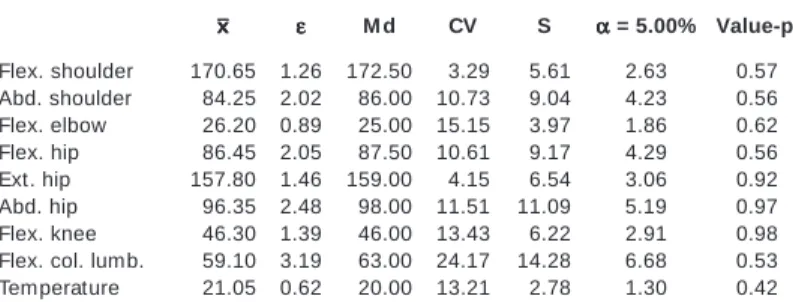
Table 2 show s the descriptive results of flexibility in the follicu-lar phase. Comparing the results of the different articulations of the flexibility test, it can be observed that in the follicular phase (table 2) only the elbow flexion and the lumbar column flexion show ed high variability (CV > 20.00% ).
TABLE 2
Descriptive results of the averages of the flexibility in the follicular phase in gymnastics practitioner w omen w ith normal menstrual cycle (n = 20)
x x x x
x εεεεε M d CV S αααα = 5.00%α Value-p
Flex. shoulder 168.85 1.71 168.50 04.53 07.65 3.58 0.97
Abd. shoulder 082.10 2.05 084.00 11.16 09.16 4.29 0.52
Flex. elbow 029.10 1.32 028.50 20.28 05.90 2.76 0.73
Flex. hip 087.85 2.10 088.00 10.69 09.39 4.40 0.66
Ext. hip 155.05 1.10 154.00 03.18 04.94 2.31 0.38
Abd. hip 094.10 2.72 096.00 12.93 12.17 5.70 0.53
Flex. knee 047.60 1.40 048.00 13.15 06.26 2.93 0.77
Flex. col. lumb. 060.10 3.38 063.50 25.18 15.13 7.08 0.60
Temperature 021.25 0.61 022.00 12.76 02.71 1.27 0.69
x = Average; ε = Standard error; M d = medium; CV = variation coefficient; S = standard deviation; α = Alfa value; p = value.
116e
Rev Bras M ed Esporte _ Vol. 12, Nº 3 – M ai/Jun, 2006 Table 4 show s the flexibility descriptive results of the luteanphase. In the lutean phase (table 4), the situation of the follicular phase repeated, that is, only the elbow flexion and the lumbar col-umn flexion show ed high variability (CV > 20.00% ). The air tem-perature w as also checked in each phase of the cycle and it kept low variability in all of them.
existence of average differences in the flexibility variables, in the distinct steps.
In the tests of the possible average differences in the articulato-ry movements of the sample, the lack of differences among the averages of all variables is observed, in other w ords, in the follicu-lar, ovulatory and lutean phases, the flexibility averages are similar. Therefore, the different phases of the M C did not influence the degree of flexibility of the sample of the actual study.
DISCUSSION
The results of this study show ed that the three phases of the M C (follicular, ovulatory and lutean) probably did not influence the flexibility in the studied group, once they did not present signifi-cant differences among them. Chaves et al.(1) have reached to the
same conclusion w hen analyzing the global body flexibility behav-ior, by articulation and by movement, in adult Young w omen, in the different phases of the M C.
The referred study(1) analyzed the flexibility by the Flexiteste
pro-tocol in 15 w omen, divided in tw o groups: experimental group – consisted of eumenoreics, and control group – consisted of w om-en in regular use, for at least a month, of oral contraception. The results show ed that there are no differences in flexibility, move-ment by movemove-ment, or through the Flexíndice, in the different phas-es of the M C for both groups. How ever, the authors mentioned the lack of hormonal control in the different phases of the cycle as a limitation to the study. It has been concluded that the obtained data do not corroborate the emphyrical impression that flexibility varies during the M C phases. Nevertheless, such data agree w ith the ones found in the actual study.
Viana et al.(10) conducted a similar study w ith the aim to verify
w hether the hip flexibility indexes in female college students w ould suffer significant decrease in the 1o day and in the 15o day after
menstruation. The 15o day corresponds to the lutean phase, w here
no variation w as observed w hen compared to the menstrual phase. In such study, the sitting and reaching test w as applied. Statistical-ly, it w as concluded that in the correlation test there w as no signif-icance betw een them.
Charkoudian e Johnson(12), did no find significant differences in
the three phases of the M C betw een the experimental and control groups w hen they studied about the estrogen and progesterone association w ith the increase of the body temperature of up to 0.5 Celsius degree. Such results w ere similar to the ones found in the actual research.
How ever, other studies(4,13,14) show that variations in the
estro-gen and progesterone levels during the M C, affect the feminine physiology in many factors such as: use of energetic substrate in different training intensities and volumes, oxygen consumption, energetic substrate storage and fats oxidation. Yet, these physio-logical changes did not demonstrate significant alterations in the flexibility levels in the three phases of the M C of the actual study. The probable lack of modification in the flexibility degree of the actual investigation can be justified by the findings by Tenaglia et al.(15). The increase of the body temperature in the lutean phase is
not sufficient to cause increase in the flexibility during the M C un-der the use and no-use of oral contraceptives in the tolerance of the thermal stress. In the referred study it w as observed that in the lutean phase the rectal temperature w as higher than in the follicular for the tw o groups, reaching to the conclusion that these alterations are due to the circadian rhythm, and not to the synthet-ic hormone administration.
Samuel et al.(16) demonstrated in their studies that the relaxin
decreases the soft tissues tension and the amount of this hor-mone varies according to the M C phases. Wojtys et al.(17)
corrobo-rate these finidings reporting that, in their research on M C and lesion of the crossed ligament, that this hormone has the ability to increase the lassitude of these tissues, increasing its concentra-TABLE 3
Descriptive results of the averages of flexibility in the ovulatory phase in gymnastics practitioner w omen w ith normal menstrual cycle (n = 20)
x xx x
x εεεεε M d CV S ααααα = 5.00% Value-p
Flex. shoulder 170.65 1.26 172.50 03.29 05.61 2.63 0.57
Abd. shoulder 084.25 2.02 086.00 10.73 09.04 4.23 0.56
Flex. elbow 026.20 0.89 025.00 15.15 03.97 1.86 0.62
Flex. hip 086.45 2.05 087.50 10.61 09.17 4.29 0.56
Ext. hip 157.80 1.46 159.00 04.15 06.54 3.06 0.92
Abd. hip 096.35 2.48 098.00 11.51 11.09 5.19 0.97
Flex. knee 046.30 1.39 046.00 13.43 06.22 2.91 0.98
Flex. col. lumb. 059.10 3.19 063.00 24.17 14.28 6.68 0.53
Temperature 021.05 0.62 020.00 13.21 02.78 1.30 0.42
x = average; ε = Standard error; M d = medium; CV = variation coefficient; S = standard deviation; α = Alfa; p = value.
TABLE 4
Descriptive results of the averages of flexibility in the lutean phase in gymnastics practitioner w omen w ith normal menstrual cycle (n = 20)
x xx x
x εεεεε M d CV S ααααα = 5.00% Value-p
Flex. shoulder 171.20 1.63 172.50 04.26 07.30 3.41 0.98
Abd. shoulder 080.35 2.07 080.50 11.54 09.28 4.34 0.69
Flex. elbow 026.05 1.31 025.00 22.54 05.87 2.75 0.38
Flex. hip 084.90 1.58 087.00 08.35 07.09 3.32 0.17
Ext. hip 156.45 1.55 155.00 04.43 06.92 3.24 0.84
Abd. hip 098.30 1.74 096.00 07.89 07.76 3.63 0.64
Flex. knee 045.60 1.27 045.50 12.47 05.69 2.66 0.60
Flex. col. lumb. 059.90 2.79 062.50 20.86 12.50 5.85 0.38
Temperature 021.35 0.60 020.50 12.65 02.70 1.26 0.46
x = Average; ε = Standard error; M d = medium; CV = variation coef ficient; S = standard deviation; α = Alfa; p = value.
Figure 1 show s the descriptive results of the sample concern-ing the flexibility levels in the three studied phases. The standard error has show n below the reference limit at all times, indicating that the variability among “ samples” is constant.
The Kolmogorov-Smirnov test w as used for the homogeneyza-tion of the sample, w here it w as observed that all flexibility vari-ables in the three considered steps w ere close to the normal dis-tribution. Such fact reinforces the use of the ANOVA to test the
Figure 1 – Descriptive results of the flexibility levels in the follicular, ovula-tory and lutean phases in gymnastics practitioner w omen w ith normal men-strual cycle (n = 20)
Rev Bras M ed Esporte _ Vol. 12, Nº 3 – M ai/Jun, 2006
117e
tion in the 12° day and reaching its peak on the 14 °. In the middleof the lutean phase (20° day of the cycle) the incr ease is repeated, w ith hormonal alterations capable of causing physical and meta-bolic changes in the articulation mobility expression or of ligament lassitude. Such evidence disagrees w ith the results of the actual investigation.
Lebrun(18), in his research, found significant differences in the
soft tissues lassitude in the group that did not make use of oral contraceptives in relation to another that made use of the method. These findings disagree w ith the study by Hinnerichs et al.(19). This
investigation did not show significant differences in the muscular force, resistance and flexibility, in physically active adult young w omen, in the M C phases, w hen the same comparison w ith the use of oral contraceptives w as made. Once again, these data dis-agree w ith the results found in the actual study, since the sample did not use contraceptive pills nor obtain differences in the broad-ness of the measured articulation arches.
Sarw ar et al.(20) reported significant changes in the contrariation
and relaxation properties of the skeletic muscle during the ovulato-ry phase. How ever,, Fridén et al.(21) did not obtain the same
an-sw ers in the three phases of the M C. These findings corroborate w ith the results of the actual study, suggesting that there is no significant differences in the flexibility levels during the three phases of the cycle.
Finally, the changes of the physical abilities presented during the phases of the M C are prone to considerable individual varia-tion. Some w omen do not present any tangible change in their capacity in the performance in any period of their M Cs, w hile oth-ers show variable performances during the cycle. According to the data found in this research, and taking the study limitations into consideration, one come to the conclusion that there is some evi-dence that the M C does not interfere in the flexibility variable in the studied phases. New investigations are recommended, using larger samples, observing other phases of the M C, checking the flexibility levels during the menstrual phase, or even daily measur-ing the flexibility durmeasur-ing the w hole cycle.
All the authors declared there is not any potential conflict of inter-ests regarding this article.
1. Chaves CPG, Simão R, Araújo CGS. Ausência de variação de flexibilidade duran-te o ciclo menstrual em universitárias. Rev Bras M ed Esporduran-te 2002;8:212-8.
2. Speroff L, Glass RH, Kase NG. Endocrinologia, ginecologia clínica e infertilidade. São Paulo: Editora M anole, 1991.
3. Costa DM , Guthrie SR. Women and sport: interdisciplinary perspectives. Cham-paign: Human Kinetics, 1994.
4. Braun B, Horton T. Endocrine regulation of exercise substrate utilization in w om-en compared to mom-en. Exerc Sport Sci Rev 2001;29:149-54.
5. Hew ett TE. Neuromuscular and hormonal factors associated w ith knee injuries in female athletes: strategies for intervention. Sports M ed 2000;29:313-27.
6. Kistiner RW. Ginecologia: princípios a prática. São Paulo: Editora M anole, 1989.
7. Halbe HW. Tratado de ginecologia. São Paulo: Editora Roca, 1993.
8. Dantas EHM , Carvalho JLT, Fonseca RM . O protocolo Labifie de goniometria. Rev Trein Des 1997;2:21-34.
9. M arins JCB, Giannichi RS Avaliação e prescrição de atividade física: guia prático. Rio de Janeiro: Editora Shape, 1998.
10. Viana AR, Rosa M C, Cardoso SH, Freitas SA. Relação do ciclo menstrual com a flexibilidade de quadril de universitárias. R M in Educ Fís 1999;7:52-9.
11. Johnson BL, Nelson JK. Practical measurements for evaluation in physical edu-cation. M innesota: Burgess Publishing Company, 1979.
12. Charkoudian N, Johnson JM . Female reproductive hormones and thermoregula-tory control of skin blood flow. Exerc Sport Sci Rev 2000;28:108-12.
13. De Cree C, Ball P, Seidlitz B, Kranenburg GV, Geurten P, Keizer HA. Responses of cathecolestrogen metabolism to acute and graded exercise in normal
men-REFERENCES
struating w omen before and after training. J Clin Endocrinol M etab 1997;82:3342-8.
14. Liu SH, Al-Shaikh R, Panossian V, Yang RS, Nelson SD. Primary immunolocaliza-tion of estrogen and progesterone target cells in the human anterior cruciate ligament. J Orthop Res 1996;14:526-33.
15. Tenaglia SA, M cLellan TM , Klentrou PP. Influence of menstrual cycle and oral contraceptives on tolerance to uncompensable heat stress. Eur J Appl Physiol 1999;80:76-83.
16. Samuel CS, Butkus A, Coghlan JP, Bateman JF. The effect of relaxin on collagen metabolism in the nonpregnant rat pubic symphysis: the influence of estrogen and progesterone in regulating relaxin activity. Endocrinology 1996;137:3884-90.
17. Wojtys EM , Huston LJ, Lindenfeld TN, Hew ett TE, Greenfield M L. Association betw een the menstrual cycle and anterior cruciate ligament injuries in female athletes. Am J Sports M ed 1998;26:614-9.
18. Lebrun CM . The effect of the phase of the menstrual cycle and birth control pill in athletic performance. Clin Sports M ed 1994;13:419-41.
19. Hinnerichs KR, Conley DS, Evetovich TK, Engebretsen BJ, Todd JB. Effects of menstrual cycle phase and oral contraceptives on muscular strength, endurance, and flexibility. M ed Sci Sports Exerc 2004;36:S35.
20. Sarw ar R, Beltran NB, Rutherford OM . Changes in the muscle strength, relaxation rate and fatigability during the human menstrual cycle. J Physiol 1996;493:267-72.