An Investigation into Spanish EFL
Learners’ Anxiety
Um estudo da ansiedade em estudantes
espanhóis de EFL
Juan de Dios Martínez Agudo*
Universidad de Extremadura Badajoz (Espanha)
ABSTRACT: This research article reports the results of a study designed to measure and analyse Spanish students’ perceived anxiety when learning and using EFL inside the classroom. This article first includes a review of the literature on foreign language anxiety. Then it describes the participants of the investigation and the research methodology procedures. This is followed by the presentation and discussion of the results and, finally, the conclusions derived from this study. The resulting data revealed interesting information about the anxiety levels present among Spanish EFL learners. While relatively high levels of speaking anxiety have been identified, somewhat lower levels of listening anxiety associated with error correction, by contrast, have also been found. More specifically, the results suggested that the level of listening anxiety seems to slightly increase when error correction is somehow involved in the process.
KEYWORDS: differential anxiety reactions; language learning.
RESUMO: Este trabalho relata os resultados de um estudo destinado a medir e analisar a ansiedade observada por estudantes espanhóis na aprendizagem e no uso de EFL em sala de aula. Este artigo inclui, primeiramente, um apanhado da literatura sobre ansiedade no aprendizado de língua estrangeira. Em seguida, descreve os participantes e os procedimentos metodológicos da pesquisa. Na sequência, expõe a apresentação e a discussão dos resultados e, finalmente, as conclusões derivadas deste estudo. Os dados resultantes revelaram informações interessantes sobre os níveis de ansiedade presentes entre alunos espanhóis de EFL. Embora níveis relativamente elevados de ansiedade na fala tenham sido identificados, níveis ligeiramente mais baixos de ansiedade na escuta associada com correção de erro, por outro lado, também foram encontrados. Mais especificamente, os resultados sugeriram que o nível de ansiedade na escuta parece aumentar ligeiramente quando a correção de erros é de alguma forma envolvida no processo.
PALAVRAS-CHAVE: reações de ansiedade diversas; aprendizagem de línguas.
Review of Literature
The humanistic view of education, and more specifically, the student-centered approach to language teaching, in which students’ affective needs are seriously taken into account, seem to play an essential role in emphasising the importance of learner individuality or rather learner individual differences (SKEHAN, 1989; OXFORD; EHRMAN, 1993; OTTÓ, 1998; ROBINSON, 2001, 2002; COOPER, 2002; DÖRNYEI; SKEHAN, 2003; ELLIS, 2004; DÖRNYEI, 2005, 2006). SLA as a domain of research which contributes to the teaching and learning of foreign languages (KRAMSCH, 2000; SEIDLHOFER, 2003) has recently highlighted the importance of learner individuality so as to better understand how each student actually approaches classroom situations and experiences. Additionally, the learner-centred approach to language teaching takes affect into account in many ways. As Arnold (1999) reminds us, a broad understanding of affect is essential to guide and improve language teaching and learning.
Over the last decades the role of emotional aspects associated with language teaching and learning has been extensively debated (STEVICK, 1990; ARNOLD, 1999; DÖRNYEI, 2001). Among the affective variables which significantly influence SLA, the multi-faceted construct called Foreign Language Anxiety (henceforth, FLA) appears as one of the most outstanding individual learner differences variable that can predict or rather explain differential success in L2 learning. Since Horwitz et al.’s pioneering study in 1986 which generated considerable research interests in the nature of FLCA, a multitude of research studies into the subject has been conducted (MACINTYRE; GARDNER, 1989, 1991a, 1991b, 1994a, 1994b; MACINTYRE, 1995, 1999, 2002; MACINTYRE et al., 1997; SAITO et al., 1999; OXFORD, 1999; KITANO, 2001; HORWITZ, 2001; DÖRNYEI, 2005; ELKHAFAIFI, 2005; LIU, 2006, 2007, 2009; LIU; JACKSON, 2008; DEWAELE et al., 2008; CHANG, 2008; ELLIS, 2008; YAN et al., 2008; KOUL et al., 2009; LIM, 2009).
learning (HORWITZ; YOUNG, 1991). However, anxiety also needs to be viewed as a normal human feeling because all human beings experience some kind of anxiety in particular contexts and situations because “even in optimum conditions, students can experience destructive forms of anxiety” (REID, 1999, p. 297).
L2-related anxiety or FLA is generally viewed as a specific-situation anxiety experienced by non-native speakers when learning and using a second or foreign language in the classroom (HORWITZ et al., 1986; MACINTYRE;
GARDNER, 1994a, 1994b; MACINTYRE, 1995; HORWITZ, 2001). Oral production in L2 is then viewed as one of the greatest sources of anxiety in the classroom context (HORWITZ, 2001; GREGERSEN; HORWITZ, 2002; HAUCK; HURD, 2005; LIU, 2009). As a matter of fact, FLA has been almost entirely associated with the oral aspects of language use (AIDA, 1994; CHENG
et al., 1999; HORWITZ, 2001). Specifically, Gardner & MacIntyre (1993, p.
184) viewed language anxiety as “the apprehension experienced when a situation requires the use of a second language with which the individual is not fully proficient”. Generally speaking, anxiety negatively affects L2 oral performance which is mainly viewed as a potentially stressful situation or rather an anxiety-provoking situation for some students (YOUNG, 1991; HORWITZ, 2001; KRASHEN, 2003; MATSUDA; GOBEL, 2004; SHEEN, 2008). Although oral performance is assumed to be the most anxiety-provoking situation (HORWITZ et al., 1986; AIDA, 1994; CHENG et al., 1999; HORWITZ,
2001; VON WÖRDE, 2003) because of students’ fears of public speaking and embarrassment, the fact is that oral production activities need to be constantly encouraged in the classroom for the development of oral communication skills. Throughout the last decades the issue of FLA and its negative effect or impact on language learning has been extensively debated (for reviews, see MACINTYRE, 1999; OXFORD, 1999; YOUNG, 1999; HORWITZ, 2001). The vast majority of empirical studies on FLA have offered evidence and supported the existence of a significant causal relationship or negative correlation between language anxiety and learning achievement (HORWITZ
et al., 1986; MACINTYRE; GARDNER, 1989, 1991a, 1991b, 1994a,
That is, FLA is then viewed as a strong indicator of academic achievement. Although this correlational relationship between language anxiety and learning achievement – the higher the anxiety, the lower the performance – is already established in research literature (PHILLIPS, 1992; AIDA, 1994; SAITO et al., 1999; CHENG et al., 1999; HORWITZ, 2001), the fact is that the
direction of such a relationship is certainly unknown yet. Specifically, Horwitz (2001, p. 121) reminds us that the issue of how anxiety exactly affects language learning is still unresolved: “It is often difficult to determine if anxiety has actually interfered with learning, thus influencing achievement levels […] the issue is unresolved”. The fact is that researchers have been unable to explain in detail how anxiety affects language learning.
As regards the beneficial/facilitating vs. inhibitory/debilitating anxiety
distinction, the fact is that most research studies have demonstrated that FLA can have a negative effect on language learning (HORWITZ et al., 1986;
YOUNG, 1991; MACINTYRE; GARDNER, 1994a; MACINTYRE, 1995, CHENG et al., 1999; OXFORD, 1999; HORWITZ, 2001), although several
researchers believed, in contrast, that FLA might have a beneficial effect on learning thus considering anxiety as facilitative rather than debilitative for second language development (CHASTAIN, 1975; SCOVEL, 1978; EYSENCK, 1979; BAILEY, 1995; SPIELMAN; RADNOFSKY, 2001). That is, it was believed that certain doses of anxiety do not necessarily have detrimental effects and, thus, can be positively associated with L2 achievement. Although most research studies have mainly concentrated on debilitating anxiety, it has also been suggested that FLA can have contradictory effects on language learning: “anxiety does not necessarily inhibit performance but in some cases can actually promote it” (DÖRNYEI, 2005, p. 198).
interventions aimed at helping anxious learners overcome or at least keep their anxiety levels to a minimum (AIDA, 1994) by making language learning interesting and fun, less stressful for them. In this sense, it needs to be made clear that what is effective for an anxious student may not necessarily be effective for another. More friendly, relaxing and supportive learning environments need to constantly be encouraged or created in the classroom context so as to relieve the tension derived from language anxiety (VON WÖRDE, 2003; TURULA, 2004). More positive reinforcement through positive comments and words of encouragement has also been suggested to be highly helpful (HORWITZ, 2001). In short, creating a low-anxiety classroom atmosphere should be one of the main responsibilities of L2 teachers. In this sense, Arnold & Brown (1999) remind us that an emotionally safe classroom atmosphere is essential to avoid the development of threatening or anxiety-provoking situations. Accordingly, pleasurable learning experiences need to constantly be assured in the classroom context.
Despite being the most highly investigated individual difference in SLA research, FLA can also be regarded as the most misunderstood affective variable of all (SCOVEL, 2001) because as Dörnyei (2005) reminds us language anxiety – the subject of this review – is seen as a complex psychological construct with several different facets. FLA is generally viewed as a serious, complex and multidimensional problem that negatively affects oral communication skills and learning in general (ONWUEGBUZIE et al.,
1999). In this sense, research on FLA is fundamental to our understanding of how learners actually approach second language learning.
Research Question
It needs to be made clear that this research study is not to establish a link between language anxiety and performance, because this is already well established in the literature. Specifically, the following research question was formulated to guide the present study:
• What are the anxiety levels experienced and perceived by Spanish EFL students?
Research Methodology
Participants
The present research study has been carried out in schools located in Extremadura, an autonomous region of western Spain, on the border with Portugal, where English represents only one compulsory subject in school curricula. It needs to be mentioned that English is taught as a foreign language from the first year of schooling in primary schools for three hours per week. In lower and in most upper secondary schools, English is taught for at least four hours per week.
Instrument and Data Collection Procedure
Generally speaking, the measurement of affective variables in L2 learning involves an enormous complexity (GARDNER; MACINTYRE, 1993; BROWN, 1994; BAILEY, 1995). In this sense, quantitative research methods have been traditionally employed when researching language anxiety. For the present research study data have been collected through a closed questionnaire served as a research instrument and designed to measure language anxiety perceived by Spanish learners when learning and using EFL inside the classroom.Participants were given the best-known and most widely used questionnaire FLCAS – Foreign Language Classroom Anxiety Scale – from Horwitz, Horwitz & Cope (1986), based on the measurement of L2-related anxiety, which provides us with quantitative data from Spanish EFL learners. The 33-item questionnaire used has a Likert-scale format with five possible responses, ranging from (1) Strongly agree to (5) Strongly disagree. It needs to be made clear that the items or statements presented in FLCAS are reflective or indicative of (1) communication apprehension, (2) test-anxiety, and (3) fear of negative evaluation in the foreign language classroom (HORWITZ et al., 1986). Given that the FLA construct is, to a large extent, moulded around the speaking component, communication apprehension or speech anxiety then appears as the most outstanding or influential component of the FLA construct (AIDA, 1994; PÉREZ-PAREDES; MARTÍNEZ-SÁNCHEZ, 2000). Possibly the three aforementioned classical FLA components are “mere analogies and perhaps FLA is something else or something different” (PÉREZ-PAREDES; MARTÍNEZ-SÁNCHEZ, 2000, p. 347).
The questionnaire used was administered by the researcher himself, who explained in Spanish through clear and simple instructions the overall purpose and potential usefulness of the survey, made it clear to the participants that the questionnaire was not a test, and that their responses would be used for research purposes only. Additionally, it needs to be made clear that the real aim of the study was not openly presented to the participants so that students’ responses could not be biased by the researcher’s goals. In fact, the research being conducted was actually presented as a study on the general topic of foreign language anxiety. After reminding our group of informants of the importance of giving honest answers, they were assured of the confidentiality of the data. In this sense, Oppenheim (1992) reminds us of the general belief that anonymous questionnaires encourage the informants to be more honest and sincere when answering the statements which must be counterbalanced by the possibility that people lose interest in the research study because of its impersonality.
Subjects were asked to think of their previous English learning experiences and to describe their feelings. In fact, participants responded to statements regarding their reactions to L2 classroom experiences. They were requested not to consult their classmates while working with the questionnaire in order to ensure that the answers actually reflected each student’s own opinions and feelings. Subjects completed the questionnaire during their scheduled language class in March 2012, at the end of the second term of the academic year. The questionnaires were completed anonymously in class and handed back on completion.
Analysis and Discussion of Results
TABLE 1
Descriptive Statistics of FLCAS Measure
FOREIGN LANGUAGE CLASSROOM ANXIETY
Strongly Agree Neither agree Disagree Strongly Total agree nor disagree disagree
Statement 1 17,02% 41,49% 14,89% 21,28% 5,32% 100,00%
Statement 2 13,83% 20,21% 13,30% 39,89% 12,77% 100,00%
Statement 3 9,57% 19,68% 17,55% 29,79% 23,40% 100,00%
Statement 4 10,64% 26,06% 17,55% 28,19% 17,55% 100,00%
Statement 5 21,28% 28,72% 24,47% 12,77% 12,77% 100,00%
Statement 6 27,66% 32,98% 17,55% 14,89% 6,91% 100,00%
Statement 7 20,21% 26,06% 27,13% 20,21% 6,38% 100,00%
Statement 8 9,57% 31,91% 22,34% 27,13% 9,04% 100,00%
Statement 9 20,21% 35,11% 15,43% 19,15% 10,11% 100,00%
Statement 10 60,11% 26,06% 5,85% 4,79% 3,19% 100,00%
Statement 11 18,09% 21,28% 43,62% 10,11% 6,91% 100,00%
Statement 12 17,02% 30,32% 15,43% 23,94% 13,30% 100,00%
Statement 13 17,55% 19,68% 17,55% 27,13% 18,09% 100,00%
Statement 14 19,68% 21,28% 23,40% 23,40% 12,23% 100,00%
Statement 15 15,43% 39,36% 22,34% 11,17% 11,70% 100,00%
Statement 16 8,51% 19,15% 20,21% 26,60% 25,53% 100,00%
Statement 17 20,74% 25,00% 20,21% 25,00% 9,04% 100,00%
Statement 18 5,85% 22,87% 29,79% 30,85% 10,64% 100,00%
Statement 19 7,45% 16,49% 25,00% 35,11% 15,96% 100,00%
Statement 20 11,70% 23,94% 20,21% 26,06% 18,09% 100,00%
Statement 21 4,79% 10,11% 17,02% 36,70% 31,38% 100,00%
Statement 22 15,43% 26,06% 27,13% 23,94% 7,45% 100,00%
Statement 23 20,21% 29,26% 22,87% 17,55% 10,11% 100,00%
Statement 24 13,83% 20,21% 18,09% 33,51% 14,36% 100,00%
Statement 25 10,11% 16,49% 20,21% 36,17% 17,02% 100,00%
Statement 26 15,96% 15,96% 18,62% 25,00% 24,47% 100,00%
Statement 27 9,04% 27,13% 19,68% 32,98% 11,17% 100,00%
Statement 28 18,62% 30,32% 29,79% 18,09% 3,19% 100,00%
Statement 29 10,11% 30,85% 23,40% 26,06% 9,57% 100,00%
Statement 30 17,02% 26,06% 18,62% 23,40% 14,89% 100,00%
Statement 31 9,57% 19,68% 11,17% 31,91% 27,66% 100,00%
Statement 32 15,96% 20,21% 32,45% 20,74% 10,64% 100,00%
Statement 33 13,30% 42,02% 23,40% 15,43% 5,85% 100,00%
Note: Scores are based on a 1 to 5 scale in which 1 represents “strongly agree” and 5 represents “strongly disagree”.
TAB. 1 reveal slightly different percentages of responses, the data obtained are consistent enough to draw overall conclusions. After the data-gathering process, the next step was to synthesise and analyse the results.
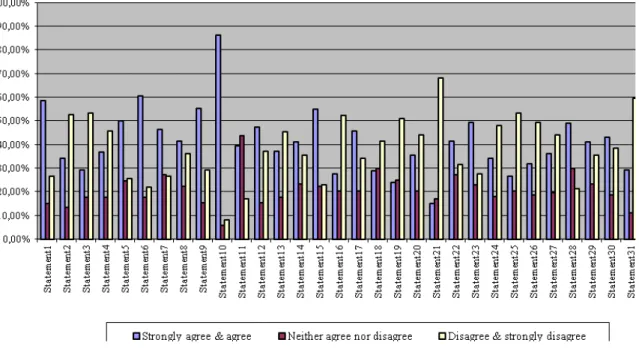
As regards students’ communication apprehension, and more specifically, speaking anxiety, we appreciated high levels of speaking anxiety in different statements. It needs to be mentioned that communication apprehension contains a group of items or statements indicating speech anxiety, shyness and bodily reactions derived from speaking in the foreign language. Specifically, the evidence of students’ lack of self-confidence when speaking the foreign language is mainly revealed by the fact that approximately 58,51% of the respondents recognised that they never felt quite sure of themselves when they were speaking in their foreign language classes (statement 1), albeit only 28,72% of the participants felt confident when they spoke in foreign language class (statement 18). Additionally, similar percentages can be found in statements 9 & 33 because more than half of the participants (55,32%) got nervous when they had to speak without preparation in language class (statement 9) or when the language teacher asked questions which they had not prepared in advance (statement 33). Besides, nearly 43,08% of the respondents felt overwhelmed by the number of rules they had to learn to speak a foreign language (statement 30).
With respect to listening anxiety reactions, relatively somewhat lower levels of listening anxiety have been found because, specifically 36,70% and 40,96%, respectively, of the participants felt nervous when they did not understand what the teacher said in the foreign language (statements 4 and 29). Quite in consonance with students’ level of worry about making mistakes in language class (52,66%, statement 2), however, it has been found that the level of listening anxiety slightly increased when error correction was involved in the process, since 54,79% of the respondents recognised that they got upset when they did not understand what the teacher was correcting (statement 15 ). It needs to be mentioned that all these statements (4, 15 and 29) mainly concern the students’ fear of not understanding their teacher.
8
3
9
RB
L
A
, B
e
lo
H
ori
zon
te
, v
. 1
3
, n
. 3
, p
. 8
2
9
-8
5
1
, 2
0
1
3
things they actually knew (statement 12) while nearly two thirds of the subjects (60,64%) found themselves thinking about things that had nothing to do with the course or rather engaged in thoughts irrelevant to the course (statement 6). However, nearly half of the participants (48,94%) acknowledged feeling very sure and relaxed when they were going to the English class (statement 28). While about 45,74% of the respondents would often skip English classes because they did not feel like going to the language class (statement 17), half of the participants (50%) surprisingly recognised, in contrast, that they would not mind taking more foreign language classes (statement 5). Finally, it needs to be made clear that what items or statements 5, 6, 17 & 22 appear to have in common is that they mainly measure anxiety only in an indirect way and, accordingly, are not very informative of learners’ language anxiety. In fact, all these statements mainly refer to learners’ attitudes to English classes.
Concerning students’ fear of negative evaluation, an important factor involved was students’ fear of making mistakes because more than half of the subjects (52,66%) showed their disagreement with the statement 2, that is, they actually worried about making mistakes in the language class. Additionally, nearly half of the respondents (49,47%) had a permanent feeling that the other students spoke the foreign language better than they did (statement 23) while a similar percentage of the students, specifically 46,27%, believed that the other students were better at languages than they were (statement 7). The fact is that both statements 7 & 23 are somehow related to the students’ fear of doing worse than their classmates.
In short, the top five sources of foreign language classroom anxiety among the students surveyed in this study are shown in TAB. 2.
TABLE 2
Top five sources of anxiety
Ranking FLCAS Statements
1 10. I worry about the consequences of failing my foreign language class.
2 6. During language class, I find myself thinking about things that have nothing to
do with the course.
3 1. I never feel quite sure of myself when I am speaking in my foreign language class.
4 9. I start to panic when I have to speak without preparation in language class.
5 33. I get nervous when the language teacher asks questions which I haven’t prepared
As can be seen from the data presented in TAB. 1 and illustrated in FIG. 1, several statements generated high levels of agreement (“strongly agree“ and “agree”). As reported in TAB. 2, we can see that the statement which obtained the highest percentage is statement 10 which concerns students’ test anxiety, followed by statement 6 which also refers to test anxiety, albeit it appears to measure this in an indirect way, being not very informative of learners’ anxiety when asking about learners’ inclinations to engage in thoughts irrelevant to the course. In fact, statement 6 is somehow related to students’ attitudes to English classes. The next highest average was obtained from statement 1 which assesses students’ communication apprehension, and more specifically, their lack of communicative confidence. Similarly, statement 9, which also received a relatively high level of agreement, is directly related to communication apprehension, and more specifically, speaking anxiety. Finally, statement 33 mainly makes reference to students’ fear of negative evaluation. What is then true is that nearly all these statements somehow reflect anticipated anxious behaviour.
Conclusions
The main goal of the present research study is to contribute to the research literature on language anxiety by investigating Spanish EFL learners’ anxiety levels perceived and experienced inside the classroom. After briefly analysing those statements or items from the FLCAS which generated high levels of agreement and/or disagreement, the resulting data revealed interesting information about the anxiety levels present among Spanish EFL learners. Results from several statements indicated that there was a relatively high level of concern over foreign language lessons in general, both outside and inside the classroom, and more particularly, test anxiety, as suggested by statement 10. While relatively high levels of communication apprehension and, more specifically, speaking anxiety have been identified, somewhat lower levels of listening anxiety associated with error correction, by contrast, have also been found. More specifically, the results suggested that the level of listening anxiety seems to slightly increase when error correction is somehow involved in the process.
in Horwitz et al.; statement 10, regarding students’ test anxiety, was endorsed
by 86,17% in our study against 42% in Horwitz et al.; statement 13, which
referred to students’ reticence to participate voluntarily, was endorsed by 37,23% in our study against 9% in Horwitz et al.; statement 25, concerning
the worry about getting left behind in the language class, was endorsed by 26,60% in our study against 59% in Horwitz et al.
The existence of relatively high levels of anxiety among the subjects surveyed who had accumulated a long experience as learners of EFL led us to conclude that FLA is not necessarily characteristic or exclusive to beginners because experienced learners also suffer it. Besides, the findings of this study somehow support or corroborate the conclusions of other research studies in suggesting that anxiety negatively affects the second language learning experiences in different ways and that alleviating, at least to an extent, its effects is thus essential. Accordingly, the findings of the present study were generally consistent with previous research efforts.
Limitations and Future Research
Several limitations in the research design make it difficult to make overall generalizations about the potential implications of this research. Accordingly, the present research study must be interpreted in the light of its limitations. The results obtained should be interpreted with caution for several reasons. Regarding the population sample, it is almost impossible to draw any overall conclusions for TEFL, because the number of participants was relatively small to make any attempt at generalising results to other classroom contexts. Because of the limited size of the population sample (n=208), research findings call for replication on larger populations and in other classroom contexts. Despite the fact that this study was conducted in a classroom setting which gives it high ecological validity, our results should be taken as indicative of the need for further research on this issue.
more research into the components of FLA also needs to be done to make clear its ultimate nature. To what extent anxiety negatively affects language learning is still a question to be answered. More specifically, the issue of understanding the relationship between anxiety and achievement is still unresolved (HORWITZ, 2001) because the effects of FLA on language learning/use are varied and numerous, and not completely understood. As Phillips (1992) stated, its influence is highly complex and difficult to measure.
These days new trends in FLA research attempt to identify particular aspects of L2 teaching and learning which provoke anxiety. As a matter of fact, further studies should focus on the relationship between language anxiety and some other variables such as language aptitude, input or L2 exposure, teaching methodology and so on. Specifically, promising research directions would be, among others, to determine if anxiety levels decrease as exposure to the second language increases. On the other hand, the great variability in learners’ anxiety reactions also deserves attention. In this sense, it would be interesting to collect additional data of individual participants. More specifically, little attention has been given to the differences between the levels of FLA of one person studying two foreign languages simultaneously (DEWAELE, 2002; DEWAELE et al.,
2008). Obviously, this issue also calls for further investigation. Similarly, further investigations in a variety of settings with younger learners who have different backgrounds are needed to better understand its real impact on L2 learning. Further research on what kind of classroom environment would alleviate learners’ anxiety would then be highly helpful. Likewise, specific skills anxieties should be carefully analysed.
Although language anxiety has been mainly investigated from the students’ perspective, anxiety research from other viewpoints, such as those of teachers, still remains unexplored. Language anxiety from the teacher’s perspective, especially as to how they perceive and deal with student anxiety in their actual teaching practices, is considered as an attempt to provide some alternative insights into the phenomenon of language anxiety from a different perspective.
Acknowledgements
I would like to thank all the participants in the study for their kind collaboration.
References
AIDA, Y. Examination of Horwitz, Horwitz, and Cope’s construct of foreign language anxiety: The case of students of Japanese. The Modern Language Journal, v. 78, p. 155-168, 1994.
ARNOLD, J. Preface. In: ARNOLD, J. (Ed.). Affect in Language Learning. Cambridge: Cambridge University Press, 1999. p. xi-xiv.
ARNOLD, J.; BROWN, H. D. A map of the terrain. In: ARNOLD, J. (Ed.). Affect in Language Learning. Cambridge: Cambridge University Press, 1999. p. 1-24.
BAILEY, K. M. Competitiveness and anxiety in adult second language learning: looking at and through the diary studies. In: BROWN, H. D.; GONZO, S. T. (Eds.). Readings on Second Language Acquisition. Englewood Cliffs, NJ: Prentice Hall Regents, 1995. p. 163-205.
BROWN, H. D. Principles of Language Learning and Teaching. Englewood Cliffs, NJ: Prentice Hall Regents, 1994. 299 p.
CAMPBELL, C.; ORTIZ, J. Helping students overcome foreign language anxiety: a foreign language anxiety workshop. In: HORWITZ, E. K.; YOUNG, D. J., (Eds.). Language Anxiety: From Theory and Research to Classroom Implications. Englewood Cliffs. NJ: Prentice Hall, 1991. p. 153-168.
CHANG, A. C. S. Sources of listening anxiety in learning English as a foreign language. Perceptual and Motor Skills, v. 106, n. 1, p. 21-34, 2008.
CHASTAIN, K. Affective and ability factors in second language acquisition. Language Learning, v. 25, p. 153-161, 1975.
CHENG, Y. S.; HORWITZ, E. K.; SHALLERT, D. L. Language anxiety: Differentiating writing and speaking components. Language Learning, v. 49, p. 417-446, 1999.
DEWAELE, J. M. Psychological and sociodemographic correlates of communicative anxiety in L2 and L3 production. International Journal of Bilingualism, v. 6, p. 23-39, 2002.
DEWAELE, J. M.; PETRIDES, K. V.; FURNHAM, A. Effects of trait emotional intelligence and sociobiographical variables on communicative anxiety and foreign language anxiety among adult multilinguals: A review and empirical investigation. Language Learning, v. 58, p. 911-960, 2008.
DÖRNYEI, Z.; SKEHAN, P. Individual differences in second language learning. In: DOUGHTY, C. J.; LONG, M. H. (Eds.). The Handbook of Second Language Acquisition. Oxford: Blackwell, 2003, p. 589-630.
DÖRNYEI, Z. Motivational Strategies in the Language Classroom. Cambridge: Cambridge University Press, 2001.
DÖRNYEI, Z. The Psychology of the Language Learner: Individual Differences in Second Language Acquisition. Mahwah, NJ: Lawrence Erlbaum Associates, 2005. 270 p.
DÖRNYEI, Z. Individual differences in second language acquisition. AILA Review, v. 19, n. 1, p. 42-68, 2006.
ELKHAFAIFI, H. Listening comprehension and anxiety in the Arabic language classroom. Modern Language Journal, v. 89, p. 206-220, 2005.
ELLIS, R. Individual differences in second language learning. In: DAVIES, A.; ELDER, C. (Eds.). The Handbook of Applied Linguistics. Oxford: Blackwell, 2004. p. 525-551.
ELLIS, R. The Study of Second Language Acquisition. 2. ed. Oxford: Oxford University Press, 2008. 1170 p.
EYSENCK, M. Anxiety, learning and memory: A reconceptualization. Journal of Research in Personality, v. 13, p. 363-385, 1979.
GARDNER, R. C.; MACINTYRE, P. D. On the measurement of affective variables in second language learning. Language Learning, v. 43, p. 157-194, 1993.
HORWITZ, E. K.; YOUNG, D. J. (Eds.) Language Anxiety: From Theory and Practice to Classroom Implications. Englewood Cliffs, NJ: Prentice-Hall, 1991. 224 p.
HORWITZ, E. K. Language anxiety and achievement. Annual Review of Applied Linguistics, v. 21, p. 112-126, 2001.
HORWITZ, E. K.; HORWITZ, M. B.; COPE, J. Foreign language classroom anxiety. The Modern Language Journal, v. 70, p. 125-132, 1986.
KITANO, K. Anxiety in the College Japanese Language Classroom. The Modern Language Journal, v. 85, p. 549-566, 2001.
KOUL, R.; ROY, L.; KAEWKUEKOOL, S.; PLOISAWASCHAI, S. Multiple goal orientations and foreign language anxiety. System, v. 37, p. 676-688, 2009. KRAMSCH, C. Second Language Acquisition, Applied Linguistics, and the teaching of foreign languages. The Modern Language Journal, v. 84, n. 3, p. 311-326, 2000.
KRASHEN, S. Explorations in Language Acquisition and Use. Portsmouth. NH: Heinemann, 2003. 97 p.
LIM, H. Y. Culture, attribution, and language anxiety. Applied Language Learning, v. 19, n. 1, p. 29-52, 2009.
LIU, M.; JACKSON, J. An exploration of Chinese EFL learners’ Unwillingness to Communicate and Foreign Language Anxiety. The Modern Language Journal, v. 92, p. 71-86, 2008.
LIU, M. Anxiety in Chinese EFL students at different proficiency levels. System, v. 34, p. 301-316, 2006.
LIU, M. Language anxiety in EFL testing situations. International Journal of Applied Linguistics, v. 15, p. 53-75, 2007.
LIU, M. Reticence and Anxiety in Oral English Lessons. Bern: Peter Lang, 2009. 300 p.
MACINTYRE, P. D.; GARDNER, R. C. Methods and results in the study of anxiety in language learning: A review of the literature. Language Learning, v. 41, p. 85-117, 1991b.
MACINTYRE, P. D.; GARDNER, R. C. The subtle effects of language anxiety on cognitive processing in the second language. Language Learning, v. 44, p. 283-305, 1994a.
MACINTYRE, P. D.; GARDNER, R. C. The effects of induced anxiety on three stages of cognitive processing in second language learning. Studies in Second Language Acquisition, v. 16, p. 1-17, 1994b.
MACINTYRE, P. D. How does anxiety affect second language learning? A reply to Sparks and Ganschow. Modern Language Journal, v. 79, p. 90-99, 1995. MACINTYRE, P. D. Language anxiety: A review of the research for language teachers. In: YOUNG, D. J. (Ed.). Affect in foreign language and second language learning: A practical guide to creating a low-anxiety classroom atmosphere. Boston: McGraw-Hill, 1999. p. 24-45.
MACINTYRE, P. D. Motivation, anxiety and emotion in second language acquisition. In: ROBINSON, P. (Ed.). Individual Differences in Second Language Acquisition. Amsterdam: John Benjamins, 2002. p. 45-68.
MACINTYRE, P. D.; NOELS, K.A.; CLEMENT, R. Biases in self-ratings of second language proficiency: the role of language anxiety. Language Learning, v. 47, n. 2, p. 265-287. 1997.
MATSUDA, S.; GOBEL, P. Anxiety and predictors of performance in the foreign language classroom. System, v. 32, p. 21-36, 2004.
ONWUEGBUZIE, A. J.; BAILEY, P.; DALEY, C. E. Factors associated with foreign language anxiety. Applied Psycholinguistics, v. 20, p. 217-239, 1999. OPPENHEIM, A. N. Questionnaire Design, Interviewing and Attitude Measurement. London: Pinter Publishers Ltd, 1992. 312 p.
OTTÓ, I. The relationship between individual differences in learner creativity and language learning success. TESOL Quarterly, v. 32, n. 4, p. 763-773, 1998. OXFORD, R.; EHRMAN, M. E. Second language research on individual differences. Annual Review of Applied Linguistics, v. 13, p. 188-205, 1993. OXFORD, R. Anxiety and the language learner: New insights. In: ARNOLD, J. (Ed.). Affect in Language Learning. Cambridge: Cambridge University Press, 1999. p. 58-67.
PHILLIPS, E. M. The effects of language anxiety on students’ oral test performance and attitudes. The Modern Language Journal, v. 76, n. 1, p. 14-26, 1992.
REID, J. Affect in the classroom: problems, politics and pragmatics. In: ARNOLD, J. (Ed.). Affect in Language Learning. Cambridge: Cambridge University Press. 1999. p. 297-306.
ROBINSON, P. Individual differences, cognitive abilities, aptitude complexes and learning conditions in second language acquisition. Second Language Research, v. 17, n. 4, p. 368-392, 2001.
ROBINSON, P. (Ed.). Individual Differences and Instructed Language Learning. Amsterdam: John Benjamins, 2002. 385 p.
SAITO, Y.; SAMIMY, K. Foreign language anxiety and language performance: A study of learning anxiety in beginning, intermediate, and advanced-level college students of Japanese. Foreign Language Annals, v. 29, p. 239-251, 1996. SAITO, Y.; HORWITZ, E. K.; GARZA, T. J. Foreign language reading anxiety. The Modern Language Journal, v. 83, p. 202-218, 1999.
SCOVEL, T. The effect of affect on foreign language learning: A review of the anxiety research. Language Learning, v. 28, p. 129-142, 1978.
SCOVEL, T. Learning New Languages: A Guide to Second Language Acquisition, Boston: Heinle and Heinle, 2001. 158 p.
SEIDLHOFER, B. (Ed.). Controversies in Applied Linguistics. Oxford: Oxford University Press, 2003. 360 p.
SHEEN, Y.H. Recasts, language anxiety, modified output, and L2 learning. Language Learning, v. 58, p. 835-874, 2008.
SKEHAN, P. Individual Differences in Second-Language Learning. London: Edward Arnold, 1989. 168 p.
SPARKS, R. J.; GANSCHOW, L. Anxiety about foreign language learning among high school women. The Modern Language Journal, v. 80, p. 199-212, 1996.
SPIELMAN, G.; RADNOFSKY, M. Learning language under tension: New directions from a qualitative study. The Modern Language Journal, v. 85, p. 259-278, 2001.
STEVICK, E. Humanism in Language Teaching: A Critical Perspective. Oxford: Oxford University Press, 1990. 168 p.
TURULA, A. Language anxiety and classroom dynamics: A study of adult learners. English Teaching Forum, v. 40, n. 2, p. 28-33, 2004.
VON WÖRDE, R. Students’ Perspectives on Foreign Language Anxiety. Inquiry, v. 8, n. 1, p. 21-40, 2003.
YAN, J. X.; HORWITZ, E. K. Learners’ perceptions of how anxiety interacts with personal and instructional factors to influence their achievement in English: A qualitative analysis of EFL learners in China. Language Learning, v. 58, p. 151-183, 2008.
YOUNG, D. J. Creating a low-anxiety classroom environment: What does language anxiety research suggest? The Modern Language Journal, v. 75, p. 426-437, 1991.
APPENDIX: TRANSLATED VERSION OF THE SURVEY INSTRUMENT
FLCAS Adaptation (Pérez-Paredes y Martínez-Sánchez, 2000)
Instrucciones: Las siguientes afirmaciones se refieren a diversas situaciones frecuentes en el aprendizaje de un idioma. Su tarea consiste en valorar su grado de acuerdo o desacuerdo con cada una de las siguientes afirmaciones, utilizando para ello la siguiente escala.
Nombre:_______________ Apellidos: ___________________________ Edad: ________ Sexo: __________ Colegio: ____________Curso: ______ No es preciso, si no lo desea, que ponga su nombre, pero sí su edad y sexo. GRACIAS.
1 2 3 4 5
Estoy Estoy de No sé No estoy Estoy
totalmente acuerdo de acuerdo totalmente
de acuerdo en desacuerdo
1. Nunca estoy completamente seguro de mí mismo cuando hablo en la clase de idioma extranjero.
2. No me preocupa cometer errores en clase.
3. Tiemblo cuando sé que me van a preguntar en clase.
4. Me asusta no entender lo que el profesor está diciendo en idioma extranjero. 5. No me molestaría en absoluto asistir a más clases de idioma extranjero. 6. Durante la clase, me doy cuenta que pienso en cosas que no tienen nada que
ver con la clase.
7. Pienso que a los otros compañeros se les dan mejor los idiomas que a mí. 8. Normalmente estoy a gusto cuando hago exámenes en clase.
9. Me pongo muy nervioso cuando tengo que hablar en clase y no me he preparado bien.
10. Me preocupa las consecuencias que pueda traer el suspender.
11. No entiendo por qué alguna gente se siente tan mal por las clases de idioma extranjero.
12. En clase, me pongo tan nervioso que se me olvidan algunas cosas que sé. 13. Me da corte salir voluntario en clase.
14. Creo que no me pondría nervioso si hablara el idioma extranjero con una persona nativa.
16. Aunque vaya con la clase preparada, me siento nervioso. 17. A menudo no me apetece ir a clase.
18. Me siento seguro a la hora de hablar en la clase.
19. Me da miedo que mi profesor corrija cada fallo que cometo.
20. Siento cómo mi corazón palpita cuando sé que me van a pedir que intervenga en clase.
21. Cuanto más estudio, más me lío.
22. No tengo ninguna presión ni preocupaciones para prepararme bien las clases.
23. Tengo la sensación de que mis compañeros hablan el idioma extranjero mejor que yo.
24. Me da mucho corte hablar en la lengua extranjera delante de mis compañeros.
25. Las clases transcurren con tal rapidez que me preocupa quedarme atrasado. 26. Comparativamente, estoy más tenso y me siento más nervioso en la clase de
idioma extranjero que en otras clases o que en mi propio trabajo. 27. Me pongo nervioso mientras hablo en clase.
28. Antes de entrar a clase, me siento seguro y relajado.
29. Me pongo nervioso cuando no entiendo cada una de las palabras que mi profesor dice.
30. Me abruma la cantidad de cosas que hay que aprender para poder hablar otro idioma.
31. Temo que mis compañeros de clase se rían de mí cuando hablo en otro idioma.
32. Creo que me sentiría a gusto hablando entre nativos que hablan el idioma que estudio.
33. Me pongo nervioso cuando el profesor pregunta cosas que no me he podido preparar.