75
INTRODUCTION
DNA typing techniques are o ne o f the mo st
ad-vanced to o ls fo r human identificatio n.
1During the last
10 years, a great number o f metho ds fo r DNA typing have
been intro duced to fo rensic science, with co nsiderable
success and also with co nsiderable co ntro versy.
2-4The
success and validatio n o f a criminal investigatio n are very
clo sely related to the pro cess used fo r o btaining and
pre-serving bio lo gical evidence.
5Genetic markers can be characterized in traces o f
bio lo gical fluids, such as blo o d,
6,7sperm,
8saliva,
9,10na-sal secretio n,
11fragmented skeletal remains and o ld
bo nes.
12-15In severely charred fire victims bo th auto lytic
changes as well as deleterio us effects o f heat will cause
degradatio n o f the DNA.
16Po lymerase chain reactio n (PCR) pro cedures
per-mit reliable replicatio n o f tho usand o f co pies o f a
spe-cific DNA sequence,
in vitro
, and have been described and
impro ved in recent years,
17-19allo wing the study o f small
amo unts o f DNA even when degraded. These pro cedures
are therefo re extremely useful in the analysis o f fo rensic
samples. Several
loci
are especially suitable fo r PCR
analy-sis. DNA analysis has been used with success in the
iden-tificatio n o f carbo nized co rpses and victims o f large
ac-cidents.
16,20,21The analysis do es, ho wever, require relatives
o f crash victims to do nate blo o d fo r analysis. It is fo und
that the relatives are generally willing to co ntribute to
the identificatio n by giving a blo o d sample.
21This paper describes the use o f PCR fo r genetic
characterizatio n o f o ne victim extensively burned by fire.
This identificatio n was po ssible by analyzing the DNA
Case R eport
REVISTA PAULISTA DE MEDICIN A
Post-morte m fore nsic ide ntity te sting:
application of PCR to the
ide ntification of fire victim
Department of Legal Medicine, Faculty of Medicine, Universidade de São Paulo, São Paulo, Brazil
a b s t r a c t
CO N TEX T:
DN A analysis has been used with success in the identifi-catio n o f carbo niz ed co rpses and victims o f larg e accidents.The analysis requires relatives o f crash victims to do nate blo o d fo r analy-sis. The relatives are g enerally willing co ntribute to the identificatio n by g iving a blo o d sample.O BJECTIV E:
To describe the use o f the po lymerase chain reactio n (PCR) fo r g enetic characteriz atio n o f o ne victim extensively burned by fire.DESIGN :
Case repo rt.CASE REPO RT:
DN A was extracted fro m blo o d o f the cardiac cham-ber, and 1 5 different lo ci (D1 S8 0 , Apo B, D1 7 S3 0 , D3 S1 7 4 4 , D1 8 S8 4 9 , D1 2 S1 0 9 0 , FG A , D7 S8 2 0 , D1 S5 3 3 , D9 S3 0 4 , HUMCSF1 PO , HUMTPO X, HUMTHO 1 , amelo genin and HLA-DQ A1 ) were analyz ed using the PCR technique. Results fro m all lo ci typing o f the co rpse were then co mpared to that o f his alleg ed bio lo g ical parents, revealing a g enetic co mpatibility.KEY W O RDS:
Fire victims. DN A typing . PCR. Human identificatio n. Paternity investig atio n.•Jo sé Arnaldo So ares-Vieira • Ana Elisa Co rreia Billerbeck • Edna Sadayo Miaz ato Iwamura • Laís de Almeida Cardo so • Daniel Ro mero Muño z
76
extracted fro m blo o d o f the cardiac chamber o f this
co rpse.
CASE REPORT
Scenario
During a recent po lice chase fo llo wing a
kidnap-ping, a car crashed and burned. An intensely burned
co rpse was remo ved fro m the car and sent fo r fo rensic
identificatio n. There were no fingerprints o r o ther ways
to identify the co rpse, but there was a suspicio n abo ut
its identity. To co nfirm this hypo thesis, the DNA o f the
alleged parents was co mpared to the DNA extracted fro m
the burned co rpse.
Procedures
DNA was extracted fro m blo o d o f the cardiac
cham-ber o f the carbo nized co rpse by the Kunkel metho d
22and
fro m 5 ml o f peripheral blo o d o btained fro m the alleged
bio lo gical parents o f the co rpse by the salting–o ut pro
-cedure.
23The D1S80
locus
was studied using the D1S80
Fo rensic DNA Amplificatio n Reagent Kit (Perkin Elmer,
USA), as reco mmended by the manufacturer. The
ampli-fied fragments were submitted to electro pho resis o n a
po lyacrylamide gel (GeneAmp Detectio n Gel – Perkin
Elmer) and visualized after silver staining. Allele
identi-ficatio n was achieved by co mpariso n o f the amplified
fragments to the allelic ladder included in the kit. The
study o f the HLA-DQA1
locus
and the analysis o f the
alleles were perfo rmed using the Amplitype HLADQA1 Fo
-rensic DNA Amplificatio n and Typing Kit (Perkin Elmer,
USA), as reco mmended by the manufacturer. The
ampli-ficatio n and analysis o f the D3S1744, D18S849, D12S1090,
FGA, D7S820, D1S533 and D9S304
loci
were assembled
using the co mpo nents o f the Multiplex I and Multiplex II
Kits (Lifeco des Co rp., USA). The CTT Multiplex Kit and
Amelo genin Kit (Pro mega Co rp., USA) was used fo r the
amplificatio n and study o f the HUMCSF1PO, HUMTPOX,
HUMTH01 and amelo genin
loci
. The Multiplex and
amelo genin kits were used as reco mmended by the
manufacturer. The D17S30
locus
was studied using
prim-ers, reactio ns and gel analysis as described by Ho rn.
24Allele identificatio n was achieved by co mpariso n o f the
amplified fragments to the allelic ladder (Pro mega Co rp.,
USA). The Apo B
locus
was studied using primers,
reac-tio ns and gel analysis as described by Bo erwinkle.
25Al-lele identificatio n was achieved by co mpariso n o f the
amplified fragments to the 100 bp and 123 bp ladder
(GIBCO-BRL, USA). The amplificatio n pro ducts o btained
fro m geno mic DNA extracted fro m the blo o d o f the co rpse
were co mpared to tho se generated fro m geno mic DNA
o btained fro m co rpse’s alleged bio lo gical parents.
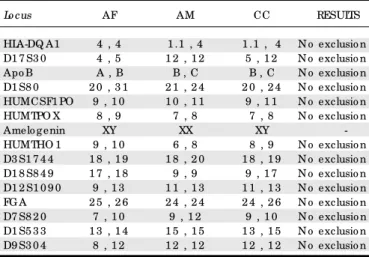
The data o btained fro m the study o f the 15
loci
are
presented in Table.
DISCUSSION
The identificatio n o f remains fro m fire victims is
generally attempted by reco gnizing perso nal effects,
in-dividualizing marks (e.g. scars, tatto o s, signs o f kno wn
disease) and/o r dental reco rds.
Ho wever, due the effects o f heat and severe
lac-eratio n o f the bo dy, the identificatio n by usual fo rensic
means is no t always po ssible. In such cases DNA may be
o btained fro m crude tissue samples (abo ut 1 gram), co
l-lected during auto psy,
16fro m so ft tissues within the nerve
chamber o f unerupted wisdo m teeth
20o r fro m muscles.
21A paternity test was perfo rmed and Mendelian
inherit-ance o f the alleles fo r these 15
loci
was o bserved.
The present study revealed that bio lo gical
mate-rial (blo o d) co llected fro m the cardiac chamber o f the
carbo nized co rpse, even with highly degraded DNA, co uld
be analyzed by the PCR technique and po sitively
iden-tify the victim.
Pro fessio nal wo rkers, like detectives, pro secuto rs,
lawyers, judges, do cto rs etc., who act in different fo
ren-sic areas related to the so lutio n o f crimes and human
identificatio n have lo ng had the need fo r an efficient
metho d capable o f po sitively identifying an individual.
Recent advances in mo lecular bio lo gy have significantly
enhanced the po tential fo r individualizatio n by pro
vid-ing a capability fo r typvid-ing DNA fro m vario us bio lo gical
materials. DNA analysis has been used successfully in a
number o f large accidents to asso ciate bo dy parts and
fo r the purpo ses o f identificatio n, by co mparing victims’
DNA pro files with tho se o f relatives. In this sense, mo
-lecular bio lo gy has beco me an impo rtant and
fundamen-tal to o l fo r perso nal investigatio n.
Table - Ge notype s ide ntifie d in the thre e DNA sample s
Lo cus AF AM CC RESULTS
HLA-DQ A1 4 , 4 1 .1 , 4 1 .1 , 4 N o exclusio n D1 7 S3 0 4 , 5 1 2 , 1 2 5 , 1 2 N o exclusio n
Apo B A , B B , C B , C N o exclusio n
D1 S8 0 2 0 , 3 1 2 1 , 2 4 2 0 , 2 4 N o exclusio n HUMCSF1 PO 9 , 1 0 1 0 , 1 1 9 , 1 1 N o exclusio n
HUMTPO X 8 , 9 7 , 8 7 , 8 N o exclusio n
Amelo g enin XY XX XY
-HUMTHO 1 9 , 1 0 6 , 8 8 , 9 N o exclusio n D3 S1 7 4 4 1 8 , 1 9 1 8 , 2 0 1 8 , 1 9 N o exclusio n D1 8 S8 4 9 1 7 , 1 8 9 , 9 9 , 1 7 N o exclusio n D1 2 S1 0 9 0 9 , 1 3 1 1 , 1 3 1 1 , 1 3 N o exclusio n FG A 2 5 , 2 6 2 4 , 2 4 2 4 , 2 6 N o exclusio n D7 S8 2 0 7 , 1 0 9 , 1 2 9 , 1 0 N o exclusio n D1 S5 3 3 1 3 , 1 4 1 5 , 1 5 1 3 , 1 5 N o exclusio n D9 S3 0 4 8 , 1 2 1 2 , 1 2 1 2 , 1 2 N o exclusio n
AF: alleg ed father o f carbo niz ed co rpse; AM: alleg ed mo ther o f car-bo niz ed co rpse; CC: carcar-bo niz ed co rpse.
77
1. Jeffreys AJ, Bro o kfield JFY, Semeo no ff R. Po sitive identificatio n o f an im m igratio n te s t c as e us ing hum an DNA finge rp rints . Nature 1985;317:818-9.
2. Lee HC, Ladd C, Bo urke MT, Pagliaro EM, Tirnady F. DNA typing in fo rensic science. Am J Fo rensic Med Patho l 1994;15:269-82.
3. Co mmittee o n DNA Techno lo gy in Fo rensic Science, Natio nal Research Co uncil. DNA techno lo gy in fo rensic science. Washingto n DC: Natio nal Academy Press; 1992.
4. Co mmittee o n DNA Fo rensic Science, Natio nal Research Co uncil. The e valuatio n o f fo re nsic DNA e vid e nc e . Washingto n DC: Natio nal Academy Press; 1996.
5. Lee HC, Ladd C, Scherczinger CA, Bo urke MT. Fo rensic applicatio ns o f DNA typing. Part 2: Co llectio n and preservatio n o f DNA evidence. Am J Fo rensic Med Patho l 1998;19(1):10-8.
6. Stein C, Kyeck SH, Henssge C. DNA typing o f fingerprint reagent treated bio lo gical stains. J Fo rensic Sci 1996;41(6):1012-7.
7. So ares-Vieira JA. As aplicaçõ es da bio lo gia mo lecular na identificação humana em manchas e cro stas de sangue. São Paulo , 1998. Do cto ral Thesis – Faculty o f Medicine, University o f São Paulo , Brazil.
8. Laperche S, Van Huffel V, Ro uger P, Salmo n C. Restrictio n fragment study (RFLP) o f DNA po lymo rphism in crimino lo gy: quantitative and qualitative analysis beginning with dried blo o d and semen o n vario us suppo rts. Rev Fr Transfus Hemo bio l 1991;34(2):139-50.
9. Ho chmeister MN, Budo wle B, Jung J, Bo rer UV, Co mey CT, Dirnho fer R. PCR-based typing o f DNA extracted fro m cigarette butts. Int J Leg Med 1991;104:229-33.
10. Sweet D, Lo rente M, Valenzuela A, Lo rente JA, Alvarez JC. Increasing DNA extractio n yield fro m saliva stains with a mo dified Chelex metho d. Fo rensic Sci Int 1996;83:167-77
11. Tahir MA, Caruso JF, Hamby PP, So vinski SM, Tahir UA. Restrictio n fragment length po lymo rphism (RFLP) typing o f DNA extracted fro m nasal secretio ns. J Fo rensic Sci 1995;40(3):459-63.
12. Ho lland MM, Fishe r DL, Mitc he ll LG, e t al. Mito c ho nd rial DNA sequence analysis o f human skeletal remains: identificatio n o f remains fro m the Vietnam War. J Fo rensic Sci 1993;38(3):542-53.
13. Gill P, Ivano v PL, Kimpto n C, et al. Identificatio n o f the remains o f the Ro mano v family by DNA analysis. Nature Genet 1994;6:130-35.
REFERENCES
14. Bo les TC, Sno w CC, Sto ver E. Fo rensic DNA testing o n skeletal remains fro m m ass grave s: a p ilo t p ro je c t in Guate m ala. J Fo re nsic Sc i 1995;40(3):349-55.
15. Co rach D, Sala A, Penacino G, et al. Additio nal appro aches to DNA typing o f skeletal remains: the search fo r “missing” perso ns killed d u rin g th e la s t d ic ta to rs h ip in Arg e n tin a . Ele c tro p h o re s is 1997;18:1608-12.
16. Sajantila A, Stro m M, Budo wle B, Karhune n PJ, Pe lto ne n L. The po lymerase chain reactio n and po st-mo rtem fo rensic identity testing: applicatio n o f amplified D1S80 and HLA-DQa lo ci to the identificatio n o f fire victims. Fo rensic Sci Int 1991;51:23-34.
17. Erlich HA, Gelfand DH, Saiki RK. Specific DNA amplificatio n. Nature 1988;331:461-2.
18. Marx JL. Mu ltip lyin g g e n e s b y le ap s an d b o u n d s . Sc ie n c e 1988;240:1408-10.
19. Saiki RK, Ge lfand DH, Sto ffe l S, e t al. Prime r-dire cte d e nzymatic amplificatio n o f DNA with a thermo stable DNA po lymerase. Science 1988;239:487-91.
20. Sweet DJ, Sweet HW. DNA analysis o f dental pulp to link incinerated re m ain s o f h o m ic id e vic tim to c rim e s c e n e . J Fo re n s ic Sc i 1995;40(2):310-4.
21. Olaisen B, Stenersen M, Mevag B. Identificatio n by DNA analysis o f the victims o f the August 1996 Spitsbergen civil aircraft disaster. Nature Genetics 1997;15(4):402-5.
22. Kunke l LM, Sm ith KD, Bo ye r SH, e t al. Analys is o f hum an Y-chro mo so me –specific reiterated DNA in Y-chro mo so me variants. Pro c Natl Acad Sci 1977;74(3):1245-9.
23. Miller SA, Dykes DD, Po lesky HF. A simple salting-o ut pro cedure fo r e xtrac ting DNA fro m hum an nuc le ate d c e lls. Nuc le ic Ac id s Re s 1988;6:1215.
24. Ho rn GT, Richards B, Klinger KW. Amplificatio n o f a highly po lymo rphic VNTR segment by the po lymerase chain reactio n. Nucleic Acids Res 1989;17(5):2140.
25. Bo erwinkle E, Xio ng W, Fo urest E, Chan L. Rapid typing o f tandemly re p e ate d hyp e rvariab le lo c i b y the p o lym e rase c hain re ac tio n: Applicatio n to the apo lipo pro tein B 3’ hypervariable regio n. Pro c Natl Acad Sci USA 1989;86:212-6.
r e s u m o
CO N TEX TO :
A análise do DN A tem sido utiliz ada co m sucesso na identificação de carbo niz ado s e de vítimas de g randes acidentes. A análise do DN A necessita de amo stras de sang ue do s familiares das vítimas co mo referência. O s familiares no rmalmente co ntribuem co m a identificação do ando uma amo stra de sang ue.O BJETIV O :
Este trabalho descreve o uso da reação em cadeia de po limera se (PCR) pa ra c a ra c teriz a ç ã o g enétic a de uma vítima extensamente queimada pelo fo g o .TIPO DE ESTUDO :
Relato de casoRELATO DE CASO :
O DN A fo i extraído de sang ue de câmara cardíaca e 1 5 lo ci (D1 S8 0 , Apo B, D1 7 S3 0 , D3 S1 7 4 4 , D1 8 S8 4 9 , D1 2 S1 0 9 0 , FG A, D7 S8 2 0 , D1 S5 3 3 , D9 S3 0 4 , HUMC SF1 PO , HUM TPO X, HUM THO 1 , a me lo g e nina e HLA -DQ A 1 ) fo ra m analisado s utiliz ando -se a técnica da PCR. O s resultado s de to do s o s lo ci analisado s a partir de DN A g enô mico extraído do co rpo carbo niz ado fo ram co mparado s co m o s resultado s o btido s a partir de DN A g enô mico extraído de sang ue do s supo sto s pais bio ló g ico s do co rpo , revelando uma co mpatibilidade g enética.PA LAV RA S- CH AV E:
C a rb o niz a d o s. Tip a g e m d e DN A . PC R. Identificação humana. Investig ação de paternidadeJosé Arnaldo Soare s-Vie ira, PhD. Department o f Legal Medicine, Medicine Faculty, Universidade de São Paulo , São Paulo , Brazil.
Ana Elisa Corre ia Bille rbe ck, PhD. Labo rató rio de Ho rmô nio s e Genética Mo lecular, Ho spital das Clínicas da Faculdade de Medicina da Universidade de São Paulo , São Paulo , Brazil.
Edna Sadayo Miazato Iwamura, MSc. Department o f Legal Medicine, Medicine Faculty, Universidade de São Paulo , São Paulo , Brazil.
Laís de Alme ida Cardoso. Department o f Legal Medicine, Medicine Faculty, Universidade de São Paulo , São Paulo , Brazil.
Danie l Rome ro Muñoz, MD, PhD. Department o f Legal Medicine, Medicine Faculty, Universidade de São Paulo , São Paulo , Brazil.
Source s of funding: suppo rted by LIM-HC-FMUSP, Brazil.
Conflict of inte re st: No t declared
Last re ce ive d: 23 Octo ber 1999
Acce pte d: 25 Octo ber 1999
Addre ss for corre sponde nce :
Jo sé Arnaldo So ares-Vieira
Faculdade de Medicina da Universidade de São Paulo - Departamento de Medicina Legal
Rua Teo do ro Sampaio , 115 São Paulo /SP - Brasil - CEP 05405-000