Rev Saúde Pública 2005;39(5) www.fsp.usp.br/rsp
INTRODUCTION
Drug abuse and violence are constant threats to quality of life. Drug dealing appears as a constant link between violence and drugs, given that the drug market is prone to generating violent actions. Begin-ning in the 1980’s, organized crime in Brazil has flour-ished and become institutionalized. It is now viewed as a social reaction, and constitutes a work market, especially for poor youths from the suburbs and slums (Minayo & Deslandes,8 1998).
Predictive model for cocaine use in prisons in
Rio de Janeiro, Brazil
M árcia Lazaro de Carvalhoa, Joaquim Gonçalves Valentea, Simone Gonçalves de Assisb
and Ana Glória Godoi Vasconcelosa
aDepartamento de Epidemiologia e Métodos Quantitativos em Saúde. Escola Nacional de Saúde
Pública (ENSP). Fundação Oswaldo Cruz (Fiocruz). Rio de Janeiro, RJ, Brasil. bCentro Latino
Americano de Estudos sobre Violência e Saúde. ENSP/Fiocruz. Rio de Janeiro, RJ, Brasil
Correspondence: Márcia Lazaro de Carvalho. Rua Leopoldo Bulhões, 1480/806. 21041-210 Rio de Janeiro, RJ, Brasil E-mail: [email protected]
*Data from the 1997 Brazilian Penitentiary Census, Brasília. Ministério da Justiça (unpublished data).
Based on a doctoral thesis presented at the Instituto de Medicina Social, Universidade do Estado do Rio de Janeiro, in 2003. Received on 9/6/2004. Reviewed on 4/4/2005. Approved on 4/6/2005.
Keywords
Cocaine-related disorders. Alcoholism. Marijuana smoking. Prisons.
Hierarchized multivariate analysis. Risk factors. Social vulnerability.
Abstract
Objective
To identify predictors of and groups vulnerable to cocaine use in prison.
Methods
We selected 376 inmates with history of cocaine use in prison (cases) and 938 inmates with no history of drug use (controls) serving sentences in the Rio de Janeiro State prison system in 1998. The analysis included exposure variables divided into three hierarchical levels: distal, intermediate, and proximal. We performed bivariate analysis using logistic regression and multivariate analysis using hierarchized regression; results are given in odds ratios.
Results
Variables associated with cocaine use in prison in the proximal level were use of alcohol and marijuana and duration of imprisonment in years. The effect of social vulnerability variables (distal level) was intermediated by variables in the next levels. Considering only the distal and intermediate levels, use of marijuana prior to imprisonment (OR=4.50; 95% CI: 3.17-6.41) and offence in order to obtain drugs (OR=2.96; 95% CI: 1.79-4.90) showed the strongest association with the outcome. For every additional year spent in prison, the odds of cocaine use increase by 13% (OR=1.13; 95% CI: 1.06-1.21).
Conclusions
Considering the distal and intermediate levels, use of marijuana prior to imprisonment and perpetration of offence in order to obtain drugs were the variables with greatest predictive value. The final model showed alcohol and marijuana use in prison and duration of imprisonment as important predictors of the outcome. The prison environment appears as a factor stimulating drug use.
Data from the Rio de Janeiro Child and Youth Court (Segunda Vara da Infância e Juventude) show that, of all illegal acts perpetrated by youths in the last five years, 13.4% are classified as possession/use of ille-gal drugs and 22.2% as drug dealing, according to Statute no. 6.368/76.
Rev Saúde Pública 2005;39(5) www.fsp.usp.br/rsp Cocaine use in prisons
Carvalho ML et al
(Departamento de Sistema Penitenciário - Desipe) of the Rio de Janeiro State Secretariat of Justice, when 2,039 inmates randomly selected from among the 10,600 inmates were interviewed.
Based on the data generated by this survey, a sub-population was selected comprising only subjects with opposite behaviors concerning cocaine use. Subjects were selected based on the occurrence of the outcome, participants were divided into two com-parison groups in order to identify possible predic-tors of cocaine use in prison.
Groups were analyzed as cases and controls, this being considered a ‘case-control’ study nested within a cross-sectional study.
The studied population was composed of 1,314 inmates. The ‘case’ group included 376 inmates (29.0%) with history of cocaine use in prison. Of these, 42 began to use the drug after imprisonment and 334 used cocaine before, and continued to use the drug after entry into the penitentiary system. The ‘control’ group included 938 inmates (71.0%) who reported never having used cocaine (neither before nor after imprisonment). This criterion was restric-tive, since it excluded inmates who reported not us-ing cocaine in prison but who had used the drug be-fore imprisonment. This restriction was intentional, since these subjects represent an ‘intermediate’ group, for which the establishment of the actual predictors of cocaine use in prison would be difficult.
A structured questionnaire was administered by means of interviews carried out by healthcare profes-sionals between March and September 1998. Non-response was approximately 15%.
The independent variables used for describing the profile of the inmates were initially classified into blocks defined as follows: socio-demographic vari-ables, penal history, history of use of other drugs, and history of sexually transmitted diseases before and after imprisonment.
Initially, data analysis included the description of cocaine use in prison according to the main variables, using odds ratios (OR) as a measure of association between the outcome variable – cocaine use in prison – and the remaining variables in each block. Com-plementary results can be found in Carvalho.***
*Secretaria de Estado de Justiça do Rio de Janeiro (SEJ-RJ). Perfil dos Internos na “ Porta-de-Entrada” do Sistema Penitenciário do Rio de Janeiro nos últimos cinco anos (1996-2000). Rio de Janeiro: Superintendência de Saúde, SEJ-RJ; 2001.
**Mattos HRA, Quitete B, Amorim E, Carvalho ML, Lacerda AC, Caputo A et al. O uso de drogas e a Prevalência de Doenças Sexualmente Transmissíveis/HIV/Aids entre os adolescentes internados no Departamento Geral de Ações Sócio-educativas (DEGASE), 1999. In: Anais, Seminário Internacional sobre as Toxicomanias. Desafios da pós-modernidade: diversidades e perspectivas; 2000; Rio de Janeiro, Brasil. Rio de Janeiro: NEPAD/UERJ; 2000. p. 99
***Carvalho ML. Sistema prisional e drogas: interfaces em uma sociedade violenta [doctoral thesis]. Rio de Janeiro: Instituto de Medicina Social da Universidade do Estado do Rio de Janeiro; 2003.
State of Rio de Janeiro in 1998, drug dealing was responsible for 45.7% of crimes committed by incar-cerated adults. The great majority of convicts cur-rently entering the prison system in Rio de Janeiro have been convicted for drug dealing (Article 12 Stat-ute 6.368/76). In 2000, these represented 47% of all men and 74% of all women entering the system, most of which were young adults.*
A study was carried out in 1998 investigating the relationship between STD/AIDS and drug use in the Rio de Janeiro prison system, and included 2,095 inmates. Cocaine use before incarceration was re-ported by 52% of inmates in male facilities, 48% of inmates in female facilities, and 25% of inmates in psychiatric hospitals (Carvalho et al,3 2000).
Another study, conducted in 1999, addressed the profile of juvenile offenders serving socio-educa-tional sentences at Departamento Geral de Ações Sócio-Educativas (DEGASE). This study showed drug dealing as the main cause for arrest among the 687 youths interviewed (34% of all boys and 46% of all girls). Lifetime drug use was reported by 90% of sub-jects, cocaine having been consumed by 50% of boys and 56% of girls.**
In order to contribute towards an understanding of the factors associated with cocaine use in prisons, one needs a conceptual model capable of explaining the relationship between each of the factors under study. We assume that, although these individuals share the same condition as prison inmates, there are differences between them that may explain the dif-ferent behaviors observed while in prison. Various factors may act directly or indirectly upon cocaine use, and these factors are distributed along different hierarchical levels (proximal, intermediate, or distal).
The identification of groups at greater risk of using cocaine in prison would allow for relevant specific interventions in the studied population. The aim of the present study was to identify predictor variables for cocaine use in prison and to determine the rela-tionship between these variables.
M ETH O D S
!
Rev Saúde Pública 2005;39(5) www.fsp.usp.br/rsp
Cocaine use in prisons Carvalho ML et al
Variables that were statistically significant (p<0.05) in explaining the differences between users and nonusers of cocaine in prison in the descriptive bivariate stage were included in the multivariate stage. Potential confounders were included in the model (sex and age). Subsequently, multivariate models were esti-mated for each block by introducing all vari-ables simultaneously (direct selection); sig-nificant variables (measured by adjusted OR and 95%CI) were included in the conceptual framework. This model was elaborated in or-der to clarify the relationship between factors preceding imprisonment.
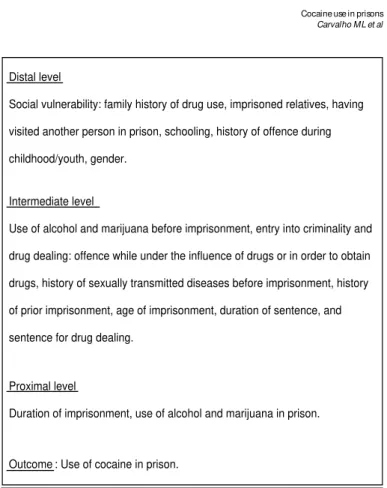
We sought to develop predictive models for cocaine use in prison by using the hierarchized conceptual modeling approach proposed by Victora et al13 (1997). We con-sidered independent variables associated with cocaine use in prison to be in different hierarchical levels, according to a proposed conceptual framework (Figure).
We began the hierarchized modeling by simultaneously introducing the variables in the first level (distal). Variables reaching sta-tistical significance in the first level were
kept in the model and included in the adjustment of the next (intermediate) level. This same procedure was employed for the following level. Analysis was controlled for potential confounders – in this case the variables maintained from the previous stages. Proximal variables were adjusted for distal and inter-mediate variables.
In the analysis of the proximal level, unlike what was proposed by Victora for hierarchized modeling, we chose to exclude the variables from the distal level that were not significant during this stage of modeling in order to obtain more precise estimates of the ad-justed ORs and a more parsimonious model.
We employed the ‘deviance’ statistic (-2 times the log likelihood) to evaluate how well the model fitted the data. The contribution of the variables in each level was evaluated as the difference between devi-ances, in the case of nested models, or using the Akaike Information Criterion (AIC) when compara-tive models were not nested. The statistical signifi-cance of differences in deviance was evaluated using the Chi-square distribution with the number of de-grees of freedom defined as the difference between the number of parameters in the two models being compared. The Akaike criterion (-2 times the log like-lihood, plus 2 times the number of parameters) is not
associated to a distribution, and the smaller the value, the better the fit(Cook & Weisberg,4 1999).
Data was analyzed using Epi Info version 6.04b and SPSS for Windows version 9.0 software.
Since this was a survey officially requested by the Health Coordination of the State Secretariat of Jus-tice, supported by the Ministry of Health and by the United Nations Drug Control Program(UNDCP), the legal support necessary for carrying out the survey was ensured. All inmates signed terms of informed consent for the laboratory tests.
Test results were informed to the participants, and those showing health problems were referred to a medical facility for follow-up.
RESU LTS
The sample was predominantly male (94%) and most subjects were young (median age =29 years) for both users of cocaine in prison and subjects who had never used the drug. With the exception of schooling, where users were more likely to be in the incomplete elemen-tary and complete elemenelemen-tary categories, there were no significant differences between the two groups with respect to socio-demographic variables (Table 1). Figure – Conceptual framework for explaining cocaine use in prison for the population of inmates of the Rio de Janeiro Penitentiary System. Rio de Janeiro, Brazil, 1998.
Distal level
Social vulnerability: family history of drug use, imprisoned relatives, having
visited another person in prison, schooling, history of offence during
childhood/youth, gender.
Intermediate level
Use of alcohol and marijuana before imprisonment, entry into criminality and
drug dealing: offence while under the influence of drugs or in order to obtain
drugs, history of sexually transmitted diseases before imprisonment, history
of prior imprisonment, age of imprisonment, duration of sentence, and
sentence for drug dealing.
Proximal level
Duration of imprisonment, use of alcohol and marijuana in prison.
" Rev Saúde Pública 2005;39(5) www.fsp.usp.br/rsp Cocaine use in prisons
Carvalho ML et al
There were important differences in penal history between the two groups. Users of cocaine in prison showed greater frequency of having been a juvenile offender, being a second offender, having visited an-other person in prison, and having served a larger proportion of their sentences. As to the main reasons for conviction, namely theft (42.0%) and drug deal-ing (29.0%), there was no difference between the groups in univariate analysis.
Cocaine use in prison was strongly associated with history of use of other drugs, including alcohol, mari-juana, and even tranquilizers, both before and after imprisonment. The number of different drugs con-sumed simultaneously was also strongly associated with drug use in prison.
Reported history of STD, both before and after im-prisonment, was strongly associated with the outcome.
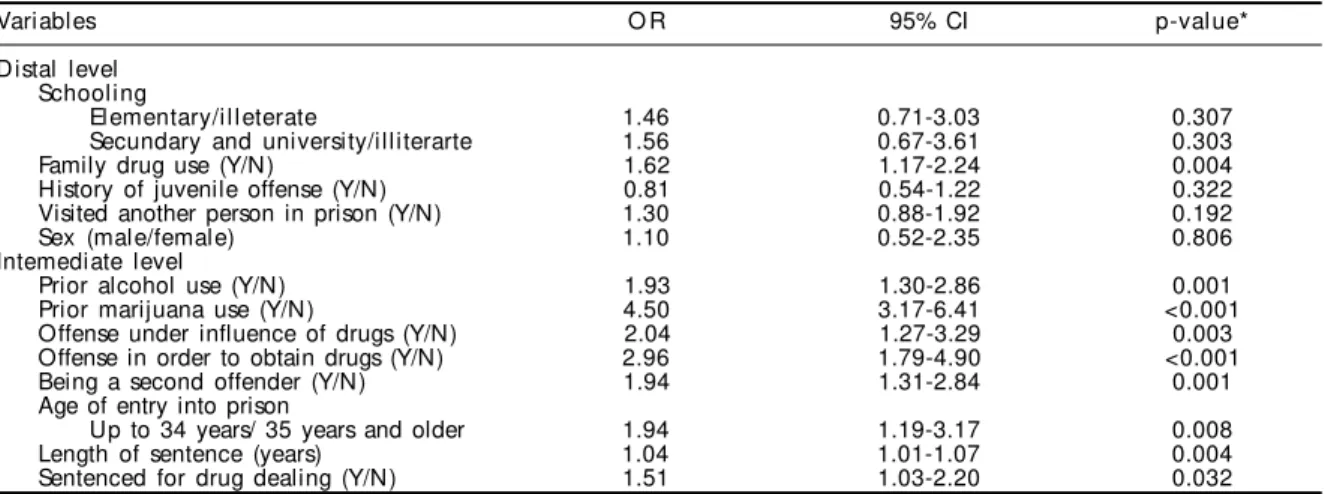
The distal level shows the total effect of variables lesser schooling, drug use in family, history of juve-nile offense, visits to prison, and male sex, adjusted for each other (Table 2). The model after the first two hierarchic levels (Table 3) shows the effects of the variables in the distal level that are not inter-mediated by variables in the following level, as well as the effects of variables in the intermediate level adjusted for each other and for the variables in the
distal level. These are appropriately considered as potential confounders for the variables of the inter-mediate level.
The only variable from the intermediate level ex-cluded from the model was history of STD before imprisonment, since it lost significance after adjust-ment for the variables in the intermediate and distal levels (Table 3). The only variable in the distal level whose effect was not intermediated by variables in the following level was family drug use. The contri-bution of intermediate level variables to the model containing only variables from the distal level is sta-tistically significant, as indicated by the difference in the deviance statistic of Tables 2 and 3 (550.21; p<0.0001).
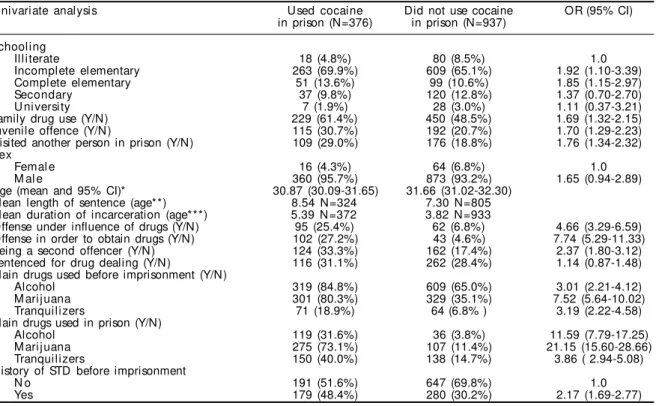
Variables excluded from the final model (Table 4) were schooling, history of juvenile offence, having visited another person in prison, and sex. All of these variables belonged to the distal level, and their ef-fects as confounders for the variables in the follow-ing levels lost statistical signif icance. When we compare the values obtained by applying the Akaike criterion to adjusted models, we see that the final model shows the lowest AIC value (787; Table 4), indicating a better fit when compared to the other models: 1,504.21 for the model including the distal variables only (Table 2), and 970.92 for the model Table 1 - Univariate analysis of cocaine use in prison according to socio-demographic variables, penal history, and sexually transmitted diseases. Rio de Janeiro, Brazil, 1998.
U nivariate analysis U sed cocaine Did not use cocaine OR (95% CI)
in prison (N=376) in prison (N=937)
Schooling
Illiterate 18 (4.8%) 80 (8.5%) 1.0
Incomplete elementary 263 (69.9%) 609 (65.1%) 1.92 (1.10-3.39)
Complete elementary 51 (13.6%) 99 (10.6%) 1.85 (1.15-2.97)
Secondary 37 (9.8%) 120 (12.8%) 1.37 (0.70-2.70)
U ni versi ty 7 (1.9%) 28 (3.0%) 1.11 (0.37-3.21)
Family drug use (Y/N) 229 (61.4%) 450 (48.5%) 1.69 (1.32-2.15)
Juvenile offence (Y/N) 115 (30.7%) 192 (20.7%) 1.70 (1.29-2.23)
Visited another person in prison (Y/N) 109 (29.0%) 176 (18.8%) 1.76 (1.34-2.32)
Sex
Femal e 16 (4.3%) 64 (6.8%) 1.0
M al e 360 (95.7%) 873 (93.2%) 1.65 (0.94-2.89)
Age (mean and 95% CI)* 30.87 (30.09-31.65) 31.66 (31.02-32.30)
Mean length of sentence (age**) 8.54 N=324 7.30 N=805
Mean duration of incarceration (age***) 5.39 N=372 3.82 N=933
Offense under influence of drugs (Y/N) 95 (25.4%) 62 (6.8%) 4.66 (3.29-6.59)
Offense in order to obtain drugs (Y/N) 102 (27.2%) 43 (4.6%) 7.74 (5.29-11.33)
Being a second offencer (Y/N) 124 (33.3%) 162 (17.4%) 2.37 (1.80-3.12)
Sentenced for drug dealing (Y/N) 116 (31.1%) 262 (28.4%) 1.14 (0.87-1.48)
Main drugs used before imprisonment (Y/N)
Alcohol 319 (84.8%) 609 (65.0%) 3.01 (2.21-4.12)
M ari j uana 301 (80.3%) 329 (35.1%) 7.52 (5.64-10.02)
Tranquilizers 71 (18.9%) 64 (6.8% ) 3.19 (2.22-4.58)
Main drugs used in prison (Y/N)
Alcohol 119 (31.6%) 36 (3.8%) 11.59 (7.79-17.25)
M ari j uana 275 (73.1%) 107 (11.4%) 21.15 (15.60-28.66)
Tranquilizers 150 (40.0%) 138 (14.7%) 3.86 ( 2.94-5.08)
History of STD before imprisonment
N o 191 (51.6%) 647 (69.8%) 1.0
Yes 179 (48.4%) 280 (30.2%) 2.17 (1.69-2.77)
#
Rev Saúde Pública 2005;39(5) www.fsp.usp.br/rsp
Cocaine use in prisons Carvalho ML et al
including both distal and intermediate variables (Table 3).
D ISCU SSIO N
Drug use is an important issue, and needs to be further investigated in Brazil. The outcome of drug use studies is difficult to measure due to the diffi-culty subjects experience in giving positive answers. This is especially true in the prison environment, where drug use has legal implications. The choice of restricting the control group, although it may rep-resent a loss in external validity, was intentional. The reason for this is that we believe that self-re-ported cessation of drug use upon entry into prison may be subject to strong information bias. The ploratory descriptive analysis showed that the ex-cluded group seems to occupy an intermediate po-sition in terms of behavior, tending to show greater similarity with cases regarding the presence of cer-tain predictors. Furthermore, according to our defi-nition of cases and controls, the excluded group would be part of the controls, since these subjects reported not using drugs while in prison. The differ-ences between cases and controls may thus have become artificially diluted. Since it was not
possi-ble to measure this bias, we chose to exclude this group from the analyses. In addition, even if this bias were not present, we believe that factors that may be important for the termination of drug use in prison may be intermingled with the predictors of such use, which was the object of our study.
Even though our data may be limited in terms of external validity, we were able to identify important associations and relationships in the groups studied, and to draw the profile of inmates at greater risk of using cocaine in prison.
Other studies have shown the importance of alcohol addiction as a potential risk marker for risk of cocaine use and have indicated that prevention and treatment programs in this area must be prepared to deal with this co-morbidity (Lopes & Coutinho,7 1999).
The associations with higher number of drugs used before imprisonment and with offence under the in-fluence or in order to obtain drugs seems to indicate that drug use in these cases was not occasional, or simply for experimentation. Moreover, inmates who reported continued use (before and after imprison-ment) or who began to use cocaine in prison were Table 2 - Predictive model for cocaine use in prison with one hierarchic level. Rio de Janeiro Penitentiary System interns. Rio de Janeiro, Brazil, 1998.
Variables O R 95% CI p-val ue*
D istal level Schooling
Elementary/ illiterate 2.12 1.23-3.64 0.007
Secondary and university/illiterate 1.61 0.85-3.03 0.142
Family drug use (Y/N) 1.62 1.26-2.09 <0.001
History of juvenile offense (Y/N) 1.53 1.15-2.03 0.003
Visited another person in prison (Y/N) 1.64 1.23-2.19 0.001
Sex (male/female) 1.96 1.08-3.58 0.027
Deviance statistic (-2 times the log likelihood): 1,492.21 with 6 degrees of freedom AIC=1,504.21
*Descriptive level, W ald test
Table 3 - Predictive model for cocaine use in prison with two hierarchic levels. Rio de Janeiro Penitentiary System interns. Rio de Janeiro, Brazil, 1998.
Variables O R 95% CI p-val ue*
D istal level Schooling
El ementary/i l l eterate 1.46 0.71-3.03 0.307
Secundary and university/illiterarte 1.56 0.67-3.61 0.303
Family drug use (Y/N) 1.62 1.17-2.24 0.004
History of juvenile offense (Y/N) 0.81 0.54-1.22 0.322
Visited another person in prison (Y/N) 1.30 0.88-1.92 0.192
Sex (male/female) 1.10 0.52-2.35 0.806
Intemediate level
Prior alcohol use (Y/N) 1.93 1.30-2.86 0.001
Prior marijuana use (Y/N) 4.50 3.17-6.41 <0.001
Offense under influence of drugs (Y/N) 2.04 1.27-3.29 0.003
Offense in order to obtain drugs (Y/N) 2.96 1.79-4.90 <0.001
Being a second offender (Y/N) 1.94 1.31-2.84 0.001
Age of entry into prison
Up to 34 years/ 35 years and older 1.94 1.19-3.17 0.008
Length of sentence (years) 1.04 1.01-1.07 0.004
Sentenced for drug dealing (Y/N) 1.51 1.03-2.20 0.032
Deviance statistic (-2 times the log likelihood): 942 with 14 degrees of freedom AIC=970.92
$ Rev Saúde Pública 2005;39(5) www.fsp.usp.br/rsp Cocaine use in prisons
Carvalho ML et al
considered as a single group of users, thus reducing potential information bias related to the difficulty in reporting drug use after entry into prison.
It is possible that part of the important association between time spent in prison and cocaine use be ex-plained by the fact that longer duration of imprison-ment may lead inmates to declare drug use with greater ease and less prejudice. This potential bias could not be measured.
Multivariate analysis showed the importance of conviction for drug dealing as a factor associated with drug use, an association that could not be established in univariate analysis. Considering only the first two hierarchic levels, which deal with the period preced-ing imprisonment, use of marijuana prior to impris-onment and offence in order to obtain drugs are the variables with the greatest predictive power (Table 3). Although the prison population as a whole is the result of a process of social exclusion that originates well before imprisonment, it is possible to identify inmates more vulnerable to cocaine use. This process is characterized mainly by the lack of opportunities, education, and work, by early insertion into the drug dealing market, and by lack of family structure.
Indeed, the use of marijuana before and after prison are closely related: over 90% of inmates that used alcohol or marijuana while in prison had also used these drugs before imprisonment, and this had an obvious influence on later use.
Some of the variables in the distal level (family drug use) and in the intermediate level (marijuana use before imprisonment and length of sentence) lost significance after the inclusion of variables in the proximal level. This indicates that more proximal variables (after imprisonment) are a connection
be-tween earlier factors (intermediate and distal levels) and the outcome, and appear as mediators rather than as confounders, as they would be interpreted by con-ventional modeling (Tables 3 and 4).
The greatest limitation of this interpretation is that it is more adequate to studies in which temporality is a known and decisive factor in the causal chain. We do not have this information in the present case, and our aim is to find markers for the causes leading to the outcome.
The model with two hierarchic levels (Table 3), applied upon entry into prison, would be enough for prediction purposes. The model with three levels is more adequate for identifying inmates at greater risk of drug use among those already in prison. The final model shows that use of alcohol and marijuana in prison and duration of imprisonment are important predictors with independent, statistically significant, effects that are maintained even after adjustment for the variables in previous levels. A similar approach has been used in other studies (Fuchs et al,5 1996; Kiely,6 1991; Olinto et al,9 1993; Petry et al,10 2000).
Although hierarchized analysis has advantages over conventional analysis, in that it allows for a better un-derstanding of the relationships between independent variables, some studies consider that indirect effects are not adequately represented by multivariate mod-els using regression techniques, and that path analysis is a more adequate multivariate statistical technique in these scenarios(Vasconcelos et al,12 1998).
In the system proposed by Victora et al13 (1997), the hierarchization of independent variables must be established in the conceptual framework and main-tained throughout data analysis, thus allowing for the selection of variables more strongly associated Table 4 - Final predictive model for cocaine use in prison with three hierarchic levels. Rio de Janeiro Penitentiary System interns. Rio de Janeiro, Brazil, 1998.
Variables O R 95% CI p-val ue*
D istal level
Family drug use (Y/N) 1.29 0.89-1.86 0.176
Intemediate level
Prior alcohol use(Y/N) 1.74 1.13-2.68 0.012
Prior marijuana use (Y/N) 1.47 0.95-2.27 0.083
Offense under influence of drugs (Y/N) 2.57 1.49-4.44 0.001
Offense in order to obtain drugs (Y/N) 2.41 1.34-4.34 0.003
Being a second offender (Y/N) 1.94 1.25-3.00 0.003
Age of entry into prison
Up to 34 years/ 35 years and older 2.01 1.16-3.47 0.013
Length of sentence (age) 0.97 0.93-1.01 0.161
Sentenced for drug dealing (Y/N) 1.65 1.07-2.53 0.022
Proximal level
Use of alcohol in prison (Y/N) 5.00 2.72-9.17 <0.001
Use of marijuana in prison (Y/N) 8.42 5.49-12.92 <0.001
Duration of incarceration (age) 1.13 1.06-1.21 <0.001
Deviance statistic (-2 times the log likelihood): 763 with 12 degrees of freedom AIC=787
%
Rev Saúde Pública 2005;39(5) www.fsp.usp.br/rsp
Cocaine use in prisons Carvalho ML et al
with the studied outcome. Some studies indicate a relationship between drug use and sexually transmit-ted diseases. Szwarcwald et al11 (1998) call attention to the importance of considering the role of specific population segments subject to specific risks. Female drug users, when in desperate need for money, are often exposed to high-risk sexual behaviors. It is pos-sible that similar practices occur in the prison popu-lation, where drugs are used as exchange currency. Bastos & Szwarcwald2 (2000) discuss the ‘pauperization’ of AIDS, and indicate drug consump-tion as the single habit/behavior related to risk of HIV infection, which is the object not only of stigma-tization, but also of criminalization.
According to Assis & Constantino1 (2001), the ‘treatment’ of young drug users by institutional criminalization only contributes to the ‘construction’ of the offender. There is a close relationship between drug policies based on the prohibition and
*Secretaria de Estado de Justiça do Rio de Janeiro (SEJ-RJ). Perfil dos Internos na “ Porta-de-Entrada” do Sistema Penitenciário do Rio de Janeiro nos últimos cinco anos (1996-2000). Rio de Janeiro: Superintendência de Saúde, SEJ-RJ; 2001.
criminalization of drug use and the difficulties in developing an effective policy for the treatment and prevention of addiction.
For every additional year spent in prison, the odds of using cocaine increase by 13%. Many inmates are also drug users, and only after imprisonment are they able to come in contact with public health services. Inmates often enter into the system already infected by Hepatitis B and C, AIDS, or syphilis.*
The prison environment must not be an additional factor stimulating the continuity of drug use when its role, in fact, should be to care for the inmate and promote recovery and social reintegration. It is, there-fore, the responsibility of prison healthcare systems to deal with these issues. The present model may con-tribute towards the identification of susceptible in-mates, and to design programs for the treatment and prevention of drug use.
REFEREN CES
1. Assis SG, Constantino P. Filhas do mundo: infração juvenil feminina no Rio de Janeiro. Rio de Janeiro: Editora Fiocruz; 2001.
2. Bastos FI, Szwarcwald CL. Aids e pauperização: principais conceitos e evidências empíricas. Cad Saúde Pública 2000;16 Supl 1:65-76.
3. Carvalho ML, Valente JG, Sáad AC. Prevalência e fatores de risco para DST/Aids em internos do sistema penitenciário do Rio de Janeiro, 1998. In: VI Congres-so Brasileiro de Saúde Coletiva; 2000; Salvador, Brasil. Livro de Resumos. p. 447.
4. Cook RD, Weisberg S. Applied regression including computing and graphics. New York: John Wiley; 1999.
5. Fuchs SC, Victora CG, Fachel J. Modelo hierarquiza-do: uma proposta de modelagem aplicada à investi-gação de fatores de risco para diarréia grave. Rev Saúde Pública 1996;30:168-78.
6. Kiely JL. Some conceptual problems in multivariable analyses of perinatal mortality. Paediatr Perinat Epidemiol 1991;5:243-57.
7. Lopes CS, Coutinho ESF. Transtornos mentais como fatores de risco para o desenvolvimento de abuso/ dependência de cocaína:estudo caso-controle. Rev Saúde Pública 1999;33:477-87.
8. Minayo MCS, Deslandes SF. A complexidade das relações entre drogas, álcool e violência. Cad Saúde Pública 1998;14:35-42.
9. Olinto MTA, Victora CG, Barros FC, Tomasi E. Determi-nantes da desnutrição infantil em uma população de baixa renda: um modelo de análise hierarquizado. Cad Saúde Pública 1993;9 Supl 1:14-27.
10. Petry PC, Victora CG, Santos IS. Adultos livres de cárie: estudo de casos e controles sobre conhecimen-tos, atitudes e práticas preventivas. Cad Saúde Pública 2000;16:145-53.
11. Szwarcwald CL, Bastos FI, Gravato N, Lacerda R, Chequer PN, Castilho EA. The relationship of illicit drug use to HIV-infection among commercial Sex workers in the city of Santos, Sao Paulo, Brazil. Int J Drug Policy 1998;9:427-36.
12. Vasconcelos AGG, Almeida RMV, Nobre FF. The path analysis approach for the multivariate analysis of infant mortality data. Ann Epidemiol 1998;8:262-71.