Clinical-epidemiological profile of acute appendicitis: retrospective
analysis of 638 cases
Perfil clínico-epidemiológico da apendicite aguda: análise retrospectiva
de 638 casos
AmAndA PereirA LimA2; FeLiPe José VieirA1,2; GAbrieLA ProcóPiode morAes oLiVeirA2; PLíniodos sAntos rAmos2; mArieLLe eLisA AVeLino2; FeLiPe GArciA PrAdo2; GiLson sALomão Júnior1; FrAncisco cAmPos siLVA1; João Vicente LinhAres rodriGues2.
INTRODUCTION
A
cute appendicitis (AA) is the leading cause of sur-gical acute abdomen worldwide, with a prevalence of approximately 7% of the population1-4. It has a peakincidence between 10-14 years in females and 15-19 in males2. Appendectomy is the treatment of choice. Besides
allowing definitive diagnosis, it also significantly reduces the risk of complications such as perforation, sepsis and death. The most important causal factor of AA appears to be the development of luminal obstruction, whose eti-ology is associated with age – lymphoid hyperplasia is the most common factor found in patients younger than 20 years, while the obstruction by a fecalith is more common in the elderly4.
The classification of the disease according to stage of evolution is important to assess severity and
prognosis, as well as allowing the development of ther-apeutic management protocols and research5. Surgical
treatment consists of appendix removal using open tech-nique, described by surgery McBurney in 1894, or by lap-aroscopic appendectomy, described in 1983 by Semm6.
Faced with the high prevalence of AA and the possible complications of this clinical picture, the aim of this study was to describe the clinical and epidemiological profile of AA patients at a reference center of Juiz de Fora macro-region, Minas Gerais State, Brazil.
METHODS
This was a retrospective, observational study, carried out in the Dr. Geraldo Teixeira Mozart Emergen-cy Hospital, in the city of Juiz de Fora, State of Minas Gerais. After approval by the institution Ethics in Research
1 - Dr. Mozart Geraldo Teixeira Emergency Hospital, Juiz de Fora, MG, Brazil. 2 - Faculty of Medical Sciences and Health, Juiz de Fora (SUPREME), Juiz de Fora, MG, Brazil.
A B S T R A C T
Objective: to describe the clinical and epidemiological profile of acute appendicitis (AA) of the patients treated at a referral center in the Juiz de Fora macro-region, Minas Gerais State, Brazil. Methods: we conducted a retrospective, observational study in the Dr. Mozart Geraldo TeixeiraEmergency Hospital. We selected 638 patients diagnosed with AA, and analyzed the variables gender, age, evolutionary phase, length of hospital stay, pathological diagnosis, use of antibiotics, use of drains, complications and mortality. Results: AA was more prevalent in young adults (19-44 years) and males (65.20%). The mean hospital stay was seven days and phase II was the most prevalent. We found the histopathological diagnosis of primary tumor of the appendix in six patients (0.94%), adenocarcinoma being the most common histologic type (66.7%). Regarding the use of antibiotics, 196 patients underwent antibiotic prophylaxis and 306 received antibiotic therapy. Eighty-one patients used some kind of drain, for an average of 4.8 days. Seventeen patients died (2.67%), predominantly males (70.59%), with mean age of 38.47 years. Conclusion: AA has a higher prevalence in males and young adults. The length of stay is directly associated with the evolutionary phase. The most common complication is infection of the surgical site. Mortality in our service is still high when compared with developed centers.
Committee (protocol 1424169), we analyzed medical re-cords of all patients hospitalized for acute abdomen (n = 1048) from January 2009 to January 2014. Of these, we selected only patients diagnosed with AA (n = 638). We excluded cases with insufficient clinical data.
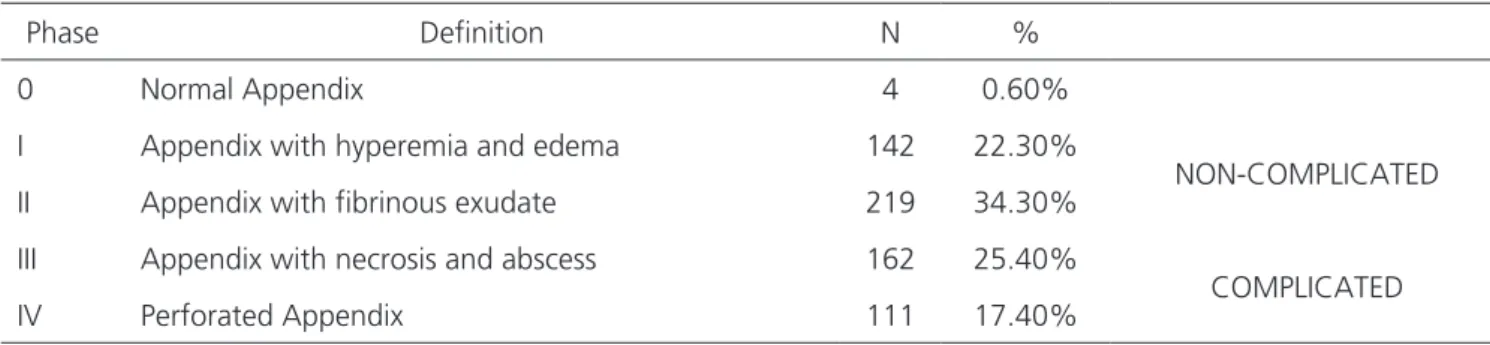
The variables obtained through the patient records were gender, age, evolutionary phase, length of stay, pathological diagnosis, use of antibiotics, use of drain, complications and mortality. The evolutionary phase was rated from 0 to IV: phase 0 – normal appendix; phase I – appendix hyperemia and edema; phase II – ap-pendix with fibrinous exudate; phase III – apap-pendix with necrosis and abscess; and phase IV – perforated appendi-citis. We stratified the phases in complicated appendicitis (III and IV) and non-complicated ones (I and II).
Initially, we tested the normality (Kolmogor-ov-Smirnov) and homoscedasticity of the distribution (Hartley test), validating the use of parametric statistics. We used the Student’s t-test to compare the average length of hospitalization between genders, between patients who used and who did not use drains, and be-tween patients undergoing antibiotic prophylaxis. We used a simple ANOVA to check the length of stay associ-ated with disease phase. We adopted the chi-square test to compare the disease phase by gender and mortality by gender. We considered the significance level of p < 0.05, and used the statistical software SPSS version 20.0 (SPSS, Chicago, USA) for data analysis.
RESULTS
Of the 1,048 patients diagnosed with acute abdomen, 638 (60.88%) had AA, representing the lead-ing cause of acute abdomen in the service. The average age was 32 years and there was a prevalence in males (65.20%). The disease was more prevalent in young
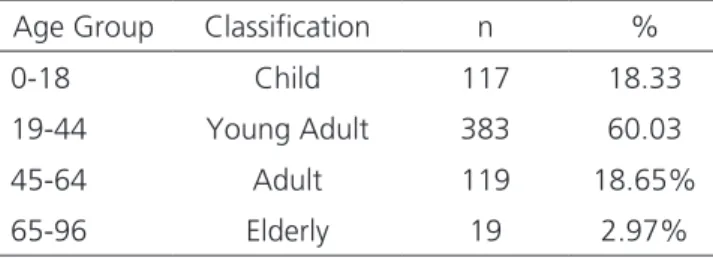
adults (19-44 years), representing 60.03% of the cases (Table 1), and less common in the elderly (2.97%). The average length of stay was 7.03 days, 6.77 for men and 7.56 days for women, with no significant difference seen between genders (p = 0.554).
Of the patients undergoing appendectomy, 98.75% had AA. Of patients who underwent inciden-tal appendectomy, 75% were female and a complicated ovarian cyst was the predominant cause in these patients. In males, the causes were Amyand hernia and adenocar-cinoma of the appendix.
Regarding the evolutionary phases, the most frequent was phase II, with 34.30% (Table 2). Of the patients diagnosed at stage IV, the majority were men (65.8%). Hospitalization was longer in phase IV, with an average of 12.37 days (Figure 1), with significant differ-ences between stage I and stage IV (p = 0.001).
Of all the pathology results, six (0.94%) had a diagnosis of primary tumor of the appendix, of which ad-enocarcinoma was the most frequent (66.7%). The oth-er histological types woth-ere squamous cell carcinoma and gastrointestinal stromal tumor (GIST). In addition, the pathological examination diagnose one case of parasitic infestation as AA etiology.
We observed the use of drains in 81 patients, for an average of 4.8 days. There was a higher hospital stay in this group, 10.37 days, compared with those who did not use drains, though without significant difference (p = 0.43).
Table 1. Prevalence of acute appendicitis according to age group.
Age Group Classification n %
0-18 Child 117 18.33
19-44 Young Adult 383 60.03
45-64 Adult 119 18.65%
65-96 Elderly 19 2.97%
As for the use of antibiotics, 196 patients were submitted to antibiotic prophylaxis, and the com-bination of amoxicillin with clavulanate was the most used (64.29%). These patients had shorter hospital stay when compared with those who did not under-go prophylaxis with, a significant difference between groups. Antibiotic therapy was performed in 306 pa-tients (47.97%), of whom 214 had complicated AA (69.94%). The most widely used therapy was the com-bination of metronidazole with another antimicrobial agent (40.13%), mainly ciprofloxacin (32.03%) and gentamicin (27.35%).
Of the total sample, 38 patients (5.96%) devel-oped complications in the postoperative period, wound infection (52.63%) and dehiscence wound (26.31%) be-ing the most frequent. There were also intra-abdominal abscesses, sepsis and fistula.
Considering mortality, 17 patients died (2.67%), with predominance of males (70.59%). The mean age was 38.47 years, 70.58% had complicated AA, and 47.06% received diagnosed at phase IV, there being a direct correlation between the evolutionary phase and death. As for the causes, 53% were due to septic shock and 47% to unknown or undetermined causes.
DISCUSSION
In this study, AA was more prevalent in males, which is consistent with other studies7-9. However, the
most prevalent age group was 19-44 years, contrasting with epidemiological data showing that the disease is more prevalent in young people aged 10-19 years7,8.
We found that only 1.25% of patients un-derwent incidental appendectomy, with a higher
prev-alence in women, the ovarian cyst being the predomi-nant etiology10. Thus, in women with acute abdomen,
ultrasound is important for the differential diagnosis of diseases of the female genital system9,10.
Further-more, due to the appendix topography, infections of the upper genital tract can lead to “reactive periapen-dicites”, whose main cause is pelvic inflammatory dis-ease (PID)10.
Histopathology is a best practice because it allows identifying malignancy in up to 1% of patients, most often in the form of neuroendocrine tumor, ade-nocarcinoma or mucinous cystadenoma11. In our study,
there was no case of neuroendocrine tumor, despite this being considered the most common appendix primary neoplasm, accounting for approximately 32-57% of tu-mors of the organ12. Adenocarcinoma was the most
prev-alent tumor in our series; this cancer is rare, accounting for less than 0.5% of all gastrointestinal tumors and be-tween 4-6% of tumors of the appendix. In these cases, hemicolectomy must be performed13,14.
A study from South Africa evaluated the pa-thology results of 371 patients who underwent appen-dectomy and revealed parasitosis as incidental diagnosis in 8.5% of cases15. In our study, only one patient had AA
by parasitic infestation.
Non-complicated AA, when treated with ap-pendectomy compared with treatment with antibiotics, has a lower rate of complications16. A systematic review
analyzed a number of meta-analyses and concluded that the treatment of AA only with antibiotics should not be routinely recommended. The realization of appendecto-my remains the gold standard for AA treatment17.
Although antibiotic prophylaxis is common in surgical procedures, the inappropriate use of these drugs
Table 2. Classification and prevalence of appendicitis according to the evolutionary phase.
Phase Definition N %
0 Normal Appendix 4 0.60%
I Appendix with hyperemia and edema 142 22.30%
NON-COMPLICATED
II Appendix with fibrinous exudate 219 34.30%
III Appendix with necrosis and abscess 162 25.40%
COMPLICATED
occurs in 25-50% of general elective surgeries18-20. All
patients undergoing appendectomy should receive an-tibiotics, prophylactic or therapeutic, and these should be started before surgery21. When prophylactic, they
should be administered in the anesthetic induction. The chosen drug must be active against Gram negative and anaerobic bacteria, and among the latter, specifically,
Bacteroides fragilis. A meta-analysis of randomized trials comparing preoperative prophylactic antibiotics with pla-cebo showed a significant reduction of wound infection with the use of any antimicrobial agent22. In our study,
the combination of amoxicillin with clavulanate was the most used prophylaxis (64.29%), and patients undergo-ing antibiotic prophylaxis had shorter hospital stay when compared with those who did not. Therefore, the preop-erative use of antibiotics is prudent; however, continued therapy will depend on the operative findings of abscess or perforation23.
In a retrospective study that evaluated 107 ap-pendectomy patients in a reference hospital, the most prevalent developmental stages were phases II (27%) and IV (27%)24. In our study, phase II was the most prevalent,
accounting for 34.30 % of cases.
Unlike uncomplicated AA, the perforated form is associated with a higher chance of postoperative com-plications such as intra-abdominal abscesses25,26. In these
cases, drains are widely used by surgeons to avoid the formation of intraabdominal abscesses. One study eval-uated 199 patients with complicated AA, of whom 79 used drains and 120 did not: 15% of patients without
peritoneal drainage developed intra-abdominal abscess after appendectomy27.
The most common appendectomy postoper-ative complications are related to the degree of ap-pendiceal inflammation. It is important to take into account the time elapsed from the onset of symptoms and the time of operation23. Postoperative
complica-tions remain around 10%, the surgical site infection being responsible for one-third of them5,28. Infection of
the surgical site occurred in 3.45% of our patients and was the main postoperative complication. Its frequen-cy ranges between 0% and 15% for the laparotomic procedure5,29.
The hospitalization time also increases with the severity of appendicitis30, which we also observed. The
mortality in developed centers is low (0.09% to 0.24%). According to the literature, in low- and middle-income countries, mortality varies between 1% and 4%, being a useful marker of health care quality. In our service, mor-tality was 2.67%, which demonstrates the close relation-ship between the socioeconomic status of the country and the quality of health services11.
In conclusion, AA showed higher prevalence among males and young adults (19-44 years). Hospital-ization time was directly associated with the evolutionary phase and increased with the severity of appendicitis. The most common complication was surgical site infection, corroborating the literature data. Mortality was also high, which shows the need to improve the quality of public health care in Brazil.
R E S U M O
Objetivo: descrever o perfil clinicoepidemiológico da apendicite aguda (AA) dos pacientes atendidos em um centro de referência da macrorregião de Juiz de Fora, MG. Métodos: estudo observacional retrospectivo, realizado no Hospital de Pronto Socorro Dr. Mozart Geraldo Teixeira. Um total de 638 pacientes diagnosticados com AA foram selecionados. As variáveis analisadas foram sexo, idade, fase evolutiva, tempo de internação, diagnóstico anatomopatológico, uso de antibióticos, uso de dreno, complicações e mortalidade.
Resultados: a AA foi mais prevalente no adulto jovem (19-44 anos) e no sexo masculino (65,20%). O tempo médio de internação foi de sete dias e a fase II foi a mais prevalente. O diagnóstico anatomopatológico de tumor primário de apêndice foi realizado em seis pacientes (0,94%), sendo o adenocarcinoma o tipo histológico mais frequente (66,7%). Quanto ao uso de antibióticos, 196 pacientes foram submetidos apenas à antiobioticoprofilaxia e 306 receberam antibioticoterapia. Da nossa casuística, 81 pacientes fizeram uso de dreno, cujo tempo de uso foi em média 4,8 dias. Considerando a mortalidade, 17 pacientes morreram (2,67%), predominando o sexo masculino (70,59%) e média de idade de 38,47 anos. Conclusão: a AA apresenta maior prevalência no sexo masculino e no adulto jovem. O tempo de internação está diretamente associado à fase evolutiva. A complicação mais comum é a infecção de sítio cirúrgico. A mortalidade em nosso serviço ainda é alta comparada a centros desenvolvidos.
REFERENCES
1. Sandell E, Berg M, Sandblom G, Sundman J, Fränneby U, Boström L, et al. Surgical decision-making in acute appendicitis. BMC surgery. 2015;15:69.
2. Papandria D, Goldstein SD, Rhee D, Salazar JH, Arlikar J, Gorgy A, et al. Risk of perforation increases with de-lay in recognition and surgery for acute appendicitis. J Surg Res. 2013;184(2):723-9.
3. Osime OC, Ajayi P. Incidence of negative appendec-tomy: experience from a company hospital in Nigeria. Cal J Emerg Med. 2005;6(4):69-73.
4. Shogilev DJ, Duus N, Odom SR, Shapiro NI. Diag-nosing appendicitis: evidence-based review of the diagnostic approach in 2014. West J Emerg Med. 2014;15(7):859-71.
5. Gomes CA, Nunes TA. Classificação laparoscópi-ca da apendicite aguda. Correlação entre graus da doença e as variávies perioperatórias. Rev Col Bras Cir. 2006;33(5):289-93.
6. Jaschinski T, Mosch C, Eikermann M, Neugebauer EA. Laparoscopic versus open appendectomy in patients with suspected appendicitis: a systematic review of meta-analyses of randomised controlled trials. BMC Gastroenterol. 2015;15:48.
7. Sulu B, Günerhan Y, Palanci Y, Isler B, Calayan K.
Epidemiological and demographic features of appen-dicitis and influences of several environmental factors. Ulus Travma Acil Cerrahi Derg. 2010;16(1):38-42. 8. Al-Omran M, Mamdani M, McLeod RS.
Epidemiolog-ic features of acute appendEpidemiolog-icitis in Ontario, Canada. Can J Surg. 2003;46(4):263-8.
9. Ximenes AMG, Mello FST, Lima-Júnior ZB, Ferreira CF, Cavalcanti ADF, Dias-Filho AV. Tempo de inter-nação após apendicectomia aberta por três técni-cas cirúrgitécni-cas diferentes. ABCD, arq bras cir dig. 2014;27(3):188-90.
10. Pages-Bouic E, Millet I, Curros-Doyon F, Faget C, Fontaine M, Taourel P. Acute pelvic pain in females in septic and aseptic contexts. Diagn Interv Imaging. 2015;96(10):985-95.
11. Bhangu A, SØreide K, Di Saverio S, Assarsson JH, Drake FT. Acute appendicitis: modern understanding
of pathogenesis, diagnosis, and management. Lancet. 2015;386(10000):1278-87.
12.Gu Y, Wang N, Xu H. Carcinoid tumor of the appen-dix: a case report. Oncol Lett. 2015;9(5):2401-3. 13.Park IJ, Yu CS, Kim HC, Kim JC. Clinical features and
prognostic factors in primay adenocarcinoma of the appendix. Korean J Gastroenterol. 2004;43(1):29-34. 14.Guraya SY, Almaramhy HH. Clinicopathological
fea-tures and the outcome of surgical management for adenocarcinoma of the appendix. World J Gastroin-test Surg. 2011;3(1):7-12.
15.Chamisa I. A clinicopathological review of 324 appen-dices removed for acute appendicitis in Durban, South Africa: a retrospective analysis. Ann R Coll Surg Engl. 2009;91(8):688-92.
16.Kirby A, Hobson RP, Burke D, Cleveland V, Ford G, West RM. Appendicectomy for suspected uncompli-cated appendicitis is associated with fewer complica-tions than conservative antibiotic management: a me-ta-analysis of post-intervention complications. J Infect. 2015;70(2):105-10.
17.Rocha LL, Rossi FM, Pessoa CM, Campos FN, Pires CE, Steinman M. Antibiotics alone versus appendectomy to treat uncomplicated acute appendicitis in adults: what do meta-analyses say? World J Emerg Surg.
2015;10:51.
18.Dellinger EP, Gross PA, Barrett TL, Krause PJ, Mar-tone WJ, McGowan JE Jr, et al. Quality standard for antimicrobial prophylaxis in surgical procedures. In-fectious Diseases Society of America. Clin Infect Dis. 1994;18(3):422-7.
19.Gyssens IC, Geerligs IE, Nannini-Bergman MG, Knape JT, Hekster YA, van der Meer JW. Optimizing the timing of antimicrobial prophylaxis in surgery: an intervention study. J Antimicrob Chemother. 1996;38(2):301-8.
20.Dahms RA, Johnson EM, Statz CL, Lee JT, Dunn DL, Beilman GJ. Third-generation cephalosporins and vancomycin as risk factors for postoperative vanco-mycin-resistant enterococcus infection. Arch Surg. 1998;133(12):1343-6.
surgical site infection and efficacy of antibiotic pro-phylaxis: a cohort study of appendectomy patients in Thailand. BMC Infect Dis. 2006;6:111-9.
22.Andersen BR, Kallehave FL, Andersen HK. Antibiotics versus placebo for prevention of postoperative infec-tion after appendicectomy. Cochrane Database Syst Rev. 2005;(3):CD001439.
23.Nutels DBA, Andrade ACG, Rocha AC. Perfil das com-plicações após apendicectomia em um hospital de emergência. ABCD, arq bras cir dig. 2007;20(3):146-9. 24.Fischer CA, Pinho MSL, Ferreira S, Milani CAC, van
Santen CR, Marquardt RA. Apendicite aguda: existe relação entre o grau evolutivo, idade e o tempo de internação? Rev Col Bras Cir. 2005;32(3):136-8. 25.Fraser JD, Aguayo P, Leys CM, Keckler SJ, Newland
JG, Sharp SW, et al. A complete course of intrave-nous antibiotics vs a combination of intraveintrave-nous and oral antibiotics for perforated appendicitis in chil-dren: a prospective, randomized trial. J Pediatr Surg. 2010;45(6):1198-202.
26.St Peter SD, Sharp SW, Holcomb GW, 3rd, Ostlie DJ. An evidence-based definition for perforated appen-dicitis derived from a prospective randomized trial. J
Pediatr Surg. 2008;43(12):2242-5.
27.Beek MA, Jansen TS, Raats JW, Twiss EL, Gobardhan PD, van Rhede van der Kloot EJ. The utility of perito-neal drains in patients with perforated appendicitis. Springerplus. 2015;4:371.
28.Johnson AB, Peetz ME. Laparoscopic appendectomy is an acceptable alternative for the treatment of per-forated appendicitis. Surg Endosc. 1998;12(7):940-3. 29.Majewski W. Diagnostic laparoscopy for the acute
ab-domen and trauma. Surg Endosc. 2000;14(10):930-7. 30.Tsai CC, Lee SY, Huang FC. Laparoscopic versus open
appendectomy in the management of all stages of acute appendicitis in children: a retrospective study. Pediatr Neonatol. 2012;53(5):289-94.
Received in: 13/03/2016
Accepted for publication: 21/06/2016 Conflict of interest: none.
Source of funding: none.
Mailing address:
Amanda Pereira Lima