Temporal variation of breast cancer surgical treatment in a
Temporal variation of breast cancer surgical treatment in a
Temporal variation of breast cancer surgical treatment in a
Temporal variation of breast cancer surgical treatment in a
Temporal variation of breast cancer surgical treatment in a
university hospital in Brazil’s Central West region
university hospital in Brazil’s Central West region
university hospital in Brazil’s Central West region
university hospital in Brazil’s Central West region
university hospital in Brazil’s Central West region
Variação temporal do tratamento cirúrgico do câncer de mama em um hospital
Variação temporal do tratamento cirúrgico do câncer de mama em um hospital
Variação temporal do tratamento cirúrgico do câncer de mama em um hospital
Variação temporal do tratamento cirúrgico do câncer de mama em um hospital
Variação temporal do tratamento cirúrgico do câncer de mama em um hospital
universitário na região Centro-Oeste do Brasil
universitário na região Centro-Oeste do Brasil
universitário na região Centro-Oeste do Brasil
universitário na região Centro-Oeste do Brasil
universitário na região Centro-Oeste do Brasil
RUFFO FREITAS-JUNIOR1, TCBC; LIZA BATISTA SIQUEIRA2; EDUARDO NAZARENODOS ANJOS CARRIJO2; ROBERTA PINTER LACERDA3;
RÉGIS RESENDE PAULINELLI1; ROSEMAR MACEDO SOUSA RAHAL1; LUIS FERNANDO PÁDUA OLIVEIRA1
A B S T R A C T A B S T R A C T A B S T R A C T A B S T R A C T A B S T R A C T
Objective Objective Objective Objective
Objective: To assess the types of surgical treatments for breast cancer performed by the Mastology program of the Clinics Hospital, Federal University of Goiás (HC-UFG). MethodsMethodsMethodsMethodsMethods: We conducted a cross-sectional, cohort study on the breast operations performed at HC-UFG from January 2002 to December 2009. We evaluated the surgical records for: surgical time and size, surgeon, type of operation, diagnosis, and type of anesthesia. The medical charts were researched for: pathology report of the tumor, lymph node involvement, primary tumor size, staging and performance of neoadjuvant therapies. We excluded operations for the removal of benign breast tumors. The temporal variation was analyzed using Poisson regression, considering the annual percentage change (APC). ResultsResultsResultsResults: 403 operations were performed for breast cancer during the study period, with an average of 50.38 operations perResults year. The most common histological type was invasive ductal carcinoma (72.6%). The mean age of patients was 52 years, and 29% had disease in stages III and IV. The temporal trend revealed a significant increase in tumor size (p <0.01), the clinical stages III and IV (p = 0.01) and the use of neoadjuvant chemotherapy (p = 0.02). There was increase in mastectomies (APC = 9 cases/year, p = .04). There was no increase in cases of breast conservation treatments or of mastectomies with immediate reconstruction. ConclusionConclusionConclusionConclusionConclusion: In recent years, the HC-UFG has had an increased number of mastectomies as a result of increased incidence of locoregionally advanced breast cancer.
Key words: Key words: Key words: Key words:
Key words: Neoplasms. Breast neoplasms. Therapeutics. Surgical procedures, operative. Mastectomy.
Work performed in Mastology Program, Faculty of Medicine, Federal University of Goiás – UFGO, Goiânia, Goiás State, Brazil. 1. Assistant Professor, Faculty of Medicine, UFGO; 2. Medical School Graduate, UFGO; 3. Resident, Mastology, Clinics Hospital, UFGO.
INTRODUCTION
INTRODUCTION
INTRODUCTION
INTRODUCTION
INTRODUCTION
T
he pattern of breast cancer in Brazil, an emerging economy, has changed in the last years 1,2, 52,680 newcases being expected in 2012, with a risk of 52 cases per 100,000 women 3. The mortality rate from breast cancer,
despite stabilized in Brazil, is still high 4.
In less developed regions, like North, Northeast and Midwest, mortality rates are low, but in ascension 5,
and survival of women are directly related to the detection of tumor in advanced stages 6.
On the other hand, most patients with breast cancer stage I and II are candidates for breast conservation treatment, allowing a more limited surgical resection, more satisfying aesthetic result and the same chance of survival in the long turn than women undergoing mastectomy 7.
Larger tumors usually present with metastases to the axilla and other remote organs, the axillary lymph node status being the most important prognostic factor for survival of patients over five years 8.
According to data from the Register of Population-Based Cancer of Goiânia, in recent years there has been an increase in the number of cases detected in the early stages rather than in advanced ones 9,10, occurring
in parallel with the increase in the coverage of screening mammography established in Goiás State between 2003 and 2008 11.
In the State of Goiás, patients using the Unified Health System (SUS) who require care in Mastology have few units available, with the Mastology Program of the Clinics Hospital of the Federal University of Goiás being one of them. It is a multidisciplinary program, created with the aim of offering a more personalized approach, acting from primary prevention to rehabilitation 12.
METHODS
METHODS
METHODS
METHODS
METHODS
The study is a retrospective cohort of oncologic breast cancer surgeries performed at the Clinics Hospital of the Federal University of Goiás (UFG-HC), by the institution’s Mastology Program, from January 2002 to December 2009. We analyzed the operating room records of the HC-UFG and data contained in medical charts. The study was approved by the Ethics in Research Committee (protocol 015/2010).
We researched the surgical records for: surgical time and size; responsible surgeon, whether the staff or the mastology resident; type of surgery, mastectomy or quadrantectomy (treatment with breast conservation); diagnosis; and type of anesthesia. Through the charts, we analyzed: the pathology report of the tumor; lymph node dissection during surgery; the size of the primary tumor; staging, according to the UICC TNM system (Classification of Malignant Tumors of the International Union Against Cancer) and then grouped into “early breast cancer” which included the stages 0, I and II and “advanced breast cancer” including stages III and IV. We also included information about the realization of neoadjuvant therapies, comprising of chemotherapy, hormone therapy and / or radiotherapy before surgery.
We excluded operations for the removal of benign breast tumors and other non-neoplastic diseases, such as breast abscess drainage and removal of supernumerary breast.
Data were stratified by year and analyzed. Data normality was verified by the Kolmogorov-Smirnov test. Numerical variables with normal distribution were presented as mean and standard deviation, compared by parametric tests. Numerical variables different from the normal distribution were presented as median and interquartile range and compared by nonparametric tests. Ordinal and categorical variables were presented as frequencies and compared using the chi-square test.
To identify significant changes in the trend of events over time, we used the Poisson regression model. The APC (annual percent change) and confidence interval (CI) of 95% were described, with significant results at p <0.05. A certain event was considered increased when there was positive evolution in the trend and the maximum value of the CI was above the unit; stabilization when, regardless of the trend, the CI included the unit; and decrease when there were negative evolution in the trend and the maximum value of CI was below the unit.
RESULTS
RESULTS
RESULTS
RESULTS
RESULTS
Four hundred and three operations were performed for the treatment of breast cancer in the period 2002-2009, with an average of 50.38 operations per year, ranging from 35 in 2003, to 66 in 2009, with no significant
increase during the study period (change annual percentage of 4.2 cases / year, p = .33).
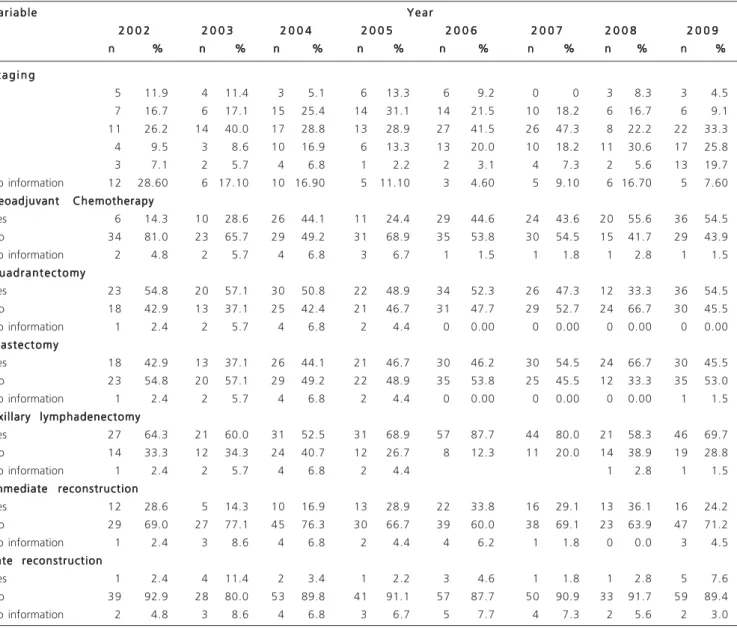
Invasive carcinomas accounted for 79.65% of cases, there were 12.16% of carcinomas in situ and 8.19% other tumors or unknown. The average age of the patients was 52.85 (± 12.80) years, with a median of 52. The average size of the tumors examined was 3.85 (± 3.18) cm, with a median of 3.0. Regarding staging, 246 cases (61.04%) were diagnosed as early breast cancers (stages 0, I and II), 105 cases (26.05%) advanced breast cancers (Stage III and IV) and this information could not recover in 52 cases distributed over the period, with no significant difference between the years studied (Table 1).
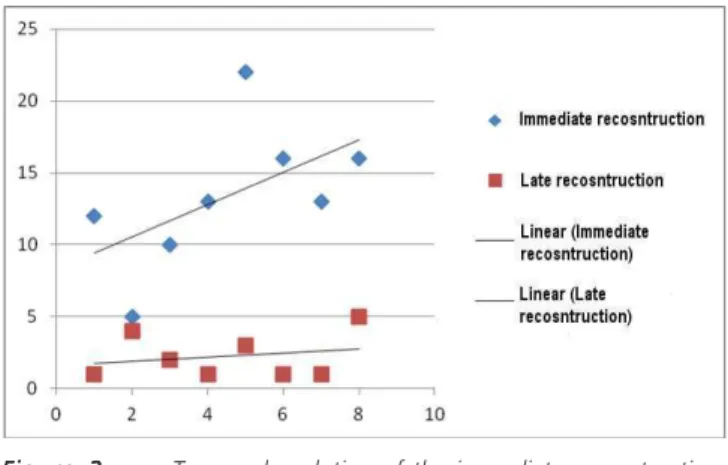
There was a significant increase in tumor size and clinical stage in this period (Table 2), causing a significant increase also in the indications of neoadjuvant chemotherapy (Table 2), as well as increase in the number of mastectomies performed by the Mastology Program (Table 2 and Figure 1), unlike the breast conservative treatment, which remained unchanged (Figure 1). Despite the increase in mastectomies, the performance of both the immediate and late breast reconstructions showed no significant increase (Figure 2).
Surgical time was not altered in the period. An average of 15.2 (± 6.6) lymph nodes were dissected, and 103 patients (25.6%) had positive lymph nodes, with a tendency to stabilization, with no increase or decrease in axillary dissection (Table 2).
DISCUSSION
DISCUSSION
DISCUSSION
DISCUSSION
DISCUSSION
Mortality from breast cancer is decreasing in many developed countries due to improved early diagnosis and treatment 13. In Brazil, in the last decade the
opportunistic screening has allowed increased detection of a larger number of initial cases 14,15. However, until 2009
this modification had not yet generated reduction of mortality from breast malignancies 4,16.
Particularly in the State of Goiás, shortage of equipment in some areas of the state 11, the cost of screening 17 and divergence in medical recommendation to request
mammography 18 are obstacles to screening for breast
cancer 18. Still, there was a considerable increase in
mammographic coverage in the State for women between 40 and 69 years, from 48% in 2003 to 61% in 2008 11.
Concurrent with the increased number of women undergoing mammography and the greater access to health insurance 19, we observed a significant reduction in cases
of advanced breast cancer in residents of the city of Goiânia and an increase in cases detected in early stages 9,10 .
(population-based registry), in this paper we use a hospital-(population-based registry, and part of the women seen in the Mastology Program came from other parts of the state of Goiás, not being residents of Goiania. This hypothesis is based on the previously reported inequality of mammographic coverage
11. In some parts of the state, there are no mammography
equipments nor mastologists or oncologists who could diagnose and properly conduct clinically detected cancer cases.
Another issue to consider has been the regulation to attend the patients who use the SUS health network. Although being correct, respecting the basic principles of the SUS of universality and equity (http:// www.portalsisreg.epm.br/conteudo/regulacao.htm), due to high demand, the interval between diagnosis and treatment in the institution reaches five months (unpublished data). In India, in a recent publication, it was found that the delay
Table 1 Table 1 Table 1 Table 1
Table 1 - Distribution of cases of breast cancer treated at the Clinics Hospital according to the year of surgery.
V a r i a b l e V a r i a b l eV a r i a b l e V a r i a b l e
V a r i a b l e Y e a rY e a rY e a rY e a rY e a r 2 0 0 2
2 0 0 2 2 0 0 2 2 0 0 2
2 0 0 2 2 0 0 32 0 0 32 0 0 32 0 0 32 0 0 3 2 0 0 42 0 0 42 0 0 42 0 0 42 0 0 4 2 0 0 52 0 0 52 0 0 52 0 0 52 0 0 5 2 0 0 62 0 0 62 0 0 62 0 0 62 0 0 6 2 0 0 72 0 0 72 0 0 72 0 0 72 0 0 7 2 0 0 82 0 0 82 0 0 82 0 0 82 0 0 8 2 0 0 92 0 0 92 0 0 92 0 0 92 0 0 9 n
n n n
n %%%%% nnnnn %%%%% nnnnn %%%%% nnnnn %%%%% nnnnn %%%%% nnnnn %%%%% nnnnn %%%%% nnnnn %%%%% S t a g i n g
S t a g i n gS t a g i n g S t a g i n g S t a g i n g
0 5 11.9 4 11.4 3 5.1 6 13.3 6 9.2 0 0 3 8.3 3 4.5 I 7 16.7 6 17.1 15 25.4 14 31.1 14 21.5 10 18.2 6 16.7 6 9.1 II 11 26.2 14 40.0 17 28.8 13 28.9 27 41.5 26 47.3 8 22.2 22 33.3 III 4 9.5 3 8.6 10 16.9 6 13.3 13 20.0 10 18.2 11 30.6 17 25.8 IV 3 7.1 2 5.7 4 6.8 1 2.2 2 3.1 4 7.3 2 5.6 13 19.7 No information 12 28.60 6 17.10 10 16.90 5 11.10 3 4.60 5 9.10 6 16.70 5 7.60 Neoadjuvant Chemotherapy
Neoadjuvant ChemotherapyNeoadjuvant Chemotherapy Neoadjuvant Chemotherapy Neoadjuvant Chemotherapy
Yes 6 14.3 10 28.6 26 44.1 11 24.4 29 44.6 24 43.6 20 55.6 36 54.5 No 34 81.0 23 65.7 29 49.2 31 68.9 35 53.8 30 54.5 15 41.7 29 43.9 No information 2 4.8 2 5.7 4 6.8 3 6.7 1 1.5 1 1.8 1 2.8 1 1.5 Q u a d r a n t e c t o m y
Q u a d r a n t e c t o m yQ u a d r a n t e c t o m y Q u a d r a n t e c t o m y Q u a d r a n t e c t o m y
Yes 23 54.8 20 57.1 30 50.8 22 48.9 34 52.3 26 47.3 12 33.3 36 54.5 No 18 42.9 13 37.1 25 42.4 21 46.7 31 47.7 29 52.7 24 66.7 30 45.5 No information 1 2.4 2 5.7 4 6.8 2 4.4 0 0.00 0 0.00 0 0.00 0 0.00 Mastectomy
MastectomyMastectomy Mastectomy Mastectomy
Yes 18 42.9 13 37.1 26 44.1 21 46.7 30 46.2 30 54.5 24 66.7 30 45.5 No 23 54.8 20 57.1 29 49.2 22 48.9 35 53.8 25 45.5 12 33.3 35 53.0 No information 1 2.4 2 5.7 4 6.8 2 4.4 0 0.00 0 0.00 0 0.00 1 1.5 Axillary lymphadenectomy
Axillary lymphadenectomyAxillary lymphadenectomy Axillary lymphadenectomy Axillary lymphadenectomy
Yes 27 64.3 21 60.0 31 52.5 31 68.9 57 87.7 44 80.0 21 58.3 46 69.7 No 14 33.3 12 34.3 24 40.7 12 26.7 8 12.3 11 20.0 14 38.9 19 28.8 No information 1 2.4 2 5.7 4 6.8 2 4.4 1 2.8 1 1.5 Immediate reconstruction
Immediate reconstructionImmediate reconstruction Immediate reconstruction Immediate reconstruction
Yes 12 28.6 5 14.3 10 16.9 13 28.9 22 33.8 16 29.1 13 36.1 16 24.2 No 29 69.0 27 77.1 45 76.3 30 66.7 39 60.0 38 69.1 23 63.9 47 71.2 No information 1 2.4 3 8.6 4 6.8 2 4.4 4 6.2 1 1.8 0 0.0 3 4.5 Late reconstruction
Late reconstructionLate reconstruction Late reconstruction Late reconstruction
Yes 1 2.4 4 11.4 2 3.4 1 2.2 3 4.6 1 1.8 1 2.8 5 7.6 No 39 92.9 28 80.0 53 89.8 41 91.1 57 87.7 50 90.9 33 91.7 59 89.4 No information 2 4.8 3 8.6 4 6.8 3 6.7 5 7.7 4 7.3 2 5.6 2 3.0
Figure 1 Figure 1 Figure 1 Figure 1
had the same reason as ours, ie, lack of balance between the need for users and service offerings, besides illiteracy of patients and the difficulty of appropriate referral of assisting physicians 20.
Neoadjuvant chemotherapy has been a current alternative to increase the rates of breast-conserving surgery in patients not candidates for the procedure due to the improper relation between volume of the breast and tumor size 21. This approach allows clinical conserving surgery in
approximately 50% of patients with primary indication of mastectomy due to the anatomic extent of the tumor 21.
The significant increase in the use of neoadjuvant chemotherapy reported here suggests both the increase in cases with advanced locoregional disease and the change in our procedure, with the use of this therapy in tumors greater than 3 cm since 2008.
Our biggest surprise in the results is presented in the significant change in mastectomies, with an average increase of nine cases per year. Despite efforts to perform breast conservation treatment, including increased
neoadjuvant chemotherapy to reduce tumors, there was no increase in the number of cases managed by quadrantectomy. Our hypothesis for this finding is that the increase of mutilating operations also occurred due to the increase of locoregional advanced tumors.
In the last decade, some studies conducted in single institutions using hospital-based records showed an increasing trend in mastectomies 22-24. The justification of
this increase was related to the use of MRI of the breast 23
and greater liberality in conducting prophylactic operations
25. Studies using population-based cancer registries showed
reduction of mastectomies in the United States 25, Norway 26 and Spain 27, though.
During the study period our patients did not have access to breast MRI; prophylactic mastectomy, although described in our protocol, has hardly been used. Another hypothesis is that with oncoplastic procedures, one could be more permissive in carrying out major operations. However, as there was no increase in cases of immediate reconstruction over the years, we refuted this hypothesis.
The late approach to cancer brings great harm to patients, since that leads to decreased survival, more complex and radical operations, including the complete removal of the breast and lymphadenectomy, and greater likelihood of metastasis, leading to major physical and psychological damage and functional limitations resulting from the surgical procedure.
The Mastology Program of the Clinics Hospital is characterized by being a tertiary care service, a reference in the treatment of patients suspected or already diagnosed with breast cancer in primary care points. As there are few public institutions that provide assistance to these patients in the State, the queue is large, hampering treatment initiation and favoring tumor growth.
Our findings showing increased tumor size, increased cases of advanced breast cancer and increased mutilating operations do not reflect current trends and appropriate diagnosis and treatment of breast cancer, but Figure 2
Figure 2 Figure 2 Figure 2
Figure 2 - Temporal evolution of the immediate reconstructions (Annual Percentage Change = 10.9 surgeries / year, p = 0.02) and late ones (Annual Percentage Change = 4.10 surgeries / year, p = 0.73) in the period 2002-2009.
Table 2 Table 2 Table 2 Table 2
Table 2 - Time trend between 2002 and 2009, using Poison* regression.
V a r i a b l e V a r i a b l e V a r i a b l e V a r i a b l e
V a r i a b l e Initial ValueInitial ValueInitial ValueInitial Value Final ValueInitial Value Final ValueFinal ValueFinal ValueFinal Value A P C * *A P C * *A P C * *A P C * *A P C * * Inferior CIInferior CIInferior CIInferior CIInferior CI Superior CISuperior CISuperior CISuperior CISuperior CI PPPPP 2 0 0 2
2 0 0 22 0 0 2
2 0 0 22 0 0 2 2 0 0 92 0 0 92 0 0 92 0 0 92 0 0 9
Early breast cancer 23 31 1.00 -11.3 14.90 0.86
Advanced breast cancer 7 30 20.60 5.10 38.40 0.01
Tumor size (median) 2 4 16.2 5.5 28.1 0.01
Quadrantectomy 23 36 0.70 -12.7 16.20 0.90
Mastectomy 18 30 9.27 0.50 18.80 0.04
Axillary dissection 27 46 6.60 -6.9 22.10 0.20
Immediate Reconstruction 12 16 10.90 -4.0 28.20 0.12
Neoadjuvant chemotherapy 6 36 22.00 4.20 43.00 0.02
Neoadjuvant hormone therapy 5 10 31.90 -43.7 209.00 0.45
Radiotherapy 28 53 6.30 -3.0 16.50 0.15
the difficulty of the public health system to respond to expectations of society that seeks and needs of this highly specialized service.
The need for regulation of the SUS attending flow should be understood. This would be beneficial for the system and would certainly respect the basic principles
of universality and equity. However, alternative mechanisms must be created to ensure ease of access and speed of treatment for patients with breast cancer. We believe that similar problems may be occurring in various services in several Brazilian cities, and must be urgently addressed by public managers.
R E S U M O R E S U M O R E S U M O R E S U M O R E S U M O
Objetivo: Objetivo: Objetivo: Objetivo:
Objetivo: avaliar os tipos de tratamentos cirúrgicos para o câncer de mama executados pelo Programa de Mastologia do Hospital das Clinicas da Universidade Federal de Goiás (HC-UFG). Métodos:Métodos:Métodos:Métodos: estudo de coorte transversal no histórico de operaçõesMétodos: mamárias realizadas no HC-UFG, no período de janeiro de 2002 a dezembro de 2009. Foram avaliados através do boletim cirúrgico: o tempo e o porte cirúrgicos; o cirurgião responsável, o tipo de operação; o diagnóstico, e o tipo de anestesia. Através dos prontuários foram analisados: o laudo anatomopatológico do tumor, o comprometimento linfonodal, o tamanho do tumor primário, o estadiamento e a realização de terapias neoadjuvantes. Foram excluídas as operações realizadas para a retirada de tumores benignos da mama. A variação temporal foi analisada pela regressão de Poisson, considerando a mudança percentual anual (MPA). Resultados:Resultados:Resultados:Resultados: foramResultados: realizadas 403 operações de câncer de mama no período estudado, com uma média de 50,38 operações por ano. O tipo histológico mais frequente foi o carcinoma ductal invasor (72,6%). A média de idade das pacientes foi 52 anos, e 29% encontravam-se com doença nos estádios III e IV. A tendência temporal mostrou que houve aumento significativo do tamanho do tumor (p<0,01), dos estadios clínicos III e IV (p=0,01), e de quimioterapia neoadjuvante (p=0,02). Observou-se aumento de mastectomias (MPA=9 casos/ ano, p=0,04). Não houve aumento dos casos de tratamentos com conservação mamária, nem de reconstruções imediatas. Conclu-Conclu-Conclu-Conclu- Conclu-são:
são: são: são:
são: nos últimos anos, no HC-UFG, tem ocorrido aumento do número de mastectomias em decorrência do aumento de casos de câncer de mama locorregional avançado.
Descritores: Descritores: Descritores: Descritores:
Descritores: Neoplasias. Neoplasias da mama. Terapêutica. Procedimentos cirúrgicos operatórios. Mastectomia.
REFERENCES
REFERENCES
REFERENCES
REFERENCES
REFERENCES
1. Freitas-Junior R, Freitas NM, Curado MP, Martins E, Moreira MA, Silva CM. Variations in breast cancer incidence per decade of life (Goiânia, GO, Brazil): 16-year analysis. Cancer Causes Control. 2008;19(7):681-7.
2. Freitas Jr R, Freitas NM, Curado MP, Martins E, Silva CM, Rahal RM, et al. Incidence trend for breast cancer among young women in Goiânia, Brazil. Sao Paulo Med J. 2010;128(2):81-4.
3. Brasil. Ministério da Saúde. Estimativa 2012: incidência de câncer no Brasil. Instituto Nacional de Câncer José Alencar Gomes da Silva, Rio de Janeiro. Acessado em: 02 jan. 2012. Disponível em http://www.inca.gov.br/estimativa/2012/estimativa20122111. pdf. 4. Fonseca LAM, Eluf-Neto J, Wunsch-Filho V. Tendências da mortalidade por câncer nas capitais dos estados do Brasil, 1980-2004. Rev Assoc Med Bras. 2010;56(3):309-12.
5. Wünsch Filho V. Mortalidade por câncer no Brasil 1980-1995: padrões regionais e tendências temporais. Rev Assoc Med Bras. 2002;48(3):250-7.
6. Schneider IJC, d‘Orsi E. Sobrevida em cinco anos e fatores prognósticos em mulheres com câncer de mama em Santa Casa, Brasil. Cad Saúde Pública. 2009;25(6):1285-96.
7. Jatoi I, Proschan MA. Randomized trials of breast-conserving therapy versus mastectomy for primary breast cancer: a pooled analysis of update results. Am J Clin Oncol. 2005;28(3):289-94. 8. Guerra MR, Mendonça GAS, Teixeira MTB, Cintra JRD, Carvalho
LM, Magalhães LMPV. Sobrevida de cinco anos e fatores prognósticos em coorte de pacientes com câncer de mama assistidas em Juiz de Fora, Minas Gerais, Brasil. Cad Saúde Pública. 2009;25(1):2455-66.
9. Martins E, Freitas Júnior R, Curado MP, Oliveira JC, Silva CMB. Evolução temporal dos estádios do câncer de mama ao diagnóstico
em um registro de base populacional no Brasil central. Rev Bras Ginecol Obstet. 2009;31(5):219-23.
10. Nunes RD, Martins E, Freitas-Júnior R, Curado MP, Freitas NMA, Oliveira JC. Estudo descritivo dos casos de câncer de mama em Goiânia, entre 1989 e 2003. Rev Col Bras Cir. 2011;38(4):212-6. 11. Corrêa RS, Freitas Júnior R, Peixoto JE, Rodrigues DCN, Lemos MEF, Martins LAP, et al. Estimativas da cobertura mamográfica no Estado de Goiás, Brasil. Cad Saude Publica. 2011;27(9):1757-67.
12. Freitas Jr R, Peixoto EML, Santos DL, Campos ACCC, Melo AFB, Rahal RMS. Programa de Mastologia: um desafio de mudança no Ensino Superior. Rev UFG [online]. 2005;7(2). Acessado em: 10 jan. 2012. Disponível em: http://www.proec.ufg.br/revista_ufg/45anos/ T-mastologia.html.
13. Peto R, Boreham J, Clarke M, Davies C, Beral V. UK and USA breast cancer deaths down 25% in year 2000 at ages 20-69 years. Lancet. 2000;355(9217):1822.
14. Caleffi M, Ribeiro RA, Duarte Filho DL, Ashton-Prolla P, Bedin AJ Jr, Skonieski GP, et al. A model to optimize public health care and downstage breast cancer in limited-resource populations in southern Brazil. (Porto Alegre Breast Health Intervention Cohort). BMC Public Health. 2009;9:83.
15. Vieira RAC, Mauad EC, Matheus AGZ, Mattos JSC, Haikel Júnior R, Luiz B, et al. Rastreamento mamográfico: começo-meio-fim. Rev Bras Mastol. 2010;20(2):92-7.
16. Gonzaga CMR, Freitas Junior R. Porque a mortalidade por câncer de mama no Brasil ainda não se reduziu? Rev Prat Hospitalar. 2011;77(5):21-3.
18. Godinho ER, Koch HA. Rastreamento do câncer de mama: aspectos relacionados ao médico. Radiol Bras. 2004;37(2):91-9. 19. Instituto Brasileiro de Geografia e Estatística. Ministério do
Planejamento, Orçamento e Gestão. Ministério da Saúde. Pesquisa nacional por amostra de domicílios: acesso e utilização de serviços de saúde 2003 [online]. Rio de Janeiro: Instituto Brasileiro de Geografia e Estatística; 2005. Acessado em 10 jan. 2012. Disponível em: http://tabnet.datasus.gov.br/cgi/pnad2003/pnaddescr.htm 20. Chintamani, Tuteja A, Khandelwal R, Tandon M, Bamal R, Jain S,
et al. Patient and provider delays in breast cancer patients attending a tertiary care center: a prospective study. JRSM Short Rep. 2011;2(10):76.
21. Bollet MA, Savignoni A, Pierga JY, Lae M, Fourchotte V, Kirova YM, et al. High rates of breast conservation for large ductal and lobular invasive carcinomas combining multimodality strategies. Br J Cancer. 2008;98(4):734-41.
22. McGuire KP, Santillan AA, Kaur P, Meade T, Parbhoo J, Mathias M, et al. Are mastectomies on the rise? A 13-year trend analysis of the selection of mastectomy versus breast conservation therapy in 5685 patients. Ann Surg Oncol. 2009;16(10):2682-90. 23. Katipamula R, Degnim AC, Hoskin T, Boughey JC, Loprinzi C, Grant
CS, et al. Trends in mastectomy rates at the Mayo Clinic Rochester: effect of surgical year and preoperative magnetic resonance imaging. J Clin Oncol. 2009;27(25):4082-8.
24. Sorbrero ME, Dick AW, Beckjord EB, Ahrendt G. Diagnostic breast magnetic resonance imaging and contralateral prophylactic mastectomy. Ann Surg Oncol. 2009;16(6):1597-605.
25. Habermann EB, Abbott A, Parsons HM, Virnig BA, Al-Refaie WB, Tuttle TM. Are mastectomy rates really increasing in the United States? J Clin Oncol. 2010;28(21):3437-41.
26. Suhrke P, Mæhlen J, Schlichting E, Jørgensen KJ, Gøtzsche PC, Zahl PH. Effect of mammography screening on surgical treatment for breast cancer in Norway: comparative analysis of cancer registry data. BMJ. 2011;343:d4692.
27. Tebé C, Márquez-Calderón S, Ramón Benítez J, Sánchez-Lanuza M, Fernandez R, Aguado MJ, et al. Current state of breast cancer surgery in Andalusia and Catalonia. Cir Esp. 2009;86(6):369-77.
Received on 18/07/2012
Accepted for publication 28/08/2012 Conflict of interest: none
Source of Funding: Work partially funded by the Foundation for Research Support of the State of Goiás (FAPEG) Protocol. 200710267000252, and the Avon Institute.
How to cite this article: How to cite this article: How to cite this article: How to cite this article: How to cite this article:
Freitas Júnior R, Siqueira LB, Carrijo ENA, Lacerda RP, Paulinelli RR, Rahal RMS, Oliveira LFP. Temporal variation of breast cancer surgical treatment in a university hospital in brazil’s central west region . Rev Col Bras Cir. [periódico na Internet] 2013;40(3). Disponível em URL: http://www.scielo.br/rcbc
Address correspondence to: Address correspondence to: Address correspondence to: Address correspondence to: Address correspondence to: Ruffo Freitas Junior