Original Article 311
-PAIN: KNOWLEDGE AND ATTITUDES OF NURSING STUDENTS, 1 yEAR
FOLLOW-UP
Alexandrina de Jesus Serra Lobo1, Jacinta Pires Martins2
1 Ph.D. in Physical Activity and Health from the Faculty of Sport of the University of Porto. Coordinating Professor of the Nursing Course of the Dr. José Timóteo Montalvão Machado School of Nursing. Portugal. E-mail: [email protected] 2 M.Sc. in Nursing Science. Specialist in Rehabilitation Nursing. Adjunct Professor of the Dr. José Timóteo Montalvão Machado
School of Nursing. Portugal. E-mail: [email protected]
ABSTRACT: The attitudes, prejudices and/or myths, combined with insuficient knowledge and skills of healthcare professionals, can inluence pain treatment. This study aimed to identify and analyze the evolution of the knowledge and attitudes of nursing students in relation to pain. It is a longitudinal study (descriptive/correlational) using a questionnaire based on the “Guia orientador de boas práticas na dor”. In the academic year of 2011/12, the students presented an increase of 11% in their level of knowledge and attitudes
in relation to pain, which reached the 40% by the end of the fourth year of the nursing course; those who showed higher rates were approximately 0.8 times more likely to relect on and analyze their beliefs and knowledge about pain. The initial training in nursing is important in relation to the level of knowledge and attitudes of the students regarding pain, particularly in the early years of the course. DESCRIPTORS: Knowledge. Attitude. Nursing. Pain.
DOR: CONHECIMENTOS E ATITUDES DOS ESTUDANTES EM UM ANO
DE SEGUIMENTO
RESUMO: As atitudes, os preconceitos e/ou mitos aliados à insuiciência de conhecimentos e competências dos proissionais de saúde podem condicionar o tratamento da dor. Com este estudo procurou-se identiicar e analisar a evolução dos conhecimentos e atitudes dos estudantes de enfermagem em relação à dor. Estudo longitudinal, descritivo/correlacional, com a utilização de um questionário com base no “Guia orientador de boas práticas na dor”. No ano letivo de 2011/12, os estudantes apresentaram uma evolução de 11% no seu nível de conhecimentos e atitudes em relação à dor, sendo que a mesma atinge os 40% no inal dos quatro anos do curso de licenciatura em enfermagem. Os que manifestam melhores índices têm cerca de 0,8 vezes mais probabilidade de relectir e analisar as suas crenças e conhecimentos sobre a dor. A formação inicial em enfermagem é preponderante para o nível de conhecimentos e atitudes dos estudantes em relação à dor, em particular nos primeiros anos do curso.
DESCRITORES: Conhecimento. Atitude. Enfermagem. Dor.
DOLOR: CONOCIMIENTOS y ACTITUDES DE LOS ESTUDIANTES DE
ENFERMERÍA, UN AÑO DE SEGUIMIENTO
RESUMEN: Las actitudes, los prejuicios y/o los mitos, junto con el insuiciente conocimiento y habilidades de los profesionales de la salud pueden condicionar lo tratamiento del dolor. Este estudio trata de identiicar y analizar la evolución de los conocimientos y actitudes de los estudiantes de la enfermería en lo que respecta del dolor. Estudio longitudinal, descriptivo/correlacional, utilizando un cuestionario basado en el “Guía orientador de boas prácticas na dor”. En el año lectivo 2011/12, los estudiantes presentaran una evolución del 11% en su nivel de conocimientos y actitudes sobre el dolor, donde la misma atinge los 40%, en lo inal de los 4 años del curso de licenciatura en enfermería; los que tienen tasas más altas, tienen cerca de 0,8 veces más probabilidad de relexionar y las suyas creencias y conocimientos sobre el dolor. La formación inicial en enfermería es preponderante para el nivele de conocimientos e actitudes de los estudiantes en relación del dolor, principalmente en los primeros años del curso.
INTRODUCTION
In recent years, pain has been contextualized as an individual, subjective and multidimensional experience. Physiological, sensory, affective, cognitive, behavioral and sociocultural factors intervene and contribute to its subjectivity. Pain, “an uncomfortable bodily sensation, subjective reference of suffering, characteristic facial expres-sion, altered muscle tone, self protection behavior, limitation of the focus of attention, altered per-ception of time, withdrawal from social contact, impairment of the thought process, distraction behavior, restlessness and loss of appetite”,1:60-61 disrupts and interferes in the quality of life of the person, so that its control is a priority aim.
In the provision of care, healthcare profes-sionals, in addition to having skills and technical-scientiic knowledge, need to have sensitivity to care for the individual with pain.2-3 This is par-ticularly relevant concerning nurses, who inter-dependently and/or autonomously must take into account the effectiveness of the therapies implemented, aiming to identify factors that better contribute to pain control, seeking to consider the painful experience in all its domains and its reper-cussions at the biological, emotional, spiritual and behavioral levels of the individual.4 Given their proximity to the patients, nurses should be aware and prepared to identify, plan and administer the required therapy, through an accurate evaluation, critical judgment and prescription of interven-tions that best meet the needs of the patients who report pain.5
For the adequate control of pain, nurses need to have a comprehensive understanding of each of the dimensions that underlie it and should support their practice through theoretical and practical knowledge.4 Inadequate pain management has se-rious consequences, often resulting in unnecessary suffering for patients, leading to complications that can cause further harm or death, increasing the costs for the healthcare system.6 According to the literature, it appears that a large proportion of nurses demonstrate a lack of technical and scien -tiic knowledge, inadequate attitudes and beliefs, and failures in record keeping in relation to pain and analgesia,7 where the insuficient/inadequate formation and/or training of the healthcare professionals, as well as their prejudices and/ or myths combine with insuficient knowledge and skills are hampering the treatment of pain.8 Thus, the present study aimed to: i) identify and
analyze the level of knowledge and the types of beliefs nursing students have regarding pain; ii) analyze and compare the evolution of the level of knowledge of students throughout the 2011/12 academic year and for the four years of the Nurs-ing Licenciate Degree Course (NLDC); and iii) determine possible associations between the levels of knowledge and attitudes of nursing students. After an extensive literature search, it was realized that there were no studies that address this issue with NLDC students, therefore, we propose that this methodology serves as a reference for future studies constituting a signiicant contribution to evaluate and identify possible gaps in the initial nursing formation.
MATERIAL AND METHODS
This is a longitudinal, descriptive/corre-lational study, based on a quantitative research strategy. In the first data collection moment (September 2011) a sample of 97% of the NLDC students was used (59 from the 1st year, 37 from the 2nd, 35 from the 3rd and 39 from the 4th year), of the Dr. José Timóteo Montalvão Machado School of Nursing (ESEDJTMM) of Chaves (northern Portugal). Subsequently, in order to investigate the progress over the 2011/12 academic year, a second evaluation was performed (June 2012), in which there was a loss of 34% of the students (15 from the 1st year, 7 from the 2nd, 5 from the 3rd and 7 from the 4th year), due to them being absent.
The data were collected in the classroom (at the place of study of the subjects), after clariication of the aims of the study for the students who volunteered to participate in the study and gave their respective informed consent. The study was approved by the Ethics Committee of the Govern-ing Board of the School.
The data were coded and analyzed using the statistical program Statistical Package for the Social Sciences (SPSS) version 19 for Windows, with the signiicance level of 5% having been estab -lished. Descriptive and inferential statistics were used, i.e., the Kolmogorov-Smirnov independence test and the Odds Ratio (OR) to identify a possible association, taking the total score of the question -naire as the independent variable. To obtain an indicator of the overall level of knowledge and of the beliefs about pain, the computation of all the issues relating to each of these dimensions was performed. Each of these issues having been stan-dardized through the Z score=(value-mean)/SD.
RESULTS
In the initial evaluation a sample of 170 NLDC students was considered, 129 being female and 41 male with an mean age of 24.4 years. The minimum age was 18 and maximum 48 years. Of the total respondents, 34% were in the 1st year, 22% in the 2nd, 21% in the 3rd and 23% in the 4th academic year of the course. Only six (3.5%) stu-dents reported having acquired speciic training in the evaluation and treatment of pain, in addition to the NLDC program content. Furthermore, a signiicant proportion of the students (88% from the 1st year, 83% from the 2nd, 89% from the 3rd and 93% from the 4th year) stated that they felt the need for more speciic training in this subject.
Table 1 - Level of knowledge by academic year. Chaves-Portugal, 2012 (n=170)
Age Total score
Beliefs score
Pharma-cology score 1st year 26±8 0.53±0.12* 0.57±0.15* 0.44±0.18 * 2nd year 23±4 0.57±0.10 0.60±0.16 0.46±0.12† 3rd year 24±7 0.69±0.16 0.73±0.16 0.59±0.18 4th year 25±4 0.71±0.17* 0.74±0.21* 0.64±0.15 *†
*† Signiicance level: p≤0.05.
From the analysis of table 1 it is revealed that the majority of the students of 1st year (53%)
believed that their knowledge on this subject was insuficient. Most students in the 2nd and 3rd years believed that they had a reasonable amount of knowledge, 63% and 56% respectively. In the inal year of the Licenciate Degree, it appears that the students considered themselves to have more knowledge on this subject: 25% rating this as ad -equate, 36% as suficient and 38% as reasonable. By analyzing the total score of the questionnaire concerning knowledge and beliefs about pain (Table 1), it can be observed that it increased sig-niicantly, by 40%, at the same rate that the train -ing time of the students increased. Given that the means obtained by students were: 0.53 ± 0.12 in the 1st year, 0.57 ± 0.16 in the 2nd year, and 0.69 ± 0.16 in the 3rd year, which rose to 0.71 ± 0.22 for the inal year students. Through the parameter -ization of the representative scores, both for the issues concerning beliefs as well as those relating to pharmacology, it was veriied that the students obtained better results with regard to beliefs.
1st evaluation 2nd evaluation
1st year 2nd year 3nd year 4nd year
* Statistically signiicant differences (p≤0.05).
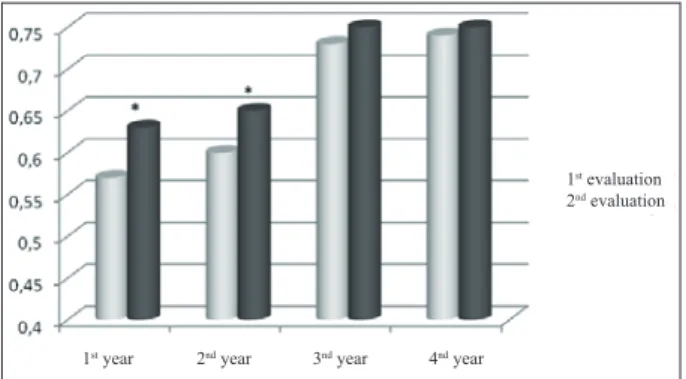
Figure 1 - Evolution of the total score in the 2011/12 academic year. Chaves-Portugal, 2012 (n=112)
1st evaluation 2nd evaluation
1st year 2nd year 3nd year 4nd year
* Statistically signiicant differences (p ≤ 0.05).
Figure 2 - Evolution of the beliefs score in the 2011/12 academic year. Chaves-Portugal, 2012 (n=112)
1st evaluation 2nd evaluation
From the comparative analysis of the two evaluations (of the 2011/12 academic year), the relative weight of each academic year on the evolu-tion of the level of knowledge and attitudes of the students regarding pain can be deduced, verifying that the 1st and 2nd years signiicantly increased the total score and the beliefs score (Figures 1 and 2).
1st evaluation 2nd evaluation
1st year 2nd year 3nd year 4nd year
* Statistically signiicant differences (p≤0.05).
Figure 3 - Evolution of the pharmacology score in the 2011/12 academic year. Chaves-Portugal, 2012 (n=112)
Finally, in igure 3, regarding the pharma -cology score, statistical differences were only observed in the 2nd year.
When the evolution of these scores are observed, throughout the NLDC (difference between the students of the 1st and 4th year), considering the 170 respondents of the irst evalu -ation, it appears that the pharmacology score is signiicantly superior (45%), compared to the beliefs score (30%).
Table 2 allows the relationship to be ana-lyzed between the total score of the knowledge and beliefs of the students and the issues of analysis and relection on their practice, high -lighting that for p≤0. 05, the logistic regression is signiicant for the following issues: “Relect and realize that their knowledge and beliefs about pain can affect the quality of the care provided” (OR=0.8) and “Always carry out the pain evalu -ation requested and seek to consider the patient’s own evaluation” (OR=0.8).
Table 2 - Logistic regression in relation to the questionnaire score. Chaves-Portugal, 2012
Variable OR CI (95%)
Minimum Maximum
Relect and realize that their knowledge and beliefs about pain can affect the quality of the care provided.
0.8* 0.22 1.25
Believe that their knowledge about the pain process is adequate. 1.02 0.68 1.52
Sensitive in their approach to the patient with pain and always strive to compre
-hend what the person is feeling.
0.8 0.49 1.26
Always carry out the pain evaluation requested and seek to consider the patient’s
own evaluation. 0.8* 0.12 1.89
* Signiicance level: p≤0.05.
DISCUSSION
According to the results, it was veriied that the majority of the students felt the need for more training in the “pain” subject, which seems to be related to the complexity of this issue and above all with the level of training of the students. Es-pecially considering that the self-perceived level of knowledge tends to increase over the years of the curriculum, with the students of 1st year re-vealing a greater need for training. Only 3.5% of the students reported having additional training speciically in relation to pain, although this is part of the syllabus of the NLDC program, which, in a certain way, allows us to ensure that the results obtained are due to the basic training of these students. This is added to the fact that the both
the knowledge and the belief were analyzed in all the students of all the academic years, which allows us to make a diagnosis of the situation and to develop a plan of action regarding the needs and gaps identiied. In addition, there are some limitations or less successful aspects, such as: the lack of validated instruments for the evaluation of this issue and the limited size of the sample.
increase of 40% in the level of knowledge and beliefs between the 1st and last year of the course. There were also lower results in issues related to pharmacological therapy, as evidenced by the scores for these issues, which is believed to be related to the need for clinical practice in order to consolidate theoretical knowledge.
Basic training should be seen as a starting point to equip professionals with knowledge and instruments for the performance of a profession.10 Speciically in this area, it is recommended that nursing students have the opportunity to ap-ply and develop their theoretical and practical knowledge, through periods of clinical training, essential for their formation. These are performed in healthcare institutions, which may occur either together with the user or simply from the contact with the institutional organization.11 Effectively, it is the theoretical bases that support the clinical practice, which in turn questions the theory, in a relationship in which both develop. In this sense, nursing education is structured to be gradual and inclusive, providing sequentiality from one phase to another.12 It is assumed therefore that the train-ing and sensitization of students in this knowledge, as the results of this study show, tend to develop in a continuous, sequential and progressive way.
Given that the development of nursing as a profession and science has evolved in recent de-cades, moving from “doing” to the triad of “know -ing”, “ knowing to be” and “ knowing to do”,13 it was perceived that in this context, for adequate pain management, it will be necessary to invest in deepening the knowledge based on scientiic evi -dence, as a way for professionals to be recognized and legitimized in the social and professional con -text. In our view, these dimensions of knowledge have been highlighted in education by successive reforms, however, there are still some dificulties and shortcomings in the training that need to be corrected, principally through research.14
The analysis of the correlations obtained shows that the total score is more related to the increased level of training than with the increase in age, furthermore, it is less common to obtain good progress with respect to such knowledge and beliefs, in the older students. This may be due, in part, to their living conditions, in that they tend to accumulate other activities and responsibili-ties, such as family life and/or being employees/ students. With regard speciically to the analysis of the attitudes and/or beliefs of the students, which was one of the aims of this study, it should be noted
that the attitude corresponds to an organization of beliefs. All attitudes incorporate beliefs, but not all beliefs necessarily form part of the attitudes, being not only cognitive but also affective. In turn, the values as standards and/or criteria to guide the action aim to develop and maintain the attitudes toward situations, morally judging them.15
The studies performed to date indicate that beliefs are dificult to deconstruct and demys -tify. Beliefs are strongly affected by the training and personal experience of each person, largely determining by how the other is perceived and comprehended.5,17 For holistic care it is essential that the professional possesses not only technical and scientiic competence, but also the ability to comprehend the human being as a relational be-ing, who has a life story that should be respected and valued.16
This study shows that “the vital signs and behavior are always indicative of the degree of pain of the patient” was the belief most positively associated with the level of training. However, it was observed that for the older subjects this belief was more dificult to deconstruct. It should be noted that, although there may be changes in the physiological parameters (tachycardia, tachy-pnea, pallor, sweating, muscle tension alterations and increased arterial and intracranial pressure) during painful stimuli, it is also important to pay attention to the behavioral manifestations. The literature has shown that subjects can express pain through facial expression, body posture and other physiological and behavioral patterns (prostration, irritability, etc.), this is very important in children and patients with alterations and dificulties in communication.17-18 Therefore, it is essential to use appropriate and precise methods for a correct evaluation of the pain.10
upon certain procedures, as well as the use of non-pharmacological techniques.20
Pain management is not an exclusive skill and responsibility of physicians, as is often be-lieved due to it being them who prescribe the analgesic medication. Whenever the occurrence of pain is expected or if, from its evaluation, there is any evidence of its presence, the nurse must act in promoting care to minimize the pain to levels con -sidered acceptable by the person. In this context, nurses should be eficient in the promotion of pain control, particularly in their autonomous interven-tions (exclusive initiative and the responsibility of the nurse), as well as in their interdependent interventions (which are complementary, initi-ated by prescription from another member of the healthcare team).10,20
Based on these results, it can be concluded that the students who have a higher level of knowledge and attitudes in relation to pain are approximately 0.8 times more likely to relect and analyze their beliefs and knowledge about how pain can affect the quality of the care they provide, and 9.8 times more likely to request and consider the assessment of the patient when evaluating pain. The majority of professionals do not always believe the reports of pain of the patients, nor do they recognize that pain is whatever the individual says it is and exists whenever the person says it does.12 From this perspective, the best way to evaluate pain is to rely on the words and behavior of the patients, respecting their singularity and their own way of being.21 Furthermore, the actions of the nurses are much more effective and better suited for the appreciation and interpretation of pain and its manifestations in and by the patient.22 In view of the above we believe that to improve pain control it is essential for both students and nursing professionals to update and deepen their knowledge in that, as members of the healthcare team, they have responsibilities in the diagnostic evaluation, in the intervention and in the monitor-ing of the results of the pain treatment.
FINAL CONSIDERATIONS
Based on the aims proposed in this study it can be concluded that the nursing students pre-sented positive progress in relation to the pain theme throughout their NLDC formation, which was most evident in the early years of the NLDC. When comparing the different scores, it was found that the score related to pharmacology knowledge presented worse results. These results represent a
signiicant contribution to recognizing the role of students as future nurses, making them multipliers of knowledge and providing them with the ability to develop integral care to patients, given the need for effective pain control, striving for excellence in the care. It should also be mentioned that these results are relevant in that the higher education in-stitutions have a duty to ensure a quality formation, presenting performance indicators for the teaching administered. This therefore permits us to relect on and gauge the teaching/formation in nursing.
REFERENCES
1. Conselho Internacional de Enfermeiros (CIPE/ ICNP). Classiicação Internacional para a Prática de Enfermagem, versão 1.0. Lisboa (PT): Ordem dos Enfermeiros; 2006.
2. Ordem dos Enfermeiros-Portugal. Guia orientador de boa prática sobre a dor. Cadernos OE. 2008 Jun; Número 1, Série I. Trabalho desenvolvido por OE – Conselho de Enfermagem.
3. Waldow RV. O cuidado humano: o resgate necessário. Porto Alegre (RS): Sagra-Luzzato; 1998. 4. Pimenta CAM. Conceitos culturais e a experiência
dolorosa. Rev Esc Enferm USP. 1998 Jul; 32(2):179-86. 5. Droes NS. Role of the nurse practitioner in
managing patients with pain. Internet J Advanced Nursing Practice. 2004 Jan [acesso 2011 Set]; 6(2):53-9. Disponível em http://lusomed.sapo.pt/ Xn320/506963.html
6. Bishop D. Nursing knowledge and attitudes regarding the pain management of cancer patients [tese]. Florida (US): The Florida State University School of Nursing; 2007.
7. Silva JA Ribeiro-Filho NP. Avaliação e mensuração de dor: pesquisa, teoria e prática. Ribeirão Preto (SP): FUNDEC; 2006.
8. Furrow BR. Pain management and liability issues. Hematol Oncol Clin North Am. 2002 Dec;16(6):1483-94.
9. Fortin MF. O Processo de investigação: da concepção à realização. Loures (PT): Lusociência. 2003. 10. Pedroso RA, Celich, KLS. Dor: quinto sinal vital,
um desaio para o cuidar em enfermagem. Texto Contexto Enferm. 2006 Abr-Jun;15(2):270-6.
11. Simões JF, Alarcão I, Costa N. Supervisão em ensino clínico de enfermagem: a perspectiva dos enfermeiros cooperantes. Rev Referência. 2008 Jun; II(6):91-108.
12. Rodrigues MA, Pereira A, Ferreira CS. Da apren-dizagem construída ao desenvolvimento pessoal e proissional. Coimbra (PT): Formasau; 2006. 13. Shin K, Jung D, Shin S, Kim M. Critical thinking
associate, Baccalaureate, and RN-to-BSN programs. J Nursing Educ. 2006 Mar;45(6):233-7.
14. Celich KLS. Dimensões do processo de cuidar: a visão das enfermeiras. Rio de Janeiro (RJ): EPUB; 2004.
15. Mendonça SHF, Leão ER. Implantação e monitoramento da dor como 5º sinal vital: o desenvolvimento do processo assistencial. In: Leão ER, Chaves LD. Dor 5º sinal vital: relexões e intervenções de enfermagem. 2ª ed. São Paulo (SP): Martinari. 2007.p. 4-9.
16. Santos JA, Procianoy RS, Bohrer BBA, Noer C, Librelato GAS, Campelo JN. Os recém-nascidos sentem dor quando submetidos à sondagem gástrica? J Pediatr. 2001 Mar;77(5):374-80.
17. Kazanowski MK, Laccetti MS. Dor: fundamentos, abordagem clínica, tratamento. Rio de Janeiro (RJ):
Guanabara Koogan. 2005.
18. Fontes KB, Jaques AE. O papel da enfermagem frente ao monitoramento da dor como 5º sinal vital. Cienc Cuid Saude. 2007 Jun;6(2):481-7.
19. Ordem dos Enfermeiros. REPE - Regulamento do Exercício Profissional dos Enfermeiros 1996 [acesso 2011 Mai]. Disponível em: http://www. ordemenfermeiros.pt
20. Sapeta P. Dor total vs sofrimento: a interface com os cuidados paliativos. DOR. 2007 Mai;15(1):16-21. 21. Potter PA, Perry AG. A enfermagem no tratamento
da dor. In: Potter PA, Perry AG. Grande tratado de enfermagem prática: clínica e prática hospitalar. São Paulo (SP): Tempo; 2001. p. 575-94.
22. Ribeiro AL, Cardoso A. Dor: um foco da prática dos enfermeiros. Dor. 2007 Jan;15(1):16-15.
Correspondence: Alexandrina de Jesus Serra Lobo Escola Superior de Enfermagem Dr. José Timóteo Montal-vão Machado
Rua Central, Quinta dos Montalvões 5400-673 – Outeiro Seco, Chaves, Portugal Email: [email protected]