ABSTRACT
BACKGROUND AND OBJECTIVES: Adequate postopera-tive pain control is a challenge among surgical specialties, in spite of recent advances in analgesic techniques and analgesics. Cafeine has been used as therapeutic adjuvant to potentiate an-algesic eicacy of some drugs, however there are still no scientiic investigation reports on the association with sodium dipyrone in the postoperative period of dental procedures. So, this study aimed at observing and comparing the eicacy of sodium dipy-rone alone or in association with cafeine to control postoperative pain of dental procedures, considering hemodynamic parameters of patients as indicators of anxiety and pain during surgery. METHODS:his is a crossover and double-blind study involving 50 young and healthy patients (25 males and 25 females) referred for bilateral extraction of impacted mandibular third molars. Op-erated side, patient’s gender and analgesic drug used were random-ized. Visual analog scale scores were submitted to Friedman test (α = 0.05) to compare pain intensity at deined intervals (preopera-tive, immediate postopera(preopera-tive, 1, 2, 4 and 12 hours, 1, 2, 3 and 7 days after surgery). Blood pressure and heart rate were measured in the preoperative period, after anesthetic injection and in the postoperative period (Friedman test, (α = 0.05).
RESULTS:Patients have referred mild pain in the irst two post-operative days and there has been no statistically signiicant dif-ference between the analgesic eicacy of sodium dipyrone alone or in association with cafeine in diferent evaluated intervals. Most cardiovascular changes were within normality, considering anxiety and stress induced by surgery.
CONCLUSION: he therapeutic protocol proposed in this
Comparative effect of sodium dipyrone and sodium dipyrone associated
to caffeine to control post-tooth extraction pain*
Efeito comparativo entre a dipirona sódica e a dipirona sódica associada à cafeína no controle
da dor pós-exodontia
Carllini Barroso Vicentini1, Juliana Cama Ramacciato2, Rubens Gonçalves Teixeira2, Francisco Carlos Groppo3, Rogério Heládio
Lopes Motta2
*Received from the School of Dentistry São Leopoldo Mandic. Campinas, SP.
1. Tocantinense Institute Presidente Antonio Carlos. Porto Nacional, TO, Brazil. 2. School of Dentistry São Leopoldo Mandic. Campinas, SP, Brazil.
3. State University of Campinas; School of Dentistry. Piracicaba, SP, Brazil.
Submitted in January 28, 2013.
Accepted for publication in August 12, 2013. Conlict of interests: None.
Correspondence to: Rogério Heládio Lopes Motta Rua José Rocha Junqueira, 13 13414-903 Campinas, SP. E-mail: [email protected]
study has not shown statistically signiicant diference between sodium dipyrone associated or not to cafeine to control post-tooth extraction pain.
Keywords:Cafeine, Dipyrone, Pain, hird molar, Tooth extraction.
RESUMO
JUSTIFICATIVA E OBJETIVOS: O adequado controle da dor pós-operatória constitui um desaio entre as especialidades cirúrgi-cas, a despeito dos recentes avanços das técnicas de analgesia e dos analgésicos. A cafeína tem sido utilizada como adjuvante terapêu-tico para potencializar a eicácia analgésica de alguns fármacos, porém ainda não existe relatos de investigação cientíica da associa-ção com a dipirona sódica em dor pós-operatória em procedimen-tos odontológicos. Dessa forma, o objetivo deste estudo foi obser-var e comparar a eicácia da dipirona sódica isolada e da dipirona sódica associada à cafeína no controle da dor pós-operatória em cirurgia dental, considerando os parâmetros hemodinâmicos dos pacientes como indicador de ansiedade e de dor durante a cirurgia. MÉTODOS: Estudo cruzado e duplo encoberto incluiu 50 pacien-tes jovens e saudáveis (25 homens e 25 mulheres) com indicação de exodontia bilateral de terceiros molares mandibulares impactados. O lado operado, o gênero do paciente e o fármaco analgésico usado foram randomizados. Os escores obtidos pela escala analógica visual, foram submetidos ao teste de Friedman (α = 0,05) para comparação das intensidades dolorosas em intervalos deinidos (pré-operatório, pós-operatório imediato, 1, 2, 4 12 horas, 1, 2, 3 e 7 dias após as cirurgias) e as alterações nos parâmetros de pressão arterial e frequên-cia cardíaca foram mensurados no pré-operatório, após a injeção anestésica e no pós-operatório (teste de Friedman, α = 0,05). RESULTADOS: Os pacientes experimentaram dor leve nos dois primeiros dias de pós-operatório e não houve diferença estatisti-camente signiicante entre a eicácia analgésica da dipirona sódi-ca isolada e da dipirona sódisódi-ca associada à sódi-cafeína nos diferentes intervalos medidos. A maioria das alterações cardiovasculares ob-servadas estava dentro da normalidade, considerando a ansiedade e estresse induzido pela cirurgia.
CONCLUSÃO: O protocolo terapêutico proposto neste estudo não demonstrou diferença estatística signiicante na eiciência analgésica da dipirona sódica associada ou não a cafeína no con-trole da dor pós-exodontia.
INTRODUCTION
Pain is a major biological phenomenon for body’s defense, however it is uncomfortable for patients. It is inherent to some dental procedures, especially surgical procedures such as third molar extraction, being its intensity related to surgery extension1,2.
Impacted third molar extraction surgery in general produces moderate to severe postoperative discomfort due to the release of chemical inlammatory mediators caused by the manipula-tion of soft, bone and dental tissues. Post-oral surgery pain has major impact on patients’ quality of life and has potential efect on physiological parameters variation, thus needing ef-fective control3-5.
Sodium dipyrone is usually indicated to control postopera-tive pain, with satisfactory results due to its peripheral action mechanism which is diferent from other analgesic drugs. Di-pyrone seems to act by desensitizing peripheral nociceptors, with direct inlammatory hyperalgesia block. his desensitiz-ing mechanism probably involves potassium channels block and nitric oxide-FMPc pathway activation in the nocicep-tor6-8. However, there are few studies evaluating its clinical eicacy for dental surgical procedures, be it alone or in as-sociation3.
Cafeine has been reported as adjuvant drug when combined to analgesics and anti-inlammatory drugs to control tension pain and migraine9-11. Cafeine antinociceptive efect occurs by the blockade of adenosine receptors, which are important for nociceptors sensitization in pain signal transmission. Caf-feine also changes cyclooxygenase enzymes activity in certain sites, improving the analgesic action of several drugs indicat-ed to control acute and chronic pain12-15.
Considering the need for adequate postoperative pain control after impacted third molar extraction, and the efectiveness of the synergistic association of cafeine to analgesic and anti-inlammatory drugs to treat acute and chronic pain in other body regions, we question cafeine’s adjuvant efect with so-dium dipyrone to control pain in a dental clinical model16-19. his study aimed at evaluating the clinical relevance of caf-feine associated to sodium dipyrone to control postoperative pain of impacted third molar surgeries, considering patients’ hemodynamic parameters control.
METHODS
his is a crossover, randomized and double-blind study car-ried out between May and December 2011, with a sample of 50 patients of both genders (25 males and 25 females), aged between 18 and 25 years, without systemic changes that would contraindicate surgical procedures. All volunteers had indication for bilateral lower third molars extraction, with similar impaction patterns according to Pell & Gregory (Class I and II and position B) and Winter (Vertical and Mesio-angulated) classiication20. A clinical card was developed for data collection were data on patient’s identiication, medical and dental history, results of preoperative exams (X-Rays, red
blood cells count, leukocytes count, coagulation time, renal and hepatic function), surgery date and time, operatory time, operated side during the session, number of needed anesthetic tubetes, group of analgesic drug used during the session and hemodynamic parameters were recorded.
For adequate patients’ control and higher idelity of results, a randomized clinical trial was proposed (generated at www. randomization.com) for the operated side, patient’s gender and analgesic therapy used, based on items 8 to 10 of the 2001 Cochrane Collaboration, Manchester, UK checklist (CONSORT)21. Postoperative analgesic therapy protocol was divided in two study groups: Group 1 – tablet of 500 mg so-dium dipirone (Magnopyrol®, São Paulo, Brazil) and Group 2 – tablet of 500 mg sodium dipirone associated to 65 mg cafeine (Cailisador®, São Paulo, Brazil), double-blindly dis-tributed, being the identiication of groups disclosed to the surgeon and to patients only after collection of results. All volunteers were submitted to two surgical procedures by the same surgeon with proven experience and with interval of 21 days between them22. his crossover (Split-mouth) study has determined that during each surgery the same patient would receive one proposed analgesic technique – sodium di-pyrone alone for one surgery and sodium didi-pyrone associated to cafeine for the other.
For each surgical procedure, patients received 1 g amoxicil-lin (Amoxil®, Rio de Janeiro, Brazil) and 4 mg dexametha-sone (Decadron®, Campinas, Brazil) one hour before surgery. Patients were asked to vigorously mouthwash with 0.12% chlorhexidine (Proderma®, Piracicaba, Brazil) for 1 minute, went through extraoral antisepsis with 2% chlorhexidine (Proderma®, Piracicaba, Brazil) and received postoperative recommendations about diet, rest and oral hygiene23.
For tooth extraction, routine materials and tools needed for this surgical practice were used, in addition to strict compli-ance with asepsis principles. Anesthetic block was induced in lower alveolar, lingual and buccal nerves with 2% lido-caine with 1:100.000 epinephrine (Alphalido-caine®, Rio de Ja-neiro, Brazil)24. Sulcular incision was made with knife blade 15 (MedGoldman®, São José, Brazil) and after detachment a mucoperiostium lap was obtained. Ostectomy and dental section were performed with rotary tool and abundant sterile saline irrigation. Nylon thread 3.0 (Polysuture®, São Sebastião do Paraíso, Brazil) was used for suture.
guidelines on the cover. Each page of this booklet represented one pain measurement moment (preoperative, immediate postoperative, 1, 2, 4 and 12 hours, 1, 2, 3 and 7 postopera-tive days). Patients were oriented to mark the horizontal line at the point related to their pain intensity, being zero no pain and 10 the worst possible pain2,5,26.
Volunteers were oriented to personally deliver the booklet with illed visual analog scales in the return consultation at 7 postoperative days. heir pain intensity marks were then mea-sured with gauged digital caliper rule (Pantec®, São Bernardo do Campo, Brazil), considering the distance from the zero mark to the point recorded by patients in every measurement moment. All volunteers have illed the booklet according to investigator’s orientation and at determined times, and have returned the postoperative evaluation when requested. In ad-dition, volunteers were daily followed up by telephone. All patients were informed about the objectives of the re-search and have signed the Free and Informed Consent Term (FICT).
Statistical analysis
his study has used descriptive estatistics techniques through absolute and percentage distributions and inferential statisti-cal methods. Paired t test, Wilcoxon test and Friedman test were used with signiicance level of 5% and calculations were obtained with the software BioEstat 5.0 (Mamirauá Founda-tion, Belém, PA).
his study was approved by the Ethics Committee for Research with human beings, Dental Research Center and School of Dentistry São Leopoldo Mandic (Process 2010/0124), in compliance with the Declaration of Helsinki and Resolution 196/1996.
RESULTS
No adverse efect was reported in the two studied periods. Among observed patients, none had to use analgesics for more than 48 hours or to use other support analgesics. All volunteers have returned for evaluation consultations and no complications were recorded.
Data analysis has shown that surgery duration was not inlu-enced (paired t test) by the operated side (p = 0.0846), by the order of surgeries (p = 0.4537) or by gender (p = 0.0548). Surgery duration has also not difered between treatments (p = 0.2449), as shown in Figure 1. In addition, it was possible to observe than mean time needed for surgery was below 45 minutes, both when dipyrone was used alone (36.3 ± 4.6 min) and when associated to cafeine (37.4 ± 5.8 min) (Figure 1). Similarly, the number of anesthetic tubetes used was not in-luenced (Wilcoxon test) by the operated side (p = 1.0000), order of surgeries (p = 0.2622), gender ((p = 0.332) and treat-ments (p = 0.2622), being that in 94% of surgeries under dipyrone and in 86% of those under dipyrone associated to cafeine three tubetes were used. Remaining surgeries used four tubetes.
here has been signiicant increase (Friedman test, p < 0.05)
Time (in minutes)
Dipyrone Dipirone/caffeine 50
45 40 35 30 25 20 15 10 5 0
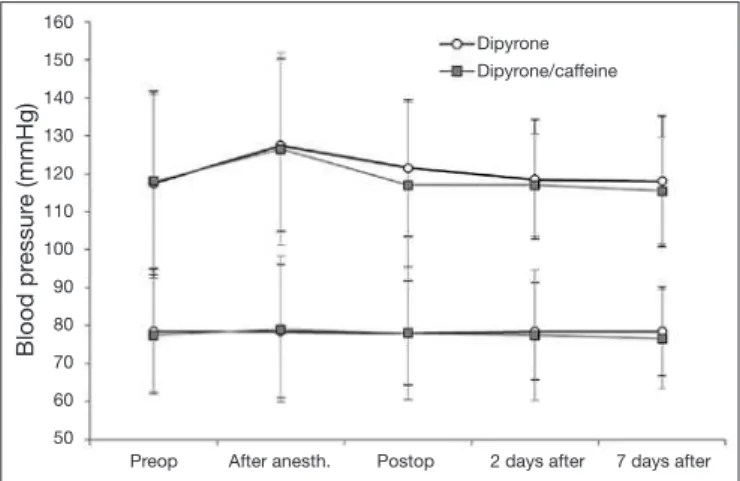
in systolic blood pressure (SBP) and diastolic blood pressure (DBP) in the period “after anesthesia” as compared to remain-ing periods, for both treatments. However, the comparison (Wilcoxon test) between SBP and DBP obtained for both treatments has shown no statistically signiicant diferences (p > 0.05) in any evaluated period (Figure 2).
Blood pr
essur
e (mmHg)
Dipyrone
Dipyrone/caffeine
Preop After anesth. Postop 2 days after 7 days after 160
150
140
130
120
110
100
90
80
70
60
50
Figure 2 – Median ± interquartile deviation of systolic blood pres-sure (upper lines) and diastolic blood prespres-sure as a function of tre-atments.
Figure 3 shows heart rate (HR) behavior along studied peri-ods. Data analysis (Friedman test) has shown signiicant HR increase (p < 0.05) in the period “after anesthesia” for both treatments, being that such increase has remained in the im-mediate postoperative period, returning to baseline values in following periods. here have been no statistically signiicant diferences (Wilcoxon test) between treatments considering each studied time period separately.
It has been observed that mean pain levels remained below 30 mm for both treatments in all periods, thus showing the eicacy of both treatments which had identical behavior with regard to reported pain during the period. here has been sig-niicant pain increase (Friedman, p < 0.05) from the immedi-ate postoperative period to one day, when values returned to baseline levels (Figure 4).
DISCUSSION
Pain is an expected physiological phenomenon during den-tal surgeries and is related to nociceptors sensitization and inlammatory mediators release at tissue injury produced by surgical procedures. Similar studies to our research have ob-served that pain measurement by the visual analog scale in the postoperative period of impacted teeth surgery corresponds to the clinical model more commonly used and broadly accepted to evaluate the efect of analgesic drugs in Dentistry1-5,26. Pain induced by impacted third molar extraction surgery may be inluenced by several factors, such as the invasive character of such procedure, anxiety with regard to pain expectation, possible complications and major impact on quality of life in the immediate postoperative period2,28. Hemodynamic pa-rameters in this study were the reference for indirect evalua-tion of patients’ anxiety. No anxiolytic drug was indicated due to their major impact on postoperative pain perception25,27,28. Blood pressure and HR results had values close to physiologi-cal parameters, and minor changes observed might be associ-ated to the surgical moment, not indicating severe anxiety able to interfere with pain perception with regard to tested treatments. Studies with similar clinical design conirm
ob-served inferences about the interaction of hemodynamic pat-terns with anxiety and pain perception25.
Control of surgical time and perioperative complications was reported as a major factor to evaluate pain induced by im-pacted third molar extraction when two therapeutic modali-ties are compared2,5,24,25. Our results showed no statistically signiicant diferences in surgical time and amount of anes-thetic tubetes used with regard to operated side, patient’s gen-der and analgesic drug used. Steroid anti-inlammatory drugs are often preemptively used in impacted tooth extraction for the adequate control of edema, trismus and postoperative
pain30,31. he interference of steroids on patients’ pain
percep-tion is an unavoidable limitapercep-tion of this study, considering that their prescription is classic and necessary for Dentistry invasive surgical procedures32.
Clinical studies with criteria similar to those adopted by this research have shown that analgesic and anti-inlammatory coverage are important in the irst 48 postoperative hours and that the addition of adjuvants seems to improve the analgesic efect of classic drugs prescribed for dental surgeries2,5,13,28,30,31. Cafeine has been associated as analgesic adjuvant to treat chronic and tension pain. Comparative studies have shown that cafeine associated to drugs such as paracetamol, ibu-profen, acetylsalicylic acid and naproxene, improves absorp-tion and plasma distribuabsorp-tion of such drugs and contributes to the inhibition of hyperalgia inlammatory mediators re-lease11,16,17,33,34. With regard to cafeine adjuvant analgesic ef-fect for sodium dipyrone in diferent situations, results are not consistent because there are few controlled, prospective and randomized studies18,19.
Sodium dipyrone is widely used to control inlammatory pain, especially in the postoperative period of general sur-geries35. Its analgesic eiciency may be attributed to the pe-ripheral action mechanism which is diferent from other com-monly used drugs6-8. he addition of cafeine seems to modify the efect of sodium dipyrone to control pain, however action mechanisms of such association are still not clear16-19. Analysis of results obtained in this study show that cafeine/dipyrone association had no diferentiated postoperative analgesic ef-fect for impacted third molar extraction surgeries and due to the scarcity of publications about the subject new controlled clinical trials are suggested.
CONCLUSION
he therapeutic protocol proposed by this study has not shown statistically signiicant diference in analgesic eiciency of sodi-um dipyrone associated or not to cafeine to control post tooth extraction pain.
REFERENCES
1. Laskin DM. Application of current pain management concepts to the prevention and management of postoperative pain. J Am Dent Assoc. 2013 Mar;144(3):284-6. 2. Ridaura-Ruiz L, Figueiredo R, Valmaseda-Castellón E, et al. Sensibility and taste
alte-rations after impacted lower third molar extractions. A prospective cohort study. Med Oral Patol Oral Cir Bucal. 2012;17(5):e759-64.
Dipyrone
Dipyrone/caffeine
Preop After anesth. Postop 2 days after 7 days after
Heart rate (bpm)
120
110
100
90
80
70
60
50
Figure 3 – Median ± interquartile deviation of heart rate as a function of treatments.
Dipyrone
Dipyrone/caffeine
0 24 48 72 96 120 144 168
V
AS (in mm)
100
90
80
70
60
50
40
30
20
10
0
3. Tickle M, Milsom K, Crawford FI, Aggarwal VR. Predictors of pain associated with routine procedures performed in general dental practice. Community Dent Oral Epi-demiol. 2012 Aug;40(4):343-50.
4. Mobilio N, Gremigni P, Pramstraller M, Vecchiatini R, Calura G, Catapano S. Explai-ning pain after lower third molar extraction by preoperative pain assessment. J Oral Maxillofac Surg. 2011 Nov;69(11):2731-8.
5. Noronha VR, Gurgel GD, Alves LC, et al. Analgesic eicacy of lysine clonixinate, paracetamol and dipyrone in lower third molar extraction: a randomized controlled trial. Med Oral Patol Oral Cir Bucal. 2009;14(8):e411-5.
6. Sachs D, Cunha FQ, Ferreira SH. Peripheral analgesic blockade of hypernocicep-tion: activation of arginine/NO/cGMP/protein kinase G/ATP-sensitive K+ channel pathway. Proc Natl Acad Sci U S A. 2004;101(10):3680-5.
7. Lorenzetti BB, Ferreira SH. Mode of analgesic action of dipyrone: direct antagonism of inlammatory hyperalgesia. Eur J Pharmacol. 1985 Aug 27;114(3):375-81. 8. Duarte ID, dos Santos IR, Lorenzetti BB, Ferreira SH. Analgesia by direct antagonism
of nociceptor sensitization involves the arginine-nitric oxide-cGMP pathway.Eur J Pharmacol. 1992 Jul 7;217(2-3):225-7.
9. Straube A, Aicher B, Fiebich BL, et al. Combined analgesics in (headache) pain therapy: shotgun approach or precise multi-target therapeutics? BMC Neurol. 2011;31(1):11:43.
10. Yancey JR, Dattoli G.Cafeine as an analgesic adjuvant for acute pain in adults. Am Fam Physician. 2013 Jan 1;87(1):11.
11. Derry CJ, Derry S, Moore RA.Cafeine as an analgesic adjuvant for acute pain in adults. Cochrane Database Syst Rev. 2012 Mar 14;3:CD009281.
12. Tavares C, Sakata RK. Cafeine in the treatment of pain. Rev Bras Anestesiol. 2012 May-Jun;62(3):387-401. doi: 10.1016/S0034-7094(12)70139-3.
13. Martins DF, Mazzardo-Martins L, Cidral-Filho FJ, Stramosk J, Santos AR. Ankle joint mobilization afects postoperative pain through peripheral and central adenosine A1 receptors. Phys her. 2013 Mar;93(3):401-12.
14. Sawynok J, Reid AR.Cafeine inhibits antinociception by acetaminophen in the for-malin test by inhibiting spinal adenosine A₁ receptors. Eur J Pharmacol. 2012 Jan 15;674(2-3):248-54.
15. Sawynok J.Cafeine and pain. Pain. 2011 Apr;152(4):726-9.
16. Suh SY, Choi YS, Oh SC, Kim YS, Cho K, Bae WK, Lee JH, Seo AR, Ahn HY.Cafeine as an Adjuvant herapy to Opioids in Cancer Pain: A Randomized, Double-Blind, Placebo-Controlled Trial. J Pain Symptom Manage. 2013 Mar 13. pii: S0885-3924(13)00020-1.
17. Pini LA, Guerzoni S, Cainazzo M, Ciccarese M, Prudenzano MP, Livrea P. Com-parison of tolerability and eicacy of a combination of paracetamol + cafeine and sumatriptan in the treatment of migraine attack: a randomized, blind, double--dummy, cross-over study. J Headache Pain. 2012 Nov;13(8):669-75.
18. Díaz-Reval MI, Galván-Orozco R, López-Muñoz FJ, et al. Synergism of cafeine on antinociceptive efects of dipyrone Cir Cir. 2008;76(3):241-6.
19. de Souza Carvalho D, Barea LM, Kowacs PA, Fragoso YD.Eicacy and tolerability of combined dipyrone, isometheptene and cafeine in the treatment of mild-to-moderate primary headache episodes. Expert Rev Neurother. 2012 Feb;12(2):159-67.
20. Pell GJ, Gregory BT. Impacted mandibular third molars: classiication and modiied techniques for removal. Dent Digest. 1933;39:330-8.
21. Moher D, Schulz KF, Altman D. he CONSORT Statement: revised recommenda-tions for improving the quality of reports of parallel-group randomized trials 2001. Explore (NY). 2005;1(1):40-45.
22. Van Gool AV, Ten Bosch JJ, Boering G., Clinical consequences of complaine and compli-cations after removal of he mandibular third molar, Int J Oral Surg. Feb;6(1):29-37, 1977. 23. Hedström L, Sjögren P. Efect estimates and methodological quality of randomized con-trolled trials about prevention of alveolar osteitis following tooth extraction: a systematic review. Oral Surg Oral Med Oral Pathol Oral Radiol Endod. 2007;103(1):8-15. 24. Martínez-Rodríguez N, Barona-Dorado C, Martín-Arés M, et al. Evaluation of the
anaesthetic properties and tolerance of 1:100,000 articaine versus 1:100,000 lidocai-ne. A comparative study in surgery of the lower third molar. Med Oral Patol Oral Cir Bucal. 2012;17(2):e345-51.
25. Alemany-Martínez A, Valmaseda-Castellón E, Berini-Aytés L, et al. Hemodynamic changes during the surgical removal of lower third molars. J Oral Maxillofac Surg. 2008;66(3):453-61.
26. Collins SL, Moore A, MacQuai HJ. he visual analogue intensity scale: what is mode-rate pain in millimeters? Pain. 1997;72(1-2):95-7.
27. Treister R, Kliger M, Zuckerman G, Goor Aryeh I, Eisenberg E. Diferentiating be-tween heat pain intensities: the combined efect of multiple autonomic parameters. Pain. 2012 Sep;153(9):1807-14.
28. de Jongh A, van Wijk AJ, Lindeboom JA.Psychological impact of third molar surgery: a 1-month prospective study. J Oral Maxillofac Surg. 2011 Jan;69(1):59-65. 29. de Jesus JA, Tristao RM, Storm H, da Rocha AF, Campos D Jr. Heart rate, oxygen
saturation, and skin conductance: a comparison study of acute pain in Brazilian new-borns. Conf Proc IEEE Eng Med Biol Soc. 2011;2011:1875-9.
30. Markiewicz MR, Brady MF, Ding EL, et al. Corticosteroids reduce postoperative morbidity after third molar surgery: a systematic review and meta-analysis. J Oral Maxillofac Surg. 2008;66(9):1881-94.
31. Alcântara CE, Falci SG, Oliveira-Ferreira F, Santos CR, Pinheiro ML.Pre-emptive efect of dexamethasone and methylprednisolone on pain, swelling, and trismus after third molar surgery: a split-mouth randomized triple-blind clinical trial. Int J Oral Maxillofac Surg. 2013 Jun 27. pii: S0901-5027(13)00255-5.
32. Herrera-Briones FJ, Prados Sánchez E, Reyes Botella C, Vallecillo Capilla M. Update on the use of corticosteroids in third molar surgery: systematic review of the literature. Oral Surg Oral Med Oral Pathol Oral Radiol. 2012 Aug 16.
33. Mitchell A, McCrea P, Inglis K, Porter G.A randomized, controlled trial comparing acetaminophen plus ibuprofen versus acetaminophen plus codeine plus cafeine (Tyle-nol 3) after outpatient breast surgery. Ann Surg Oncol. 2012 Nov;19(12):3792-800. 34. Borel JF, Deschaumes C, Devoize L, Huard C, Orliaguet T, Dubray C,
Baudet-Pom-mel M, Dallel R.Treating pain after dental surgery: a randomised, controlled, double-blind trial to assess a new formulation of paracetamol, opium powder and cafeine versus tramadol or placebo. Presse Med. 2010 May;39(5):e103-11.