Depart ment of Neurology - Universit y of Campinas (FCM /UNICAM P), Campinas SP, Brazil. Support ed by FAPESP. Received 16 November 2004, received in f inal f orm 21 M arch 2005. Accept ed 9 M ay 2005.
D r. Carlos A.M. Guerre i ro - Department of Neuro l o g y, FCM/UNICAMP, Caixa Postal 6111 - 13083-970 Campinas SP - Brasil. E-mail: [email protected]
MENSTRUAL CYCLE WORSENING OF EPILEPTIC
SEIZURES IN WOMEN WITH SYMPTOMATIC
FOCAL EPILEPSY
Ana Carolina Belini Bazán, Maria Augusta Montenegro,
Fernando Cendes, Li Li Min, Carlos A.M. Guerreiro
A B S T R A C T- I n t ro d u c t i o n :H o rmonal f luct uat ion is responsible f or w orsening of epilept ic seizures during t he m enst rual cycle. Objective: To ident if y irregularit ies in t he menst rual cycles of w omen w it h mesial t emporal lobe epilepsy (M TLE) and ext rat emporal f ocal epilepsy (ETFE) and correlat e t he f requency of sei-z u res during the menstrual cycles. Method: We evaluated prospectively women in t he menacme w it h M T L E and ETFE. Calendars w ere provided f or t hese patient s, and they w ere asked t o mark t heir seizure f re q u e ncy a c c o rding t o t he menses. Calendars w ere review ed in each routine medical appoint ment . Results: T h i rt y -nine pat ient s w it h M TLE and 14 w it h ETFE w ere evaluat ed. We re g i s t e red 211 cycles in t he pat ient s w it h M TLE and 49 in t hose w it h ETFE. Irregular menst rual cycles w ere f ound in 28 (28/39, 71.7% ) pat ient s w it h M TLE and 6 (6/14, 42.8% ) wit h ETFE (p=0.052). Pre m e n s t rual seizure w orsening w as observed in 46 (21.8%) pat ient s w it h M TLE and 9 (18.3% ) w it h ETFE (p=0.596). M enst rual w orsening w as observed in 47 (22.2% ) pat ient s w it h M TLE and 15 (30.6% ) w it h ETFE (p=0. 217). Ovulat ory w orsening w as observed in 36 (17% ) pat ients w it h MTLE and 13 (26.5%) with ETFE (p=0,126). Catamenial w orsening w as observed in 58 (27.4%) of t he pat ient s w it h M TLE and in 17 (34.7% ) of t he pat ient s w it h ETFE (p=0.315). Conclusion: T h e re was no diff e rence bet w een t he group of patient s w it h MTLE and ETFE re g a rding t he f requency of irregular cy-cles and seizure w orsening during t he premenst rual, menst rual, cat amenial or ovulat ory periods. KEY WORDS: epilepsy, cat amenial, t emporal lobe epilepsy, ext ra-t emporal epilepsy, menst rual cycle.
Piora de crises epilépticas durante o período menstrual em mulheres com epilepsia focal sinto-mática
RESUM O - I n t rodução: Admite-se que a f lutuação hormonal seja a responsável para a piora de crises epilépt i-cas no período cat amenial. Objetivo: Ident if icar irregularidades nos ciclos menst ruais de mulheres com epilepsia de lobo t emporal mesial (ELTM) e epilepsia focal extrat emporal (EFET); e relacionar a frequencia d e crises durant e o ciclo menstru a l . Método: Avaliamos mulheres na menacme, que apresent em quadro clí-nico laboratorial compat ível com ELTM e EFET. Foram fornecidos calendários para estas pacientes e inst ru íd a s para preenchiment o corret o da menst ruação e das crises epilépt icas e serão revistos em cada consulta médi-ca ro t i n e i r a . Resultados: Foram avaliadas 39 pacient es com ELTM e 14 com EFET. Regist ramos 211 ciclos nas pacient es com ELTM e 49 nas com EFET. Ciclos menstruais irre g u l a res f oram apresentados por 28 (71,7%) pacient es com ELTM e 14 (42,8% ) com EFEP (p=0,052). Piora pré-menst rual f oi observada em 46 (21,8% ) pacient es com ELTM e 9 (18,3% ) com EFET (p=0,596). Piora menst rual f oi observada em 47 (22,2% ) pacientes com ELTM e 15 (30,6%) com EFET (p=0,217). Piora ovulatória f oi observada em 36 (17%) pacientes com E LT M e 13 (26,5% ) com EFET (p=0,126). Piora cat amenial f oi observada em 58 (27,4% ) das pacient es com ELTM e em 17 (34,7%) das pacient es com EFET (p=0,315). Conclusão: Não houve dif erença ent re os grupos de pa-cient es com ELTM e EFET quant o à f reqüência de ciclos irre g u l a res e piora das crises nos períodos pré-men-st rual, menpré-men-st rual, cat amenial ou ovulat ório.
PA L AV R A S - C H AVE: epilepsia, catamenial, epilepsia de lobo temporal, epilepsia ext ratemporal, ciclo mens t ru a l .
Epilepsy has an est imat ed prevalence bet ween
1 and 1.8%1 - 3. The incidence of epilepsy in w omen
is similar t o t hat in men. Anovulat ory cycles are m o-re f o-requent in w o men w it h epilepsy. In addit ion, it seems t hat epilept ic seizures are more fre q u e n t
in anovulat ory cycles t han in normal cycles4. There
a re re p o rts that up t o 50% of w omen w ith epilep-sy in t he menacme present w orsening of seizures
t hrough t he menst rual cycle5.
sei-z u re w orsening related t o diff e rent periods of t he m e n s t rual cycle: a) seizures t hat occur during t he t h ree days before menses and on the first three days of menses; b) seizures t hat occur close t o the mid-dle of t he cycle, before t he ovulat ion betw een t he
8t hand 14t hdays; c) seizures t hat are f requent bet
-w een t he 8t hday of a cycle and t he 2n dday of t he
next; these cycles are anovulatory. This last standard is more difficult to identify, comparing to those that occur in normal menstrual cycles. Experimental studi-es showed that studi-estrogen is epileptogenic and pro g e
s-t e rone pros-tecs-ts againss-t seizure s7. Epileptiform
activi-ty is observed during menses, on the days that pre c e-de it and in t he middle of the menstrual cycle. Pa-t ienPa-t s w iPa-th boPa-t h parPa-tial and generalized epilepsies
p resent cat amenial seizure w orsening8.
The object ive of this st udy w as t o identify irre g-ul ari t ies in t h e menst rual cycl es of w o men w it h mesial t emporal lob e epilepsy (M TLE) and ext ra-t emporal f ocal epilepsy (ETFE), and correlara-t e ra-t he f requency of seizures during menst rual cycle.
METHOD
Women in fert ile age w ere evaluat ed. Pat ient s w ere seen at t he epilepsy clinic of our Universit y Hospit al.
M TLE was charact erized according t o clinical end elec-t roencephalographic crielec-teria eselec-tablished by elec-the ILAE9. Pa-t ienPa-t s presenPa-t ed seizures w iPa-th epigasPa-t ric sensaPa-t ion, nau-sea, aut onomic signs, eruct ation, pallor, f acial flush, act ivi-ty break, pupillary dilatation, fear, panic and olfactory a n d
g ust at ive hallucinat i on9. Neuroi maging evaluat i on by high resolution showed hippocampal at rophy and hyper-intense T2 signal indicat ing mesial temporal sclero s i s .
ETFE w as based on clinical, EEG and neuro i m a g i n g f indings of f ront al, pariet al and occipit al epilepsy10,11.
E v e r y p at ien t w as su b mi t t ed t o a qu est io nn air e c o n c e rning gynecol ogical and obst et rical ant ecedent s and det ai led menst rual hist ory. In addit ion t hey w ere asked t o fill out of the calendar re g a rding the menst ru-al period.
We co nsidered as irregular cycl es t h e ones sh ort e r t han 26 days and longer t han 32 days of durat ion.
Inclusion criteria – a) Women in t he menacme w it h M TLE an d ETFE d iag no sis acco rd ing t o t he cri t eria of t he ILAE for at least one year9;b) M RI and EEG invest iga-t ion perf o rmed aiga-t our insiga-t iiga-t uiga-t ion; c) Good compliance t o t he t reat ment and available telephone f or cont act if needed; d) At tendance t o clinical f ollow -ups re g u l a r l y ; e) Fill out the calendar properly; f) Absence of horm o n-al t herapy or the use of vn-alproat e; g) Signat ure of inf or-med consent submit t ed and approved by t he Research Et hics Commit t ee of t he inst it ut ion.
Analysis of the data – The analysi s of t he dat a w as based on t he diff e rent periods of t he menst rual cycle. The average of crises per day w as calculated f or each p e-riod and compared t o other days of t he cycle. We est im a-t ed w orsening w hen a-the average of seizure/day in a de-t ermined period of de-t he cycle w as higher de-t han de-the eide-ther average of t he ot h er days o r t w ice or t h ree t imes t he average.
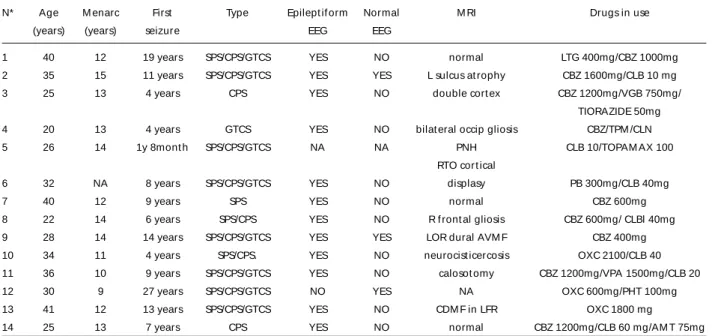
Table 1. Patients with extratemporal focal epilepsy.
N* Age M enarc First Type Epilept if orm Normal M RI Drugs in use
(years) (years) seizure EEG EEG
1 40 12 19 years SPS/CPS/GTCS YES NO normal LTG 400mg/CBZ 1000mg
2 35 15 11 years SPS/CPS/GTCS YES YES L sulcus at rophy CBZ 1600mg/CLB 10 mg
3 25 13 4 years CPS YES NO double cort ex CBZ 1200mg/VGB 750mg/
TIORAZIDE 50mg
4 20 13 4 years GTCS YES NO bilat eral occip gliosis CBZ/TPM /CLN
5 26 14 1y 8mont h SPS/CPS/GTCS NA NA PNH CLB 10/TOPAM AX 100
RTO cor t ical
6 32 NA 8 years SPS/CPS/GTCS YES NO displasy PB 300mg/CLB 40mg
7 40 12 9 years SPS YES NO normal CBZ 600mg
8 22 14 6 years SPS/CPS YES NO R f ront al gliosis CBZ 600mg/ CLBl 40mg
9 28 14 14 years SPS/CPS/GTCS YES YES LOR dural AVM F CBZ 400mg
10 34 11 4 years SPS/CPS. YES NO neurocist icercosis OXC 2100/CLB 40
11 36 10 9 years SPS/CPS/GTCS YES NO calosot omy CBZ 1200mg/VPA 1500mg/CLB 20
12 30 9 27 years SPS/CPS/GTCS NO YES NA OXC 600mg/PHT 100mg
13 41 12 13 years SPS/CPS/GTCS YES NO CDM F in LFR OXC 1800 mg
14 25 13 7 years CPS YES NO normal CBZ 1200mg/CLB 60 mg/AM T 75mg
P re m e n s t rual period: three days bef ore t he f irst day of t he cycle (t he menst ruat ion f irst day).
M enst rual period: period w hen t here w as bleeding unt il t he f if t h day.
O v u l a t o ry perio d: peri od of 5 days, 14 days bef ore t he menst ruat ion ± 2 days.
Cat amenial period: pre m e n s t rual period + menst ru-al period.
Cat amenial w orsening: three-fold increase in seizure f requency in relat ion t o t he ot her days of t he cycle.
St at i st i cal anal ysis w as p er f o rmed usin g t h e Ch i-Square t est .
RESULTS
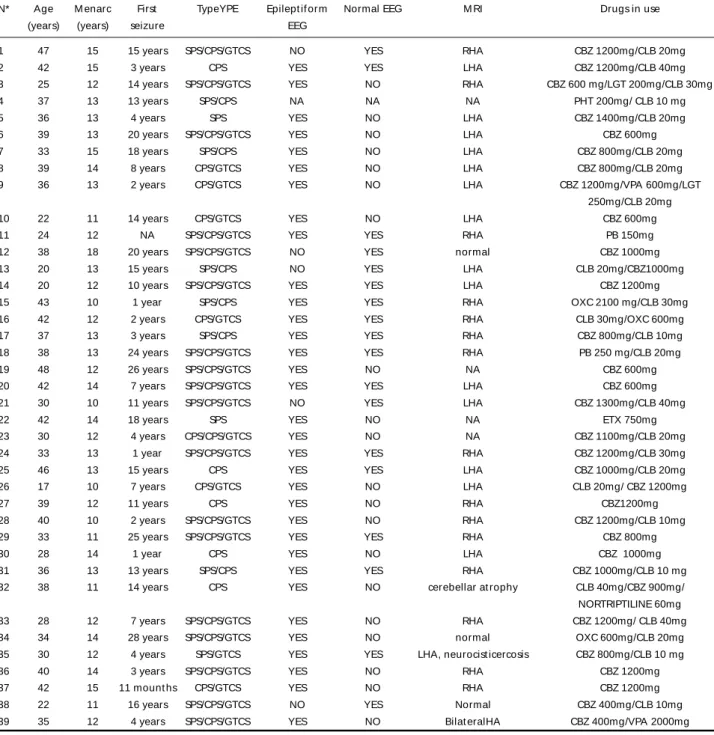
T h i rt y-n in e pat i en t s w i t h M TLE an d 14 w i t h ETEF w ere evaluat ed (Tables 1 and 2). We re g i s t e-red 211 cycles in pat ients w ith M TLE and 49 in t ho-se w it h ETFE.
I rregular m enst rual cycles w ere present ed by 28 (28/39, 71.7% ) pat ient s w it h M TLE and 6 (6/14,
Table 2. Patients with temporal lobe epilepsy.
N* Age M enarc First TypeYPE Epilept if or m Normal EEG M RI Drugs in use (years) (years) seizure EEG
1 47 15 15 years SPS/CPS/GTCS NO YES RHA CBZ 1200mg/CLB 20mg 2 42 15 3 years CPS YES YES LHA CBZ 1200mg/CLB 40mg 3 25 12 14 years SPS/CPS/GTCS YES NO RHA CBZ 600 mg/LGT 200mg/CLB 30mg 4 37 13 13 years SPS/CPS NA NA NA PHT 200mg/ CLB 10 mg 5 36 13 4 years SPS YES NO LHA CBZ 1400mg/CLB 20mg 6 39 13 20 years SPS/CPS/GTCS YES NO LHA CBZ 600mg 7 33 15 18 years SPS/CPS YES NO LHA CBZ 800mg/CLB 20mg 8 39 14 8 years CPS/GTCS YES NO LHA CBZ 800mg/CLB 20mg 9 36 13 2 years CPS/GTCS YES NO LHA CBZ 1200mg/VPA 600mg/LGT
250mg/CLB 20mg 10 22 11 14 years CPS/GTCS YES NO LHA CBZ 600mg 11 24 12 NA SPS/CPS/GTCS YES YES RHA PB 150mg 12 38 18 20 years SPS/CPS/GTCS NO YES normal CBZ 1000mg 13 20 13 15 years SPS/CPS NO YES LHA CLB 20mg/CBZ1000mg 14 20 12 10 years SPS/CPS/GTCS YES YES LHA CBZ 1200mg 15 43 10 1 year SPS/CPS YES YES RHA OXC 2100 mg/CLB 30mg 16 42 12 2 years CPS/GTCS YES YES RHA CLB 30mg/OXC 600mg 17 37 13 3 years SPS/CPS YES YES RHA CBZ 800mg/CLB 10mg 18 38 13 24 years SPS/CPS/GTCS YES YES RHA PB 250 mg/CLB 20mg 19 48 12 26 years SPS/CPS/GTCS YES NO NA CBZ 600mg 20 42 14 7 years SPS/CPS/GTCS YES YES LHA CBZ 600mg 21 30 10 11 years SPS/CPS/GTCS NO YES LHA CBZ 1300mg/CLB 40mg
22 42 14 18 years SPS YES NO NA ETX 750mg
23 30 12 4 years CPS/CPS/GTCS YES NO NA CBZ 1100mg/CLB 20mg 24 33 13 1 year SPS/CPS/GTCS YES YES RHA CBZ 1200mg/CLB 30mg 25 46 13 15 years CPS YES YES LHA CBZ 1000mg/CLB 20mg 26 17 10 7 years CPS/GTCS YES NO LHA CLB 20mg/ CBZ 1200mg
27 39 12 11 years CPS YES NO RHA CBZ1200mg
28 40 10 2 years SPS/CPS/GTCS YES NO RHA CBZ 1200mg/CLB 10mg 29 33 11 25 years SPS/CPS/GTCS YES YES RHA CBZ 800mg
30 28 14 1 year CPS YES NO LHA CBZ 1000mg
31 36 13 13 years SPS/CPS YES YES RHA CBZ 1000mg/CLB 10 mg 32 38 11 14 years CPS YES NO cerebellar at rophy CLB 40mg/CBZ 900mg/ NORTRIPTILINE 60mg 33 28 12 7 years SPS/CPS/GTCS YES NO RHA CBZ 1200mg/ CLB 40mg 34 34 14 28 years SPS/CPS/GTCS YES NO normal OXC 600mg/CLB 20mg 35 30 12 4 years SPS/GTCS YES YES LHA, neurocist icercosis CBZ 800mg/CLB 10 mg 36 40 14 3 years SPS/CPS/GTCS YES NO RHA CBZ 1200mg 37 42 15 11 mount hs CPS/GTCS YES NO RHA CBZ 1200mg 38 22 11 16 years SPS/CPS/GTCS NO YES Normal CBZ 400mg/CLB 10mg 39 35 12 4 years SPS/CPS/GTCS YES NO Bilat eralHA CBZ 400mg/VPA 2000mg
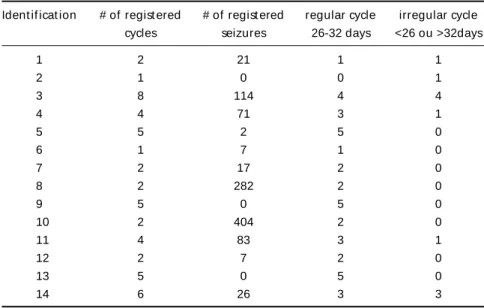
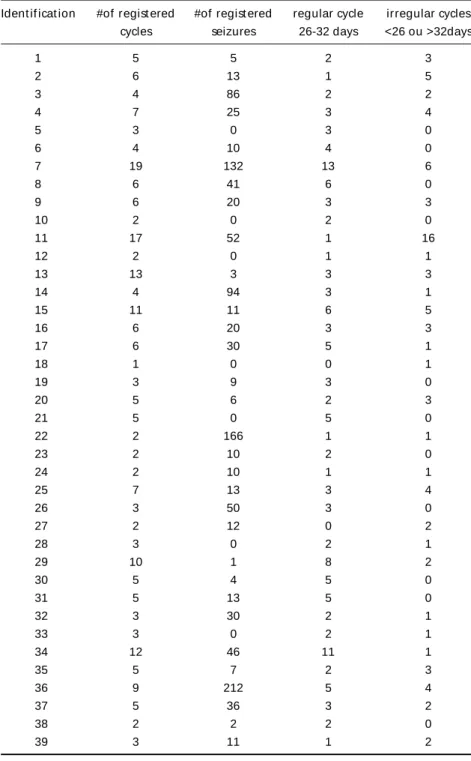
42.8% ) w it h ETFE (p= 0.052). Inf ormat ion relat ed to seizure count ing and regular and irregular men-s t rual cyclemen-s are in Table 3 and 4. M enmen-st rual w ormen-se- orse-ning w as observed in 46 cycles (21.8% ) of pat ients w it h M TLE and 9 cycles (18.3% ) of pat ient s w it h ETFE (p= 0.596). M enst rual w orsening w as obser-ved in 47 cycles (22.2% ) of pat ients w it h M TLE and 15 cycles (30.6% ) of patient s w it h ETFE (p= 0.217). O v u l a t o ry w or seni ng w as o bser ved i n 36 cycles (17% ) of patient s w it h M TLE and 13 cycles (26.5% ) of pat ient s w it h ETFE (p= 0.126).
Catamenial increasing of seizures (seizures pre-dominant ly on t he pre and menst rual cycles) w as o b s e rved i n 58 cycl es (27.4% ) o f p at ient s w i t h MTLE and in 17 cycles (34.7%) of patients with E T F E (p=0.315). Catamenial w orsening (according t o our definition of t hree-fold increase in seizure fre q u e n-cy in relation to the other days of the n-cycle) was p re-sent in 29 (13.7% ) of t he pat ient s w it h M TLE and 4 (8.1% ) of t he pat ient s w it h ETFE (p= 0.290)
DISCUSSION
Cat amenial ep ilepsy ref ers t o seizures re l a t e d t o m enst rual cycle and af f ect s approxim at ely m 10-70% of w o men w i t h epilepsy, d ependi ng on
t he def init ion of w orsening6. Experiment al st
udi-es demonst rat ed t hat t he ovarian st eroid hormo-nes aff ect t he neuronal excit abilit y, t hat w ay t hey give support t o a biologic base f or t hese f luct ua-t ions in epilepsy ua-thaua-t occur in associaua-t ion w iua-t h ua-t he m e n s t ruat ion, f rom t he menarche t o t he m
eno-p a u s e1 2 - 1 9. The lo w l evels of pro g e s t e rone in t he
menses, t he rising of est rogen level in t he
ovula-t ion and low levels of pro g e s ovula-t e rone during ovula-t he lu-t eal phase of anovulalu-t ory cycles are among lu-t he se-veral factors that precipitate the catamenial epilep-s y. Theepilep-se f actorepilep-s reepilep-sult in the elevat ion of the eepilep-stro-
estro-g e n / p ro estro-g e s t e rone rat io2 0. A decrease on serum
lev-els of t he ant iepileptic drugs on the days t hat pre-cede t he menst ruation, can also cont ribut e f or t he p r e m e n s t rual exacerb at io n o f t he seizures. It is supposed that the low er serum levels of antiepilep-t ic drugs is due antiepilep-to an increase in antiepilep-t heir meantiepilep-t abolism by t he hepat ic microsomal enzyme syst em t hat
in-volves t he gonadal st eroid met abolism19.
M at t son et al.4re p o rted an increase in seizure
f requ ency duri ng t h e anovulat ory cycl e, m ain ly
during t he est rogen peak. Jansen and Va e rn e t2 1
related larger incidence of amenorrhea in w omen w it h M TLE t han in t he general populat ion of w o-men. Our dat a show ed t hat one t hird of pat ient s evaluat ed present ed cat amenial seizure w orsen-ing; if w e accept t he def init ion proposed by
Her-zog et al.6- higher f requency of seizure on the
ca-t amenial (pre + mensca-trual) period ca-t han ca-thaca-t of ca-t he rest of t he cycle.
We evaluat ed t he menst rual disorders in pa-t ienpa-t s w ipa-t h M TLE and ETFE because of pa-the facpa-t pa-t hapa-t t hese conditions are w ell-defined electro-clinic
syn-d ro m e s1 0 , 1 1 , 2 2 , 2 3. These tw o f orms of lesional
epilep-sies, f requent ly re f r a c t o ry t o t he ant iepilept ic dru g (AED) t reat ment , w ere evaluat ed in w omen w ho did not use hormone t herapy or sodium valpro a t e . It is conf irmed t hat t he use of valproat e incre a s e s t he occurrence of anovulatory cycles, mainly in w
o-Table 3. Presence of regular and irregular menstrual cycles, and re g i s t e red seizures in patients with ETFE.
Ident if icat ion # of regist ered # of regist ered regular cycle irregular cycle cycles seizures 26-32 days <26 ou >32days
1 2 21 1 1
2 1 0 0 1
3 8 114 4 4
4 4 71 3 1
5 5 2 5 0
6 1 7 1 0
7 2 17 2 0
8 2 282 2 0
9 5 0 5 0
10 2 404 2 0
11 4 83 3 1
12 2 7 2 0
13 5 0 5 0
men with generalized idiopat hic epilepsy2 4 , 2 5.
Theo-re t i c a l l y, t he group of pat ient s w it h limbic lesions (M TLE) w ould be more inclined t o hormonal dys-f unct ions originat ed dys-f rom t he indys-f luence odys-f limbic s t ru c t u r es on t he hypot halamus and hypophysis and t he consequent hormonal disorder and pos-sible inf luence on t he menst rual cycle.
A n o v u l a t o ry cycles occur in 14 t o 39% o n t he
diverse f orms of epilepsy in w omen2 6 , 2 7. Accord i n g
t o t he met hodology ut ilized, w e did not evaluate
the patients under the endocrinologic point of view (if t he irregular cycles observed w ere anovulat ory or not ). Nevert heless, it is known t hat 11% of w o-men w it h epilepsy have cycles w ith int ervals out of t he period of 21-35 days, w hich is larger t han w hat i s expect ed on t he general pop ulat ion, abou t 2 %2 6 , 2 8 , 2 9. We adopted t he period of 26-32 days f or
the definition of regular cycles based on the Herz o g
and Friedman’s f indings2 6, w ho f ound signif icant
increase of anovulat ory cycles out of this period. It
Table 4 - Presence of regular and irregular menstrual cycles, and registeredseizures in patients with MTLE.
Ident if icat ion #of regist ered #of regist ered regular cycle irregular cycles cycles seizures 26-32 days <26 ou >32days
1 5 5 2 3
2 6 13 1 5
3 4 86 2 2
4 7 25 3 4
5 3 0 3 0
6 4 10 4 0
7 19 132 13 6
8 6 41 6 0
9 6 20 3 3
10 2 0 2 0
11 17 52 1 16
12 2 0 1 1
13 13 3 3 3
14 4 94 3 1
15 11 11 6 5
16 6 20 3 3
17 6 30 5 1
18 1 0 0 1
19 3 9 3 0
20 5 6 2 3
21 5 0 5 0
22 2 166 1 1
23 2 10 2 0
24 2 10 1 1
25 7 13 3 4
26 3 50 3 0
27 2 12 0 2
28 3 0 2 1
29 10 1 8 2
30 5 4 5 0
31 5 13 5 0
32 3 30 2 1
33 3 0 2 1
34 12 46 11 1
35 5 7 2 3
36 9 212 5 4
37 5 36 3 2
38 2 2 2 0
is know n t hat the irregular cycles have higher pro
b-abilit y of being anovulat ory2 6. The irregular cycle
f inding has clinic import ance because t he f re q u e
n-cy of epilept ic seizures is higher in t hese n-cycles6 , 2 0.
In addition, the incidence of re p roductive endocrine
d i s o rders is higher in these women3 0 - 3 2, part i c u l a
r-ly t he por-lycyst ic ovary syndro m e3 2 - 3 4. These dist
ur-bances are associated with an increase of the infert i-lity rate, migraine, emotional dist urbances, re s i s t a
n-ce t o insulin, cardiovascular disease and cann-cer3 5.
The real role of t he irregular or anovulat ory cycles in these patients and their medical dimension need c o m p l e m e n t a ry invest igat ions.
A recent st udy about lo ng-t erm re p ro d u c t i v e endocrine healt h in yo ung w omen w it h epilepsy during pubert y have show n that 56% patients tak-ing antiepilept ic medication, 32% of pat ients w ith-out drugs and 38% normal control presented irre g-ular menst rual cycles. They def ined irregg-ular cycle if t he interm e n s t rual variat ion w as > 7 days or the cycle durat ion w as >35 days or <21 days, at least once during t he preceding 6 mont hs. In t he same
s t u d y, Mikkonen et al.3 6f ound t hat polycystic ovary
s y n d rome w as more common in pat ient s on medi-cation (38%, mainly valproate) than in patients w i t h-out medication (6%) or in controls (11% ). These a
u-t h o r s3 6p roposed that irregular menses may be
con-s i d e red an advercon-se event of antiepileptic drug t re a t-ment , part icularly in pubert y.
T h e re w as no seizure w orsening diff e rence on t he pre m e n s t rual, menst rual, cat amenial or ovula-t o ry periods in ovula-the ovula-tw o groups of paovula-tienovula-ts w e sovula-t ud-ied. This is a pre l i m i n a ry st udy and a lar ger sam-ple should be evaluat ed in order t o conf irm our f indings.
REFERENCES
1. Marino R Jr, Cukiert A, Pinho E. Aspectos epidemiológicos da epilep-sia em São Paulo: um estudo da prevalência. A rq Neuropsiquiatr 1986; 44:243-254.
2. Fernandes JG, Schimidt MI, Monte TL, et al. Prevalence of epilepsy: the Porto Alegre study. Epilepsia 1992;33(Suppl 3)S:132.
3. B o rges MA. Prevalência urbana da epilepsia: estudo populacional na cidade de São José do Rio Preto-Brasil. Tese. São José do Rio Preto, 2002. 4. Mattson RH, Kamer JA, Caldwell BV, et al. Seizure frequency and
men-strual cycle: a clinical study. Epilepsia 1991;22:242.
5. Millichap JP. Systemic electrolyte and neuroendocrine mechanisms. In Jasper HH, Wa rd A A J r., Pope A (eds). Basic mechanisms of the epilep-sies. Boston: Little, Brown, 1969:709-726.
6. Herzog AG, Klein P, Ransil BJ. Three patterns of catamenial epilepsy. Epilepsia 1997;38:1082-1088.
7. Lagothetis J, Harner R. Electrocortical activation by estrogens. A rc h Neurol 1960;3:290-297.
8. Marcus EM, Watson CW, Goldman PL. Effects of steroids on cerebral electrical activity. Arch Neurol 1966;15:521-532.
9. Comission on Classification and Terminology of the International Lea-gue Against Epilepsy. Proposal for revised classification of epilepsies and epileptic syndromes. Epilepsia 1989;30:389-399.
10. Foldvary N. Symptomatic focal epilepsies. In Wyllie E (ed). The treat-ment of epilepsy: principles and practice. Philadelphia: Lippincott Wi l-liams &Will-liams, 2001:467-474.
11. Williamson PD, Jobst BC. Selection of candidates for extratemporal resection. In Wyllie E (ed). The treatment of epilepsy: principles and practice. Philadelphia: Lippincott Williams &Williams, 2001:1095-111 4 . 12. Abassi F, Krumholz A, Kittner SJ, et al. Effects of menopause on seizure s
in woman with epilepsy. Epilepsia 1999;40:205-210.
13. Diamantopoulos N, Crumrine PK. The effect of puberty on the course of epilepsy. Arch Neurol 1986;43:873-876.
14. G u e r re i ro CAM, Ramos MC. Pre m e n s t rual seizure increase: influence of age, duration of disease, seizure fre q u e n c y, previous complaint of p e r i m e n s t rual accentuation, EEG and CT scan findings. A rq Neuro-psiquiatr 1991;49:27-32.
15. G u e r re i ro CAM. Período ovulatório e crises epilépticas. A rq Neuro-psiquiatr 1991;49:198-203.
16. Silveira DC, Guerre i ro CAM. Início de crises epilépticas na menarc a . Arq Neuropsiquiatr 1991;49:434-436.
17. H a rden CL, Pulver MC, Ravdin L, et al. The effects of menopause on the course of epilepsy. Epilepsia 1999;40:1402-1407.
18. Zahn C. Catamenial epilepsy: clinical aspects. Neurology 1999;53 (Suppl.1):S34-S37.
19. M o r rell M. Managing epilepsy in women across the re p roductive cycle. Monograph. A CME Monograph for Neurologists, Secaucus, NJ: Pro j e c t s in Knowledge, 2001.
20. B a c k s t rom T. Epileptic seizures in women related to plasma estro g e n and pro g e s t e rone during the menstrual cycle. Acta Neurol Scand 1976; 54:321-347.
21. Jansen I, Vaernet K. Temporal lobe epilepsy follow up investigation of 74 temporal lobe resected patients. Acta Neurochir 1977;37:173-200. 22. Engel J Jr. Update on surgical treatment of the epilepsies. Neuro l o g y
1993;43:1612-1617.
23. Pedley T. Neurobiologia da epilepsia de lobo temporal. In Guerre i ro CAM, Guerre i ro MM (eds). Epilepsia. São Paulo:Lemos Editorial, 1996: 19-29.
24. M o r rell MJ. Effects of epilepsy on women’s re p roductive health. Epi-lepsia 1998;39(Suppl 8):S32-S37.
25. Stephen LJ, Kwan P, Shapiro D, Dominickzak M, Brodie MJ. Hormone profiles in young adults with epilepsy treated with sodium valproate or lamotrigine monotherapy. Epilepsia 2001;42:1002-1006.
2 6 . Herzog AG, Friedman MN. Menstrual cycle interval and ovulation in women with localization-related epilepsy. Neurology 2001;57:2133-2135. 27. M o r rel MJ, Giudice L, Flynn KL, et al. Predictors of ovulatory failure
in women with epilepsy. Ann Neurol 2002;52:704-711.
28. Vollman RF. The menstrual cycle. In Friedman E (ed). Major pro b l e m s in obstetrics and gynecology. Philadelphia: WB Saunders, 1977:1-193. 29. Trealoar AE, Boynton RE, Borghild GB, et al. Variation of human
men-strual cycle through reproductive life. Int J Fertil 1967;12:77-126. 30. Bilo, L, Meo R, Nappi C, et al. Reproductive endocrine disorders in
women with epilepsy with primary generalized epilepsy. Epilepsia 1988;29:612-619.
31. Herzog AG, Russel V, Vaitukaitis JL, et al. Neuroendocrine dysfunc-tion in temporal lobe epilepsy. Arch Neurol 1982;39:135-139. 3 2 . Herzog AG, Seibel MM, Schomer DL, et al. Reproductive endocrine
dis-o rders in wdis-omen with partial epilepsy. A rch Neurdis-ol 1986;43:341-346. 33. Genton P, Bauer J, Duncan S, et al. On the association between valpro
a-te and polycystic ovary syndrome. Epilepsia 2001;42:295-304. 34. Isojärvi JIT, Tauboll E, Tapanainen JS, et al. On the association between
v a l p roate and polycystic ovary syndrome: a response and an alternati-ve view. Epilepsia 2001;42:305-310.
35. Herzog AG, Schachter SC. Va l p roate and the polycystic ovary syndro-me: final thoughts. Epilepsia 2001;42:311-315.