1MD, Hospital Universitário de Brasília, Brasília DF - Brazil (UnB); 2Neurologista, MD, PhD, Chefe de Serviço, UnB.
Received 16 May 2006, received in final form 28 July 2006. Accepted 19 September 2006.
Dr. Eduardo Siqueira Waihrich - SQS 306 / Bloco B / Apartamento 403 / Asa Sul - 70353-020 Brasília DF - Brasil. E-mail: [email protected]
COMPARATIVE ANALYSIS OF MULTIPLE SLEEP
LATENCY TESTS (MSLT) PARAMETERS AND
OCCURRENCE OF DREAMING IN PATIENTS WITH
DAYTIME SLEEPINESS OF NARCOLEPTIC AND
NON-NARCOLEPTIC ORIGIN
Eduardo Siqueira Waihrich
1, Raimundo Nonato Delgado Rodrigues
2,
Henrique Aragão Silveira
1, Fernando da Fonseca Melo Fróes
1,
Guilherme Henrique da Silva Rocha
1ABSTRACT -Objective:To compare MSLT parameters in two groups of patients with daytime sleepiness,
c o rrelated to the occurrence and onset of dre a m s . Method:Patients were submitted to the MSLT between
J a n u a ry/1999 and June/2002. Sleep onset latency, REM sleep latency and total sleep time were determ i n e d . The occurrence of dreams was inquired following each MSLT series. Patients were classified as narc o l e p t i c
(N) or non-narcoleptic (NN). Results:T h i rty patients were studied, 12 were classified as narcoleptics (N
g roup; 40%), while the remaining 18 as non-narcoleptic (NN group; 60%). Thirty MSLT were perf o rm e d , resulting in 146 series. Sleep was detected in 126 series (86%) and dreams in 56 series (44.44%). Mean sleep
time in the N group was 16.0±6.3 min, while 10.5±7.5 min in the NN group (p<0.0001). Mean sleep
laten-cy was 2.0±2.2 min and 7.2±6.0 min in the N and NN group, respectively (p<0.001). Mean REM sleep
laten-cy in the N group was 3.2±3.1min and 6.9±3.7 min in the NN group (p=0.021). Dreams occurred in 56.9%
of the N group series and 28.4% in that of the NN group (p=0.0009). Dream frequency was detected in
29.8% and 75% of the NREM series of the N and NN groups, respectively (p=0.0001). Conclusion:P a t i e n t s
f rom the N group, compared to the NN group, slept longer and earlier, demonstrated a shorter REM sleep onset and greater dream fre q u e n c y. NN patients had a greater dream frequency in NREM series. Thus, the o c c u rrence of dreams during NREM in the MSLT may contribute to diff e rentially diagnose narcolepsy and daytime sleepiness.
KEY WORDS: narcolepsy, daytime sleepiness, multiple sleep latency test, dreams, REM.
Estudo comparativo de parâmetros de testes de latências múltiplas do sono (TLMS) e ocorrên-cia de sonhos em pacientes hipersones narcolépticos e não-narcolépticos
RESUMO - Objetivo:Comparar variáveis do TLMS em dois grupos de pacientes hipersones e correlacionar
p resença e momento de ocorrência de sonhos. Método:Os pacientes foram submetidos a TLMS entre
j a n e i ro de 1999 e junho de 2002. Analisou-se a média das latências de sono, latências de sono REM e tem-po total de sono. A presença de sonhos foi inquirida após cada série. Classificou-se os pacientes em
nar-colépticos (N) e não-narnar-colépticos (NN). Resultados:Do total de 30 pacientes, 12 foram classificados no
g rupo N (40%) e 18 no NN (60%). Dos 30 TLMS foram obtidas 146 séries. Houve sono em126 (86%) e
so-nho em 56 (44,44%). O tempo médio de sono no grupo N foi 16,0±6,3min e no NN 10,5±7,5min (p<0,0001).
A latência média de sono no grupo N foi 2,0±2,2min e no NN 7,2±6,0min (p<0,001). A latência média do
sono REM no N foi 3,2±3,1min e no NN 6,9±3,7min (p=0,021). Houve sonhos em 56,9% das séries do gru p o
N e 28,4% do NN (p=0,0009). A freqüência de sonhos em séries NREM no N foi 29,8 % e no NN 75% (p=
0 , 0 0 0 1 ) . Conclusão:Os pacientes do grupo N dormiram mais e mais rapidamente, apresentaram REM
mais precocemente e maior freqüência de sonhos que os NN. Estes apresentaram maior freqüência de so-nhos em séries NREM. A presença de soso-nhos em NREM no TLMS pode contribuir no diagnóstico difere n-cial entre narcolepsia e hipersonia diurna.
N a rcolepsy is a chronic neurological disord e r, mainly characterized by uncontrollable sleep attacks and cataplexy, although hypnagogic hallucinations and sleep paralysis may also occur1 - 5. In spite of its low prevalence (0.02%)2 , 3, this disorder is one of the most debilitating diseases within Sleep Medicine ( H y p-n i a t ry), leadip-ng to professiop-nal problems, social stig-mas and risks to the patients’ physical integrity2 - 5. N a rcolepsy is highly under-diagnosed, with a 10-15 year time lag between symptom onset and definite d i a g n o s i s2 , 4. Thus, accurate early identification of these patients is very important. In this sense, the Multiple Sleep Latency Test (MSLT) has proved to be and important tool in diff e rentially diagnosing day-time sleepiness, one of the main complaints within H y p n i a t ry1 - 6. From a physiopathological perspective, n a rcolepsy characterizes a multi-level dysfunction of the activation and control mechanisms of REM sleep, to which the absence of the thalamic peptide hypo-cretin is an important contributing factor7,8.
REM sleep, on the other hand, is mainly characte-rized by diffuse muscle atonia (except for the dia-phragm and extrinsic ocular muscles), intense cere-bral activity and occurrence of dre a m s6 , 9 - 1 4. As dre a m s a re initiated by a complex synaptic network, the study of its patterns is of great scientific interest6,9,14,15. Al-though the functions of dreams have not been fully elucidated, qualitative and quantitative differences between REM and NREM dreams have been describ-e d1 3 - 1 8. In general, more complex, vivid and bizarre d reams are re p o rted during REM sleep1 2 , 1 3 , 1 5 , 1 8. As n u m e rous sleep disorders, including narc o l e p s y, char-acteristically modify dream patterns or coexist with oniric hallucinations3 , 4 , 1 4, a better functional and eti-ological understanding of the dream-related mech-anisms may provide a more efficient clinical and ther-apeutic approach to these diseases3 , 4 , 1 4 , 1 9 , 2 0. This study thus aimed at analyzing specific MSLT parameters in two distinct groups of patients with a general com-plaint of excessive daytime sleepiness, studying the frequency and moment of dreaming onset.
METHOD
An analytical case-controlled investigation was conduct-ed on data obtainconduct-ed from patient re c o rds who had been submitted to the MSLT as part of the investigation for exces-sive daytime sleepiness complaints. The patients selected w e re young adul ts with complaints of excessive daytime sleepiness, without any previous treatment. The study was held at the Sleep Laboratory of the University Hospital of Brasilia, Brazil, between January/1999 and June/2002. Fre e and informed consent was obtained from all subjects.
For the MSLT, the patient w as allowed 4 or 5 naps, at 2-h interval, with a maximum 20-min duration (corre s p o
n-ding to one series)2. Electroencephalograms (EEG) were
re c o rded on three channels (C3-A1, C4-02, F3-O2) with elec-t rodes posielec-tioned according elec-to elec-the 10-20 Inelec-tern a elec-t i o n a l System. A right and left electro-oculogram and an eletro-myogram (mentonian electrodes) were also performed.
Patients were classified as narcoleptic- or non-narc o l e p-tic-compatible using the diagnostic criteria of the Inter-national Classification of Sleep Disorders, revised version
of 2005 (ICSD-2005)1 , 4 , 2 1. Patients presenting mean sleep
latency under 5-min, and 2 or more series with REM sleep, w e re considered as being narcoleptics (N) and the re m a i n-ing subjects as non-narcoleptics (NN). Mean sleep latencies under 5-min, associated to 2 or more REM sleep episodes, a re high suggestive of narcolepsy (sensitivity 70%,
speci-ficity 97%)2,3. Following each MSLT series, the patient was
i n q u i red as to whether he/she had dreamt in the pre c e d-ing series.
Patients and series were also divided into groups accord-ing to the presence or absence of dreams and total sleep time. Then absolute NREM and REM sleep latencies were c o m p a red between series with and without the occurre n c e of dreams. The frequency of dreams re p o rted was also com-p a red between NREM and REM series. Tests that were inter-rupted without a minimum of 4 series, with a total sleep time greater than 20-min for one given series or with an inadequate EEG were excluded.
The study was submitted to and approved by de Ethics Committee of our Institution.
Statistical analyses were perf o rmed using the exact Fisher and Mann-Whitney tests. Statistical significance was set at p<0.05.
RESULTS
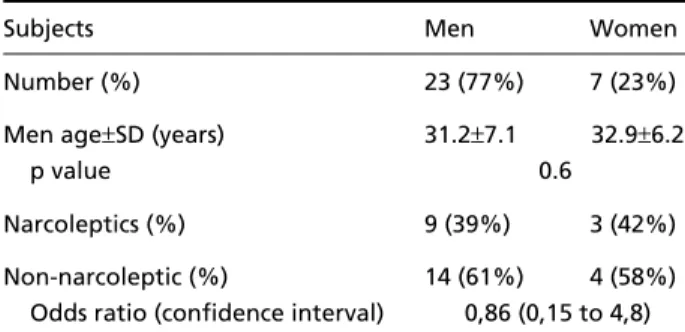
M S LT was perf o rmed on 82 patients during the study period 30 of which fulfilled the selection crite-ria, being 23 (77%) men and 7 (23%) women, with the mean age of 31,6±6.87 (p=0,6). Twelve patients (40%) were classified as narcoleptics (N) and 18 (60%) as non-narcoleptics (NN). No significant diff e re n c e s in mean ages were found between the two sexes. Besides, no correlation was found between sex and
Table 1. Demographic data.
Subjects Men Women
Number (%) 23 (77%) 7 (23%)
Men age±SD (years) 31.2±7.1 32.9±6.2
p value 0.6
Narcoleptics (%) 9 (39%) 3 (42%)
p revalence of narcolepsy (Odds ratio= 0.86 with con-fidence interval = 0.15 to 4.8), as re p o rted in Ta b l e 1. Within the N group, a mean sleep time of 16±6.3 min was observed, while for the NN group it was 1 0 . 5±7.5 min (p<0.0001). Furt h e rm o re, the mean sleep onset latency was significantly shorter (p<0.001) in the N group (2.0±2.2 min) than the NN group (7.2±6 . 0 min). A similar pattern was also observed for the mean REM sleep latency (3.2±3.1 and 6.9±3.7 min, N and NN group, respectively) (p=0.021). The fre q u e n-cy of dreams re p o rted was significantly greater in the N (56.9%) than the NN group (28.4%) (p=0.0009). A significantly higher frequency of dreams re p o rt e d in the NREM sleep series was observed in the NN g roup (75%), compared to the N group (21.87%) (p= 0.0001) (Table 2).
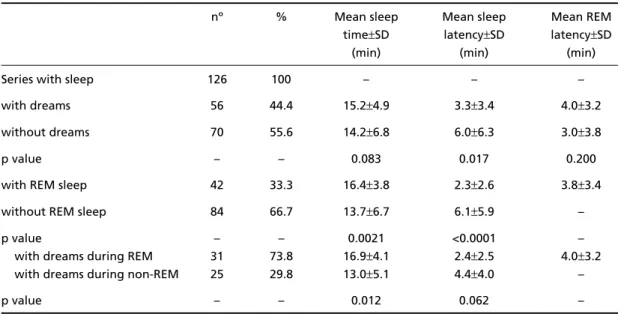
F rom the total of 146 series obtained, sleep was o b s e rved in 126 (86.3%). NREM and REM sleep
laten-cies, as well as sleep time of series with and without dreams are reported in Table 3.
DISCUSSION
Within our study sample, consisting essentially of individuals with excessive daytime sleepiness, a 40% p revalence of narcoleptic-compatible patients was o b s e rved. Mean sleep latency of patients from the N g roup (2.0±2.2 min) was considerably lower than the 5-min minimum frequently employed in other stud-i e s2 , 4, as well as the values observed in the NN gro u p ( 7 . 2±6 min). Similarly, significant diff e rences in mean REM sleep latency were also seen between the N (3.2 ±3.1 min) and the NN groups (6.9±3.7 min; p= 0.021). These findings seem to corroborate the notion that REM sleep mechanisms in narcoleptics are triggere d earlier than in patients with excessive daytime sleepi-ness of non-narcoleptic origin.
Table 2. MSLT parameters observed in narcoleptic group and non-narcoleptic group.
Narcoleptics Non-Narcoleptics p value
Subjects 12 (40%) 18 (60%) –
Mean sleep time (min) 16±6.3 10.5±7.5 <0.0001
Mean sleep onset latency (min) 2.0±2.2 7,2±6.0 <0.001
Mean REM sleep latency (min) 3.2±3.1 6.9±3.7 0.021
Frequency of dreams reported in each series 56.9% 28.4% 0.0009
Frequency of dreams reported in the NREM sleep series 21.87% 75% 0.0001
Table 3. MSLT parameters observed for each type of series analyzed.
nº % Mean sleep Mean sleep Mean REM
time±SD latency±SD latency±SD
(min) (min) (min)
Series with sleep 126 100 – – –
with dreams 56 44.4 15.2±4.9 3.3±3.4 4.0±3.2
without dreams 70 55.6 14.2±6.8 6.0±6.3 3.0±3.8
p value – – 0.083 0.017 0.200
with REM sleep 42 33.3 16.4±3.8 2.3±2.6 3.8±3.4
without REM sleep 84 66.7 13.7±6.7 6.1±5.9 –
p value – – 0.0021 <0.0001 –
with dreams during REM 31 73.8 16.9±4.1 2.4±2.5 4.0±3.2
with dreams during non-REM 25 29.8 13.0±5.1 4.4±4.0 –
In general, group N patients dreamt more, par-ticularly during REM sleep. This result is not surpris-ing as in these patients REM sleep seems to be more critically involved. On the other hand, neural circ u i t s underlying REM mental activity, in addition to the activation of REM sleep itself, may be facilitated in n a rcoleptic patients. However, the earlier onset of REM sleep did not influence dream fre q u e n c y, as REM sleep latency of series with and without dreams were similar. Small sample size, however, may have influ-enced this result. REM duration, continuity or stabil-ity in each series may, in fact, be more directly re l a t-ed to the onset of dreams. This issue should be fur-ther investigated employing a greater number of subjects. Among the non-narcoleptic patients, on the other hand, dreams were predominantly re p o rted to occur during NREM sleep series (75%). Changes in REM sleep onset mechanisms were not apparent in this group.
Mental activity, including the oniric type, has been re p o rt for over 50 years. In fact, dreams are re p o rt-ed by 5-10% of individuals awoken during NREM sleep14,22, although this percentage is thought to be as high as 50%. In the present study, dreams were registered in 25 of the 84 series in which REM sleep had not been electrographically identified (29.8%). In general, such dreams are said to be less complex and vivid than those occurring during REM s l e e p1 4 , 1 5 , 1 9 , 2 2 , 2 3. This result is corroborated by pre v i-ous studies describing the “covert REM sleep” mod-e l2 4. The later conceptualizes the existence of an inter-mediate sleep stage; i.e. a transitional sleep period w h e re REM sleep elements (e.g. changes in physio-logical parameters, eye movements, oniric activity) may be detected during a polysomnographically char-acterized NREM period. Several factors, such as the absence of REM when it is physiologically expected (i.e. after approximately 90 min of sleep), the influ-ence of certain compounds (reserpine, barbiturates) or even the transitional period between wakefulness and stage 1 sleep, may contribute to the advent of this “intermediate sleep”.
On the other hand, REM sleep pre s s u re itself (sec-o n d a ry t(sec-o sleep dis(sec-orders (sec-or deprivati(sec-on) is kn(sec-own to induce the transition from “covert REM sleep” sta-ge to a full REM sleep24. As both groups in the pres-ent study (i.e. N and NN) had daytime sleepiness com-plaints, a similar pressure upon total sleep time was expected. In addition, patients from the N group also s u ff e red specific pre s s u re from REM sleep, typical of a narcoleptic condition, which were not observed in
the NN patients. Therefore, in the later group, REM sleep may not have had sufficient pre s s u reto favor the transition of the “intermediate state” into a po-lysomnographically defined REM stage, which in turn could account for the greater NREM dreaming fre-quency reported (75%).
F u rt h e rm o re, the advent of dreams during REM sleep is known to be associated with stimulation of d o p a m i n e rgic pathways in the ventro-medial fro n t a l lobe re g i o n1 4. Theore t i c a l l y, within an excessive day-time sleepiness population, the activation of such cir-cuits may also happen during NREM sleep, as the physiological mechanisms are due to the direct inter-action of anatomical and functionally proximate neu-ral pathways (brainstem, basal region of the fro n t a l l o b e )1 4 , 1 5 , 1 9. Thus, beyond certain intensity of sleep p re s s u re, features of NREM sleep may also possibly activate dreaming circ u i t ry during NREM sleep itself. In the general population, however, dreaming dur-ing NREM sleep may be considered part of a physio-logical process14.
In conclusion, the present study demonstrated that narcoleptic-compatible patients had longer sleep time, faster sleep onset, earlier REM onset and d reamt more than subjects with daytime sleepiness of a diff e rent origin in the MSLT. The later group, on the other hand, demonstrated a significantly higher d reaming frequency during NREM sleep. Such find-ings may be explained, in part, by the “covert REM sleep” model1 5 , 2 3. Dreaming during NREM sleep may be part of a homeostatic mechanism in cases of sleep d i s o rders or deprivation. Taken together, these re s u l t s indicate that routine investigation of dreaming, fol-lowing each MSLT series, as well as the exact moment they occur (NREM, REM), may contribute in a more objective way to the differential diagnosis between n a rcolepsy and excessive daytime sleepiness of a dis-tinct etiology.
REFERENCES
1. Aldrich MS, Chervin RD, Malow BA. Value of the multiple sleep laten-cy test (MSLT) for the diagnosis of narcolepsy. Sleep 1997;20:620-629. 2. Baker MJ, Bendadis SR. Narc o l e p s y, 2004. (Acessed February 20,2005
at http://www.emedicine.com/neuro/topic522.htm.)
3. Douglas NJ. “Why am I sleepy?” sorting the somnolent. Am J Respir Crit Care Med 2001;163:1310-1313.
4. G reen PM, Stillman MJ. Narcolepsy: signs, symptoms, diff e rential diag-nosis, and management. Arch Fam Med 1998;7:472-478.
5. S t o res G. Recognition and management of narc o l e p s y. A rch Dis Child 1999;81:519-524.
6. Bendadis SR, Wolgamuth BR, Perry MC, Dinner DS. Dreams and rap-id eye movement sleep in the multiple sleep latency test. Sleep 1995; 18:105-108.
8. Nishino S, Kanbayashi T. Symptomatic narc o l e p s y, cataplexy and hyper-somnia, and their implications in the hypothalamic hypocretin/orex-in system. Sleep Med Rev 2005;9:269-310.
9. Eiser AS. Physiology and psychology of dreams. Semin Neurol 2005; 25:97-105.
10. Lehtonen J. Origins of dreaming. Trends Cogn Sci 2002;6:23-30. 11. Reiser MF. The dream in contemporary psychiatry. Am J Psychiatry
2001;158:351-359.
12. Russo MB. Normal sleep, sleep physiology, and sleep deprivation: gen-eral principles, 2005. (Acessed February 20,2005, at http:// www. e m e d-icine.com/neuro/topic444.)
13. Schwartz S, Maquet P. Sleep imaging and the neuro - p s y c h o l o g i c a l assessment of dreams. Trends Cogn Sci 2002;6:23-30.
14. Solms M. Dreaming and rem sleep are controlled by diff e rent brain mechanisms. Behav Brain Sci 2000;23:843-850.
15. Takeuchi T, Miyasita A, Inugami M, Yamamoto Y. Intrinsic dreams are not produced without rem sleep mechanisms: evidence through elici-tation of sleep onset REM periods. J Sleep Res 2001;10:43-52. 16. Cartwright RD, Lloyd SR. Early REM sleep: a compensatory change in
depression? Psychiatry Res 1994;51:245-252.
17. Niiyama Y, Shimizu T, Abe M, Hishikawa Y. Phasic eeg activities
asso-ciated with rapid eye movementes during REM sleep in man. J Neuropsychiatry Clin Neurosci 2002;14:283-288.
1 8 . Peterson ND, Henke PG, Hayes Z. Limbic system function and dre a m content in university student. Psychiatry Clin Neurosci 2002;56:345-354. 19. Gottesman C. The neurochemistry of waking and sleeping mental activ-ity: the disinhibition-dopamine hipotesis. Am J Psychiatry 2002;159:459. 20. Lucchesi LM, Pradella-Hallinan M, Lucchesi M, Moraes WAS. O sono
em transtornos psiquiátricos. Rev Bras Psiquiatr 2005;27:27-32. 21. Americam Academy of Sleep Medicine. The internatinal classification
of sleep disorders, revised, 2005. (Acessed January 28,2006, at http:// www.absm.org/PDF/ICSD.pdf).
22. Suzuki H, Uchiyama M, Tagaya H, et al. Dreaming during non-rapid eye movement sleep in the absence of prior rapid eye movement sleep. Sleep 2004;27:1486-1490.
23. Nielsen T, Stenstrom P, Takeuchi T, et al. Partial REM-sleep depriva-tion increases the dream-like quality of mentadepriva-tion from REM sleep and sleep onset. Sleep 2005;28:1083-1089.