Determination of Acetylsalicylic Acid in Tablets with Salicylate Ion
Selective Electrode in a Batch Injection Analysis System
Julio Cesar B. Fernandesa, Carlos Alexandre B. Garciaa, Luciane A. Grandina, Graciliano de Oliveira Netoa, and Oswaldo E.S. Godinhob*
a
Instituto de Química, Universidade Estadual de Campinas, Campinas, SP, Brazil
b
Departamento de Química, Centro Tecnológico, Universidade Federal do Maranhão,
Campus Universitário do Bacanga, 65080-040 São Luis - MA, Brazil
Received: August 29, 1997
A possibilidade do uso do sistema de Análise por Injeção em Batelada (BIA) para a determinação potencimétrica de ácido acetilsalicílico em comprimidos, com eletrodo íon seletivo de membrana, foi investigado. Não há uma diferença significativa entre os resultados obtidos pelo método do proposto e pelo método padrão da Farmacopéia Britânica, ao nível de confiaça de 95%. Valores de 4% e 2.5% para o desvio padrão relativo foram obtidos pela aplicação do método BIA- poten-ciométrico e para as injeções respectivamente. Cerca de 90 determinações por hora podem ser realizadas pela aplicação do método descrito.
The feasibility of the use of a Batch Injection Analysis (BIA) system for potentiometric determination of acetylsalicylic acid in tablets, with a membrane ion selective electrode, was investigated. There is no significant difference between the results obtained by the proposed method and those obtained by the Standard British Pharmacopaeia method12 at the 95% confidence level. Values of 4% and 2.5% for R.S.D. were obtained by the application of the BIA-potentiometric method and for the injections respectively. About 90 determinations per hour can be performed with the proposed BIA potentiometric method.
Keywords:potentiometry, ion selective electrode, batch injection analysis, acetylsalicylic acid
Introduction
Several methods have been proposed for the determi-nation of acetylsalicylic acid such as chromatography1, fluorimetry2, potentiometry3, voltammetry4, colorimetry5 and spectrophotometry6. However the Trindler test6 is the more commonly employed in routine and clinical analysis in spite of the interference of phenolic and aliphatic enolic compounds.
However by considering the demand for the determina-tion of salicylic acid, mainly in the field of clinical analysis, the development of automated methods to attain this objec-tive is desirable. Batch injection analysis (BIA)7,8, an ino-vation in the field of dynamic methods, is based in the injection of the solution to the detector immersed in a large volume of blank solution. Similarly to what happens in the case of flow
injection analysis, it is based in the reproductibility of transference of an the sample to the detector. The suitability of the use of ion selective electrode as detector in BIA, for pH, chloride and fluoride measurements, has already been studied9.
In an earlier paper10 the ion selective electrodes response to anions such as nitrate, perchlorate, periodate and salicylate, based on membranes of ethylene-vinyl-acetate copo lymer (EVA) was described. In these instances the membranes were developed from ethylene-vinyl-acetate polymer and the ap-propriate quaternary ammonium (Aliquat), without the use of any plasticizer. In this work the use of the salicylate ion selective electrode refered to above, as detector in BIA, for determination of acetylsalicylic acid was investigated. The results were compared with those obtained by the Standard British Pharmacopaeia method12.
Article
J. Braz. Chem. Soc., Vol. 9, No. 3, 249-251, 1998. © 1998 Soc. Bras. Química
Experimental
Reagents
All reagents were A.R. grade obtained from Aldrich. Poly(ethylene-co-vinyl-acetate)(EVA) with a content of vinyl acetate of 40%, from Poliolefinas (Brazil) was em-ployed.
Apparatus
The BIA potentiometric cell employed is shown in Fig. 1.The salicylate ion selective electrode is introduced through the bottom and a double junction Ag/AgCl, 0.1 mol L-1 LiCl reference electrode was introducted through the top of the cell. A jacket is in the indicator electrode in order to accomodate the tip of micropipette. A model OP-271,Radelkis potentiometer coupled to a model RB-101, ECB recorder, was employed in the acquisition of potentiometric data. An Eppendorf computerized pipette, model 4850 (5-100 µL) was used for the dispension of the samples. The membrane selective to salicylate was pre-pared as described earlier10. Chloroform solutions contain-ing 0.35 g of EVA and 0.23 g of exchanger solution, based in the Aliquat 336S, without any plasticizer, were mixed and dropped in the surface of carbon paste electrode of 10 mm diameter.
Comparison of methods
The paired t test13 was employed in order to evaluate if the results obtained by the proposed method and by Stand-ard Bristish Phamacopaeia method12 are statistically differ-ent. Before the application of t test, the F test13 was employed in order to determine if there is a statistical difference between the variances of the two methods.
Procedure
Three previously powdered acetylsalycilic acid tablets were treated with 50 mL of 0.5 mol L-1 NaOH solution and the mixture was boiled during 10 min, in order tohydrolize the acetylsalicylicacid. Approximately 700 mL of phos-phate buffer, pH 8.0, were added to the BIA cell. During the measurements the solutions were agitated with a mag-netic stirrer and the temperature was maintained constant at 25+1 °C.
Results and Discussions
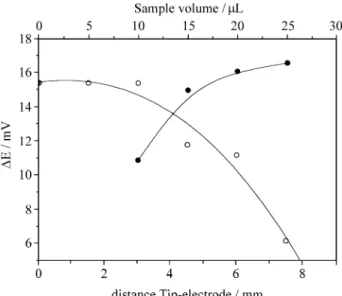
The influence of various factors that affect the BIA-po-tentiometric measurements, such as the distance from the injector-tip to the detector and the injection volume are shown in Fig. 2. It is observed that the potential peak increases with the increase of injection volume up to about 25 µL and then starts to level off. On the other hand it is observed in this figure that the electrode response is main-tained nearly constant with the increase of the distance between the injector tip and the detector up to 3 mm and above this value it decays quickly. It was also observed that a better precision is obtained at slower values of the
dispen-250 Fernandes et al. J. Braz. Chem. Soc.
Figure 1. Schematic diagram of the large-volume Wall-jet cell for BIA-potentiometric system . A. reference electrode; B. salycilate ion-selective electrode; C. micropipet tip; D. stirring bar; E. jacket.
sion rate of the sample solution which is attributed to the finite response time of the electronics involved11. Other factors, such as, the distance between the electrodes and the stirring rate does not affect significantly the measurements. In virtue of these studies the following conditions were chosen for the application of the method: distance between the injector-tip and the detector equal to 1.5 mm; injection volume equal to 15 µL and a dispension time medium or high.
From the study of the behavior of the salicylate ion selective electrode it was observed that it is appropriate to be employed in the dynamic conditions of BIA. In fact the electrode response was rapid(< 2 s) and presented a slope of 43 mV by decade in BIA conditions.
A typical BI profile for the potentiometric determina-tion of acetylsalicylic acid in the range of concentradetermina-tion of 7.5 x 10⁻³ to 7.5 x 10⁻² mol L-1 is shown in Fig. 3. The BI
peaks corresponding to the application of the method for the determination of acetylsalicylic acid in tablets are also presented in this figure. The results of this application are
presented in Table 1. It is observed that the results obtained are higher than those obtained by spectrophotometric means6. Howeven, a significant difference between the results obtained by the proposed method and those obtained by the Standard Method of British Phamacopaeia was not observed12, at the confidence level of 95%.
Certainly the more obvious advantage of the BIA-po-tentiometric method in comparison to the conventional method is the speed. In fact the method permits the execu-tion of 90 determinaexecu-tions per hour. In addiexecu-tion the method presents the advantages of simplicity and the use of low cost apparatus. However the main objective of this work is related to its contribution to a better knowledge of the behaviour of the ion selective electrodes in BIA systems.
References
1. Tam, Y.K.; Au, D.S.L.; Abott, F.S. J. Chromatogr.
1979, 174, 239.
2. Adams, S.; Miller, J. J. Pharm.Pharmacol.1979, 30, 81.
3. Hassam, S.M.; Hamada, M.A. Analyst 1988, 113, 1709.
4. Fung, I.S.; Luk, S.F. Analyst1989, 114, 943. 5. Furman, M.S.M.; Finberg, M.D. J. Pediatr. 1967, 70,
287.
6. Trinder, P. Biochem. J. 1954, 57, 301.
7. Wang, J.; Taha, Z. Anal. Chem. 1991, 63, 1053. 8. Chen, J.L.; Wang, J.; Angnes, L. Electroanalysis
1991, 3, 773.
9. Wang, J.; Taha, Z. Anal. Chim. Acta 1991, 252, 215. 10. Rover Jr, L.; Garcia, C.A.B.; Oliveira Neto, G.;
Kubota, L.T.; Galembeck, F. Anal. Chim. Acta in press.
11. Wang, J.; Chen, L.; Angnes, L.; Tian, B. Anal. Chim. Acta 1992, 267, 171.
12.British Pharmacopaeia, vol. II, University Press, Cambridge, 1980.
13. Christian, G. D. Analytical Chemistry; John Wiley & Sons: New York, 1994, p 39.
FAPESP helped in meeting the publication costs of this article Vol. 9, No. 3, 1998 Acetylsalicylic Acid in Tablets with Salicylate Ion 251
Table 1. Results obtained in the determination of acetylsalicylic acid in tablets.
Sample Nominal value (mg / tablet) Amount of Acetylsalicylic acid found (mg / tablet)
potentiometric Spectrophotometric Method6 * British pharmacopaeia method12 * BIA- method **
Infantile tablet 85 70.0 ± 0.7 83.0 ± 0.7 79 ± 3
Adult tablet 500 460 ± 5 513 ± 5 495 ± 22
* Average of three determinations. ** Average of six determinations.