Printed in Brazil - ©2007 Sociedade Brasileira de Química 0103 - 5053 $6.00+0.00
A
r
ti
c
le
*e-mail: [email protected]
Silsesquioxane 3-
n
-Propylpyridinium Chloride: a New Polymer for the Potentiometric
Analysis of Cr(VI) in Electroplating and Leather Industry Wastes
Alfredo A. Muxel, Débora A. de Jesús, Rení V. S. Alfaya and Antonio A. S. Alfaya*
Departamento de Química, Universidade Estadual de Londrina, CP 6001, 86051-990 Londrina-PR, Brazil
Um novo polímero, cloreto de 3-n-propilpiridínio-silsesquioxano (SiPy+Cl–), foi utilizado
na preparação de um eletrodo. Este eletrodo íon seletivo, formado de um bastão de grafite recoberto pelo polímero, foi construído e avaliado pela determinação de Cr(VI) em amostras de águas residuárias de indústrias de galvanoplastia e de couro. O eletrodo exibiu uma resposta Nernstiana para Cr(VI) entre as concentrações 3,1×10⁻⁶ e 1,8×10⁻² mol L-1 e limite de detecção de 2,8×10⁻⁶ mol L-1 (0,15 ppm). A resposta do eletrodo para Cr(VI) foi rápida (15 s) e o potencial independente do pH na faixa de 3,0 a 7,0. Os coeficientes de seletividade para diversos ânions mostram que o eletrodo apresenta um excelente desempenho. O sensor exibe um tempo de vida útil de 6 meses com boa reprodutibilidade. A determinação de Cr(VI) em águas residuárias de indústrias de galvanoplastia e de couro usando o sensor foi realizada com sucesso.
A new polymer, silsesquioxane 3-n-propylpyridinium chloride (SiPy+Cl–), was used in the
preparation of an electrode. The polymer coated graphite rod ion selective electrode for Cr(VI) was constructed and evaluated for the determination of Cr(VI) in samples of electroplating and leather industry wastes. This electrode exhibited a Nernstian response for Cr(VI) concentrations between 3.1×10⁻⁶ and 1.8×10⁻² mol L-1 and a detection limit of 2.8×10⁻⁶ mol L-1 (0.15 ppm). The response of the electrode for Cr(VI) was fast (15 s) and the independent potential of pH in the range of 3.0 to 7.0. The selectivity coefficients for several anions showed that the electrode presents excellent performance. The sensor exhibits a shelf-life of 6 months with good reproducibility. Determination of Cr(VI) in electroplating and leather wastes using the sensor was successfully achieved.
Keywords: chromium, sensors, chromium-selective electrode, silsesquioxane 3-n-propylpyridinium chloride
Introduction
The interest in chromium speciation originates from widespread use of this metal in many industries, such as: metallurgical (steel, ferrous and nonferrous alloys), refractories, and chemical (pigments, electroplating, tanning and others). Due to these industrial processes, large quantities of Cr compounds are discharged as liquid, solid and gaseous wastes into the environment and can, ultimately, have significant adverse biological and ecological effects.
The two common oxidation states of Cr present in the environment, Cr(III) and Cr(VI), are drastically different in charge, physicochemical properties, as well as, chemical and biochemical reactivity. Cr(III) is considered to be a trace element essential for the proper functioning of living
organisms1-6 while Cr(VI) exerts toxic effects on biological
systems. Occupational exposure to hexavalent Cr compounds leads to a variety of clinical problems7,8 and
Cr(VI) compounds toxicity derives from its ability to diffuse through cell membranes and oxidize biological molecules.9
Extensive efforts have been made to develop a good sensitive sensor for chromium.14-22 However, most of the
sensors already developed do not allow chromium estimation at lower concentrations (< 1 ppm). They exhibit poor selectivity in the presence of common anions, have a non-Nernstian response or a high response time.
Silsesquioxane 3-n-propylpyridinium chloride (Figure 1) is a new water soluble polymer 23 and its most important
characteristic is the capacity of forming a stable thin film on substrate surfaces such as aluminum oxide, cellulose fibers, silica gel or glass surfaces.24,25 The polymer is a strong
anionic exchanger and since the immobilized counterion is the pyridinium ion, the exchange reaction does not depend on the solution pH.26 Considering the excellent capacity of
this new anionic exchanger polymer for forming a thin film on the graphite surface, HCrO4– ion was adsorbed on the
resulting modified surface (graphite rod) by an ion exchange reaction at pH 4.0 and investigated for their response towards anions. The results, reported hereby, show that this polymer presents high selectivity towards chromate ions over a large number of anions and could, therefore, be used as a selective sensor for its quantification. To probe the potential usefulness of the modified electrode as a chemical sensor, the studies were extended to analyze chromate ions in electroplating and leather industry wastes around Londrina city (Paraná state).
Experimental
The polymer silsesquioxane 3-n-propylpyridinium chloride, referred as SiPy+Cl–, was prepared according to a
method described elsewhere.23 All reagents were analytical
grade, without further purification and solutions were prepared with water from a Millipore Milli-Qplus system.
Polymer coated graphite
An electrode was made by inserting, under pressure, a spectroscopically pure 8 mm diameter and 15 cm length graphite cylinder in a Teflon bar hole with the same internal diameter. The graphite surface end was polished and the clean surface was immersed in an aqueous solution of polymer SiPy+Cl– (2.5 % m/v) for 30 min and, then,
dried at room atmosphere.
The infrared spectrum of the thin film on the graphite surface was obtained by using the ATR technique and of the pure polymer as NaBr pellets on a Bomen FT-IR MB series. The electrode, referred to as graph/SiPy+Cl–, was
immersed in a 1.0×10⁻³ mol L-1 K2Cr2O7 solution at pH
4.0 (adjusted with potassium hydrogen phthalate/KOH buffer) for 20 min, rinsed with water and dried at room temperature. The resulting modified electrode is designated (graph/SiPy+) HCrO
4 –.
The electrode was previously equilibrated in a solution of 1.0×10⁻³ mol L-1 Cr(VI) at pH 4.0 (potassium hydrogen
phthalate/KOH) for 2-3 h and was stored dry when not in use.
Sample preparation
Samples of electroplating and leather industry wastes were collected, filtered and stored without any other pretreatment. Suitable aliquots of sample solution were analyzed, after adjustment at pH 4.0. When necessary, appropriate dilutions were done. The analysis were performed by direct potentiometry using calibration plot and the results showed the chromate content in the electroplating and leather industry wastes obtained from triplicate measurements with the sensor (graph/ SiPy+)HCrO
4
– were found to be in agreement with that
determined by spectrofotometric method.27
Potential measurements
The potential measurements were carried out in a thermostated cell at 25.0 ± 0.2 oC. The equipment used
was a Hanna HI 9321 Microprocessor pH meter with 0.1 mV resolution. Saturated calomel was used as the reference electrode, with a double junction containing an external saturated KNO3 solution.
Determination of the potentiometric selectivity coefficients
The interference in the (graph/SiPy+)HCrO 4
– electrode
response of most common species found within the sample wastes were evaluated by determining the potentiometric selectivity coefficient KP
A O ,B
“matched potential method” which is independent of the Nicolsky-Eisenman equation and is recommended by IUPAC.28,29
Results and Discussion
Figure 2a and 2b show the spectra of pure polymer and that of the film on graphite surface, respectively. The bands observed at 1132 cm-1 corresponding to the Si-O-Si stretching
mode and 1630 and 1486 cm-1 corresponding to the pyridinium
ring modes of the pure polymer are observed in the polymer film on graphite surface at 1047, 1630 and 1486 cm-1, indicating
that the polymer film is adhered on the surface.
For the development of the potentiometric method using the coated-graphite rod ion-selective electrode, some analytical parameters were studied, such as: stability of the electrode membrane, response time, life time, dependence of the potential as a function of the Cr(VI) concentration and pH of the medium.. The selectivity and the detection limit of the electrode were also evaluated.
In the aqueous phase, chromium(VI) species could be found in different ionic forms (HCrO4–, Cr
2O7 2–, CrO
4 2–,
HCr2O7–). The distribution of Cr(VI) species is dependent
on both the total concentration of Cr(VI) and pH of the equilibrium solution. The following equations describe the distribution of chromium species in aqueous solution.30-32
H2CrO4 HCrO4– + H+
HCrO4– CrO 4
2– + H+
2HCrO4– Cr 2O7
2– + H 2O
HCr2O7– Cr 2O7
2– + H+
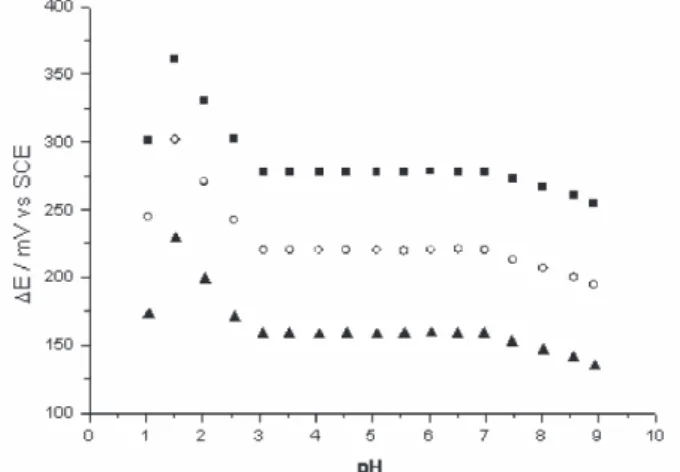
The pH of aqueous 1.0×10⁻³, 1.0×10⁻⁴ and 1.0×10⁻⁵ mol
L-1 solutions were altered by diluted NaOH or HCl solutions
and the potential of the solutions was monitored. The results obtained are shown in Figure 3. In every case, the potential was constant in pH range from 3.0 to 7.0. Below pH 1.5, a decrease of the potential was observed, which could be explained by the protonation of the HCrO4– anion30 forming
H2CrO4, which is leached off from the electrode membrane. For solutions with pH over 7.0, a decrease of the potential was also observed. In alkaline solutions, the hydroxyl ions compete with the adsorbed Cr(VI) anion and by an ion exchange reaction Cr(VI) ions can be leached off from the surface and released to the solution phase. The potential values are drastically changed in pH range from 1.5 to 3.0. This probably corresponds to the decrease in the measurable concentration of HCrO4– and formation of dichromate and
polychromate,33 to which the (graph/SiPy+)HCrO 4
– sensor
does not appear to respond in Nernstian manner. The potentiometric measurements were made at pH 4.0 (potassium hydrogen phthalate/KOH buffer) due to better experimental results, such as, response time and reproducibility.
The response time of the electrode for Cr(VI) solutions in the concentration range of 3.1×10⁻⁶ to 1.8×10⁻² mol L-1
was about 15 s. No potential changes were obtained after 8-9 hours of continuous sampling of a Cr(VI) solution. Also, no memory effect was observed for ten determinations of Cr(VI) solutions alternating the concentrations between 1.0×10⁻⁴ and 5.0×10⁻⁴ mol L-1. The
electrode showed a life-time of six months, with more than 500 determinations for each polymeric membrane and a potential decrease of only 5-10%, compared to the initial response. The calibration plot (Figure 4) has a linear
Figure 3. Effect of the solution pH in the response of the (graph/SiPy+)HCrO 4
–
electrode. Cr(VI) concentrations: ()1.0×10⁻⁵ , (c) 1.0×10⁻⁴ e (c) 1.0×10⁻³
mol L-1.
relationship between the electrode potential and the logarithmic concentration of Cr(VI) in the range of 3.1×10⁻⁶
to 1.8×10⁻² mol L-1, showing linear correlation with the
equation represented by ΔE(mV) = 17.8 – 58.8 log[Cr(VI)]
with r = 0.9999. The angular coefficient of 58.8 is very close to the 59 mV required for Nernstian behavior. The detection limit calculated was 2.8×10⁻⁶ mol L-1 (0.15 ppm).
Potentiometric selectivity
The interference on the electrode response of the species usually found in electroplating and leather industry wastes, such as: Cl– , NO
3 – , HPO
4 2– , SO
4 2–, NO
2 –, C
2O4 2–, MnO
4 –,
Br–, SCN–, I–, F– and CH
3COO
–, was verified by determining
the KP A O ,B
T of the membrane, according to the IUPAC
recommended “matched potential method”, which is independent of the Nicolsky-Eisenman (N-E) equation.28,29
To determine the selectivity coefficient, the potential change was measured by changing the primary ion concentration. The interfering ion was then added to an identical reference solution until the same potential change was obtained. The change in the potential must be produced in a constant initial background of the primary ion and must be the same in both cases.28,29 Table 1 shows the average calculated values,
from five determinations for each sample, by using this methodology. The coefficients were very low (KP
A O ,B
T < 0.001),
Therefore, these studies reveal that the developed
(graph/SiPy+)HCrO 4
– sensor is selective over the commonly
present interfering ions.
Analytical application
The proposed Cr(VI) sensor has been used for determining Cr(VI) in electroplating and leather industry wastes. Sixteen samples from a local electroplating and
Table 2. Determination of Cr(VI) in electroplating and leather waste water using diphenylcarbazide method and (graph/SiPy+)HCrO
4 – sensor
Samples Cr(VI)a/ppm
Spectrophotometry Potentiometry
1 35.1 ± 0.2 34.9 ± 0.2
2 30.5 ± 0.2 30.1 ± 0.3
3 27.4 ± 0.1 26.2 ± 0.2
4 12.3 ± 0.2 10.7 ± 0.3
5 11.2 ± 0.2 11.0 ± 0.3
6 40.7 ± 0.2 40.2 ± 0.4
7 58.6 ± 0.1 57.7 ± 0.2
8 22.3 ± 0.2 22.1 ± 0.2
9 77.5 ± 0.2 77.4 ± 0.3
10 11.1 ± 0.2 11.1 ± 0.4
11 23.6 ± 0.2 23.2 ± 0.4
12 29.4 ± 0.2 28.9 ± 0.2
13 17.6 ± 0.2 17.5 ± 0.4
14 15.4 ± 0.1 15.4 ± 0.4
15 5.6 ± 0.2 4.9 ± 0.3
16 32.9 ± 0.2 32.5 ± 0.3
a Assay values represent the average of three (n=3) determinations.
Table 1. Potentiometric selectivity coefficients for the Cr(VI) (graph/ SiPy+)HCrO
4
- electrode KP A O ,B
Tdetermined by the IUPAC recommended method 29
Interferent ion (B) Selectivity coefficients (KP A O ,B T)
Cl– 0.0009
NO3– 0.0004
HPO42– 0.0007
SO42– 0.00002
NO2– 0.0003
CH3COO– 0.00005
MnO4– 0.00001
C2O42– 0.0005
F– 0.0008
SCN– 0.0003
Br– 0.0006
I– 0.00005
Table 3 - Comparison of the proposed sensor with reported electrodes
S. No. Reference No. Detection limit/ppm Response time/s Life time/month Selectivity
1 19 2.0 nm nm Good
2 20 0.4 30 6 weeks Very good
3 21 2.9 20 12 Good
4 22 0.3 20 5 Very good
5 23 0.2 60 5 Very good
6 (graph/SiPy+)HCrO 4
– sensor 0.15 15 6 Excellent
NM: not mentioned.
leather unit were collected. The analyses were performed by direct potentiometry using calibration plot. The results showed the Cr(VI) content in the samples obtained from triplicate measurements with the sensor were in agreement with those determined by spectrophotometric method (diphenylcarbazide)27 (Table 2). Table 3 compares (graph/
SiPy+)HCrO 4
– sensor characteristics with other electrodes
reported in the literature.
Conclusions
The electrode prepared with silsesquioxane 3-n -propylpyridinium chloride, for the quantification of Cr(VI), proved to be very selective regarding the low detection limit (0.15 ppm) and with fast response time (15 s). The developed sensor is fast, stable, and reproducible. It is easily constructed and presents selective response over a prolonged period. A comparison of the proposed sensor with reported electrodes presented in Table 3, indicates that this sensor is superior not only in the working concentration range and response time, but also with regard to its construction.
Acknowledgments
Authors A.A.S.A. and R.V.S.A. are grateful to Londrina State University (UEL) for the financial support and A.A.M. to the National Counsel of Technological and Scientific Development (CNPq/PIBIC) and D.A.J. to UEL/ IC for undergraduate studies scholarship.
References
1. Anderson, R. A.; Sci. Total Environ.1989, 86, 75.
2. Nieboer, E.; Jusys, A. A. In Chromium in Natural and Human Environments; Nriagu, J.O., Nieboer, E., eds., Wiley Interscience: New York, 1988, pp. 81-104.
3. Mertz, W.; J. Nutr.1993, 123 , 626.
4. Anderson R. A.; In Handbook of Metal-Ligand Interactions in Biological Fluids: Bioinorganic Medicine; Berthon, G., ed., Dekker: New York, 1995, vol. 1, p. 261.
5. Vincent, J. B.; Acc. Chem. Res.2000, 33, 503. 6. Anderson, R. A.; Nutr. Rev..1998, 56, 266. 7. Gad, C. S.; Sci. Total Environ.1989, 86, 149.
8. Lee, K. P.; Ulrico, C.E.; Geil R. G.; Ttochimowicz, H. J.; Sci. Total Environ.1989, 86, 83.
9. Shaffer, R.E.; Cross,; J.O.; Rose-Pehrsson S.L.; Elam, W.T.; Anal. Chim. Acta 2001, 442 , 295.
10. Jain, A. K.; Grupta, V. K.; Singh, L. P.; Srivastava P.; Raisoni, J. R.; Talanta2005, 65, 716.
11. Davidson, C. M.; Thomas, R.P.; McVey, S.E.; Perala, R.; Littlejohn D.; Ure, A.M.; Anal. Chim. Acta1994, 291, 277. 12. Menon, S.; Yilmaz, M.; J. Mol. Struct.2001, 595, 101. 13. Miret, A.; Ruffo, J.; Sastre, A. M.; Cortina, J. L. In Chemical
Industry and Enviroment II, Piccinini, N.; Delorenzo, R. eds., Politecnico di Torino: Torino, 1996, ch. 1.
14. Wang, K.; Yu, R.; Fenxi Huaxue1986, 14, 599. 15. Feng, D.; Chen, C.; Huaxue Xuebao1983, 41, 371.
16. Grtzapis, P. C.; Efstathiou C.E.; Hadjiioannou, T.P.; Anal. Chim. Acta1985, 171, 165.
17. Urusov, Yu. L.; Sergievskii, V.V.; Zhuklov. A.F.; Gordievskii, A.V.; Zh. Anal. Khim. 1979, 34, 156.
18. Granzhan A.V.; Charykov, A.K.; Zh. Anal. Khim.1991, 16 , 2370.
19. Hasan, S.S.M.; Abbas, M.N.; Moustafa, G.A.E.; Talanta1996, 43 , 797.
20. Jain , A. K.; Singh, L.P.; Jain, P.K.; Sens. Actuators, B1995, 24-25 , 729.
21. Jain, A. K.; Gupta, V.K.; Singh, L.P.; Srivastava P.; Raisoni, J. R.; Talanta2005, 65, 716.
22. Alfaya , A.A.S.; Gushikem, Y.; J. Colloid Interf. Sci.1999, 209, 428.
23. Gushikem, Y.; Alfaya, R.V.S.; Alfaya, A.A.S.; Br. Pat., INPI 9803053-1, 1998.
24. Alfaya, R.V.S.; Gushikem, Y.; J. Colloid Interface Sci.1999, 213, 438.
25. Fujiwara, S.T.; Gushikem, Y.; Alfaya, R.V.S.; Colloid Surf. A, Phys. Chem. Eng. Aspects 2001, 178, 135.
26. Oyama, N.; Shimomura, T.; Shigehara, K.; Anson, F.C.; J. Electroanal. Chem. 1980, 112, 271.
27. Greenberg, A. E.; R. Trussell, R.; Clesceri, L.,S.; Franson, M., A., H. eds., Standard Methods for the Examination of Water
and Wastewater, American Public Health Association Water Pollution Control Federation, American Public Health Association: New York, 18th ed., 1992, p. 3-59.
28. Umezawa, Y.; Umezawa, K.; Sato, H.; Pure Appl. Chem.1995,
67, 507.
29. Gadzekpo, V.P.Y ; Christian, G.D.; Anal. Chim. Acta1984, 164, 279.
30. Tandon, R.K.; Crisp, P.T.; Ellis J.; Baker, R.S.; Talanta1984,
31, 227.
31. Brito, F.; Ascanio, J.; Polyhedron1997, 16, 3835.
32. Kabay, N.; Arda, M.; Saha, B.; Streat, M.; React. Funct. Polym. 2003, 54, 103.
33. Vallejo, M.E.; Persin, F.; Innocent, C.; Sistat, P.; Pourcelly, G.; Sep. Purif. Technol.2000, 21, 61.
Received: September 5, 2006