Biocorrosion of Mild Steel by SRB: Electrochemical Studies
Inês T.E. Fonseca*a, M. José Feiob, Ana R. Linob, and Valter L. Rainhaa
a
CECUL, Rua da Escola Politécnica, 58, 1294 LISBOA Co dex, Por tu gal
b
ITQB, Rua da Quinta Grande, Apartado 127, 2780 OEIRAS, Por tu gal
Re ceived: June 30, 1996; No vem ber 13, 1996
Realizaram-se estudos electroquímicos sobre a biocorrosão de aço carbono na presença e ausência de bactérias redutoras de sulfato (SRB) em meios aquosos de lactato/sulfato e lactato/nitrato. Medidas de potencial em circuito aberto revelaram um deslocamento do potencial no sentido dos potenciais mais nobres, em ambos os meios. Contudo, oscilações regulares de potencial foram observadas somente no meio de lactato/sulfato.
As fotografias de SEM revelaram a presença de pites, distribuídas na superfície das amostras em ambos os meios, com pites de pequeno tamanho e de forma mais uniforme no meio de lactato/sulfato, o que está de acordo com os resultados de potencial em circuito aberto. A voltametria cíclica mostrou claramente que as SRBs em meio de lactato/sulfato originam velocidades de dissolução elevadas na região transpassiva, com formação de espécies Fe3+.
Elec tro chem i cal stud ies of the biocorrosion of mild steel in the pres ence and ab sence of sul-fate re duc ing bac te ria (SRB) grown in lac tate/sul sul-fate and lac tate/ni trate aque ous me dia were per formed. Open cir cuit po ten tial mea sure ments re vealed a dis place ment of the po ten tial in the no ble di rec tion in both me dia. How ever, reg u lar os cil la tions in the po ten tial were ob served only in the lac tate/sul fate me dium.
SEM mi cro graphs showned pits clearly dis trib uted over the sur face of the steel sam ples exposed to SRB cul tures in both me dia, with small size and more uni form pits in the lac tate/sul -fate me dia, in agree ment with the open cir cuit po ten tial data. Cy clic voltammetry clearly shows that the SRBs grown in the lac tate/sul fate me dium lead to high dis so lu tion rates in the transpassive re gion with the for ma tion of Fe(III) spe cies.
Key words: biocorrosion, sul fate-reducing bac te ria (SRB), mild steel, elec tro chem i cal data
In tro duc tion
The role of mi cro-organisms on the cor ro sion of met als has re ceived in creas ing at ten tion in re cent years1-4. The pres ence and ac tiv i ties of mi croorganisms can cause se ri -ous prob lems, in in dus try and mil i tary and wher ever met als are pres ent in our so ci ety.
Sul fate-reducing bac te ria, SRB, are an as sem blage of bac te ria that can grow in an aer o bic me dia by the ox i da tion of or ganic nu tri ents, with sul fate be ing re duced to H2S.
The pres ence and met a bolic ac tiv ity of sul-fate-reducing bac te ria on metal sur faces leads to changes in H2S con cen tra tion and pH level in flu enc ing the rates and the type of cor ro sion.
Feio5 has stud ied the growth of Desulfovibrio
desulfuricansATCC 27774 bac te ria in lac tate/sul fate, as well as in lac tate/ni trate me dia, at 37 ºC, in the pres ence of mild steel. From these stud ies growth curves such as those given in Fig. 1 were ob tained. The curves in Fig. 1 show that there is a pe riod in which the bac te ria pop u la tion in-creases al most ex po nen tially, and af ter about two days a steady-state of 60 x 106 cells/cm2is reached.
In the sul fate me dium the met a bolic ac tiv ity of SRB leads to the pro duc tion of S2-, while in the ni trate me dium the re duc tion pro cess leads to NH4+, ac cord ing to the mech a nism pro posed by sev eral au thors6, 7.
Biofilm for ma tion nec es sar ily plays an im por tant role in the cor ro sion pro cess, but the ex act de scrip tion of the biofilm has not yet been es tab lished. Biocorrosion, like Ar ti cle
many other cor ro sion pro cesses, is es sen tially due to elec-tro chem i cal re ac tions; there fore elec elec-tro chem i cal tech-niques are nec es sar ily good tools to eval u ate, mon i tor, and un der stand biocorrosion both in field and lab o ra tory stud-ies. Ex ten sive elec tro chem i cal stud ies of mild steel sam-ples ex posed to the bac te ria cul tures of Desulfovibrio desulfuricansATCC 27774, in ei ther the lac tate/sul fate or the lac tate/ ni trate me dium, have been per formed in our lab o ra tory8-10.
Cy clic voltammograms (CVs), open cir cuit po ten tial curves, and re dox po ten tials of mild steel in lac tate/sul fate and lac tate/ni trate me dia will be re ported in this pa per.
Elec tro chem i cal data is com ple mented with scan ning elec tron mi cro graphs and other tech niques.
Ma te rials and Methods
Studies were per formed with pure cul tures of the strain
Desulfovibrio desulfuricansATCC 27774, grown in a lactate/sul fate or a lac tate/ni trate me dium with the com po si -tion as given in Ta ble 1. The me dia were pre pared by se quen tial ad di tion of the com pounds to pure wa ter. The pH was ad justed to 7.6 af ter deaeration with pure ni tro gen, and the so lu tions were ster il ized at 120 ºC for 30 min. In oc -u lates were made at 10% (v:v) in jec tions of steady-state (1 day) cul tures.
Steel sam ples were made from steel with the nom i nal com po si tion given in Ta ble 2.
All ex per i ments were per formed at 37 ºC (op ti mum growth tem per a ture for the strain un der study).
The open cir cuit po ten tial of each sys tem was mea sured against a com mer cial sat u rated cal o mel elec trode from Ra-di om e ter®, model K401. The ref er ence elec trode was placed in a sep a rate com part ment, con nected to the main so lu tion by a KNO3 salt bridge. The work ing elec trode, a 0.2 cm2 mild steel disk was pre-treated, as de scribed above.
A HP®34401A dig i tal multimeter con nected by an in-ter face RS-232 to an IBM® PC model 80286, al lowed au to -matic data ac qui si tion at short enough in ter vals to as sume a
quasi-continuous mea sure ment. For the mea sure ments in the bac te ria cul tures, in oc u la tion was made at time t = 0.
Potentiodynamic curves were run with a PARC wave-form gen er a tor, model 173, cou pled to a PARC potentiostat, model 178 and re corded on an x-y re corder from Philips, model PM 8120.
A con ven tional three-electrode two-compartment glass cell was used. The sec ond ary elec trode was a long he lix of Pt wire and the ref er ence was a com mer cial sat u rated cal o -mel elec trode (E0 = 0.242 Vvs. SHE).
Be fore each run the work ing elec trode (a 0.2 cm2 mild steel disk) was pol ished when nec es sary, and then washed and dried.
Fig ure 1. Growth curves of Desulfovibrio desulfuricans ATCC 27774 in lac tate/sul fate and lac tate/ni trate me dia 5.
Ta ble 1. Chem i cal com po si tion of the lac tate/ni trate and lac tate/sul -phate me dia.
Lac tate/Ni trate me dium
Com pounds Amounts / 1000 mL
NH4Cl 2 g
MgCl2.6H2O 2 g
K2HPO4 0.5 g
NaNO3 2.4 g
FeCl2.4H20 0.007 g
CaCl2 0.20 g
Min eral com ple ment 1 mL
So dium Lac tate 60% (w/w) 12.5 mL Yeast ex tract 1 g
Cysteine 0.25 g
Lac tate/Sul phate me dium
Com pounds Amounts / 1000 mL
NH4Cl 2 g
MgSO4.7H2O 2 g
K2HPO4 0.5 g
Na2SO4 4 g
FeSO4.9H20 0.010 g
CaCl2 0.20 g
Na2S. 9H20 0.25 g
Wolfe’s min er als 1 mL So dium Lac tate 60% (w/w) 12.5 mL
Yeast ex tract 1 g Cysteine-HCl 0.25 g
Ta ble 2. Nom i nal chem i cal com po si tion of mild steel (% p/p).
Fe C S Si Mn P
Re sults and Dis cus sion
Open cir cuit po ten tial mea sure ments
The open cir cuit po ten tial, Eocp, of mild steel in the var i -ous me dia un der study was fol lowed and stored over 50 h of ex po sure. The cor re spond ing Eocpvs. time curves are given in Fig. 2.
Dur ing the first 20 h of ex po sure in the ab sence of the bac te ria cul ture the Eocp kept an al most con stant value of -600 and -625 mVvs.SCE in the lac tate/ni trate and the lac-tate/sul fate me dia, re spec tively. There af ter, in the lac-tate/ni trate me dium, Eocp is slightly dis placed in the neg a tive di rec tion (600 to 625), while in the lac tate/sul -fate me dium a slight dis place ment in the pos i tive di rec tion was ob served (-625 to -600 mVvs. SCE). The pres ence of a SRB cul ture in the lac tate/ni trate me dium leads to a slight dis place ment of the po ten tial in the neg a tive di rec tion dur-ing the first 5 h, fol lowed by a rapid in crease in the pos i tive di rec tion from -650 to -400 mVvs. SCE. In the lac tate/sul -fate me dium with the SRB the Eocp also var ies from -600 to -400 mVvs.SCE, but at a slower rate, over 20 h of ex po -sure. There af ter, strong and reg u lar os cil la tions in the Eocp val ues are ob served, the av er age value be ing on the or der of -0.389 ± 0.009 Vvs.SCE. On the other hand, in the
lac-tate/ni trate me dium with SRB, large (-400 to -300 mV) and long (5 h) os cil la tions are ob served be tween 40 and 50 h of ex po sure.
The re sults of the Eocp mea sure ments showed that in both cul ture me dia (lac tate/ni trate and lac tate/sul fate) the SRB lead to a sig nif i cant dis place ment of the cor ro sion po-ten tial in the pos i tive di rec tion. This en no ble ment may be due to the for ma tion of a pas sive film, the ki net ics of which are fast in the lac tate/ni trate me dium. The strong os cil la -tions in the Eocp af ter long ex po sures are also in dic a tive of the on set of lo cal ized cor ro sion, i.e., pit ting due to the lo cal rup ture or dis so lu tion of the pas sive film. Videla11 has dem on strated that the pas sive film formed un der ac tive SRB biofilm may lead to a pit ting at tack of steel. How ever, a de fin i tive in ter pre ta tion of the re sults can not be ob tained based only on these mea sure ments. Re sults need to be com-ple mented by ad di tional data, such as re dox po ten tial mea-sure ments and re sis tance po lar iza tion mea mea-sure ments.
The en no ble ment does not di rectly dem on strate an in-crease in the re sis tance to cor ro sion. It may be due to ki-netic ef fects, ther mo dy namic ef fects, or both. On the other hand, the en no ble ment may be re lated not only to the an-odic re ac tion, but also to changes in the cath an-odic prop er ties of the sam ple as a re sult of the mi cro bial ac tiv ity on the sur-face.
Re dox po ten tial mea sure ments
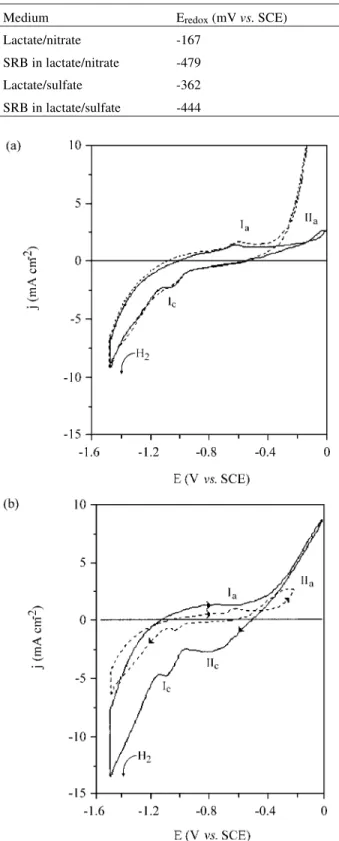
Ta ble 3 gives the re dox po ten tials ob tained for the var i -ous me dia un der study.
In both cases, the re dox po ten tials in di cate, in agree-ment with other data, an in crease in the aggressivity of the me dium due to the pres ence of a bac te rial cul ture.
The dif fer ence ob served be tween the re dox po ten tials of both ster ile me dia may be ex plained by the fact that the lac tate/sul fate me dium has been poi soned which sul fide (see Ta ble 1) added to en sure a very re duc ing en vi ron ment, while in the lac tate/ni trate me dium the bac te rial growth is en sured only by deaeration.
The re dox po ten tials in the pres ence of SRB in both me-dia pres ent about the same value ( -450 mVvs. SCE)
Cy clic voltammetry
Cy clic voltammetric ex per i ments were per formed for mild steel im mersed in the var i ous me dia un der study. Typ-i cal CVs re corded at 20 mV/s are gTyp-iven Typ-in FTyp-ig. 3. The CVs show clearly no ef fects due to the SRB in the lac tate/ni trate me dium be tween -1.5 and -0.4 Vvs. SCE. At the up per po-ten tial limit of about -0.4 Vvs. SCE a de crease in the an odic transpassive cur rent due to SRB is clearly vis i ble. In any case the cath odic side of the CV shows only one peak lo-cated around -1.0 Vvs. SCE.
Com pletely dif fer ent be hav ior is ob served in the lac-tate/sul fate me dium. Both the an odic and the cathodic sides Fig ure 2. Open cir cuit po ten tial curves of mild steel in the (a)
of the CVs are in flu enced by the pres ence of SRB. The charge in the voltammetric curve in creases over the en tire
po ten tial po lar iza tion re gion (-1.5 to 0 Vvs. SCE), the ef-fect be ing par tic u larly strong in the transpassive re gion (at about -0.4 Vvs. SCE). Two cath odic peaks are ob served at -0.65 and -1.0 Vvs. SCE, while in the ab sence of SRB, only the cath odic peak around -1.0 Vvs. SCE was re corded. This is a clear in di ca tion that SRB in the lac tate/sul fate me-dium lead to the for ma tion of Fe(III) spe cies when ever po-lar iza tions higher than -0.4 V are ap plied. The H2 evo lu tion re ac tion is also strongly cat a lyzed by SRB in the lac-tate/sul fate me dium.
Un der the ex per i men tal con di tions of Fig. 3, an hys ter -esis loop in the re verse scan is ob served for both base cul-tural me dia (lac tate/ni trate and lac tate/sul fate) in the ab sence of SRB and also in their pres ence, but in this case only in the lac tate/ni trate me dium. The cross over (hys ter esis loop) is an in di ca tion of the on set of lo cal ized cor ro -sion of the base metal (the for ma tion of pits nu cle at ing the base metal af ter or si mul ta neous with the lo cal dis so lu tion of the pas si vat ing film).
The oc cur rence of pit ting in the ab sence of SRB is most prob a bly due to the amount of Cl- in the min eral base me dia (see Ta ble 1). The high transpassive cur rents ob served with the bac te ria cul ture in the lac tate/sul fate me dium, shown in Fig. 3(b), clearly in di cate the high aggressivity of the me-dium in duced by the mi cro bial ac tiv ity of the SRB cul ture in the lac tate/sul fate me dium, most prob a bly due to changes in pH (pro duc tion of or ganic or min eral ac ids), lead ing to the elec tro chem i cal dis so lu tion of the pas si vat -ing film.
Pitting has been con firmed by SEM mi cro graphs (see Fig. 4). Fig ure 4 shows mi cro graphs of the mild steel sam-ples af ter 21 days of ex po sure in the lac tate/sul fate and the lac tate/ni trate me dia in the pres ence of SRB (af ter biofilm and cor ro sion prod ucts re moval).
The pho to mi cro graphs given clearly show pits dis trib -uted over the sur face of the steel sam ples ex posed to SRB cul tures in both me dia; how ever the pits of the ex posed sam ples in the lac tate/sul fate me dium are small and more uni form in shape, in agree ment with open cir cuit po ten tial data.
Con cluding Re marks
The pres ence of SRB shifts the cor ro sion po ten tial to more pos i tive val ues, but in tro duces os cil la tions in dic a tive of lo cal ized cor ro sion; the po ten tial os cil la tions are par tic -u larly well de fined and reg -u lar in sam ples ex posed to SRB grown in the lac tate/sul fate me dium.
With out sul fate the re sults in the ster ile me dium and in the SRB cul ture are sim i lar, while in its pres ence their strong in flu ence is well dem on strated: the re duc tion of SO42- to S2- or H2S is a key pro cess in SRBinduced cor ro -sion.
Ta ble 3. Re dox po ten tials for the var i ous me dia un der study.
Me dium Ere dox (mVvs. SCE) Lac tate/ni trate -167
SRB in lac tate/ni trate -479 Lac tate/sul fate -362
SRB in lac tate/sul fate -444
The es tab lish ment of a mech a nism for the an aer o bic cor ro sion of mild steel in a SRB cul ture in ei ther a lactate/ni trate or lac tate/sul fate me dium re quires com ple men -tary stud ies, e.g., cell-counting, bac te ria ac tiv ity, hydrogenase ac tiv ity, de ple tion of ni trate, sul fate and lac-tate, H2S/S2- and pH eval u a tions, etc. Some of these stud ies are in prog ress, and with them we ex pect to be able to cor re -late some of the vari ables and to make con tri bu tions in or-der to sup port mech a nisms al ready pro posed.
The use of other elec tro chem i cal tech niques, namely, microelectrodes, split-cells and noise anal y sis, may also lead to use ful data, par tic u larly when lo cal ized cor ro sion is in volved.
Ac knowl edg ments
V.R. thanks the Junta Nacional de Investigação Científica e Tecnológica (JNICT) for a fel low ship (FMRH/ BIC/1394/94).
The au thors thank JNICT (EU REKA-CAMICO pro-ject 1121 and CECUL Unidade I & D 301/94) for fi nan cial sup port. The sup port of Grace Dear born (Wa ter Sys tems) is also ac knowl edged.
Thanks are also due to Prof. J.J.G. Moura for help ful sug ges tions and com ments.
Ref er ences
1. Iverson, W.P.Adv. Appl. Microbiol.1987,32, 1. 2. Edyvean, R.G.J.; Videla, H.A. Interdis. Sci. Rev.
1981,16, 267.
3. Sand, W.Werkstoffe und Korrosion1994,45, 10. 4. Lee, W.; Lewandowski, Z.; Niel sen, P.H.; Ham il ton,
W.A.Biofouling1995,8, 165.
5. Feio, M.J. InBiocorrosão: Mecanismo e Controlo;
Fi nal year re port; FCUL; Lisboa, 1993.
6. Cord-Ruwish, R.; Widell, F. Appl. Microbiol. Biotechnol.1986,25, 165.
7. Pankhania, I.P.; Moosavi, A.N.; Ham il ton, W.A.J. Gen. Microbiol.1986,132, 3357.
8. Rainha, V.L. InBiocorrosão de aços pelas Bactérias Redutoras de Sulfato; Fi nal year re port; FCUL; Lisboa, 1994.
9. Fonseca, I.T.E.; Lino, A.R.; Rainha, V.L. In The Pro-ceed ings of the 3rd In ter na tional EFC Work shop; In-sti tute of Ma te rials; Lon don, 1995, p 188.
10. Fonseca, I.T.E.; Lino, A.R.; Feio, M.J.; Rainha, V.L.
Corr. e Prot. Mat.1996,15, 6.
11. Videla, H.A. In Bi o log i cal In duced Cor ro sion, NACE-8; Dex ter, S.G. Ed.; Hous ton, TX, 1985, p 162. Fig ure 4. Mi cro graphs of mild steel sam ples af ter 21 days of ex po sure