An Electrochemical Study of the Crevice Corrosion of Titanium
M.M. Pariona*, and I.L. Müller
Universidade Fed eral do Rio Grande do Sul, Escola de Engenharia,
Programa de Pós-graduação em Engenharia Metalúrgica e dos Materiais -PPGEMM,
Av. Osvaldo Aranha 99, 6° andar, 90035-190 Porto Alegre - RS, Brazil
Re ceived: June 30, 1996; De cem ber 16, 1996
Estudou-se a influência de diferentes fatores na corrosão por fresta em titânio comercialmente puro, em cloreto de sódio, a temperaturas intermediárias. Investigou-se as condições de pH, desarejamento do meio, temperatura e das caraterísticas geométricas da fresta, sob as quais este tipo de corrosão se apresenta. O tipo de íon de titânio que predomina na zona ativa foi determinado como sendo Ti3+. Foram usadas técnicas eletroquímicas e gravimétricas. Pites foram encontrados no titânio apenas a al tos potenciais (~5,3V) mas a corrosão por fresta pode aparecer ao potencial de corrosão. A utilização de uma célula de dois compartimentos mostrou que não se pode ultrapassar uma relação máxima en tre área catódica e anódica para poder modelar a ativação da superfície metálica dentro da fresta. O desenvolvimento de uma queda ôhmica através dos produtos de corrosão na entrada da fresta é proposto como um fator estabilizador da corrosão.
The in flu ence of dif fer ent pa ram e ters (pH and aer a tion of the so lu tions, tem per a ture and geo met ric fea tures) on the elec tro chem i cal be hav ior of com mer cially pure ti ta nium in so dium chlo ride so lu tions at in ter me di ate tem per a tures was stud ied, with the aim of con trib ut ing to the un der stand ing of the crev ice cor ro sion sus cep ti bil ity of this metal. The ti ta nium ion that forms in the ac tive dis so lu tion re gion was de ter mined bo be Ti3+. Elec tro chem i cal and gravimetric tech niques were used. Pitting of ti ta nium was found only at high an odic overpotentials (~5.3V), but crev ice cor ro sion can oc cur at the free cor ro sion po ten tial. The uti li za tion of a two-compartment cell showed that a max i mum ra tio of cath odic area to an odic area can not be sur passed in or der to model the ac ti va tion of the me tal lic sur face in the crev ice. The de vel op -ment of an ohmic drop through the cor ro sion prod ucts at the en trance of the crev ice is pro posed as a sta bi liz ing fac tor in the cor ro sion pro cess.
Key words: crev ice cor ro sion, ti ta nium
In tro duc tion
Crev ice cor ro sion is a lo cal ized form of cor ro sion which is very dif fi cult to pre dict, and which can oc cur when me tal lic parts in close con tact with non-metallic or other me tal lic ma te ri als are im mersed in cor ro sive so lu tions, mainly those con tain ing chlo rides or other ag gres sive ions. This type of cor ro sion has been de tected in ma te ri als which are nor mally pas sive in the stud ied so lu tions, as is the case of ti ta nium and its al loys in chlo ride so lu tions1-3. The first
stud ies of crev ice cor ro sion of ti ta nium in so dium chlo ride de rived from prac ti cal prob lems in the chem i cal in dus tries,
where, due to its ex cel lent re sis tance to gen eral cor ro sion, this metal has been ex ten sively em ployed.
As the elec tro chem i cal be hav ior of ti ta nium in acid so -lu tions has be come more in ves ti gated2,4,5, sev eral pro pos -als have been made for the con di tions of the so lu tion and the po ten tial in side the crev ice. Au thors gen er ally agree that the so lu tion in the crev ice is deoxygenated, very acidic, and con cen trated in the ag gres sive an ions and me -tal lic ions3. Some mathemathical mod els are used to sim u -late the pro files of the con cen tra tion, po ten tial, or cur rent in the crev ice6. Re cently, microelectrodes have been used to
mea sure vari ables such as pH, cur rent and po ten tial in side
Ar ti cle
the crev ice as a func tion of time7. Nev er the less, the
reproducibility of crev ice cor ro sion tests is poor, in duc tion times may be long and no sat is fac tory re la tion of these times to geo met ric fac tors (i.e. crev ice width and depth, mi -cro- and ma-cro-roughness of the crev ice wall), nor to other vari ables such as tem per a ture and the na ture of the ma te rial in con tact with the metal, has been pro posed. More over, not with stand ing the fact that the at tain ment of a crit i cal con di tion of crev ice so lu tion is gen er ally ad mit ted, it is not clear how this con di tion is sta bi lized over time.
In this work, crev ice cor ro sion of com mer cially pure ti ta nium was stud ied us ing dif fer ent elec tro chem i cal tech -niques: potentiodynamic po lar iza tion curves, spon ta ne ous ac ti va tion mea sure ments, elec tro chem i cal sim u la tion of crev ice cor ro sion in a two-compartment cell, and the re dox po ten tial mea sure ment of the sim u lated crev ice so lu tion. Im mer sion tests in an au to clave were also per formed. Cor -ro sion p-rod ucts were an a lyzed by Raman spect-roscoy, X-ray dif frac tion, and scan ning elec tron mi cros copy (SEM).
Ex per i men tal
The test spec i mens of com mer cially pure ti ta nium were used in block or sheet forms of dif fer ent di men sions, with the sam ple ar eas ex posed to the so lu tion varyng from 1 to 12 cm2. The spec i mens were pol ished with sil i con car bide pa per (from 100 to 2400 grit). For the elec tro chem i cal tests, sam ples were pre pared with out or with crev ices ob tained by fas ten ing an acrylic sheet with a Ti screw on the sam ple sur face. For the im mer sion tests in the au to clave, crev ices were pro duced by ty ing sand wiches of in ert ma te rial and ti ta nium plates to gether with PTFE tape. In the elec tro chem -i cal tests, the Py rex cell con ta-in -ing the sam ples was placed in side a wa ter bath at room tem per a ture or at 50, 70, or 90 °C. The so lu tion used was 1 M so dium chlo ride pre pared with dou ble dis tilled wa ter, acid i fied with HCl, so as vary the pH be tween 0.87 and 6.72. Some tests were made in Na2SO4 at pH 6.72. For the deaerated tests, pure ni tro gen
was bub bled in the so lu tions. The pH within the crev ice was mea sured with pH-indicating pa per af ter the test. The ref er ence elec trode used a the sat u rated cal o mel elec trode (SCE), and all po ten tials in the text are re ferred to it. The equip ment used in the elec tro chem i cal tech niques in cluded a potentiostat (PAR model 174), a pro gram mer con trol ling the po ten tial scans (BESPW model SMP 72), and an xt re -corder (ECB).
Re sults and Dis cus sion
Spon ta ne ous ac ti va tion curves
The ef fect of the en vi ron men tal vari ables (pH, so lu tion tem per a ture, and the pres ence or ab sence of O2) on crev ice
cor ro sion was stud ied by mea sur ing the spon ta ne ous ac ti -va tion time, mon i tor ing the cor ro sion po ten tial, Ecorr ,as a
func tion of time, of uncreviced sam ples in NaCl so lu tions. This type of test eval u ates the en vi ron men tal con di tions un der which crev ice cor ro sion may take place.
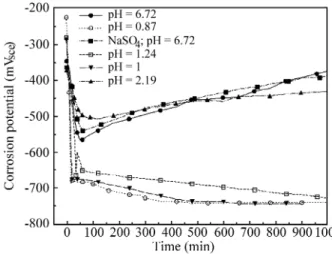
Fig ure 1 shows the ef fect of pH on the Ecorrvs. time (t)
curves in deaerated me dium. It is ob served that, for pH 2, for both NaCl and Na2SO4, the pre-existent ox ide film on
the ti ta nium sam ple tends to dis solve ini tially. The po ten -tial drops to ap prox i mately -550 mV, but these so lu tions seem un able to com pletely dis solve the film, since the po ten tial soon in creases again to less neg a tive val ues. This in -crease in di cates a new for ma tion or trans for ma tion of a pas sive film, which was con firmed by a change in the su -per fi cial color to dark gray. This film for ma tion may be due to a re ac tion of the metal with wa ter.
At pH 2, dis so lu tion of the ox ide film is more ef fec tive. In the same fig ure it can be ob served that the po ten tial de -cay is faster for lower pHs, sta bi liz ing at a con stant value of around 720 mV. This kind of ex per i ment in very acid so lu -tions was also car ried out by Kelly2, who ob served a
change in the slope of the de cay curve at trib uted to a tran si -tion from a thin ox ide phase to a monolayer of ad sorbed spe cies.
In the equi lib rium po ten tialpH di a gram at 90 °C pre -sented by Lee4, the po ten tial value of -720 mV is sit u ated in
the Ti2+ zone, al most on the bor der with the Ti3+ zone, in di
-cat ing that Ti may dis solve with the for ma tion of one or both of these spe cies.
The ef fect of tem per a ture on spon ta ne ous ac ti va tion was also stud ied. It was ob served that the dis so lu tion of the ox ide film be came faster as the tem per a ture in creased. The sta tion ary po ten tials were also more neg a tive at higher tem per a tures, which means that cor ro sion is more likely as the tem per a ture in creases.
Potentiodynamic curves af ter spon ta ne ous ac ti va tion
Fig ure 2 shows potendiodynamic po lar iza tion curves ob tained af ter the spec i mens were pre vi ously ex posed to
the so lu tions for 1000 min, as in Fig. 1. This fig ure shows the ef fect of pH on the an odic po lar iza tion curves. At pHs less than 2, there is al ways an ac tive cur rent peak at low po -ten tials. The peak cur rent den sity, im, in creases and the cor
-re spond ing po ten tial, Em, also in creases when the pH
de creases, in agree ment with Kelly’s data2. At pHs greater than 2, the ac tive peak is not vis i ble and a sec ond peak ap -pears at higher po ten tials; this peak po ten tial in creases as the pH is raised. A sim i lar peak was ob served by Levy and Sklover5 for com mer cial ti ta nium in 5% HCl, and was at
-trib uted to a sec ond ary ac tive-passive tran si tion. Shibata and Ameer8 ob served a sim i lar peakfor zir co nium in 1 N H2SO4 at 30 °C, which it ap pears at 1.8 V vs. Ag/AgCl.
These au thors at trib uted this peak to a phase change in the film that passes from a thin film be fore the peak to a thick golden film with struc tural de fects af ter the peak. The re ac -tions that oc cur in zir co nium and ti ta nium may be sim i lar, as they both be long to the pe ri odic group 4.
The tem per a ture did not show any sig nif i cant in flu ence on Em, which re mained al most con stant at -650 mV; im, on
the other hand in creased when the tem per a ture in creased, in agree ment with re sults re ported by Griess1 and Kelly2.
Above 3 V, the cur rent in creases more rap idly at higher tem per a tures. Nev er the less, no pit ting was ob served in this zone. Thus, it was as sumed that the an odic re ac tion in this zone cor re sponds to the ox i da tion of wa ter. Using ex per i men tal data for tem per a tures be tween 50 and 90 °C, the ac -ti va -tion en ergy for the dis so lu -tion of -ti ta nium was ob tained from the slope of the ln imvs. 1/T plot; the re sult ing value
(5.3 kcal/mol) is quite low when com pared with the value ob tained by Kelly in a so lu tion of HCl 0.1 M + NaCl 0.9 M (11 kcal/mol) but his data were ob tained at lower tem per a tures (be tween 30 and 75 °C) which may in di cate some dif -fer ence in the dis so lu tion path.
Sim u la tion of the crev ice con di tions in a two-compartment cell
The ob jec tive of sim u lat ing crev ice cor ro sion con di -tions in a two-compartment cell is to eval u ate the ef fect of the elec tro lyte com po si tion, the aer a tion of the ano lyte and catholyte, and the ra tio be tween the an odic area (Aa) and
the cath odic area (Ac), on the cor ro sion pro cess at the an
ode, un der purely spon ta ne ous con di tions (with out the ap -pli ca tion of an ex ter nal cur rent).
For this type of test, two phys i cally sep a rated metal sam ples (with out crev ices) were used, which were linked to each other by means of a potentiostat act ing as a zero re -sis tance am me ter which main tained the sam ples at a zero po ten tial dif fer ence and si mul ta neously read the short-circuit cur rent. Both com part ments were con nected through a salt bridge; one sam ple was im mersed in a NaCl so lu tion, acid i fied to pH 1 and deaerated with N2, sim u lat
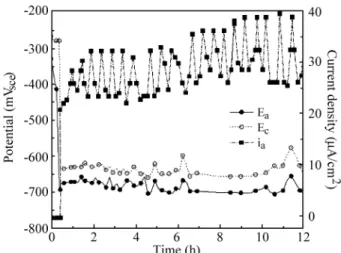
-ing the crev ice en vi ron ment (an odic sam ple). The other sam ple was im mersed in a neu tral aer ated NaCl so lu tion, rep re sent ing the ex ter nal sur face of the crev ice (cath odic sam ple). The po ten tials of both sam ples were in de pend -ently mon i tored with the help of high re sis tance voltammeters and sat u rated cal o mel ref er ence elec trodes. Fig ure 3 pres ents the vari a tions of the an ode (Ea) and
cath ode (Ec) po ten tials, and the an odic cur rent den sity as a
func tion of time. Ini tially, both sam ples were pas sive and showed rel a tively high po ten tials, but soon these po ten tials dropped, show ing that an ode ac ti va tion oc curred. Ec al
-ways re mained higher than Ea. The cur rent den sity ac com
-pa nied the po ten tial vari a tion. Ini tially, there was lit tle cur rent cir cu lat ing, but then the cur rent in creased with in -tense os cil la tion, which may be at trib uted to rup ture and ref or ma tion ep i sodes of the pas sive film on the an odic sur -face.
Fig ure 2. Potentiodynamic curves for dif fer ent pHs af ter spon ta ne ous
Kain and Lee9 pro posed four stages of crev ice cor ro
sion. The first (ex haus tion of ox y gen) and the sec ond (in -crease of acid ity and chlo ride con tent) are as sumed to have al ready oc curred in the pres ent tech nique, be cause an acid and deaerated so lu tion is used in the an odic com part ment of the cell. So, only the last two stages are sim u lated, be ing the per ma nent rup ture of the pas sive film and the prop a ga -tion of crev ice cor ro sion at the an ode.
The fol low ing area ra tios (Ac/Aa) were tested: 8.0; 1.5;
1.0, and 0.6. It was found that for ti ta nium, the ra tio should be less than 1 in or der for cor ro sion to set in. Oth er wise os cil la tions be tween an odic and cath odic cur rent val ues oc -cur. These re sults are con trary to those of Rosenfeld and Marshakov who sup posed that an in crease in the above-mentioned area ra tio would al ways in crease crev ice cor ro sion10. How ever, they are sim i lar to those ob tained by
Kain and Lee for stain less steel11. The re sults may be ex
-plained by hy po thet i cal an odic and cath odic po lar iza tion curves, con sid er ing that re duc tion of ox y gen oc curs in the cath odic zone where the pH of the so lu tion is neu tral. When Ac/Aa is too high, the cath odic curve should in ter cept the
an odic curve at a po ten tial in the pas sive zone, and this sit u -a tion is not ex pected to le-ad to crev ice cor ro sion. When this ra tio is small, the in ter cep tion is ex pected in the ac tive zone of the an ode. An other pos si bil ity in this sec ond case is to as sume that there is a rea son able dif fer ence be tween Ec and
Ea , which may cor re spond to an ohmic drop be tween the
in side and the out side of the crev ice, as sug gested by Shaw
et al. for the crev ice cor ro sion of a nickel al loy12.
It was also ob served that cor ro sion does not take place when the cell com part ment con tain ing the an ode is aer ated, de spite a pH of 1, in agree ment with the re sults of Kain and Lee for stain less steels11. This con firms that ox y gen de ple -tion of the crev ice is a nec es sary step for crev ice cor ro sion in ti ta nium.
Re dox po ten tial
Fig ure 4 pres ents the re dox po ten tial (Ere dox) of a 1 M
NaCl so lu tion, with an ini tial pH = 1, at a tem per a ture of 90 °C in con tact with ti ta nium fil ings, in a deaerated N2 me
dium. This so lu tion rep re sents the one that would be gen er -ated by crev ice cor ro sion. Ere dox be comes more neg a tive
with time, at tain ing a value of -450 mV af ter 30 h. It should be noted that af ter 15 h the so lu tion changed from col or less to vi o let blue, in di cat ing the pres ence of Ti3+, which should
there fore be ex pected in the crev ice, in agree ment with the Pourbaix di a gram4 and with the cor ro sion po ten tial val ues
of Fig. 1, which also point to the pres ence of Ti3+ in the
crev ice so lu tion.
Dis con tin u ous and con tin u ous cy clic voltammetric curves
Fig ure 5 shows the dis con tin u ous and con tin u ous cy clic voltammetric curves ob tained in 1 M NaCl at 90 °C. Curves
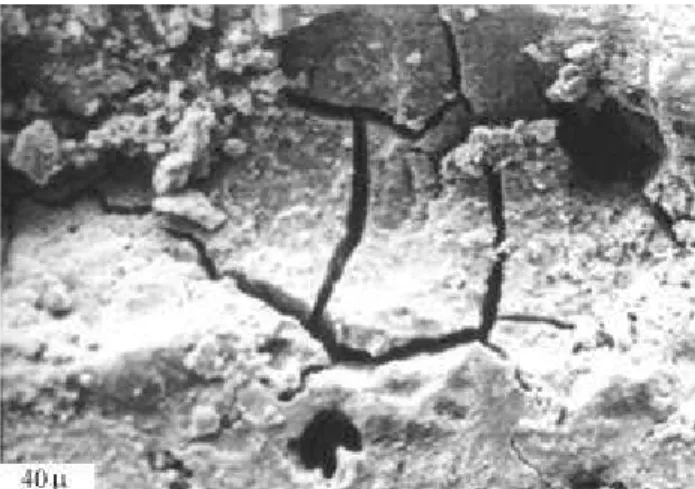
1 and 2 are dis con tin u ous curves with a hold at +5300 mV (with a crev ice, a for ward scan at v = 1200 V/min and a re -verse at v = 120 mV/min) and curve 3 is a con tin u ous one (with out a crev ice, and with scan ning in both di rec tions at v = 1200 mV/min). When the po ten tial was main tained at +5300 mV for 120 min (curve 1), the cur rent den sity, in spite of de creas ing with time, showed fairly high val ues (higher than 70 µA.cm-2). On re vers ing the po ten tial scan, the sam ple repassivated with an os cil lat ing cur rent. Af ter the test, a deep hole was ob served in the crev ice, shown in the SEM mi cro graph of Fig. 6.
Curve 2 was ob tained by hold ing the po ten tial at +5300 mV for 200 min. The cur rent in creased dur ing the hold. Fig ure 4. Vari a tion of the re dox po ten tial of a deaerated 1 M NaCl so -lu tion, pH = 1, in the pres ence of Ti fil ings (T = 90 °C).
When the po ten tial scan was re versed, the sam ple repassivated slowly. At the end of the test there were sev -eral holes and some cor ro sion prod uct in the crev ice, and pit ting was also ob served on the free sur face. This po ten tial is there fore higher than or equal to the pit ting po ten tial, as pits were formed in the area ex posed to the bulk so lu tion. Uhlig and Revie13 re ported a pit ting po ten tial of 6.74 V at 90 °C.
The con tin u ous curve 3 pres ents de creas ing cur rents on the re verse scan. No cor ro sion was ob served, only a sur face color change to dark blue, prob a bly as so ci ated with a mod i -fi ca tion in the pas si vat ing -film. These ex per i ments show that even ex cur sions to high po ten tials fail to pro mote in -stan ta neous lo cal ized cor ro sion of ti ta nium, in spite of the pres ence of a phys i cal crev ice. Nev er the less, crev ice cor ro -sion is nu cle ated sooner than pit ting at the same po ten tials.
When the spec i men was main tained at +5300 mV for 930 min in the same so lu tion, cat a strophic cor ro sion oc curred through out the whole sam ple, be ing more pro -nounced within the crev ice. The pH in the crev ice was about 1, and great quan ti ties of cor ro sion prod uct pre cip i -tated. This prod uct was later dried and an a lyzed. Ti ta nium di ox ide in ores can be found in three forms: rutile (tetragonal), ana tase (tetragonal), and brookite (orthorhombic)14. Raman spec tros copy anal y sis as well as
X-ray anal y sis of the cor ro sion prod uct showed fea tures of ana tase. Nev er the less, not all peaks could be iden ti fied, in -di cat ing a more com plex na ture of the cor ro sion prod uct. De tails of the anal y sis are given else where6. Sev eral au
-thors have tried to iden tify dif fer ent forms of TiO2 by
Raman spec tros copy, but the re sults do not al ways agree14.
Weight loss method (im mer sion tests)
For weight loss tests the spec i mens were placed in side a PTFE lined au to clave half filled with neu tral 1 M NaCl at 100 °C for 15, 30, and 47 days. Af ter the tests, in or der to
de ter mine the weight loss, the sam ples were pick led in a 20% HNO3- 2% HF so lu tion at 60 °C.
The area used to cal cu late the cor ro sion rates, Vc, was
only the crev ice sur face, as no vis i ble at tack was found on the ex ter nal sur faces. For each test, six sam ples were placed in the au to clave, two of each sand wich type: Ti/acrylic sheet, Ti/PTFE, and Ti/Ti. It was noted that in some cases cor ro sion did not take place be cause the crev ice was too tight. Mean cor ro sion rates of ca. 100 mg dm-2 day-1 (mdd), 200 mdd, and 300 mdd were found for the tests of 15, 30, and 47 days, re spec tively. The pH in the crev ice for times lon ger than one month was around 1. For the 15 day ex per i ment, the pH mea sured with pa per strips was higher than 2, but as the cor ro sion had not yet spread over en tire the crev ice sur face, the mea sured value was prob a bly only a mean value be tween higher and lower ones. Also the cor re spond ing lower cor ro sion rate must be at trib uted to the non-uniform at tack of the sur face. Note that the cor ro sion rate is higher as time in creases and the so -lu tion within the crev ice is more acid. For 47 days a very ad her ent cor ro sion prod uct ob structed the crev ice en trance, which can be at trib uted to the pre cip i ta tion of the ti -ta nium ions com ing from the in te rior of the crev ice as they come in con tact with the less acidic so lu tion out side the crev ice. This cor ro sion prod uct rep re sents a bar rier be tween the an odic (in side) and the cath odic (out side) re -gions of the crev ice, and prob a bly leads to a sig nif i cant ohmic drop, thus sta bi liz ing a po ten tial dif fer ence be tween both re gions. It is worth not ing that the cor ro sion rate ob -tained from weight loss data (equiv a lent to some hun dreds of µA.cm-2) is much higher than the one ex tracted from the
cor ro sion cur rent den si ties in the two-compartment cell sim u la tion. This may be as cribed not only to the 10 de gree dif fer ence in tem per a ture be tween the two ex per i ments, but also to the dif fer ent time scale, be sides the dis tinct phys i cal con di tions of the spec i mens. The dou ble cell ex -per i ments were run for only 12 h, and in the au to clave tests it was ob served that the mean at tack rate was still in creas -ing af ter 15 days. Yao et al.7 mea sured cur rent den si ties in a ti ta nium crev ice at 100 °C and ob tained data of c.a. 30
µA.cm-2, but their ex per i ments were not con ducted for more than 90 h.
Con clu sions
The re sults of the pres ent study con firm cer tain as sump tions made in the lit er a ture about the crev ice cor ro -sion of ti ta nium in chlo ride so lu tions. This form of cor ro sion can arise at an open cir cuit po ten tial when Ti forms crev ices with acrylic, PTFE, or Ti ta nium it self, at around 100 °C. The prin ci pal me tal lic ion in the crev ice so -lu tion is Ti3+, the pH of this so lu tion is around 1, and very
high cor ro sion cur rent den si ties can be found in it. The tem -per a ture not only fa vors the ki net ics of ac tive cor ro sion, but Fig ure 6. A scan ning elec tron mi cros copy im age of the in te rior of the
also ac cel er ates the dis so lu tion of the pre-existent pas sive film.
By means of the sim u la tion tech nique of the crev ice con di tions in a two-compartment cell, it was found that the ra tio of cath odic to an odic area (Ac/Aa) should be less than
1 for ti ta nium in NaCl in or der for crev ice cor ro sion to be -come es tab lished. This re sult can be better in ter preted as the ne ces sity of an ap pro pri ate ohmic drop be tween an odic and cath odic ar eas to sta bi lize the crev ice cor ro sion. This ohmic drop, which may be as so ci ated with the thick cor ro sion prod ucts pro trud ing from the ac tual Ti crev ices, can -not be prop erly mod eled in the two-compartment cell.
Ac knowl edg ments
The au thors wish to thank CNPq and FAPERGS for fi -nan cial sup port in the de vel op ment of this re search, and Prof. Sonia R. Biaggio for many help ful com ments.
Ref er ences
1. Griess Jr., J.C. Cor ro sion 1968, 24, 96.
2. Kelly, E.J. J. Electrochem. Soc. 1979, 126, 2064 3. Schutz, R.W. Ma te rials Per for mance 1992, 31, 57. 4. Lee, J.B. Cor ro sion 1981, 37, 467.
5. Levy, M.S.; Sklover, N. J. Electrochem. Soc. 1969,
116, 323.
6. Pariona, M.M. In Crev ice Cor ro sion of Ti ta nium in So dium Chlo ride So lu tion at In ter me di aryTem per a -tures; PhD The sis, Escola de Engenharia Metalúrgica e dos Materiais, UFRGS, Porto Alegre, Brazil, 1993.7.
Yao, L.A.; X.Gan, F.; Zhao, Y.X.;Yao, C.L.;Bear, J.L. Cor ro sion 1991, 47, 420
8. Shibata, T.; Ameer, M.A.M. Cor ro sion Sci. 1992, 33, 1633.
9. Kain, R.M.; Lee, T. In 5th In ter na tional Con gress on Ma rine Cor ro sion and Biofouling; Bar ce lona, 1980, p.22.
10. Rosenfeld, I.L.; Marshakov, I.L. Cor ro sion 1964, 20, 115.
11. Kain, R.M.; Lee, T. In ASTM.STP 866; ASTM, Phil a -del phia; 1985, p.299.
12. Shaw, B.A.; Moran, P.J.; Gartland, P.O. Cor ro sion Sci. 1991, 32, 707
13. Uhlig, H.H.; Revie, R.W. In Cor ro sion and Cor ro sion Con trol; John Wiley; New York, 1985.