The Effects of Temperature and pH on the Dissolution and
Passivation Processes of Copper in Carbonate-Bicarbonate
Solutions
S.B. Ribotta, and M.E. Folquer*
Instituto de Química Física, Facultad de Bioquímica, Química y Farmacia,
Universidad Nacional de Tucumán, Ayacucho 491, (4000) Tucumán, Ar gen tina
Re ceived: June 30, 1996; De cem ber 3, 1996
Foram feitos estudos eletroquímicos de eletrodos de cobre policristalino em soluções de carbonato-bicarbonato, analisando os efeitos da temperatura e do pH, cobrindo uma extensa faixa de composições eletrolíticas num intervalo de 5-65 °C. As condições hidrodinâmicas do sistema também foram consideradas. Os resultados são explicados com base numa modificação das características do filme decorrente dos efeitos de agitação da solução e das temperaturas elevadas. Nestas situações, forma-se uma camada menos hidratada, reduzindo o processo de dissolução. A força iônica torna-se um fator adicional que afeta o estado geral do sistema.
Elec tro chem i cal stud ies of polycrystalline cop per elec trodes in car bon ate-bicarbonate so-lu tions an a lyz ing both tem per a ture and pH ef fects were car ried out, cov er ing a wide range of elec tro lyte com po si tion in the 5-65 °C range. Hy dro dy namic con di tions were also con sid ered. The re sults are ex plained on the ba sis of a mod i fi ca tion of the char ac ter is tics of the film through so lu tion stir ring and high tem per a ture. In this sit u a tion, a less hy drated pas sive layer is ob-tained, re duc ing the dis so lu tion pro cess. The ionic strength be comes an ad di tional fac tor that af fects the gen eral state of the sys tem.
Key words:cop per, pH, tem per a ture, voltammetry
In tro duc tion
The be havior of cop per in neu tral and al ka line so lu tions has been stud ied by several au thors1-11. There ex ists a gen-eral agree ment about the struc ture and com position of prepassive and pas sive films, al though the ki net ics of com-plex an odic pro cesses can change de pending on po ten tial perturbations, the na ture of ions in so lution4-7,9,11, ionic strength, pH, and hy dro dy namic con di tions5-8.
The aim of this study was to at tain in for ma tion about the potentiodynamic be hav ior of cop per in so lu tions con-taining car bon ate/bi car bon ate ions, cov ering wide ranges of elec trolyte pH, tem per a ture, and ionic strength, in or der to es tab lish their con tri bu tions to the metal dis so lu tion and passivation pro cesses.
Ma te rials and Methods
The elec trochemical equip ment, ex perimental de tails and elec trode treat ment have been pre vi ously de scribed in de tail7,12. “Specpure” cop per ro tat ing disks (John son Matthey Chem i cals., 0.15 cm2 ap par ent area) em bedded in PTFE hold ers were used as the work ing elec trodes.
The potentials were measured against a saturated calomel electrode (SCE), but in the text the potential are re ferred to the NHE scale, tak ing into ac count the cor-rected po ten tial val ues of SCE ac cording to a suit able equa-tion13. A large-area plat i num plate was em ployed as the coun ter elec trode.
The elec tro lyte so lu tions con sisted of a mix ture of xM KHCO3 + yM K2CO3(0.0075≤ x≤ 2.25; 0.0005≤ y ≤ 1.5), cov er ing the 8.3-11.6 pH range. They were
pre-pared from an a lyt i cal grade re agents and tri ple-distilled wa ter pre vi ously boiled to re move car bon di ox ide. At each pH, the val ues of x and y were set to cover a wide range of Article
J. Braz. Chem. Soc., Vol. 8, No. 2, 159-163, 1997. © 1997 Soc. Bras. Química
ionic strength by keep ing the HCO3- - CO32- con centration ratio con stant. Elec tro chem i cal mea sure ments were per-formed at 5, 25, 45, and 65 °C un der pu rified ni tro gen gas satu ra tion us ing sin gle and re pet i tive tri an gu lar po ten tial sweeps, be tween pre set cath odic (Es,c) and an odic (Es,a) switch ing po tentials at po tential scan rates (v) in the 0.002 V/s≤ v≤ 0.300 V/s range. The work ing elec trode was maintained ei ther at rest or un der ro ta tion at speedZ, which was var ied in the range of 600 rpm≤Z≤ 2500 rpm.
After elec tro chem i cal mea surements, some spec imens were ex am ined by scan ning elec tron mi croscopy (SEM).
Re sults and Dis cus sion
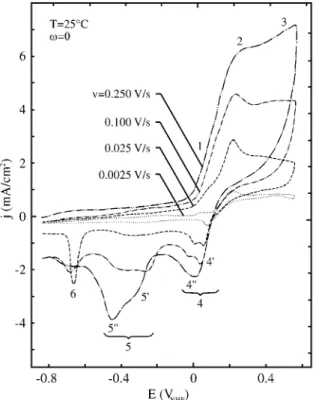
The voltammograms of cop per in still 0.75M KHCO3 + 0.05M K2CO3 so lution at pH 8.9 run at dif fer ent v, at 25 °C, between Es,c=-0.95 V and Es,a=0.55 V (Fig. 1), show three anodic cur rent con tri bu tions, at ~ 0.03 V (Peak 1), 0.18 V (Peak 2), and 0.40V (Re gion 3). Peak 1 is re lated to the Cu2O electroformation (first pas si vat ing layer)1,4, while Peak 2 was at trib uted to the for ma tion of a Cu(OH)2-CuO complex layer through a nu cle ation and growth mech a nism under dif fu sion con trol1,4,10. The broad cur rent con tri bu -tion cor re spond ing to Re gion 3 may be re lated to the pres-ence of a pro tec tive com pos ite CuCO3-Cu(OH)2 layer (second pas si vat ing layer)5-7. Peaks 1 and 2 over lap at v > 0.025 V/s, so Peak 1 can not be clearly dis tin guished. At v < 0.025 V/s, re verse scans show a re ac ti va tion of the
electroxidation pro cess in the po ten tial re gion cor re spond -ing to Peak 2 and Re gion 3, sug gest -ing a de crease in the pas sive film sta bil ity. The re verse scan shows three cath-odic con tri bu tions, which ex hibit com plex con tours (Peaks 4, 5, and 6), whose rel a tive heights and lo ca tions de pend on tem per a ture, v, Es,a, elec tro lyte com po si tion, and so lution pH. Peak 4 in volves two con tri bu tions, Peak 4’ and 4’’, which were as sociated with the electroreduction of Cu(II) to the Cu(I) spe cies, in the -0.07 to -0.06 V po ten tial range9. Peaks 5’ and 5’’ have been re lated to the electroreduction of the com posite CuCO3-Cu(OH)2 layer in the -0.28 to -0.43V re gion6,11, and Peak 6, in the -0.60 to -0.80V re gion, has been as signed to the electroreduction of the Cu(I) spe cies to Cu(0)6 (Fig. 1). Peak 1 is better de fined when ei ther tem perature or ionic strength in creases, but its rela tive con tri bu tion di min ishes; also, it ap pears at more negative po tentials, so a lower overpotential is re quired for the Cu2O electroformation re ac tion (Fig. 2). As tem per a -ture rises, the height of Peak 2 in creases, Peak 1 oc curs at more neg a tive po tentials, and the changes cor re spond ing to Region 3 in di cate greater sta bilization of the pas sive layer. In di lute so lu tions, a sig nif i cant tem perature ef fect is not ob served.
A lin ear log jp2vs. log v re la tion ship is ob tained in still car bon ate/bi car bon ate so lu tions cov er ing the 5-65 °C range, with the cor re spond ing slope be ing ~0.45§ 0.08, in-di cat ing a in-diffusional pro cess. At con stant v, jp2 in creases as tem perature and ionic strength are raised (Fig. 3).
At 25 °C, in the 8.39.5 pH range, at con stant bi car bon -ate con cen tra tion, jp2 is in de pend ent of pH, whereas a lin ear log jp2vs. pH is ob served at pH > 9.5 (see Fig. 9 in Ref. 7). These data, to gether with the anal y sis of the cor responding stoichiometric equa tions and the as so ci ated re action or-ders, show that in the first pH re gion HCO3- be haves as the
160 Ribotta & Folquer J. Braz. Chem. Soc.
Fig ure 1. The in flu ence of v on the voltammograms run with STPS in still 0.75 M KHCO3 + 0.05 M K2CO3, pH 8.9 at 25 °C.
ag gres sive an ion, but in the sec ond pH re gion the lo cal pH value at the re gion in ter face be comes an ad di tional fac tor7. Sim i lar re sults are ob tained un der stir ring.
Under stir ring, an odic cur rent peaks and the re ac ti va -tion pro cess dur ing the back ward po ten tial scan in crease with tem per a ture, ionic strength, andZ (Fig. 4). This ef fect is as so ci ated with the in crement of sol u ble Cu(II) spe cies ob tained from the dis solution of the CuO-Cu(OH)2 film and ba sic cop per car bon ates. This sit u a tion im proves the dis so lu tion-precipitation mech anism in volved in the forma tion of the pro tec tive sec ond pas si vat ing layer con sti -tuted by Cu (II) com pounds. A sig nif i cant ef fect of hydrodynamics on Peak 1 is not ob served. In gen eral, cath-odic peaks de crease un der stir ring, but they in crease with T.
Linear de pend ence of jp2vs.Z1/2 at a con stant v are ob-served, whose slopes in crease with tem per a ture. Greater slope changes are ob tained with in creasing ionic strength (Fig. 5).
In still so lu tions the ac ti va tion en ergy (Ea ) for the CuO-Cu(OH)2electroformation is ~15 kJ/mol at pH 8.9 and ionic strength 1, but di min ishes to 6.5 kJ/mol when the ionic strength is 0.1 at the same pH. In gen eral, Ea in creases with in creasing ionic strength, but a clear re la tion be tween Ea and pH does not ex ist.
Under stir ring (Z = 1000 rpm), Ea at tains higher val ues, thus, at pH 8.9 and ionic strength 1, Ea is 25 kJ/mol, sug-gest ing changes in the pas si vating layer com position, par-tic u larly in its wa ter con tent, which is re duced.
Vol. 8, No. 2, 1997 Dis solution and Passivation Pro cesses of Cop per 161
Fig ure 3. The de pend ence of jp2 on v at dif fer ent Ts in still so lu -tions.( ,•) 0.75 M KHCO3 + 0.05 M K2CO3, pH 8.9; ( ,O) 0.075 M KHCO3 + 0.15 M K2CO3, pH 10.5.
Fig ure 4. The in flu ence of T on the voltammograms run at 0.025 V/s,
Z = 1000 rpm. (a) 0.75 M KHCO3 + 0.05 M K2CO3, pH 8.9; (b) 0.075 M KHCO3 + 0.15 M K2CO3, pH 10.5.
The in fluence of both T andω on the sur face la yers was analyzed through SEM mi crographs in car bo na -te-bicarbonate buf fers at dif ferent pHs and io nic strengths. Considerable dif ferences can be ob served when T,ω, or
io-nic strength are chan ged.
At 25 °C andω = 1000 rpm, the cop per sur face is
com-pletely co vered with the cor rosion pro ducts, the ap peara When T ri ses to 65 °C the film se ems to be less hydra ted (Figs. 6 and 7). This is an in dication that pro tective cha rac -teristics of the film are bet ter ob served un der stir ring and at high tem perature through a loss of wa ter mo lecules. Also, these ob servations are in agre ement with the Ea va lues
ob-tained.
Conclusions
The elec trochemical res ponse of cop per in HCO3-
-CO32- so lutions (8.3≤ pH≤ 11.6 ) de pends on T, pH, io nic
strength of the elec trolyte, and hydrody namic con ditions. Solution stir ring and high tem perature chan ge the characteristics of the pas sivating la yer, ma king it more pro tec -tive; this si tuation is ob tained through a de crease of the water con tent, so the film be comes less hydra ted.
The ac tivation energy ob tained for the CuO-Cu(OH)2
electroformation de pends on io nic strength. This re sult is
also ob tained un der stir ring, the refore the elec tro dis so lu ti -on pro cess is hin dered by films c-on taining less wa ter.
Acknowledgments
The aut hors thank J.R. Vil che for dis cussions about this work. This re search pro ject was fi nancially sup ported by the Con sejo Na cional de Inves tigaciones Ci entíficas y Téc-nicas, the Con sejo de Inves tigaciones de la Uni versidad Nacional de Tu cumán, and the Fun dación Antor chas. The authors are in debted to A. Andra da Ba rone for SEM mi cro -graphs.
References
1. Streh blow, H.-H.; Speck mann, H.-D.Werks. Kor ros.
1984, 35, 512.
2. Gen nero de Chi alvo, M.R.; Mar chiano, S.L.; Arvia, A.J.J. Appl. Elec trochem.1984,14, 165.
3. Speck mann, H.-D.; Loh rengel, M.M.; Schult ze, J.W.; Strehblow, H.-H. Ber. Bun senges. Phys. Chem.1985,
89, 392.
162 Ri bot ta & Fol quer
Fi gu re 6. SEM mi cro graphs of polycrystal li ne Cu spe ci mens af ter po ten ti al hol ding for 10 min in the re gi on of Peak 2, in 0.075 M KHCO3 + 0.15 M K2CO3 so lu ti on pH 10.5,ω = 1000 rpm, at 25 °C.
4. Tromans, D.; Sun, R.-H.J. Elec trochem. Soc.1992,
139, 1945.
5. Dro gowska, M.; Bros sard, L.; Mé nard, H.J. Elec tro -chem. Soc.1992,139, 39;1993,140, 1247.
6. Pé rez Sán chez, M.; Sou to, R.M.; Bar rera, M.; Gon zá -lez, S.; Sal varezza, R.C.; Arvia, A.J. Electrochim. Acta1993,38, 703.
7. Ri botta, S.B.; Fol quer, M.E.; Vil che, J.R.Corrosion
1995,51, 682.
8. Ri botta, S.B.; Fol quer, M.E.; Vil che, J.R. Sub mitted for pu blication toCorrosion.
9. Pé rez Sán chez, M.; Bar rera, M.; Gon zález, S.; Sou to, R.M.; Sal varezza, R.C.; Arvia, A.J.Electrochim. Acta
1990,35, 1337.
10. Mayer, S.T.; Mul ler, R.H.J. Elec trochem. Soc.1992,
139, 426.
11. Van Muyl der, J. InComprehensive Tre atise of Elec-trochemistry; Ple num Press; New York, 1981, Vol 4, p. 1-96.
12. Ger vasi, C.A.; Bi aggio, S.R.; Vil che, J.R.; Arvia, A.J.
Corros. Sci.1989,29, 427.
13 .Hills, G.J.; Ives, D.J.G. In Reference Elec tro des; Aca-demic Press; New York, 1961, p. 161.