The Electrochemical Behavior of Brass in 0.1 M HCl Solution
E. Geler, and D.S. Azambuja*
Insituto de Química, UFRGS, Av.Bento Gonçalves 9500, C.P. 15003, 91501-970 Porto Alegre - RS, Brazil
Re ceived: June 30, 1996; De cem ber 3, 1996
Estudou-se a eletrodissolução de um latão comercial (60,8Cu-36,3Zn-2,9Pb) e do cobre em HCl 0,1 M usando a técnica de voltametria cíclica e eletrodo rotatório de disco e anel. O mecanismo de dissolução deste latão e do cobre apresentam diferentes parâmetros cinéticos. O mecanismo de dissolução do componente Cu da liga é análogo ao do cobre puro.
The electrodissolution of com mer cial brass (60.8Cu-36.3Zn-2.9Pb) and pure cop per in 0.1 M HCl were com par a tively stud ied us ing cy clic voltammetry and a ro tat ing ringdisk elec -trode. The dis so lu tion mech a nism of both spec i mens pres ents dis tinct ki netic pa ram e ters. How ever, the dis so lu tion mech a nism of the Cu com po nent of brass is the same as that ob served for pure cop per.
Key words: cop per dis so lu tion, (α+β)-brass, ro tat ing ring-disk elec trode, voltammetry
In tro duc tion
The an odic dis so lu tion of bi nary al loys in dif fer ent aque ous en vi ron ments has been in ves ti gated un der a wide range of ex per i men tal con di tions1-6 mainly fol low ing a dis pute be tween se lec tive and si mul ta neous dis so lu tion pro -cesses of the com po nents. In this work, the dis so lu tion of com mer cial brass (60.8Cu-36.3Zn-2.9Pb) in 0.1 M HCl was in ves ti gated. An un der stand ing of the al loy dis so lu tion mech a nism re quires knowl edge of such a pro cess for pure cop per. De spite the num ber of pub li ca tions on this sub -ject5-8, the dis so lu tion of Cu-Zn al loys con tain ing Pb has not re ceived much at ten tion. The aim of this pa per is to ob -tain in for ma tion on the electrodissolution mech a nism of com mer cial brass in 0.1 M HCl, us ing cy clic voltammetry and a ro tat ing ring-disk elec trode.
Ex per i men tal Method
A con ven tional three elec trode cell has been used. The elec tro chem i cal mea sure ments were made us ing a Cu disk ( 9 9 . 9 9 % p u r e ) , a n d o n e o f c o m m e r c i a l b r a s s (60.8Cu-36.3Zn-2.9Pb) with a 0.2 cm2 ap par ent area as a work ing elec trode. Each elec trode was pol ished with em ery pa per up to grade 600, and rinsed with al co hol and dis -tilled wa ter. To de tect the for ma tion of sol u ble spe cies, dur ing the voltammetric sweep of the work ing elec trodes (Cu and brass) a ro tat ing ring-disk elec trode (RRDE) with a
gold ring was used. The col lec tion ef fi ciency of the RRDE is N = 0.509. For the de tec tion of the cuprous spe cies the ring po ten tial was fixed at 0.45 V vs. SCE, in which ox i da -tion to Cu(II) takes place. To de tect the Cu(II) spe cies, the ring po ten tial was set at -0.1 V vs. SCE. A sat u rated cal o mel elec trode (SCE) was used as the ref er ence, and all po -ten tials were re ferred to this elec trode. A large area Pt wire, prop erly shielded, was used as the coun ter elec trode. The elec tro lyte so lu tions con sisted of 0.1 M HCl pre pared from an a lyt i cal grade re agents and twice dis tilled wa ter. Ex per i -ments were car ried out un der Ar gas sat u ra tion at 298 K. A bipotentiostat (EG&C, model 366) and a ro ta tor (EG&C, model 636) were em ployed for the mea sure ments.
Re sults and Dis cus sion
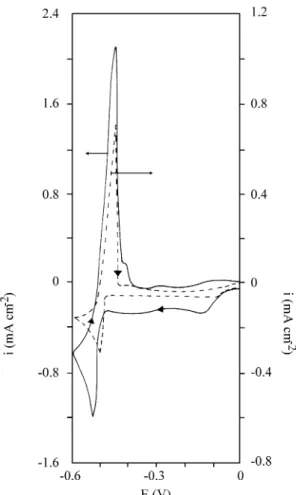
The voltammograms of Cu and brass in still 0.1 M HCl (Fig. 1), run from Es,c = -0.6 V to Es,a = 0.8 V , at 0.002 V/s, show three an odic peaks for brass, be tween -0.6 and -0.2 V, which are ab sent for Cu. At more pos i tive po ten tials, two an odic peaks (A1 and A2) are ob served and the re verse scan pres ents a cath odic peak (C) at more neg a tive po ten tials for both work ing elec trodes. The height of peaks A1 and C are higher for brass. The voltammograms of Cu and brass spec -i mens are qual -i ta t-ively com pa ra ble. In the pres ent study, the cur rent/po ten tial curve for brass is di vided into three re -gions ac cord ing to the pre vail ing pro cess. Thus, re gion I Ar ti cle
J. Braz. Chem. Soc., Vol. 8, No. 2, 165-168, 1997. © 1997 Soc. Bras. Química
cov ers the po ten tial range of 0.6 to 0.2 V, re gion II in -cludes the po ten tial range from -0.2 V up to peak A1, and re -gion III cor re sponds to the peak A1 po ten tial. The re gion of higher an odic overpotentials was not ex am ined in this study.
Peak iden ti fi ca tion in re gion I was made by com par ing the voltammograms of a Au elec trode in 0.1 M HCl so lu -t i o n c o n -tain ing Pb+ 2 ( F i g . 2 ) w i t h t h e b r a s s voltammograms (Fig. 3) in 0.1 M HCl, run from Esc = -1.2 V to Esa = 0 V, at ω = 0 and dif fer ent scan rates. The peaks A01, A02, and A03 are as so ci ated with the pres ence of Pb in the al loy. This fact has been fur ther con firmed by X-ray dif frac tion anal y sis of the brass sam ple10 be fore and af ter the an odic po lar iza tion up to the A01 peak (not shown). As can be ob served, the Pb re ac tion is es pe cially sig nif i cant at high sweep rates (Figs. 2 and 3), in di cat ing a fast re ac tion. Se lec tive dis so lu tion of Zn was not ob served (Fig. 3), ac -cord ing to ther mo dy namic data2,4. How ever, β phase dis -solves se lec tively in this me dia, which shows up in the voltammetric curve as a shoul der, la beled as Aβ (Fig. 3). These re sults are con sis tent with what has been re ported pre vi ously7, which al lows the char ac ter iza tion of the brass spec i men em ployed in this study as a (α+β)brass con tain -ing Pb11. The in flu ence of ω on the brass voltammograms
166 Geler & Azambuja J. Braz. Chem. Soc.
Fig ure 1. Voltammograms re corded at the pure Cu (... ) and brass (—) elec trodes in 0.1 M HCl so lu tion, at ν = 0.002 V/s and ω = 0.
Fig ure 2. Voltammograms at the Au elec trode in 10-4 M Pb+2 + 0.1 M HCl, at ν = 0.050 V/s (—) and ν = 0.002 V/s (—-), ω = 0.
Fig ure 3. Voltammograms at the brass elec trode in 0.1 M HCl at ν = 0.05V/s (—) and ν = 0.002V/s, ω = 0.
at ν = 0.002V/s can be seen in Fig. 4. The in crease of ω re -sults in a marked in crease in height for the an odic peaks (A1 and A2). The re verse scan ex hib its an an odic re ac ti va tion pro cess, which in creases un der stir ring. This be hav ior is sim i lar to that ob tained with pure Cu (data not shown). Ap -par ently the ro ta tion of the work ing elec trodes fa vours the re moval of part of the an odic layer, which is poorly ad hered to the elec trode sur face. Re gion II is char ac ter ized by a mixed mass trans fer and ac ti va tion con trol . Plots of i-1vs. ω-1/2 (Fig. 5) are straight lines with pos i tive in ter cepts, and the slopes are higher for pure Cu. These re sults in di cate that the cur rent of the Zn com po nent is less in flu enced by the mass trans port ef fect, and are con sis tent with what has been pre vi ously re ported for a Cu-NI al loy12. Fur ther more, the value of the re la tion (iE,brass - iE,Cu )/ iE,Cu was cal cu lated for var i ous po ten tials re sult ing in val ues greater than 1 in all cases. This fact sug gests that the pref er en tial dis so lu tion of Zn also takes place in this po ten tial range2,4,7. Re gion III cor re sponds to the peak A1 po ten tial and pres ents mixed con trol ki net ics (data not shown) for both work ing elec -trodes. Ta ble 1 shows the re la tion (ip,brass - ip,Cu ) /ip,Cu at dif -fer ent sweep rates at peak A1. The al loy com po nents ap pear to dis solve at rates that are in ac cor dance with their chem i -cal com po si tion. Once more, uni form dis so lu tion takes
place at this peak, and the Zn dis so lu tion in creases at a higher sweep rate.
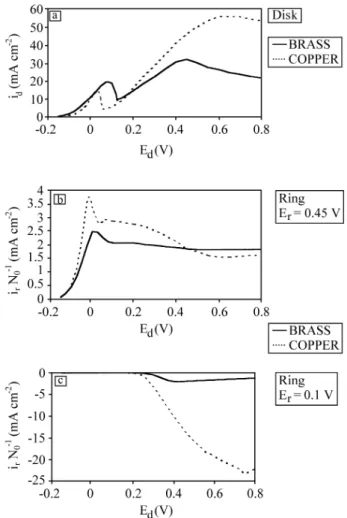
The rate of cuprous spe cies for ma tion dur ing the dis so -lu tion of Cu and brass was mon i tored with the RRDE (Fig. 6b). The disk and the ring cur rents do not co in cide in the as -cend ing part of peak A1 for both disks em ployed. For the Cu disk, this means that not all the cuprous spe cies pro -duced are de tected by the ring, which in di cates a CuCl film for ma tion10,13-15 which pre sented a max i mum thick ness at the po ten tial cor re spond ing to peak A1. For brass, it is not pos si ble to make sim i lar com ments since the Zn par tial cur -rent was not de ter mined. Cu pric spe cies were de tected for pure cop per and brass (Fig. 6c) only at higher an odic overpotentials, af ter ex ceed ing the po ten tial value of peak A1. These find ings agree with those pre vi ously re -ported1,10,12-14.
The main fea ture of the over all pro cess which can be de rived from the RRDE data is the re la tion∂E/∂logid, ob -tained in re gion II, and re sult ing in 85 mV/dec for the Cu disk and 104 mV/dec for the brass one. Cal cu lating ∂E/∂ir,
Vol. 8, No. 2, 1997 Elec tro chem i cal Be hav ior of Brass 167
Ta ble 1. De pend ence of the sweep rate (ν) on the re la tion ip,brass - ip,Cu /ip,Cu in 0.1 M HCl
Sweep rate (V/s) [ipbrass -ipCu] / ip,Cu
0.002 0.60
0.005 0.66
0.010 0.65
0.020 0.65
0.030 0.66
0.050 0.67
Fig ure 5. Plot of 1/i against 1/ω1/2 for dif fer ent po ten tials, for the Cu (....) and brass (—) elec trodes in 0.1 M HCl.
when the ring is set at 0.45 V (the cur rent due to the cuprous spe cies only), a value of 96 mV/dec was found for both work ing disk elec trodes. Again, this is a in di ca tion that al though the dis so lu tion mech a nism of brass is quite dif fer -ent from that of cop per, the dis so lu tion mech a nism of the Cu com po nent of the al loy is the same as the one which was ob served for pure cop per. These re sults are qual i ta tively con sis tent with those re ported by Costa et al.13 and Lee and Nobe14 for other Cu-Zn al loys.
Con clu sions
T h e r e s u l t s of this study in d i c a t e t h a t t h e electrodissolution of a (α+β) brass con tain ing Pb and of pure cop per in 0.1 M HCl are in flu enced by the mass trans -port ef fect. The dis so lu tion mech a nisms of both spec i mens pres ent dis tinct ki netic pa ram e ters. Dur ing the electrodissolution of com mer cial brass, pref er en tial dis so -lu tion of Zn oc curred in the as cend ing part of peak A1 and is fa voured at high scan rates. The si mul ta neous dis so lu tion of Cu and Zn com po nents takes place at an odic peak A1. The Cu com po nent of brass be haves like pure cop per dur -ing the dis so lu tion pro cess.
Ac knowl edg ments
The au thors wish to thank CNPq, CAPES, and FAPERGS for fi nan cial sup port.
Ref er ences
1. Flatt, R.K.; Brook, P.A. Corros. Sci. 1971, 11, 185.2. Pickering,H.W.; Byrne, P.J. J. Electrochem. Soc. 1969, 116 (11), 1492.
3. Pickering, H.W. J. Electrochem. Soc. 1970, 117 (1), 8. 4. Tay lor, A.H. J. Electrochem. Soc. 1971, 118 (6), 854.
5 Pchelnikov, A.P.; Sitnikov, A.D.; Marshakov, I.K.; Losev, V.V. Electrochim. Acta 1981, 26 (5), 591. 6. Polunin, A.V.; Pozdnyakova, I.A.; Pchelnikov, A.P.;
Losev, V.V.; Marshakov, I.K. Élektrokhimiya 1982, 18 (6), 792.
7. Stevanovic, J.; Skibina, L.J.; Stefanovic, M.; Despic, A.; Jovic, V.D. J. Ap plied Electrochem. 1992, 22, 172.
8. Vyazovikina, N.V.; Marshakov, I.K.; Tutukina, N.M. Élektrokhimiya 1981, 17 (6), 838.
9. Albery, J.; Hitchman, M.L. In Ring-Disc Eletrodes; Ox ford; Clar en don Press, 1971.
10. Geler, E. Mas ter’s The sis, IQ-UFRGS 1996. 11. Suryanarayana, C.; Anantharaman, T.R. Met al lur gi
-cal Trans ac tions 1971, 2, 3237.
12. Crundwell, F.K. Electrochim. Acta 1991, 36 (14), 2135.
13. Costa, S.L.F.A. da; Agostinho, S.M.L.; Nobe, K. J. Electrochem. Soc. 1993, 140 (12), 3483.
14. Lee, H.P.; Nobe, K.; Pearlstein, A.J. J. Electrochem. Soc. 1985, 132 (5), 1031.
15. Crunwell, F.K. Electrochim. Acta 1992, 37(15), 2707.