Ar
ti
cle
0103 - 5053 $6.00+0.00
*e-mail: [email protected]
#In memoriam
A Contribution to the Estimation of Binary Halide and Pseudo-Halide Equilibrium
Constants using a Linear Extrapolation Methodology
Astréa F. de S. Silva,*,a Manuel M. Ortega,#,b Cristo B. Melios,c Leonardo Pezza,c
Mercedes de Moraes, cMário Alberto Tenand and André F. Oliveiraa
aNúcleo de Ciências Ambientais, Universidade de Mogi das Cruzes, UMC,
Av. Cândido Xavier de Almeida Souza, 200, Centro Cívico, 08780-911 Mogi das Cruzes-SP, Brazil
bDepartamento de Química, UFMA, 65085-580 São Luís-MA, Brazil
c Instituto de Química, UNESP, 1480-970 Araraquara-SP, Brazil
dInstituto de Física Gleb Wataghin, Universidade Estadual de Campinas-UNICAMP,
13083-970 Campinas-SP, Brazil
O coeiciente de atividade molar individual do íon luoreto (yF) foi determinado a 25° C para valores de força iônica entre 0,100 and 3,00 mol L-1 (NaClO
4) usando-se um eletrodo íon-seletivo. A dependência do coeficiente de atividade com a força iônica é explicada pela equação
ΦF = log yF = 0,2315I – 0,041I2. A função Φ
F(I), foi associada a outras funções estimadas em trabalhos anteriores, por exemplo,ΦCu(I) para cobre, e ΦH(I) para íon hidrogênio, possibilitando a estimativa de constantes de estabilidade estequiométricas e termodinâmicas tanto para equilíbrios de protonação de alguns haletos e pseudo-haletos como para as constantes de formação de complexos 1:1 de metais bivalentes com luoreto e pseudo-haletos. O procedimento de cálculo proposto é consistente com dados experimentais criticamente selecionados da literatura. Veriicou-se que é possível usar ΦF(I) na previsão de parâmetros de equilíbrio termodinâmicos independentemente do caráter HSAB de Pearson .
The molar single ion activity coefficient (yF) of fluoride ions was determined at 25 °C and ionic strengths between 0.100 and 3.00 mol L-1 NaClO
4 using an ion-selective electrode. The activity coefficient dependency on ionic strength was determined to be
ΦF = log yF = 0.2315I – 0.041I2. The function Φ
F(I), combined with functions obtained in previous work for copper (ΦCu) and hydrogen (ΦH), allowed us to make the estimation of the stoichiometric and thermodynamic protonation constants of some halides and pseudo-halides as well as the formation constants of some pseudo-halides and luoride 1:1 bivalent cation complexes. The calculation procedure proposed in this paper is consistent with critically-selected experimental data. It was demonstrated that it is possible to use ΦF(I) for predicting the thermodynamic equilibrium parameters independently of Pearson’s hardness of acids and bases.
Keywords: thermodynamic activity, ion-selective electrode analysis, stability constants
Introduction
The stoichiometric and thermodynamic constants for both protonation and complexation equilibria are parameters of fundamental importance. The development of reliable empirical methods for the estimations and/
or evaluations of these parameters is equally relevant.1-6
Furthermore, the most common procedures for inding the thermodynamic values for protonation or complexation equilibria are based on graphical extrapolations to zero
ionic strength of stoichiometric values of log KH (or log β)
or on complicated functions involving extended forms of
the Debye-Hückel or Pitzer equations.5,7-9 The existing
procedures are not reliable except in a few favorable
cases.5,7 In some cases, the deviations obtained via common
extrapolation methods can be as great as 400%,8 however,
can be avoided by considering linear relationships,1-3 as explained below.
The linear methodology
The methodology is based on the following relation, which is valid for the metal-ligand formation equilibrium:
log β - ΦM - ΦL =log βT - Φ
ML (1)
where M is a divalent metallic ion, L is a monovalent anionic ligand, ML is the irst complex species formed,
ΦM,ΦL andΦML represent the functions of the single molar
activity coeficients for the species, and βT and β are the
thermodynamic and stoichiometric formation constants of ML at a given ionic strength. To simplify the notation, charges were omitted and only the formation of a 1:1 metal-ligand was considered.
The three terms on the left side of Eq. (1) can be calculated as functions of the ionic strength I of the
medium. Furthermore, the values of log βcan be found
in the literature,12 whereas those for Φ
M and ΦL can be calculated by taking into account the following empirical relation:10
Φi = log yi = ai I0.5 + b
iI + ciI1.5 + ... (2)
where i represents M or L, yi is the molar activity coeficient
of species i, and ai, bi, ci... are coeficients to be determined
by considering extra-thermodynamic arguments.2,3 It should
be noted that the necessity of getting information about the single-ion activities is not a problem, as recognized by
Wilczek-Vera & Vera,11 since the activity and hence the
activity coeficient of a single ion can be calculated from ion-selective electrode measurements.
Since the sum Y of the three terms on the left side of Eq. (1) can be found as a function of I, the next step in the methodology consists of looking for a non-negative integer
number n for which a plot of Y versus In/2 becomes linear
(in practice, n = 1 or 2 has been suficient). From this linear itting, it is possible to empirically determine the right side
of Eq. (1); namely, the difference log βT - Φ
ML.
In conclusion, the functions Φi(I) = log yi, together
with a suficient number of stoichiometric (log β, I) or
(log KH, I) pairs of values critically selected from the
literature,12 allow us to ind linear relations that provide a
reliable extrapolation of the thermodynamic values log βT
(or log KHT), as well as the interconversion of
stoichiometric values of log β (or log KH) at different ionic
strengths.
Estimation of Φi(I) with potentiometric measurements
Potentiometric measurements using metal or ligand ion-selective electrodes can be carried out in an inert electrolyte at constant ionic strength and temperature. The electromotive force of the potentiometric cell obeys the following simpliied equation:
E = Ei0’ + S log[i] (3)
where i represents an ion or a neutral substance, [i] is the molar concentration of species i, S is a constant, and
Ei0’ is the sum of all constant terms that contribute to the
total measured electromotive force (reference electrode, liquid junction and indicator electrode potentials). The constant sum term can be expressed in terms of the activity
coeficient yi as:
Ei0’ = (Ei0’)0 + S log yi (4)
where (Ei0’)0 is the ininite dilution limit value of Ei0’.
Equation (3) shows that E0’
i and S can be obtained
graphically from the measured values of an E versus
log [i] plot. From Eqs. (2) and (4), we obtain
E
i 0’ = (E
i 0’)
0 + S(aiI 0.5 + b
iI + ciI
1.5 + …) (5)
The experimental determination of suficient pairs of
values (I, Ei0’) makes it possible to estimate the parameter
(Ei0’)
0 and the empirical coeficients ai, bi, ci... from a
polynomial itting. The function Φi = log yi may then be
estimated.
Experimental
Materials and Solutions
Analytical-grade reagents were used in all experiments. A stock solution of sodium perchlorate was standardized by
evaporation, drying, and constant weighing at 120 °C. The
solution pH was measured with a glass electrode and varied between 6.80 and 7.00. The stock solution of perchloric acid was standardized with sodium carbonate. The sodium luoride solution was prepared in a polyethylene volumetric lask, without previous reagent puriication. All of the solutions were prepared with Milli-Q water.
Instruments
The potentiometric measurements were performed with
The temperature was kept at 25.0 ± 0.1 °C using a Tecnal Scientific Appliances cryostat connected to a 35 mL titration cell with a thermostatization jacket. The internal glass surface of the titration cell was totally covered with a layer of parafin to avoid luoride attack. Metrohm E274 piston burettes (precision of 0.01 mL) and automatic
pipettes of 0.100 ± 0.001 mL and 0.500 ± 0.002 mL were
used. The ionic strength was adjusted with NaClO4 over
the 0.1-3.0 mol L-1range. An Orion 94-04 luoride
ion-selective electrode and an Orion 90-01 single junction Ag/AgCl reference electrode adequate for use in luoride media were employed.
Potentiometric Cell
The potentiometric cell used for the NaF-NaClO4
systems is
Ag/AgCl NaCl 0,01 mol/L NaF c mol/L EISF NaClO4(I-0,01) mol/L NaClO4 (I-c) mol/L
Procedure
Solutions of 0.090 mol L-1 NaF were prepared in
100.0 mL polyurethane volumetric lasks for each ionic strength. Using a piston burette Methrom E274, the
necessary volumes of a 5.223 mol L-1 NaClO
4 solution and
water were added to adjust the ionic strength of the NaF solution to the desired value.
The indicator and reference electrodes were placed
in a cell containing 10.00 mL of NaClO4 at the given
ionic strength. After stirring the NaClO4 solution for
10 min, aliquots (0.5 or 0.1 mL) of the 0.090 mol L-1 NaF
solution wereadded. The potential value was registered
after 40 s, which represents the time recommended by the manufacturer.
When not in use, the indicator electrode was kept in a
10-3 mol L-1 solution of NaF. The single junction reference
electrode was kept in a NaClO4 solutionat the ionic strength
of the next group of measurements to be carried out.
Results and Discussion
Estimate of the luoride ion activity coeficient dependency on the ionic strength of the medium
The junction potential Ej for the NaF-NaClO4 system
was evaluated with the help of the Henderson equation13
and molar ionic conductivity data from the literature.14 The
resulting values obtained for Ej were small enough to be
neglected. The parameters EF0’ and S were determined by
simple linear regression.15 The correlation coeficient r was
greater than 0.999, in all cases. A variation of ca. 18 mV in
the E0’ values and an average value of 59.7 mV/decade for
S were obtained in the interval of ionic strength considered (Electronic Supplementary Information).
The best it1-3,16 obtained for the Eo’ versus I curve was:
EF0’ = (–317.7 ± 0.3) + (13.82 ± 0.6)I – (2.47 ± 0.2)I2 (6)
with a correlation coeficient of 0.8897 and a standard deviation of 2.34. Considering the average experimental
value of S (59.7 ± 1.4 mV/decade), it can be veriied that the
dependency of yF on the ionic strength of the NaF-NaClO4
system at 25.0 ± 0.1 °C is given by:
ΦF = log yF = 0.2315I – 0.041I2 (7)
The inluence of the electrolyte on the molar activity
coeficient of F- is highly signiicant. These results indicate
that structural effects of the solvent as well as ion-ion and ion-solvent interactions (hydration) should be taken into account to produce a realistic description of these systems. The sodium ion produces a weak-ordering effect on the structure of water. In contrast, the perchlorate ion plays a signiicant role in promoting a disordering effect on the water structure. The signiicant variations in the activity coeficients of luoride in the sodium perchlorate media due to an increase in the ionic strength can be at least partially justiied by the perchlorate ion disordering effect. Similar
behavior was observed for H+, copper(II), cadmium(II), and
lead(II) in a sodium perchlorate medium.1 An exception was
the acetate ion, in which case no signiicant change was observed probably due to the fact that the ordering effect
compensates that caused by the perchlorate ion.1
Estimates of the thermodynamic equilibrium constants for some equilibria in aqueous solutions
The function ΦF(I) determined in the present paper
was used in connection with the functions ΦCu(I),
ΦCd(I), ΦPb(I) and ΦH(I) obtained by Pezza and
co-workers1-3 for the same conditions of temperature, ionic
strength and ionic medium. The proposed methodology was applied for the estimation of the thermodynamic
constants for the mono-protonation (log KHT) of
halides or pseudo-halides (HX species), as well as the
formation of (1:1) bivalent metal complexes (log βT)
with halides (MF+) or pseudo-halides (MX+ species).
The corresponding linear relations for the calculation
MX+ systems were established from suficient pairs of
stoichiometric values (log KH, I) or (log β, I) critically
selected from the literature.12
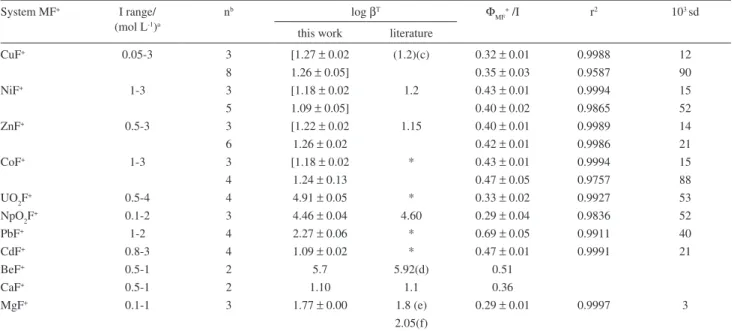
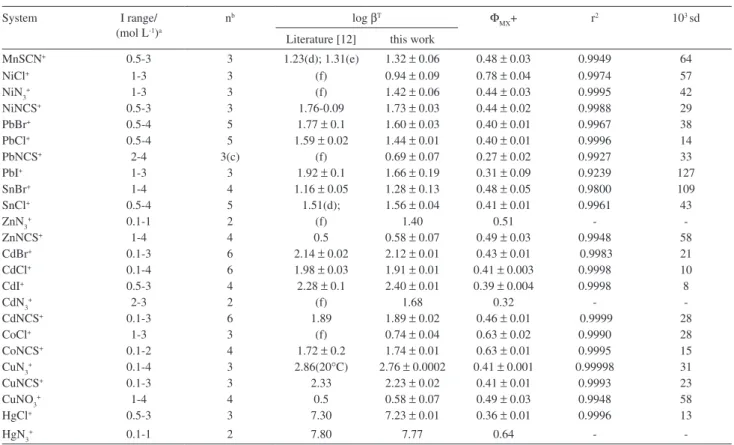
The empirical coeficients a and b in equation 2 are
listed in Tables 1-3 for the HX, MF+ and MX+ systems.
Also listed are the experimental conditions and the corresponding equations established.
The estimated values of log KHT and log βT (Tables 2
and 3) are consistent with the experimental data critically
selected in the literature,12 showing the comprehensiveness
of the proposed methodology in predicting the thermodynamic constants. It was also veriied that it is
possible to use ΦF(I) in predicting log βT for complexes of
other halides and pseudo-halides (electronic supplementary information), independently of the hard and soft acids/
bases classiication.17
Other Successful Applications of the Linear Methodology
Figure 1 compares the plots of log β and log β - ΦCu - ΦF
as functions of the ionic strength I for the complexes
PbBr+ and SnCl+. In contrast to the linear extrapolation
of log β - ΦCu - ΦF to zero ionic strength, the degree of
uncertainty in the non-linear extrapolation of log β is
very high. The same behavior was observed in the cases
of CoF+, MgF+, CoCl+, NiCl+, NiN
3+, PbCl+ and PbNCS+. These cases are clear examples of the inherent advantage of the linear methodology in providing reliable estimations of thermodynamic constants via extrapolation.
In some cases, it can be observed that although one point deviates noticeably from the linear relation (e.g. Fig 2), the remaining points lead to stability constant values that agree
with those reported in the literature.12 These results suggest
further investigation of these systems, since the values of
log β for the deviant points could probably be in error.
Another striking example of the effectiveness of the
linear extrapolation is presented by the PbNCS+ system
(see Fig. 3).The linear extrapolation predicts for the
thermodynamic constant a value of 0.69 with an uncertainty
of ca. 0.07 (electronic supplementary information). In
contrast, a non-linear itting hardly leads to a reliable thermodynamic value based on the three stoichiometric
values available in the literature.12
The linear methodology was also applied to the calculation of the thermodynamic stability constants of the
CoF+, MnF+, PbF+, PbNCS+, CdF+, MnF+, CdN
3+, NiCl+,
NiN3+and ZnN
3+ systems, for which the corresponding
values have not been reported in the literature.12
Another very interesting inding is that with just the
two values of log β available for the CaF+ and HgN
3+ systems, it was possible to obtain thermodynamic values compatible with those found in the literature. Moreover, the
parameters ΦCu and ΦF were used successfully to correlate
stoichiometric constants determined at ionic strengths outside the experimental range considered in this work,
namely 0.05 or 4.00 mol L-1, for the CuF+, UO
2F+, CdCl+,
PbBr+, PbCl+, PbNCS+, SnBr+, SnCl+,ZnNCS+ and CuN
3+ systems.
Table 1. log βT and ΦMF+ estimates for some MF+ complexes in aqueous solution at T = 25 °C
System MF+ I range/
(mol L-1)a
nb log βT Φ
MF+ /I r2 103 sd
this work literature
CuF+ 0.05-3 3 [1.27 ± 0.02 (1.2)(c) 0.32 ± 0.01 0.9988 12
8 1.26 ± 0.05] 0.35 ± 0.03 0.9587 90
NiF+ 1-3 3 [1.18 ± 0.02 1.2 0.43 ± 0.01 0.9994 15
5 1.09 ± 0.05] 0.40 ± 0.02 0.9865 52
ZnF+ 0.5-3 3 [1.22 ± 0.02 1.15 0.40 ± 0.01 0.9989 14
6 1.26 ± 0.02 0.42 ± 0.01 0.9986 21
CoF+ 1-3 3 [1.18 ± 0.02 * 0.43 ± 0.01 0.9994 15
4 1.24 ± 0.13 0.47 ± 0.05 0.9757 88
UO2F+ 0.5-4 4 4.91 ± 0.05 * 0.33 ± 0.02 0.9927 53
NpO2F+ 0.1-2 3 4.46 ± 0.04 4.60 0.29 ± 0.04 0.9836 52
PbF+ 1-2 4 2.27 ± 0.06 * 0.69 ± 0.05 0.9911 40
CdF+ 0.8-3 4 1.09 ± 0.02 * 0.47 ± 0.01 0.9991 21
BeF+ 0.5-1 2 5.7 5.92(d) 0.51
CaF+ 0.5-1 2 1.10 1.1 0.36
MgF+ 0.1-1 3 1.77 ± 0.00 1.8 (e) 0.29 ± 0.01 0.9997 3
2.05(f)
Table 2. log βT and ΦMX+ estimates for some MX+ complexes in aqueous solution at T = 25 °C*
System I range/
(mol L-1)a
nb log βT Φ
MX+ r2 103 sd
Literature [12] this work
MnSCN+ 0.5-3 3 1.23(d); 1.31(e) 1.32 ± 0.06 0.48 ± 0.03 0.9949 64
NiCl+ 1-3 3 (f) 0.94 ± 0.09 0.78 ± 0.04 0.9974 57
NiN3+ 1-3 3 (f) 1.42 ± 0.06 0.44 ± 0.03 0.9995 42
NiNCS+ 0.5-3 3 1.76-0.09 1.73 ± 0.03 0.44 ± 0.02 0.9988 29
PbBr+ 0.5-4 5 1.77 ± 0.1 1.60 ± 0.03 0.40 ± 0.01 0.9967 38
PbCl+ 0.5-4 5 1.59 ± 0.02 1.44 ± 0.01 0.40 ± 0.01 0.9996 14
PbNCS+ 2-4 3(c) (f) 0.69 ± 0.07 0.27 ± 0.02 0.9927 33
PbI+ 1-3 3 1.92 ± 0.1 1.66 ± 0.19 0.31 ± 0.09 0.9239 127
SnBr+ 1-4 4 1.16 ± 0.05 1.28 ± 0.13 0.48 ± 0.05 0.9800 109
SnCl+ 0.5-4 5 1.51(d); 1.56 ± 0.04 0.41 ± 0.01 0.9961 43
ZnN3+ 0.1-1 2 (f) 1.40 0.51 -
-ZnNCS+ 1-4 4 0.5 0.58 ± 0.07 0.49 ± 0.03 0.9948 58
CdBr+ 0.1-3 6 2.14 ± 0.02 2.12 ± 0.01 0.43 ± 0.01 0.9983 21
CdCl+ 0.1-4 6 1.98 ± 0.03 1.91 ± 0.01 0.41 ± 0.003 0.9998 10
CdI+ 0.5-3 4 2.28 ± 0.1 2.40 ± 0.01 0.39 ± 0.004 0.9998 8
CdN3+ 2-3 2 (f) 1.68 0.32 -
-CdNCS+ 0.1-3 6 1.89 1.89 ± 0.02 0.46 ± 0.01 0.9999 28
CoCl+ 1-3 3 (f) 0.74 ± 0.04 0.63 ± 0.02 0.9990 28
CoNCS+ 0.1-2 4 1.72 ± 0.2 1.74 ± 0.01 0.63 ± 0.01 0.9995 15
CuN3+ 0.1-4 3 2.86(20°C) 2.76 ± 0.0002 0.41 ± 0.001 0.99998 31
CuNCS+ 0.1-3 3 2.33 2.23 ± 0.02 0.41 ± 0.01 0.9993 23
CuNO3+ 1-4 4 0.5 0.58 ± 0.07 0.49 ± 0.03 0.9948 58
HgCl+ 0.5-3 3 7.30 7.23 ± 0.01 0.36 ± 0.01 0.9996 13
HgN3+ 0.1-1 2 7.80 7.77 0.64 -
-* ΦM = ΦCu (estimated by Pezza and co-workers)1,2; a: ionic strength (I) adjusted with NaClO
4; b: numbers of pairs (log β, I) taken from reference 12;
c: value related to coordination with N; d: value given in vol. 4, ref. 12; e: value given in vol. 5, ref.12; f: not available; sd = standard deviation.
Table 3: Values of log β as calculated by Eq. 8 for I = 0.7 mol L-1 (NaClO 4),
compared with those given by Martell18, for soluble components of the
sea water (electrolyte: NaCl, Temperature: 25° C)
System b* log βT
this work
log β for I =0.7 M this work Martell18
HgCl+ 0.36 7.23 6.74 6.73
CdF+ 0.47 1.09 0.52 0.50
CdBr+ 0.43 2.12 1.58 1.50
PbCl+ 0.40 1.44 0.92 0.90
PbBr+ 0.40 1.60 1.08 1.08
PbF+ 0.69 2.27 1.55 1.40
CaF+ 0.36 1.10 0.61 0.6
MgF+ 0.29 1.77 1.33 1.30
MnF+ 0.38 1.22 0.71 0.70
CuF+ 0.32 1.27 0.81 0.80
UO2F+ 0.33 4.91 4.44 4.4
CdCl+ 0.41 1.91 1.38 1.35
HF 0.32 3.16 2.94 2.95
ZnF+ 0.40 1.22 0.70 0.7
NiF+ 0.43 1.18 0.64 0.5
NiCl+ 0.78 0.94 0.15 -0.1
log β = log βT - b I +Φ
M + ΦX where ΦM = ΦCu e ΦX = ΦF; *b values
from Tables 1-2
Figure 2. Plots of (ο) Y=log β and (+) Y = log β -ΦCu - ΦF, as functions of the ionic strength I, for the CoNCS+ system.
Figure 3. Plots of (ο) Y=log β and (+) Y = log β -ΦCu - ΦF, as functions of the ionic strength I, for the PbNCS+ system.
A useful feature of this methodology is that its effectiveness in the prediction of stability constants is not
limited to systems for which the parameter ΦMetal is available.
Good estimates were obtained for several complexes of
other divalent metallic ions besides Cu2+; namely, Fe2+, Co2+,
Ni2+, Zn2+, Be2+, Ca2+, Mn2+, Sn2+, Pb2+, Cd2+, and Hg2+. This provides some support for the consideration that similar ions
should present similar equilibrium parameters.1-4 It is worth
emphasizing that the function ΦF associated with the luoride
ion provided good results for the protonation and stability constants for various metal complexes with halides such as
Cl–, Br–, and I–, and pseudo-halides such as CN–, SCN–, N
3–,
NO3– and NO
2– (see Tables 1-3).
Application of the methodology in speciation of some MX+
soluble components in seawater
The thermodynamic stability constants (log βT) and
the empirical coeficients b determined for some MX+
species in NaClO4 media were used to calculate log β by
considering I = 0.7 mol L-1 in the following equation:
log β = log βT – b I +Φ
M + ΦX , (8)
where ΦM = ΦCu and ΦX = ΦF . As shown in Table 3, the
results are in good agreement with those critically selected
by Martell18 for the MX+ species inseawater (supporting
electrolyte NaCl at I = 0.7 mol L-1 and T = 25 °C). The
exceptions are the results for NiF+ and NiCl+. Although
different supporting electrolytes were considered (NaClO4
in the present work and NaCl from Martell), the very good agreement obtained for the majority of cases (thirteen species) suggests that the values of the stoichiometric
constants given by Martell18 for the two exceptional cases
(NiF+ and NiCl+) should be reviewed.
Conclusions
The possibility of using ΦF to predict log βT for complexes
of other halides and pseudo-halides, independently of the classiication of the hard and soft acids and bases, has been clearly demonstrated. This result is certainly one of the most signiicant contributions of this work.
Furthermore, the analysis in this paper extends the
usefulness of the methodology proposed previously.2 As
noted by Pezza et al.,2 it is possible to use Φ
Cu to predict
the equilibrium parameters related to other metallic ions such as Pb and Cd. In this investigation, the methodology has been successfully applied to several other metallic ions. The satisfactory results obtained in the speciation of
some components of seawater for I = 0.7 mol L-1 show
that this methodology can contribute to the determination of parameters of essential importance in the study and speciation of chemical systems such as biological luids, soils, and natural and supply waters.
In conclusion, the variety of cases analyzed in this paper form a sound basis for the effectiveness of the linear methodology in providing reliable estimations of equilibrium constants for several binary systems in aqueous media.
Acknowledgements
The authors are indebted to the Brazilian Foundations CNPq, CAPES, FAPESP and FAEP/UMC.
Suplemmentary Information
Suplemmentary data are available free of charge at http://jbcs.sbq.org.br, as pdf ile.
References
2. Pezza, L.; Molina, M.; Moraes, M. de; Melios, C. B.; Gomes, H. M.; Tognolli, J. O; Talanta1996, 43, 1697.
3. Pezza, L.; Molina, M.; Moraes, M. de; Melios, C. B.; Tognolli, J. O.; Int. J. Environ. Anal. Chem.1997, 68, 295.
4. Anderegg, G.; Kholeif, S.; Talanta1994, 41, 1507.
5. Partanen, J. I.; Juusola, P. M.; Vahteristo, K. P.; Mendonça, A. J. G.; J. Solution Chem. 2007, 36, 39.
6. Hancock, R. D.; Analyst 1997,122, 51R.
7. Rossotti, F.J.; Rossotti, H.; The Determination of Stability Constants, McGraw Hill: New York, 1961.
8. Beck, T.; Nagypál, I.; Chemistry of Complex Equilibria, Wiley: New York, 1990.; Grenthe, I.; Wanner, H.; TB-52 Guidelines for the Extrapolation to Zero Ionic, OECD Nuclear Energy Agency: Issy-les-Moulineaux, 2000.
9. Hartley, F.R.; Burguess, C., Alcock, R.; Solution Equilibria, Wiley: New York, 1980.
10. Gordon, J. E.; The Organic Chemistry of Electrolyte Solutions; Wiley: New York, 1975.
11. Wilczek-Vera, G.; Vera, J.H.; Fluid Phase Equilibr.2005, 236, 96.; Rodil, E.; Vera, J. H.; Fluid Phase Equilibr. 2003, 205, 115;
Zhuo, Z. , Dong, W., Wang, W. , Wang; Fluid Phase Equilibr. 2008, 274, 80.
12. Martell, A.E.; Smith, R.M.; Critical Stability ConstantsVols.3-6, Plenum: New York, 1976, 1977, 1982, 1989.
13. Henderson, P.; Z. Phys. Chem. 1907, 59, 118 apud Harris, D.C.;
Quantitative Chemical Analysis, 2nd ed., W.H. Freeman & Co.:
New York,1992.
14. Parsons, R.; Handbook Electrochemical Constants,
Butterworths: London, 1959.
15. Oliveira, A.F.; Silva, A. F. S.; Molina, M.; Abstracts oftheXI CIBAE-IX SIBEE, Águas de Lindóia, Brasil, 1994.
16. Microcal Software; Microcal Origin, Northampton, USA, 1994.
17. Huheey, J.E.; Inorganic Chemistry - Principles of Structure and Reactivity, 3rd ed., Harper & Row: New York, 1983.; Reed, J.
L.; Inorg. Chem.2008, 47, 5591.
18. Martell, A.E.; Motekaitis, R.J.; Smith, R.M. In Environmental Inorganic Chemistry; Ingolic, K.J.; Martell, A.E., eds., Verlag Chemie: Florida, 1985.
19. Brown, P.; Sylva, J.; J.Chem. Res. 1987, S , 4; Brown, P.; Sylva, J.; J.Chem. Res.1987, M, 110.
Received: June 11, 2009 Web Release Date: October 23, 2009
Su
pp
le
m
enta
ry
Inf
or
m
ati
on
0103 - 5053 $6.00+0.00
*e-mail: address: [email protected]
#In memoriam
A Contribution to the Estimation of Binary Halide and Pseudo-Halide Equilibrium
Constants using a Linear Extrapolation Methodology
Astréa F. de S. Silva,*,a Manuel M. Ortega,#,b Cristo B. Melios,c Leonardo Pezza,c
Mercedes de Moraes,cMário Alberto Tenand and André F. Oliveiraa
aNúcleo de Ciências Ambientais, Universidade de Mogi das Cruzes, Av. Cândido Xavier de Almeida
Souza, 200, Centro Cívico, 08780-911 Mogi das Cruzes-SP, Brazil
bDepartamento de Química, UFMA, 65085-580 São Luís-MA, Brazil
c Instituto de Química, UNESP, 1480-970 Araraquara-SP, Brazil
dInstituto de Física Gleb Wataghin, Universidade Estadual de Campinas-UNICAMP,
13083-970 Campinas-SP, Brazil
Table S1. Calibration Parameters for the NaF-NaClO4 System at (25.0 ± 0.1) °C in the linear pF interval (3.05-1.28)
I/(mol L-1) (E
i
o’ ± sd)/(mV) (S ± sd)/(mV/dec) r SSR
0.1 -312.6 ± 0.4 59.8 ± 0.2 0.99981 10.069
0.3 -310.0 ± 0.7 57.8 ± 0.4 0.99989 0.368
0.5 -306.8 ± 0.2 61.1 ± 0.2 0.99994 0.838
1.0 -302.9 ± 0.5 58.0 ± 0.2 0.99991 0.522
1.5 -299.3 ± 0.4 61.4 ± 0.2 0.99980 11.729
2.0 -296.5 ± 0.2 59.8 ± 0.1 0.99993 3.915
2.5 -295.1 ± 0.1 60.3 ± 0.3 0.99999 0.282
3.0 -294.9 ± 0.2 59.8 ± 0.1 0.99996 0.258