Article
Synthesis of Platinum Complexes from N-Benzyl Ethylenediamine Derivatives
Mauro V. de Almeidaa,*, Eloi T. Cesarb,c, Emanoel de C. A. Felícioa, Ana Paula S. Fontesa and Malka Robert-Gerod
a
Departamento de Química, Universidade Federal de Juiz de Fora, 36036-330, Juiz de Fora - MG, Brazil
b
Colégio de Aplicação João XXIII, Universidade Federal de Juiz de Fora, 36036-330, Juiz de Fora - MG, Brazil
c
Departamento de Química, Universidade Federal de Minas Gerais, 31270-901, Belo Horizonte - MG, Brazil
d
ICSN - CNRS - 91190 - Gif/Yvette - France
O ligante N-benziletilenodiamina e derivados foram preparados em bons rendimentos utilizando-se metodologia diferente da descrita na literatura. Espectros de RMN de 1H e de 13C
foram empregados para a caracterização destes compostos. Nove novos complexos de platina(II) com estes ligantes, análogos da cisplatina e da carboplatina, foram preparados e caracterizados. Testes preliminares in vitro em linhagens celulares de carcinoma bucal humano (células KB) indicam que estes complexos são citotóxicos.
N-benzylethylenediamine derivatives have been prepared in good yields using methodology diferent than that described in the literature. 1H and 13C NMR spectra were used to characterize
those compounds. Nine new platinum(II) complexes, analogs of cisplatin and carboplatin, containing these ligands have been prepared and characterized. Preliminary in vitro tests against buccal human carcinoma cell lines (KB cells) showed that the complexes are cytotoxic.
Keywords: platinum(II) complexes, N-benzylethylenediamine, anticancer agents, substitution reactions
Introduction
cis-Diamminedichloroplatinum(II) (cisplatin)1 is one of the most widely used and effective oncological agents against cancers of the testicles, ovaries, bladder, head and neck2-4. It is also an important adjunct for cancers of the lung, cervix and breast2. Its most spectacular success has been in the treatment of testicular cancer, a form of cancer previously resistant to any therapy, but now considered to be curable in most cases. However, its clinical usefulness has frequently been limited by severe side effects5-7, such as nephrotoxicity, ototoxicity and neurotoxicity, and by the emergence of cancer cells resistant to cisplatin.
cis-Diammine(1,1-cyclobutanedicarboxylato) platinum(II) (carboplatin)8-10 is the only clinically successful second-gen-eration platinum complex, being less nephrotoxic and emetogenic than cisplatin. These properties have been attrib-uted to the greater pharmacokinetic stability of its 1,1-cy-clobutanedicarboxylate ligand in solution11,12. Nonetheless, carboplatin still has drawbacks. Like cisplatin, it only exhibits a relatively narrow spectrum of antitumor activity, and it is not effective in the treatment of cancer cells resistant to cisplatin.
In recent years, extensive efforts have been made to de-velop third-generation platinum complexes with a broader spectrum of activity, improved clinical effectiveness, lack of cross-resistance to cisplatin, and enhanced water solubil-ity13. Since some substituted ethylenediamine platinum com-plexes have shown antitumor activity against a variety of cell tumors14,15, and since aromatic compounds have shown the possibility of intercalation between DNA bases16, we sought to synthesize several complexes containing N-benzylethylenediamine and derivatives as ligands, which are analogs of cisplatin and carboplatin.
Experimental
IR spectra were obtained on a Bomem FT IR MB-102 spectrometer in KBr pellets. 1H NMR (200 and 400 MHz), 13C NMR (50 and 100 MHz) and 195Pt NMR (86 MHz) spec-tra were recorded on a Bruker Avance DRX 200 and DRX 400 spectrometers at the Federal University of Minas Gerais. Elemental analyses were done at the Microanalyses Labora-tory at ICSN/CNRS, Gif/Yvette, France. The cytotoxicity stud-ies were done at ICSN/CNRS, Gif/Yvette, France.
Reagents:
All chemicals were reagent grade and were used with-out further purification.
Synthesis of ligands PhCH2NH(CH2)2N H2 (a),
ClPhCH2NH(CH2)2NH2(b) and CH3OPhCH2NH(CH2)2
NH2(c)
To ethylenediamine (6.7 mL, 100 mmol) in ethanol (30 mL), the corresponding benzyl chloride (20 mmols) was slowly added during 4 h. The reaction mixture was stirred for 24 h. at room temperature, after which time, it was evaporated under reduced pressure, and the residue puri-fied on silica gel 60 G (0.2-0.5 mm), using dichloromethane/ methanol 9/1 as eluent. Yields: 2.70 g, 90 % for compound
a; 3.14 g, 85 % for compound b and 2.95 g, 82 % for compound c.
a: IR νmax KBr (cm-1): 3294, 3027, 2934, 2850, 1568, 1453, 1312, 740, 699; 1H NMR (200 MHz DMSO-d
6) δ 2.19 (s, 3H, NH, NH2), 2.45 (m, 2H, CH2NH2), 2.60 (m, 2H, CH2NH), 3.68 (s, 2H, CH2Ar), 7.28 (m, 5H, Ar); 13C NMR (50 MHz DMSO-d6) δ 41.4, 51.9, 52.9 (CH2), 126.4, 127.8, 128.0, 141.1 (Ar); MS (m/z, %): 151(100); 134(12); 120(16); 106(2); 91(20).
b:IR νmax KBr (cm-1): 3287, 2934, 2830, 1595, 1489, 1089, 1016, 803; 1H NMR (200 MHz DMSO-d
6) δ 2.28 (s, 3H, NH, NH2), 2.54 (m, 2H, CH2NH2), 2.62 (m, 2H, CH2NH), 3.67 (s, 2H,CH2Ar), 7.35 (m, 4H, Ar); 13C NMR (50 MHz DMSO-d6) δ 41.4, 51.8, 52.0 (CH2), 127.9, 129.6, 130.8, 140.2 (Ar); MS (m/z, %): 185(100); 168(6); 154(28); 140(3); 125(99).
c: IR νmax KBr (cm-1): 3290, 3001, 2936, 2837, 1613, 1513, 1461, 1245, 1178, 1036, 820; 1H NMR (200 MHz DMSO-d6)
δ 2.30 (s, 3H, NH, NH2), 2.50 (m, 2H, CH2NH2), 2.60 (m, 2H,CH2NH), 3.63 (s, 2H, CH2Ar), 3.72 (s, 3H, OCH3), 6.85 (d, 2H, H3, H3’, J3-2 8.6Hz), 7.22 (d, 2H, H2, H2’); 13C NMR (50 MHz DMSO-d6) δ 51.7, 52.3, 54.9 (CH2), 113.4, 129.4, 133.0, 157.9 (Ar); MS (m/z, %): 181(92); 163(3); 150(4); 136(4); 121(100).
Synthesis of complexes [PtCl2(PhCH2NH(CH2)2NH2)]
(1), [PtCl2(ClPhCH2NH(CH2)2NH2)] (2) and [PtCl2
(CH3OPhCH2NH(CH2)2NH2)] (3)
To a solution of K2PtCl4 (0.415 g, 1 mmol) in water (10 mL), the appropriate ligand (1 mmol) was dissolved in water (5 mL), and added slowly with stirring. After 24 h in the dark at room temperature, the yellow solid that formed was fil-tered off, washed with water, and dried. Yields: 0.37 g, 90% for compound 1; 0.36 g, 80 % for compound 2 and 0.35 g, 80% for compound 3.
1: IR νmaxKBr (cm-1): 3294, 3180, 3119, 3027, 2951, 2889, 2863, 1579, 1453, 1282, 1191, 1062, 1017, 760; 1H NMR (400 MHz DMSO-d6) δ 2.01, 2.22 (2 s, 4H, CH2NH2, CH2NH), 3.86, 4.20 (2 dd, 2H, CH2Ar), 5.30 (2 s, 2H, NH2), 6.60 (s, 1H, NH), 7.40 (m, 5H, Ar);13C NMR (100 MHz DMSO-d6) δ 46.3, 54.3, 55.3 (CH2), 127.9, 128.4, 130.0, 135.1 (Ar); 195 Pt NMR (DMSO-d6) δ - 2357; Anal. Calcd. for C9H14Cl2N2Pt: C, 25.97; N, 6.73; H, 3.39; Cl, 17.04; found: C, 25.76; N, 6.91; H, 3.43; Cl, 16.94.
2: IR νmax KBr (cm-1): 3299, 3188, 3108, 2949, 2889, 1597, 1575, 1493, 1188, 1153, 1093, 1066, 1018, 840, 796, 753, 602, 496; 1H NMR (400 MHz DMSO-d6) δ 2.05, 2.21 (2 s, 4H, CH2NH2, CH2NH), 4.01 (dd, 2H, CH2Ar), 5.27 (2 s, 2H, NH2), 6.65 (s, 1H, NH); 7.37 (d,2H, H3, H3’), 7.57 (d, 2H, H2, H2’, J2-3 7.6 Hz); 13C NMR (100 MHz
DMSO-d6) δ 46.4, 54.1, 54.3 (CH2), 128.3, 132.03, 132.7, 134.1 (Ar); 195 Pt NMR (DMSO-d6) δ - 2361; Anal. Calcd. for C9H13Cl3N2Pt: C, 23.99; N, 6.22; H, 2.91; found: C, 24.21; N, 6.19; H, 2.97.
3:IRνmax KBr (cm-1): 3280, 3193, 3135, 2970, 2932, 2837, 1612, 1513, 1452, 1245, 1180, 1113, 1010, 835, 762, 629, 513; 1H NMR (400 MHz DMSO-d6) δ 1.88, 2.10 (2 s, 4H, CH2NH2, CH2NH); 3.70 (s, 3H, OCH3), 3.90 (dd, 1H, H7’), 5.26, 5.34 (2 s, 2H, NH2), 6.53 (s, 1H, NH), 6.93 (d, 2H, H3, H3a, J3-2= 8,0 Hz), 7.46 (d, 2H, H2, H2a); 13C NMR (100 MHz DMSO-d
6) δ 46.1, 54.1, 54.5 (CH2), 55.0 (OCH3), 113.7, 127.0, 131.4, 158.9 (Ar); 195Pt NMR (DMSO-d6) δ -2359; Anal. Calcd. for C10H16Cl2N2OPt: C, 26.92; H, 3.61; N, 6.28;found: C, 27.25; H, 3.71; N, 6.25.
Synthesis of compounds [PtI2(PhCH2NH(CH2)2NH2)] (4), [PtI2(ClPhCH2NH(CH2)2NH2)] (5) and [PtI2 (CH3OPhCH2NH(CH2)2NH2)] (6)
A solution of K2PtCl4 (0.415 g, 1 mmol) and KI (0.664 g, 4 mmol) in water (10 mL) was stirred in the dark at room temperature for 30 min, after which the appropriate ligand (1 mmol) dissolved in water (5 mL) was added slowly. After stirring 24 h in the dark at room temperature, the brown product was isolated by filtration and recrystalized from acetone/water. Yields: 0.50g, 83% for compound 4; 0.62 g, 95% for compound 5 and 0.57 g, 91% for 6.
5: IR νmax KBr (cm-1): 3250, 3189, 3145, 2950, 2885, 1599, 1567, 1494, 1447, 1141, 1090, 1066, 1009, 841, 796, 491; 1H NMR (400 MHz DMSO-d6) δ 2.50 (m, 4H, CH2NH2, CH2NH), 4.05 (dd, 1H, H7, J7-7’ 13.2 Hz, J7-NH 9.2 Hz), 4.52 (dd, 1H, H7’, J7’-NH 4.8Hz), 6.06 (s, 2H, NH2), 7.04 (s, 1H, NH), 7.55 (m, 4H, Ar); 13C NMR (100 MHz DMSO-d6) δ 46.7, 53.9, 54.6 (CH2), 128.6, 131.8, 132.0, 133.7 (Ar); 195Pt NMR (DMSO-d6) δ - 3313;Anal. Calcd. for C9H13ClI2 N2Pt.H2O: C, 16.57; N, 4.29; H, 2.30; found: C, 16.16; N, 3.98; H, 1.96.
6: IR νmaxKBr (cm-1): 3238, 3185, 3000, 2951, 2827, 1609, 1512, 1458, 1254, 1176, 1030, 835, 804, 571;1H NMR (400 MHz DMSO-d6) δ 2.50 (m, 4H, CH2NH2, CH2NH), 3.75 (s, 3H, OCH3), 3.95 (d, 1H, H7, J7-7’ 13.2 Hz), 4.50 (d, 1H, H7’), 6.01, 6.05 (2 s, 2H, NH2), 6.27 (s, 1H, NH), 6.95 (d, 2H, H3, H3,, J3-2 8.4Hz), 7.42 (d, 2H, H2, H2,); 13C NMR (100 MHz DMSO-d6) δ 46.5, 53.6, 54.9 (CH2), 55.1 (OCH3), 113.9, 126.5, 131.2, 159.3 (Ar); 195 Pt NMR (DMSO-d6) δ -3313; Anal. Calcd. for C10H16I2N2OPt: C, 19.09; N, 4.45; H, 2.56; found: C, 19.52; N, 4.26; H, 2.57.
Synthesis of compounds [Pt(CBDCA)(PhCH2NH(CH2)2
NH2)].H2O (7), [Pt(CBDCA)(ClPhCH2NH(CH2)2
NH2)].2H2O (8) and [Pt(CBDCA)(CH3OPhCH2
NH(CH2)2NH2)].3H2O (9), (CBDCA =
1,1-cyclobuta-nedicarboxylate)
To a solution of 1 mmol of the appropriate iodide com-plex (compounds 4, 5 and 6) in 5 mL of acetone was added 1 mmol of silver 1,1-cyclobutanedicarboxylate previously prepared by reaction of 1,1-cyclobutanedicarboxylic acid with silver nitrate in water. After stirring for 48 h at room temperature in the dark, the silver iodide formed was fil-tered off. The volume of the filtrate was reduced and after 24 h in the freezer, a white powder was isolated. Yields: 0.16 g, 33 % for compound 7; 0.17 g, 31 % for compound 8 and 0.18 g, 31 % for compound 9.
7: IR νmax KBr (cm-1): 3204, 3170, 3105, 2991, 2954, 2883, 1652, 1364, 1115, 755, 708, 472; 1H NMR (400 MHz CD
3OD)
δ 1.69 (m, 2H, CH2 cyclobutane), 2.25 (m, 4H, 2 CH2 cyclobutane), 2.73 (m, 4H, CH2NH, CH2NH2), 3.80 (dd, 1H, H7, J7-7’ 10.8 Hz; J7-NH 8.4 Hz), 3.93 (dd, 1H, H7’, J7’-NH 2.8 Hz), 5.47, 5.72 (2 s, 2H, NH2), 6.81 (s, 1H, NH), 7.45 (m, 5H, Ar); 13C NMR (100 MHz DMSO-d
6) δ15.0, 30.2, 30.3 (CH2 cyclobutane), 45.8, 54.4, 55.3, 55.4 [CH2N, C(CH2)2], 128.1, 128.5, 130.1, 134.3 (Ar), 177.2, 177.4 (C=O); Anal. Calcd. for C15H20N2O4Pt. 1 H2O: C, 35.65; H, 4.39; N, 5.54, found: C, 35.66; H, 4.48; N, 5.43.
8: IR νmax KBr (cm-1): 3268, 3144, 3013, 2995, 1658, 1548, 1377, 1305, 1098; 1H NMR (200 MHz DMSO-d6) δ 1.67, 2.20 (2 m, 6H, 3CH2 cyclobutane), 2.70 (m, 4H, CH2NH,
CH2NH2), 3.83 (m, 2H, CH2Ar), 5.44, 5.68 (2 s, 2H, NH2), 6.85 (s, 1H, NH), 7.45 (d, 2H, H3, H3’, J3-2 8.4 Hz), 7.60 (d, 2H, H2, H2’); 13C NMR (50 MHz DMSO-d6) δ 15.0, 30.0, 30,4 (CH2 cyclobutane), 45.0, 54.2, 55.4 [CH2N, C(CH2)2], 128.4, 132.2, 133.0, 133.3 (Ar), 177.1, 177.3 (C=O); Anal. Calcd. for C15H19ClN2O4Pt.2H2O: C, 32.26; N, 5.01; H, 4.12; found: C, 32.36; N, 4.51; H, 4.51.
9: IR νmax KBr (cm-1): 3252, 3109, 3001, 2946, 1651, 1612, 1515, 1253, 1181, 1115, 1025, 842, 469l; 1H NMR (400 MHz DMSO-d6) δ 1.64 (s, 2H, CH2 cyclobutane), 2.15 (m, 4H, 2 CH2 cyclobutane), 2.66 (m, 4H, CH2NH2, CH2NH), 3.70 (s, 3H, OCH3), 3.75 (m, 2H, CH2Ar), 5.40, 5.63 (2 s, 2H, NH2), 6.67 (s, 1H, NH), 6.87 (d, 2H, H3, H3’, J3-2 8 Hz), 7.40 (d, 2H, H2, H2’);13C NMR (100 MHz DMSO-d6) δ 15.0, 30.2, 30.3 (CH2 cyclobutane), 45.8, 54.2, 54.7, 55.1, 55.4 [CH2N, C(CH2)2, OCH3], 113.8, 126.2, 131.6, 159.1 (Ar), 177.3, 177.5 (C=O);195Pt NMR (DMSO-d6) δ -1996; Anal. Calcd. for C16H22N2O5Pt.3H2O: C, 33.62; N, 4.89; H, 4.93; found: C, 33.77; N, 4.92; H, 4.83.
Results and Discussion
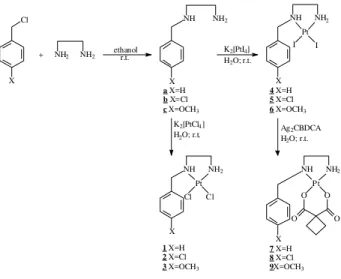
The syntheses of ligands PhCH2NH(CH2)2NH2(a), ClPhCH2NH(CH2)2NH2 (b) and CH3OPhCH2NH (CH2)2NH2(c) are described in the literature17-19 from the reactions of the corresponding benzaldehyde with ethyl-enediamine, followed by reduction of the resulting Schiff bases with formic acid. We found that these ligands can be prepared in satisfactory yields by treatment of ethylenedi-amine with the corresponding benzyl chloride in ethanol at room temperature for 24 h (Scheme 1). The IR spectra of all the ligands showed the characteristic absorptions at νN-H at 3294 cm-1, νC-H(aromatic) at 3027 cm-1 and νC-H(aliphatic) at 2934 cm-1 for compound a, for instance. In addition to these absorptions, the IR spectrum of compound b showed
For compound c, m/z: 181(M+H)+; 163 (OCH3ArCH2NCH2 CH2); 150 (CH3OArCH2NHCH2); 136 (CH3OArCH2NH) and 121 (CH3OArCH2).
Reactions of 4, 5 and 6 with an aqueous silver 1,1-cyclobutanedicarboxylate (Ag2CBDCA) suspension af-forded the corresponding carboplatin analogs [Pt(CBDCA) (PhCH2NH(CH2)2NH2)].H2O (7), [Pt(CBDCA)(ClPhCH2 NH(CH2)2NH2)].2 H2O (8) and [Pt(CBDCA)(CH3OPhCH2 NH(CH2)2NH2)].3H2O (9),(Scheme 1). The IR spectra showed absorptions at 3204 cm-1 (νNH), 3064 cm-1 (νCH aromatic), 2954 cm-1 (νCH aliphatic) and 1652 cm-1 (νC=O), as well as the νPt-N and νPt-O at 472 cm-1 and 535 cm-1, respectively. In the 1H NMR spectrum, multiplets at
δ 1.69 and 2.25 corresponding to the CH2 groups of the cyclobutane ring were evident. The downfield shift of the NH and NH2 signals was also evident, as mentioned previ-ously for compounds 1, 2 and 3. In the 13C NMR spectrum the signals corresponding to the CH2 groups of the cyclobutane ring appear at δ 15.0, 30.2 and 30.3. The qua-ternary carbon exhibits a resonance at δ 55.4, and the car-bonyl carbons at δ 177.2 and 177.4. The 195Pt NMR spec-tra, as expected, showed only one signal at δ - 1996. Com-pared to compounds 1, 2 and 3, the coordination of the oxygen atoms in these complexes causes a downfield shift of the signal in the 195Pt NMR spectra, as expected. For instance, the spectrum of [Pt(DACH)(ox)] shows a signal at δ - 1857 (DACH= 1,2-diaminocyclohexane and ox= ox-alate anion)23. Figure 1 shows the 195Pt NMR spectra of compounds 3, 6 and 9. One can see the upfield and downfield shifts of the signal when chloride 3 is replaced for iodide 6 or carboxylate 9.
+ NH2 NH2 ethanolr.t. Cl
X X
NH NH2
X NH NH2
Pt
I I
a X=H
b X=Cl
c X=OCH3
1 X=H
2 X=Cl
3 X=OCH3
K2[PtCl4]
H2O; r.t.
Ag2CBDCA
H2O; r.t.
Pt
X
NH NH2
O O
O O
4 X=H
5 X=Cl
6 X=OCH3
7 X=H
8 X=Cl
9X=OCH3
K2[PtI4]
H2O; r.t.
X NH NH2
Pt
Cl Cl
Scheme 1
The dichloro platinum(II) complexes [PtCl2(PhCH2 NH(CH2)2NH2)] (1), [PtCl2(ClPhCH2NH(CH2)2NH2)] (2) and [PtCl2(CH3OPhCH2NH(CH2)2NH2)] (3) were synthesized by reaction of the corresponding ligands with K2[PtCl4] in water at room temperature for 12 h, and isolated by simple filtration. For these complexes, one can see in the IR spectra the absorp-tions corresponding to νPt-N and νPt-Cl at 495 and 322 cm-1, respectively, in addition to the absorptions observed for the ligand. In the 1H NMR spectra one observes that there is a marked downfield shift for the NH and NH2 signals compared to those for the ligands. The 195Pt NMR spectra showed only one signal at δ -2357, -2361 and -2359 for compounds 1, 2 and
3, respectively. These chemical shift values can be expected based on data for similar compounds described in the litera-ture. For instance, the spectrum of [Pt(DACH)Cl2] shows a signal at δ - 2287 (DACH= 1,2-diaminocyclohexane)20.
Compounds a, b and c were reacted with an equimolar amount of potassium tetraiodoplatinate(II), generated in situ, to produce the diiodo platinum(II) complexes [PtI2(PhCH2NH(CH2)2NH2)] (4), [PtI2(ClPhCH2NH (CH2)2NH2)] (5) and [PtI2(CH3OPhCH2NH(CH2)2NH2)]
(6). Besides the absorptions observed in the spectra of the ligands, the IR spectra of the iodide complexes showed one absorption due to νPt-N at 491 cm-1. The 1H and 13C NMR spectra are analogous to those of compounds 1, 2 and 3. The 195Pt NMR spectra of these complexes showed one signal at δ -3313, supporting the proposed structure. Com-pared to compounds 1, 2 and 3, the replacement of chloride by iodide causes an upfield shift of the signal in the 195Pt NMR spectrum, as expected21,22.
Figure 1. 195Pt NMR spectra of complexes 3, 6 and 9.
The results of elemental analysis for all the complexes prepared are in agreement with the calculated values.
Preliminary cytotoxicity tests for complexes 1, 2 and 3
lines (KB cells)24,25 was performed in vitro along with cisplatin, as the reference drug, using a colorimetric method. These compounds are not cytotoxic at 1 and 10mg mL-1 concentrations. Complexes 1 and 2 show 30% and 65% cytotoxicity, respectively, at a concentration of 50mg mL-1.
Conclusion
This work describes the synthesis and characteriza-tion of three N-benzylethylenediamine analogs used as ligands for the preparation of nine new platinum(II) com-plexes. These complexes were fully characterized and have potential for acting as cytotoxic agents, which was demonstrated by a preliminary test done using KB cells. Further investigation of the biological properties of the new compounds is desirable to determine their possible utility as anticancer agents.
Acknowledgments
E. T. C. gratefully acknowledges CAPES (Fundação Coordenação de Aperfeiçoamento de Pessoal de Nível Su-perior) for a fellowship. The authors are grateful to Dr. Ri-chard Grazul for his review of this paper.
References
1. Rosenberg, B.; VanCamp, L.; Trosko, J. F.; Mansour, V. H. Nature (London) 1969, 222, 385.
2. Krakoff, I. H. Platinum and Other Metal Coordination Compounds in Cancer Chemotherapy: Clinical Aplications of Platinum Complexes; Nicoline, M., ED.; Martinus Nijhoff Publishing: Boston, MA, 1988, p. 351. 3. Loehrer, P. J., Williams, S. D.; Einhorn, L. H. J. Natl.
Cancer Inst.1988, 80, 1373.
4. Loehrer, P. J.; Einhorn, L. H. Ann. Intern. Med.1984,
100, 704.
5. Krakoff, I. H. Cancer Treat. Resp.1979, 63, 1623. 6. Vermorken, J. B.; Pinedos, H. M. Neth. J. Med.1982,
25, 270.
7. Vonhoff, D. D.; Schilky, R.; Reichert, C. M. Cancer Treat. Resp.1979, 63, 1527.
8. Calvert, A. H.; Harland, S. J.; Newell, D. R.; Siddik, Z.
H.; Jones, A. C.; McElwain, T. J.; Raju, S.; Wiltshaw, E.; Smith, I. E.; Baker, J. M.; Peckham, M. J.; Harrap, K. R. Cancer Chemother. Pharmaco.1982, 9, 140. 9. Harland, S. J.; Smith, I. E.; Smith, N.; Alison, D. L.
Platinum Coordination Complexes in Cancer Chemotherapy; Hacker, M. P., Douple, E. B., Krakoff, I. H., Eds; Martinus Nihoff Publishing: Boston, MA,
1984, 352.
10. Egorin, M. J.; Van Echo, D. A.; Olman, E. A.; Whitacre, M. Y.; Forrest, A. Aisner J. Cancer Res. 1985, 45, 6502. 11. Harland, S. J.; Newell, D. R.; Siddik, Z. H.; Chadwick, R.; Calvert, A. H.; Harrap, K. R. Cancer Res.1984,
44, 1693.
12. Mauldin, S. K.; Husain, I.; Sancar, A.; Chaney, S. G.
Cancer Res.1986, 46, 2876.
13. Fontes, A. P. S.; Almeida, S. G.; Nader, L. A . Quím. Nova, 1997, 20, 398.
14. Beaumont, K. P.; McAuliffe, C. A.; Cleare, M. J. Chem. Biol. Interact.1976, 14, 179.
15. Paul, A. K.; Srivastava, T. S.; Chavan, S. J.; Chitnis, M. P.; Desai, S.; Rao, K. K. J.Inorg. Biochem. 1996,
61, 179.
16. Farrell, N. P. Transition Metal Complexes as Drugs
and Chemotherapeutic Agents; Kluwer Academic
Publishers; Dordrecht, 1989, p. 18.
17. Eckstein, Z.; Lukasiewicz, A. Bull. Acad. Polon. Sci. Sér. Sci. Chim. Géol. Et Géograph. 1959, 7, 789. 18. Eckstein, Z.; Lukasiewicz, A. Bull. Acad. Polon. Sci.
Sér. Sci. Chim. Géol. Et Géograph.1959, 7, 797. 19. Bonet, D.; Funke, A. Compt. Rend. Soc. Biol. 1947,
141, 325.
20. Vollano, J. F.; Al-Baker, S.; Dabrowiak, J. C.; Schurig, J. E. J. Med. Chem.1987, 30, 716.
21. Pesek, J.; Mason, W. R. J. Magn. Reser.1977, 25, 519. 22. Pregosin, P. S. Coord. Chem. Rev. 1982, 44, 247. 23. Hoeschele, J. D.; Farrell, N.; Turner, W. R.; Rithner, C.
D. Inorg. Chem.1988, 27, 4106.
24. Sachinvala, N. D.; Chen, H.; Niemezura, W. P.; Furusawa, E.; Cramer, R. E.; Rupp, J. J.; Ganjian, I. J. Med. Chem.1993, 36, 1791.
25. Ichikawa, M.; Yoshimura, A.; Furukawa, T.; Sumizawa, T.; Nakazima, Y.; Akiyama, S. I. Biochim. Biophys. Acta
1991, 1073(2), 309.