Article
Printed in Brazil - ©2008 Sociedade Brasileira de Química 0103 - 5053 $6.00+0.00
*e-mail: [email protected]
Local Magnetic Moments and Hyperfine Fields at Ta Impurities Diluted in
X
Fe
2(
X
= Y, Gd, Yb) Laves Phases Compounds
Amós Troper,*
,a,bNilson A. de Oliveira,
bMarcus V. Tovar Costa
cand Alexandre L. de Oliveira
daCentro Brasileiro de Pesquisas Físicas, Rua Dr. Xavier Sigaud, 150, 22290-180 Rio de Janeiro-RJ, Brazil.
bInstituto de Física, Universidade do Estado do Rio de Janeiro, Rua São Francisco Xavier, 524,
20550-013 Rio de Janeiro-RJ, Brazil
cInstituto de Aplicação, Universidade do Estado do Rio de Janeiro, Rua Santa Alexandrina, 288,
20261-232 Rio de Janeiro-RJ, Brazil
dCentro Federal de Educação Tecnológica de Química de Nilópolis / RJ, Rua Lúcio Tavares, 1045,
26530-060 Nilópolis-RJ, Brazil
Neste trabalho, estudamos, à temperatura finita, a sistemática na formação dos momentos locais de uma impureza de Ta diluída em compostos intermetálicos de fases de Laves XFe2 (X = Y, Gd, Yb). Utilizamos um hamiltoniano de Hubbard, extendido à duas sub-redes acopladas, para descrever as matrizes de fases de Laves. A interação eletrônica d-d é tratada via método da integral funcional, na aproximação quase estática. Efeitos da pressão dependentes da temperatura estão incluídos, considerando a interação elétron-fônon induzida que renormaliza a hibridização do elétron puro. Os campos hiperfinos magnéticos calculados, relacionados aos momentos magnéticos locais, estão em bom acordo com os dados experimentais avaliados.
In this work, we study the systematics, at finite temperature, of the formation of local magnetic moments at a Ta impurity diluted in intermetallic Laves phases compounds XFe2 (X = Y, Gd, Yb). We use an extended two-coupled sublattice Hubbard Hamiltonian, to describe the Laves phases host. The d-d electronic interaction is treated via a functional integral approach in the quasi-static saddle point approximation. Temperature dependent pressure eěects are included considering induced electron-phonon interaction which renormalizes the pure electron hybridization. The calculated magnetic hyperfine fields related to the obtained local magnetic moments, are in a quite good agreement with available experimental data.
Keywords: intermetallic compounds, magnetic hyperfine fields, impurities
Introduction
The Laves phase intermetallic compounds XFe2 crystallize either in the cubic C15 or hexagonal C14 structure.1They exhibit an interesting variety of behaviors related to the changes in their magnetic, electronic, and lattice structures. For instance, in the intermetallic compound YFe2 the magnetic order is sustained mainly by the itinerant electrons of the Fe sublattice and a small magnetic moment is induced at the Y sublattice. On the other hand the compounds of GdFe2 and YbFe2 exhibit magnetization associated both with the localized spins of the rare earth sublattice and
Theoretical Model
In order to calculate the magnetic properties of the XFe2 intermetallic hosts, we use a two sublattice Hamiltonian, describing a subsystem of itinerant d-electrons coupled with localizedf-spins of rare earth ions.4One has:
(1)
whereEx 0 (E
Fe
0) is the energy of the center of X (Fe) sub-lattice, dg
jS(djS) is the creation (annihilation) operator, njS=djgSdjS is the number operator. TljXX (T
lj
FeFe) is the hopping
integral between only X (Fe) sub-lattice atoms, and TXFe is the corresponding to the processes involving X and Fe sub-lattices atoms. Jdf is an exchange interaction parameter and UFe(UX) is the Coulomb interaction parameter for the Fe (X). Notice that in the case of the YFe2 host the last term of the equation (1) does not appear, since there is no magnetic moment at the Y sublattice.
We use the functional integral technique to treat the d-d electron-electron interaction.4-7In this framework of the functional integral method, the initial Hamiltonian with Coulomb correlations is mapped into an eěective one-body Hamiltonian in which the electrons are under the action of fluctuating charge (N) and spin (X) fields. These fluctuating fields which are randomly distributed all over the sites, define a “disorder problem” in both sublattices. We treat this intrinsic disorder in the Coherent Potential Approximation (CPA) and so one defines eěective media3SFe and 3
S
X to restore the translational invariance
of the pure Laves phase host. The self-energies are self consistently determined by a CPA equation,7and thereby theX sublattice host is completely described at any finite temperature.
We consider that the Ta impurity diluted in the X sublattice, defines a Wolf-Clogston problem in the eěective medium at the X sublattice. The local d-density of states per spin direction at the impurity site is given by
(2)
where GX 0 X
0S(z) is the local perturbed Green function given by:
(3)
and gX 0 X
0S(z) is the host Green function written in terms of
the self-energy. The energy ETa
0 should be self consistently determined by the Friedel screening condition
(4)
where$NX
S is the change in the occupation number at the X sublattice calculated by:8
(5)
The electron occupation number at the impurity site (n0S) is obtained by integrating the local density of states up to the Fermi level EF, i.e.,
(6)
f(E) being the Fermi function. The local d-magnetic moment at the Ta impurity is then given by
(7)
We also consider the s-p sublattice band to describe hyperfine interactions.9The local s-p magnetic moment is obtained by
(8)
wheremX
dis the X sublattice d-magnetization and the pa-rameterG is of order of 0.1.9The total magnetic hyperfine field at the Ta impurity site, is made up by a conduction electron polarization (CEP) contribution due to the s-p conduction electrons and by a core polarization (CP) due to the d conduction electrons. One has
(9)
whereA(Zimp) is the Fermi-Segrè contact coupling param-eter and Ad
cp is d-core polarization parameter. 10
Results and Discussions
In order to obtain the numerical results for a Ta impurity diluted at XFe2 metallic host, we need to follow some self-consistent calculation steps.
that, as mentioned before the s electrons are not considered explicitly and they contribute to the appearance of the local moment through equation (8). Moreover, since the s-p band is large and flat, the local s-moment is constant with temperature, and is not considerately affected by the presence of the Ta impurity since the charge screening is made by the d-band.
Secondly, once the self-consistent calculations for the pure host were made at 0 K temperature, for a fixed set of the model parameters, we determine the self-energies 3SFe and3SXfor at a given temperature. After that, we determine
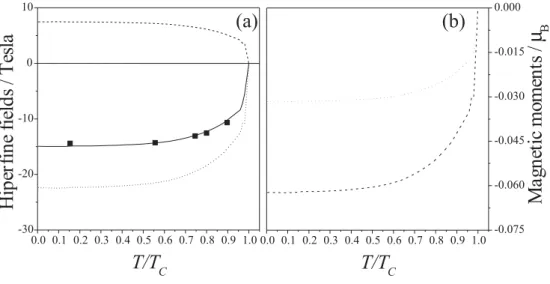
Figure 1. (a) Magnetic hyperfine field at Ta impurity diluted in YFe2 intermetallic host. The dotted line corresponds to the CEP contribution and the dashed line corresponds to the CP contribution. The solid line represents the total hyperfine field. The squares represent the experimental data collected from reference 2. (b) Local magnetic moments at Ta impurity diluted in YFe2 intermetallic host. The dotted line corresponds to the m~c(0) contribution and the dashed line corresponds to the m~d(0) contribution.
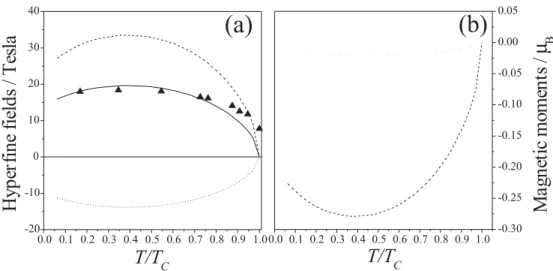
Figure 2. (a) Magnetic hyperfine field at Ta impurity diluted in GdFe2 intermetallic host. The dotted line corresponds to the CEP contribution and the dashed line corresponds to the CP contribution. The solid line represents the total hyperfine field. The circles represent the experimental data collected from reference 3. (b) Local magnetic moments at Ta impurity diluted in GdFe2 intermetallic host. The dotted line corresponds to the m~c(0) contribution and the dashed line corresponds to the m~d(0) contribution.
the impurity energy ETa
0 via the Friedel screening condition and calculate the local magnetic moment and the related magnetic hyperfine fields at a Ta impurity.
In Figures 1(b), 2(b), and 3(b) we plot as a function of temperature, the calculated local magnetic moments at a Ta impurity dilute in YFe2, GdFe2, and YbFe2.
field at the Ta impurity in GdFe2 and YbFe2 is antiparallel to the magnetization of the Fe sublattice being positive in both cases.
In Figure 4, we show a semi phenomenological calculation to include pressure effects.11In this case, we assume that external pressure excites the elastic degrees of freedom of the host. Therefore one has an electron-phonon interaction which modifies the pure electronic hybridization-like term,13,14 V
SX = ESTa – 3SX (EF) (see equation (5)).
Figure 3. (a) Magnetic hyperfine field at Ta impurity diluted in YbFe2 intermetallic host. The dotted line corresponds to the CEP contribution and the dashed line corresponds to the CP contribution. The solid line represents the total hyperfine field. The triangles represent the experimental data collected from reference 3. (b) Local magnetic moments at Ta impurity diluted in YbFe2 intermetallic host. The dotted line corresponds to the m~c(0) contribution and the dashed line corresponds to the m~d(0) contribution.
Figure 4. Magnetic hyperfine field at Ta impurity diluted in GdFe2 intermetallic host. The solid line corresponds to the high pressure calculated total magnetic hyperfine field and the dashed line to the total calculated hyperfine field at normal pressure. Triangles and circles represent experimental data collected from reference 3. Inset: Local magnetic moments at Ta impurity in GdFe2 intermetallic host with pressure effect. Dotted line and dashed line represent the m~c(0) and the m~d(0) contributions, respectively.
When the electron-phonon interaction is included in equation (5), one has a temperature dependence of VS. Figure 4 illustrates such pressure effects. The experimental data were obtained for a high pressure of 7.7 GPa and our theoretical results are again in a good agreement with the experimental data reported in reference 3. So, we have shown, that a functional integral approach, using a mean field approximation can describe the magnetic hyperfine field behavior of Laves phase intermetallics. The theory should be enlarged to account also for light rare earth, in the beginning of the 4f series such as Ce, Pr and Nd, following the calculation made at T = 0 K made in reference 15.
Acknowledgment
This article was written for a special volume in honor of Professor Ricardo Ferreira. Professor Ricardo Ferreira is a true “natural philosopher” and his contribution to the development of natural sciences (physics, chemistry and biology) in Brazil has been extremely important. In his scientific work, originality and imagination are always present, thus being a source of inspiration to a whole generation of scientists.
References
1. Buschow, K. H. J.; Rep. Prog. Phys.1977,40, 1179. 2. Akselrod, Z. Z.; Budzynski, M; Komissarova, B. A.; Kryukova,
L. N.; Ryansny G. K.; Sokorin, A. A.; Phys. Stat. Sol. (b)1983,
119, 667.
4. de Oliveira, A. L.; de Oliveira, N. A.; Troper, A.; J. Magn. Magn. Mater.2004,272, 631.
5. Stratonovich, R. L.; Dokl. Akad. Nauk. SSSR1957,115, 1097. 6. Hubbard, J.; Phys. Rev. Lett.1959,3, 77.
7. de Oliveira, N. A.; Gomes, A. A.; J. Magn. Magn. Mater.1992,
117, 175.
8. de Oliveira, A. L.; de Oliveira, N. A.; Troper, A.; J. Appl. Phys.
2002,91, 8876.
9. de Oliveira, N. A.; Gomes, A. A.; Troper, A.; Phys. Rev. B1995,
52, 9137.
10. Campbell, I. A.; J. Phys. C1969,2, 1338.
11. Tovar Costa, M. V.; de Oliveira, N. A.; Troper, A.; J. Appl. Phys.
1997,81, 3880.
12. Sorokin, A. A.; Komissorova, B. A.; Ryasnyi, G. K.; Shpin’kova, L. G.; Aksel’rod, Z. Z.; Tsvyashchenko, A. V.; Shirani, E. N.; Fomicheva, L. N.; JETP1997,84, 599.
13. de Menezes, O. L. T.; Troper, A.; Phys. Rev. B1980, 22, 2127.
14. de Menezes, O. L. T.; Troper, A.; Physica B1981,108, 1345. 15. de Oliveira, A. L.; de Oliveira, N. A.; Troper, A.; J. Magn. Magn.
Mater.2004,270, 208.
Received: August 21, 2007