A Cross-Section of Voter Learning, Campaign Interest and
Intention to Vote in the 2008 American Election: Did Web
2.0 Matter?
Jacob Groshek & Daniela Dimitrova
Erasmus University Rotterdam, Netherlands & Iowa State University, United States
E-mail: [email protected], [email protected]
T
HE2008 American presidential election was notable for many reasons,including ethnic, gender, and financial components (Federal Election Commission, 2009) as well as a robust Democratic primary contest and the highest turnout rate in 40 years (McDonald, 2008). Also, during this cam-paign, ratings remained competitive among many print and broadcast media (Stelter & Pérez-Peña, 2008) despite the growth of an increasingly diverse me-diascape. As part of this process, the Internet continued to expand as a news source and Web-based technologies became more available, interactive, and replete with user-generated political content (Pew Research Center, 2010). These political and media developments seemed so interrelated that Sanson (2008, p. 162) wrote that this election cycle “marks the first presidential campaign defined by new media.” Given these features, the 2008 American election provides a useful opportunity to empirically analyze and compare the effects of different forms of traditional and online media.
The purpose of this study is therefore to measure the political influences of citizens’ exposure and attention to a variety of media platforms. Decades of political communication research on traditional media outlets have gener-ally found positive relationships between such media use and key political variables of political knowledge, involvement, and participation (see Drew & Weaver, 2006; Zhao & Chaffee, 1995). Nonetheless, debates between me-dia malaise and meme-dia mobilization scholars have never been perfectly recon-ciled largely due to distinctions in content rather than format type (Aarts & Semetko, 2003; Cappella and Jamieson, 1997).
Considering the more recently diffusing Web 2.0 applications (O’Reilly, 2005), a good body of scholarship has come to position the Internet as a po-litical tool that has the potential to invigorate certain aspects of American democracy (Boulianne, 2009; Gil de Zúñiga, Puig-I-Abril, & Rojas, 2009).
Yet since many such technologies are still just emerging on a wide scale and reach a relatively small percentage of the population (Pew Research Center, 2010), their overall effects remain fairly uncertain. Thus, a number of schol-ars position uses of Web 2.0 media as signs of increased political interest or enthusiasm but do not observe these online uses as having tangible effects on political behaviors or political systems (see Bimber, 2001; van Dijk, 2006).
The study reported here is positioned to contribute to a gap in the existing literature by examining diverse forms of traditional media as well as several dimensions of online media. Specifically, traditional print, radio, and tele-vision news outlets are incorporated along with televised campaign ads and politically-informed talk and entertainment programs. In addition, this study also examines general Internet news use as well as campaign-related Web 2.0 use as these relate to prospective voters’ political knowledge, interest in the campaign, and intention to vote. Findings are then considered within the con-text of similar studies that have been carried out and reported for other national elections.
Political Effects, Media Formats, and Web 2.0
Traditionally, political communication scholars have considered media formats as a baseline for examining campaign effects. In this manner, scholars looked at print media, and newspapers in particular, to examine media influ-ence on citizens’ political activity in elections. A series of studies pioneered by Drew and Weaver that surveyed Indiana voters for every national elec-tion since 1988 showed that newspaper attenelec-tion was a significant predictor of vote intention in the 1996 and 2000 presidential election (Drew & Weaver, 1998; Weaver & Drew, 2001). Likewise, Dalton, Beck and Huckfeldt (1998) analyzed the influence of newspapers in the 1992 presidential campaign and found that editorial content was strongly related to voters’ decision-making processes in choosing a political candidate. More recently, a field experiment of newspapers’ effects on voters demonstrated that newspaper readership sig-nificantly impacted voting behavior in the 2005 Virginia gubernatorial elec-tion (Gerber, Karlan, & Bergan, 2006).
Along these lines of traditional media effects research, a number of stud-ies have examined the impact of television on political knowledge, interest,
and behavior. In this area of inquiry the well-known Chaffee studies gener-ally show that television constitutes a significant predictor of issue knowledge (Zhao & Chaffee, 1995; Chaffee, Zhao & Leshner, 1994). Drew and Weaver’s (2006) study of the 2004 presidential election indicated that television news attention emerged as a significant predictor of campaign interest while TV debate exposure was significantly related to both issue knowledge and cam-paign interest. Other studies have also taken into account not just traditional forms of mass media but also personal characteristics, such as knowledge and interest in politics.
For instance, Nadeau and colleagues (2008, p. 242) concluded that mod-erately well-informed voters were most likely to be influenced by information about political issues through traditional media while “those at the top and bot-tom of the information ladder are similarly unresponsive to new information about issues.” Similarly identifying a key aspect of the intersection between citizen characteristics and media use, models proposed by Converse (1962) and Zaller (1989) have suggested that those with middling levels of political interest are most likely to be politically influenced by traditional media. Tak-ing these findTak-ings and perspectives into account, prior research on traditional mass media (notably newspaper and television) in elections has produced re-sults that generally find a positive relationship between media use and political campaign involvement, broadly conceived.
Nonetheless, this body of scholarship does not provide a definitive pattern of which traditional media might influence voters, especially over time and across campaigns (see Drew and Weaver, 2006). In light of the rather dramatic media developments over the last several American election cycles (Polsby, Hopkins, & Wildavasky, 2008), there is good reason to believe that the pattern of traditional media influence might be in a state of increased flux. Indeed, the presence of online media technologies in political communication continues to grow in importance as more and more citizens engage with these media for political purposes. This development now has clear implications not only for politics but also for the political effects of different forms of media.
Such characteristics have led some to argue that online media do more than simply serve as conduits (Howard, 2006) but rather act as “associates within the network” and thus take the role of human agents (Contractor, 2002). Accordingly, a number of scholars have documented the increasing role of the Internet in political elections. Tolbert and McNeal (2003), for example,
found that Internet access and online election news use increased the likeli-hood of voting in both the 1996 and 2000 presidential elections. In addition, use of the Internet for political purposes has been shown to have a positive effect on civic engagement (Weber, Loumakis & Bergman, 2003), especially among Generation X (Shah, Kwak & Holbert, 2001). In the 2004 campaign, Drew and Weaver (2006) documented a statistically significant relationship between increased Internet news exposure and attention to issue knowledge and campaign interest. Using American National Election Studies (ANES) data, Xenos and Moy (2007) demonstrated a pattern of direct effects in the 2004 election in which more Internet use lead to higher political information acquisition.
Based on the findings reported here, it seems clear that more interactive (i.e., online) media formats are likely to have greater political effects than less interactive (i.e., traditional) mass media. Of course, previous research has demonstrated that demographic characteristics and political backgrounds often constitute the strongest predictors of political engagement (Bennett & Iyengar, 2008; Drew and Weaver, 2006) but in a series of multivariate models that control for these influences, we examine the following propositions:
H1: Ceteris paribus, online media will have a greater influence upon in-creased campaign issue knowledge than will traditional mass media. H2: Ceteris paribus, online media will have a greater influence upon
in-creased campaign interest than will traditional mass media.
H3: Ceteris paribus, online media will have a greater influence upon in-creased intention to vote than will traditional mass media.
Methods
In many ways, the study reported here drew upon Drew and Weaver’s comparative studies of media use in presidential elections (see Drew & Weaver, 1991; Drew & Weaver, 1998; Drew & Weaver, 2006; Weaver & Drew, 1995; Weaver & Drew, 2001). There are several reasons for this approach, notably that their research tradition of nearly 20 years established this model as vital to the field of political communication research. While other survey instruments such as ANES could have been modeled, Drew and Weaver sampled residents from the Midwestern part of the country (Indiana), and it seemed especially
useful to build on their framework when drawing our sample from Iowa, an-other state in the Midwest with numerous socioeconomic similarities. In an-other words, the questionnaire utilized by Drew and Weaver has proven suitably re-liable and valid when examining statewide samples from the Midwest and it was therefore a logical starting point for this particular study.
A staff of trained interviewers at a research institute at a large Midwestern university carried out the surveys between October 16th and October 30th, 2008 to examine the hypotheses posed. A sample of random residential tele-phone numbers was generated using a list-assisted method that incorporates unlisted and newly listed numbers in the sample. Though there are, of course, certain limitations that arise from telephone-based sampling (especially of landline phones), this study was interested in the uses and effects of both traditional and online media formats. The sampling frame created by this pro-cess thus seems a fair one for this purpose, especially considering that only approximately 17% of the U.S. population had only cellular phones at the time of the 2008 American election (Pew Research Center, 2008b).
The response rate was 30.9% of eligible respondents and with a 95% con-fidence interval, the maximum possible variation due to sampling in the study reported here was an acceptable plus or minus 4.1 percentage points. Alto-gether, this survey comprised 561 adults aged 18 and over from the state of Iowa and included a number of relevant demographic questions. These items included measures of political party affiliation, age, gender, education, in-come, and employment status. The independent variables of interest included frequency of use and attention to a number of different media, generally rang-ing from older to newer. Broadly conceived for the purposes of hypothesis testing, the media variables were categorized as either traditional mass media or online media formats (Drew & Weaver, 2006). Of course, there are dis-tinctions that were and can be made within and between these different media platforms, as outlined below.
Traditional Media Variables: Much like previous studies of this kind (Drew & Weaver, 1991; Drew & Weaver, 2006; Weaver & Drew, 1995), this survey included ratio-level questions about the number of days respondents read a newspaper and watched television news over the course of the previous week. This survey included measures of the amount of attention respondents
de-voted to news about the presidential campaign in newspapers, television news, television talk shows, radio news broadcasts and talk radio shows. Further questions queried the number (out of three) of presidential debates between John McCain and Barack Obama respondents had viewed as well as if they watched the vice-presidential debate between Sarah Palin and Joe Biden. In addition, respondents were asked to gauge how closely they had paid atten-tion to television-based campaign advertising. When considering attenatten-tion measures, this survey employed the same four-point attention scale used by Drew and Weaver.
Online Media Variables: To measure general online news use, the survey asked how many days during the past week respondents had visited a Web site for news as well as self-reports on how much attention they paid to online information about the presidential campaign. Four additional questions were then introduced to capture different dimensions of online use and thus account for some of the changes to the media landscape since 2004. These four addi-tional items focused specifically on respondents’ uses of Web 2.0 applications and measured whether respondents got presidential campaign news from so-cial networking sites such as Facebook or Myspace, online video sites like YouTube, political Weblogs, and Web sites set up by the candidates them-selves. The scales used here were modeled after similar questions from a recent Pew study and all comprised four-point scales for these newer forms of online media use (Pew Research Center, 2008a). The inclusion of these on-line media items augments the onon-line media block of variables to this survey instrument and thus constructs a more even system of comparing traditional media to online media.
Dependent Variables: Four questions assessed respondents’ campaign knowledge in terms of the issue positions of the candidates. In this study, respondents were asked to identify whether John McCain or Barack Obama were more likely to support a certain plan of action regarding four issues: en-ergy (including gas prices), the economy, the situation in Iraq, and healthcare. These were the top four issues reported in a June 2008 Gallup Poll (2008) as “extremely important” in choosing a presidential candidate. Answers to these questions were added together to create a scale for campaign issue knowledge.
Each correct response was awarded 1 point. Thus, it was possible for each re-spondent to earn an overall campaign issue knowledge score of “0” (no issue positions questions correct) to “4” (all issue positions correct).
As a more general measure of overall interest level in the 2008 presiden-tial campaign, respondents were asked to self-report their level of interest in the American election. This campaign interest measure was constructed to follow the same three-point metric employed by Drew and Weaver (2006). Respondents were also asked to provide their likelihood of voting on election day. The measurement used here is a four-point scale also identical to that of Drew and Weaver (2006).
Data Analysis: Hierarchical multiple regression analyses were used to iden-tify significant predictors of the three key dependent variables: issue knowl-edge, campaign interest, and likelihood of voting. Demographic measures comprised the first block and were entered first to act as a basic control. The remaining blocks were entered in the exact order of Drew and Weaver for reasons of analytic parsimony and also to draw comparisons as necessary.
Campaign interest was therefore entered as the second predictor block of issue knowledge and likelihood of voting. As has been noted over the course of this line of research, the impact of the media has been, at least to some extent, a byproduct of how the campaign interest variable is handled. Historically, previous studies have relied upon a more conservative measure of media effects by placing the interest block before any media measures in regression analyses. This does create the possibility that some of variance in the dependent variables might have been explained away before media were even considered. That said, we feel it is crucial to follow previous research patterns primarily to avoid spuriously overstating or inaccurately comparing effects of media.
Thus, the next block entered was traditional media variables, which were followed by the block of Internet measures. This online media block included the Internet campaign news exposure/attention variable as well as the newly conceived online media measures. Exposure to the presidential and vice-presidential debates on television was entered last to not only follow the prece-dent of previous research but also to take into account that these debates were among the most watched in American history (the vice-presidential debate,
for example, attracted the second largest audience ever). Thus, it is possible that the debate measure might predict additional variance beyond other media measures as it has in previous inquiries.
For each of the three regression models, F tests measured the significance of each block in addition to standardized Beta tests on the statistical signifi-cance of each predictor variable. Prior to modeling the regressions, frequen-cies were run for every variable to examine potential outliers and blocks of missing data. In all cases but one–income–there were very few missing or un-usable responses. The income measure, however, was “Refused” or reported as “Don’t Know” by 100 respondents. Rather than lose this considerable num-ber of otherwise viable responses, the mean income figure was substituted for the missing cases.
Of course, there are many other factors that shape political knowledge and decision-making such as interpersonal communication, political efficacy, and the perceived level of campaign competitiveness. The findings of this study are limited in that they do not specifically account for all such measures or the changes that newer forms of media might have on political communication messages and processes themselves. As part of an ongoing research inquiry, additional measures are being developed and incorporated for future elections. Nonetheless, as it stands, this study does build upon and update the rich re-search history on more direct forms of media influence upon voter learning, campaign interest, and intention to vote.
Before proceeding to regression models, correlations between all indepen-dent and depenindepen-dent variables were checked for evidence of multicollinearity. Most of these correlations were below .20 and most were less than .10, which indicates that multicollinearity was not a threat to further data analysis. Fol-lowing the regressions, multicollinearity diagnostic tests were examined, with particular attention paid to the tolerances of each independent variable in the models. When derived as excluded variables for each block, all instances of tolerance collinearity statistics were .74 or higher, with the notable exception of the debate exposure measure, which demonstrated an acceptable tolerance of .62 to .66 in the three regressions.
Results
The survey respondents had an average age of 56.8 years. While this sam-ple is, indeed, an older one, the distribution is within the limits of normal skewness (-0.08) and post-hoc models demonstrated no age-related bias in the findings reported here.1Political party affiliation was split three ways among
this group, where 27.5% reported being affiliated with the Republican Party and 35.7% indicated belonging to the Democratic Party (29.2% reported they were Independents). Males represented a minority (31.2%) of this sample and the average household income was between $35,000 and $50,000 per year. On average, respondents had completed some college or post-secondary tech-nical training, and a majority reported being gainfully employed. Generally speaking, these characteristics resemble those of Iowans overall.
This sample’s media use for the 2008 election is summarized in Table 1. Here, it is quite evident that these respondents did not rely all that heavily on the Internet for campaign information, in general preferring traditional forms of media.
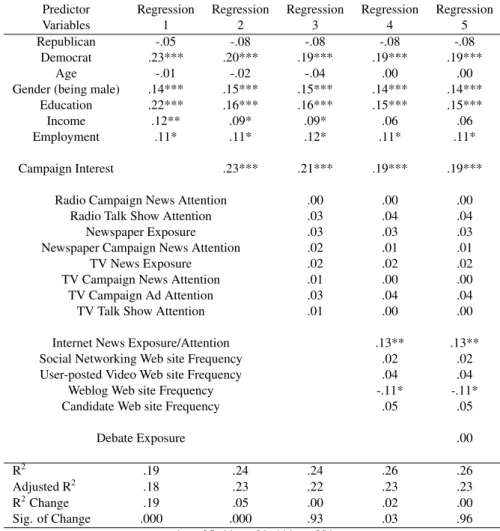
Campaign Issue Knowledge: The first block of demographic variables de-monstrated the strongest relationship (Adjusted R2= .19) with knowledge of
candidates’ positions on campaign issues. As shown in Table 2, identifying with the Democratic Party, having more education, being male, and holding gainful employment were related to being able to correctly answer the four issue questions posed in the survey when controlling for interest and other media factors. The second predictor block was campaign interest, which was also statistically significant in predicting issue knowledge (R2change = .05, p
< .001).
The third block brought in measures of traditional media use, with no significant R2 change or any statistically significant predictors. Individuals
who reported higher levels of radio, newspaper, and television exposure and attention did not demonstrate higher scores on the issue questions than those with lower levels of traditional media exposure and attention.
1. Importantly, numerous additional models (heavy or younger users) have not had an ap-preciable effect upon the media-related findings of the models, and many such models have considerably lower R2values.
Table 1:Means of Media Use Media Mean (S.D.) Newspaper Exposure* 4.09 (2.88) Newspaper Attention** 2.60 (1.14) TV News Exposure 5.40 (2.32) TV News Attention 3.13 (1.00)
Radio News Attention 2.29 (1.16)
Radio Talk Show Attention 1.73 (1.13)
TV Ad Attention 2.40 (0.96)
TV Talk Show Attention 2.07 (1.21)
Debate Exposure*** 2.42 (1.50)
Internet Exposure 1.83 (2.74)
Internet Attention 1.80 (1.14)
Social Networking Web site Frequency**** 1.12 (0.48) User-posted Video Web site Frequency 1.19 (0.58)
Weblog Web site Frequency 1.20 (0.60)
Candidate Web site Frequency 1.28 (0.70)
* Media exposure measures ranged from 0 to 7 days.
** Media attention measures ranged from 1 “no attention” to 4 “a lot of attention.” *** Out of four debates.
****Frequency of use measures use scales ranging from 1 “never” to 4 “regularly.”
In the fourth block of online media measures, however, there was a statis-tically significant effect (R2change = .02, p < .05). Within this block, an
in-crease in general exposure and attention to online news was observed to be re-lated to increased issue knowledge (β = 0.13, p < .01). In addition, frequency of Weblog use actually had a negative relationship with issue knowledge (β = -0.11, p < .05). Other forms of online media use, including visiting social networking Web sites, user-posted video Web sites, and candidates’ Web sites were not significantly related to voter learning of campaign issue positions.
Finally, the regression results show that exposure to the campaign debates that were introduced in block five was not related to issue knowledge. The only media technologies that influenced Iowans’ candidate issue knowledge were general Internet news use and increased Weblog use. Interestingly, gen-eral Internet use was a positive predictor of campaign issue knowledge but Weblog use was negatively related to this dependent variable. The results of
the hierarchical regression models are summarized in Table 2. Hypotheses 1 is generally supported in that the R-squared change of the online media block of variables was significant while the block of traditional media variables was not. Nonetheless, there is some reason for pause due to the negative coeffi-cient of Weblog use as related to campaign issue knowledge, which seems to signal that wholesale assumptions regarding differing online media formats may not be most suitable.
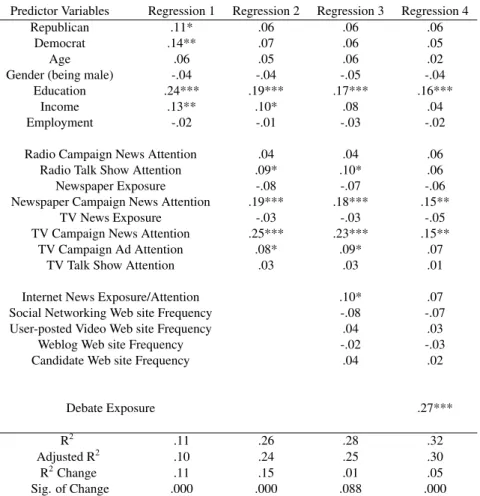
Campaign Interest: In this model, statistically significant associations were observed in all of the four blocks of predictor variables. When the demo-graphic block was set as the only block in the regression model, affiliation with either political party, higher education levels, and greater household in-come were all positive predictors of campaign interest (Adjusted R2 = .10).
When this block was modeled as a component with all other blocks, only hav-ing more formal education remained a statistically significant predictor (see Table 3).
The block of traditional media measures remained the strongest predic-tor of campaign interest (R2 change = .15, p < .001). In the study reported
here, attention to radio talk shows as well as attention to TV campaign ad-vertisements produced statistically significant relationships until debate expo-sure was introduced to the regression model. Other traditional media factors that were statistically significant in all regression models included attention to campaign news in newspapers and attention to campaign news on television.
The online media block of variables was significant only at the p < .10 level. Here, exposure and attention to news on the Internet was a statistically significant predictor of campaign interest but only until debate exposure was entered into the regression and it then became non-significant. Debate expo-sure itself was a statistically significant block that predicted campaign inter-est, though we do acknowledge the possibility for bi-directionality between campaign interest and media use measures. Newspaper attention, TV news attention, and debate exposure were all forms of media that influenced cam-paign interest among this sample. When considering Hypothesis 2, there is no specific evidence here that Web 2.0 forms of online media were more influen-tial upon campaign interest than other forms of traditional media. Indeed, the opposite seems to hold true in this case.
Table 2:Hierarchical Regression Analysis of Predictors of Campaign Is-sue Knowledge (Betas, N=544)
Predictor Regression Regression Regression Regression Regression
Variables 1 2 3 4 5
Republican -.05 -.08 -.08 -.08 -.08 Democrat .23*** .20*** .19*** .19*** .19***
Age -.01 -.02 -.04 .00 .00
Gender (being male) .14*** .15*** .15*** .14*** .14*** Education .22*** .16*** .16*** .15*** .15***
Income .12** .09* .09* .06 .06
Employment .11* .11* .12* .11* .11* Campaign Interest .23*** .21*** .19*** .19***
Radio Campaign News Attention .00 .00 .00 Radio Talk Show Attention .03 .04 .04 Newspaper Exposure .03 .03 .03 Newspaper Campaign News Attention .02 .01 .01 TV News Exposure .02 .02 .02 TV Campaign News Attention .01 .00 .00 TV Campaign Ad Attention .03 .04 .04 TV Talk Show Attention .01 .00 .00 Internet News Exposure/Attention .13** .13** Social Networking Web site Frequency .02 .02 User-posted Video Web site Frequency .04 .04 Weblog Web site Frequency -.11* -.11* Candidate Web site Frequency .05 .05
Debate Exposure .00 R2 .19 .24 .24 .26 .26 Adjusted R2 .18 .23 .22 .23 .23 R2Change .19 .05 .00 .02 .00 Sig. of Change .000 .000 .93 .03 .96 * p<.05; ** p<.01; *** p<.001
Likelihood of Voting: As was the case with the majority of the findings reported here, the block of demographic variables was a relatively strong pre-dictor of intention to vote (Adjusted R2= .06). Political affiliation with either
Table 3: Hierarchical Regression Analysis of Predictors of Campaign In-terest (Betas, N=544)
Predictor Variables Regression 1 Regression 2 Regression 3 Regression 4
Republican .11* .06 .06 .06
Democrat .14** .07 .06 .05
Age .06 .05 .06 .02
Gender (being male) -.04 -.04 -.05 -.04 Education .24*** .19*** .17*** .16***
Income .13** .10* .08 .04
Employment -.02 -.01 -.03 -.02 Radio Campaign News Attention .04 .04 .06
Radio Talk Show Attention .09* .10* .06 Newspaper Exposure -.08 -.07 -.06 Newspaper Campaign News Attention .19*** .18*** .15**
TV News Exposure -.03 -.03 -.05 TV Campaign News Attention .25*** .23*** .15**
TV Campaign Ad Attention .08* .09* .07 TV Talk Show Attention .03 .03 .01 Internet News Exposure/Attention .10* .07 Social Networking Web site Frequency -.08 -.07 User-posted Video Web site Frequency .04 .03
Weblog Web site Frequency -.02 -.03 Candidate Web site Frequency .04 .02
Debate Exposure .27*** R2 .11 .26 .28 .32 Adjusted R2 .10 .24 .25 .30 R2Change .11 .15 .01 .05 Sig. of Change .000 .000 .088 .000 * p<.05; ** p<.01; *** p<.001
the Republican or Democratic parties, being older, and having a higher educa-tion levels were all positive predictors as well. Only educaeduca-tion remained sig-nificant when controlling for all other factors introduced by additional blocks of interest and media variables.
In addition, campaign interest was a strong predictor of respondents’ in-tentions to vote (R2change = .11, p < .001). This was the only other
statisti-cally significant block of variables. Traditional media variables, online media variables, and the debate exposure measure also returned non-significant re-sults. When controlling for demographics and campaign interest, media atten-tion and use had no significant direct effects on individuals’ voting intenatten-tions here. Thus, Hypothesis 3 was not supported since there were no media (tradi-tional or online) that directly influenced vote intention among the members of this cross-sectional sample.
Discussion and Conclusions
Much has been made of the transformative capacities of Internet applica-tions on political processes (Castells, 2008), and this was especially true in the 2008 election, where many credited Barack Obama’s use of online media as vital to his success (for one example, see Haynes & Pitts, 2009). Nonethe-less, there is only limited empirical evidence that has directly linked the use of online resources to positively augmenting political knowledge, interest, or behavior. It is therefore quite important to note that more frequent exposure to Internet news and more attention to campaign information online was a signif-icant predictor of political knowledge among our sample, even when control-ling for all other factors. In addition, exposure and attention to Internet-based news also predicted campaign interest after controlling for demographic mea-sures and traditional media use.
Though these findings add some promise to the notion that online media might reinvigorate political participation, an increase in one aspect of online media use – frequency of visiting Weblogs – actually predicted less campaign issue knowledge. This may be related to the observation that blogs and blog-gers often appear to have strong partisan positions that tend to disproportion-ately favor the issue stances of a particular candidate rather than seek out multiple views or sources (Baum & Groeling, 2008; Wallsten, 2005). Based on the relationships observed in this study, Web 2.0 types of online media such as social networking Web sites, user-generated online video, Weblogs, and more interactive candidate Web sites have not drastically (or at least di-rectly) reshaped citizens’ political action in terms of whether or not
individu-als would vote in the presidential American election as compared to traditional media. Moreover, this study found no specific evidence among this sample of voting-age Iowans that such Web 2.0-type applications, not just Internet use in general, had any appreciable, positive effect upon voter learning or campaign interest in this election.
Although the campaign interest levels in this study were higher than any reported in the Drew and Weaver line of studies, the impact of online me-dia in this election can best be summarized as modest and comparable with traditional media in previous election studies (Drew & Weaver, 1991, 1998, 2006). Placing this seemingly incongruent finding in line with the research of Liu and Eveland (2005) as well as Wei and Lo (2008), interest itself may have intervened with knowledge acquisition and contributed to the limited variance in vote intention. In some respects, these findings come back to the assertions of Zaller (1989) as well as Orbell (1970) when considering that the reception of information flows are moderated by different levels of engagement.
When considering these findings as a critical test of Web 2.0, it seems that the effects of traditional and online media still remain complementary, at least among this sample of relatively light online media users. As an em-pirical snapshot of media effects in the 2008 presidential election, the results reported here suggest that online media–particularly Web 2.0 formats–were less influential overall (at least in Iowa) than popularly reported. This is not to say, however, that the impact of more interactive forms of online media was not meaningful.
The fact that general Internet news exposure and attention was the only positive, statistically significant media predictor of campaign knowledge is relatively remarkable and signifies that the use of online media may well con-tribute to knowledge acquisition. Alternatively, the negative relationship be-tween blog use and campaign issue knowledge indicates a greater need for the study of user-generated media content, and examinations of online media information processing among less familiar and older populations. Addition-ally, the non-significance of online media use as related to campaign interest and vote intention demonstrates the need for circumspection and prudence amongst the scholarly community regarding the impact of newer and less dif-fuse forms of online media.
Altogether, the results of this study suggest that it may be increasingly dif-ficult to capture traditionally-conceived direct media effects today considering
the augmentation and personalization of information channels and the expan-sion of online media technologies. As Bennett and Iyengar (2008) wrote, such dramatic changes in the media landscape may be influencing not only the audience composition but also the experience of politics itself. We echo their suggestion that an era of minimal direct effects may be at the doorstep of political communication research, and that different questions and conceptual-izations may need to be developed by future scholars to capture these evolving relationships.
References
AARTS, Kees; SEMETKO, Holli A, The divided electorate: Media use and political involvement. Journal of Politics, 2003. Vol. 65(3), 759-794. ANDERSON, Chris, The long tail. New York, NY: Hyperion, 2006. BAUM, Matthew A; GROELING, Tim, New media and the polarization of
American political discourse. Political Communication, 2008. Vol. 25(4), 345-365.
BENNETT, Lance; IYENGAR, Shanto, A new era of minimal effects? The changing foundations of political communication. Journal of Commu-nication, 2008. Vol. 58(4), 707-731.
BIMBER, Bruce, Information and political engagement in America: The search for effects of information technology at the individual level. Po-litical Research Quarterly, 2001. Vol. 54(1), 53-67.
BOULIANNE, Shelley, Does Internet Use Affect Engagement? A Meta-Analysis of Research. Political Communication, 2009. Vol. 26(2), 193-211.
CAPPELLA, Joseph N; JAMIESON, Kathleen H, Spiral of cynicism: The press and the public good. New York, NY: Oxford University Press, 1997.
CASTELLS, Manuel, The new public sphere: Global civil society, commu-nication networks and global governance. The ANNALS of the Amer-ican Academy of Political and Social Science, 2008. Vol. 616: 78-93.
CHAFFEE, Steven H; ZHAO, Xinshu; LESHNER, Glenn, Political knowl-edge and the campaign media of 1992. Communication Research, 1994. Vol. 21(2), 305-24.
CONTRACTOR, Noshir S, New Media and Organizing: Introduction. In Lievrouw, Leah; Livingstone, Sonia, Eds., Handbook of New Media: Social Shaping and Consequences of ICTs (pp. 201-205). London: Sage, 2002.
CONVERSE, Philip E, Information flow and the stability of partisan atti-tudes. The Public Opinion Quarterly, 1962. Vol. 26(4), 578-599. DALRYMPLE, Kajsa E; Scheufele, Dietram A, Finally Informing the
Elec-torate? How the Internet Got People Thinking about Presidential Pol-itics in 2004. The International Journal of Press/PolPol-itics, 2007. Vol. 12(3), 96-111.
DALTON, Russell J; BECK, Paul A; HUCKFELDT, Robert, Partisan cues and the media: Information flows in the 1992 Presidential elections. American Political Science Review, 1998. Vol. 92(1), 111-126. DREW, Dan; WEAVER, David H, Voter learning in the 1988 Presidential
election: Did the the media matter? Journalism Quarterly, 1991. Vol. 68(1/2), 27-37.
DREW, Dan; WEAVER, David H, Voter learning in the 1996 Presidential election: Did the media matter? Journalism & Mass Communication Quarterly, 1998. Vol. 75(2), 292-301.
DREW, Dan; WEAVER, David H, Voter learning and interest in the 2004 Presidential election: Did the media matter? Journalism and Mass Communication Quarterly, 2006. Vol. 83(1), 25-53.
EVELAND, William P, The Cognitive Mediation Model of Learning from the News: Evidence from Nonelection, Off-Year Election, and Presidential Election Contexts. Communication Research, 2001. Vol. 28(5), 571-601.
FEDERAL ELECTION COMMISSION. 2009. Presidential Campaign Fi-nance. Available in http://www.fec.gov/DisclosureSearch/ mapApp.do. Accessed on March 30, 2009.
GALLUP. June 24, 2008. Obama Has Edge on Key Election Issues. Avail-able in
http://www.gallup.com/poll/108331/Obama-Has-Edge-Key-Election-Issues.aspx. Accessed on September 2, 2008.
GERBER, Alan; KARLAN, Dean S; BERGAN, Daniel, 2006. Does the media matter? A field experiment measuring the effect of newspapers on voting behavior and political opinions. Yale Economic Applica-tions Working Paper No. 12. Available in http://ssrn.com/ abstract=903812. Accessed on March 18, 2009.
GIL DE ZÚÑIGA, Homero; PUIG-I-ABRIL, Eulàlia; ROJAS, Hernando, Weblogs, traditional sources online and political participation: An as-sessment of how the internet is changing the political environment. New Media & Society, 2009. Vol. 11(4), 553-574.
HAYNES, Audrey A; PITTS, Brian, New media in the 2008 Presidential nomination campaigns. Political Science & Politics, 2009. Vol. 42, 53-58.
HOWARD, Phillip N, New Media Campaigns and the Managed Citizen. New York: Cambridge University Press, 2006.
KENSKI, Kate; STROUD, Natalie J, Connections Between Internet Use and Political Efficacy, Knowledge, and Participation, Journal of Broadcast-ing & Electronic Media, 2006. Vol. 50(2), 173–192.
LIU, Yiu; EVELAND, William P, Education, need for cognition, and cam-paign interest as moderators of news effects on political knowledge: An analysis of the knowledge gap. Journalism and Mass Communication Quarterly, 2005. Vol. 82(4), 910-929.
MARTINELLI, Kathleen A; CHAFFEE, Steven H, Measuring new-voter learning via three channels of political information. Journalism & Mass Communication Quarterly, 1995. Vol. 72, 18-32.
MCDONALD, Michael, 2008. United States Elections Project. Available in http://elections.gmu.edu/voter_turnout.htm. Accessed on March 29, 2009.
NADEAU, Richard; NEVITTE, Neil; GIDENGIL, Elisabeth; BLAIS, An-dré, Election campaigns as information campaigns: Who learns what and does it matter? Political Communication, 2008. Vol. (25), 229-248.
NEUMAN, W. Russell; GUGGENHEIM, Lauren, 2009. The Evolution of Media Effects Theory: Fifty Years of Cumulative Research. Paper pre-sented at the annual meeting of the International Communication Asso-ciation, Marriott, Chicago, IL. Available inhttp://www.allacademic. com/meta/p300007_index.html. Accessed on June 05, 2010.
ORBELL, John M, 1970. An information-flow theory of community influ-ence. The Journal of Politics, 1970. Vol. 32(2), 322-338.
O’REILLY, Tim, 2005. What is Web 2.0 Available inhttp://www.oreillynet. com/pub/a/oreilly/tim/news/2005/09/30/what-is-web-20.html.
Accessed on March 29, 2009.
PEW RESEARCH CENTER. August 17, 2008a. Audience segments in a changing news environment: Key news audiences now blend online and traditional sources. Pew Research Center Biennial News Consump-tion Survey. Available in http://pewresearch.org/pubs/928/key-news-audiences-now-blend-online-and-traditional-sources.
Accessed on August, 14, 2010.
PEW RESEARCH CENTER. September 23, 2008b. Cell Phones and the 2008 Vote: An Update. Available in http://pewresearch.org/ pubs/964/. Accessed October 10, 2010.
PEW RESEARCH CENTER. June 24, 2010. How Media Consumption Has Changed Since 2000. Available in
http://pewinternet.org/Presentations/2010/Jun/How-Media-Consumption-Has-Changed-Since-2000.aspx. Accessed on June
25, 2010.
POLLING REPORT. 2009. Problems and Priorities. Available in http:// www.pollingreport.com/prioriti.htm. Accessed on March 29, 2009.
POLSBY, Nelson; HOPKINS, David; WILDAVASKY, Aaron, Presidential Elections: Strategies and Structures of American Politics. Lanham, MD: Rowman and Littlefield, 2008.
QUINTELIER, Ellen; VISSERS, Sara, The Effect of Internet Use on Polit-ical Participation: An Analysis of Survey Results for 16-Year-Olds in Belgium. Social Science Computer Review, 2008. Vol. 26(4), 411-427.
SANSON, Angela, Facebook and youth mobilization in the 2008 presiden-tial election. gnovis journal, 2008. Vol. 8(3), 162-174.
SHAH, Dhavan; KWAK, Nojin; HOLBERT, R. Lance, "Connecting" and "disconnecting" with civic life: Patterns of Internet use and the pro-duction of social capital. Political Communication, 2001. Vol. 18(2), 141-162.
SOTIROVIC, Mira; MCLEOD, Jack M, Values, communication behavior, and political participation. Political Communication, 2001. Vol. 18, 273-300.
STELTER, Brian; PÉREZ-PEÑA, Richard, August 4, 2008. Media Outlets Are Seeking a Campaign Bounce of Their Own. Available inhttp:// www.nytimes.com/2008/08/04/business/media/04ratings. html. Accessed on October 10, 2010.
TOLBERT, Caroline J; MCNEAL, Ramona S, Unraveling the Effects of the Internet on Political Participation? Political Research Quarterly, 2003. Vol. 56(2), 175-185.
WALLSTEN, Kevin, 2005. Political blogs and the bloggers who blog them: Is the political blogosphere an echo chamber? Paper presented at the American Political Science Association (APSA) annual meeting, Wash-ington, D.C.
WEAVER, David H; DREW, Dan, Voter learning in the 1992 Presidential election: Did the ‘nontraditional’ media and debates matter? Journal-ism & Mass Communication Quarterly, 1995. Vol. 72(1), 7-17. WEAVER, David H; DREW, Dan, Voter learning and interest in the 2000
Presidential election: Did the media matter? Journalism & Mass Com-munication Quarterly, 2001. Vol. 78(4), 787-98.
WEBER, Lori M; LOUMAKIS, Alysha; BERGMAN, James, Who Partici-pates and Why? An Analysis of Citizens on the Internet and the Mass Public. Social Science Computer Review, 2003. Vol. 21(1), 26-42. WEI, Ran; LO, Ven-hwei, News Media Use and Knowledge about the 2006
U.S. Midterm Elections: Why Exposure Matters in Voter Learning. In-ternational Journal of Public Opinion Research, 2008. Vol. 20(3), 347-362.
WILLIAMS, Christine B; GULATI, Girish J, 2007. Social Networks in Po-litical Campaigns: Facebook and the 2006 Midterm Elections. Paper presented at the American Political Science Association (APSA) annual meeting, Chicago, IL.
XENOS, Michael; Moy, Patricia, Direct and differential effects of the In-ternet on political and civic engagement. Journal of Communication, 2007. Vol. 57, 704–718.
ZHAO, Xinshu; CHAFFEE, Steven H, Campaign advertisements versus tele-vision as sources of political issue information. Public Opinion, 1995. Vol. 59(1), 41-65.