A
RTIGOC
IENTÍFICO Revista Brasileira de FisioterapiaPlantar force distribution and pressure center
oscillation in relation to the weight and positioning
of school supplies and books in student’s backpack
Distribuição da força plantar e oscilação do centro de pressão em relação
ao peso e posicionamento do material escolar
Rodrigues S, Montebelo MIL, Teodori RM
Abstract
Objective: The influence of the weight and positioning of school supplies and books in backpacks, on plantar force distribution (PFD) and pressure center location, was investigated among students. Methods: Thirty volunteers of both genders participated in the study.
Their mean age was 10.76 (± 1.35) years and none of them had postural abnormalities. Baropodometric data were collected using a
computerized baropodometric system (Matscan Research, Tekscan, 5.72): without load (control) and with loads of 5, 10 and 15% of
body weight in a backpack, positioned on the back, on the chest and on the right and left shoulders. Results: The PFD without load
was greater on the left heel than on the right heel (p< 0.05). With a load of 10% on the left shoulder, the PFD was greater on the right and smaller on the left foot, in comparison with the control (p< 0.05). With a load of 5% on the back, the PFD was smaller on the right midfoot (RMF) and left forefoot (lff); with 10%, it was smaller on the RMF and left midfoot (LMF) and greater on the right toes (RT); with 15%, it was smaller on the RMF and greater on the RT (p< 0.05). The plantar force was greater on the RT with loads of 10% and 15% than it was with loads of 5% (p< 0.05). With loads of 15% on the back and on the chest, the pressure center displacement was greater than with a load of 5% (p< 0.05). The PFD was not influenced by the different loads and backpack positions. Conclusions: Taking into consideration the increased pressure center displacement with a load of 15%, it is recommended that school backpack loads should not exceed 10% of body mass. Investigations on posture adaptations to different loads and backpack positions are suggested, in order to detect possible abnormalities and propose preventive actions.
Key words: plantar force; pressure center oscillation; schoolchildren.
Resumo
Objetivo: Investigou-se a influência da carga e posicionamento do material escolar sobre a distribuição da força plantar (DFP) e trajetória do centro de pressão (COP) em estudantes. Métodos: Participaram 30 voluntários (10,7 ± 1,35 anos), ambos os gêneros, sem alteração postural. Dados baropodométricos foram coletados em sistema de baropodometria computadorizada (Matscan Research, Teckscan
, 5.72):sem carga (controle); com carga (mochila) de 5, 10 e 15% da massa corporal, posicionada nas regiões anterior e
posterior do tronco, ombro direito e esquerdo. Resultados: Sem carga, a DFP foi maior no calcâneo esquerdo comparado ao direito
(p< 0,05). Com carga de 10% no ombro esquerdo, a DFP foi maior à direita e menor à esquerda, comparado ao controle (p< 0,05). Com 5% na região posterior do tronco, a DFP foi menor no médio-pé direito (mpD) e antepé esquerdo (apE); com 10%, foi menor no mpD e mpE e maior no artelho direito (atD); com 15%, foi menor no mpD e maior no atD (p< 0,05). A força plantar foi maior no atD com carga de 10 e 15% em relação a 5% (p< 0,05). Com carga de 15% nas regiões anterior e posterior do tronco, a trajetória do COP foi
maior (p< 0,05) comparada à carga de 5%. A DFP não foi influenciada pelas diferentes cargas e posições da mochila. Conclusões:
Considerando o aumento da trajetória do COP com carga de 15%, recomenda-se que a carga das mochilas escolares não ultrapasse 10% da massa corporal. Sugere-se investigação das adaptações da postura às diferentes cargas e posições da mochila, visando detectar possíveis alterações e propor ações preventivas.
Palavras-chave: força plantar; oscilação do centro de pressão; escolares.
Recebido: 28/02/2007 – Revisado: 11/07/2007 – Aceito: 2/10/2007
Postgraduate Physical Therapy program, Universidade Metodista de Piracicaba (Unimep), Piracicaba (SP), Brazil
44
Introduction
Children and adolescents perform a daily routine of carrying school material over their elementary and mi-ddle school years. These phases of education correspond to to the ages between 7 and 14 years. Girls demonstrate a “growth peak” at a mean age of 12 and boys, at approxi-mately 14 years1,2. During this growth period, the vertebral
column becomes more susceptible to external influences, especially to loads that are imposed on it, and shows the possibility of suffering lateral and anteroposterior dislocations3.
Considering that backpacks are practical and are the most commonly used means of carrying school material4-8,
taking care with the load and the way in which it is suppor-ted is fundamental for this age group. When the backpack load is greater than the support capacity of the muscle groups, there is an overload on the vertebral column9, which
may cause postural alterations, pain or dysfunctions. Since carrying school material is a daily routine that is repeated over consecutive years, special care is needed to avoid the presence of postural alterations that might become establi-shed over the medium to long term, thereby bringing risks to this population’s health3,7,9.
Brackley and Stevenson3 showed that, although
epidemio-logical, physiological and biomechanical data in the literature justiies backpack load-carrying amounting to between 10 and 15% of body weight, this limit may not be suicient to prevent musculoskeletal disorders, tissue lesions or low-back pain. his suggests that there is a need for studies investigating the diferent factors, which may inluence the student’s vertebral column structure.
Homogeneous distribution of body weight on the plan-tar area provides adequate alignment to the pelvis and con-sequently to the vertebral column10. Therefore, the present
study proposed to investigate whether the suggested load (10% to 15% of the body weight) and asymmetrical support for this load on the trunk could alter the plantar force dis-tribution and the body’s pressure center pathway among elementary-level students. The influences of a load lower than the proposed values were also investigated in relation to these variables.
The presence of abnormalities in the plantar force dis-tribution and in the body’s pressure center pathway may suggest that inadequate postures are being adopted when carrying school material. Over the long term, this would favor several vertebral column abnormalities. Such abnor-malities may cause functional11, psychosocial, work and
quality-of-life3 constraints, thus justifying the need for
pre-ventive intervention.
Material and methods
his was an analytical observational cross-sectional study, for which approval was granted by the Institutional Research Ethics Committee (Procedure no. 91/04). hirty volunteers of both genders, with a mean age of 10.7 (±1.35) years, were re-cruited from state schools in the region. heir parents or the adults responsible for them signed a free and informed consent statement. he students who were included demonstrated normal results from postural evaluations, without any pain, histories of lower-limb injuries or neurological dysfunctions.
he volunteers were screened on the premises of these schools, using a standardized form for postural evaluation. Using a Symmetrigraf and a plumb line, the students were evaluated wearing bikini/swim trunks. hose who demonstrated normal results from the postural evaluation were selected for the next stage, while those who showed any abnormalities in the vertebral column or misalignments/asymmetry in the anterior, posterior and/or lateral views, were referred for treatment.
Next, anthropometrical data (body weight and height) were obtained from the selected individuals and a lower-limb dominance test was applied, which consisted of asking the in-dividuals to climb steps. he limb that was chosen for starting to go up was considered to be the dominant limb, as descri-bed by Gobbi, Secco and Marins12. Baropodometric data were
collected using a computerized baropodometric system that consisted of a pressure platform (Matscan research software version 5.72, Tekscan) connected to a microcomputer.
he volunteers were asked to remain in an orthostatic posture on the pressure platform, with bare feet and bipedally supported with their eyes open, so that the equipment could be calibrated for each data collection session and for the irst reading (control data collection). hey were then asked to po-sition a standardized backpack containing 5%, 10% and 15% of each student’s body weight, in the following regions, for data collection: anterior of the trunk (A), posterior of the trunk (P), right (R) and left shoulder (L).
he backpack load was composed of magazines and sheets of paper that were weighed on a digital balance so that each individual’s load could be obtained. During the baropodome-tric data collection, three ilms of approximately seven seconds were recorded, in which the variations in force and pressure imposed on the plantar surface during the whole data collec-tion period were iled in the program, thus obtaining a mean value for each parameter analyzed.
the anterior and posterior regions of the trunk, the plantar force distribution was observed in four regions of the foot: heel, midfoot, forefoot and toes. When positioned on the right and left shoulders, the force distribution was considered over the whole plantar area. he body’s pressure center pathway was obtained by selecting in the program the option Save Center of Force. he pressure center oscillation was thus recorded for subsequent quantiication.
he Shapiro-Wilk test was applied to investigate whether the variables demonstrated a normal distribution. Compara-tive analyses were then performed, applying the Student t test for paired data or the Wilcoxon test for variables that did not meet the assumption of normality. he statistical signiicance level was taken to be 5%. he analyses were processed in the SPSS 11.0 software (Statistical Package for the Social Sciences) and the Statistica 6 software.
Results
Plantar Force
he initial evaluation in a bipedal position with no load (control) showed greater force on the left foot (52.42% ± 4.02)
than on the right (47.56% ± 4.03) (p< 0.05 – Figure 1). When the diferent loads were added to the right shoulder, the force values on the right and left foot, respectively, were 48.49%
± 6.08 and 50.34% ± 4.64, with a 5% load; 48.55% ± 5.89 and 51.40% ± 5.91, with a 10% load; and 48.36% ± 6.53 and 51.57%
± 6.57, with a 15% load. hese were not diferent from the right control values (47.55% ± 4.03) and left control values (52.41% ± 4.02) (p> 0.05).
When a 10% body weight load was added to the left shoul-der, there was an increase in plantar force on the right foot (48.73% ± 4.56) and a decrease on the left foot (51.22% ± 4.59), in comparison with the control (p< 0.05 – Figure 2).
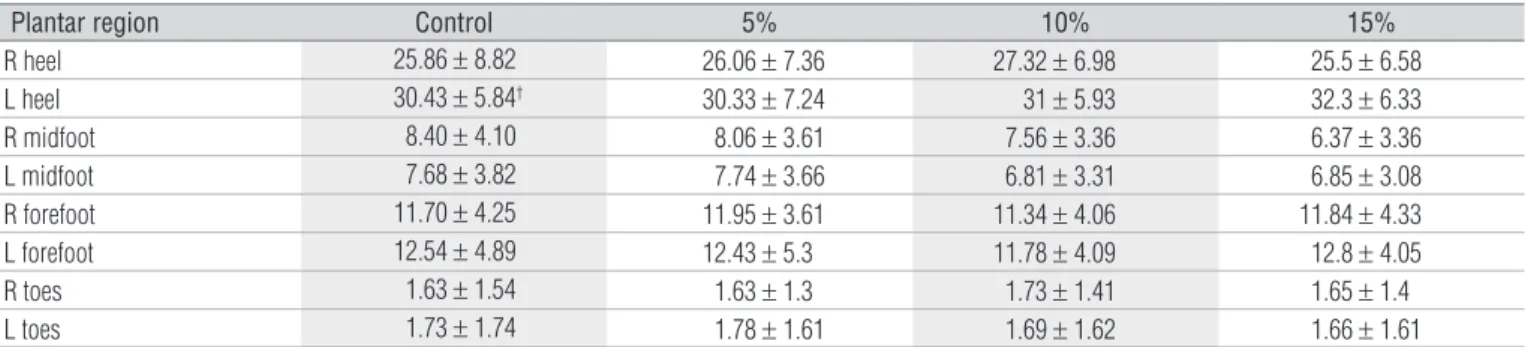
he plantar region that demonstrated the greatest overload in the bipedal position with no load (control) was the left heel, in relation to the right heel. When the backpack was positioned in the anterior region of the torso and the force distribution was evaluated in the diferent regions of the foot, the values that were obtained with 5, 10 and 15% body weight loads were not diferent from the control. here were also no signiicant diferences when the values obtained with the diferent loads were compared between each other (p> 0.05 – Table 1).
Table 2 represents the force distribution in the diferent area of the feet when the backpack was supported on the posterior
Figure 1. Mean values ± SD for relative force on the right and left feet
(control values).
*
42 44 46 48 50 52 54 56 58
Right foot Left foot
Relative Force (%)
*
42 44 46 48 50 52 54 56 58
(*) Differs significantly from mean for right foot.
Figure 2. Comparative mean values ± SD for relative force on the right
(R) and left (L) feet, for the control (CO) and loads of 5%, 10% and 15%, with backpack positioned on left shoulder.
* *
40 43 46 49 52 55 58
Relative Force (%)
* *
40 43 46 49 52 55 58
RCO LCO 5R 5L 10R 10L 15R 15L
(*) Differs significantly from means for CO.
R: right; L: left
† Differs significantly from the control right heel.
Table 1. Mean values ± SD for force distribution on different plantar regions: without load (control) and with loads of 5%, 10% and 15% of body
weight, with the backpack placed on the anterior region of the trunk.
Plantar region Control 5% 10% 15%
R heel 25.86 ± 8.82 26.06 ± 7.36 27.32 ± 6.98 25.5 ± 6.58
L heel 30.43 ± 5.84† 30.33 ± 7.24 31 ± 5.93 32.3 ± 6.33
R midfoot 8.40 ± 4.10 8.06 ± 3.61 7.56 ± 3.36 6.37 ± 3.36
L midfoot 7.68 ± 3.82 7.74 ± 3.66 6.81 ± 3.31 6.85 ± 3.08
R forefoot 11.70 ± 4.25 11.95 ± 3.61 11.34 ± 4.06 11.84 ± 4.33
L forefoot 12.54 ± 4.89 12.43 ± 5.3 11.78 ± 4.09 12.8 ± 4.05
R toes 1.63 ± 1.54 1.63 ± 1.3 1.73 ± 1.41 1.65 ± 1.4
46
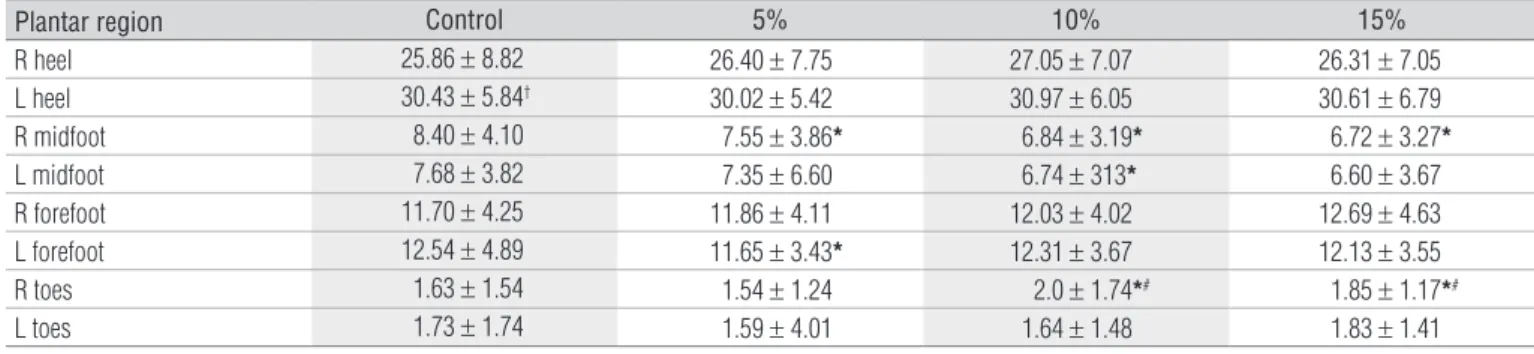
region of the trunk. For the 5% body weight load, there was a decrease in the force distribution to the right midfoot and left forefoot, in relation to the respective control values (p< 0.05). With the 10% load, there was a decrease in the force distribu-tion to the right and left midfoot in reladistribu-tion to the respective control values (p< 0.05). When the load was 15%, there was a decrease in the force distribution to the right midfoot and an increase in the force distribution to the right toes, in relation to the control (p< 0.05). he relative force distribution to the right toes with 10% and 15% loads was greater than that with a 5% load (p< 0.05 – Table 2).
Pressure Center Pathway
Table 3 shows the values for the anteroposterior pressure cen-ter pathway with no load and when the backpack with diferent
loads was positioned in the anterior and posterior regions of the trunk and on the right and left shoulders. It was observed that there was increased postural oscillation when the backpack with a 15% body weight load was positioned on the anterior and poste-rior regions of the trunk, in relation to the 5% load (p< 0.05).
Table 4 shows the values of the medial-lateral pressure center pathway. No signiicant diferences were noted between the diferent positions and backpack loads and the control, or when comparing the loads with each other (p> 0.05).
Discussion
Backpacks are one of the means of carrying school material that is most used4-8. hey are most commonly attached to the
back, followed by scapular attachment9,13. he literature reveals
Plantar region Control 5% 10% 15%
R heel 25.86 ± 8.82 26.40 ± 7.75 27.05 ± 7.07 26.31 ± 7.05
L heel 30.43 ± 5.84† 30.02 ± 5.42 30.97 ± 6.05 30.61 ± 6.79
R midfoot 8.40 ± 4.10 7.55 ± 3.86* 6.84 ± 3.19* 6.72 ± 3.27*
L midfoot 7.68 ± 3.82 7.35 ± 6.60 6.74 ± 313* 6.60 ± 3.67
R forefoot 11.70 ± 4.25 11.86 ± 4.11 12.03 ± 4.02 12.69 ± 4.63
L forefoot 12.54 ± 4.89 11.65 ± 3.43* 12.31 ± 3.67 12.13 ± 3.55
R toes 1.63 ± 1.54 1.54 ± 1.24 2.0 ± 1.74*# 1.85 ± 1.17*#
L toes 1.73 ± 1.74 1.59 ± 4.01 1.64 ± 1.48 1.83 ± 1.41
Table 2. Mean values ± SD for force distribution on different plantar regions: without load (control) and with loads of 5%, 10% and 15% of body
weight, with the backpack placed on the posterior region of the trunk.
R: right; L: left;
* Differs significantly from the mean for the control; (#) Differs significantly from the mean for the right toes with 5% body weight load; (†) Differs significantly from the control right heel.
Table 3. Mean values ± SD for anteroposterior pathway of body’s center of pressure, for the control and different backpack positions with loads of
5, 10 and 15% of body weight.
R: right; L: left;
* Differs significantly from the mean with posterior backpack 5%; (#) Differs significantly from the mean with anterior backpack 5%.
Control 5% 10% 15%
21.35 ± 1.8 - - - -
-Posterior backpack - - 21.24 ± 2.11 21.7 ± 1.75 21.96 ± 2.47*
Anterior backpack - - 21.2 ± 1.88 21.57 ± 1.72 22.26 ± 2.34#
R shoulder backpack - - 21.2 ± 2.07 21.51 ± 1.87 22.02 ± 2.67
L shoulder backpack - - 21.43 ± 2.05 21.47 ± 1.7 21.22 ± 2.26
Control 5% 10% 15%
14.95 ± 2.44 - - - -
-Posterior backpack - - 14.61 ± 2.0 14.49 ± 2.27 14.70 ± 1.98
Anterior backpack - - 14.80 ± 1.90 14.40 ± 1.84 14.43 ± 2.03
R shoulder backpack - - 14.41 ± 1.98 14.37 ± 2.05 14.33 ± 2.01
L shoulder backpack - - 14.58 ± 1.89 14.12 ± 2.33 14.27 ± 2.09
Table 4. Mean values ± SD for mediolateral pathway of body’s center of pressure, for the control and different backpack positions with loads of 5,
10 and 15% of body weight.
a discussion about the load limit for backpacks, between 10 and 15% of the body weight. However, no scientiically justiied speciic value has been determined that presents no risk to any of the musculoskeletal structures3.
Some authors have suggested that loads of 10% of body weight might not ofer any risk, but state that further research must be carried out to cover all the variables involved4,14,15.
Negrini and Carabalona6 suggest a maximum limit of up to 15%
of body weight. Nonetheless, such information is also not based on scientiic data. Although there is a need for analysis of other variables that would make it possible to identify the speciic way in which the load and method of carrying the school material inluence students’ posture, the data in the present study were obtained based on scientiic criteria. he data show that there is asymmetry in the plantar force distribution and oscillation in the body’s pressure center. hese points can be considered in future studies, with the aim of drawing up primary prevention proposals for elementary and middle school students.
Considering that scoliosis is the most serious postural altera-tion among the studied populaaltera-tions16, investigations of possible
asymmetries in plantar force distribution caused by the habit of carrying inappropriately positioned and excessive loads of school material is important within the sphere of public health. Early identiication of such asymmetries may give rise to pre-ventive and corrective intervention actions to inluence pelvis alignment and consequently, vertebral column alignment.
In the present study, the abnormality in plantar force dis-tribution in the bipedal position with no load (control) was possibly related to lower limb dominance. Some studies have deined foot preference such that the preferred foot is the one used for manipulating an object or initiating a movement and the non-preferred foot is the one used for postural support17.
Gobbi, Secco and Marins12 proposed some tests for
investi-gating lower limb dominance, such as kicking a ball, lifting an object made of foam or drawing a letter (static tests), and some dynamic tasks, such as directing a ball, aligning small balls or going around a hoop with a ball. In the present study, 29 volun-teers (96.6%) demonstrated dominance of the right lower limb, which was investigated in accordance with the tests proposed by Gobbi, Secco and Marins12. he higher plantar force
distri-bution on the left lower limb that was found could be related to postural support, as stated by Peters17.
Although there were no signiicant diferences in plantar force distribution when the backpack with diferent loads was positioned on the right shoulder, a tendency towards asymmetry was noted. his tendency could also be seen when the loads were added to the left shoulder. he greater symmetry after adding the loads was probably related to preexisting diferences, thus making it impossible to reach conclusions regarding the inluence of the load when positioned unilaterally on the shoulders.
Another important point from analyzing the inluence of the loads was the force distribution in the diferent plantar regions. hese forces were distributed heterogeneously in diferent re-gions of the foot, in the static posture. In the bipedal position with no load, the force distribution was 56.29% on the heel, 16.08% on the mid-foot, 24.24% on the forefoot and 3.36% on the toes. hese data coincide with what was observed by Cavanagh, Rodgers and Liboshi18, who evaluated 107 normal adult
individu-als, among whom 60.5% of the body weight fell on the heel, 7.8% on the midfoot, 28.1% on the forefoot and 3.6% on the toes.
When the backpack was positioned on the posterior region of the trunk with loads of 5%, 10% or 15% of body weight, there was the same tendency for plantar force distribution as in the control (with no load). he values, which were signiicant, did not alter the distributions, which were always greater on the heel and forefoot and smaller on the midfoot and toes. With a load, the tendency was for there to be greater symmetry be-tween the right and left foot, in comparison with the control.
Studies carried out by Rebelatto, Caldas and De Vitta9; De
Vitta, Madrigal and Sales15; Negrini, Carabalona and Sibila14;
and Negrini and Carabalona6 showed that children and
ado-lescents carried large loads in their backpacks. he greatest concern is the consequences that this daily routine can bring to the musculoskeletal structures, over the medium and long term, considering that these individuals are in the middle of their skeletal development phase.
Postural control is inluenced by learned motor experiences. Shummay-Cook and Woollacott19 stated that motor learning
is acquired when processes associated with practice favor the capacity to produce a skilful action from interactions between perception, cognition and action while performing a task that interacts with the environment. When a task is carried out functionally, it means that a new strategy for perception and action has been learned.
Considering that students perform the task of carrying school material every day for many years, it is possible that this motor ability has been incorporated into the students’ habits and, consequently, fine adjustment of muscle activity has been achieved. This is because the plantar force distri-bution demonstrated behavior that was nearly symmetrical, even with larger loads and with less appropriate positioning of the backpack. These results indicated the need for detai-led analyses of individuals’ posture when different overloads are imposed.
Postural oscillation is related to postural control. he fact that there were no increases in this oscillation in the mediola-teral direction in the presence of loads and diferent backpack positions may be related to adaptations of the central nervous system for the proposed task19, which represents the daily
48
References
postural balance, even when the load was the maximum, the-refore again suggesting the need for speciic postural analysis.
It was concluded that the plantar force distribution was not inluenced by the diferent loads and positions of the backpack. Considering the increases in the body’s pressure center pathway caused by the load of 15% of body weight, symmetrically positioned in the anterior and posterior re-gions of the trunk, it is recommended that the maximum limit for loads carried in school backpacks should not exceed 10% of body weight.
It is emphasized that there is a need for studies to investigate possible postural adaptations to diferent loads and backpack
positions, to aim at early identiication of abnormalities and drawing up of preventive strategies, by means of working on health education that would cover elementary and middle school students, their families and the school’s social body.
Acknowledgements
To the Coordination Oice for Higher Level Personnel De-velopment (CAPES/PROSUP), for the Master’s Degree grant, and the UNIMEP Extension Support Fund (FAE-UNIMEP), for inancial support.
1. Bradford DS, Lonstein JE, Moe JH, Ogilvie JW, Winter RB. Escolioses e outras deformidades da coluna: “O livro de Moe”. 2ª ed. São Paulo: Livraria Santos Editora; 1994.
2. Rowland TW. Developmental exercise physiology. Champaign (IL): Human Kinetics; 1996.
3. Brackley HM, Stevenson JM. Are children’s backpack weight limits enough? A critical review of the relevant literature. Spine. 2004;29(19):2184-90.
4. Grimmer K, Dansie B, Milanese S, Pirunsan U, Trott P. Adolescent standing postural response to backpack loads: a randomised controlled experimental study. BMC Musculoskelet Disord. 2002;3(10):1-10.
5. Whittfield JK, Legg SJ, Hedderley DI. The weight and use of schoolbags in New Zealand secondary schools. Ergonomics. 2001;44:819-24.
6. Negrini S, Carabalona R. Backpacks on schoolchildren’s perceptions of load, associations with back pain and factors determining the load. Spine. 2002;27:187-95.
7. Sheir-Neiss GJ, Kruse RW, Rahman T, Jacobson LP, Pelli JA. The association of backpack use and back pain in adolescents. Spine. 2003;28:922-30.
8. Goodgold S, Corcoran M, Gamache D, Gillis J, Guerin J, Coyle JQ. Backpack use in children. Pediatr Phys Ther.2002;14:122-31.
9. Rebelatto JR, Caldas MAJ, De Vitta A. Influência do transporte do material escolar sobre a ocorrência de desvios posturais em estudantes. Rev Bras Ortop. 1991;26(11-12):403-10.
10. Norkin CC, Levangie PK. Articulações, estrutura e função: uma abordagem prática e abrangente. 2ª ed. São Paulo: Revinter; 2001.
11. Penha PJ, João SM, Casarotto RA, Amino CJ, Penteado DC. Postural assessment of girls between 7 and 10 years of age. Clinics. 2005;60(1):9-16.
12. Gobbi LTB, Secco CR, Marins FHP. Influências da lateralidade na locomoção sobre obstáculos. In: Quevedo AAF, De Oliveira JR, Mantoan TEM (org.). Mobilidade e comunicação: desafios à tecnologia e à inclusão social. 1ª ed. Campinas: WVA; 1999. p. 11-5.
13. Korovessis P, Koureas G, Papazisis Z. Correlation between backpack weight and way of carrying, sagittal and frontal spinal curvatures, athletic activity, and dorsal and low back pain in schoolchildren and adolescents. J Spinal Disord Tech. 2004;17(1):33-40.
14. Negrini S, Carabalona R, Sibila P. Backpack as a daily load for schoolchildren. Lancet. 1999;354:1974.
15. De Vitta A, Madrigal C, Sales VS. Peso corporal e peso do material escolar transportado por crianças em idade escolar. Fisio Mov. 2003;16(2):55-60.
16. Marty-Poumarat C, Scattin L, Marpeau M, Garreau de L, Aegerler P. Natural history of progressive adult scoliosis. Spine. 2007;32(11):1227-34.
17. Peters M. Footedness asymmetries in foot preference and skill and neuropsychological assessment of foot movement. Psychol Bull. 1988;103(2):179-92.
18. Cavanagh PR, Rodgers MM, Liboshi A. Pressure distribution under symptom-free feet during barefoot standing. Foot Ankle Int. 1987;7(5):262-76.