AR
TIGO ORIGINAL / ORIGINAL AR
TICLE
INTRODUCTION
Nonsteroidal anti-inlammatory drugs (NSAIDs) such as diclofenac, mefenamic acid, etc. are used to induce ulcer in animal models(4,6,17). In humans,
chronic administration of diclofenac for the treatment of various diseases such as rheumatoid and osteoar-thritis induces gastric ulcer in 35%-60% of patients(9).
In general, NSAIDs are prescribed for its analgesic, antipyretic, and anti-inlammatory properties; its ac-tion is mediated by inhibiac-tion of the biosynthesis of prostaglandins, cyclooxygenase, and leukotriene(8,36).
They induce gastric mucosal lesions because of its acidic properties. A highly acidic gastric environ-ment favors the migration of nonionized lipophilic NSAIDs into the epithelial cells, and at the surface these are dissociated into ions, trapping hydrogen ions and inducing mucosal injury. This action is further enhanced by the decrease of the following: mucosal blood low, secretion of mucous and bicarbonates,
ADMINISTRATION OF H
2
BLOCKERS IN
NSAID INDUCED GASTROPATHY IN RATS:
effect on histopathological changes in
gastric, hepatic and renal tissues
Sachin
MANOCHA
1, Dushyant
LAL
2and Subramanian
VENKATARAMAN
3Received 7/11/2015 Accepted 10/11/2015
ABSTRACT - Background- Nonsteroidal anti-inlammatory drugs induces gastric mucosal lesions because of its acidic properties.
Ranitidine, an H2 receptor antagonist, has proved beneicial in patients with gastric ulcers. Objective- The present study was per-formed to assess the effect of administering ranitidine in Nonsteroidal anti-inlammatory drugs (diclofenac, nimesulide) induced gastropathy, and their effect on the histopathology of stomach, kidney and liver. Methods- Diclofenac, nimesulide, and ranitidine were administered in doses of 2, 4, and 6 mg/kg, p.o. once daily for 14 days, and their effect on gastric volume, acidity, mean ulcer number, and gastric pH. In addition, histopathological examination was also performed on sections of stomach, kidney and liver. Results-Following the administration of diclofenac or nimesulide, all the gastric parameters were signiicantly altered as well as the histopathology of stomach, liver and kidney. In the control group, the renal sections showed normal glomeruli with no thickening of glomerular basement membrane, while in diclofenac alone, nimesulide alone, and ranitidine with nimesulide groups, the thickening of glomerular basement membrane was observed. These alterations were observed to be reversed in the ranitidine with diclofenac group. In the sections from the liver, the control group showed anastomosing plates and cords of cuboidal hepatocytes with round well stained nuclei and abundant cytoplasm. In the ranitidine with diclofenac, and ranitidine with nimesulide groups, mild dilatation of sinusoids is seen coupled with prominence of central vein. In the diclofenac alone and nimesulide alone groups, the proximal and distal convoluted tubules show mild focal tubular necrosis. In the gastric sections, the control group showed several folds forming villi, and the epithelial lining surface of the mucosa. In the ranitidine with diclofenac, and ranitidine with nimesulide groups, the duodenum showed scattered inlammatory cells composed predominantly of lymphocytes. In diclofenac alone and nimesulide alone group, the sections from the gastric areas showed partial necrosis and mild chronic inlammation respectively. Conclusion- The study, therefore, has provided therapeutic rationale towards simultaneous administration of H2 receptor blocker ranitidine with diclofenac to be more beneicial as compared to ranitidine with nimesulide, to minimise the gastric intolerance of diclofenac in long term treatment of inlammatory conditions.
HEADINGS - Diclofenac. Ranitidine. Histamine H2 antagonist. Stomach diseases. Non-steroidal anti-inlammatory agents.
Declared conflict of interest of all authors: none Disclosure of funding: no funding received
1 Department of Pharmacology, Vardhaman Mahavir Medical College and Safdarjung Hospital, New Delhi, India; 2 Department of Pharmacology, ESIC Dental College and Hospital, Rohini, New Delhi, India; 3 Department of Pharmacology, Dr. A.L.M.P.G. Institute of Basic Medical Sciences, University of Madras, Taramani, India.
Correspondence: Sachin Manocha. Assistant Professor, Department of Pharmacology, Vardhaman Mahavir Medical College and Safdarjung Hospital, New Delhi - 110029,
and the defensive factors of the gastric layer(3).
Several lines of evidence indicate that the pathogenesis of NSAID-induced gastrointestinal damage may also depend on PG-independent pathways, such as the un-coupling of oxidative phosphorylation, a reduction in mucosal cell proliferation and neutrophil activation, followed by enhanced endothelial adhesion(10,28). These
mechanisms, in combination with those related to the inhibition of PG synthesis, lead to microvessel occlusion and subsequent hyperproduction of oxy-gen reactive metabolites. These substances are then able to induce oxidative tissue injury, which appears to play a prominent role in the pathophysiology of
NSAID-induced digestive ulceration(13). Further,
several previous studies have reported that apart from the stomach, the NSAIDs also have detrimental effects on the morphology of liver and kidney(2,33).
NSAID toxicity is an important clinical problem(26).
This requires prophylaxis with antiulcer drugs. H2
NSAID-induced gastric lesions(24). Ranitidine, a well known H
2 receptor
antagonist, has proved effective in patients with gastric ulcers(5).
It has been demonstrated previously that ranitidine prevents the release of neutrophil elastase and reactive oxygen species, the cell surface expression of CD11b and CD18, and the increase in intracellular calcium concentration in neutrophils stimulated
with formyl-methionylleucyl-phenylalanine (fMLP)(21).
Such inhibitory activities of ranitidine on neutrophil activation may contribute to reduce stress-induced gastric mucosal injury in rats(21). Ranitidine is frequently used for prophylaxis
of acute gastric mucosal injury in patients with circulatory shock or sepsis(19).
Lichtenberger and co-workers has shown that the antise-cretory drugs impair the analgesic and antipyretic activities
of acidic NSAIDs(16). Thus, prescribing NSAIDS together
with antisecretory agents seems to be a safe strategy but the combination might become less effective for its primary intention. Higher doses of NSAIDs would be required for the therapeutic effects but the incidence of adverse effects will increase. Very few studies of this kind have been reported in the literature. Hence the present study was undertaken to assess the rationale of using H2 blocker in NSAIDs (di-clofenac, nimesulide) induced gastropathy, and its effect on the histology of stomach, liver and kidney.
METHODS
Animals
Healthy Wistar albino rats of both sexes weighing 160-200 g were used for the study. The animals were kept in polypropylene cages (six animals per cage) with food
and water ad libitum. The study was duly approved by
Institutional Animal Ethics Committee, Vardhaman Ma-havir Medical College and Safdarjung Hospital, New Delhi (Approval no. IAEC/2012/02, dated 17/08/2012).
Drugs and dosing schedule
Diclofenac and nimesulide were used for inducing gastropathy in doses of 2 and 4 mg/kg, p.o. once daily for 14 days. Ranitidine was used as H2 blocker drug, and administered in a dose of 6 mg/kg, p.o. once daily for 14 days. Group I was administered ranitidine alone, and served as positive control group. Group II was administered ranitidine followed by diclofenac for 14 days. Group III was administered diclofenac alone. Group IV was ranitidine followed by nimesulide for 14 days. Group V was administered nimesulide alone.
Methodology
• Surgical procedure
Pilot experiments performed in our laboratory have shown that recovery of quantities of gastric juice was un-satisfactory from intact fasting stomach as well as quite impossible. Therefore, in order to collect suficient quantities of juice, pylorus was tied and gastric secretion was allowed to accumulate in stomach(27).
Following the administration of drugs according to the respective groups, food was withdrawn 12 h after the last day’s
dose. However, water was continued ad libitum. After 24 h
of starvation, the rats were anesthetized with pentobarbital sodium (35 mg/kg). A midline abdominal incision was made extending from the xiphoid for a distance of about one inch. Stomach was identiied and ligature was placed at pyloric end of stomach, extreme care being exercised that no damage to either the blood supply or traction in pylorus occurs. Grasping of stomach with instruments was avoided to prevent ulceration which could have developed invariably at such points. The abdominal wall was closed by interrupted sutures.
Twelve hours after the pyloric ligation procedure, all the animals were sacriiced by an overdose of anesthesia. The abdomen was reopened and a ligature was placed on oesophagus, close to diaphragm. The stomach was removed and contents were drained into graduated centrifuge tubes. The emptied stomach was opened along the greater curvature, stretched moderately and the inner surface was examined for mucosal integrity and occurrence of ulcers.
• Analysis of gastric contents
The gastric contents were analyzed individually and the volume of gastric contents measured. The samples were centrifuged in a graduated centrifuge tube at 2000 rpm for 10 min. The volume of supernatants and of solid was recorded. The pH of gastric juice was also measured by using pH paper strips of varying ranges. The colour of the pH paper after the procedure, was matched with standard scale and pH was recorded for different groups of animals.
The free acidity was assayed by titration to pH 3.5 with 0.01 N NaOH using Toepfer’s reagent (0.5% dimethylami-noazobenzene in absolute ethanol) as an indicator, and total acid production by titration to pH 8.0 with 0.01 N NaOH using phenolphthalein as an indicator as follows:
One mL of iltered gastric contents was pipette into a 60 ml beaker. Toepfer’s reagent (2-8 drops) were added to it which gave it a red colour, and then titrated with 0.01 N NaOH until all traces of the red colour disappeared, and the colour changed to yellowish orange. The volume of alkali added was recorded. This volume was free acid volume. Then, 2-3 drops of phenolphthalein was added, and titration was continued until a deinite red tinge reappeared. Again, the burette was read for the total volume of alkali added. This volume measured combine acidity. The sum total of free and combined acidity volumes gave total acidity volume. It is better not to mix the two indicators but to add them separately. Appearance of yellow colour on adding Toepfer’s reagent signiies absence of free acid. Observations were ex-pressed in mEq/L by multiplying factor 10 with observations recorded in mL.
Histopathology
Statistical analysis
The values are expressed as mean ±S.E.M. (Standard error of mean). Analysis of values between groups was performed using one way ANOVA (analysis of variance) followed by Tukey’s test.
RESULTS
Gastric secretions
• Volume of solids and supernatant
Following centrifugation of gastric contents, the solids settled at the bottom of centrifuge tubes were measured and recorded. Significant increase in volume of solids were recorded in the diclofenac and nimesulide groups as compared to the control (P<0.0001; Figure 1). However,
ranitidine decreased the volume of solids as compared to the control (P<0.05). Moreover, the combination of ranitidine
and diclofenac signiicantly reduced the volume of solids as compared to the diclofenac group (P<0.001; Figure 1).
The volume of clear gastric juice (supernatant) collected above the solids was measured and recorded. Signiicant increase in the volume of supernatant (gastric juice produc-tion) was recorded in the diclofenac and nimesulide groups as compared to the control (P<0.0001). Volumes recorded
for groups IV and V were not signiicant as compared to the control group (Figure 1). Moreover, the combination of ranitidine and diclofenac signiicantly reduced the volume of supernatant as compared to the diclofenac group (P<0.01).
• Total acidity
The groups administered with diclofenac or nimesulide signiicantly increased the total acidity (P<0.0001) as
com-pared to the control group (Figure 2). However, the group treated with the combination of ranitidine and diclofenac signiicantly reduced the total acidity (P<0.05) as compared
to diclofenac alone group (Figure 2).
• Free acidity
In this, the diclofenac and nimesulide treated groups showed signiicant rise in free acidity as compared to the control group (P<0.001), whereas the group treated with
ranitidine and diclofenac signiicantly decreased the free acidity as compared with the diclofenac group (P<0.01;
Figure 2).
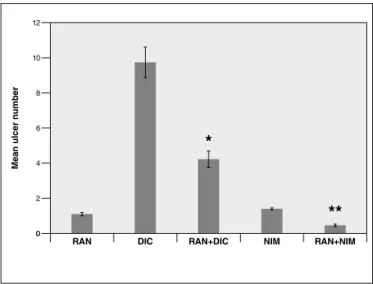
• Mean ulcer number
In this, both the ranitidine with diclofenac, and ranit-idine with nimesulide groups showed signiicant decrease in the mean ulcer number as compared to the diclofenac and nimesulide groups respectively (Figure 3).
FIGURE. 1. Gastric volume (solids and supernatants) in rats treated with ranitidine (RAN), either alone or in combination with diclofenac (DIC) or nimesulide (NIM). The data is expressed as mean±S.E.M. *P<0.05 vs
***
Gastr
ic v
olume (in mL)
0 1 2 3 4 5 6 7 8 9
*
*
**
**
#
**
**
Control RAN DIC RAN+DIC NIM RAN+NIM
Solids Supernatants
FIGURE 2. Total acidity and free acidity in rats treated with ranitidine (RAN), either alone or in combination with diclofenac (DIC) or nimesulide (NIM). The data is expressed as mean±S.E.M. * P<0.0001 vs. Control; ** P<0.05 vs. DIC; # P<0.001 vs. Control;## P<0.01 vs. DIC.
A
cidity (mEq/L/1
0
0g)
0
*
*
**
# #
##
Control RAN DIC RAN+DIC NIM RAN+NIM
Total Free
0 140
120
100
80
60
40
20
FIGURE 3. Mean ulcer number in rats treated with ranitidine (RAN), either alone or in combination with diclofenac (DIC) or nimesulide (NIM). The data is expressed as mean±S.E.M. * P<0.001 vs DIC; ** P<0.0001
Mean ulcer n
umber
0
*
**
RAN DIC RAN+DIC NIM RAN+NIM
0 12
10
8
6
4
Histopathology
In the control group, the sections of kidney showed numerous normal glomeruli with adequate cellularity and no thickening of glomerular basement membrane amidst tubules between which few scattered arterioles in scant interstitium can be seen. In group 2 (ranitidine and diclofenac), few glomeruli show scattered mononuclear inflammatory cells, which extend to the interstitium with mild oedema (Figure 5B). Mild tubular atrophy present. No evidence of necrosis or calciication. While in groups 3 (diclofenac alone), 4 (ranitidine and nimesulide), and 5 (nimesulide alone), sections from the kidney showed normal glomeruli with adequate cellularity with thickening of glomerular basement membrane amidst tubules (Figure 5C, 5D, 5E).
Further, in the control group, sections from the liver showed anastomosing plates and cords of cuboidal hepatocytes with round well stained nuclei and abundant cytoplasm. The architecture of the portal triad is maintained. The classical lobule unit composed of the arrangement between the portal canal (hepatic artery, portal vein and hepatic bile duct) and the central vein are anatomically normal. Moreover, in group treated with ranitidine and diclofenac, mild dilatation of sinusoids is seen coupled with prominence of central vein (Figure 6B). The classical lobular unit is, however, intact. In group 3 (diclofenac alone), the proximal and distal convoluted tubules show mild focal tubular necrosis with intraluminal secretions between which are seen few scattered dilated arterioles in scant interstitium (Figure 6C). Further,
sections from the liver show areas of well deined necrosis of hepatocytes. The central veins appear congested and dilated. There is evidence of periportal inlammation characterised predominantly by lymphocytes which do not extend beyond the limiting plate. Focal areas show degenerative cystic changes in the parenchyma. In group 4 (ranitidine and nimesulide), mild interstitial oedema was noticed and mild dilatation of sinusoids was also seen coupled with prominence and congestion of central vein (Figure 6D). In group 5 (nimesulide alone), the sections from the liver showed areas of necrosis with congestion and dilatation of sinusoids and mild periportal inlammation (Figure 6E).
In the control group, the sections from the gastroduodenal junction show luminal surface thrown out into several folds forming villi. The epithelial lining surface of the mucosa is composed of absorptive cells, goblet cells, paneth cells and undifferentiated cells. The submucosa is seen as a narrow band of connective tissue domain beneath the muscularis mucosa. The muscularis externa surrounding the submucosa is composed of two prominent layers of smooth muscle layer of cells, between which is seen myenteric plexus. In group 2 (ranitidine and diclofenac), the duodenum showed scattered inlammatory cells composed predominantly of lymphocytes beneath the epithelial surface of the mucosa (Figure 7B). The submucosa and the muscle layer are unremarkable. In group 3 (diclofenac alone), the sections from the gastric areas showed partial necrosis with discontinuity of the mucosa with covering slough and chronic inlammatory cells invading the entire mucosa involving the glands, with poor attempts of regeneration and ibrosis (Figure 7C). In group 4 (ranitidine and nimesulide), the sections from the gastric areas showed chronic inlammation of gastric mucosa, with chronic inlam-matory cells lying scattered over a wide area in both mucosa and submucosa (Figure 7D). In group 5 (nimesulide alone), the sections from the gastroduodenal junction showed mild chronic inlammation of gastric mucosa, with lymphocytes scattered between the glands (Figure 7E).
DISCUSSION
Gastric pain, mucosal erosion/ulceration and blood loss are produced by most NSAIDs to varying extent; relative gastric toxicity is the major consideration(4,6,17,33). Inhibition
of synthesis of gastroprotective prostaglandins (PGE2, PGI2) is clearly involved, though local action induction back diffusion of H+ ions in gastric mucous is also playing
a role(1). Deiciency of PGs reduces mucous and HCO
3-
se-cretion, tends to enhance acid secretion and may promote mucosal ischemia. Thus NSAIDs, speciically non-speciic COX-1 and COX-2 inhibition, enhance aggressive factors and curtails defensive factors in gastric mucosa, and are therefore ulcerogenic. NSAIDs with weak COX-1 inhibition or selective COX-2 inhibition are practically free of gastric toxicity and are safer.
Initially, all NSAIDs were thought to act by inhibiting the action of a single cyclooxygenase enzyme. Cyclooxygen-ase comprises of two associated enzymes with two distinct
FIGURE 4. Gastric pH in rats treated with ranitidine (RAN), either alone or in combination with diclofenac (DIC) or nimesulide (NIM). The data is expressed as mean ±S.E.M. * P<0.001 vs. Control; ** P<0.0001 vs. DIC; *** P<0.0001 vs NIM.
Gastr
ic pH
0
*
*
***
**
0 6
5
4
3
2
1
Control RAN DIC RAN+DIC NIM RAN+NIM
• Change in pH
The diclofenac and nimesulide treated groups showed signiicant decrease in the pH as compared to the control group (P<0.001 for both). However, the administration of
FIGURE 5. The igure shows the histology of kidney of rats treated with (A) Ranitidine alone; (B) Ranitidine with diclofenac; (C) Diclofenac alone; (D) Ranitidine with nimesulide; and (E) Nimesulide alone.
functions: cyclooxygenase activity, converting arachidonate liberated from the phospholipid membrane by phospholipase to prostaglandin G2 (PGG2), then converting PGG2 to pros-taglandin H2 (PGH2) by a peroxidise action. PGH2 is then converted to a variety of prostaglandins in a cell type speciic manner(33). In chronic inlammatory situations,
prostaglan-dins appear to have an anti-inlammatory action. NSAIDs are thought to act as anti-inlammatory drugs by inhibiting inlammatory prostaglandin production. Unfortunately, such an inhibitory action has deleterious effects in areas relying on prostaglandin production, including gastric mucosal protection and renal blood low. NSAIDs also damage the gastrointestinal tract via other mechanisms including effects on neutrophil function, altering gastric mucosal blood low in a non-prostaglandin dependent manner, direct irritant effects including the concept of ion trapping and interference with growth factors and ulcer healing mechanisms(33). The focus of
recent research has been to investigate ways of counteracting gastric mucosal damage due to inhibition of prostaglandin formation by interference with COX.
Diclofenac and nimesulide (both NSAIDs), in the present study, appeared to act by inhibition of prostaglandin synthesis via COX-independent route. Previous study has described the induction and suppression of COX function in human mono-cytes by bacterial lipopolysaccharides and dexamethasone, suggesting the existence of two isoforms(12). This increase in
prostaglandin production was associated with de novo
produc-tion of new COX protein. Further, the H2 receptor blockers are presently recommended for both the prevention and treat-ment of gastroduodenal ulcers associated with NSAID use(24).
Ranitidine is a histamine H2-receptor antagonist that inhibits stomach acid production. It is commonly used in treatment of peptic ulcer disease and gastroesophageal relux disease.
In the present study, administration of the NSAIDs, diclofenac and nimesulide, induced gastric damage and liver toxicity. This is in agreement with the earlier reports that have administered NSAIDs and observed severe hepatotoxicity and intestinal damage in the rat small intestine that was evident both macroscopically and histologically, resulting in loss of surface epithelium, mucosal necrosis and massive inlammatory cell iniltration(14,25,30,35,36). Previous studies have
reported that NSAIDs may also induce gastric damage by acid-independent mechanisms such as by increasing oxidative stress parameters viz. increase in mucosal myeloperoxidase levels, together with increase in mucosal malondialdehyde and reduced glutathione concentration(7,20,23).
Malondialde-hyde is an end product of the peroxidation of polyunsatu-rated fatty acids and related esters within cell membranes, such that the measurement of this compound represents a suitable index of oxidative tissue damage(15). Sulfhydryl
com-pounds are involved in the maintenance of gastric integrity, particularly when reactive oxygen species are implicated in the pathophysiology of tissue damage(18,29). Indeed, GSH
par-ticipates in many aspects of oxidative metabolism, including the neutralization of hydroperoxides and the maintenance of the physiological sulfhydryl status of proteins(11,18). Our
present indings are consistent with evidence indicating that
NSAIDs, acting through local and systemic mechanisms, promote ischemic and inlammatory alterations, which result in gastric neutrophil iniltration, release of oxygen metabo-lites, and cell membrane peroxidation. Moreover, rats treated with the combination of ranitidine and diclofenac showed decreased production of gastric acid and also decreased incidence of gastric ulcers. This may be attributed to the ranitidine’s antioxidative potential as has been reported in previous studies(7,20,23). Histologically too, ranitidine was
ob-served to reduce gastric and liver damage which may be due to inhibition of neutrophil activation as observed in earlier studies(21,22). However, the administration of ranitidine
to-gether with nimesulide had insigniicant effect on the gastric volume, total acidity and free acidity, whereas it signiicantly reduced the mean ulcer number and increase the gastric pH. Earlier studies have reported that NSAIDs, promote ischemic and inlammatory alterations, which result in gastric neutrophil iniltration, and increase in oxidative stress(31,34).
Further, the H2 receptor blocker Ranitidine has been
ob-served to reduce ischemia/reperfusion-induced liver injury by inhibiting neutrophil activation directly, or indirectly by inhibiting the production of TNF-α, which is a potent ac-tivator of neutrophils(22). Therefore, the effect of ranitidine
on the decreasing the detrimental effects of diclofenac and nimesulide could be due to the inhibition of the neutrophl activation. Therefore, the study has provided therapeutic ra-tionale towards simultaneous administration of H2 receptor blocker ranitidine with diclofenac to be more beneicial to minimise the gastric intolerance of diclofenac in long term treatment of inlammatory conditions.
Authors’ contributions
Study concept and design: Manocha S. Acquisition of data: all authors. Analysis and interpretation of data: all authors, mainly Manocha S and Lal D. Drafting of the manuscript: Manocha S. Critical revision of the manuscript for important intellectual content: all authors. Study supervision: Venkataraman S.
Manocha S, Lal D, Venkataraman S. Administração de bloqueadores H2 em ratos com gastropatia induzida por AINES: efeito nas alterações histopa-tológicas em tecidos gástrico, hepático e renal. Arq Gastroenterol. 2016,53(1):36-43.
RESUMO-Contexto- Anti-inlamatórios não esteroidais induzem lesões da mucosa gástrica devido às suas propriedades ácidas. Ranitidina, um
anta-gonista dos receptores H2, revelou-se benéico em pacientes com úlceras gástricas. Objetivo- O presente estudo foi realizado para avaliar o efeito da
administração de ranitidina em gastropatia induzida por anti-inlamatórios não esteroidais (diclofenaco, nimesulida) e seu efeito sobre a histopato-logia do estômago, dos rins e fígado. Métodos- Diclofenaco, nimesulida e ranitidina foram administradas em doses de 2, 4 e 6 mg/kg, p.o. uma vez diariamente por 14 dias e seu efeito sobre o volume gástrico, acidez, signiicam o número de úlcera e o pH gástrico. Além disso, o exame histopa-tológico também foi realizado em seções do estômago, dos rins e fígado. Resultados- Após a administração de diclofenaco ou nimesulida, todos os
parâmetros gástricos foram signiicativamente alterados assim como a histopatologia do estômago, fígado e rim. No grupo controle, as seções renais mostraram glomérulos normais sem espessamento da membrana basal glomerular, enquanto em diclofenaco isolado, nimesulida isolado e grupos com ranitidina e nimesulida, foi observado espessamento da membrana basal glomerular. Estas alterações observou-se serem revertidas no grupo ranitidina com diclofenaco. As seções do fígado, o grupo controle mostrou placas e cordões de hepatócitos cuboidais anastomosados com núcleos bem demarcados e citoplasma abundante. Nos grupos ranitidina com diclofenaco e ranitidina com nimesulida, leve dilatação dos sinusoides é vista acoplados com proeminência de veia central. Nos grupos diclofenaco e nimesulida sozinhos, túbulos proximais e distais contorcidos mostram necrose tubular focal leve. Nas secções gástricas, o grupo controle mostrou várias dobras formando vilosidades e a superfície do revestimento epitelial da mucosa. Nos grupos ranitidina com diclofenaco e ranitidina com nimesulida, o duodeno mostrou dispersas células inlamatórias predominantemente compostas por linfócitos. Nos grupos diclofenaco e nimesulida sozinhos, as secções de áreas gástricas mostraram necrose parcial e inlamação crônica moderada respectivamente. Conclusão- O estudo, portanto, forneceu o fundamento terapêutico para administração simultânea de bloqueador de receptor H2 (ranitidina) com diclofenaco, sendo mais benéica em comparação com ranitidina com nimesulida para minimizar a intolerância gástrica de diclofenaco no tratamento a longo prazo de condições inlamatórias.
DESCRITORES- Diclofenaco. Ranitidina. Antagonistas dos receptores histamínicos H
REFERENCES
1. Appleyard CB, McCafferty DM, Tigley AW, Swain MG, Wallace JL. Tumor necrosis factor mediation of NSAID induced gastric damage: role of leukocyte adherence. Am J Physiol. 1996;270:G42-8.
2. Aydin G, Gõkçimen A, Õncü M, Çlçek E, Karahan N, Gõlkalp O. Histopathologic changes in liver and renal tissues induced by different doses of diclofenac Sodium in rats. Turk J Vet Anim Sci. 2003;27:1131-40.
3. Burke A, Smyth E, Fitzgerald GA. Goodman & Gilman’s: the pharmacological bases of therapeutics. In: Brunton LL, Lazo JS, Parker KL, editors. Analgesic-Antipyretic Agents, Pharmacotherapy of Gout. 11th ed. New York: McGraw-Hill; 2006:671-715.
4. Choi YJ, Kim N, Lee JY, Nam RH, Chang H, Seo JH, et al. Protective effects of garlic extract, PMK-S005, against nonsteroidal anti-inlammatory drugs-induced acute gastric damage in rats. Dig Dis Sci. 2014;59:2927-34.
5. Deakin M, Williams JG. Histamine H2-receptor antagonists in peptic ulcer disease.
Drugs. 1992;44:709–12.
6. Fong SY, Wong YC, Xie C, Zuo Z. Herb-drug interactions between Scutellariae
Radix and mefenamic acid: Simultaneous investigation of pharmacokinetics, anti-inlammatory effect and gastric damage in rats. J Ethnopharmacol. 2015;170:106-16. 7. Fornai M, Natale G, Colucci R, Tuccori M, Carazzina G, Antonioli L, et al.
Mechanisms of protection by pantoprazole against NSAID-induced gastric mucosal damage. Naunyn Schmied Arch Pharmacol. 2005;372:79-87.
8. Gambero A, Becker TL, Zago AS, de Oliveira AF, Pedrazzoli J Jr. Comparative study of anti-inlammatory and ulcerogenic activities of different cyclo-oxygenase inhibitors. Inlammopharmacology. 2005;13:441-54.
9. Hawkey CJ. Nonsteroidal anti-inlammatory drug gastropathy. Gastroenterology. 2000;119:521–35.
10. Hawkey CJ. Non-steroidal anti-inflammatory drugs and peptic ulcers. BMJ. 1990;300:278-84.
11. Hayes JD, McLellan LI. Glutathione and glutathione-dependent enzymes represent a coordinately regulated defence against oxidative stress. Free Radic Res. 1999;31:273–300.
12. Hinz B, Brune K, Pahl A. Cyclooxygenase-2 expression in lipopolysaccharide-stimulated human monocytes is modulated by cyclic AMP, prostaglandin E(2), and nonsteroidal anti-inflammatory drugs. Biochem Biophys Res Commun. 2000;278:790-6.
13. Hiraishi H, Shimada T, Terano A. Involvement of oxidative stress in the pathogenesis of NSAID-induced gastric mucosal damage. J Gastroenterol. 2000;35:567–9. 14. Konaka A, Kato S, Tanaka A, Kunikata T, Korolkiewicz R, Takeuchi K. Roles
of enterobacteria, nitric oxide and neutrophils in pathogenesis of indomethacin-induced small intestinal lesions in rats. Pharmacol Res. 1999;40:517–24. 15. Kwicien S, Brzozowski T, Konturek SJ. Effects of reactive oxygen species action on
gastric mucosa in various models of mucosal injury. J Physiol (Paris). 2002;53:39–50. 16. Lichtenberger LM, Ulloa C, Romero JJ, Vanous AL, Illich PA, Dial EJ. Nonsteroidal
anti-inlammatory drug and phospholipid prodrugs: Combination therapy with antisecretory agents in rats. Gastroenterology. 1996;111:990-5.
17. Lim JH, Kim JH, Kim N, Lee BH, Seo PJ, Kang JM, et al. Gastroprotective effect of Cochinchina momordica seed extract in nonsteroidal anti-inlammatory drug-induced acute gastric damage in a rat model. Gut Liver. 2014;8:49-57.
18. Loguercio C, Di Pierro M. The role of glutathione in the gastrointestinal tract: a review. Ital J Gastroenterol Hepatol. 1999;31:401–7.
19. Messori A, Trippoli S, Vaiani M, Gorini M, Corrado A. Bleeding and pneumonia in intensive care patients given ranitidine and sucralfate for prevention of stress ulcer: meta-analysis of randomized controlled trials. BMJ. 2000;321:1103–6.
20. Natale G, Lazzeri G, Lubrano V, Colucci R, Vassalle C, Fornai M, Blandizzi C, Del Tacca M. Mechanisms of gastroprotection by lansoprazole pretreatment against experimentally induced injury in rats: role of mucosal oxidative damage and sulfhydryl compounds. Toxicol Appl Pharmacol. 2004;195:62-72.
21. Okajima K, Murakami K, Liu W, Uchiba M. Inhibition of neutrophil activation by ranitidine contributes to prevent stress-induced gastric mucosal injury in rats. Crit Care Med. 2000;28:2858–65.
22. Okajima K, Harada N, Uchiba M. Ranitidine reduces ischemia/reperfusion-induced liver injury in rats by inhibiting neutrophil activation. J Pharmacol Exp Ther. 2002;301:1157-65.
23. Pastoris O, Verri M, Boschi F, Kastsiuchenka O, Balestra B, Pace F, Tonini M, Natale G. Effects of esomeprazole on glutathione levels and mitochondrial oxidative phosphorylation in the gastric mucosa of rats treated with indomethacin. Naunyn Schmied Arch Pharmacol. 2008;378:421-9.
24. Patrignani P, Tacconelli S, Bruno A, Sostres C, Lanas A. Managing the adverse effects of nonsteroidal anti-inlammatory drugs. Expert Rev Clin Pharmacol. 2011;4:605-21.
25. Reuter BK, Davies NM, Wallace JL. Nonsteroidal anti-inflammatory drug enteropathy in rats: role of permeability, bacteria and enterohepatic circulation. Gastroenterology. 1997;112:109–17.
26. Rostom A, Dube C, Wells GA, Tugwell P, Welch V, Jolicoeur E, et al. Prevention of NSAID-induced gastroduodenal ulcers. Cochrane Database Syst Rev. 2002;4:CD002296.
27. Shay H, Komarov SA, Fels SS, Meranze D, Gruenstein M, Siplet H. A simple method for the uniform production of gastric ulceration. Gastroenterology. 1945;5:43-61.
28. Somasundram S, Sigthorsson G, Simpson RJ, Watts J, Jacob M, Tavares IA, Rai S, Roseth A, Foster R, Price AB,Wrigglesworth JM, Bjarnason I. Uncoupling of intestinal mitochondrial oxidating phosphorylation and inhibition of cyclooxygenase are required for the development of NSAID-enteropathy in the rat. Aliment Pharmacol Ther. 2000;14:639–50.
29. Szabo S. Mechanisms of gastric mucosal injury and protection. J Clin Gastroenterol. 1991;13:S21–34.
30. Tomic Z, Milijasevic B, Sabo A, Dusan L, Jakovljevic V, Mikov M, Majda S, Vasovic V. Diclofenac and ketoprofen liver toxicity in rat. Eur J Drug Metab Pharmacokinet. 2008;33:253-60.
31. Wallace JL. Pathogenesis of NSAID-induced gastroduodenal mucosal injury. Best Pract Res Clin Gastroenterol. 2001;15:691–703.
32. Wallace JL. Prostaglandins, NSAIDs, and gastric mucosal protection: why doesn’t the stomach digest itself? Physiol Rev. 2008;88:1547-65.
33. Werawatganon D, Rakananurak N, Sallapant S, Prueksapanich P, Somanawat K, Klaikeaw N, Rerknimitr R. Aloe vera attenuated gastric injury on indomethacin-induced gastropathy in rats. World J Gastroenterol. 2014;20:18330-7.
34. Whittle BJR. Gastrointestinal effects of nonsteroidal anti-inlammatory drugs. Fundam Clin Pharmacol. 2003;17:301–13.
35. Yamada T, Grisham MB. Role of neutrophil-derived oxidants in the pathogenesis of intestinal inlammation. Klin Wochenschr. 1991;69:988–94.