ARTICLE DOI: Xxxxxxxxxxxxxxxxxxxxx
Clinical predictors of response to
immunomodulators for multiple sclerosis
Preditores clínicos de resposta aos imunomoduladores em esclerose múltipla
Guilherme Sciascia do Olival1, Leonardo Ciciarelli Pereira Lima2, Gabriel Paiva Silva Lima1,Charles Peter Tilbery3
Multiple sclerosis (MS) is an autoimmune disease char-acterized by demyelinating inlammatory activity of the cen-tral nervous system. It is most prevalent in young adults be-tween 20 and 40 years of age and constitutes a frequent cause of neurological dysfunction in this age group1.
Immunomodulatory therapy had been proven to be efec-tive in modifying the natural course of the disease in patients with MS. Interferon beta (IFNb) and glatiramer acetate (GA) comprise the irst line of therapy for MS and have seemed to reduce the rate of demyelination exacerbations compared to placebo in clinical trials2-5. However, not all patients are
re-sponsive to this treatment6.
1 Neurologists of the Irmandade da Santa Casa de Misericórdia de São Paulo, São Paulo SP, Brazil;
2 Graduate Student of the Santa Casa de São Paulo, Faculty of Medical Sciences, São Paulo SP, Brazil;
3 MD, PhD, Full Professor of the Santa Casa de São Paulo, Faculty of Medical Sciences, São Paulo SP, Brazil.
Correspondence: Guilherme Sciascia do Olival; Rua Piauí, 305 – Apto. 51; 01241-001 São Paulo SP – Brasil; E-mail: [email protected] / [email protected]
Conflict of interest: There is no conflict of interest to declare.
Charles Peter Tilbery is member of Advisory Board of Biogen Idec and Merck Serono, participate in clinical trials for Bayer Schering, Merck Serono and Genzyme and has received honoraria for speaking at symposia from Bayer Schering, Merck Serono, Biogen Idec and Teva Neuroscience.
Received 10 May 2011; Received in final form 17 August 2011; Accepted 24 August 2011 ABSTRACT
Objectives: To determine, based on clinical criteria, the proportion of multiple sclerosis (MS) patients responsive to immunomodulators (RI) and nonresponsive to immunomodulators (NRI), and to ascertain whether clinical and epidemiological data differs between RI and NRI pa-tient groups. Methods: Patients were assessed on rate of exarcerbations per year, for the period before and after commencement of treat-ment. The RI and NRI groups were compared for several clinical and epidemiological characteristics. Discussion and conclusion: A total of 31.4% of the patients were nonresponders to the immunomodulatory treatment. The main predictors of immunomodulatory response were early diagnostic and commencement of therapy and high rate of annual exacerbations prior to treatment. Given the arsenal of medication options available for MS management, screening potential candidates for different therapeutic approaches are critical to optimize evolu-tion of patients with the disease.
Key words: multiple sclerosis, immunomodulators, predictors.
RESUMO
Objetivos: Avaliar por meio de critérios clínicos, a proporção de pacientes com esclerose múltipla (EM) responsivos aos imunomoduladores (RI) e não responsivos aos imunomoduladores (NRI) e avaliar se dados clínicos e epidemiológicos são distintos nesses dois grupos. Méto-dos: Os pacientes foram avaliados quanto à taxa de surtos por ano no período antes e após o início do tratamento. Diversas características clínicas e epidemiológicas foram comparadas entre os pacientes RI e NRI. Discussão e conclusão: Em nossa população, 31,4% dos pa-cientes não responderam ao tratamento com os imunomoduladores. Os principais preditores de resposta aos imunomoduladores foram: diagnóstico e início precoce da terapia e elevada taxa de surtos anual antes do tratamento. Como existem várias opções medicamentosas disponíveis para o tratamento da EM, a identificação de candidatos potenciais para abordagens terapêuticas diferentes representa o ponto crucial para otimizar a evolução dos pacientes com essa doença.
Palavras-Chave: esclerose múltipla, imunomoduladores, preditores.
he absence of biomarkers and the unpredictability of MS evolution leads to diiculty in distinguishing between response to therapy and disease activity7, requiring the use
of clinical and imagiologic criteria to deine the eicacy of therapies.
he aims of this study were:
• to determine, based on clinical criteria, the proportion of
RI and NRI patients with MS seen at the Care Center for Multiple Sclerosis Treatment (CATEM) of the Neurology Discipline of the Department of Medical Sciences at Santa Casa de São Paulo Hospital;
• to ascertain whether clinical and epidemiological data,
such as gender, age at MS onset, disease duration, and clinical evolution, difer between RI and NRI patient groups and identify which of them could be used as clini-cal predictors.
METHODS
he present study was previously approved by the Research Ethics Committee of Santa Casa de São Paulo Hospital.
Inclusion criteria
Patients diagnosed with relapsing-remitting MS between 1998 and 2008 were retrospectively selected for inclusion in the study, according to the following criteria: Poser’s from 1998 to 20018; McDonald’s from 2001 to 20059; and revised
McDonald’s criteria from 2005 to 200810. During such period,
those patients were treated at the CATEM of the Neurology Discipline of the Department of Medical Sciences of Santa Casa de São Paulo Hospital.
Exclusion criteria
All patients with irregular use of immunomodulators, treatment time of less than two years, poor anamnesis for the period prior to treatment, harboring the primary progressive form of MS, conversion to the secondary progressive form in less than two years, or use of medications other than IFNb or GA during the study period, were excluded from the study.
Follow-up
he decision to start treatment was made after the clinical-ly deined diagnosis, meaning the second exacerbation. After commencement of treatment, patients were seen every three months and checked for the presence of symptoms and chang-es in the physical examination, consistent with exacerbation, and instructed to seek treatment at the service in the event of new symptoms. he expanded disability status scale (EDSS) was applied at each consultation. Patients were administered with the following immunomodulators: intramuscular IFNb 1a 30 mcg once per week11, subcutaneous IFNb 1b 300 mcg on
al-ternate days12, subcutaneous IFNb 1a 22 or 44 mcg three times
per week13, and daily subcutaneous GA 20 mg14. Medications
were switched in the event of treatment failure or intolerable adverse reactions. he changes were made from IFNb lower dose to higher dose and, then, GA and vice versa.
Criteria for clinical response to treatment
Patients were assessed based on rate of relapses per year between disease onset and commencement of treatment, and rate of exacerbations after the beginning of treatment.
Patients were classiied as RI if a 25% or greater reduction in exacerbation was evident after start of the treatment, given that this had been the response to placebo in the larger ran-domized trials2-5. Remaining patients were classiied as NRI.
Clinical parameters of response analyzed
Patients were divided into RI and NRI groups and com-pared for the following clinical and epidemiological charac-teristics: age at disease onset; age at diagnostic and treat-ment commencetreat-ment; time between disease onset and diagnostic/start of treatment; gender; interval between irst and second relapses; relationship between rate of exacerba-tion per year in the period before and after treatment; and EDSS at the start and after two years of treatment.
Statistical analysis
Statistical analyses were performed using the SPSS®
Statistics software package, version 19.0.0 (SPSS, Chicago, USA), on an IBM® personal computer.
he association among categorical variables was as-sessed by the chi-square and Fisher tests. For continuous nonparametric and parametric variables, the Mann-Whitney and ANOVA tests were used, respectively, in comparisons be-tween RI and NRI.
A 95% conidence interval was used and a p-value <0.05 was considered statistically signiicant.
RESULTS
Of 430 patients registered between 1998 and 2008 at CATEM, 145 used immunomodulators for more than two years. Patients were excluded from this subgroup for the fol-lowing reasons: four due to irregular immunomodulator use; ten with poor prior anamnesis data for a period prior to the study; two with primary progressive form of MS; and eight subjects that converted to the secondary progressive form. his gave a total study sample of 121 patients.
disease-modifying therapy, such as azathioprine, methotrex-ate, or natalizumab.
Response to immunomodulators
he proportion of RI was 83 patients (68.6%) and the NRI was 38 (31.4%), based on the clinical criteria of a 25% or greater reduction in exacerbation.
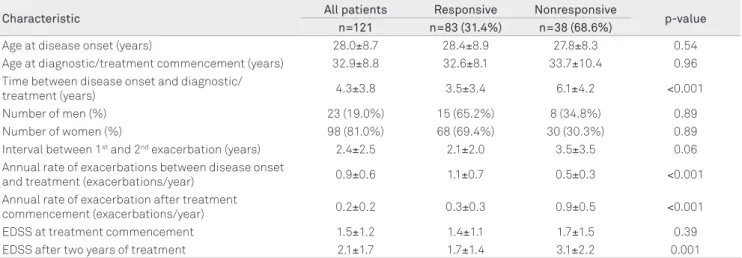
Table contains the clinical parameters of response to the immunomodulators evaluated.
Clinical characteristics in relation to response to immunomodulators
Comparing the RI and NRI patient groups, no diference for age at disease onset (p=0.54) or age at diagnostic and treat-ment onset (p=0.96) was found. However, longer time between disease onset and diagnostic/therapy beginning commence-ment was found in the NRI Group (6.1 years, on average) com-pared to the RI Group (3.5 years, on average), with p<0.001. No diferences were found between men and women (p=0.89).
he interval between the irst and second exacerbations was not associated with response to medications. he annual rate of relapses prior to treatment was 1.1 in RI greater than 0.5 in NRI, and the annual rate of exacerbations after treat-ment was 0.3 in RI lower than 0.9 in NRI (p<0.001).
Both groups had the same rating on the EDSS at treat-ment commencetreat-ment and showed increased ratings during the study period (p=0.39). he EDSS rating in the NRI Group rose from 1.6 to 3.1 after two years of treatment, whereas the RI Group rating increased from 1.4 to 1.7 over the same period.
DISCUSSION
In the present study, response to therapy was based on the clinical criteria of the rate of relapses per year before and
after treatment. Patients exhibiting a 25% or greater reduc-tion in exacerbareduc-tions after therapy commencement were considered responsive to treatment, a igure based on the re-sponse to placebo described in previous trials2-5.
Functional assessment by the EDSS can be employed, but it has several limitations. First, the scale is nonlinear with a bimodal distribution. Second, the scale places greater em-phasis on gait disabilities and is less sensitive for assessing other neurologic sequelae. Lastly, the scale tends to have a high inter-rater variability.
he neurological damage caused by MS is erratic and unpredictable, where in some cases minor lesions can lead to severe functional impairment, yet in other cases large le-sions have minimal functional impact. hus, rating response to therapy by quantifying dysfunction does not provide a re-alistic picture in that the aim of immunomodulators is not to cure, but to control the disease.
Based on this rationale, we proposed that response to im-munomodulators be assessed by rate of relapses per year or by time interval between exacerbations in the same individual.
he aim of this study was not to compare eicacy of the medications, because head-to-head studies have previously conirmed, only the negligible diference among the drugs used15-17.
In this study, 31.4% of the patients had an unsatisfacto-ry reduction in annual rate of relapses, a inding comparable with rates reported in the literature6,18-20.
Waubant et al.18, in a study of similar design, comparing
reduction in rate of exacerbations after immunomodulator therapy, found a proportion of 31% NRI.
Villoslada et al.19 conducted a study in Pamplona, Spain,
and found that patients responsive to therapy were older and had longer intervals between disease onset and start of ther-apy, and they suggested that these data represent a patient group with a milder form of the disease from the outset.
Characteristic All patients Responsive Nonresponsive p-value
n=121 n=83 (31.4%) n=38 (68.6%)
Age at disease onset (years) 28.0±8.7 28.4±8.9 27.8±8.3 0.54 Age at diagnostic/treatment commencement (years) 32.9±8.8 32.6±8.1 33.7±10.4 0.96 Time between disease onset and diagnostic/
treatment (years) 4.3±3.8 3.5±3.4 6.1±4.2 <0.001 Number of men (%) 23 (19.0%) 15 (65.2%) 8 (34.8%) 0.89 Number of women (%) 98 (81.0%) 68 (69.4%) 30 (30.3%) 0.89 Interval between 1st and 2nd exacerbation (years) 2.4±2.5 2.1±2.0 3.5±3.5 0.06
Annual rate of exacerbations between disease onset
and treatment (exacerbations/year) 0.9±0.6 1.1±0.7 0.5±0.3 <0.001 Annual rate of exacerbation after treatment
commencement (exacerbations/year) 0.2±0.2 0.3±0.3 0.9±0.5 <0.001 EDSS at treatment commencement 1.5±1.2 1.4±1.1 1.7±1.5 0.39 EDSS after two years of treatment 2.1±1.7 1.7±1.4 3.1±2.2 0.001
Table. Clinical characteristics of multiple sclerosis patients in use of immunomodulators for at least two years.
In the present study, patient ages at disease onset and start of therapy were found not to difer between groups, al-though the assessment of delay to diagnostic and therapy onset reached statistical signiicance, with the NRI patients experiencing longer delays before diagnostic and start of the treatment.
his disparity with the literature may be explained by the diference in our study population and healthcare resources. Access to public health services in Brazil is limited. MS is less incident, and diagnosis can sometimes be delayed. Moreover, CATEM was the irst MS center in the country and drew pa-tients from regions throughout São Paulo state and even in-dividuals from other states, who had harbored the disease for some time without treatment.
herefore, we believe that in our milieu, patients with late diagnoses did not present milder forms of the disease, but delayed undergoing diagnosis due to diiculties in accessing reference centers in neurology.
EDSS studied in this casuistic revealed that RI and NRI started out with similar neurological compromise yet evolved diferently.
he group of patients delaying diagnostic/treatment could represent individuals at a more treatment-resistant phase of MS, raising questions on the impact of long-term immunomodulatory therapy on the natural course of the disease. Studies assessing the impact of long-term immuno-modulatory therapy use are lacking.
he rate of relapses also reached statistical diference, proving to be higher in RI patients prior to treatment. hese data may relect the fact that patients that beneit most from therapy are those with greater disease-related inlammatory activity. It is likely that the group of RI was diferently than NRI since the beginning of the disease with a more inlam-matory physiopathology and, therefore, more responsive to immunomodulatory treatment.
In MS patients that had two or more relapses prior to treatment, it is possible to calculate a rate of exacerbation per year, which is likely to be the natural history of disease. We propose that therapy can be considered efective or not based on this rate, instead of an absolute number of relapses.
However, we should note that while some patients have a milder form of the disease, groups with more aggressive forms must receive the earliest diagnosis and treatment pos-sible and, in some cases, it may require a more potent thera-py, since the response to the immunomodulators may not be suiciently efective.
Likewise, increased attention is necessary to readily change therapy, if so required, in the group at higher risk for poor response to therapy, such as those whose diagnostic/ therapy commencement was delayed after the irst exacer-bation and with lower rate of annual exacerexacer-bations prior to treatment.
Some limitations apply to this study with reduced impact to the main indings. Potential bias in our data stem from the adoption of rate of exacerbation as a measure of response, giv-en that the severity of exacerbations depgiv-ends on the region with demyelination, while incomplete recovery after relapses could relect the individual pathological pattern of the dis-ease activity. Nevertheless, patients, who had converted to the secondary progressive form in less than two years, were excluded because their group had a low relapse rate per year and could be mistakenly regarded as RI. his strategy over-estimated the proportion of RI up to 7%. Other bias would be the diferent diagnosis criteria, which has changed during the assessed period. Also, these results are derived from a sin-gle center and there is no control group. Consequently, these results need to be reproduced in other cohorts.
In view of the erratic progression of MS and that the in-lammatory phase can result in irreversible axonal loss, iden-tiication of patients who respond poorly to immunomodula-tors is pivotal in reconsidering other therapeutic approaches and consequent switches in irst-line treatments or in indi-cating second-line therapies.
Although MS has long been suspected as constituting a primary autoimmune disease afecting the central nervous system (CNS), no single physiopathology has yet been estab-lished for the diferent mechanisms of damage. Diferences in pathologies among patients suggest that clinically diag-nosed MS may in fact comprise several diferent entities, all of which damage the CNS.
hus, this raises the possibility that perhaps a substantial number of patients are not responsive to current therapy be-cause their individual pathology is not responsive.
It can therefore be surmised that, at present, MS therapy is partially efective and has common inherent collateral efects, which limit its application. his situation is in part due to the absence of biomarkers of response to therapy. Biomarkers of response to therapy would allow the identiication of the best RI, increasing the eicacy of drugs and preventing unneces-sary treatment of NRI with these drugs, thereby reducing both costs and collateral efects. his scenario is set to become more complex with the emergence of novel drugs at phase 3 of clini-cal trials (e.g., laquinimod, rituximabe, daclizumabe) plus the development of combination therapy20,21.
In conclusion, in the population studied, 31.4% of the pa-tients were NRI to the immunomodulatory treatment. he main predictors of immunomodulatory response were ear-ly diagnostic/commencement of therapy after the irst ex-acerbation, and high rate of annual exacerbations prior to treatment.
1. Moreira M, Lana-Peixoto MA, Callegaro D, et al. Consenso expandido do BCTRIMS (Comitê Brasileiro de Tratamento e Pesquisa em Esclerose Múltipla) para o tratamento da esclerose múltipla: II. As evidências para o uso de glicocorticóides e imunomoduladores. Arq Neuropsiquiatr 2002;60:875-880.
2. Group TIbS. Interferon beta-1b is effective in relapsing-remitting multiple sclerosis. Neurology 1993;43:655-661.
3. Jacobs L, Cookfair D, Rudick R. Intramuscular interferon beta-1a for disease progression in relapsing multiple sclerosis. Ann Neurol 1996;39:285-294.
4. PRISMS PoRaDbIb-aSiMS. Randomised doubled-blind placebo-controlled study of interferon beta-1a in relapsing/remitting multiple sclerosis. Lancet 1998;352:1498-1504.
5. Bornstein M, Miller A, Slagle S, et al. A pilot trial of COP 1 in exacerbating-remitting multiple sclerosis. N Engl J Med 1987;317:408-414.
6. Rio J, Nos C, Tintoré M, et al. Defining the response to interferon-b in relapsing-remitting multiple sclerosis patients. Ann Neurol 2006;59:344-352.
7. Martinez-Forero I, Pelaez A, Villoslada P. Pharmocogenomics of multiple sclerosis: in search for a personalized therapy. Expert Opin Pharmacother 2008;9:1-15.
8. Poser C, Paty D, Scheinberg L, et al. New diagnostic criteria for multiple sclerosis: guidelines for research protocols. Ann Neurol 1983;13: 227-231.
9. McDonald W, Compston A, Edan G, et al. Recommended diagnostic criteria for multiple sclerosis: guidelines from the International Panel on the diagnosis of multiple sclerosis. Ann Neurol 2001;50:121-127.
10. Polman C, Reingold S, Edan G, et al. Diagnostic criteria for multiple sclerosis: 2005 revisions to the “McDonald Criteria”. Ann Neurol 2005;58:840-846.
11. Avonex (interferon beta-1a). Prescribing information. Cambridge, MA: Biogen Inc.; 1996.
12. Betaferon (interferon beta-1b). Prescribing information. Richmond, CA: Berlex Laboratories; 1993.
13. Rebif (interferon beta-1a). Prescribing information. Oakville. Ontario: Serono, Canada; 1998.
14. Copaxone (acetato de glatirâmer). Prescribing information Petah-Tikva, IS: Teva laboratories; 1990.
15. O’Connor P, Filippi M, Arnason B, et al. 250 microg or 500 microg interferon beta-1b versus 20 mg glatiramer acetate in relapsing-remitting multiple sclerosis: a prospective, randomised, multicentre study. Lancet Neurol 2009;8:889-897.
16. Mikol D, Barkhof F, Chang P, et al. Comparison of subcutaneous interferon beta-1a with glatiramer acetate in patients with relapsing multiple sclerosis (the REbif vs Glatiramer Acetate in Relapsing MS Disease [REGARD] study): a multicentre, randomised, parallel, open-label trial. Lancet Neurol 2008;7:903-914.
17. Cadavid D, Wolansky L, Skurnick J, et al. Efficacy of treatment of MS with IFNbeta-1b or glatiramer acetate by monthly brain MRI in the BECOME study. Neurology 2009;72:1976-1983.
18. Waubant E, Vukusic S, Gignoux L. Clinical characteristics of responders to interferon therapy for relapsing MS. Neurology 2003;61:184-189.
19. Villoslada P, Oksenberg IR, Rio J, Montalban X. Clinical characteristics of responders to interferon therapy for relapsing MS. Neurology 2004;62:1653.
20. Pozzilli C, Prosperini L. Clinical markers of therapeutic response to disease modifying drugs. Neurol Sci 2008;29(Suppl):S211-S213.
21. Graber JJ, McGraw CA, Kimbrough D, Dhib-Jalbut S. Overlapping and distinct mechanisms of action of multiple sclerosis therapies. Clin Neurol Neurosurg 2010;112:583-591.