CHEMICAL INVESTIGATIONS ON THE HYDROGRAPHICAL SYSTEM
OF CANANÉIA LAGOON
(Received for publication in 1959)
KENJI K ATO ':+
Faculty' of Fisheries, Hokkai do University Japan Oceanographi c I nstitute, University of São P aulo - B razil
SYNOPSIS
Periodical observations were made in 1958 in the hydrographical system of Cananéia lagoon State of São Paulo. The present paper reports the general characteristics of the regional distribution of chemical constituents in the water of the lagoon as observed on the F ebruary 11, 1958.
The outer sea water (34 °/00 salinity, 4.5 ml!l 0 2, pH 8.4, 0.1 j.tg-atoms-nitrate-N / I, 0.3 /-tg-atoms-phosphate-P/ I and 4 ;ug-atoms-silicate-Si/l) flows in to the lagoon at flood tide through the Barra de Cananéia. The major portion of the inflowing sea water moves westward through the Baía de Trapandé pushing the inner lagoon water toward the northern sheltered region, while a smaller portion enters along the eastern waterway called Mar de Cananéia, but is apparentI:y blocked in its flow because of the narrow passage. In the shelter ed inner region the rise of the water leveI apparently depends upon an accumulation on the water of the tributaries which is blocked by the outer tidal wave.
The lowering of the water leveI of the open sea during the ebb sucks out the lagoon water , and a high velocity of the outflow through the narrow watér -way of the Mar de Cananéia is then usually observed.
In the inner region Df the lagoon when the horizontal movement of the water due to the tides is weakened, a reduction state is likeI:y to develop in the bottom layer on account of active decomposition by bacteria of the deposited organic materiaIs. AccordingI:y, considerable lowering of the oxygen t ension is observed in the water overlying the bottom. In thé surface water at the same station the amount of dissolved oxygen is near satura tion point. The decomposing activity of the bacteria is very important for the lagoon's metabolismo The return of nutrients into the water undoubtedly contributes efficiently to enr ich the phyto-plankton crop.
INTRODUCTION
The studies reported in thi s paper were carried out at the Research Station of the Oceanographic Institute (University of São Paulo, Brazil) at Ca-nanéia, on the Island of Cananéia on the south coast of the State of São Paulo in 1958 .
The island of Cananéia is surrounded by the waters of a large lagoon and channel system which is llO km long, reaching from the Barra do Arara-pira (where the AraraArara-pira chan nel begins) to the mouth of the Ribeira de I guape ri ver. This system is subdivided into smaller systems which are almost independent of each other from the hydrograph ic point of view (BESNARD 1950a , b ).
• At prese nt in t he F aculty of F isheries, Prefectu ral Un lver s ity of Mie, Tsu, Japa n.
Bolm Inst . qceanogr . S P a u lo, 15: (1): 1 -12, 1966
The present research is a contribution towards the knowledge of the fundamental hydrochemicaI properties of the lagoon waters as weIl as a survey of the regional distribution of nutrients in reIation to the organic production of the lagoon water.
The hydrographical properties of the water are influenced chiefIy hy tidal fIuctuations and by the discharge of runoff from land into the lagoon. The hydrography is also infIuenced by the coastal wind prevailing in the region and by geochemical changes caused by mixing of coastal sea water with the mano grove "ri ver" water. These "rivers" or "marigots" (BESNARD 1950a, b) are in most cases channels or creeks containing marine tidal waters and fresh·water from the mangrove flats.
MATERIAL AND METHODS
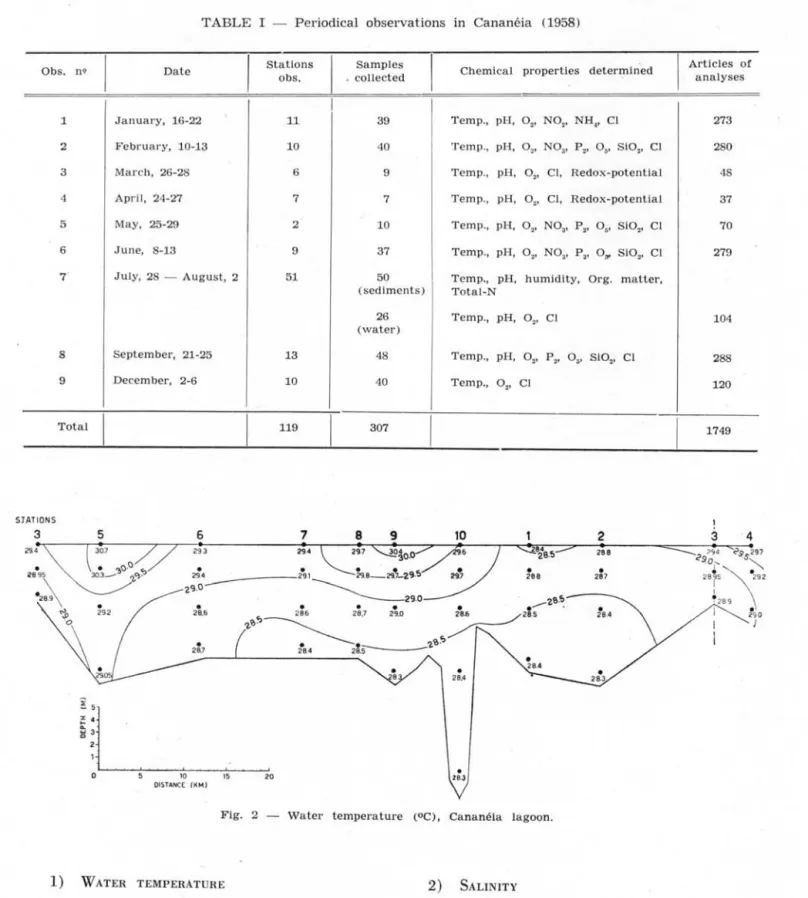
Nine geochemical observations were made as summarized in Table I.
The Petersen·Nansen insulated water bottle was used to coIlect water samples at known depths. Rou·
tine observations on temperature, salinity, oxygen, pH, phosphate, silicate and nitrate were made on the water of the samples. Measurements of tem-perature and pH as weIl as fixation of the dissolved oxygen were ma de on board as quickly as possible immediately after sampling; pH was measured by means of a portable glass-eIectrode pH-meter (Me-trohm, Type E 280) and oxygen by WINKLER'S method. Samples for determining silicate conte~t
were stored in polyethylene bottles so as to avoid dissolving of silicate from the glass-bottle. Nitrate, phosphate and silicate were determined on the day foIlowing sampling. Nitrate was determined by MA-CHIDA'S modification of the reduced strychnine me· thod, phosphate by DENIGÉS and ATKINS' method; and silicate by DIENERT and W ANDENBULKE'S method. A Coleman Universal Spectrophotometer Model 14 was used in determining the quantities of these nutrients. Titration of dissolved oxygen was also done in the laboratory at Cananéia. The deter· mination of the salinity of the water samples was done at the chemical laboratory of the Institute In São Paulo using MOHR and KNUDSEN'S method.
•
Pontal Shore
CARDOSO ISLAND
CANANÉ 1A
BAR
o 5 10
RH 71066
Flg. 1 - Lagunar reglon of Cananéia (Mar Pequeno) showlng the staUons posltions.
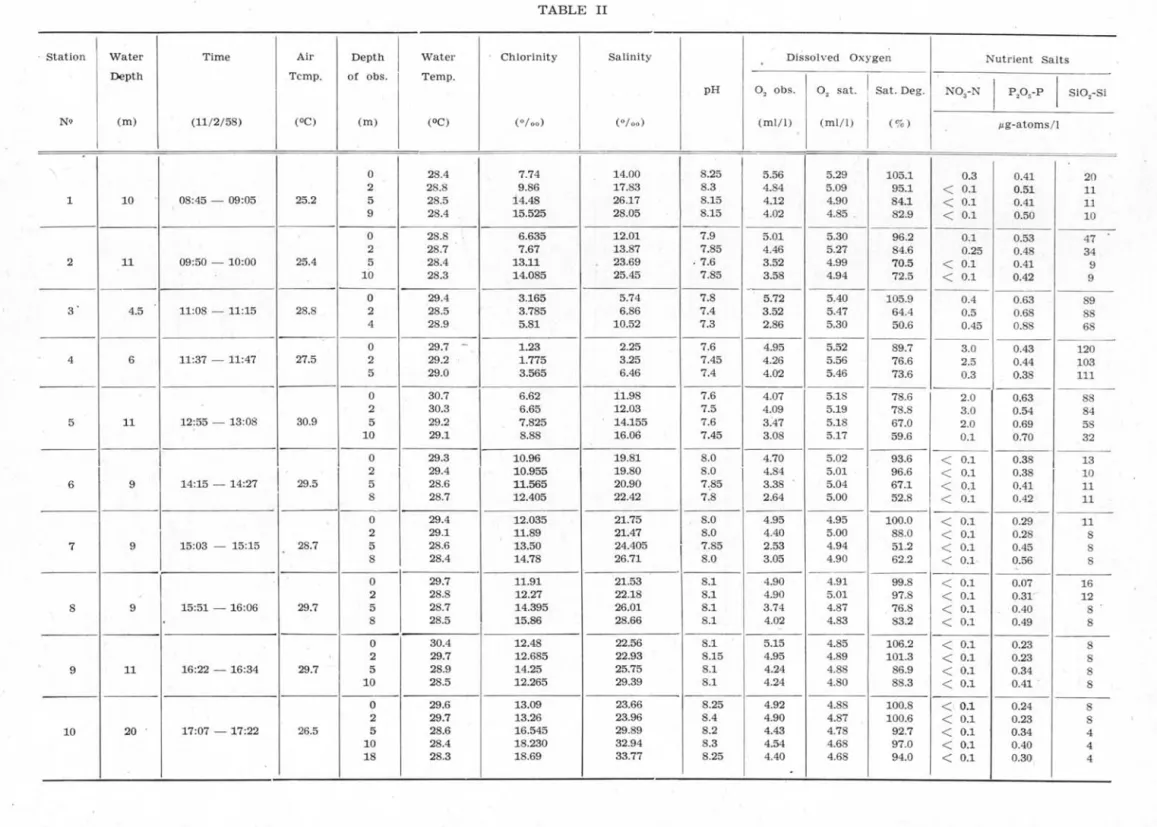
GENERAL FEATURES OF THE REGIONAL DISTRI13UTION OF CHEMICAL CONSTITUENTS IN THE WATER OF THE CANANÉIA LAGOON To avoid the effect of tides and winds the day chosen for the collection of data on the chemicaI constituents of the lagoon water was a caIm day when the difference between the tidaI leveIs at high and Iow water was reduced to a minimum. On the 11 Ih February, 1958 the tidaI gauge indicated onIy
20 cm in the tidaI leveI difference and the wind velocity was low, approximateIy 0-2 m/seco while the observatjons were being carried out. These re-quired eIeven hours, from 07.30 to 18.30. They were ma de from a motor boat at ten stations
dis-Bolm Inst. oceanogr. S Paulo, 15: (1): 1-12, 1966
tributed so as to cover the whoIe channeI region around Cananéia Island (Fig. 1). Forty water sam-pIes were collected.
The results of the observations made in February are shown in TabIe II and the distribution of the chemical constituents · in the lagoon water are
i1-lustrated in Figures 2-15.The bottom topography of the lagoon . is so complicated and variable and cannot be shown 1Il detail until a through survey of the whole area is made. A reliable map of the topography of the whole lagoon region could not be found for the present work. Thus, the bottom topography of the lagoon was onIy represented as a succession of straight lines connecting the observed stations.
Obso nQ SJATIONS 3 2'14
•
2895 1 2 3 4 5 6 7 ' 8 9 Total. 2~
<'1 '0 5.
29.2TABLE I - Periodical observations in Cananéia (1958)
Date Stations obs o
I
Samples° collected Chemical properties determilled
I
I
Januar,y, 16-22 11 39 Tempo, pH,
February, 10-13 10 40 Temp o, pH,
March, 26-28 6 9 Temp o, pH,
April, 24-27 7 7 Tempo, pH,
Ma,y, 25-29 2 10 Tempo, pH,
June, 8-13 9 37 Temp., pH,
JuJy, 28 - August, 2 51 50
I
Temp., pH,
(sediments) Total-N
26 Temp., pH,
(water)
September, 21-25 13 48 Temp., pH,
December, 2-6 10 40 Temp., 0"
119 307
6 7 8 9 10
293 294 29.7 30~O.O ~ ? 6
•
• • •
os/" •
29.4 _ _ _ _ _ 291 29.8_2'17_2" 297
0" NO" NH" CI
°
21 NOal P 21 0:"iJ Si02J CI0 " CI, Redox-potential
0" CI, Redox-potential
0" NO" P" 0., SiO" C I
°2' NO" P" 0 .. S iO" CI
humidity, Org. matter,
0" 0" CI
•
288 ClP21 0" SiO"
2
288
.
28.7CI
,'l.O ~
• • • • 29.0 . . ..---2S.~
28.6 'l.s'> ~ 28.7 29.0 ~28 . 5 28 .4
•
• •
~.~'l.S'>
28.7 28.4 28.5
.
8 28,4.
il,---:---:,,::---::-,
o 10 15 20
OISTANCE II<M)
.
28.J
Fig. 2 - Water t e mpera ture (OC), Cananéla lagoon .
I) WATER T EMPERATURE 2) SALINITY
Articles or analyses 273 280 48 37 70 279 104 288 120 1749 !
3 4
>94 <'.9S'97
O?QOf
28!S
~ ' ~
292~ 2S9
I tso
I J
I
Since most of the lagoon is comparatively shal-low, the depths ranging from 3 to 6 m approximately, the water temperature is greatly influenced by the solar radiation. Accordingly it should not be used in the hydrographic discussion of the characters of the lagoon water system. The wat~r of higher sal-inity from the open sea generally contributes to lower the temperatures, for example 28.3°C as compared with 30.0°C for the inner lagoon water, at the time the observation was made.
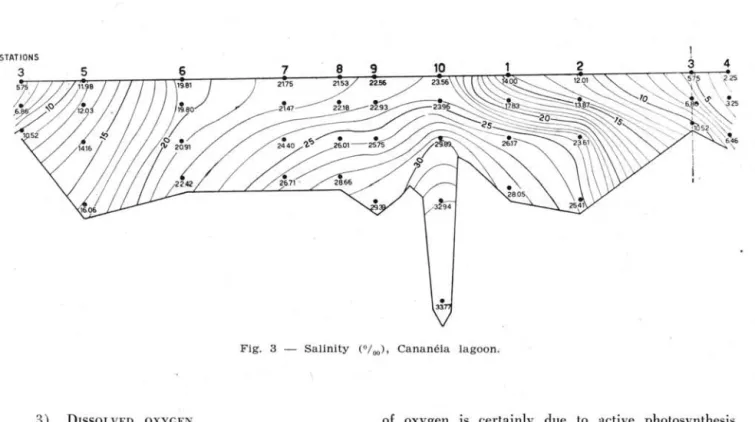
The sea water (Fig. 3) with 30.33.80/ 00 salinity
flows into the lagoon region over the bar (Barra de Cananéia) and divides into a major portion which flows westwards into Baía de Trapandé approaching the Mar de Itapitanguí near to Mar de Cubatão, and another portion which blocks the outflow of the lagoon water in the Mar de Cananéia and inflows at a deeper layer, near the Ilha do Boqueirão at St. 2.
Bolm Inst o oceanogr. S Paulo, 15: (1): 1-12, 1966
TABLE II
Station Water Time Air Depth
I Water . Chlorinity Salinity Dissolved Oxygen Nutrient Salts
Depth Temp. o! obs. Temp.
I
I
I
pH O, obs. 0 , sat. i Sat. Deg. N03-N P,O, -P SiO,-Si
I
No (m) (11/2/58) (OC) (m) (OC) (O I 00) (o I 00) (mil!) (ml / l)
I
( % ) "g -atoms / l
I
I
O 28.4 7 .74 14.00 8.25 5.56 5.29 105.1 0.3 0.41 20
2 28.8 9 .86 17.83 8.3 4.84 5.09 95.1
<
0.1 0.51 111 10 08:45 - 09:05 25.2 5 28.5 i4.48 26.17 8.15 4.12 4.90 84.1
<
0.1 0.41 119 28.4 15.525 28.05 8.15 4.02 4.85 . 82.9
<
0.1 0.50 10
-O 28.8 6.635 12.01 7.9 5.01 5.30 96.2 0.1 0.53 47
2 28.7 7.67 13.87 7.85 4.46 5.27 84.6 0.25 0.48 34
2 11 09:50 - 10:00 25.4 5 28.4 13.11 23.69 . 7.6 3.52 4.99 70.5
<
0.1 0.41 910 28.3 14.085 25.45 7 .85 3.58 4.94 72.5
<
0.1 0.42 9- - --
-O 29.4 3.165 5.74 7.8 5.72 5.40 105.9 0.4 0.63 89
3 ' 4.5 11:08 - 11:15 28.8 2 28.5 3.785 6.86 7.4 3.52 5.47 64.4 0.5 0.68 88
4 28.9 5.81 10.52 7.3 2.86 5.30 50.6 0.45 0.88 68
O 29.7
-
1.23 2.25 7.6 4.95 5.52 89.7 3.0 0.43 1204 6 11:37 - 11:47 27.5 2 29.2 1.775 3.25 7.45 4.26 5.56 76.6 2.5 0.44 103
5 29.0 3.565 6.46 7.4 4.02 5.46 73.6 0.3 0.38 111
- --
-O 30.7 6.62 Íl.98 7 .6 4.07 5.18 78.6 2.0 0.63 88
2 30.3 6.65 12.03 7.5 4.09 5.19 78.8 3.0 0.54 84
5 11 12:55 - 13:08 30.9 5 29.2 7.825 14.155 7.6 3.47 5.18 67.0 2.0 0.69 58
10 29.1 8.88 16.06 7.45 3.08 5.17 59.6 0.1 0.70 32
O 29.3 10.96 19.81 8.0 4.70 5.02 93.6
<
0.1 0.38 13I
2 29.4 10.955 19.80 8.0 4.84 5.01 96.6<
0.1 0.38 106 9 14:15 - 14:27 29.5 5 28.6 11.565 20.90 7 ,85 3.38 . . 5.04 67.1
<
0.1 0.41 118 28.7 12.405 22.42 7 .8 2.64 5.00 52.8
<
0.1 0.42 11O 29.4 12.035 21.75 8.0 4.95 4.95 100.0
<
0.1 0.29 11I
2 29.1 11.89 21.47 8.0 4.40 5.00 88.0
<
0.1 0.28 87 9 15:03 - 15:15 28.7 5 28.6 13.50 24.405 7.85 2.53 4.94 51.2
<
0.1 0.45 88 28.4 14.78 26.71 8.0 3.05 4.90 62.2
<
0.1 0.56 8'.
O 29.7 11.91 21.53 8.1 4.90 4.91 99.8
<
0.1 0.07 162 28.8 12.27 22.18 8.1 4.90 5.01 97.8
<
0 .1 0.31 128 9 15:51 - 16:06 29.7 5 28.7 14.395 26.01 8.1 3.74 4.87 76.8
<
0.1 0.40 88 28.5 15.86 28.66 8.1 4.02 4.83 83.2
<
0.1 0.49 8O 30.4 12.48 22.56 8.1 5.15 4.85 106.2
<
0.1 0.23 82 29.7 12.685 22.93 8.15 4.95 4.89 101.3
<
0.1 0.23 89 11 16:22 - 16:34 29.7 5 28.9 14.25 25.75 8.1 4.24 4.88 86.9
<
0.1 0.34 810 28.5 12.265 29.39 8.1 4.24 4.80 88.3
<
0.1 0.41 8O 29.6 13.09 23.66 8.25 4.92 4.88 100.8
<
0.1 0.24 82 29.7 13.26 23.96 8.4 4.90 4.87 100.6
<
0.1 0.23 810 20 17:07 - 17:22 26.5 5 28.6 16.545 29.89 8.2 4.43 4.78 92.7
<
0.1 0.34 410 28.4 18.230 32.94 8.3 4.54 4.68 97.0
<
0.1 0.40 4At the same time fresh water of about 20/ 00
salinity flows so uthwards alon g the narrow water-way from Iguape, runs into and mixes with the brackish water of the lagoon at a place where three waterways join, (St. 3), near the northern end of Cananéia Island.
The salinity distribution in the lagoon shows the folIowing pattern of flow into and fram coastal waters with the tides :
A) During flood sea water enters the lagoon from Barra de Cananéia apd its major portion flows westward through Baía de Trapandé pushing the inner lagoon water toward the northern upper reaches of the channel. The other smaller portion of sea water seems to be almost blocked in its flow into the Mar de Cananéia channel. Consequently the water leveI at the upper region of the lagoon i.e. Mar de Cananéia and Mar de Cubatáo rises and with the added accumulation of fresh water from the affluen ts, blocks the outer tidal fIood.
STATl ONS
B) During ebb tide however, the hydrography of the lagoon looks somewhat different. The lower-. ing of the tidal levei acts like the suction of a
syringe causing the inner water, which has been more or less mixed with sea water, to flow outward to the open sea_ The suction is . more evident in the eastern narrow waterway, or Mar de Cananéia, where the ebb current gains a fairly high velocity. At St. 5, in the vícinity of the estuary of Rio Guatapará, there is the meeting point of waters which coming from opposite directions would most likely meet due to the tides and remain in hydro-dynamical balance, at that point.
In
an area like this the horizontal movement of the water is usually minimum and the rise of the water leveI is mostly attributed to the accumulation of inflowed waters as well as to the supply of fresh water from the affluents. This also brings about another character-istic of the hydrography of the area with relation to nutrient distribution in the lagóon water as will be mentioned lciter.•
33.
Fig. 3 - Salinity ("/00)' Cananéia lagoon.
3) DISSOLVED OXYGEN
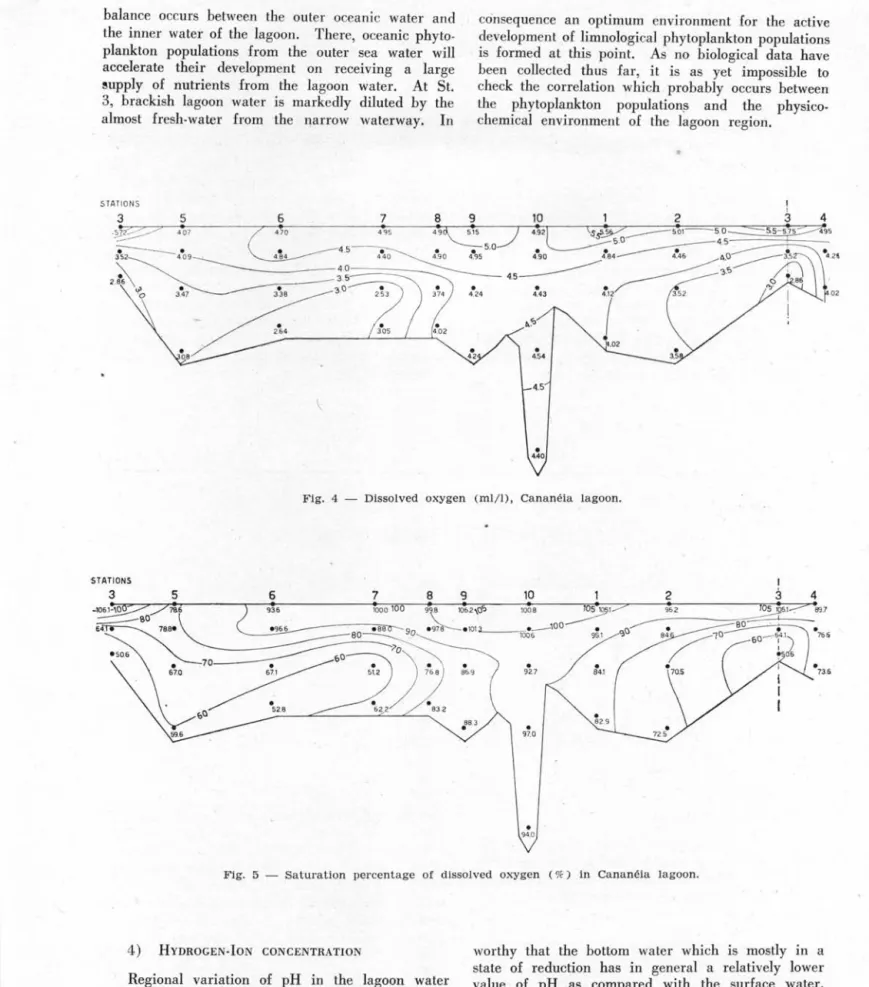
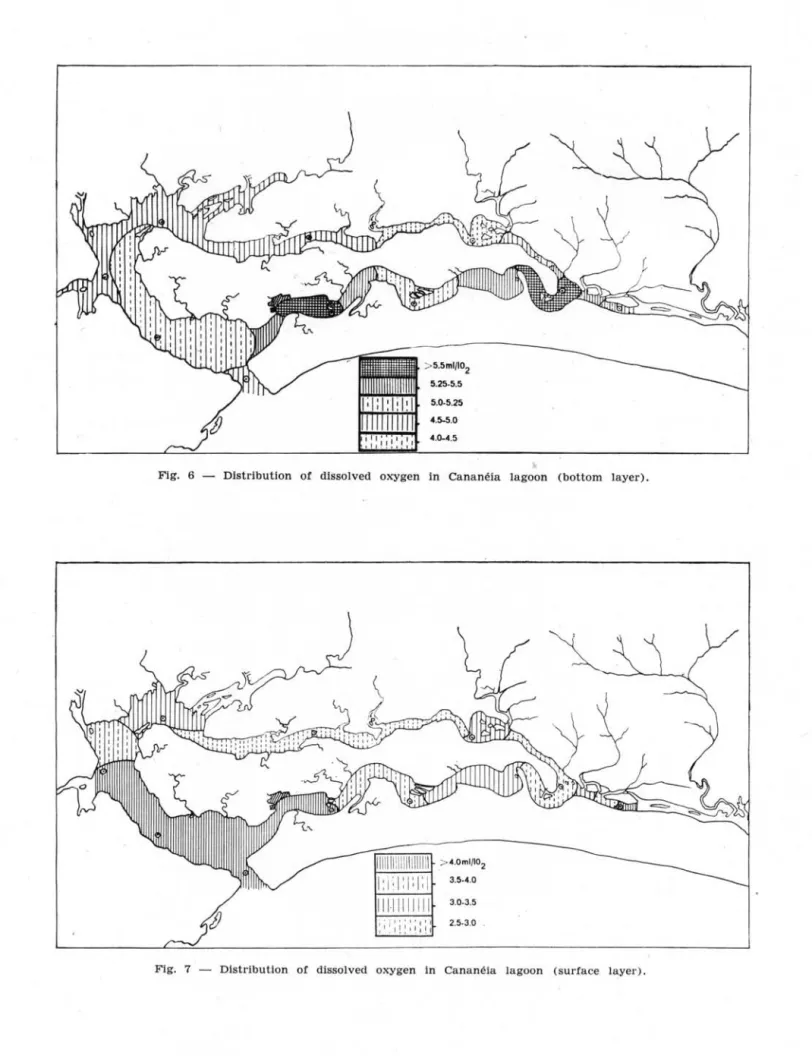
Regional distribution of dissolved oxygen in the lagoon water is of considerable interest from the point of view of photosynthesis of the phytoplankton and bacterial consumption of oxygen. The sea water is almost saturated with oxygen and has about 4.5 mI/I, while the oxygen content of the inner water of the lagoon, particularly the bottom layer decreases according to the state of reduction over 01' within Lhe bottom sediments. The reduced state is probably correlated with bacterial action.
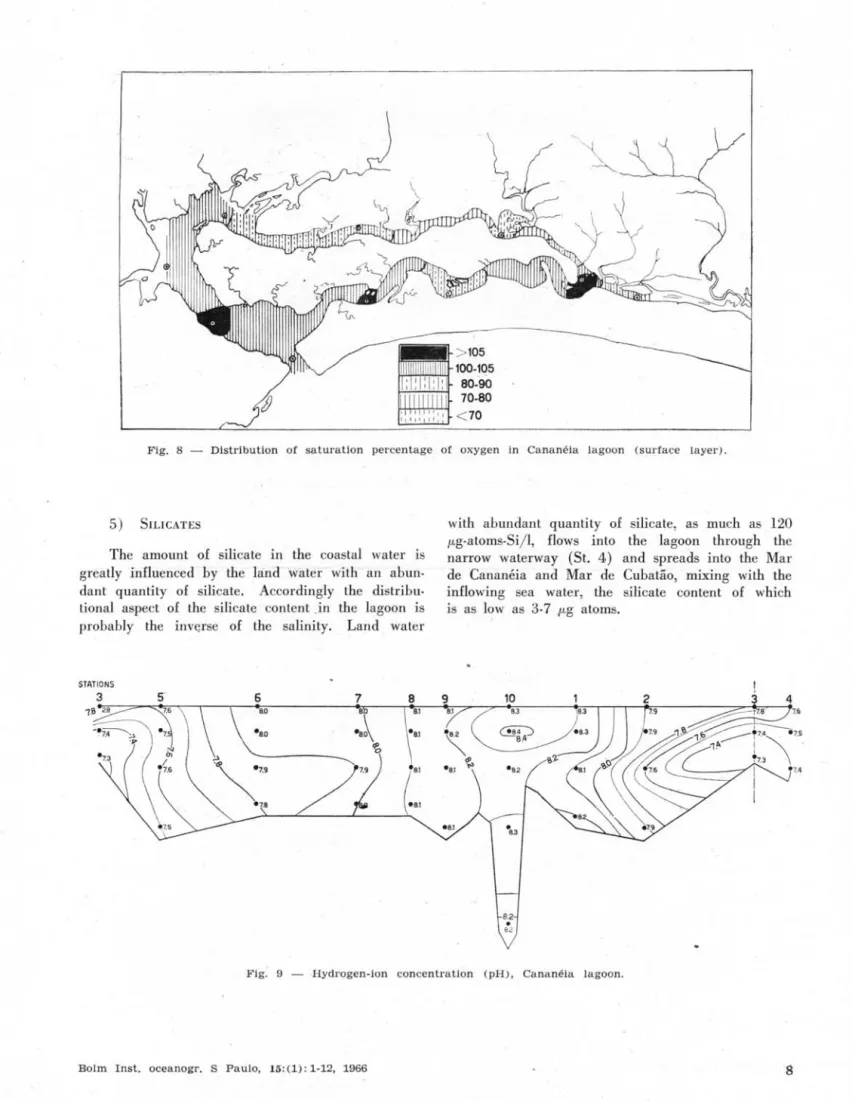
Supersaturation of dissolved oxygen to 105% occurs in the surface layer at three stations in the lagoon, as shown in Fig_ 8. This supersaturation
Bolm Inst. oceanogr. S Paulo, 15 ~ (I): 1-12, 1966
of oxygen is certainly due to active photosynthesis caused by the rapid development of phytoplankton populations at these stations. Of course, the bio-logical character of the phytoplankton populations . probably depends upon the hydrographic and
geo-chemical conditions of the water. Therefore, phyto-plankton species adapted to the regional variation of physical and chemical characteristics of the water should be found at the · above three stations_ Pre-sumably the predominant populations found at the two stations near the entrance (St. 1 and 9) are adapted to marine conditions while those at the interior stations like St. 3 are of brackish 01' fresh-water types. That is to say, at the forme r stations there is probably a region where pydrographical
balance occurs between the outer oceanic water and the inner water of the lagoon . There, oceanic phyto. plankton populations from the outer sea water will accelerate their development on receiving a large !lupply of nutrients from the lagoon water. At St. 3, brackish lagoon water is markedly diluted by the almost fresh·water from lhe narrow waterway. In
ST ATIO NS
consequence an optimum environment for the active development of limnological phytoplankton populations is formed at this point. As no biological data have been collected thus far, it is as yet impossible to check the correlation which probably occurs between the phytoplankton population.s and the physico-chemical environmen t of the lagoon region.
4.5
•
4.40
Fig. 4 - Dissolved oxygen (ml/I) , Cana nêla lagoon.
~TATlONS
3 5 6 7
-~S O
78.\
é
9::66_ _ _ _ _ _ 1000 100
6~9.8· ~8 0 . 88 '1090
~ 5°~
~~
• 7 0 . •0
. 670
0_:
S ~2
'óQ~
· 52.8~
622•
94.0
I
3
4fIl.7
.
76 .6.
73.6Flg. 5 - Saturation percentage of d issolved oxygen ( * ) In Ca nanéia lagoon .
4) HYDROGEN·IoN CONCENTRATION
Regional variation of pH in the lagoon water is of interest when studied in connection with those of salinity and dissolved oxygen contento
The pH of outer sea water is 8.4 while most of the lagoon ' 'Yater has pH of about 7.9. It is note·
Bolm Inst. oceanogr. S Paulo, 15:(1): 1-12, 1966
worthy that the bottom water which is mostly in a state of reduction has in general a relatively lower value of pH as compared with the surface water. This lower pH is caused by bacterial decomposition of organic materiaIs deposited in the bottom. Such a biochemical lowering of the pH was especially re-markable at the bottom in St. 3.
Fig. 6 - DlstributIon of dlssolved oxygen in Cananéia lagoon (bottom layer).
IIIIIII!!IIIIIIIIIII
1:1:1:1:1:1
11111111111
> 4.0ml/102 3.5·4.0
3.0.3.5
2.5·3.0
Fig. 7 - Distribution of dissolved oxygen In Cananéla lagoon (surface layer).
..
> 105
t\9':"i't\'~ 100-105
80-90 70-80
< 70
Fig. 8 - Distribution of saturation percentage of oxygen in Cananéia lagoon (surface layer).
5) S ILl CATES
The amount of silicate in the coastal water is greatly influenced by the land water wíth an abun-dant quantity of silicate. Accordingly the distribu-tional aspect oI lhe silicate content .in the lagoon is probably the inv«,;rse of the salinity. Land water
STATIONS
with abundant quantity of silicate, as much as 120 f.Lg-atoms-Sijl, flows into the lagoon through the narrow waterway (St. 4) and spreads into the Mar de Cananéia and Mar de Cubatáo, mixing with the inflowing sea water, the silicate content of which is as low as 3-7 JJ-g atoms.
3 5 6 7 10
.,.--:::=-...,~"-r--.----Õo,;---it,;,;----r+.;;--i .... -;?"--::,,.-...,,8.3,----tiT---,--r-,---1.,...---:::""'=:!;;;C--;7.6
8.2
.
8.2
Flg: 9 - ·Hydrogen-ion concentratlon (pH), Cananéia lagoon.
STATIONS
3 5 6 7 8
8 9 88 13 11
,
.
•
88.
10.3~
7.5 1~2.
-'.8 O
'"
•
11.3 S!• •
7.8 7.6•
·,.8
•
107 7.7
9
7.5
·7.7
•
7.5,;;~
)
I
•
7810 7.7
•
7.5, ,
,
·
4.1\ ,•
4.1•
4.1I
2 :3 4
(
~'2
,
,
Fig. 10 - Silicate-Si (Jl.g-atoms-Si/l), Cananéia lagoono
6) PHOSPHATES
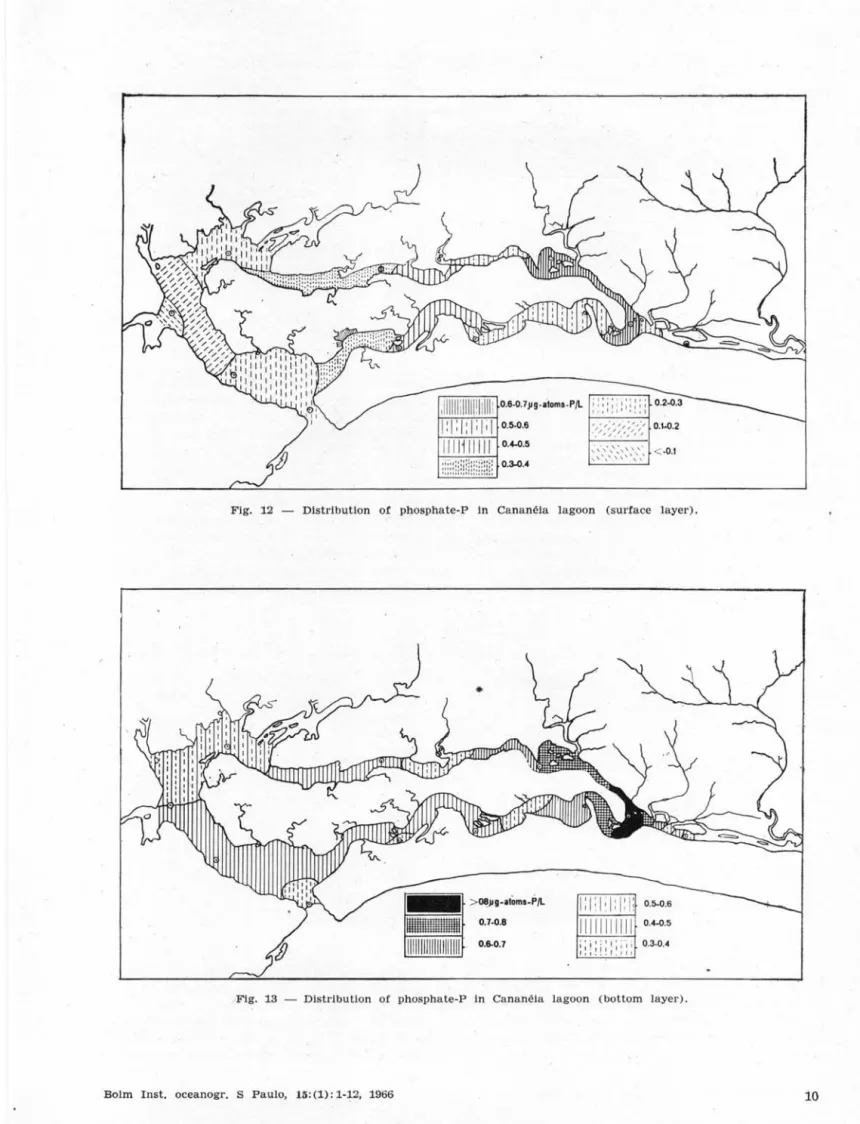
The outer water contains a relatively low content of phosphates, up to 003 JLg-atoms-P
l I,
and differs from the bottom water at the inner part of the la-goon where a fair amount of phosphate is foundo The accumulation of phosphate in the bottom layer is closely related to the amount of dissolved nutrients produced by bacterial decomposition of organic de-tritus which is suspended in the bottom layer or deposited on the sediments. As the return of phos-phorus into the water is likely to promote the active growth of phytoplankton, it follows that the oxygen content in the upper layer of water will increase5TATlONS
3 5 6
0.38
7 8 9
023
markedly with active photosynthesis. This biochem· ical aspect is outstanding in the surface layer of an interior station like St. 3. Here a characteristic supersaturation of oxygen over 105'
%
was observed in the surface layer in spite of a remarkable falI of oxygen tension due to bacterial consumption, at the bottom. As pointed out above it is noteworthy that the return of the nutrients into the overlying water contributes greatly to the organic productíorr in the present lagoon. Therefore another study will be carried out to estimate the budget of organic con-sumption and the geo-biochemical return of nutrients from the bottom sediments of this lagoon.~ 37<3
'--- - -- - - - 0.40 0.30
· 0.41 . 0.45 ____ e .40 ' e().34
0.50
0.40
0 ~0 03
Figo 11 - Phosphate-P (Jl.g-atoms P / I), Cananéia lagoon o
7) NITRATES
The distribution of nitrate in this lagoon IS important in connection with the hydrography of the lagoon water and as a biochemical facto r of organic production.
Bolm Ins t . oceanogr. S Paulo, 15: (1): 1-12, 1966
As illustrated in Figures 14 and 15, a remark-able accumulation of nitrate is found in the interior region of the lagoon, at St. 5 and 4, whereas an extremely low content, below 0.1 JLg-atoms-N/ I of nitrate, is found in. the open area near the southern, entrance of the lagoon. The plankton populatio.n
,illlllilllll!llllli
0.6-0.7 JI 9 -.Iom'-P/L '1 " " · "1" 11111 1 111111 ,., 1 ,1 1 ',,1 1:1: 1: 1; 1;1 0.5-0.6 :~;:~~;.~:;>: 0.1-0.2111 1111111 0.4-0.5
:"
~.~~~\> ~ ~ ~~\~ ~ZJ
:
~ ~~:i
1~!j j r~ i i j ;l jl 0.3-0.4 < -0.1Fig_ 12 - Dlstributlon or phospha te-P in Ca n a néla la goon (s urface layer)_
> 08j1g-alom'-P/L 1:1:1;1:1: 1: 0.5-0.6 0.7-0.8
11111111111 0.4-0.5
0.6-0.7 : ~ j ;
! ; :.
~:.: :
0.3-0.4Fig. 13 - Distribution of phospha te-P in Cana néia la goon (bottom layer )_
usually increases actively in summer in the lagoon so that a large consumption of nutrients by the plankton wilI sometimes cause a lack of nutrients, especiaIIy nitrogenous materiais. Seasonal variation of the nitrate content in the lagoon water is very large. A fairly high amount of nitrate, as much as 6·12 jLg.atoms.N/ I, in winter (June) , while an explosive increase of phytoplankton population in summer, causes some times an almost complete con-sumption of nitrogenous nutrients as In the case mentioned above.
Characteristic accumulation of nitrates in the water of the inner region will illustrate the
foIIow-STATIO NS
7
<0.1
•
<0.1
•
<0.1
•
<0.1
8
<OI
•
< 0.1
•
<o.,9
<0.1
ing hydrographic characteristic of the interior water of the lagoon.
Most of the nutrient substances, probably as suspended detritus, wilI be carried in from the neigh-bouring fresh-water system and accumulate at the northern portion of the lagoon. This is shown at St. 5 and 3, where horizontal movement of the water with the tidal fIuctuations is not so strong as to wash out the accumulation 'of suspended materiais in the water. Subsequently in such sheltered areas (like the above) an active decomposition by bacteria would turn the .organic suspension into a form usable by the plankton population.
J
10 2
3 •
4<0.1
<!'O.l <0.1
•
•
<O-I (0,1
•
•
<:0,1
•
<0.1
Figo 14 - Nitrate-N (I'g-atoms N / I), Cananéla lagoon o
> 3.oopg-atoms _N/L
2.00·300 ~ ::::: ::::~
0.10·0.25 1.00-2.00
0.50.0.50
Fig. 15 - Dlstributlon of nitrate-N in Cananéia lagoon (surfa ce layer).
Another contribution of the neighbouring fresh· water system to the nutrient enrichment of the whole lagoon was observed in the first serial investigation carried out in January 1958 at the mouth of the Rio Nóbrega, one of the SQ·called "marigot" (KATO, 1966b). A good amount ofnitrate, as much as 3.0 p.g.atoms.Nj l on the average was observed duro ing the investigation. The above amount is rather high compared to the small quantity of nitrate ob· served in the - outer lagoon water. Therefore the
fer~lization of the lagoon is probably brought about
hy the supply of a large amount of nutrients materiaIs hy the mangrove rivers or "marigots".
ACKNOWLEDGEMENTS
The author is particularly indehted to Prof.
W.
BESNARD, Director of · the Oceanographic Institute of the University of São Paulo, for his suggestions and encouragement during this work. Thanks are also due to Dr. I. EMILSSON, Dr. M. FURUYA and Dr.
V.
SADOWSKY of the Institute for their coopera· tion and to Dr. T. K. S. BJORNBERG who revised this manuscript. The author thanks the National Council of Research of Brazil for the fellowship.RESUMO
O presente trabalho, sôbre os resultados de es- · tudos que foram realizados periodicamente no siste-ma hidrográfico de Cananéia, Estado de São Paulo, em 1958, descreve as características da distribuição dos constituintes quíÍnicos das águas daquela região, segundo observações levadas
a
efeito em fevereiro de 1958.A água oceânica (salinidade 34 °/00; 4,5 ml/l O2 ;
pH 8,4; 0,1 j.tg-átomos-nitrato-N/l; 0,3 ,ug-átomos-fosfato-P I I e 4 ,ug-átomos-silicato-Sijl) penetra na região lagunar durante a maré alta, através da barra de Cananéia. A maior ·parte dessa água toma a di-reção oeste, pela baía de Trapandé, represando a água lagunar para o norte, enquanto uma quanti-dade menor entra pela parte leste, pelo chamado mar de Cananéia, no que é aparentemente impedida pela exigüidade da passagem. Na parte interna da regiâo lagunar, o aumento do nível das águas de-pende, aparentemente, de um acúmulo de água dos tributários, causado pelas ondas de maré.
A queda do nível do mar durante a maré baixa, puxa para fora as águas da região lagunar e co-mumente observa-se uma grande velocidade do fluxo da água, que sai através da estreita passagem do mar de Cananéia.
Na parte interna da região lagunar, quando di-minui o movimento horizontal das águas, devido às marés, surge um estado de redução na camada de . fundo, devido à decomposição de matérias orgâr}icas em depósito, causada pelas bactérias. Sendo assim, observa-se uma baixa considerável · do oxigênio na água imediatamente acima do fundo . Nas águas de superfície, na mesma estação, a quantidade de oxi-gênio dissolvido alcança quase o ponto de satura-. çãosatura-. A ação das bactérias é muito importante para
o metabolismo da região. lagunar. A devolução de nutrientes, para a água, sem dúvida alguma, con-tribui de forma eficiente para o enriquecime'nto da produção de fitoplâncton.
Bolm In st. oceanogr. S Paulo,15 : (1): 1-12, 1966
REFERENCES
AB'SÁBER, 1953.
A. N. & BERNARD, W. ·
BESNARD, W. 1950a.
1950b .
Sambaquis da região lagunar de Cana-néia. I. Observações geográficas. H. Especulações pré-históricas. Bolm Inst. oceanogr., vol. 4, n.o 1/2, p. 215-230, fots.
Considerações gerais em tôrno da re-gIão lagunar de Cananéia-Iguape. I. Bolm Inst. paul. oceanogr., vol. I, n.o I, p. 9-26, figs.
Considerações gerais em tôrno da re-gião lagunar de Cananéia. lI. Diversos aspectos atuais da região lagunar. Ibid ., vol. I, n.o 2, p. 3-28, figs.
BIGARELLA, J. J.
1954. Nota sôbre os depósitos arenosos recen-tes do litoral sul-brasileiro. Bolm Inst. oceanogr., vol. 5, n.o 1/2, p. 233-240, figs.
CARVALHO., J. P.
1950. O plâncton do Rio Maria Rodrigues (Ca-nanéia). I. Diatomáceas e dinoflagela-lados. Bolm Inst. paul. oceanogr., vol. ·
I, n.o I, p. 27-43, figs ., tabs. CARVALHO., J.
1952. P. & CHERMo.NT, E. M. L.
KATO, K. 1966a.
1966b.
Sôbre alguns Foraminífera da costa do Estado de São Paulo. Bolm Inst. ocea-nagr., vol. 3, n.o 1/2, p. 77-100, est.
Studies on calcium content in sea water. IH. Calcium in the waters of Cananéia lagoon and its adjacent regions, State of São Paulo, BraziI. Bolm Inst. ocea-nogr., vaI. 15, n.o I, p. 41-4.5.
Geochemical studies on the mangrove region of Cananéia, BraziI. I. Tidal va-riations of water properties. Ibid ., voI. 15, n.o I, p. 13-20.
MACHADO, . L. B. 1950 .
1952.
SADOWSKY, V. 1952.
1953.
1954 .
Pesquisas físicas e qUlmIcas do sistema hidrográfico da região lagunar de Ca-nanéia. I. Cursos de água. Nota pré-via sôbre · os "rios" Maria Rodrigues e Baguaçu. Bolm. Inst. paul. oceanogr., vol. I, n.o I, p. 45-68, figs. map. Pesquisas físicas e químicas do sistema hidrográfico da região lagunar de Ca-nanéia. H. Aguas de junção. Estudos iniciais das águas comuns da região da ilha da Casca. Nota preliminar sôbre as águas na junção da canal de Arara-pira e baía de Trapandé. Balm Inst. oceanogr., voI. 3, n.o 1/ 2, p. 55-75, grafs. map.
Observações sôbre as modificações em curso na entrada de Cananéia, de sua barra e da região adjacente. I. Des-gaste das castas, n.o 1 - Ponta da Trincheira. Ibid. , voI. 3, n.o 112, p. 201-212, fots. map.
Madificações em curso na entrada da barra de Cananéia. Ibid., vol. 4, n.o 1/ 2, p. 191-214, fots. grafs. map. Novas cantribuições ao. estudo da en-trada da barra de Cananéia. Ibid. , voI. 5, n.o 1/2 , p. 151-178, fots. grafs. map.