Olfactory function and Parkinson’s
disease in Southern Brazil
Ricardo Santin1, Vicente Faraon Fonseca1, Cristina Birlen Bleil1, Carlos R.M. Rieder3, Arlete Hilbig1,2
ABSTRACT
The idiopathic Parkinson disease (IPD) is traditionally diagnosed by motor signs, but non-motor symptoms and signs are frequent and may help in the clinical diagnosis. Purpose: To evaluate the olfactory function in Brazilian healthy subjects, patients with early-onset PD (EOPD) and late-onset PD (LOPD) using the Sniffin’ Sticks odor-identification test (SST). Method: We studied 70 patients with IPD (19 EOPD and 51 LOPD) and 70 controls matched for gender, age and years of schooling. Subjects with dementia and loss of smell for other reasons were excluded. Results: The SST showed a significant difference (p<0.001) between groups: control groups (12.0±0.3), EOPD (8.3±0.7), and LOPD (6.7±0.4) when the groups were adjusted for gender, age, disease duration, and years of schooling. Conclusion: Both groups of IPD patients presented olfactory impairments, but those whose symptoms started before 45 years-old (EOPD) had better sense of smell than the LOPD patients.
Key words: Parkinson disease, olfactory function, sniffin’ sticks.
Função olfatória e doença de Parkinson no sul do Brasil
RESUMO
A doença de Parkinson idiopática (DPI) tradicionalmente é diagnosticada pelos sinais motores, porém os sinais e sintomas não-motores são freqüentes. Objetivo: Avaliar a função olfatória em sujeitos brasileiros saudáveis e em pacientes com doença de Parkinson precoce (DPP) e doença de Parkinson tardia (DPT) utilizando o teste Sniffin’ Sticks (TSS) de identificação de odores. Método: Setenta pacientes com DPI (19 DPP e 51 DPT) e 70 controles pareados para as variáveis gênero, idade e anos de escolaridade foram estudados. Foram excluídos sujeitos com demência e/ou perda de olfato por outros motivos. Resultados: O TSS mostrou uma diferença significativa (p<0,001) entre os grupos controle (12,0±0,3), DPP (8,3±0,7) e DPT (6,7±0,4) quando os grupos foram ajustados para sexo, idade, duração da doença e anos de escolaridade. Conclusão: Pacientes com DPI apresentam redução do olfato, sendo mais importante entre aqueles com DPT. A disfunção olfatória pode ser uma ferramenta muito útil no diagnóstico de DPI.
Palavras-chave: doença de Parkinson, função olfatória, sniffin sticks.
Correspondence
Arlete Hilbig Rua Sarmento Leite 245 90050-170 Porto Alegre RS - Brasil E-mail: [email protected]
Received 14 September 2009 Received in final form 26 October 2009 Accepted 9 November 2009
1Movement Disorders Outpatient Clinics of Santa Casa de Porto Alegre (ISCMPA), RS, Brazil; 2Internal Medicine Department of
Fundação Universidade Federal de Ciências da Saúde de Porto Alegre (UFCSPA), RS, Brazil; 3Movement Disorders Outpatient
Clinics of Hospital de Clínicas de Porto Alegre (HCPA), RS, Brazil. Idiopathic Parkinson disease (IPD) is the second most common neurodegener-ative disorder. Although traditionally con-sidered as a degeneration of dopaminergic neurons of substantia nigra pars compac-ta (SNc), it has been proved to be a much more spread disease with involvement of multiple systems. Braak et al.1, studying
brainstem progressively before reaching the SNc, when motor signs usually appear. his pathological description has found support in clinical studies. Usually patients seek medical attention due to motor signs, but non-mo-tor symptoms and signs are frequent and some of them, especially smell problems and sleep disturbances, might even precede motor signs2.
As there is no biological marker and the clinical diag-nosis of IPD is probabilistic and based on a set of symp-toms and signs, clinicians have to look for as many signs as possible to build up the diagnosis. Smell dysfunction may be a very helpful tool in an diagnosis of IPD. here are diferent smell tests currently in use in Europe and North America3, but few studies of olfactory function are
available in other regions4.
he aim of this study was provide normative data of olfactory test for south Brazilian healthy population us-ing the Sniin’ Stick odor identiication test and compare the results with an IPD population. We also compared the olfactory function on subgroups of IPD: early-onset PD (EOPD) and late-onset PD (LOPD).
Method Sample
We performed a case-control study and a smell test in 140 subjects distributed in two diferent groups:
Group 1
Seventy subjects with clinical diagnosis of IPD, based on the UK Parkinson’s disease Society Brain Bank’s crite-ria5, were assessed from movement disorders outpatient
clinics at Universidade Federal de Ciências da Saúde de Porto Alegre (UFCSPA), Hospital de Clínicas de Porto Alegre (HCPA), and private clinics. his group was fur-ther separated in two subgroups: patients with symptoms starting before 45 years-old (early-onset PD - EOPD, n=19); and patients whose symptoms started after 45 years-old (late-onset PD - LOPD, n=51). All IPD patients were given a smell test during the on period and were classiied via the Hoehn and Yahr (H&Y) rating scale and motor part (III) of the Uniied Parkinson Disease Rating Scale (UPDRS III).
Group 2
Seventy healthy volunteers were recruited from other outpatient clinics and the community. hey were matched to IPD patients for gender, age and, years of schooling. We had selected people without neurological diseases, no family history of parkinsonism, and no complains of smell problems.
Olfactory test
he smell test was performed by means of the Snif-in’ Sticks odor-identiication test (SST) (Burghart Mediz-intchnik, Gemany), commercially available, validated and
largely used in Europe. he test consists of sixteen pens illed with common odorants: orange, leather, cinnamon, peppermint, banana, lemon, licorice, turpentine, garlic, cofee, apple, cloves, pineapple, rose, anise, and ish. he pens have approximately 14 cm in length and can be used for up to one year, according to manufacturer. he test was translated to Portuguese and had been used before on a Brazilian population6.
During the test, the experimenter had to remove the cap and place the tip of the pen 2 cm from both nostrils of the patients. hey were free to sample the odors as often as necessary until they were able to identify the odorant from a list of four options given by the examiner for each pen. If they were not able to identify it, they had to guess (forced multiple choice task identiication test). he in-terval between each odorant was at least 30 seconds. he test was performed in a quiet, well-ventilated room and we did not employ any self-administered test.
Both the IPD and the control subjects were submitted to mini-mental examination prior to the test to exclude cognitive dysfunctions. Subjects with respiratory symp-toms during the previous two weeks before the test were excluded from both groups, and we also assessed smoking status and the presence of chronic rhinitis and sinusitis. All had agreed to participate, after full explanation about the study, and signed a consent form. he study was ap-proved by UFCSPA Ethical Committee (no 428/07).
Statistical analysis
The statistical analysis was performed through the SPSS 15.0 Software. We used the chi-square, 2-way ANO-VA, and Pearson’s correlation test for comparison of qual-itative, quantitative versus qualitative and quantitative variables, respectively. To compare SST scores among groups, we have used the ANCOVA Model to adjust for the efects of sex, age, disease duration and schooling.
Results
Both groups had thirty-eight male subjects (54.3%) and thirty-two female (45.7%). he baseline characteris-tics of control subjects. EOPD and LOPD are shown in Table 1. here was no diference between the groups for sinusitis (p=0.27) and rhinitis (0.50). Subjects with previ-ous history of sinusitis or rhinitis did not have diferent scores from those without these problems (p=0.36 and p=0.10, respectively). here was a signiicant diference (p=0.02) for smoking between control group (zero ers and 11 ex-smokers) and the IPD groups (seven smok-ers and 13 ex-smoksmok-ers), but we did not ind a diference in the SST score between ex-smokers and non-smokers (p=0.15) in controls or among smokers, ex-smokers and non-smokers in IPD patients (p=0.27).
12.0 (±2.2 SD) (range: 6-16; median: 12). hrough a multi-ple regression analysis, we found that age (p=0.001), years of education (p=0.037), and gender (p=0.049) were
inde-Table 1. Comparison of baseline characteristics and Sniin’ Sticks test among control and Parkinson disease subjects.
Characteristic Controln=70 EOPDn =19 LOPDn=51 p
Age, years 63.8±10.5 45.0±5.6 67.8±9.0 <0.001[1] Male sex, No. (%) 38 (54.3) 9 (47.4) 29 (56.9) 0.778[2]
Schooling, years 6.9±4.5 8.9±4.4 5.4±3.5 0.006[1]
Duration of disease, years – 9.7±5.9 5.9±4.2 0.005[1] Age of onset, years – 35.3±7.4 61.9±9.5 <0.001[1]
First symptom – 0.06[2]
Tremor – 10 (53) 43 (84)
Bradykinesia – 8 (42) 5 (10)
Rigidity – 1(5) 3 (6)
Familiar history – 6(32) 6(12) 0.08[2]
Hoehn & Yahr – 2.6±0.6 2.2±0.9 0.09[1]
UPDRS III – 17.8±7.6 16.7±7.6 0.64[1]
SST crude 12.0±2.2 9.6±2.3 6.3±2.8 <0.001[1]
SST adjusted* 12.0±0.3 8.3±0.7 6.7±0.4 <0.001[3]
Data are presented as mean±SD or mean±SE (in the adjusted model) and counts (percentages). SST: Sniin’ Sticks test; EOPD: early onset Parkinson disease; LOPD: early onset Parkinson disease; p: statistical signiicance; [1]ANOVA; [2]Chi-square; [3]ANCOVA
model adjusting for age, sex, disease duration and years of schooling. *Multiple contrasts: control vs. EOPD: p<0.001, control vs. LOPD: p<0.001; EOPD vs. LOPD: p=0.032.
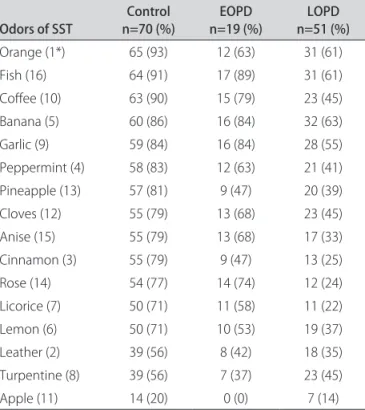
Table 2. Distribution of correct identification of odors among control, EOPD and LOPD.
Odors of SST n=70 (%)Control n=19 (%)EOPD n=51 (%)LOPD
Orange (1*) 65 (93) 12 (63) 31 (61) Fish (16) 64 (91) 17 (89) 31 (61) Cofee (10) 63 (90) 15 (79) 23 (45) Banana (5) 60 (86) 16 (84) 32 (63) Garlic (9) 59 (84) 16 (84) 28 (55) Peppermint (4) 58 (83) 12 (63) 21 (41) Pineapple (13) 57 (81) 9 (47) 20 (39) Cloves (12) 55 (79) 13 (68) 23 (45) Anise (15) 55 (79) 13 (68) 17 (33) Cinnamon (3) 55 (79) 9 (47) 13 (25) Rose (14) 54 (77) 14 (74) 12 (24) Licorice (7) 50 (71) 11 (58) 11 (22) Lemon (6) 50 (71) 10 (53) 19 (37) Leather (2) 39 (56) 8 (42) 18 (35) Turpentine (8) 39 (56) 7 (37) 23 (45) Apple (11) 14 (20) 0 (0) 7 (14)
Data are presented in counts (percentages). SST: Sniin’ Sticks test; EOPD: early onset Parkinson disease; LOPD: early onset Parkinson disease. *The number indicates the sequence of odor in the SST.
pendently correlated with the SST score. Females had a mean score around one point above males (12.5±1.7 and 11.5±2.5 respectively). here was a negative correlation with age: for each increased year of age there was a 0.08 point decrease in the SST score. he identiication of hits of each odor is show in Table 2.
Most IPD patients (n=70) had a mild to moderate dis-ease (H&Y 1.0 to 3.0). he EOPD developed their symp-toms at an average age of 35.3 (±7.4) years and the LOPD group, at 61.9 (±9.5) years (p<0.001). here was no difer-ence between the subgroups in disease severity, although the EOPD group had a longer disease duration (9.7±5.9) than the LOPD (5.9±4.2) (p=0.005). he average score in the SST of the IPD group was 7.2 (±3.0) (range: 2-14). he family history of IPD was positive in 6 patients (13%) of the LOPD and in other 6 patients (31.6%) of the EOPD, without a signiicant diference (p=0.084).
diference in SST score among the IPD subgroups were not due to these variables, but independently related with the subgroup (early or late onset PD), being better among those with EOPD.
We also found that olfactory dysfunction was diferent depending upon the irst symptom, being better among those who presented bradykinesia at irst. Using subgroup stratiication, we found that the diference is due to sub-groups: EOPD had usually started the disease with bra-dykinesia while the LOPD had mainly tremor as the irst symptom.
he cut-of score in the SST that better discriminated IPD from the controls in our population was diferent de-pending upon the age of onset. For LOPD patients, nine or less correct answers (of 16) give us a score with sensi-bility of 88.2% and speciicity of 85.7% for the IPD diag-nosis. If we are trying to establish a diagnosis of EOPD, we should consider a higher score, with ten or less correct answers (of 16) showing sensibility of 63.2% and speciic-ity of 78.6% (Table 3). A particular patient with mild signs of parkinsonism and SST below the chosen cut-of would have 17 times more chance of belonging to the IPD group instead of the control group.
discussion
he sense of smell has been under evaluated on clin-ical practice: physicians usually do not give importance to smell problems and patients are often unaware of their smell dysfunction and do not complain about it. Howev-er, this sensation plays an important role in quality of life: it determines the lavor of food and drinks and provides protection against dangerous and spoiled substances. he olfactory loss may also indicate an ongoing neurodegen-erative disease. Many authors have drawn attention to smell problems in disorders such as Parkinson’s disease7.
Alzheimer’s disease and mild cognitive impairment8,9.
herefore, a routine evaluation of smell function can be
a very helpful tool in the clinical diagnosis of these dis-eases, or at least a “red lag” for closer evaluation and fol-low-up in asymptomatic subjects.
Many tests are available to detect olfactory loss, but there are cross-cultural diferences, which imply we cannot use the results of one study for every population. he most used tests are the University of Pennsylvania Smell Iden-tiication Test (UPSIT) and the Sniin’ Stick test (SST). UPSIT is a one-way scratch and snif test used in North America since 1984; SST is a reusable and portable test currently in use mainly in European countries and has been standardized and validated since 1995. Both tests evalu-ate the olfactory function by means of olfactory thresh-old, discrimination, and identiication. As far as we know, there is no commercially available smell test in Brazil. A population of IPD patients and healthy Brazilian subjects had been tested for odor identiication through cross-cultural UPSIT6,13 and SST6. Both tests were
per-formed with patients from São Paulo and did not separate EOPD of LOPD. Our sample comes from very south of Brazil, with diferent culture and environment. Quagliato et al. studied a sample of 75 controls and 50 IPD patients whose mean age were 64.8 years, and found a sensitivity of 80% at UPSIT test13. Silveira-Moriyama et al. analyzed
118 controls and 106 IPD patients, with a mean age of 61.3 years. he UPSIT sensitivity was 82.1% and its spec-iicity was 83.5%; the SST sensitivity was 81.1% and the speciicity was 89.0%6. Our LOPD group showed similar
results (sensibility of 88.2% and speciicity of 85.7%). Using the SST to test our population, most subjects claimed to be familiar to all odors presented. Among 16 odors, only turpentine and apple were poorly identiied by the controls and also did not show diferences between the controls and the IPD patients. Previous studies showed similar results6,13 and then, these odors should
proba-bly be excluded when testing the Brazilian population. In healthy populations, we conirmed an age-relat-ed decrease of the olfactory function and a better sense of smell among women. Hummel et al., 2007, studying more than 3,000 healthy subjects in Germany, showed age and sex efects in olfactory ability; and an age-related de-crease of olfactory function has been suggested in numer-ous previnumer-ous studies3. he best odor performance occurs
between 20 and 40 years and begins to decline steadily af-ter this age14. Although regularly observed, loss of the
ol-factory function is not inevitable and age is not the cause of this loss. It has been shown that “successfully aged el-derly” also exhibit a normal olfactory function15.
Other-wise, it was also shown that the olfactory bulb is one of the earliest sites where Alzheimer’s and Parkinson’s types of changes appear in the brain16,17. Considering the
pres-ence of smell dysfunction in asymptomatic elderly pop-ulations and a high prevalence of neurodegenerative
dis-Table 3. Sensibility and speciicity for diferent cut-of SST scores in the EOPD and LOPD.
Subgroup Cut-of Score Sensibility Speciicity
EOPD ≤ 11 78.9% 61.4%
EOPD ≤ 10 63.2% 78.6%
EOPD ≤ 9 36.8% 85.7%
EOPD ≤ 8 26.3% 94.3%
LOPD ≤ 10 90.2% 78.6%
LOPD ≤ 9 88.2% 85.7%
LOPD ≤ 8 76.5% 94.3%
LOPD ≤ 7 66.7% 95.7%
eases, this inding might be a predictor of further devel-opment of neurodegenerative diseases, which can have a long pre-clinical phase. Hyposmia seems to precede the development of IPD2 but further studies are needed to
address the risk of neurodegenerative diseases in asymp-tomatic elderly populations with smell dysfunctions.
he sense of smell is better developed in females. he reasons for gender diferences are also unknown and have been speculated to be attributed to various factors in-cluding hormonal efects, verbal skills or congenital fac-tors3. A stereological study18 of the human olfactory bulb
showed that the number of tyrosine hydroxylase (TH) positive cells (dopaminergic cells) in females is half than that found in males. As TH cells appear to be inhibitory in the olfactory bulb, probably decreasing the inputs from the olfactory epithelium to the olfactory cortex, the lack of inhibition may be one reason.
Olfactory dysfunctions in the IPD include impair-ments in both odor identiication and discrimination per-formance. Boesveldt et al.10, studying 404 IPD patients
and 150 controls tested with the SST, showed that use of the odor identiication test is a good and suicient tool to discriminate IPD patients from controls with no increase in speciicity and/or sensibility if one adds discrimina-tion and/or identiicadiscrimina-tion tests. he impairment of odor identiication is more prevalent than a deicit on odor discrimination, although odor discrimination seems to worsen, increasing the duration of the disease. he mul-tiple-choice identiication test, in which the subject has to identify the stimulus from a list of odor names, is the most sensitive and speciic procedure11. As the subject is
forced to select one answer in each case, some correct answers could be given by chance, but it has been shown that the probability of more than seven correct answers by chance is very low (less than 5%), and scores lower than seven should be considered as anosmia12.
here was a signiicant diference in the SST scores between controls and IPD patients. The presence of a smell dysfunction had a high sensibility (EOPD 63.2%; LOPD 88.2%) and speciicity (EOPD 78.6%; LOPD 85.7%) for the IPD diagnosis in our population, suggesting that it may be very helpful when evaluating a particular pa-tient with mild or atypical symptoms both for diagnosis and diferential diagnosis. Other parkinsonian syndromes such as progressive supranuclear palsy, multiple system atrophy, and vascular Parkinsonism do not seem to have smell dysfunctions19,20. Also, patients with essential
trem-or, whose diferential diagnosis with IPD may sometimes be very challenging, have a normal smell function21.
We also found that subjects whose symptoms started before the age of 45 years (EOPD) had a better sense of smell than those whose symptoms started after that. We studied a small population of EOPD and there was
dif-ference between subgroups on age, education, and dis-ease duration, but the age of onset did not depend on these variables in the SST score. From 19 patients with EOPD, twelve (63%) scored in normal range, while 12% of LOPD had a normal smell test. hen, in order to im-prove diagnosis speciicity, we must use a higher cut-of among EOPD patients, which results in a lower diagnosis sensibility in this subgroup. We can just speculate about the reasons for this diference. Although olfactory loss is present in most IPD patients (up to 90%), it is not present in all of them, IPD is a disease with many faces, or many diferent diseases. Diverse causes and mechanisms may initiate a process that seems to follow a similar pattern, both clinically and pathologically. It is possible that a sub-group with normal smell functions belongs to a speciic subtype of disease, with a diferent cause and/or mecha-nism. It is also possible that, due to the individual variabil-ity and/or neuronal susceptibilvariabil-ity, sites other than the ol-factory tract may initiate the pathologic process and these individuals will not show any smell dysfunction.
here are clues pointing to environmental and genetic factors as a key for the IPD development. A study of pa-tients with parkin mutations (Park 2), a monogenic form of EOPD, showed that the smell function is preserved in this population22. We did not perform genetic tests in the
whole EOPD subgroup, but two siblings with a PINK 1 mutation in our group had normal smell tests (data not published). Patients with EOPD are more prone to have genetic forms of disease and data about olfactory func-tion among genetic forms of EOPD are still lacking. Pa-tients with LRRK2 mutations present olfactory dysfunc-tion comparable to the IPD6, but this autosomal
domi-nant Parkinsonism has a late disease onset and a similar phenotype of IPD.
Environmental toxins may also be responsible for the development of the Parkinsonian syndrome. he IPD has been proposed to be a primary olfactory disorder and the disease could start in the olfactory system with an al-pha-synuclein conformational change generated in the olfactory epithelium, under the influence of environ-mental molecules and/or caused by genetic/molecular factors23,24. he pathogenic agent should have the
abili-ty to induce conformational transformation of a native α-helix α-synuclein into a pathological isoform, a β-sheet α-synuclein, with the ability to form ibrils of Lewy bodies and Lewy neurites. he agent could be a prion-like pro-tein, as recently suggested by Lerner and Bagic24. he
Although the Lewy body pathology has been demon-strated in olfactory areas by many authors, it is still un-known why IPD patients lose their smell function. In a pathological study of dopaminergic cells in the olfactory bulb of IPD and control subjects. Huisman et al.18 showed
that IPD patients, both males and females, have the same amount of cells as control males. hey suggest that hy-posmia in PD is not just related with dopamine in the ol-factory bulb.
aCknOwLEDgmEnTS– The authors thank Dr. Laura
Silveira-Moriyama and Professor Andrew Lees (Queen Square Brain Bank,
UK) for their comments and the Sniffin’ Sticks material provided.
ReFeRences
1. Braak H, Tredici KD, Rüb U, de Vos RA, Jansen Steur EM, Braak E, Staging of brain pathology related to sporadic ParkinsonÅfs disease. Neurobiol Aging 2003;24:197-211.
2. Ross GW, Petrovitch H, Abbott RD, et al. Association of olfactory dysfunction with risk for future ParkinsonÅfs disease. Ann Neurol 2008;63:167-173. 3. Hummel T, Kobal G, Gudziol H, Mackay-Sim A. Normative data for th
Åg-SniinÅf SticksÅh including tests of odor identiication, odor discrimination, and olfactory thresholds: an upgrade based on a group of more than 3,000 subjects. Eur Arch Otorhinolaryngol 2007;264:237-243.
4. Double KL, Rowe DB, Hayes M, et al. Identifying the pattern of olfactory def-icits in Parkinson disease using the brief smell identiication test. Arch Neu-rol 2003;60:545-549.
5. Hughes AJ, Ben-Shlomo Y, Daniel SE, Lees AJ. What features improve the ac-curacy of clinical diagnosis in ParkinsonÅfs disease: a clinicopathologic study. Neurology 1992;42:1142-1146. Erratum in: Neurology 1992;42:1436. 6. Silveira-Moriyama L, Carvalho Mde J, Katzenschlager R, et al. The use of smell
identiication tests in the diagnosis of ParkinsonÅfs disease in Brazil. Mov Dis-ord 2008;23:2328-2334.
7. Ansari KA, Johnson A. Olfactory function in patients with ParkinsonÅfs dis-ease. J Chronic Dis 1975;28:493-497.
8. Christen-Zaech S, Kraftsik R, Pillevuit O, et al. Early olfactory involvement in AlzheimerÅfs disease. Can J Neurol Sci 2003;30:20-25.
9. Murphy C, Gilmore MM, Seery CS, Salmon DP, Lasker BR. Olfactory thresholds are associated with degree of dementia in AlzheimerÅfs disease. Neurobiol Aging 1990;11:465-469.
10. Boesveldt S, Verbaan D, Knol DL, et al. A comparative study of odor identii-cation and odor discrimination deicits in ParkinsonÅfs disease. Mov Disord 2008;23:1984-1990.
11. Eibenstein A, Fioretti AB, Lena C, Rosati N, Ottaviano I, Fusetti M. Olfactory screening test: experience in 102 Italian subjects. Acta Otorhinolaryngol Ital 2005;25:18-22.
12. Kobal G, Hummel T, Sekinger B, Barz S, Roscher S, Wolf S. ÅgSniinÅf stick-sÅh: screening of olfactory performance. Rhinology 1996;34:222-226. 13. Quagliato LB, Viana MA, Quagliato EM, Simis S. Olfactory dysfunction in
Par-kinsonÅfs disease. Arq Neuropsiquiatr 2007;65:647-652.
14. Kovács T. Mechanisms of olfactory dysfunction in aging and neurodegener-ative disorders. Ageing Res Rev 2004;3:215-232.
15. Almkvist O, Berglund B, Nordin S. Odor detectability in successfully aged el-derly and young adult. Reports from the Dept. of Psychology. Stockholm Uni-versity 1992;744:1-12.
16. Kovács T, Cairns NJ, Lantos PL. Olfactory centres in AlzheimerÅfs disease: ol-factory bulb is involved in early BraakÅfs stages. Neuroreport 2001;12:285-288. 17. Braak H, Del Tredici K, Bratzke H, Hamm-Clement J, Sandmann-Keil D, Rüb U. Staging of the intracerebral inclusion body pathology associated with idio-pathic ParkinsonÅfs disease (preclinical and clinical stages). J Neurol 2002;249 (Suppl 3):S1-S5.
18. Huisman E, Uylings HBM, Hoogland PV. Gender-related changes in Increase of dopaminergic neurons in the olfactory bulb of ParkinsonÅfs disease pa-tients. Mov Disord 2008;23:1407-1413.
19. Doty Rl, Golbe LI, McKeown DA, Stern MB, Lehrach CM, Crawford D. Olfac-tory testing diferentiates between progressive supranuclear palsy and idio-pathic ParkinsonÅfs disease. Neurology 1993;43:962-965.
20. Wenning GK, Shephard B, Hawkes C, Petruckevitch A, Lees A, Quinn N. Olfac-tory function in atypical parkinsonian syndromes. Acta Neurol Scand 1995;91: 247-250.
21. Busenbark KL, Huber SJ, Greer G, Pahwa R, Koller WC. Olfactory function in essential tremor. Neurology 1992;42:1631-1632.
22. Verbaan D, Boesveldt S, van Rooden SM, et al. Is olfactory impairment in Par-kinson disease related to phenotypic or genotypic characteristics? Neurolo-gy 2008;71:1877-1882.
23. Hawkes CH, Del Tredici K, Braak H. ParkinsonÅfs disease: a dual-hit hypothe-sis. Neuropathol Appl Neurobiol 2007;33:599-614.