Rev Bras Anestesiol SCIENTIFIC ARTICLE 2011; 61: 5: 561-567
Revista Brasileira de Anestesiologia 561
Vol. 61, No 5, September-October, 2011
Received from the Departamento de Anestesiologia, Dor e Terapia Intensiva – Universidade Federal de São Paulo (USP), Brazil.
1. Physiotherapist; Master’s Degree Student at USP 2. Physician; Professor, USP
3. Physician; Coordinator of the Setor de Dor, USP
Submitted on January 4, 2011. Approved on February 28, 2011.
Correspondence to: Dra. Rioko Kimiko Sakata R. Três de Maio 61/51 Vila Clementino
04044-020 – São Paulo, SP, Brazil E-mail: [email protected] SCIENTIFIC ARTICLE
Assessing the Effects of Transcutaneous Electrical Nerve
Stimulation (TENS) in Post-Thoracotomy Analgesia
Fabiana Cristina Ferreira
1, Adriana Machado Issy
2, Rioko Kimiko Sakata
3Summary: Ferreira FC, Issy AM, Sakata RK – Assessing the Effects of Transcutaneous Electrical Nerve Stimulation (TENS) in Post-Thoracotomy Analgesia.
Background and objectives: Transcutaneous electrical nerve stimulation (TENS) is commonly used to treat musculoskeletal pain, but it may also be indicated for postoperative analgesia. The objective of this study was to evaluate the analgesic effects of TENS on post-thoracotomy.
Methods: Thirty patients between 18 and 60 years of age undergoing thoracotomy for lung cancer resection on the second postoperative day were included in this study. Patients were divided into two groups (G1 and G2). G1 patients were treated with TENS; and in G2 (without TENS) electrodes were placed but the equipment was not turned on. TENS was maintained for one hour. The visual analogue scale was used to eva-luate the analgesic effects on three moments: before TENS (M0), immediately after TENS (M1), and one hour later (M2), with the patient at rest, elevation of the upper limbs, change in decubitus, and coughing.
Results: The intensity of pain at rest was higher in G2 immediately after TENS, but not one hour after the procedure. There was no difference between both groups with elevation of the upper limbs, decubitus change, and coughing.
Conclusions: With the use of TENS for one hour on the second post-thoracotomy day in patients who received fentanyl (50 mg) associated with bupivacaine (5 mL), a reduction in pain intensity was observed at rest immediately after TENS; with elevation of the upper limbs, change in decu-bitus, and coughing, a reduction in pain severity was not observed.
Keywords: Transcutaneous Electrical Nerve Stimulation; Thoracotomy; Pain, Postoperative; Pain Measurement.
©2011 Elsevier Editora Ltda. All rights reserved.
INTRODUCTION
Postoperative pain causes complications in several organs hindering patient recovery 1,2. It may also develop into chronic pain syndrome 3-5.
After thoracotomy pain is severe for a long time, and a mul-timodal approach to therapy is used for pain relief. Drugs and techniques with different mechanisms of action are used to obtain the best results. In general, epidural opioids associated with systemic anti-inflammatories are used, and other drugs may also be added.
Transcutaneous electric nerve stimulation (TENS) is com-monly used to treat musculoskeletal pain 6,7. Some authors observed a postoperative analgesic effect with TENS 8,9. A re-duction on postoperative complication rate such as atelectasis and ileus, besides a reduction in patients remain in intensive care unit when undergoing thoracic surgery 10, has also been observed. Patients showed better tolerance to respiratory physiotherapy and had less side effects (nausea, vomiting, and sedation) caused by opioids 9.
Transcutaneous electrical nerve stimulation inhibits the transmission of stimuli in the spinal cord dorsal horn where connections between peripheral and central fibers occur. It ac-tivates inhibitory interneurons by stimulating large fibers 11,12.
Transcutaneous electrical nerve stimulation uses low fre-quency electrical current, stimulating A-β fibers that transmit the information to the brain, activating descending inhibitory pathways to the spinal dorsal horn, reducing the traffic of pain stimuli. It is a simple, non-invasive, safe, low-cost procedure and it may be used for long periods 11,12.
FERREIRA, ISSY, SAKATA
562 Revista Brasileira de Anestesiologia
Vol. 61, No 5, September-October, 2011
METHODS
After approval by the Ethics Committee and signing of the in-formed consent, a prospective randomized study was under-taken. Thirty patients were divided into two groups of equal size by drawing numbers placed in envelopes.
Patients of both genders, ages 18 to 60 years, undergoing thoracotomy for resection of lung cancer were included in this study. Patients with pacemaker, cognitive dysfunction, and in need of mechanical ventilation were excluded. The day befo-re surgery patients befo-received the befo-requibefo-red information on the procedure to be performed postoperatively.
Patients underwent epidural anesthesia (bupivacaine with fentanyl) associated with general anesthesia. Postoperative analgesia consisted of epidural administration of 5 mL of the solution (0.25% bupivacaine with 50 mg of fentanyl) at 4-hour intervals. Patients also received intravenous dypirone 1 g, every four hours. Pain intensity was evaluated one hour after administration of epidural solution. In times of TENS applica-tion patients did not receive any other analgesics.
Transcutaneous electrical nerve stimulation was performed on the second postoperative day. Patients in G1 underwent TENS one hour after having received the epidural solution; in patients in G2 (without TENS) electrodes were placed but the equipment was not turned on. Patients were informed that they could feel or not the stimulus and that if they felt any dis-comfort they should communicate to the investigator. TENS was maintained for one hour with the equipment regulated for a pulse width of 100 msec, frequency of 100 Hz, and variable current intensity according to the perception of the patient. Electrodes were placed parallel to the incision.
The visual analogue scale was used to assess the anal-gesic effect of TENS at three moments: before the procedure (M0), immediately after the procedure (M1), and one hour la-ter (M2). The scale was applied with the patient at rest, with change in decubitus (from laying down to sitting up), moving the upper limbs, and coughing.
The sample size was calculated by the Instat Graph® soft-ware. A difference of at least 3 cm in VAS was considered clinically significant. Based on a preliminary evaluation, a standard deviation (SD) of 2.5 was estimated for pain scores. For 95% and α = 0.05 it was estimated that each group should have 15 patients. The software Instat Graph® was used for statistical analysis. Results were expressed as mean ± SD. The follow ing tests were used: Mann-Whitney test for anes-thesia and surgery duration, as well as pain severity; Student t test for age, weight, and height; and Fisher exact test for gender. A level of significance of p ≤ 0.05 was considered.
RESULTS
Demographic data was similar in both groups and they are sho-wn in Table I. Mean anesthesia duration was 412.2 ± 131.3 min in G1, and 397.3 ± 90.9 min in G2 without significant differen-ces between groups (p = 0.7400; Mann-Whitney test). Mean
surgery duration was 298 ± 118.6 in G1, and 271 ± 88.4 min in G2 without significant differences between groups (p = 0.6040; Mann-Whitney test).
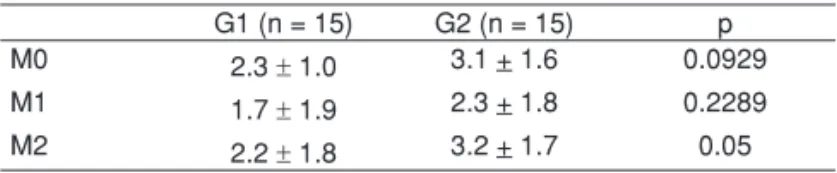
Pain severity is shown in Tables II, III, IV, and V. Pain se-verity at rest was greater in G2 immediately after the end of TENS, but not one hour after the procedure. With elevation of the upper limbs pain severity was greater in G2 one hour after the end of TENS. When changing decubitus (from laying down to sitting up) and with coughing, differences between groups were not observed.
Table I – Patients Demographic Data
G1 (n = 15) G2 (n = 15) p Gender M / F 10 / 5 8 / 7 0.71041
Age (years) 49.0 + 14.0 55.0 + 14.9 0.26572
Weight (kg) 70.3 + 13.4 68.7 + 11.9 0.73292
Height (cm) 165.6 + 9.6 163.6 + 7.4 0.54432
G1: with TENS, G2: without TENS; 1: Fisher Exact test; 2: Student t test.
Table II – Pain Severity at Rest
G1 (n = 15) G2 (n = 15) p
M0 2.2 + 0.9 3.2 + 1.9 0.1408
M1 1.0 + 1.6 1.9 + 1.4 0.0380
M2 1.8 + 1.8 2.5 + 1.8 0.1913
G1: with TENS, G2: without TENS; Mann-Whitney test.
Table III – Pain Severity with Elevation of the Upper Limbs G1 (n = 15) G2 (n = 15) p
M0 2.3 ± 1.0 3.1 + 1.6 0.0929
M1 1.7 ± 1.9 2.3 + 1.8 0.2289
M2 2.2 ± 1.8 3.2 + 1.7 0.05
G1: with TENS, G2: without TENS; Mann-Whitney test.
Table IV – Pain Severity with Changes in Decubitus from Laying Down to Sitting Up
G1 (n = 15) G2 (n = 15) p
M0 4.4 ± 2.2 4.6 ± 2.4 0.7244
M1 3.8 ± 2.5 4.4 ± 2.6 0.5755
M2 3.4 ± 2.4 4.9 ± 2.3 0.1102
G1: with TENS, G2: without TENS;Mann-Whitney test.
Table V – Pain Severity with Coughing
G1 (n = 15) G2 (n = 15) p
M0 5.3 ± 2.6 4.9 ± 3.0 0.6333
M1 3.8 ± 2.9 5.1 ± 2.9 0.1985
M2 3.8 ± 2.1 5.71 ± 2.8 0.0815
ASSESSING THE EFFECTS OF TRANSCUTANEOUS ELECTRICAL NERVE STIMULATION (TENS) IN POST-THORACOTOMY ANALGESIA
Revista Brasileira de Anestesiologia 563
Vol. 61, No 5, September-October, 2011
DISCUSSION
It were chosen patients undergoing thoracotomy because the procedure causes severe pain and the objective of the study was to evaluate whether TENS can help relieve it since often-times it can hinder physiotherapy.
In several studies TENS was used immediately after the end of surgery 13,16,17, on the following day 15, and on the third day 18. In the present study TENS was evaluated on the se-cond postoperative day because patients are more coopera-tive. Transcutaneous electrical nerve stimulation was used once because the objective of this study was to evaluate the analgesic effect of this procedure.
In one study, TENS was performed after eight hours with-out analgesics 18. However, at this moment patients are ex-periencing severe pain without analgesia and it is difficult to manage them without medication. For this reason epidural analgesia and intravenous dypirone were maintained, and the use of TENS as adjuvant therapy was assessed. Trans-cutaneous electrical nerve stimulation was performed for one hour after the last administration of epidural solution, since this provides enough time without interference of analgesia in the evaluation of TENS efficacy.
In the present study parameters recommended in literature were used 9,13,15,16 in order to produce comparable results.
It is known that movements, deep inspiration and coughing increase pain intensity, and it is important to evaluate the effi-cacy of an analgesic technique in different positions.
The duration of TENS application varied in different studies (20 min 19, 30 min 16, 45 min 17, 60 min 12, and 48 h 13). In this study it was applied for 60 min, since we believe that this time is required to adjust conventional TENS and to achieve signi-ficant pain relief.
A significant difference was observed at rest only after one hour of stimulus, but pain scores were lower in the TENS group at rest, with mobilization, and coughing. Because this is a non-invasive procedure and free of side effects its use should be considered for pain relief in association with other techniques.
The authors of a study concluded that TENS increases the analgesic effects of epidural solution in patients undergoing thoracotomy consisting of an important strategy in adjuvant analgesia for acute postoperative pain; however, they advi-sed that its effects could be short-lived 12,17, and therefore to be effective on relieving postoperative pain it should be main-tained for 24-48 hours.