Factors Associated With the Development of
Chronic Post-Sternotomy Pain: a Case-Control
Study
Mário Augusto Cray da Costa
1, MD, PhD; Conrado Auer Trentini
2; Marcelo Derbli Schafranski
2, MD, PhD; Oswaldo
Pipino
3, MD; Ricardo Zanetti Gomes
2, MD, PhD; Elise Souza dos Santos Reis
2, MD, PhD
Abstract
Objective: The aim of the present study was to investigate the factors associated with chronic post-sternotomy pain in heart surgery patients.
Methods: Between January 2013 and February 2014, we evaluated 453 patients with >6 months post-sternotomy for cardiac surgery at a surgical outpatient clinic. The patients were allocated into a group with chronic post-sternotomy pain (n=178) and a control group without pain (n=275). The groups were compared for potential predictors of chronic post-sternotomy pain. We used Cox proportional hazards regression to determine which independent variables were associated with the development of chronic post-sternotomy pain.
Results: In total, 39.29% of the patients had chronic post-sternotomy pain. The following factors were significantly associated
with chronic post-sternotomy pain: (a) use of the internal thoracic artery in coronary bypass grafting (P=0.009; HR=1.39; 95% CI, 1.08 to 1.80); (b) a history of antidepressant use (P=0.0001; HR=2.40; 95% CI, 1.74 to 3.32); (c) hypothyroidism (P=0.01; HR=1.27; 95% CI, 1.03 to 1.56); (d) surgical wound complication (P=0.01; HR=1.69; 95% CI, 1.08 to 2.63), and (e) patients on disability benefits or scheduled for a consultative medical examination for retirement (P=0.0002; HR=2.05; 95% CI, 1.40 to 3.02).
Conclusion: The factors associated with chronic post-sternotomy pain were: use of the internal thoracic artery; use of antidepressants; hypothyroidism; surgical wound complication, and patients on disability benefits or scheduled for a consultative examination.
Keywords: Chronic Pain. Cardiac Surgical Procedures. Sternotomy.
INTRODUCTION
Chronic postoperative pain (CPOP) is defined as pain of onset following a surgical procedure and persisting for more than 2 months without other apparent causes such as infection
or the underlying disease that motivated the surgery[1].
The concept of CPOP was first proposed by Crombie, in
1998[2]; thereafter, various studies have been performed in an
Abbreviations, acronyms & symbols
CI COPD CPOP CPSP HR ITA OR SAH
= Confidence interval
= Chronic obstructive pulmonary disease = Chronic postoperative pain
= Chronic post-sternotomy pain = Hazard ratio
= Internal thoracic artery = Odds ratio
= Systemic arterial hypertension
DOI:10.5935/1678-9741.20150059
1Universidade Estadual de Ponta Grossa (UEPG), Ponta Grossa, PR, Brazil, and
Santa Casa de Misericórdia de Ponta Grossa, Ponta Grossa, PR, Brazil.
2Universidade Estadual de Ponta Grossa (UEPG), Ponta Grossa, PR, Brazil.
3Santa Casa de Misericórdia de Ponta Grossa, Pronta Gross, PR, Brazil.
This study was carried out at the Universidade de Ponta Grossa, PR, Brazil.
No financial support.
Correspondence Address: Mário Augusto Cray da Costa
Universidade Estadual de Ponta Grossa - Departamento de Medicina Av. General Carlos Cavalcanti, 4748 - Bloco M – Uvaranas Ponta Grossa, PR, Brazil - Zip code: 84030-900 E-mail: [email protected]
Article received on February 12th, 2015
Article accepted on August 16th, 2015
attempt to identify, define, quantify, and stratify the associated factors leading to CPOP. Median sternotomy is the most widely used approach in cardiac surgery and, despite all the advances in this field, a large number of patients report postoperative chest pain. The incidence of chronic post-sternotomy pain (CPSP)
varies between 17% and 56%[3-5]; in approximately one-third
of these patients, CPSP can compromise quality of life, affecting
their sleep patterns and impairing their working ability[3].
In addition to the diverse characteristics of pain in the various body tissues, sensitivity to pain varies between individuals
depending on age, gender, and the underlying disease itself[5].
Other psychosocial factors such as depression, anxiety, low education level and fear of surgery are established risk factors for CPOP[6,7].
Even though CPOP is frequently regarded as expected or irrelevant, it should be seen as a major clinical - and even social - issue. Chronic pain is often responsible for delayed return to work, which entails greater burden on the public health system and social security.
surgery at the Santa Casa de Misericórdia Hospital in Ponta Grossa, Paraná, Brazil.
METHODS
After approval by the Human Research Ethics Committee of the Universidade Estadual de Ponta Grossa (Ponta Grossa State University) under Formal Opinion 159.531, we performed an observational analytical case-control study to examine the influence of a number of factors on the development of CPSP following heart surgery.
Patients
We evaluated 453 consecutive patients with more than 6 months post-sternotomy for cardiac surgery assisted at the Heart Surgery and Cardiology Outpatient Clinic and private practice office of the Heart Surgery Service of the Santa Casa de Misericórdia Hospital of Ponta Grossa in the years 2013 through 2014. The time from surgery to evaluation ranged from 6 to 279 months, mean 58 months. All of these patients agreed to complete a pain questionnaire. Clinical and surgical data were complemented with data from the patients’ medical records. Patients were included if they had undergone valve surgery, coronary artery bypass surgery, interatrial communication closure, aortic surgery, left ventricle aneurysm repair, myxoma resection or combined procedures in which sternotomy was the selected approach to the thoracic cavity.
Exclusion criteria
Patients with less than 6 months of surgery and patients with connective tissue disorders were excluded. There weren’t other exclusion criteria.
Study Variables
The patients were inquired with respect to the presence of chest pain, its characteristics, and intensity ranging from 1 to 10. For the aim of our study, only the binary variable “presence or absence of pain” was taken into account. Chronic pain was defined as new-onset pain that arose postoperatively, persisting
for more than 6 months after the surgery. Macrae[1] defined
CPOP as pain originated after a surgical procedure and lasting at least 2 months. In the present study, as a factor of safety, we only included patients with a postoperative period > 6 months. Any sternal or anterior chest pain, regardless of its intensity, was taken into account and provided that the pain was present at the time of evaluation.
The patients were allocated into a group with chronic pain and a control group without pain (dependent variable). The following independent variables were included in the Cox regression model: (a) age; (b) gender; (c) foreign descent (patients whose parents were not born in Brazil. There are a lot of European descents in the study and it was intended to assess whether this population has different sensitivity to pain); (d) use of internal thoracic artery (ITA) grafts in coronary artery bypass surgery; (e) depression or anxiety that needed use of antidepressant medication at any point in time for treatment to exclude any minor episode of depression or anxiety that did not need use of medications; (f) diabetes mellitus (only patients who were in treatment for diabetes at the time of evaluation); (g) chronic obstructive pulmonary disease (COPD) clinically
confirmed by patient history, physical examination, and use of COPD medication; (h) systemic arterial hypertension (SAH) (only patients in antihypertensive treatment at the time of evaluation; (i) hypothyroidism (patients with confirmed disease by TSH level and on thyroid hormone replacement therapy); (j) dyslipidemia (patients with history of dyslipidemia and using lipid-lowering agents); (k) surgical wound complication (resolved superficial wound infection, cured mediastinitis, keloid formation, or dehiscence of healed wound), and (l) patient on disability benefits or scheduled for a consultative medical examination for retirement purposes.
The clinical criteria were based on history, laboratorial exams and disease treatment, since the patients were receiving optimized medical treatment and in the late postoperative period with multiple medications.
Statistical Analysis
The data were analyzed using the Cox proportional hazards model. The Cox model makes it possible to determine which independent variables have an intensifying effect when analyzed as a set, and computes their statistical significance within a confidence interval (CI) 95%. Thus, we were able to estimate the hazard ratio (HR) of each of these variables. Values
of P<0.05 were considered statistically significant.
RESULTS
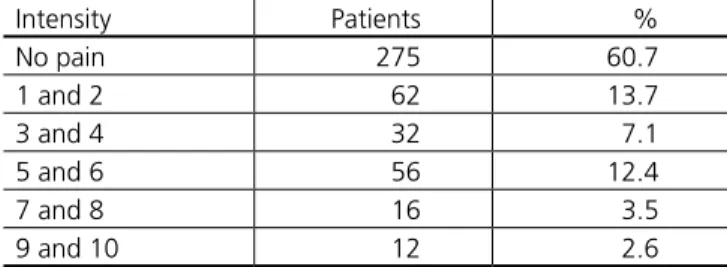
We evaluated 453 patients; 178 (39.29%) of these had CPSP (Table 1). The prevalence of factors related to the event of CPSP was compared between the groups and is shown in Table 2.
The mean age of CPSP patients was 58±10.9 years vs.
62±12.6 years for the control patients. In all, 94 (52.8 %) patients were male and 84 (47.2%), female.
Of the patients who developed CPSP, 120 (67.4%) received internal mammary artery grafts; 116 (65.2%) patients had depression or anxiety disorders at some point in their lives; 29 (16.3%) had hypothyroidism, and 25 (14%) underwent postoperative sternotomy wound complications. With regard to work status, 92 (51.6%) patients were retired; 43 (24.1%) were receiving disability benefits or scheduled for a consultative medical exam; 13 (7.3%) were working; 4 (2.2%) patients were unemployed, and 26 (14.6%) were self-employed.
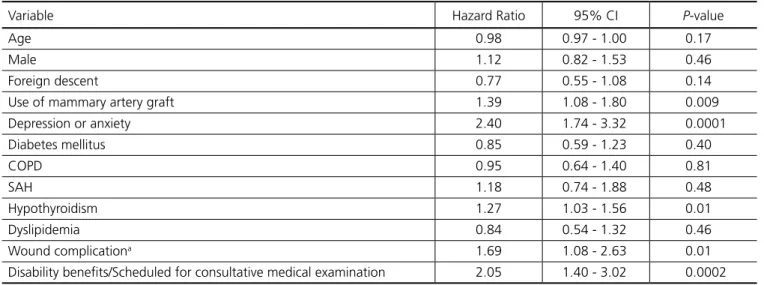
The results of the statistical analysis by Cox regression are presented in Table 3.
The following variables were statistically significant according to Cox model of logistic regression: ITA grafts
(P=0.009; HR=1.39; 95% CI, 1.08 to 1.80); history of use of
Table 1. Pain stratification by intensity from 0 to 10.
Intensity Patients %
No pain 275 60.7
1 and 2 62 13.7
3 and 4 32 7.1
5 and 6 56 12.4
7 and 8 16 3.5
depression or anxiety medication (P=0.0001; HR=2.40; 95%
CI, 1.74 to 3.32); hypothyroidism (P=0.01; HR=1.27; 95% CI,
1.03 to 1.56); surgical wound complication (P=0.01; HR=1.69;
95% CI, 1.08 to 2.63), and patients on disability benefits or scheduled for a consultative medical examination for retirement
(P=0.0002; HR=2.05; 95% CI, 1.40 to 3.02).
Table 2. Factors associated with the development of CPSPa.
Patient’s demographics With Pain
n=178 (39.29)
Without Pain n=275 (60.7)
Age (years)
Mean (SD) 58 (10.9) 62 (12.6)
Gender
Male 94 (52.8) 165 (60)
Female 84 (47.2) 110 (40)
Work status
Retired 92 (51.6) 181 (65.8)
Disability benefits/Scheduled for consultative medical examination 43 (24.1) 30 (10.9)
Working 13 (7.3) 21 (7.6)
Unemployed 4 (2.2) 7 (2.5)
Self-employed 26 (14.6) 36 (13.1)
Foreign descent 53 (19.1) 100 (36.4)
Depression/anxiety 116 (65.2) 79 (28.7)
Comorbidities
Diabetes mellitus 48 (26.9) 58 (21.1)
COPD 16 (8.9) 41 (14.9)
SAH 148 (83.1) 217 (78.9)
Dyslipidemia 125 (70.2) 177 (64.3)
Hypothyroidism 29 (16.3) 34 (12.3)
Use of mammary graft 120 (67.4) 138 (50.2)
Wound complicationb 25 (14) 7 (2.5)
Time between surgery and evaluation (months) 46 (25.8) 65 (23.6)
COPD=chronic obstructive pulmonary disease, SAH=systemic arterial hypertension aResults presented as n (%)
bInfection, mediastinitis, keloid formation, or wound dehiscence
Table 3. Statistical analysis using Cox’s regression model.
Variable Hazard Ratio 95% CI P-value
Age 0.98 0.97 - 1.00 0.17
Male 1.12 0.82 - 1.53 0.46
Foreign descent 0.77 0.55 - 1.08 0.14
Use of mammary artery graft 1.39 1.08 - 1.80 0.009
Depression or anxiety 2.40 1.74 - 3.32 0.0001
Diabetes mellitus 0.85 0.59 - 1.23 0.40
COPD 0.95 0.64 - 1.40 0.81
SAH 1.18 0.74 - 1.88 0.48
Hypothyroidism 1.27 1.03 - 1.56 0.01
Dyslipidemia 0.84 0.54 - 1.32 0.46
Wound complicationa 1.69 1.08 - 2.63 0.01
Disability benefits/Scheduled for consultative medical examination 2.05 1.40 - 3.02 0.0002
COPD=chronic obstructive pulmonary disease; SAH=systemic arterial hypertension
DISCUSSION
According to the literature, the incidence of CPSP ranges
from 17% to 56%[2-5]. This is consonant with the results of the
present sample, which showed an incidence rate of 39.29%. An extensive review of the literature allowed us to conclude that the present study involved the world’s largest number of published cases of patients interviewed face-to-face in CPSP research.
In our study, 67.4% of the patients with CPSP had
received an ITA graft. Mailis et al.[8] described the association
between postoperative thoracic pain and the use of ITA grafts in myocardial revascularization and indicated the possibility of a pain syndrome resulting from the use of that artery. This finding prompted studies aimed at proving the source of the
pain. Eng & Wells[9] reported that the use of ITA grafts resulted
in a high incidence of CPSP compared with venous grafts in revascularization surgeries. Thus, the use of ITA coronary grafts emerged as one of the risk factors for chronic pain. This finding
corroborates those of Alston & Pechon[10], who affirmed that
damage to the intercostal nerves could occur in the dissection of the ITA bed using diathermy.
Intraoperative nerve injury is a major cause of pain manifest postoperatively as hyperalgesia and allodynia, both typical
symptoms of neuropathic pain[11]. Van Gulik et al.[12], in a
prospective cohort study with 146 patients who underwent heart surgery by sternotomy, found that 54.8% of the patients with CPSP had received ITA revascularization (OR=1.27; 95% CI, 0.60-2.70), values that are close to those of our study (67.4 %; HR=1.39; 95% CI, 1.08-1.80). Because OR and HR are effect size measures, both resulting from a regression study, OR and HR values are comparable.
The proportional hazards regression of Cox made it possible to demonstrate the relationship between CPSP and depression
or anxiety disorder. Romano & Turner[13] performed a study
that provided evidence of the association of chronic pain with
depression. Ohayon & Schatzberg[14], in a 2010 study with 3243
patients, informed that 66.3% of the patients with depression reported chronic pain in the most diverse locations. In the present study, 65.2% of the patients with CPSP had depression or anxiety disorder. If analyzed separately, 59.4% among the patients diagnosed with depression or anxiety disorder had chronic pain, which is close to the percentage found in the
Ohayon & Schatzberg[14] study. Nevertheless, data are still
lacking in the literature correlating CPSP to depression or anxiety disorder.
The origin of this type of pain can be explained by a number of theories, with depression or anxiety disorder and pain being related on the most diverse levels, such as the psychological, behavioral, and neurobiological. Neurotransmitters such as serotonin and noradrenaline, both implicated in depressive or anxiety disorders, act on the neurobiological level and play an
important role in the modulation of pain. Osterweis et al.[15]
stated that, on account of the action of neurotransmitters, pain conduction can in fact be altered by depression in the same way as a nociceptive impulse is capable of inducing or exacerbating a given mood. It has been hypothesized that, psychologically, chronic pain is a particular form of somatization in which negative emotions are expressed through physical complaints - including pain. Somatosensory amplification is a
related concept that has been defined as a person’s increased propensity to feel and express pain. Based on the explanation
for these complex mechanisms, Von Korff & Simon.[16] were able
to prove the relationship between pain and depression, which was also found in the present study sample.
About dyslipidemia, all of the patients were using statin. Although statin can cause muscle pain there wasn’t statistical differences in this variable. Hypothyroidism was also more common in the group of patients with CPSP. Many reports can be found in the literature concerning thyroid hormones and their functions; however, studies of their connection with pain are scarce. The thyroid gland has a prominent role in tissue metabolism and development; in addition, the hypothalamic-pituitary-thyroid axis is central to the modulation and
neurotransmission processes in the central nervous system[17].
Aloisi et al.[17], in a pilot study with a group of 200 women
with chronic pain - whose medical history was investigated - found that 19% of them had some degree of thyroid dysfunction. That rate is similar to the overall value of 16.3% found in our analysis.
Despite the number of existing studies, the hypothesized relationship between hypothyroidism and chronic pain is still far from understood. The origin of pain could be neuropathic; this is one of the key points to be elucidated, as neuropathic pain
is prominent in somatosensory system injury[18]. Aminoglycan
deposits surrounding nerves, primary axonal degeneration, and segmental demyelination mechanisms have been proposed for the peripheral nerve dysfunction in hypothyroidism, as
demonstrated in rodents[19]. Another piece of evidence is the low
oxygen consumption and high blood pressure frequently found among hypothyroid individuals, leading to regional hypoxia and eventually to muscle spasms due to the inadequate supply of
blood and nutrients for the muscles[20]. This could explain some
of the mechanisms involving hypothyroidism and pain.
As evidenced by Cox regression, sternal surgical wound complications are associated with the outcome under study. Sternal wound complications increase the risk of CPSP, ranging from superficial infections to sternal instability and
mediastinitis[21]. Marques et al.[22] pointed out that although
wound complications following sternotomy are rare, infection is a threatening occurrence because it could extend to other areas, thus causing future complications.
Einsenberg et al.[4] suggested that sternal surgical wound
infection is one of the likely causes of CPSP. This had already been
indicated by Ottino et al.[23] in 1987. Although there are reports
on the relationship between surgical wound complications and chronic pain, concrete data to evidence this association were still lacking.
Another risk factor for CPSP was identified in the patients who were receiving disability benefits or were scheduled for a consultative medical examination to apply for early retirement by the National Social Security Institute. Although no reports can be found in the literature addressing this specific variable and its relationship to CPSP, similar studies have been developed. In
1995, Rosomoff et al.[24] studied the relationship between the
Authors’ roles & responsibilities
MACC Conception and design; final approval of the manuscript CAT Analysis/interpretation of data; implementation of
projects/experiments; manuscript writing/critical review of its content; statistical analysis; final approval of the manuscript
MDS Study design; manuscript writing/ critical review of its content; final approval of the manuscript
OP Conception and design; implementation of projects/ experiments; final approval of the manuscript
RZG Analysis/interpretation of data; final approval of the manuscript
ESSR Analysis/interpretation of data; implementation of projects/experiments; manuscript writing/critical review of its content; final approval of the manuscript
able to demonstrate a difference between the group receiving benefits and the group without benefits.
Along these lines, Vaccaro et al.[25], in a 1997 retrospective
study with 24 patients who had chronic low back pain, found that 11 out of the 13 patients who had applied for worker’s compensation showed poor outcomes in the management of their chronic pain while 9 of the 11 patients in the group of non-claimants had excellent results. Those authors concluded that although the sample size was small and the study was retrospective, worker’s compensation and litigation claims were strongly associated with worse outcomes in the management of chronic pain.
Our clinical experience shows that the patients who have not yet retired and are not working complain of chronic pain more often, which was evidenced in the present case population. Psychological and behavioral mechanisms may be implicated in the enhanced pain of patients who expect to be granted social security benefits or who fear losing those benefits, since these beneficiaries have to undergo frequent consultative medical exams for years. On the other hand, given that patients with pain are more likely to seek disability benefits, CPSP may be either the cause or the effect in the case of patients on disability benefits.
CONCLUSION
In the case patients of the present study, the factors associated with increased incidence of chronic post-sternotomy pain were: (a) use of ITA grafts; (b) history of depression or anxiety that needed use of antidepressant medication; (c) hypothyroidism; (d) surgical wound complications, and (e) patients on disability benefits or scheduled for a consultative examination.
REFERENCES
1. Macrae WA. Chronic pain after surgery. Br J Anesth. 2001;87(1):88-98. 2. Crombie IK, Davies HT, Macrae WA. Cut and thrust: antecedent sur-gery ad trauma among patients attending a chronic pain clinic. Pain. 1998;76(1-2):167-71.
3. Kalso E, Mennander S, Tasmuth T, Nilsson E. Chronic post-sternoto-my pain. Acta Anaesthesiol Scand. 2001;45(8):935-9.
4. Eisenberg E, Pultorak Y, Pud D, Bar-El Y. Prevalence and character-istics of post coronary artery bypass graft surgery pain (PCP). Pain. 2001;92(1-2):11-7.
5. Lahtinen P, Kokki H, Hynynen M. Pain after cardiac surgery: a pro-spective cohort study of 1-year incidence and intensity. Anesthesiol-ogy. 2006;105(4):794-800.
6. Peters ML, Sommer M, De Rijke JM, Kessels F, Heineman E, Patijn J, et al. Somatic and psychologic predictors of long-term unfavorable outcome after surgical intervention. Ann Surg. 2007;245(3):487-94. 7. Tasmuth T, Estlanderb AM, Kalso E. Effect of present pain and mood
on the memory of past postoperative pain in women treated surgi-cally for breast cancer. Pain. 1996;68(2-3):343-7.
8. Mailis A, Chan J, Basinski A, Feindel C, Vanderlinden G, Taylor A, et al. Chest wall pain after aortocoronary bypass surgery using in-ternal mammary artery graft: a new pain syndrome? Heart Lung. 1989;18(6):553-8.
9. Eng J, Wells FC. Morbidity following coronary artery revascularisation with the internal mammary artery. Int J Cardiol. 1991;30(1):55-9. 10. Alston RP, Pechon P. Dysaesthesia associated with sternotomy for
heart surgery. Br J Anaesth. 2005;95(2):153-8.
11. Steegers MA, Snik DM, Verhagen AF, van der Drift MA, Wilder-Smith OH. Only half of the chronic pain after thoracic surgery shows a neuropathic component. J Pain. 2008;9(10):955-61.
12. Van Gulik L, Janssen LI, Ahiers SJ, Bruins P, Driessen AH, Van Boven JW, et al. Risk factors for chronic thoracic pain after cardiac surgery via sternotomy. Eur J Cardiothorac Surg. 2011;40(6):1309-13. 13. Romano JM, Turner JA. Chronic pain and depression: does the
evi-dence support a relationship? Psychol Bull. 1985;97(1):18-34. 14. Ohayon MM, Schatzberg AF. Chronic pain and major depressive
dis-order in the general population. J Psychiatr Res. 2010;44(7):454-61. 15. Osterweis M, Kleinman A, Mechanic D, eds. Pain and Disability: Clin-ical, Behavioural, and Public Policy, Perspectives. Washington: Na-tional Academy Press; 1987.
16. Von Korff M, Simon G. The relationship between pain and depres-sion. Br J Psychiatr. 1996;168(Suppl 30):101-8.
17. Aloisi AM, Vodo S, Buonocore M. Pain and thyroid hormones. Neurol Sci. 2013;34(9):1501-8.
18. Treede RD, Jensen TS, Campbell JN, Cruccu G, Dostrovsky JO, Griffin JW, et al. Neuropathic pain: redefinition and a grading system for clinical and research purposes. Neurology. 2008;70(18):1630-5. 19. Ferreira AA, Nazario JC, Pereira MJ, Azevedo NL, Barradas PC. Effects
of experimental hypothyroidism on myelin sheath structural organi-zation. J Neurocytol. 2004; 33(2):225-31.
20. Dernellis J, Panaretou M. Effects of thyroid replacement therapy on arterial blood pressure in patients with hypertension and hypothy-roidism. Am Heart J. 2002;143(4):718-24.
21. Cahalin LP, Lapier TK, Shaw DK. Sternal Precautions: Is It Time for Change? Precautions Versus Restrictions - A Review of Litera-ture and Recommendations for Revision. Cardiopulm Phys Ther J. 2011;22(1):5-15.
22. Marques RL, Arnoni AS, Dinkhuysen JJ, Chaccur P, Abdulmassih Neto C, Souza LCB, et al. Manuseio da deiscência do esterno no pós-oper-atório de cirurgia cardíaca. Rev Bras Cir Cardiovasc. 1990;5(2):125-36. 23. Ottino G, De Paulis R, Pansini S, Rocca G, Tallone MV, Comoglio
C, et al. Major sternal wound infection after open-heart surgery: a multivariate analysis of risk factors in 2,579 consecutive operative procedures. Ann Thorac Surg. 1987;44(2):173-9.
24. Rosomoff HL, Fishbain DA, Cutler RB, Steele-Rosomoff R. II. Do chronic pain patients’ perceptions about their preinjury jobs differ as a function of worker compensation and non-worker compensation status? Clin J Pain. 1995;11(4):279-86.