DOI: http://dx.doi.org/10.5007/1980-0037.2015v17n2p205
original article
Licence Creative Commom CC
RBCDH
1 São Judas Tadeu University. Graduate Program in Physical Education. São Paulo, SP. Brazil.
Received: 12 October 2014 Accepted: 14 January 2015
Physical activity and associated factors
among students attending evening classes
Fatores associados à atividade física em adolescentes
estudantes do período noturno
Fabio Luis Ceschini1 Erinaldo Luiz de Andrade1 Aylton Figueira Júnior1
Abstract – he aim of this study was to describe the physical activity level and associated factors among students attending evening classes in public and private schools in a region of the city of São Paulo. he sample was composed of 1,844 adolescents of both sexes aged 15-20 years. hree public and private schools in the city of São Paulo were visited. Daily physical activity level was assessed through International Physical Activity Questionnaire that classiies physical activity level. Physical activity level was divided into insuiciently active (when subject reported less than 300 minutes of moderate to vigorous physical activities per week) and physically active (when subject reported more than 300 minutes of moderate to vigorous physical activities per week). Information related to risk behavior such as smoking and alcohol consumption was collected. Data were analyzed using lo-gistic regression with three levels of data input and p<.05 as signiicance. he prevalence of physically active adolescents was 36.1%. Most active subjects were: A) younger boys with low socioeconomic levels; B) adolescents from private schools; C) adolescents that do not smoke or drink alcoholic beverages; D) those who do not attend formal exercise program; E) those who go to school to perform physical activities on weekends. Adoles-cents attending evening classes tended to be insuiciently active. We believe that school structure, working hours, and distance from home and workplace to school and risk factor should explain these data. Intervention programs could signiicantly contribute to increase the physical activity level among adolescents.
Key words: Adolescents; Evening classes; Motor activity.
ativi-INTRODUCTION
he last decades have been marked by major technological changes world-wide, which may explain in part the decrease in daily physical activity levels in adolescents and young adults both in developed and developing
coun-tries1. Scientiic evidence has demonstrated that reduced physical activity
levels are associated with higher prevalence of chronic diseases, especially when there is combination of health risk behaviors such as tobacco use, alcohol consumption and poor diet, which result in high levels of blood
cholesterol, overweight and type II diabetes2,3. On the other hand, there is
consensus about the relationship between regular physical activity and its
health beneits, regardless of age, ethnicity and social class4,5.
Speciically during adolescence, the combination between low phys-ical activity levels and health risk behaviors are determining factors in the development of the cardiorespiratory, neuromuscular and bone mass
problems during adolescence and adulthood6,7.
Studies have shown various health risk indicators in adolescents, which have led public health authorities worldwide to increase interventions, fol-lowing recommendations of health promotion focusing on regular physical
activity for adolescents supported by the World Health Organization2,
American Heart Association5, Centers for Disease Control and
Preven-tion3, American College of Sports Medicine7 and American Academy of
Pediatrics8. Recommendations suggest that all adolescents should perform
at least 300 minutes of physical activity per week, over ive days of week, 60
minutes per session, preferably at moderate and vigorous intensities2,3,7,8.
In a recent meta-analysis study evaluating Brazilian adolescents, it was demonstrated that the prevalence of physical inactivity (<300 minutes of PA per week) ranged from 5.4% to 91%, according to sex, age, socioeconomic status, alcohol and tobacco use, and this variation was due to the diferent
types of instruments used to measure physical activity levels9.
Although scientiic information available in literature has evaluated the physical activity level among adolescents, only one study was conducted with individuals at this age group in cities with high degree of
urbaniza-tion attending high school evening classes in the city São Paulo10. hus,
quantifying the prevalence of physical activity and associated factors will facilitate health promotion programs with speciic focus, seeking to reduce the prevalence of health risk factors in this population.
he aim of this study was to describe factors associated with physical activity in adolescents attending evening classes in schools in a city with high degree of urbanization.
METHODOLOGICAL PROCEDURES
his study was conducted in 2013 in the city of São Paulo with approxi-mately 1 million adolescents aged 14-20 years distributed in an area of
of a project that has evaluated the physical activity level and health risk behaviors of adolescents in nine regions of São Paulo.
he study sample was deined from the process of selection of public and private schools in the city of São Paulo. Among the 204 schools, 129 were public and 75 private. hree public and three private schools were se-lected. Schools participating in the study were located in northern region of São Paulo according to two selection criteria: 1) public and private schools included in the list of the Department of Education of northern city of São Paulo; 2) schools ofering high school evening classes. Ater the selection of schools, the researchers contacted the heads of each school, explaining the study objectives, instruments, application form and evaluation logistics.
Sample size estimation was performed according to the following pa-rameters: a) expected prevalence of physical activity of 50.0%; 2) sampling error of 3 points; and 3) 95% conidence interval. hus, the minimum sample required was estimated in at least 384 adolescents, and with no response rate of 10%, the sample included 406 adolescents.
he sample selection considered the total number of students enrolled in three private schools (1,567 students) and three public schools (2,434 students). A drawing for two grades in each school was carried out, and all students participated in the study, except if they were not attending high school evening classes, aged over 20 years and did not agree to complete or sign the Free Informed Consent Form, when over 18 or did not have the form signed by their parents or guardians when under 18. Sample included 2,042 adolescents and 198 were excluded. hus, the inal sample included 1,844 adolescents aged 15-20 years (17.1 ± 2.1 years).
Socioeconomic status (SES) was assessed by the classiication
ques-tionnaire of the Brazilian Association of Research Companies (ABEP)12,
using as criteria the educational level of the household head and some consumer goods, allowing categorizing SES in descending order into 5 categories from A to E.
Physical activity level was determined by the International Physical
Activity Questionnaire (IPAQ), short version 8 13. he classiication of
the physical activity level of adolescents considered all physical activities performed at moderate and / or vigorous intensities inside or outside the school in structured or unstructured way for at least 300 minutes per week. hus, adolescents who have accumulated more than 300 minutes per week
of physical activities were classiied as physically active 7.
Health risk behaviors were determined by the “Questionnaire on Health and Nutrition Conditions (2004)” and considered the use of tobacco and
alcohol consumption14. Adolescents who reported smoking at least once a
week were classiied as smokers. Regarding the consumption of any type of alcoholic beverage, contact with this type of drink at least once in the month prior to the evaluation was considered. All questionnaires were answered by self-report method.
using the chi-square test for heterogeneity or linear trend. Multivariate analysis was performed using logistic regression to estimate odds ratios (OR) and conidence intervals (CI 95%) and the input order of variables
according to the hierarchical model of causality previously determined15.
he hierarchical model included three levels of importance of depen-dent variables, and for the independepen-dent variable to remain in the adjusted model, it would have to show signiicance of p <0.20 in the crude analysis. In the irst level, socio-demographic variables (sex, age and skin color); in the second level, socioeconomic variables (SES), type of school (public or private) and paid activity during the weekdays were consider; the third level included behavioral variables (smoking, alcohol consumption and physical activity on the weekends at school). he signiicance level adopted was p <0.05.
he research was approved by the Research Ethics Committee of the São Judas Tadeu University (CAAE – No. 212 655) and protocols followed recommendations of the National Research Ethics System.
RESULTS
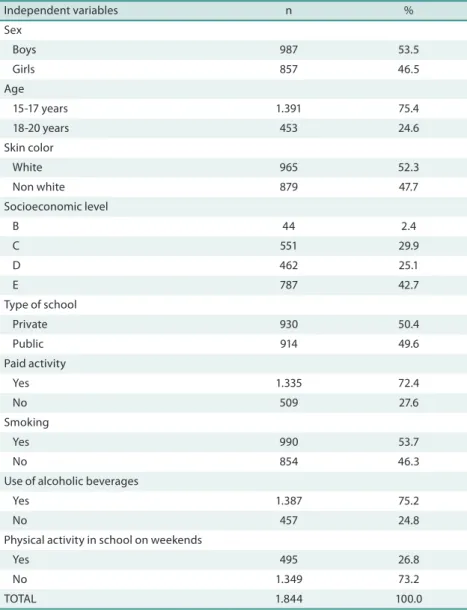
Sociodemographic and behavioral characteristics of adolescents are shown in Table 1. Adolescents who attended evening classes reported paid activity (72.4%), being signiicantly higher among adolescents from public schools compared to those from private schools (p <0.001).
he overall prevalence of tobacco use was 53.7% and was signiicantly higher among adolescents from private schools (56%) compared to those from public schools (46%), p = 0.031 and among boys (68.3%) compared to girls (39.2%), p = 0.031. he overall prevalence of alcohol consumption was 75.2% and was signiicantly higher in adolescents from public schools than in those from private schools. here was no signiicant diference in the prevalence of alcohol consumption in relation to sex (p = 0.452).
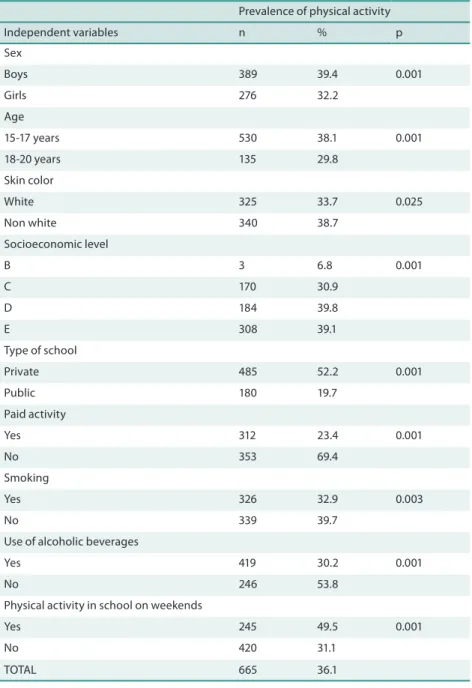
he overall prevalence of physical activity was 36.1% in adolescents at-tending evening classes of public and private schools. he results presented in Table 2 showed that the prevalence of physical activity was signiicantly higher in boys (39.4%) and younger adolescents (38.1%). Regarding socio-economic level, adolescents of levels D (39.8%) and E (39.1%) had higher prevalence of physical activity, although 52.2% of adolescents attending private schools were classiied as physically active. On the other hand, 69.4% of adolescents who reported no paid activity during the week were classiied as active, as well as those who did not report use of tobacco (39.7%) or alcohol consumption (53.9%). he practice of some type of physical activity at school on weekends was positively associated with adolescents classiied as physically active (49.5%).
Table 1. Socio-demographic and behavioral characteristics of adolescent attending high school evening classes in public and private schools of São Paulo.
Independent variables n % Sex
Boys 987 53.5
Girls 857 46.5
Age
15-17 years 1.391 75.4
18-20 years 453 24.6
Skin color
White 965 52.3
Non white 879 47.7
Socioeconomic level
B 44 2.4
C 551 29.9
D 462 25.1
E 787 42.7
Type of school
Private 930 50.4
Public 914 49.6
Paid activity
Yes 1.335 72.4
No 509 27.6
Smoking
Yes 990 53.7
No 854 46.3
Use of alcoholic beverages
Yes 1.387 75.2
No 457 24.8
Physical activity in school on weekends
Yes 495 26.8
No 1.349 73.2
TOTAL 1.844 100.0
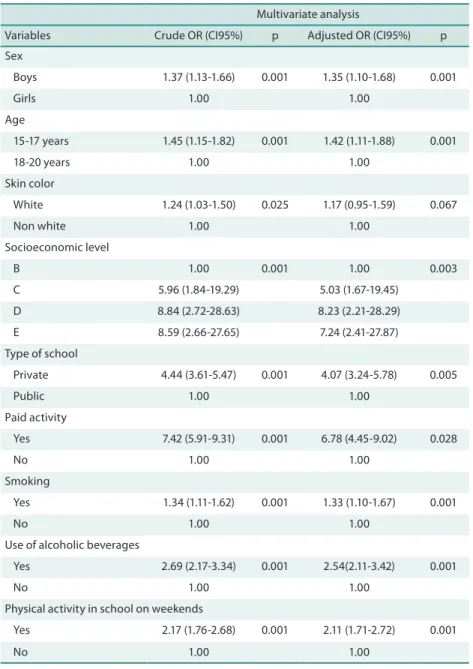
he adjusted model showed that students from private schools were more active than those from public schools (OR: 4.07 [CI 95%: 3.24-5.78]). Adolescents from socioeconomic levels D and E were 7 and 8 times more likely to achieve the weekly physical activity recommendation of health proportion compared to those from socioeconomic level B.
Table 2. Prevalence of physical activity according to categories of independent variables of adolescents attending evening classes in public and private schools of São Paulo.
Prevalence of physical activity Independent variables n % p Sex
Boys 389 39.4 0.001
Girls 276 32.2
Age
15-17 years 530 38.1 0.001 18-20 years 135 29.8
Skin color
White 325 33.7 0.025
Non white 340 38.7
Socioeconomic level
B 3 6.8 0.001
C 170 30.9
D 184 39.8
E 308 39.1
Type of school
Private 485 52.2 0.001
Public 180 19.7
Paid activity
Yes 312 23.4 0.001
No 353 69.4
Smoking
Yes 326 32.9 0.003
No 339 39.7
Use of alcoholic beverages
Yes 419 30.2 0.001
No 246 53.8
Physical activity in school on weekends
Yes 245 49.5 0.001
No 420 31.1
TOTAL 665 36.1
DISCUSSION
he regular practice of physical activities is important during adolescence because it promotes many health beneits, especially in physiological
responses related to growth, development and human behavior6,7. hese
beneits may relect a lower prevalence of chronic diseases and behavioral disorders in adulthood.
According to Wong and Leatherdale16, low prevalence of physical
ac-tivity in adolescence is related to risk behaviors such as increased body fat
and increased risk of developing cardiovascular disease at the adult age17
adolescence is associated with health risk behaviors, which can be associ-ated with the development of chronic diseases at early ages.
his study showed low prevalence of physical activity (36.1%) in adoles-cents attending evening classes of public and private schools in the northern region of the city of São Paulo and also that demographic, behavioral and social factors are associated with this complex phenomenon.
Epidemiological studies focusing on the prevalence of physical activ-ity and physical inactivactiv-ity are important to identify risk factors associated with outcomes, allowing the development of health promotion programs with speciic objectives based on public health policies.
Few studies on the prevalence of physical activity in adolescents of
large urban centers of Brazil have been found in literature23-26. On the other
Table 3. Crude and adjusted Odds Ratio (OR) for the prevalence of physical activity according to categories of independent variables of adolescents attending evening classes in public and private schools of São Paulo
Multivariate analysis
Variables Crude OR (CI95%) p Adjusted OR (CI95%) p Sex
Boys 1.37 (1.13-1.66) 0.001 1.35 (1.10-1.68) 0.001
Girls 1.00 1.00
Age
15-17 years 1.45 (1.15-1.82) 0.001 1.42 (1.11-1.88) 0.001 18-20 years 1.00 1.00
Skin color
White 1.24 (1.03-1.50) 0.025 1.17 (0.95-1.59) 0.067
Non white 1.00 1.00
Socioeconomic level
B 1.00 0.001 1.00 0.003
C 5.96 (1.84-19.29) 5.03 (1.67-19.45) D 8.84 (2.72-28.63) 8.23 (2.21-28.29) E 8.59 (2.66-27.65) 7.24 (2.41-27.87) Type of school
Private 4.44 (3.61-5.47) 0.001 4.07 (3.24-5.78) 0.005
Public 1.00 1.00
Paid activity
Yes 7.42 (5.91-9.31) 0.001 6.78 (4.45-9.02) 0.028
No 1.00 1.00
Smoking
Yes 1.34 (1.11-1.62) 0.001 1.33 (1.10-1.67) 0.001
No 1.00 1.00
Use of alcoholic beverages
Yes 2.69 (2.17-3.34) 0.001 2.54(2.11-3.42) 0.001
No 1.00 1.00
Physical activity in school on weekends
Yes 2.17 (1.76-2.68) 0.001 2.11 (1.71-2.72) 0.001
hand, several epidemiological studies with adolescents from other countries have been found. For example, the World Health Organization published a report with global data containing the prevalence of physical activity among 162,306 adolescents aged 11-15 years. he results showed low prevalence
of physical activity (34%), being higher in boys (40%) than in girls (27%)19.
Butcheret al.20 evaluated 6,125 adolescents aged 14-17 years of the 100
most populous cities in the United States and found a prevalence of
physi-cal activity of 48%, 57% for boys and 40% for girls. Janssen et al.21 found
a prevalence of physical activity of 50% in 7,235 young Canadians, 55%
for boys and 45% for girls. Chen et al.22 evaluated 2,235 adolescents aged
12-18 years in Taiwan and found prevalence of physical activity of 28%, 33% for boys and 25% for girls.
In Brazil, data on the prevalence of physical activity in urban areas
of João Pessoa - PB23, Curitiba –PR24, Pelotas - RS25 and Sao Paulo - SP26
have shown overall prevalence of physical activity of 50.2%, 58.2 %, 48.2% and 62.5%, respectively. All of the above studies have shown that boys had higher prevalence of physical activity than girls.
Speciically in São Paulo, which is the largest city in Brazil, with the highest population density and economic potential, there are few studies showing the prevalence of physical activity in adolescents. Studies con-ducted by our research group with adolescent attending morning classes have found low prevalence of physical activity and high prevalence of physical inactivity. In a study with 1,738 adolescents attending private high schools in southern city of São Paulo showed that 53.8% of individu-als did not meet the minimum recommendations related to maintaining
health through physical activity31. In another study performed with 3,845
adolescents from public schools in all regions of São Paulo, the authors found prevalence of physical inactivity of 62.5%, but this study included
only adolescent attending morning classes26.
his study found low prevalence of physical activity in adolescents at-tending evening classes. On the other hand, there is only one study found in literature evaluating the relationship between shit (morning and even-ing) that adolescents attended classes and physical activity level. his study was conducted in only one public school in northern city of São Paulo and concluded that students attending evening classes showed higher prevalence of physical inactivity, also showing that 87.3% of students did not meet the minimum recommendations of physical activity for health promotion and
that 47.9% of students in the morning shit met these recommendations10.
were found in a study with American adolescents who performed physical activities at school [OR CI 95%: 0.82 (0.71-0.95)], in recreation centers [OR CI 95%: 0.82 (0.71-0.95)] or voluntary participation in sport modalities [OR CI 95%: 0.61 (0.54-0.69)], and physical activity level was a protective factor in relation to tobacco use. Alcohol consumption was lower among physically active adolescents regarding the weekly frequency of ive days a week and moderate intensity, suggesting a protective efect of physical
activity in relation to alcohol consumption [OR CI 95%: 0.84 (0.74 -0.96])18.
In a recent study, Davis et al.29 evaluated the economic impact of
physi-cal inactivity and found that between 1 and 4% of total direct health ex-penditures are associated with physical inactivity, reaching approximately 8% annually. he authors concluded that the best investment in terms of health promotion is to encourage the practice of regular physical activity and that the school environment plays a central role in the adoption of an active lifestyle, especially for adolescents.
In this context, the school structure can be exploited as an incentive to
the adoption of a healthy lifestyle in children and adolescents5, as recently
demonstrated in intervention programs, in which the school structure contributed to an increase from 2 to 11 times the likelihood of an individual
to become more active30.
Adolescents who reported the performance of physical activities in private schools on weekends were more active than those who did not use the school structure. he population evaluated in this study was composed of adolescents enrolled in evening classes, 72.4% reported paid activity, with daily workload of at least six hours, which together with the total hours remaining in school and less free time to practice physical activity on weekdays, may have contributed for them not to reach 300 minutes per week of physical activities. hus, the possibility of using the school structure can signiicantly contribute with increasing physical activity level of the study group.
he scarcity of data on the prevalence of physical activity in adolescents from public and private schools in the same region of São Paulo will assists in future comparisons, especially in the analysis of cultural, social and economic characteristics of this region, which shows high level of social and economic development. Further studies in other regions of the city of São Paulo will propose health intervention strategies aimed to increase physical activity levels, thus contributing to existing preventive actions.
CONCLUSIONS
hus, it could be hypothesized that increased physical activity levels among adolescents are associated with: A) interdisciplinary discussion about the health beneits of the regular practice of physical activities in order to increase the knowledge of students in all high school grades in the evening shit; B) promoting educational activities on how to increase the daily physical activity level, particularly in unstructured and daily life activities, could help this group of individuals; C) the use of the structure of existing physical activity promotion programs through partnerships seems to be an important strategy in this context; D) discussion and im-plementation of public policies for children and adolescents.
REFERENCES
1. Blair SN, LaMonte MJ, Nichaman MZ. he evolution of physical activity recom-mendations: how much is enough? Am J Clin Nutr 2004;79(suppl):91S-20S. 2. World Health Organization. Global Recommendations on Physical
Activ-ity for Health. Geneva; 2010; Available from: http://whqlibdoc.who.int/publica-tions/2010/9789241599979_eng.pdf. [2014 jul 5].
3. Center for Disease Control and Prevention. State Indicator Report on Physical Activity, 2010; Atlanta, GA: U.S. Department of Health and Human Services; 2010. Available from: < http://www.cdc.gov/physicalactivity/downloads/PA_State_Indi-cator_Report_2010.pdf> [2014 ago 5].
4. Haskell, WL, I-Min L, Pate RR, Powell KE, Blair SN, Franklin BA, et al. Physical activity and public health: Updated recommendation for adults from the Ameri-can College of Sports Medicine and the AmeriAmeri-can Heart Association. Circulation 2007;39(9):1423-34.
5. Pate RR, Davis MG, Robinson TN, Stone EJ, McKenzie TL, Young JC. Promotion physical activity in children and youth: a leadership role for schools: a scientiic statement from the American Heart Association Council on Nutrition, Physical Activity, and Metabolism (physical activity committee) in collaboration with the Councils on Cardiovascular Disease in the Young and Cardiovascular Nursing. JAHA 2006;114(11): 1214-24.
6. Parsons TJ, Power C, Logan S, Summerbell CD. Childhood predictors of adult obe-sity. A systematic review . Int J Obes Relat Metab Disord 1999; 23(Suppl 8): S1-107. 7. Strong WB, Malina RM, Blimkie CJR, Daniels SR, Dishman RK, Gutin B, et al.
Evidence based physical activity for school-age youth. J Pediatr 2005;146(6):732-7. 8. American Academy of Pediatrics. Council on Sports Medicine and Fitness and
Council on School Health. Active Health Living: prevention of childhood obesity through increased physical activity. Pediatrics 2006;117(5):1834-42.
9. Barufaldi LA, Abreu GA, Coutinho ESF, Bloch KV. Meta-analysis of the preva-lence of physical inactivity among Brazilian adolescents. Cad Saúde Pública 2012;28(6):1019-32.
10. Ceschini FL, Florindo A, Benício MHA. Nível de atividade física em adolescentes de uma região de elevado índice de vulnerabilidade juvenil. Rev Bras Ciên Mov 2007;15(4):67-78.
11. Instituto Brasileiro de Geograia e Estatística. Produto Interno Bruto (PIB) dos Municípios 2013. Disponível em: <http://www.ibge.gov.br/home/estatistica/popu-lacao/condicaodevida/indicadoresminimos/ sinteseindicsociais2010/SIS_2010.pdf >. [2014 jul 2].
12. Associação Nacional de Empresas de Pesquisa. Critério de classiicação econômica Brasil. São Paulo: Associação Nacional de Empresas de Pesquisa. 2003; Available from: < http://www.abep.org > [2014 jul 2].
Corresponding author
Fabio Luis Ceschini: Universidade São Judas Tadeu. Departamento de Pós Graduação Rua Taquari, 546, Moóca.
CEP: 03166-000 - São Paulo, SP, Brasil. Email: [email protected] 14. Ministério da Saúde. Questionário de Avaliação das Condições de Saúde, Nutrição
e Atividade Física. 2004, portaria n° 2,246, DOU n° 2, seção 1, p:28-29, Brasil. Available from: http://portalsaude.saude.gov.br/ [[2014 abr 5].
15. Victora CG, Huttly SR, Fuchs SC, Olinto MT. he role of conceptual frameworks in epidemiological analysis: a hierarchical aprroach. Int J Epidemiol 1997, 26(1):224-7. 16. Wong SL, Leatherdale ST. Association between sedentary behavior, physical
activ-ity, and obesity: inactivity among active kids. Prev Chronic Dis 2009;6(1):A26. 17. Kvaavik E, Klepp KI, Tell GS, Meyer HE, Batty D. Physical itness and physical
activity at age 13 years as predictors of cardiovascular disease risk factors at ages 15,25,33 and 40 years: extended follow-up of the Oslo youth study. Pediatrics 2009;123(1):80-6.
18. Nelson MC, Gordon-Larsen P. Physical activity and sedentary behavior pat-terns are associated with selected adolescent health risk behaviors. Pediatrics 2006;117(4):1281-90.
19. World Health Organization. Young people’s health in context. Health behavior in school-aged children (HBSC) study: international report from the 2001\2002 survey. Denmark: World Health Organization; 2004. Available from: < http://www.who.int/ immunization/hpv/target/young_peoples_health_in_context_who_2011_2012. pdf> [2014 jul 2].
20. Butcher K, Sallis JF, Mayer JA, Woodruf, S. Correlates of physical activity guideline compliance for adolescents in 100 U.S. Cities. J Adolesc Health 2008; 42(4): 360-8. 21. Janssen I, Katzarzyk PT, Boyce WF, King MA, Pickett W. Overweight and obesity
in Canadian adolescents and their associations with dietary habits and physical activity patterns. J Adolesc Health 2004; 35(5): 360-7.
22. Chen LJ, Haase AM, Fox KR. Physical activity among adolescents in Taiwan. Asia Pac J Clin Nutr 2007; 16(2): 354-61.
23. Farias Júnior JC, Lopes AS, Mota J, Hallal PC. Prática de atividade física e fatores associados em adolescentes no Nordeste do Brasil. Rev Saúde Pública 2012;46(3):505-15.
24. Fermino RC, Rech CR, Hino AAF, Anes CRR, Resi RS. Atividade física e fatores associados em adolescentes do ensino médio de Curitiba-PR. Rev Saúde Pública 2010;44(6):986-95.
25. Dumith SC, Domingues MR, Gigante DP, Hallal PC, Menezes AMB, Kohl RW. Prevalence and correlates of physical activity among adolescents from Southern Brazil. Rev Saúde Pública 2010;44(3):457-67.
26. Ceschini FL, Andrade DR, Oliveira LC, Araújo JF, Matsudo VKR. Prevalence of physical inactivity and associated factors among high school students from state’s public schools. J Pediatr 2009;85(4):301-6.
27. Ceschini FL e Figueira Júnior AJ. Prevalência de atividade física insuiciente e fatores associados em adolescentes. Rev Bras Ciên Mov 2008;16(13):15-22.
28. Croezen S, Visscher TL, Ter Bogt NC, Veling ML, Haveman-Nies A. kipping breakfast, alcohol consumption and physical inactivity as risk factors for over-weight and obesity in adolescents: results of the E-MOVO project. Eur J Clin Nutr 2009; 63(3):405-12.
29. Davis JC, Verhagen E, Bryan S, Liu-Ambrose, Borland J, Buchner D, et al. 2014 Consensus Statement from the first Economics of Physical Inactivity Consensus (EPIC) Conference (Vancouver). Br J Sports Med. 2014; 48(12):947-51.