w w w. s b f g n o s i a . o r g . b r / r e v i s t a
Original
article
Combined
structure-
and
ligand-based
virtual
screening
to
evaluate
caulerpin
analogs
with
potential
inhibitory
activity
against
monoamine
oxidase
B
Vitor
Prates
Lorenzo
a,b,
José
Maria
Barbosa
Filho
a,
Luciana
Scotti
a,
Marcus
Tullius
Scotti
a,∗aProgramadePós-graduac¸ãoemProdutosNaturaiseSintéticosBioativos,UniversidadeFederaldaParaíba,JoãoPessoa,PB,Brazil bInstitutoFederaldoSertãoPernambucano,Petrolina,PE,Brazil
a
r
t
i
c
l
e
i
n
f
o
Articlehistory: Received30April2015 Accepted9August2015
Availableonline19September2015
Keywords: Alzheimer’sdisease Caulerpin Moleculardocking MonoamineoxidaseB Virtualscreening
a
b
s
t
r
a
c
t
Naturalmarineproductscanhelpincreasethequalityoflifeinpatientswithneurologicaldiseases.A
largenumberofmarineproductsactagainstAlzheimer’sdiseasethroughvaryingpathways.
Accord-ingtostructure-andligand-basedanalyses,caulerpin,analkaloidprimarilyisolatedfromthegenus
Caulerpa,possessesactivity againstmonoamine oxidaseB. Topredicttheactivity ofcaulerpin, we
employedVolsurfdescriptorsandthemachinelearningRandomForestalgorithminparallelwitha
structure-basedmethodologythatincludedmoleculardocking.Usingcaulerpinasaleadcompound,
adatabasecontaining108 analogswasevaluated,andninewereselectedasactive.Thestructures
selectedasactiveexhibitedpolarandnon-polarsubstitutionsonthecaulerpinskeleton,whichwere
relevantfortheiractivity.Dragonconsensusdrug-likescoringwasappliedtoidentifytheactiveanalogs
thatmightserveasgooddrugcandidates,andtheentiregrouppresentedsatisfactoryperformance.
Theseresultsindicatethe possibilityof usingtheseanalogsaspotentialleadsagainstAlzheimer’s
disease.
©2015SociedadeBrasileiradeFarmacognosia.PublishedbyElsevierEditoraLtda.Allrightsreserved.
Introduction
Alzheimer’sdisease(AD)hasemergedasthemostprevalent
typeoflate-lifedisorderinhumans,afflicting45%ofpeopleover 85yearsold(Liuetal.,2013).Thisburdenisincreasingastheelderly
populationcontinuestogrow. Ingeneral,ADisassociatedwith
neuronalloss,synapticdysfunctionandfunctionalabnormalities ofmitochondrialstructures(LaFerlaandOddo,2005).Inthe litera-ture,differentmethodsofcontrollingADhavebeenreported,which offeralternativemechanismsofaction(Tianetal.,2014;Riediger etal.,2009).InanattempttoimprovethequalityoflifeforAD
patients,numerousstudiesarebeingconductedtodevelopmore
efficientdrugs.
Themarineenvironmentcovers70%oftheearth’ssurfaceand
providesa fascinating variety of biodiversity that exceeds that
of the terrestrial environment. The biodiversity of the marine
∗ Correspondingauthor.
E-mail:[email protected](M.T.Scotti).
environment and its associated chemical diversity constitute
a practically unlimited resource of new active substances that
may potentially be developed into novel bioactive products
(Souza et al., 2009a,b). The exploration of this biodiversity to
identifynewchemical compounds hasonlyjust begun. Marine
organisms synthesize a plethora of small molecules with
fas-cinating chemical structures and potent biological properties.
The variety of marine organisms that have been discovered
to date offers a dramatic potential pool of resources for drug
discovery,andmanynewdiscoveriesremaintobemade(
Bidon-Chanaletal.,2013;Schumacheretal.,2011;GerwickandMoore,
2012).
Naturalmarineproductsplayanimportantroleinincreasing
thequalityoflifefor patientswithneurologicaldiseases.These productsincludefattyacids(suchasn-3fattyacid,whichdelays theonsetofAD),terpenes,alkaloidsandvaryingothersecondary metabolites,allofwhichactthroughdifferentpathways(Choietal.,
2007;GulandHamann,2005).
Severalphlorotannins,suchaseckstolonol[639514-05-9](1), eckol[99798-74-7](2)andphlorofucofuroeckol-A[128129-56-6]
http://dx.doi.org/10.1016/j.bjp.2015.08.005
(3), may represent useful nutraceuticals for the prevention of ADduetotheirinhibitoryactivitiesagainstacetylcholinesterase
(AChE)andbutylcholinesterase(BChE),whichhavebeen
demon-stratedinvitro(ThomasandKim,2011;Yoonetal.,2009).Hexane extractsofTetraselmischuii,ChlorellaminutissimaandRhodomonas salina also exhibited cholinesterase inhibitory activity toward
AChE (Custódio et al., 2012). Additional kinase inhibitors that
are useful for the treatment of AD include steroidal alkaloid
4-acetoxy-plakinamine B [1003045-50-8] (4) (Langjae et al.,
2007), sargaquinoic acid [70363-87-0] (5) and sargachromenol
[70363-89-2];thelattertwoaremeroditerpenes(6)(Choietal.,
2007).Sargaquinoicacidwas foundtopotently inhibit BChE, a
noveltargetforthetreatmentofAD,withpotencycomparableto orgreaterthantheanticholinesterasesthatareincurrentclinical
use (Mayer et al., 2011). Potential AChE inhibitors have been
discoveredinextractsfromLatrunculialendenfeldiandLatrunculia bocageisponges(Turketal.,2013).
6 5 3
1 2
4
Additionalstudieshavereporteddiscoveriesofnovelglycogen synthasekinase3(GSK-3)inhibitorsinnaturalmarineproducts (Jinet al.,2006).Examplesoftheseactivemarine-derived com-poundsincludepalinurim[71947-64-3](7)(Bidon-Chanaletal., 2013), lamellarin E [115982-19-9] (8) (Baunbaek et al., 2008), hymenialdisine [82005-12-7] (9) (Meijer et al., 2000),
merid-ianine E [213473-03-1] (10) (Radwan and El-Sherbiny, 2007),
manzamineA [104196-68-1](11)(Hamannet al.,2007)and
6-Bromoindirubin[200273-66-1](12)(Meijeretal.,2003).Palinurin,
afuranosesquiterpene,inhibitsGSK-3activitythrougha novel
mechanismofaction(Bidon-Chanaletal.,2013).Debdaband col-laborators havealso reportedthekinaseinhibitory activitiesof
derivativesofthemarinealkaloidleucettamineB[147395-96-8]
(13)(Debdabetal.,2010).
7
9 10
12 13
11 8
TumescenamideA[1335094-05-7](14)inducesreportergene
expressionunderthecontroloftheinsulin-degradingenzyme(IDE)
promoter,whichsuggeststhatitmayhavepromiseasapotential
treatment for AD (Motohashi et al.,2010). The
3,5-dibromo-4-methoxyphenyl-pyruvicacid[1356930-31-8](15), isolatedfrom
sponge Callyspongia sp., is able to modulate apolipoprotein E
(ApoE) (Tian et al., 2014). Dragmacidin D [142979-34-8] (16)
inhibits neural nitric oxide synthase, which may prove to be
an option for the treatment of Huntington’s, Parkinson’s and
Alzheimer’sdiseases(Yangetal.,2002).
14 15
16
Monoamineoxidase(MAO)isaFAD-containing enzymethat
catalyzestheoxidativedeaminationofavarietyofbiogenicand
xenobioticaminesincludingmonoamineneurotransmitterssuch
asserotonin,noradrenalineanddopamine(Bindaetal.,2011;Bolea etal.,2013).MAOplaysanimportantroleinthemetabolismof
several neurotransmittersand could therefore be useful in the
MAOactivityhelpsto ensurethat neuron firingrates through-outthebodyremainwithinhomeostaticlimits.MAO-Binhibitors, suchasselegiline(R-(−)-deprenyl)[14611-52-0](17)and
rasagi-line[161735-79-1](18),areusefulcompoundsforthesymptomatic treatmentofParkinson’sandAlzheimer’sdiseases(Zhuetal.,2008;
Choiand Choi,2015), astheyincrease concentrationsof
synap-ticdopaminebyblockingits degradation(Fernandezand Chen,
2007).AnotherMAO-Binhibitor,safinamide[133865-89-1](19),is currentlyundergoingphaseIIIclinicaltrialsasanadjuvantin
com-binationwithadopamineagonistorlevodopa(Schapina,2011).
MAO-Binhibitorshavealsobeenextensivelystudiedfortheir pos-sibleneuroprotectiveordisease-modifyingactions,andthereisan
abundantamountofevidencethatMAO-Binhibitorshavesome
neuroprotectiveproperties(Patiletal.,2013).
17 18 19
Caulerpin [26612-48-6](20, CLP001) isa bisindole alkaloid thatisprimarilyisolatedfromgreenalgaeofthegenusCaulerpa
(Souzaetal.,2009a,b);ithasanextraeight-memberringbetween
thetwo indole rings,which areincorporated directly withthe
carbonylgroup.Our researchgrouphasreportedthatcaulerpin
hasanon-selectivespasmolyticeffectandthatthiseffectisduein parttotheinhibitionofCa2+influxthroughvoltage-gatedcalcium channels(Cav)(Cavalcante-Silvaetal.,2013)andnoticedforthe firsttimethatcaulerpinhasshowedaconsiderableantinociceptive andanti-inflammatoryactivities(Souzaetal.,2009a,b).
20
OCH3
10
11 1
11'
10'
9' 8' 2' 1' 7a'
3a' 3'
H3CO
O NN
NH O
Computer-aideddrugdesign(CADD)hasbecomean
indispens-abletool tothepharmaceuticalindustryand academiaoverthe
lastdecade(LillandDanielson,2011)andhasbeenemployed dur-ingvariousstagesofthedrug-designprocess.Initially,thismethod focusesonreducingtheoverallnumberofpossibleligands;inthe laterstages,duringlead-optimization,theemphasisshiftsto reduc-ingexperimentalcostsandthedurationoftimerequiredtomake adiscovery.Appliedligand-basedvirtualscreeningusingVolsurf
andMolegrodescriptorsandarandomforestalgorithm(amethod
ofmachinelearning)wereincludedinthestructure-basedvirtual screening.
Once AD evidence an activation of inflammatory pathways
(Wyss-CorayandRogers,2012)andcaulerpinpresentconsiderable
anti-inflammatoryactivity,inthisstudy,wecreatedadatabaseof caulerpinanalogsandevaluateditwithaligand-basedmodelthat includedmoleculardescriptors,aswellaswithastructure-based
approachthatincludeddockingstudiesofmonoamineoxidaseB
(MAO-B)inhibitors.
Materialsandmethods
Database
From the ChEMBL database, we selected a diverse set of
1523structures(https://www.ebi.ac.uk/chembl/),whichhadbeen
screened (in vitro) to inhibit the single protein of human
monoamineoxidaseB(SupportingInformationTableS1).The com-pounds were classified using values of -logIC50 (mol/l)=pIC50, whichledustoassign696actives(IC50≥6)and827in-actives
(IC50<6).Inthiscase,IC50representedtheconcentrationrequired
for 50% inhibition of thesingle protein of human MAO-B. The
database that included caulerpin(CLP001) and its 108 analogs
(CLP002-109)wasselectedtobuildinourdatabase.Forall struc-tures,SMILEScodeswereusedasinputdatainaMarvin14.9.1.0,
2014, ChemAxon (http://www.chemaxon.com). We used
Stan-dardizersoftware[JChem14.9.1.0,2014;ChemAxon(http://www.
chemaxon.com)]tocanonizestructures,addhydrogens,perform
aromatic formconversions, clean the moleculargraph in three
dimensions,andsavecompoundsinsdfformat(Imreetal.,2003).
Volsurfdescriptors
Three-dimensional structures (3D) were used as input data
in the Volsurf+ program v. 1.0.7 (Cruciani et al., 2000) and
were subjected to molecular interaction fields (MIF) (Cruciani
etal.,2000)togeneratedescriptorsusingthefollowingprobes:
N1 (amide nitrogen-hydrogen bond donor probe), O (carbonyl
oxygen-hydrogenbondacceptorprobe),OH2(waterprobe),and
DRY(hydrophobicprobe).Additionalnon-MIF-deriveddescriptors
weregeneratedtocreateatotalof128descriptors(Crucianietal., 2000).Volsurfdescriptorshavebeenpreviouslyusedtopredictthe inhibitoryactionsofflavonoidsagainstenzymes(Scottietal.,2011).
Drug-likescore
Structureswere usedas inputdata in DRAGONProfessional
version6.0.30togenerateDragondrug-likeconsensus,whichwas
calculatedasameanof7drug-likescoresthatwerebasedonthe following:Lipinski’srules(Lipinskietal.,2001);thedrug-likefilter producedbyOpreaetal.(2000);thedrug-likescoreimplemented byWalters(WaltersandMurcko,2002);thedrug-likefilter pro-ducedbyChen(Chenetal.,2005);thedrug-likescorethat was basedontworulesproposedbyZheng (Zhengetal.,2005);the drug-likescorethatwasproposedbyRishton(Rishton,2003);and
thedrug-likefilterimplementedbyVeberandco-workers(Veber
etal.,2002).
Models
Knime2.10.0software(KNIME 2.10.0theKonstanz
Informa-tionMinerCopyright,2003–2014,www.knime.org)(Bertholdetal.,
2007) was used to perform all of the following analyses. The
descriptorsandclassvariableswereimportedfromtheVolsurf+
program,v.1.0.7,andthedataweredividedusingthe “Partition-ing”nodewiththe“stratifiedsample”optiontocreateatraining
setandatestset,encompassing80%and20%ofthecompounds,
respectively.Althoughthecompoundswereselectedrandomly,the
sameproportionofactiveand inactivesampleswasmaintained
inbothsets.Forinternalvalidation,weemployedcross-validation usingtenrandomlyselected,stratifiedgroups,andthedistributions
accordingtoactivityclassvariableswasfoundtobemaintained
inallvalidationgroupsandinthetrainingset.Descriptorswere selected,andamodelwasgeneratedusingthetrainingsetandthe
RandomForestalgorithm(RF)(Breiman,2001),usingtheWEKA
Table1
Summaryoftraining,internalcross-validation,testresults,andcorrespondingmatchresults,whichwereobtainedusingtheRFalgorithmonthetotalsetof1523compounds (1218wereinthetrainingsetand305inthetestset).
Training Validation Test
Samples Match %Match Match %Match Samples Match %Match
Active 557 556 99.8 393 70.6 139 115 82.7
Inactive 661 659 99.7 662 74.5 166 142 85.5
Overall 1218 1215 99.8 886 72.7 305 257 84.3
followingsettings:numberoftreestobuild=50,seedforrandom number generator=1, for training and internal cross-validation sets.Theinternalandexternalperformancesoftheselected mod-els were analyzed for sensitivity (true positive rate, i.e., active rate),specificity(truenegativerate,i.e.,inactiverate),andaccuracy (overallpredictability).Additionally,thesensitivityandspecificity oftheReceiverOperatingCharacteristic(ROC)curvewasfindto describetrueperformance withmoreclaritythanaccuracy.The plottedROCcurveshowsthetruepositive(active)rateeither ver-susthefalsepositiverates,i.e.sensitivityversus(1-specificity).In atwo-classclassification, whena variablethatis being investi-gatedcannotbedistinguishedbetweenthetwogroups(i.e.,when there is nodifferencebetween thetwo distributions),the area under theROC curve equals 0.5, which is to saythat theROC curvewill coincide withthediagonal. Whenthere is a perfect separationofvaluesbetweentwogroups(i.e.,nooverlappingof distributions),theareaundertheROCcurve equals1,which is tosaythattheROCcurvewillreachtheupperleftcornerofthe
plot(Hanley andMcNeil,1982).Additionally, wecalculatedthe
Mathewscorrelationcoefficient,whereinavalueof1representsa perfectprediction,avalueof0representsarandomprediction,and avalueof−1representstotaldisagreementbetweenpredictionand
observation.
Docking
ThestructureofMAO-Bincomplexwithrosiglitazone(PDBID
4A7A)(Bindaetal.,2012)wasdownloadedfromtheProteinData
Bank (http://www.rcsb.org/pdb/home/home.do). Alkaloid
struc-tures were submitted to moleculardocking using theMolegro
VirtualDocker,v.6.0.1(MVD)(ThomsenandChristensen,2006).
Allofthewatercompoundsweredeletedfromtheenzyme
struc-ture,and theenzyme andcompound structures wereprepared
usingthesamedefaultparametersettingsinthesamesoftware
package(Scorefunction:MolDockScore;Ligandevaluation:
Inter-nalES, Internal HBond,Sp2–Sp2Torsions,all checked;Number
ofruns:10runs;Algorithm:MolDockSE;MaximumInteractions:
1500;Max.populationsize:50;Max.steps:300;Neighbordistance factor:1.00;Max.numberofposesreturned:5).Thedocking pro-cedurewasperformedusingaGRIDof15 ˚Ainradiusand0.30in resolutiontocovertheligand-bidingsiteoftheMAO-Bstructure. Templateswithfeaturesexpectedtoberelevantforligandbinding
(rosiglitazone)weregeneratedtoperformdocking.TheMoldock
score[GRID]algorithm wasusedasthescorefunction,andthe
Moldocksearchalgorithmwasused(Thomsenand Christensen,
2006).
Resultsanddiscussion
TheVolsurf(v1.0.7)programgenerated128descriptorsthat,
togetherwiththedependentvariables(binaryclassification)that describedwhetherthecompoundswereactive(A)orinactive(I), wereusedasinputdataintheKnimeprogram(v.2.10.0)togenerate
theRandomForestmodel.Forall1523compoundsthatcomprised
0.1 0.1 0.2 0.3 0.4 0.5 0.6 0.7 0.8 0.9 1.0
0.2 0.3 0.4 0.5 0.6 0.7 0.8
AUC=0.846
0.9 1.0
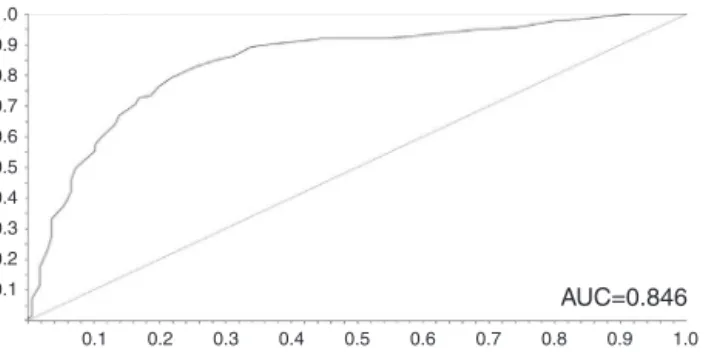
Fig.1.ReceiverOperatingCharacteristic(ROC)plot,sensitivityversus1-specificity, generatedbytheselectedRandomForestmodelfortestsetandvalueofthearea underthecurve(AUC).
the training data sets,the generation of all128 descriptorsby
Volsurf+tookapproximately20minusingacomputerwithani7
processor,runningat3.4GHz,andequippedwith12GBofRAM
memory.
Table1summarizesthestatisticalindicesoftheRFmodelfor
thetraining,cross-validation,andtest sets.For thetraining set, thelearningmachineprogramgavesimilarhitratesforthe
inac-tivecompoundsandactivecompounds,whichwereabove99.7%.
However,forthecross-validationandtestsets,theRFmodelwas betteratpredictingtheinactivecompounds;therefore,the speci-ficity(truenegativerate)washigherforthecross-validationand testsets(74.5%and85.5%,respectively)thanthesensitivity(true positiverate),whichwasmeasuredtobe70.6%and82.7%, respec-tively(Table1).Becausethefalsepositiverate(1-specificity)was significantlylower,therewasonly25.5%and14.5%specificityfor thecross-validationandtestsets(Table1),respectively.Therefore,
compoundsselectedbythemodelasactivehadalow
probabil-ityofbeingfalsepositives(i.e.,ofbeinginactive).Theseresultsare illustratedinTable1aswellasintheROC(ReceiverOperating Char-acteristic)plotthatwasgeneratedforthetestset,whichplottedthe truepositive(active)rateagainstthefalsepositiveratesandhadan areaunderthecurvevalueofapproximately0.846(Fig.1),which iscloseto1.
The Matthews Correlation Coefficient (MCC) values for the
training,cross-validationandtestsetswere0.99,0.46and0.68,
respectively. Because an MCC value of 1 represents a perfect
prediction, a value of 0 representsa random prediction, and a
valueof−1indicatestotaldisagreementbetweenpredictionand
observation,theRFmodelindicatedthatthevaluesofMCCthat
werecalculatedweresignificant,particularlywithrespecttothe trainingandtestsets.Theequationusedtoobtainthesevaluesis asfollows:
MCC= TP×TN−FP×FN
(TP+FP)(TP+FN)(TN+FP)(TN+FN)
,
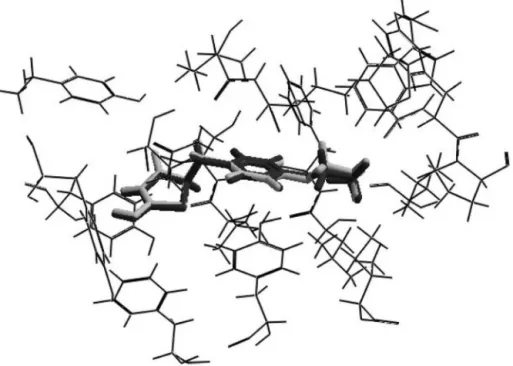
Fig.2.Superpositionofcrystalpose(black)anddockingpose(gray)validatingthemethodology.
Dockingwasvalidatedredockingtheoriginalligand rosiglita-zoneinactivesiteofMAO-Basobservedincrystallographypdbfile (PDBID4A7A)(Bindaetal.,2012).Thesameparameterdescribes toevaluatecaulerpinandanalogswasusedinvalidation.
Super-positionof poses is represented in Fig. 2 and shows a perfect
match.
Initially,wesoughttoevaluatethepotentialofusingcaulerpin
as an MAO-B inhibitor. The results presented in Table 2
indi-catethatcaulerpinexhibitspotentialinhibitoryactivityandcan
therefore beused as a lead. Aswe aimedto include a
restric-tive screening in this study, we selected 33 as the perceptual
limit for ourdocking methodology,such that only theanalogs
that had energy lower than a −151.87 Moldock score (i.e.,the
lowest 33% of MolDock energies of the whole database) were
selectedasactive.TheVolsurfprogram (v.1.0.7)generated128 descriptorsthat,togetherwithadependentvariable(binary classi-fication),describedwhetheracompoundwasactive(A)orinactive
(I); thesewere used asinput data in theKnime software
pro-gram(v.2.10.0).FromtheRFmodel,weselectedthecompounds
classifiedasbeing active(i.e., havinga predictedprobability of greaterthan50%).Crossingtheresults,weobservedaconsensusof
56.9%betweenthemethodologies.Usingthemixedligand-based
andstructure-basedapproach,weselectednineactiveanalogsof caulerpin(21).
21
Inanalyzing thefivebestanalogs fromeach methodological
approach, we observed a clear connection between thevalues
obtainedforthecompoundsCLP012,CLP068,CLP078andCLP
100,whichweretheleadresultsinthetwostudies.Inevaluating
thechemicalcharacteristicsfromtheactiveanalogs,weobserved
thatamonosubstitutionthatwassymmetricalwithchlorineand
Table2
SummaryoftheMoldockenergy,predictedprobability(%)andDragondrug-likeconsensusofbothcaulerpin(CLP001)andofitsanalogsthatwerefoundtobeactiveagainst MAO-B.
Moldockenergy Predictedprobability Drug-likescore
CLP001 −152 58 0.77
CLP012 −164 60 0.87
CLP032 −153 64 0.75
CLP049 −155 52 0.87
CLP068 −159 66 0.87
CLP078 −155 62 0.80
CLP100 −161 64 0.87
CLP107 −152 58 0.77
CLP108 −155 58 0.75
CLP109 −153 54 0.65
In corroborating the analysis of active compounds, several similar characteristics to the inactive group were observed, including the presence of groups with similar polarities in R or R1 (21). Whether in a symmetric (CLP 006 and CLP 009) or asymmetric (CLP 0013) context, the presence of a polar groupwasfoundtonegativelyinfluenceperformance.Thesame effectoccurs in thepresence of nonpolar groups (CLP 037and CLP074). The substitution ofboth indolenitrogens with alter-native heteroatoms such as oxygen to serve as the binding groupsofthatpositionreducedtheinhibitoreffect(CLP065and CLP022).
Although aromatic substitutions did not lead CLP 032 and CLP 049 to become more effective, both a change in position and disubstitution were found to significantly reduce potency (CLP 029, CLP 051, CLP 033 and CLP 057). Strong activators suchashydroxylalsodecreased inhibitoractivity(CLP034and CLP036).
InFig.3,itispossibletoobservethehydrogenbonding(H-bond) interactionsbetweenrosiglitazone(A),thedrugutilizedas tem-plate,andtwocaulerpinanalogs,whichwereclassifiedasactive (CLP012)(B)andinactive(CLP006)(C).Itisalsopossibletoobserve theinteractionsbetweentheTyr435(A)residuefromMAO-Band rosiglitazone(A),andbetweenTyr435(A)andCLP012(B).InCLP 012(D)andCLP006(E),theelectrostaticdistributionisshown, corroboratingtheimportanceofpolar(blue)andnon-polar(green) substitutionstoactivity.
In this work, we identified the fundamental physical and
chemical characteristicsofcaulerpinanalogs (21)andindicated a possibilityof howtheycanproduceinhibitory effectsagainst
MAO-B.Ligandandstructure-basedresults,associatedwith
Tyr 435(A)
Tyr 326(A)
D
A
B
C
E
Thr 201(A) Thr 201(A)
Gln 206(A)
Gln 206(A)
Tyr 435(A)
Ie 198(A)
Cys 172(A) Gly 57(A)
Lys 296(A)
Fig.3.Hydrogenbondinginteractionsofrosiglitazone(A),CLP012(B)andCLP006(C)withMAO-BandtheirelectrostaticdistributionsonCLP012(D)andCLP006(E).
Conflictsofinterest
Theauthorsdeclarenoconflictsofinterest.
Authors’contributions
VPLproducedtheanalogs andperformedthedockingstudy.
MTSandLScreatedtheligandbasedmodel.Alloftheauthorshave
readthefinal manuscriptandhaveagreedtoitssubmissionfor
appraisal.
Acknowledgment
TheauthorswouldliketothanktheBrazilianNationalCounsel ofTechnologicalandScientificDevelopment(CNPq)forfinancial support.
AppendixA. Supplementarydata
Supplementarydataassociatedwiththisarticlecanbefound,in theonlineversion,atdoi:10.1016/j.bjp.2015.08.005.
References
Baunbaek,D.,Trinkler,N.,Ferandin,Y.,Lozach,O.,Ploypradith,P.,Rucirawat,S., Ishibashi,F.,Iwao,M.,Meijer,L.,2008.Anticanceralkaloidlamerallinsinhibit proteinkinase.Mar.Drugs6,514–527.
Berthold,M.R.,Cebron,N.,Dill,F.,Gabriel,T.R.,Kötter,T.,Meinl,T.,Ohl,P.,Sieb,C., Thield,K.,Wiswedel,B.,2007.In:Preisach,C.,Burkhrdt,H.,Schimidt-Thieme,
L.,Decker,R.(Eds.),Dataanalysis,machinelearningandapplications.Springer, Berlin,pp.319–326.
Bidon-Chanal,A.,Fuertes,A.,Alondo,D.,Perez,D.I.,Martinez,A.,Luque,F.J.,Medina, M.,2013.EvidenceforanewbindingmodetoGSH-3:allostericregulationby themarinecompoundpalinurin.Eur.J.Med.Chem.60,479–489.
Binda,C.,Aldeco,M.,Geldenhuys,W.J.,Tortorici,M.,Mattevi,A.,Edmondson,D.E., 2012.MolecularinsightsintohumanMonoamineOxidaseBinhibitionbythe glitazoneanti-diabetesdrugs.Med.Chem.Lett.3,39–42.
Binda,C.,Milczek,E.M.,Bonivento,D.,Wang,J.,Mattevi,A.,Edmondson,D.E.,2011. Lightsandshadowsonmonoamineoxidaseinhibitioninneuroprotective phar-macologicaltherapies.Curr.Top.Med.Chem.11,2788–2796.
Bolea,I.,Gella,A.,Unzeta,M.,2013.Propargylamine-derivedmultitarget-directed ligands:fightingAlzheimer’sdiseasewithmonoamineoxidaseinhibitors.J. Neu-ralTransm.120,893–902.
Breiman,L.,2001.Randomforests.Mach.Learn.45,5–32.
Cavalcante-Silva,L.H.A.,Correia,A.C.C.,Barbosa-Filho,J.M.,Silva,B.A.,Santos,B.V.O., Lira,D.P.,Miranda,G.E.C.,Cavalcante,F.A.,Moreira,M.S.A.,2013.Spasmolytic effectofcaulerpininvolvesblockadeofCainfluxonguineapigileum.Mar.Drugs 11,1553–1564.
Chen,G.,Zheng,S.,Luo,X.,Shen,J.,Zhu,W.,Liu,H.,Gui,C.,Zhang,J.,Zheng,M.,Puah, C.M.,Chen,K.,Jiang,H.,2005.Focusedcombinatoriallibrarydesignbasedon structuraldiversity,druglikenessandbindingaffinityscore.J.Comb.Chem.7, 398–406.
Choi,B.W.,Ryu,G.,Park,S.H.,Kim,E.S.,Shin,J.,Roh,S.S.,Shin,H.C.,Lee,B.H.,2007. AnticholinesteraseactivityofplastoquinonesfromSargassumsagamianum:lead compoundsforAlzheimer’sdiseasestherapy.Phytother.Res.21,423–426. Choi,D.Y.,Choi,H.,2015.Naturalproductsfrommarineorganismswith
neuropro-tectiveactivityintheexperimentalmodelsofAlzheimer’sdisease,Parkinson’s diseaseandischemicbrainstroke:theirmoleculartargetsandaction mecha-nisms.Arch.Pharm.Res.38,139–170.
Cruciani,G.,Crivori,P.,Carrupt,P.A.,Testa,B.,2000.Molecularfieldsin quanti-tativestructure-permeationrelationships:theVolsurfapproach.J.Mol.Struc. Theochem.503,17–30.
Debdab,M.,Renault,S.,Lozach,O.,Meijer,L.,Paquin,L.,Carreaux,F.,Bazureau, J.P.,2010.Synthesisandpreliminarybiologicalevaluationofnewderivatives ofthemarinealkaloidleucettamineBaskinaseinhibitors.Eur.J.Med.Chem.45, 805–810.
Fernandez,H.H.,Chen,J.J.,2007.Monoamineoxidase-Binhibitioninthetreatment ofParkinson’sdisease.Pharmacotherapy27,174–185.
Gerwick,W.H.,Moore,B.S.,2012.Lessonsfromthepastandchartingthefutureof marinenaturalproductsdrugdiscoveryandchemicalbiology.Chem.Biol.19, 85–98.
Gul,W.,Hamann,M.T.,2005.Indolealkaloidmarinenaturalproducts:an estab-lishedsourceofcancerdrugsleadswithconsiderablepromiseforthecontrolof parasitic,neurologicalandotherdiseases.LifeSci.78,442–453.
Hall,M.,FranK,E.,Holmes,G.,Pfahringer,B.,Reutemann,P.,Witten,I.H.,2009.The WEKAdataminingsoftware:anupdate.SIGKDDExploration11.
Hamann,M.,Alonso,D.,Martin-Aparicio,E.,Fuertes,A.,Pérez-Puerto,M.J.,Castro, A.,Morales,S.,Navarro,M.L.,DelMonte-Millán,M.,Medina,M.,Pennaka,H., Balaiah,A.,Peng,J.,Cook,J.,Wahyuono,S.,Martínez,A.,2007.Glycogen syn-thasekinase(GSK-3)inhibitoryactivityandstructureactivityrelationship (SAR)studiesofthemanzaminealkaloids.PotencialforAlzheimer’sdisease.J. Nat.Prod.70,1397–1405.
Hanley,J.A.,McNeil,B.J.,1982.Themeaninganduseoftheareaunderareceiver operationcharacteristic(ROC)curve.Radiology143,29–36.
Imre,G.,Veressc,G.,Volfordd,A.,Farkas,Ö.,2003.MoleculesfromtheMinkowski space:anapproachtobuilding3Dmolecularstructure.J.Mol.Struc.Theochem. 666,51–59.
Jin,D.Q.,Lim,C.S.,Sung,J.Y.,Choi,H.G.,Ha,I.,Han,J.S.,2006.Ulvaconglabata, amarinealgae,hasneuroprotectiveandanti-inflammatoryeffectsinmurine hippocampalandmicroglialcells.Neurosci.Lett.402,154–158.
LaFerla,F.M.,Oddo,S.,2005.Alzheimer’sdisease:abeta,tauandsynaptic dysfunc-tion.TrendsMol.Med.11,170–176.
Langjae,R.,Bussarawit,S.,Yuenyongsawad,S.,Ingkaninan,K.,Plubrukarn,2007. Acetylcholinesterase-inhibitingsteroidalalkaloidfromthespongeCorticiumsp. Steroids72,682–685.
Lill,M.A.,Danielson,M.L.,2011.Computer-aideddrugdesignplatformusingPyMOL. J.Comput.AidedMol.Des.25,13–19.
Lipinski,C.A.,Lombardo,F.,Dominy,B.W.,Feeney,P.J.,2001.Experimentaland com-putationalapproachestoestimatesolubilityandpermeabilityindrugdiscovery anddevelopmentsettings.Adv.Drug.Deliver.Rev.46,3–26.
Liu,C.-C.,Kanekiyo,T.,Xu,H.,Bu,G.,2013.ApolipoproteinEandAlzheimerdisease: risk,mechanismsandtherapy.Nat.Rev.Neurol.9,106–118.
Mayer,A.M.S., Rodrígiez,A.D.,Berlink,R.G.S.,Fusetani,N.,2011.Marine phar-macologyin 2007-8:marinecompoundswith antibacterial,anticoagulant, antifungal, anti-inflammatory, antimalarial, antiprotozoal, antituberculosis, and antiviral activities; affecting the immune and nervous system, and other miscellaneous mechanism of action. Comp. Biochem. Physiol. 153, 191–222.
Meijer,L.,Thunnissen,A.M.W.H.,White,A.W.,Garnier,M.,Nokolic,M.,Tsai,L.H., Walter,J.,Cleverley,K.E.,Salinas,P.C.,Wu,Y.-Z.,Bienart,J.,Mandelkow, E-M.,Kim,S.H.,Petit,G.R.,2000.Inhibitionofcyclin-dependetkinase,GSK-3 andCSK1 byhymenialdisine, amarinespongeconstituent.Chem.Biol.7, 51–63.
Meijer,L.,Skaltsounis,A.L.,Magiatis,P.,Polychronopoulus,P.,Knockaert,M.,Leost, M.,Ryan,X.P.,Vonica,C.A.,Brivanlou,A.,Dajani,R.,Crovace,C.,Tarricone,C., Musacchio,A.,Roe,S.M.,Pearl,L.,Greengard,P.,2003.GSK-3-selectiveinhibitors derivedfromtyrianpurpleindirubins.Chem.Biol.10,1255–1266.
Motohashi,K.,Toda,T.,Sue,M.,Furihata,K.,Shizuri,Y.,Matsuo,Y.,Kasai,H.,Shinya, K.,Takagi,M.,Izimikawa,M.,Horikawa,Y.,Seto,H.,2010.Isolationandstructure elucidationoftumescenamidesAandB,twopeptidesproducedbyStreptomyces tumescensYM23-260.J.Antibiot.63,549–552.
Oprea,T.I.,Sherbukhin,V.,Svensson,P.,Kuhler,T.C.,2000.Chemicalinformation managementindrugdiscovery:optimizingthecomputationaland combinato-rialchemistryinterfaces.J.Mol.Graph.Model.18,512–524.
Patil,P.O.,Bari,S.B.,Firke,S.D.,Deshmukh,P.K.,Donda,S.T.,Patil,D.A.,2013.A com-prehensivereviewonsynthesisanddesigningaspectsofcoumarinderivativesas monoamineoxidaseinhibitorsfordepressionandAlzheimer’sdisease.Bioorg. Med.Chem.21,2434–2450.
Radwan, M.A., El-Sherbiny, M., 2007. Synthesis and antitumor activity of indolylpyrimidines:marinenaturalproductmeridianinDanalogues.Bioorg. Med.Chem.15,1206–1211.
Riediger,N.D.,Othman,R.A.,Suh,M.,Moghadasian,M.H.,2009.Asystemicreviewof therolesofn-3fattyacidinhealthanddiseases.J.Am.Diet.Assoc.109,669–679. Rishton,G.M.,2003.Nonleadlikenessandleadlikenessinbiochemicalscreening.
DrugDiscoveryToday8,86–96.
Schumacher,M.,Kelkel,M.,Dicato,M.,Diederich,M.,2011.Goldfromthesea: marinecompoundsinhibitorsofthehallmarksofcancer.Biotechnol.Adv.29, 531–547.
Scotti,L.,Fernandez,M.B.,Muramatsu,E.,Pasqualoto,K.F.M.,Emereciano,V.D., Tavares,L.C.,Silva,M.S.,Scotti,M.T.,2011.Self-organizingmapsandVolsurf approachtopredictaldosereductaseinhibitionbyflavonoidcompounds.Rev. Bras.Farmacog.21,170–180.
Souza,E.T.,Queiroz,A.C.,Miranda,G.E.C.,Lorenzo,V.P.,Silva,E.F.,Freire-Dias,T.L.M., Cupertino-Silva,Y.K.,Melo,G.M.A.,Santos,B.V.O.,Chaves,M.C.O., Alexandre-Moreira,M.S.,2009a.Antinociceptiveactivitiesofcrudemethanolicextractand phases,n-butanolic,chloroformicandethylacetatefromCaulerparacemosa
(Caulerpaceae).Rev.Bras.Farmacog.19,115–120.
Souza, E.T., Pereira, D.L., Queiroz, A.C., Miranda, G.E.C., Lorenzo, V.P., Silva, D.J.C.,Bezerra,A.A.,Campessato,E.A.M.,Araújo-Júnior,J.X.,Barbosa-Filho,J.M., Athayde-Filho,P.F.,Santos,B.V.O.,Chaves,M.C.O.,Alexandre-Moreira,M.S., 2009b.Theantinociceptiveandanti-inflammatoryactivitiesofCaulerpin,a bisindolealkaloidisolatedfromseaweedsofthegenusCaulerpa.Mar.Drugs 7,689–704.
Taletesrl,Dragon(SoftwareforMolecularDescriptorCalculation)Version6.0. (2014).http://www.talete.mi.it/.
Thomas,N.V.,Kim,S.-K.,2011.Potentialpharmacologicalapplicationsof polyphe-nolicderivativesfrommarinebrownalgae.Environ.Toxicol.Pharmacol.32, 325–335.
Thomsen,R.,Christensen,M.H.,2006.Moldock:anewtechniqueforhigh-accuracy moleculardocking.J.Med.Chem.49,3315–3321.
Tian,L.W.,Feng,Y.,Shimizu,Y.,Pfeifer,T.A.,Wellington,C.,Hooper,J.N.A.,Quinn,R.J., 2014.ApoEsecretionmodulatingbromotyrosinederivatefromtheAustralian marinespongeCallyspongiasp.Bioorg.Med.Chem.Lett.24,3537–3540. Turk,T.,Avgustin,J.A.,Batista,U.,Strugar,G.,Kosmina,R.,Civovic,S.,Janussen,
D.,Kauferstein,S.,Mebs,D.,Sepcic,K.,2013.Biologicalactivitiesofethanolic extractsfromdeepseaAntarcticmarinesponges.Mar.Drugs11,1126–1139. Veber,D.F.,Johnson,S.R.,Cheng,H.Y.,Smith,B.R.,Ward,K.W.,Kopple,K.D.,2002.
Molecularpropertiesthatinfluencetheoralbioavailabilityofdrugcandidates. J.Med.Chem.12,2615–2623.
Walters,W.P.,Murcko,M.A.,2002.Predictionof‘drug-likeness’.Adv.DrugDeliv. Rev.54,255–271.
Wyss-Coray,T.,Rogers,J.,2012.InflammationinAlzheimerdisease–abriefreview ofthebasicscienceandclinicalliterature.ColdSpringHarb.Perspect.Med.2, a006346.
Yang,C.G.,Liu,G.,Jiang,B.,2002.Preparingfunctionalbis(indole)pyrazineby step-wisecross-couplingreactions:anefficientmethodtoconstructtheskeletonof dragmacidinD.J.Org.Chem.67,9392–9396.
Yoon,N.Y.,Lee,S.H.,Li,Y.,Kim,S.K.,2009.PhlorotanninsfromIshigeokamuraeand theiracetylandbutylcholinesteraseinhibitorseffects.J.Func.Foods1,331–335. Zheng,S.,Luo,X.,Chen,G.,Zhu,W.,Shen,J.,Chen,K.,Jiang,H.,2005.Anewrapid andeffectivechemistryspacefilterinrecognizingadruglikedatabase.J.Chem. Inf.Model.45,856–862.