Blood discard rate and the prevalence of infectious and contagious diseases in blood donors
from provincial towns of the state of Paraná, Brazil
Sueli Donizete Borelli1 Jocimara Costa Mazzola1 Alessandra Cristina Gobbi Matta1,2 Angélica Yukari Takemoto3,4 Marta Bértoli1
1Universidade Estadual de Maringá - UEM, Maringá, PR, Brazil
2Faculdade Ingá, Maringá, PR, Brazil 3Faculdade Guairacá, Guarapuava, PR, Brazil 4Faculdade Campo Real, Guarapuava, PR, Brazil
Conlict-of-interest disclosure:
The authors declare no competing inancial interest
Submitted: 9/24/2012 Accepted: 12/18/2012
Corresponding author: Sueli Donizete Borelli
Universidade Estadual de Maringá – UEM Departamento de Ciências Básicas da Saúde Av Colombo, 5.790 – Bloco T-20 – Sala 108 A, Jd. Universitário
87020-900 Maringá, PR, Brazil Phone: 55 44 3011-5388 [email protected]
www.rbhh.org or www.scielo.br/rbhh
DOI: 10.5581/1516-8484.20130126
Introduction
Blood donation is one of the noblest gestures a human can make when its purpose is to save lives(1). Although blood transfusions were seen as a mere transmission of physiological material, changes occurred that made the screening of donors highly relevant to the quality of blood. Since the start of the practice, blood donation in Brazil has changed from donors being paid to life-saving volunteers(2).
Blood donation in Brazil is currently regulated by the Health Ministry through the National Health Surveillance Agency (ANVISA) by Resolution number 57 of the Collegiate Directory published on December 16th, 2010 and by Decree 1353 of the Health Ministry of June 13th, 2011 that standardize the technical norms for procedures in blood centers. These regulations support all the activities of blood centers in Brazil according to the principles and guidelines of the Brazilian policy for the transfusion of blood, components and blood-derived compounds. In fact, the regulations aim to protect donor and recipient, control collection, processing, storage, distribution and the transfusion of blood and its components and derivatives of human venous and arterial blood and establish essential institutional norms for the adequate execution of these activities(3). So that an improvement in the selection of donors can be achieved and the risk to the recipient of transfused blood can be reduced, prospective donors are submitted to clinical and serological screening(4-6)
.
The Brazilian Health Ministry determined that all blood centers must apply highly sensitive tests for transmissible infections to decrease the risk of disease and to maintain the quality of donated blood. The laboratory tests that should be performed are for syphilis,
Chagas’ disease, hepatitis B virus (HBV), hepatitis C virus (HCV), acquired immunodeiciency
syndrome (AIDS) and human T cell lymphotropic virus (HTLV) types I and II(6).
The blood unit discard rate in Brazil ranges between 10 and 20%. Infectious diseases are the main cause of this high percentage, which exceeds that of developed countries(7,8). The current research investigated the frequency of discarded blood and the prevalence of
infectious-contagious diseases identiied by positive serological markers in blood donors of
the Regional Blood center in Maringá, Paraná, Brazil in 2011.
Methods
The current cross-sectional descriptive investigation with a quantitative approach collected data from the HEMOVIDA system which is used to store all the information about donated blood. Data were collected between 1st January and 31st December 2011. The variables Background: So that an improvement in the selection of donors can be achieved and the risk to the recipient of transfused blood can be reduced, prospective donors are submitted to clinical and serological screening.
Objective: This study investigated the blood discard rate and the rate of infectious and contagious diseases in blood donors from provincial towns of the state of Paraná, Brazil.
Methods: This study was an exploratory cross-sectional descriptive investigation with a quantitative approach of donations between January and December 2011.
Results: In the study period the Regional Blood center in Maringá, Brazil received 8337 blood donations from people living in the city and neighboring towns. However, 278 (3.33%) donations were discarded during serological screening owing to one or more positive serological markers. A total of 46.4% of the discarded blood
units were conirmed positive by serology with anti-HBc being the most common (66.7%), followed by syphilis (22.5%), HBsAg (4.7%), anti-hepatitis C virus (3.1%), human immunodeiciency virus (1.5%) and Chagas’
disease (1.5%). The rate of infectious-contagious diseases that can be transmitted by blood transfusions was 1.55% (129/8337) of the donor population with a frequency of 1.03% for anti-HBc and 0.35% for syphilis.
Conclusion: This study demonstrates a high prevalence of the anti-HBc marker in prospective blood donors from provincial towns in the state of Paraná, Brazil.
Keywords: Hemotherapy service; Serology; Blood bank; Quality control; Blood donors/statistics & numerical
investigated were age, gender, ethnic group, schooling, marital status, place of residence, profession and the serological tests for
infectious diseases as deined by the Brazilian Health Ministry(6). Within the context of serological screening by the Blood Center, Decree 153/2011 of the Health Ministry states that each donation must be evaluated using highly sensitive tests for determined serological markers that would impair the health of the recipient. These tests include markers that detect the HBV surface antigen (HBsAg) and antibodies against HBV capsid (anti-HBc - IgG or IgG + IgM), HCV markers that identify antibodies against HCV or detect the antibody and antigen combined and two distinct tests are made for AIDS, one to detect the antibody against HIV I and II and the other to detect the antibody against HIV and the p24 antigen. Moreover, the test for the anti-Trypanosoma cruzi antibody which causes Chagas’ disease is carried out as are tests for syphilis to determine the anti-Treponema pallidum antibody or non-treponemal antibody and tests to detect antibodies against HTLV-I and -II. All methods of serological screening followed the manufacturer’s instructions.
Results
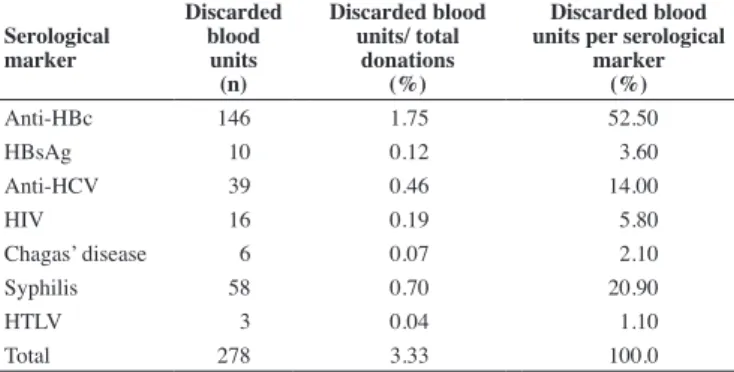
The Blood center of Maringá received 8337 blood donations from people living in the city of Maringá and in neighboring towns between 1st January and 31st December 2011. However, 278 blood units (3.33%) failed serological screening as they were positive for one or more serological markers. Data were collected at two
distinct stages, namely, selection and conirmation of exclusion
as shown in Tables 2 and 3.
Table 1 - Method, manufacturer and assay used for to identify serological markers used in the Regional Blood center of Maringá, 2011
Marker Method Manufacturer Assay
HBsAg ELISA MEIA CMIA Biokit Abbott (Axsym) Abbott (Architect)
Bioelisa HBsAg 3.0 HBsAg (V2) HBsAg qualitative Anti-HBc MEIA CMIA Abbott (Axsym) Abbott (Architect) Core Anti-HBc II Anti-HCV ELISA ELISA Beijing United Biomedical Abbott/Murex HCV Ultra Hepanostika Anti-HCV 4.0 Anti-HIV types I and II
ELISA ELISA ELISA Biomerieux Biomerieux Abbott/Murex
HIV Uniform II Ag/Ab Vironostika HIV Ag/Ab HIV Ag/Ab combination Anti-HIV types
I and II
MEIA CMIA
Abbott (Axsym) Abbott (Architect)
HIV Ag/Ab Combo HIV Ag/Ab Combo
Anti-HTLV-I
and -II ELISA Abbott/Murex HTLV I/II
Chagas’ disease ELISA Abbott/Grupo Bios Test Elisa Chagas III
Syphilis ELISA Biomerieux Trepanostika TP recombinant
HCV: Hepatitis C virus; HIV: Human immunodeiciency virus; HTLV: Human T cell lymphotropic virus
The inclusion criterion for the current study was all discarded
blood due to conirmed positive markers during serological
screening. Serology with undetermined results and the absence
of the donor for a repeat collection of blood to conirm initially
positive serological tests were valid criteria for sample exclusion. Data was collected between January and February 2012.
Data were organized on a Microsoft Ofice Excel sheet in tables.
This study was developed according to the Decree of the National Health Council 196/1996, after approval of the Commission that Regulates Academic Activities in the Hospital Regional de Maringá and of the Ethics Committee on Research on Human Beings of the Universidade Estadual de Maringá (UEM: # 211/2011).
Table 2 - Blood discard due to positive serology of blood donors at the Regional Blood center of Maringá, Maringá, Paraná, Brazil in 2011
Serological marker Discarded blood units (n) Discarded blood units/ total donations (%) Discarded blood units per serological
marker (%)
Anti-HBc 146 1.75 52.50
HBsAg 10 0.12 3.60
Anti-HCV 39 0.46 14.00
HIV 16 0.19 5.80
Chagas’ disease 6 0.07 2.10
Syphilis 58 0.70 20.90
HTLV 3 0.04 1.10
Total 278 3.33 100.0
HCV: Hepatitis C virus; HIV: Human immunodeiciency virus; HTLV: Human T cell lymphotropic virus
Table 3 - Discarded blood unit conirmation due to positive serological type
and infectious-contagious diseases in blood donors at the Regional Blood center of Maringá, 2011
Serological marker
Discarded
blood units Conirmed serology
Positivity per marker Prevalence of infectious-contagious diseases
(n) (n) (%) (%) (%)
Anti-HBc 146 86 58.90 66.7 1.03
HBsAg 10 6 60.00 4.7 0.07
Anti-HCV 39 4 10.25 3.1 0.04
HIV 16 2 12.50 1.5 0.02
Chagas 6 2 33.30 1.5 0.02
Syphilis 58 29 50.00 22.5 0.35
HTLV -I
and -II 3 0 0.00 0.00 0.00
TOTAL 278 129 224.95 100 1.55
HCV: Hepatitis C virus; HIV: Human immunodeiciency virus; HTLV: Human T cell lymphotropic virus
During the screening stage, the Anti-HBc marker was the cause of 52.5% of the discarded blood units during serological screening, followed by syphilis (20.9%), anti-HCV (14.0%), HIV (5.80%), HBsAg (3.60%), Chagas’ disease (2.10%) and HTLV-I
and -II (1.10%). The conirmation of exclusion due to serological results was based on speciic criteria listed in Decree 1353/2011
of the Brazilian Health Ministry(6).
Table 3 shows the absolute frequency of conirmed
The epidemiological proile of donors with positive serology was evaluated after conirmation (Table 4). The data relate to 122 donors, but there were 129 conirmed positive serology tests as more than
one positive blood sample was submitted by some donors.
Discussion
The Regional Blood center of Maringá is part of the state of Paraná’s network of blood centers called HEMEPAR. It collects blood from the 30 towns of the 15th Regional Health Area. The serology laboratory tests approximately 12,000 donors per year: 8500 donors are seen in the Blood Center and 3500 donors are seen in the Blood Collection and Transfusion Service of Cianorte. On average, some 100,000 tests/year are carried out (70,000 at the Regional Blood Center of Maringá and 30,000 at the Cianorte unit).
As blood centers have, as a rule, great dificulties in maintaining an ideal blood stock for emergencies and blood speciicities,
they adopt strategies to recruit donors(9). Consequently, it is very
important to know the proile of people who donated blood but
were considered inappropriate for donation so that blood donation safety is ensured. In fact, such knowledge is the basis to develop
speciic strategies to improve the technology in the selection of
donors and to improve blood quality(10).
It is mandatory that blood centers have pre-transfusion strategies for the proper conditioning of blood products to reduce health risks to both donors and recipients alike(7).
According to ANVISA, the serological screening of potential blood donors is mandatory due to the great variety of transmittable pathogens(11). The current study shows that 52.5% of discarded blood units during the serological screening process were positive for the
Anti-HBc serological marker with 66.7% of these being conirmed.
In fact, according to one study, a blood center in the state of Acre, Brazil also had a high prevalence for HBV. In this particular study, reactivity to anti-HBc reached 54.8% of discarded blood units which
conirms the high prevalence of the virus in the population(12). This fact has been corroborated by a similar study in the Blood Center of Campo Mourão, Paraná, Brazil in which the serological rate for HBV (anti-HBc) reached 71.3% of discarded blood units(13).
Of the 129 conirmed serology tests, 4.7% were positive
for HBsAg giving a prevalence of 0.07% in the population. This result fails to corroborate studies performed in the states of Rio Grande do Sul(14) and Maranhão, Brazil(15), with prevalences of 0.18% and 0.24%, respectively.
The prevalence of syphilis at the Regional Blood center of Maringá was 0.35%, lower than the mean of 0.65% in Caxias do Sul, Rio Grande do Sul, Brazil(14). Similar results were found in towns of the same state; Cruz Alta(16) and Santa Maria(17) with prevalences of 0.3% and 0.48%, respectively. The positivity rate for the pathology in Guarapuava, Paraná(18) according to the immune-enzyme test was 2.1%, thus a higher rate than that reported in the current study. Research in blood centers of other states also showed a high positivity rate for syphilis tests, such as those in the Brazilian states of Amazonas(19), São Paulo(7) and Sergipe(20).
The prevalence of anti-HCV was 0.04% in current study similar to that found by Perz(21) in the UK and Scandinavia (between 0.01% and 0.1%) and less than that reported in Rio de Janeiro (0.7%)(22).
Table 4 - Epidemiological data of donors (n = 122) with positive serology in the Blood center of Maringá, Maringá, Paraná, Brazil in 2011
Variable n %
Gender
Male 66 54.1
Female 56 45.9
Marital Status
Single 53 43.4
Married 52 42.6
Divorced/widower 17 13.9
Ethnicity
Caucasian 109 89.3
Afro-descendent 10 8.2
Oriental 3 2.5
Schooling
Not given 1 0.8
Illiterate 1 0.8
Basic education 40 32.8
High school 51 41.8
College degree 29 23.8
Age (years)
19-21 6 4.9
22-32 34 27.9
33-43 32 26.3
44-54 30 24.6
55-65 20 16.4
Town
Maringá 60 49.2
Paiçandu 7 5.7
Floraí 2 1.6
Iguaraçu 1 0.8
Sarandi 12 9.8
Itambé 3 2.5
Ivatuba 1 0.8
Mandaguaçu 4 3.3
Mandaguari 4 3.3
Colorado 2 1.6
Marialva 7 5.7
Itapetinga 1 0.8
Astorga 3 2.5
Apucarana 1 0.8
Atalaia 3 2.5
Cruzeiro do Oeste 1 0.8
California 2 1.6
Munhoz de Melo 1 0.8
Nova Esperança 3 2.5
Ourizona 1 0.8
Paranacity 1 0.8
Santo Inácio 1 0.8
São José dos Pinhais 1 0.8
This analysis shows that 129 (46.4%) out of 278 discarded
blood units were conirmed positive by serology. Anti-HBc
(66.7%) was the greatest cause of discard followed by syphilis (22.5%), HBsAg (4.7%), anti-HCV (3.1 %), HIV (1.5%) and Chagas’ disease (1.5%).
The risk of HIV transmission by transfusion in Brazil has decreased from 4.4% at the start of the epidemic to 2.7% in 1992 to 0.4% in 2007(23). The positivity rate in the current analysis was 0.02% for the same year as that of the study at the Regional Blood Center of Pelotas, Rio Grande do Sul, Brazil (HEMOPEL) at 0.08% between 2004 and 2007(24).
The prevalence for Chagas’ disease among donors was relatively low (0.02%) when compared to the 0.31% reported by Moraes-Souza(25). This rate was corroborated by investigators
in other regions of Brazil that demonstrated signiicant progress
in the control of Chagas’ disease from transfusions over the last forty years. The prevalence of donors with Chagas’ disease in the 1970s reached 11.08%; it decreased to 7.03% in the 1980s, to 0.73% in 2000 and to 0.17% in 2010(6).
Serological screening for HTLV-I and -II at blood centers became mandatory only in 1993 due to great risks of transmission by blood transfusions(26). No positivity occurred in the current study and it should be emphasized that infection by the virus is in sharp decline according to studies of blood donors in Uberaba, Minas Gerais which assessed the prevalence of HTLV-I and II between 1995 and 2008. The prevalence for 1995-2000 was 0.6%, whereas it declined to 0.1% during the 2002-2008 period(27).
Conclusions
In conclusion, the frequency of discarded blood units due to positive serology is important to transfusion services as it allows
the proiling of donors and identiies the prevalence of infectious
diseases in a particular region. This study demonstrates the need for strict quality control that is able to minimize costs and increase the quality of services provided.
Acknowledgements
The authors would like to thank the University Hospital of Maringá, the Regional Blood center of Maringá, Conselho Nacional de Desenvolvimento Cientíico e Tecnológico and Coordenação de Aperfeiçoamento de Pessoal de Nível Superior.
References
1. Gomes FV, Eleutério Junior J. HTLV-II in blood donors at the Blood Center Net of Ceará - HEMOCE. Rev Assoc Med Bras. 2011;57(3):309-12.
2. Almeida Neto C, Mendrone Júnior A, Salles NA, Chamone DA, Sabino EC. The role of the doctor in the reduction of residual risk of the virus
transmission of human immunodeiciency (HIV) for blood transfusion
and blood constituent. Diagn Tratamento. 2009;14(2):57-61.
3. Brasil. Ministério da Saúde. Agência Nacional de Vigilância Sanitária. Resolução - RDC nº 12, de 2 de janeiro de 2001. Aprova o regulamento técnico sobre padrões microbiológicos para alimentos [Internet]. Brasília; ANVISA; 2001. [cited 2001 Mar 3]. Available from: http://www.anvisa. gov.br/legis/decretos/3990_01.html
4. Carrazzone CF, Brito AM, Gomes YM. The importance of pre-transfusional serological screening in blood transfusion recipients. Rev Bras Hematol Hemoter. 2004;26(2):93-8.
5. Caram C, Monteiro-de-Castro MS, Caiaffa WT, Oliveira CD, Proietti AB, Almeida MC, et al. [Spatial-temporal distribution of potential blood
donors at the Hemominas Foundation, Belo Horizonte, Minas Gerais State, Brazil, in 1994 and 2004]. Cad Saude Publica. 2010;26(2):229-39.
6. Brasil. Ministério da Saúde. Secretaria de Atenção à Saúde. Coordenação-Geral de Sangue e Hemoderivados. Sangue e hemoderivados: produção hemoterápica [Internet]. 5th ed. Brasília; MS; 2011. [cited 2012 Mar 21]. Available from: http://bvsms.saude.gov.br/bvs/publicacoes/caderno_ informacao_sangue_hemoderivados_2011.pdf
7. Salles NA, Sabino EC, Barreto CC, Barreto AM, Otani MM, Chamone DF. [The discarding of blood units and the prevalence of infectious diseases in donors at the Pro-Blood Foundation/Blood Center of São Paulo, São Paulo, Brazil]. Rev Panam Salud Publica. 2003;13(2-3):111-6. Portuguese.
8. Valente VB, Covas DT, Passos AD. [Hepatitis B and C serologic markers in blood donors of the Ribeirão Preto Blood Center]. Rev Soc Bras Med Trop. 2005;38(6):488-92. Portuguese.
9. Rodrigues RS, Reibnitz KS. [Strategies for attracting blood donors: an integrative literature review]. Texto Contexto Enferm. 2011;20(2):384-91. Portuguese.
10. Rohr JI, Boff D, Lunkes DS. [Proile of ineligible candidates for blood
donation in the hemotherapy service of Santo Ângelo Hospital, RS, Brazil]. Rev Patol Trop. 2012;41(1):27-35. Portuguese.
11. Brasil. Ministério da Saúde. Agência Nacional de Vigilância Sanitária. Resolução –RDC No 57, de 16 de dezembro de 2010. Determina
o regulamento sanitário para serviços que desenvolvem atividades relacionadas ao ciclo produtivo do sangue humano e componentes e procedimentos transfusionais [Internet]. Brasília: Ministério da Saúde; 2010 [cited 2012 Mar 13]. Available from: http://bvsms.saude.gov.br/ bvs/saudelegis/anvisa/2010/res0057_16_12_2010.html
12. Silva Rdo S, Ribeiro SA, Silveira RP, Freitas Mdos S. [Evaluation of the sorologic pre-selection for the hepatitis B virus marker (total anti-HBc) in candidates to blood donation in the State of Acre, 2002]. Rev Soc Bras Med Trop. 2006;39(2):179-82. Portuguese.
13. Ramos VF, Ferraz FN. Peril epidemiológico dos doadores de sangue do
hemonúcleo de Campo Mourão-PR no ano de 2008. SaBios: Rev Saúde Biol. 2010;5(2):14-21.
14. Rodriguez MD, Lara GM, Lazzarotto AR, Michelim L, Fracasso J, Lovatel R, et al. The prevalence of serologic markers at the Caxias do Sul Blood Center. Rev Panam Infectol. 2008;10(3):32-5.
15. Viana GM, Diniz Neto JA, Binda Júnior JR, Rabelo EM, Costa MH, Sousa JG, et al. Hepatitis B and C serological markers in blood donors from Maranhão State, Brazil. Rev Panam Infectol. 2009;11(1):20-4.
16. Boff D, Lunkes DS, Kunzler A, Rohr JI . Prevalência de VDRL reagente em doadores do hemocentro regional de Cruz Alta- RS, Brasil no período de 2003 a 2009. Rev Patol Trop. 2011;40(2):179-84.
17. Machado MM, Zuravski L. Soroprevalência em doadores de sangue do Hospital Universitário de Santa Maria/RS no ano de 2005. NewsLab. 2007;80:108-12.
18. Oliveira VM, Verdasca IC, Monteiro MC. Detecção de síilis por ensaios de
ELISA e VDRL em doadores de sangue do Hemonúcleo de Guarapuava, Estado do Paraná. Rev Soc Bras Med Trop. 2008;41(4):428-30.
19. Ferreira CM, Ferreira WA, Motta CL, Vasquez FG, Pinto AF. Reatividade do teste VDRL em bolsas de sangue da Fundação de Hematologia e Hemoterapia do Amazonas- HEMOAM, os custos decorrentes do descarte
e estimativa de prevalência de síilis em doadores de sangue do Estado do
Amazonas. DST - J Bras Doenças Sex Transm. 2006;18(1):14-17.
20. Santos EA, Marcellini PS, Ribeiro JP. Avaliação epidemiológica das rejeições dos doadores de sangue no HEMOLACEN/SE no período de 2004 a 2006. Rev Bras Anal Clin. 2008;40(4):251-6.
22. Barcelos MW, Araujo L, Paula VS, Villar LM. Prevalência de anticorpos
contra o vírus da Hepatite C e da imunodeiciência humana no Norte do
Estado do Rio de Janeiro. NewsLab. 2010;102:90-3.
23. Brasil. Ministério da Saúde. Boletim Epidemiológico AIDS e DST [Internet]. Brasília: MS; 2007. [cited 2012 Dec 21]. Available from: http:// bvsms.saude.gov.br/bvs/periodicos/Boletim2007_internet090108.pdf
24. Araújo AB, Nachtigal GC, Cerqueira MS, Ferreira AP, Almeida SE, Silva CM. Blood donors HIV prevalence in southern of Rio Grande do Sul, Brazil. Rev Panam Infectol. 2011;13(1):19-22.
25. Moraes-Souza H, Martins PR, Pereira GA, Ferreira-Silva MM, Abud
MB. Serological proile concerning Chagas’ disease of blood donors at
Uberaba Blood Center. Rev Bras Hematol Hemoter. 2006;28(2):110-14.
26. Brasil. Ministério da Saúde. Normas técnicas para coleta, processamento e transfusão de sangue, componentes e derivados. Brasília: Secretaria de Assistência à Saúde; 1994. 77 p.
27. Lima GM, Eustáquio JM, Martins RA, Josahkian JA, Pereira GA, Moraes-Souza H, et al. Declínio da prevalência do HTLV-1/2 em doadores de sangue do Hemocentro Regional da cidade de Uberaba, Estado de Minas Gerais, 1995 a 2008. Rev Soc Bras Med Trop. 2010;43(4):421-4.