Overweight and abdominal in adult population of Teresina, PI
LORENA GUIMARÃES MARTINS HOLANDA1, MARIADO CARMODE CARVALHOE MARTINS2, MANOEL DIASDE SOUZA FILHO3, CECÍLIA MARIA RESENDE GONÇALVESDE CARVALHO4, REGINA CÉLIADE ASSIS5, LÍVIA MARIA MOURA LEAL6, LORENA PATRÍCIA LEAL MESQUITA6, EMANUELLA MACHADO COSTA61M.D. from Universidade Federal do Piauí - UFPI, Teresina, PI, Brazil
2PhD in Biological Sciences; Professor of the Post-graduation Program on Food and Nutrition, UFPI; Professor of the Department of Biophysics and Professor of Faculdade NOVAFAPI, Teresina, PI, Brazil
3M. Sc. in Sciences and Health; Professor of UFPI – Campus Ministro Reis Veloso, Parnaíba, PI, Brazil
4PhD in Nutrition Science from Universidade Estadual de Campinas; Professor of the Post-Graduation Programme, Food and Nutrition Department, of UFPI, Teresina, PI, Brazil 5PhD in Biochemistry from Faculdade de Medicina de Ribeirão Preto, Universidade de São Paulo – USP; Professor of the Department of Biochemistry and Pharmacology of UFPI,
Teresina, PI, Brazil
6M. D. from UFPI, Teresina, PI, Brazil
Received from Universidade Federal do Piauí – UFPI, Teresina, PI
Submitted on: 07/24/2010
Approved on: 09/30/2010
*Corresponding author:
Manoel Dias de Souza Filho Rua Equador, n. 118 - Conjunto
Jardim Esperança 3 – Ceará Parnaíba-PI, Brazil CEP: 64.215-620 Phone: (86)9924-3868 [email protected];
Conlict of interest: None.
ABSTRACT
Objective: To determine the prevalence of overweight and abdominal fat in the adult population in the urban area of Teresina, PI, Brazil. Methods: his is a cross-sectional study with probability sampling by conglomerates. he study evaluated 464 adults, 20 to 59 years of age, living in the urban area of Teresina, PI, Brazil. Nutritional status was classiied according to body mass index (BMI), and abdominal fat accumulation was estimated according to waist circumference. he signiicance level was set at 5% (p < 0.05). Results: he prevalence of overweight and obesity according to nutritional status, based on BMI, was 30.0% and 7.7%, respectively. An increase in the proportion of over-weight and obesity among men with progressively higher family income was observed. Higher rates of obesity were found among individuals 50 to 59 years of age with stable relationships and nonsmokers. An association between individual or family income and presence of abdominal fat was not observed in the population. Conclusion: he preva-lence of overweight in the study population follows the national trend. Proportions of overweight and obesity were higher among men and increased with age. Women and married individuals showed a greater tendency for abdominal obesity.
INTRODUCTION
Obesity is a chronic disease and a known risk factor for several debilitating diseases, with a high social cost, such as type 2 diabetes, hypertension, strokes, cardiopa-thies, dyslipidemias, and some types of cancer1.
he pattern of fat distribution can reveal some predis-position of an individual for developing complications, and it is widely known that central adiposity is associated to metabolic imbalances and cardiovascular risk2. hus, it has been demonstrated that abdominal obesity can in-crease in up to 10 times the risk for developing type 2 diabetes, besides also being a risk factor for hypertension in adults with ages between 20 and 45 years3.
he prevalence of overweight and obesity is univer-sally increasing, achieving, according to estimates of the Pesquisa de Orçamentos Familiares (POF), approxi-mately 40% and 12.7%, respectively, of the adult Brazil-ian population in 2002-20034. he increased prevalence of overweight, both in developing and developed coun-tries, is associated with a high incidence of a number of clinical and surgical pathologies5.
Anthropometry is the method used more oten in obesity diagnosis, since it is cheaper, non-invasive, universally applicable, and has good acceptance by the population6. Body mass index (BMI) and waist circum-ference are among the most used anthropometric indi-cators. At a populational level, waist circumference is more practical and easy to use in large scale studies, as well as in health promotion actions, allowing the identi-ication of levels of intervention in the population7.
he objective of the present study was to identify the prevalence of overweight and abdominal fat in adults in the urban area of Teresina, PI, Brazil.
METHODS
his is a transversal, domiciliary-based study with prob-ability sampling by conglomerates. Calculation of the sample size was based on POF, which estimated a 40% prevalence of overweight in the Brazilian adult popula-tion4. Conidence level of 95% and margin of error of 3% was established. he sample population was dis-tributed in ive strata, according to zoning provided by Census8, and redistributed in clusters corresponding to neighborhoods in each zone of Teresina, PI.
Parameters investigated were divided in two blocks. he irst one included socio-demographic parameters, such as age, gender, marriage status, religion, race, num-ber of persons residing in that house, schooling, and fa-milial and individual income. he second block includ-ed anthropometric parameters, such as weight, height, body mass index (BMI), and waist circumference (WC).
Height and weight measurements were performed with the subject barefoot and wearing light clothes. Height was calibrated to the nearest 0.5 cm with a tape
measure ixed vertically on a wall in order to make a 90 degree angle with the loor. Weight was measured using a portable scale, previously calibrated to the proximal 0.1 kg. Waist circumference was obtained by using a non-elastic tape measure with 0.5 cm scale, placed without applying pressure, in a horizontal plane, in the smaller circumfer-ence between the inferior border of the last rib and the iliac crest9.
Global nutritional state was classiied according to body mass index (BMI), based on cutting points proposed by the WHO10. Normal weight was deined as BMI > 18.5 and < 25 kg/m2; overweight, BMI ≥ 25 and < 30 kg/m2; and obesity as BMI ≥ 30 kg/m2. he expression overweight was used to deine individuals with excess weight or obesity, i.e., individuals with BMI ≥ 25 kg/m2.
Weight circumference (WC) was used to identify the pattern of fat distribution, which, besides being associated with abdominal fat mass (subcutaneous and intra-abdom-inal), is considered as an indicator risk of cardiometabolic diseases11. Waist circumference was classiied, according to cut-of points suggested by the WHO10, as increased when equal or greater than 80 cm for females; equal or greater than 94 cm for males; and very increased when equal or greater than 88 cm for females and equal and greater than 102 cm for males.
his study was approved by the Ethics on Research Committee of Universidade Federal do Piauí. he study was conducted in compliance with the recommendations of Resolution 196/96 of the National Health Council on studies involving humans12 and the Declaration of Helsin-ki13. All individuals enrolled signed an informed consent ater explanations on the objectives and possible beneits and risks of the study.
Data were processed in the BioEstat 5.014 and EpiInfo 6.04b15 programs. he level of signiicance was established at 5% (p < 0.05), and Analysis of Variance (ANOVA), Tukey post-hoc test, and Chi-square test were used for sta-tistical analysis.
RESULTS
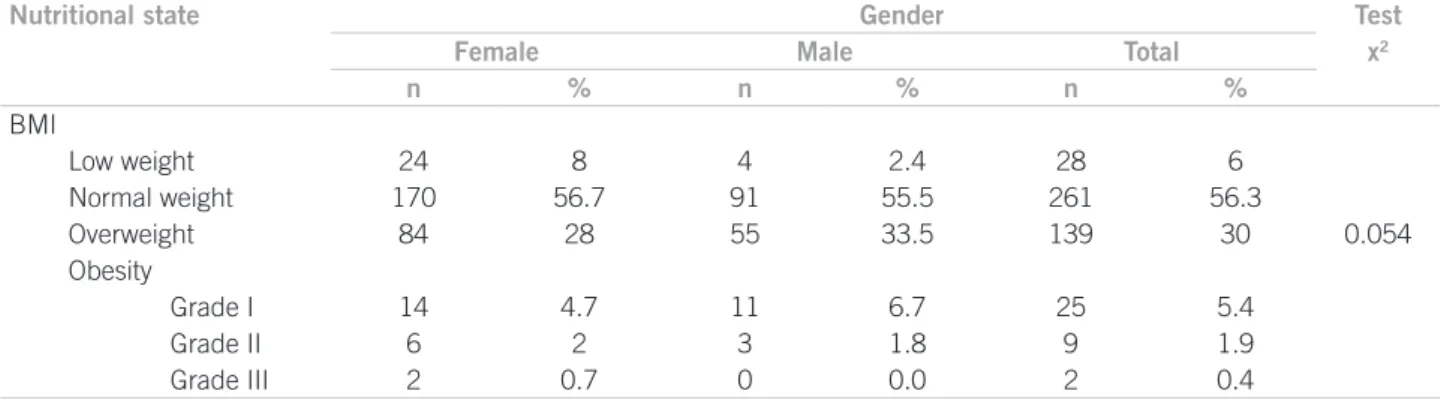
Four hundred and sixty-four individuals, ages 20 to 59 years, with a mean age of 35.82 years, mostly females (64.6%), par-ticipated in this study. When evaluating the distribution of the study population regarding their nutritional state, we observed that 30% and 7.7% of adults were overweight or obese, respectively. Regarding gender, the proportion of overweight individuals, i.e., BMI greater than 25 kg/m2, was 35.4% in females, and 42% in males (Table 1).
Table 1 – Distribution of adult population in the urban area of Teresina, PI, according to gender and nutritional status
Table 2 – Prevalence of overweight and obesity based on BMI according to socio-economic characteristics, physical exercise, smoking, family history of obesity, and gender in the adult population of the urban area of Teresina, PI, Brazil
Nutritional state Gender Test
Female Male Total x2
n % n % n %
BMI
Low weight 24 8 4 2.4 28 6
Normal weight 170 56.7 91 55.5 261 56.3
Overweight 84 28 55 33.5 139 30 0.054
Obesity
Grade I 14 4.7 11 6.7 25 5.4
Grade II 6 2 3 1.8 9 1.9
Grade III 2 0.7 0 0.0 2 0.4
Variables Female Test Male Test
Eutrophic Overweight
and Obesity
Total x2 Eutrophic Overweight
and Obesity
Total x2
% % % P % % % P
Age group (years)
20-29 76.8 23.2 100 0.0001 69.1 30.9 100 0.027
30-39 73.8 26.2 100 57.1 42.9 100
40-49 49.3 50.7 100 40.9 59.1 100
50-59 29.5 70.5 100 50 50 100
Marriage status
Single 69.7 30.3 100 0.014 73.1 26.9 100 0.0008
Married 55.2 44.8 100 45.2 54.8 100
Individual income (minimal wage)
< 1 60.3 39.7 100 0.57 62.5 37.5 100 0.09 ≥1 e <3 67.1 32.9 100 55.4 44.6 100
≥3 56.5 43.5 100 35.5 64.5 100
Family income (minimal wage)
< 1 69.7 30.3 100 0.33 92.3 7.7 100 0.02 ≥1 e <3 68.0 32.0 100 58.8 41.2 100
≥3 59.5 40.5 100 51.6 48.4 100
Physical activity
None 67.0 33.0 100 0.0006 58.6 41.4 100 0.57
Yes 42.6 57.4 100 54.1 45.9 100
Schooling
< College 58.4 41.6 100 0.02 56.1 43.9 100 0.71
≥ College 76.0 24.0 100 59.5 40.5 100
Smoking
Non-smoker 38.3 61.7 100 0.0008 40.0 60.0 100 0.04
Smoker 75.9 24.1 100 63.6 36.4 100
Former smoker 65.0 35.0 100 62.1 37.9 100
Family history of obesity
No 62.5 37.5 100 0,14 57.7 42.3 100 0.19
Yes 76.8 23.2 100 25.0 75.0 100
income and prevalence of overweight and obesity was not observed in males and females, but an increased propor-tion of overweight and obesity was observed among males with increased familial income (p = 0.02).
Table 3 – Prevalence of abdominal obesity according to socio-economic characteristics, physical exercise, smoking, family history of obesity, and gender in the adult population of the urban area of Teresina, PI, Brazil
Variables Abdominal obesity
Female Test Male Test
Absent Present Total x2 Absent Present Total x2
% % % p % % % P
Age group (years)
20-29 77.5 22.5 100 0.0001 88.6 11.4 100 0.0005
30-39 70.0 30.0 100 86.2 13.8 100
40-49 39.2 60.8 100 62.2 37.8 100
50-59 31.1 68.9 100 55.0 45.0 100
Marriage status
Single 68.8 31.2 100 0.002 90 10 100 0.001
Married 51.2 48.8 100 67 33 100
Individual income (Minimum wage)
< 1 55.6 44.4 100 0.72 84.0 16.0 100 0.055 ≥1 e <3 57.0 43.0 100 77.8 22.2 100
≥3 48.1 51.9 100 58.8 41.2 100
Family income (Minimum wage)
< 1 63.9 36.1 100 0.86 92.9 7.1 100 0.32 ≥1 e <3 59.5 40.5 100 75.9 24.1 100
≥3 59.1 40.9 100 75.0 25.0 100
Physical activity
None 64.7 35.3 100 0.0002 75.2 24.8 100 0.54
Yes 38.7 61.3 100 79.4 20.6 100
Schooling
< College 56.4 43.6 100 0.01 76.8 23.2 100 0.98
≥ College 75.0 25.0 100 76.9 23.1 100
Smoking
Non-smoker 36.0 64.0 100 0,0009 60.0 40.0 100 0.01
Smoker 70.0 30.0 100 78.8 21.2 100
Former smoker 63.2 36.8 100 83.5 16.5 100
Family history of obesity
No 95.5 4.5 100 0,62 98.4 1.6 100 0.04
Yes 94.3 5.7 100 92.1 7.9 100
49 age group, the proportion of males with overweight and obesity was 59.1% (p = 0.027) (Table 2).
It was also observed that 57.4% of the females physi-cally active were obese or overweight (p = 0.0006), but the same did not apply to males (p = 0.57). Among women with higher education, approximately 24% had a BMI above 25 kg/m2, although this proportion was higher in women who did not have the same degree of schooling (41.6%) (p = 0.02). Among males, a positive relationship between schooling and BMI was not ob-served (p = 0.71) (Table 2).
Regarding the results in Table 2, it was observed among female smokers a proportion of overweight and obesity of 24.1% (p = 0.0008), and this proportion among female non-smokers was 61.7%. Regarding male non-smokers, approximately 60% had a BMI above 25 kg/m2, while among male smokers, the proportion was
36.4% (p = 0.04). As for family history of obesity, an as-sociation with overweight and obesity was not observed (p > 0.05)(Table 2).
Table 3 shows the distribution of abdominal obe-sity prevalence in both genders in the study popula-tion. Higher proportion of abdominal obesity in the age group of 50 to 59 years, stable relationship, and non-smokers (p < 0.05) was observed. Additionally, an as-sociation between individual or family income and ab-dominal obesity was not observed (p > 0.05).
DISCUSSION
WHO16 considers overweight and obesity, which afect all age groups, the main public health problems in the world. In the present study, the prevalence of overweight (30%) and obesity (7.7%) observed are similar to the na-tional pattern4.
POF results regarding males revealed a prevalence of overweight and obesity of 41% and 8.9%, respectively. Among females, 40% are overweight and 13.1%, obese4. An-alyzing the proportion of overweight and obesity between genders, we observed that approximately 28% of females and 33.5% of males were overweight, while a little over 7% of females and 8.5% of males were obese. hese results were lower than those of Gigante et al.17 in a study on the prevalence of overweight and obesity and associated factors in Brazil, in which 39% of females and 47% of males were overweight and, in both genders, 11% were obese.
We observed that the proportion of overweight and obesity increase with age, and this characteristic is greater in females. hese results are in agreement with the POF data of 2002-2003, in which obesity with age partially re-produces the pattern of overweight, which tends to in-crease more slowly and steadily with age in women (20 to 64 years) and more quickly in men (20 to 54 years)4.
Francischi et al.3 justiied weight gain with aging due to factors such as reduction in basal metabolism due to loss of muscle mass, reduction of physical activities, and increase in food consumption.
When stratiication by income is investigated, an increase in overweight and obesity prevalence with in-creased income was observed in males, which was also reported by Abrantes et al.18 On the other hand, Mon-teiro et al.19 observed greater prevalence of overweight and obesity in low income families.
In the present study, the prevalence of overweight and obesity, both identiied by BMI and WC, was greater among those individuals in stable relationships, without diference between genders. he inluence of marital sta-tus on nutritional stasta-tus is not clear, since in some stud-ies, such as that of Sarturi et al.20, a positive relationship between those variables was not observed. On the other hand, in other studies, such as that by Rosmond and Björntorp, who demonstrated using waist/hip relation-ship that married women had a higher risk of obesity21.
Physical activities were associated with greater preva-lence of overweight and obesity in females, but this as-sociation was not observed in males. his inding can be probably explained by the fact that many people start physical activities because they are overweight. hese individuals would beneit from physical activities, since physically active individuals have better insulin sensitiv-ity, glucose tolerance, and lipid metabolism, as well as lower morbidity and mortality than those with a seden-tary lifestyle22.
An inverse relationship between overweight and schooling was observed in females, similar to the results of the study by Gigante et al.17; however, schooling was not associated with overweight in males.
Accumulation of abdominal fat is a more serious risk factor for cardiovascular diseases risk and changes in glucose-insulin homeostasis than generalized obsesity23. A positive association between increased waist circum-ference and higher blood pressure levels has been dem-onstrated24. In the present study, the presence of abdomi-nal obesity evaluated by waist circumference was related to gender and age, corroborating the observations of Martins et al.25 who observed an increased prevalence of abdominal obesity with age and in females. Unlike the study of Veras et al.26, with college students, which did not observe a relationship between abdominal obesity and gender.
A strong concordance between the classiication of obesity according to BMI and WC in females was ob-served. his was also observed by Velásquez-Meléndez
et al.23 who reported a concordance greater than 80% be-tween overweight and obesity, determined by BMI and WC in women.
Regarding physical activities, the present study di-verges from others, since a greater prevalence of ab-dominal obesity among physically active patients was observed, while other studies indicate a relationship be-tween obesity and a sedentary lifestyle27. As mentioned, this result is probably due to the fact that physically ac-tive individuals usually had weight problems.
In the present study, smoking was associated with obesity, as deined by BMI and WC, and greater preva-lence of obesity was observed among non-smokers. Oth-er studies also have reported highOth-er prevalence of obe-sity among non-smokers and former smokers. However, these data should be carefully analyzed, since there is no conclusive evidence of direct association between smok-ing, easy weight loss and weight maintenance in stable condition, or the large efect of quitting on weight gain28. On the other hand, even if smoking had a proven efect on weight gain, it would be much smaller than the ben-eits associated with healthier lifestyle habits, and cessa-tion of smoking is among them2.
CONCLUSION
REFERENCES
1. Field AE, Coakley EH, Must A, Spadano JL, LAird N, Dietz WH, et
al. Impact of overweight on the risk of developing common chronic
disease during a 10-year period. Arch Int Med. 2001; 161:1581-6. 2. Sousa RMRP, Sobral DP, Paz SMRS, Martins MCC. Prevalência de
sobrepeso e obesidade entre funcionários plantonistas de unidades de saúde de Teresina-PI. Rev Nutr. 2007; 20:473-82.
3. Francischi RPP, Pereira LO, Freitas CS, Klopfer ML, Santos RC,
Vieira P, et al. Obesidade: atualização sobre sua etiologia,
morbi-dade e tratamento. Rev Nutr. 2000; 13:17-29.
4. Brasil. Ministério do Planejamento, Orçamento e Gestão. Instituto Brasileiro de Geograia e Estatística. Pesquisa de orçamento famil-iar 2002-2003. Análise da disponibilidade domicilfamil-iar de alimentos e do estado nutricional no Brasil. Rio de Janeiro: IBGE; 2004. p. 40-76.
5. Mancini MC; Carra MK. Diiculdade diagnóstica em pacientes obesos: parte I. [citado 5 nov 2010]. Rev Abeso. 2001; 3(3). Dis-ponível em: http://www.abeso.org.br.
6. Organização Mundial da Saúde. Physical status: the use and inter-Physical status: the use and inter-pretation of anthropometry. Geneva; WHO; 1995.
7. Olinto MTA, Nácul LC, Dias-da-Costa JS, Gigante DP, Menezes AM. B, Macedo S. Níveis de intervenção para obesidade abdo-minal: prevalência e fatores associados. Cad Saúde Pública. 2006; 22:1207-15.
8. Instituto Brasileiro de Geograia e Estatística. Censo Demográico 2000. Características da população e dos domicílios. Rio de Janei-ro: IBGE; 2001.
9. Centro Colaborador em Alimentação e Nutrição da Região Cen-tro-Oeste/MS/UFJ. Antropometria. Manual de técnicas e procedi-mentos. Vigilância nutricional. 2ª ed. Goiânia; 2003.
10. Organização Mundial da Saúde. Division of Noncommunicable Diseases. Programme of Nutrition Family and Reproductive Health. Obesity: preventing and managing the global epidemic: report of a WHO consultation on obesity. Geneva; WHO; 1998. 11. Klein S, Allison DB, Heymsield SB, Kelley DE, Leibel RL, Nonas
C, et al. Waist circumference and cardiometabolic risk. Diabetes
Care. 2007; 30:1647-52.
12. Brasil. Ministério da Saúde. Conselho Nacional de Saúde. Comis-são Nacional de Ética em Pesquisa. Resolução 196/96 sobre pesqui-sa envolvendo seres humanos. Brasília (DF); 1996.
13. World Medical Association. Declaration of Helsinki. Ethical
prin-ciples for medical research involving human subjects. 59th WMA
General Assebly, Seoul; 2008.
14. Ayres M, Ayres JRM, Ayres DL, Santos AAS. Bioestat 5.0. Socieda-de Civil Mamirauá. Pará; 2007.
15. Dean AG, Dean JA, Coulombier D, Brendel KA, Smith DC, Burton
HA, et al. Epi Info, version 6.04: a word processing database and
statistics program for a epidemiology on microcomputers. Atlanta: Centers for Disease Control and Prevention; 1996.
16. Organização Mundial de Saúde. Obesity: preventing and managing the global epidemic. Geneva; WHO; 2000.
17. Gigante DP, Moura EC, Sardinha LMV. Prevalência de excesso de
peso e obesidade e fatores associados, Brasil, 2006.Rev Saúde
Pú-blica. 2009; 43:83-9.
18. Abrantes MM, Lamounier JA, Colosimo EA. Prevalência de so-brepeso e obesidade nas regiões Nordeste e Sudeste do Brasil. Rev Assoc Med Bras. 2003; 49:162-6.
19. Monteiro CA, Mondini L, Souza ALM, Popkin BM. Da desnutrição para a obesidade: a transição nutricional no Brasil. In: Monteiro CA. Velhos e novos males da saúde no Brasil: a evolução do país e de suas doenças. 2ª ed. São Paulo: Hucitec, Nupens-USP; 2000. p. 247-55.
20. Sarturi JB, Neves J, Peres KG. Obesity in adults people: a popula-Obesity in adults people: a popula-tion based study in a small town in South of Brazil, 2005. Ciênc Saúde Coletiva. 2010; 15:105-13.
21. Rosmond R, Björntorp P. Psychosocial and socioeconomic factors in women and their relationship to obesity and regional body fat distribution. Int J Obes Relat Metab Disord. 1999; 23:138-45. 22. Blair SN. Evidence for success of exercise in weight loss and
con-trol. Ann Intern Med. 1993; 119:702-6.
23. Velásquez-Meléndez G, Kac G, Valente JG, Tavares R, Silva CQ, Garcia ES. Evaluation of waist circumference to predict general obesity and arterial hypertension in women in Greater Metropoli-tan Belo Horizonte, Brazil. Cad Saúde Pública. 2002; 18:765-71. 24. Martins MCC, Ricarte IF, Rocha CHL, Maia RB, Silva VB, Veras
AB, et al. Pressão arterial, excesso de peso e nível de atividade físi-Pressão arterial, excesso de peso e nível de atividade
físi-ca em estudantes de universidade públifísi-ca. Arq Bras Cardiol. 2010; 95:192-9.
25. Martins IS, Marinho SP. O potencial diagnóstico dos indicadores da obesidade centralizada. Rev. Saúde Pública. 2003; 37:760-7. 26. Veras AB, Sousa LG, Assis RC, Souza Filho MD, Martins MCC.
Level of Physical Activity and Nutritional Status of Students at a Public University in Brazil. he FIEP Bulletin. 2009; 79:648-52. 27. Björntorp P. Body fat distribution, insulin resistence, and
meta-bolic disease. Nutrition. 1997; 13:795-03.