Corresponding Author : Rupa Dasgupta
10.1590/S1517-707620150001.0028
Received on: 10/10/2014 Accepted on: 10/11/2014
Changes in the properties of Cu-Al-Mn
shape memory alloy due to quaternary
addition of different elements
Pravir Kumar1, Ashish Kumar Jain1, Shahadat Hussain1 Abhishek Pandey1, Rupa Dasgupta1
1 CSIR-AMPRI, Bhopal, Madhya Pradesh, INDIA - 462026
e-mail: [email protected], [email protected], [email protected], [email protected], [email protected];
ABSTRACT
Advantages of Cu based shape memory alloy include amongst other features, high transformation temperature, low cost of production, ease in manufacturing processes and ability to vary the achieved properties through alloying additions. It has been often reported that these alloys are very sensitive to the alloying additions in terms of properties achieved and phase precipitation necessary for development of shape memory properties. This behaviour in Cu based shape memory alloys i.e. being very sensitive to its constituents can be used positively to design alloys with pre set properties if the alloying additions and their percentages are properly controlled.
In an attempt to understand the effect of different alloying additions, 2% of different elements [Zn, Si, Mg & Cr] were added to a known Cu-based shape memory alloy [Cu-12.5 wt% of Al-5 wt % of Mn].The objective was to ascertain changes or improvements achieved due to the additions in terms of microstructural changes, hardness, phase precipitation and transformation temperatures. Attempts have been made to analyze the changes in properties achieved in the base Cu-Al-Mn alloys due to the quaternary additions. Grain structure with α+ phases, which is a pre requisite for martensite formation on quenching is seen in all the alloys indicating that all the alloys have potential to exhibit the shape memory behaviour. The martensite formation with different morphologies is observed in the quenched samples however. XRD results have identified the precipitated phases to be the martensitic phases.The DSC results indicate clear transformation peaks in most of the samples with significantly high transformation temperatures. The findings confirm the variation in properties achieved due to different additions and improvements achieved in terms of higher transformation temperatures and martensite formation due to the alloying additions. An attempt has been made to understand the findings.
Keywords: Shape memory alloys, transition temperature, martensite, X-ray diffraction studies, phase precipitation
1.INTRODUCTION
The main advantage of Cu based shape memory alloy which has triggered a wide range of investigation and research work in the field of shape memory effects are its possibility of high transformation temperature, low cost of production and ease in manufacturing processes. Among the Cu based shape memory alloys mostly investigated, the Cu-Al-Ni [1-7], Cu-Al-Zn [8-12] and Cu-Al-Mn [13-21] alloys have been studied extensively. But most Cu-Al-Ni and Cu-Zn-Al polycrystalline shape memory alloys are brittle and cannot therefore be cold worked. Attempts to improve the ductility of these polycrystalline Cu based shape memory alloys by grain refinement have only resulted in limited success. However, it has been reported in recent studies that Cu-Al-Mn alloys with low aluminum contents show excellent ductility because their parent phase with L2 structure possesses comparatively a lower degree of order [21, 22]. This feature could well be useful for the shape memory alloys to exhibit better pseudoelasticity. It has been reported that alloying additions play a very significant role in the properties of Cu-based shape memory alloys and pre requisite properties can be achieved by proper designing/selection of the alloying elements.
285 improvements achieved due to the additions in terms of microstructure, hardness, phase precipitation and transformation temperatures. Attempts have been made to analyse the changes in properties achieved in the base Cu-Al-Mn alloys due to the quaternary additions.
2. MATERIALS AND METHODS
Four different alloying elements were added to the base alloy as Cu-12.5wt%Al-5wt%Mn-2wt%X [X=Zn, Si, Mg, Cr]. The samples were prepared through liquid metallurgy route using gravity die in the as cast conditioning. Pure copper, aluminum, manganese and the respective quaternary alloying element were taken in right quantities to weigh 1000 g of the alloy in total and were melted together. Molten alloys were poured in graphite mould to get in the as cast conditionings in cylindrical shape of 12 mm diameters and 150 mm length.
Samples from the cast alloys were chemically analysed using optical emission spectroscope; Bruker Make OES Model No. 4549 Q4 TASMAN.
Samples from the in the as cast condition alloys were subject to homogenization treatment at 473K for 2 hours in a muffle furnace and furnace cooled. Samples from the homogenized alloys were heated and held for 2 hrs at 1193K followed by ice quenching in an attempt to precipitate the martensitic structure.
The homogenised and quenched samples were polished metallographically using an automatic polishing machine capable of polishing six samples together (Buehler make, Model EcoMet 3000) using standard procedures. The microstructure was observed in an optical microscope (LEICA make, Model LEICA DM 6000M and Metalloplan) and FESEM (FEI make, Model Nova Nano SEM 430) were optical micrographs were not properly resolved.
XRD of polycrystalline samples was done using X-Ray Diffractometer [Make:Bruker Model:D8 Advanced] with CuK radiation to identify the phases present in the samples at room temperature.
Differential Scanning Calorimetric studies were carried out on quenched samples using a Differential Scanning Calorimeter [Mettler Toledo make, Model DSC1 STARe SYSTEM] Approximately 8 to 9 mg of powder sample was used which was scrapped from the quenched samples. Tests were carried out in two steps to identify transformation at low and high temperatures; from -10ºC to 200 ºC and room temperature to 550ºC maintaining a constant rate of 10ºC/min.
The hardness of samples was determined on metallographically polished samples using Vicker’s hardness tester (K.B. Pruiftechnik, Model No. KB250BVRZ) applying a load of 5 kg. An average of at least seven readings was taken at different portions of the sample for reporting.
3. RESULTS AND DISCUSSION
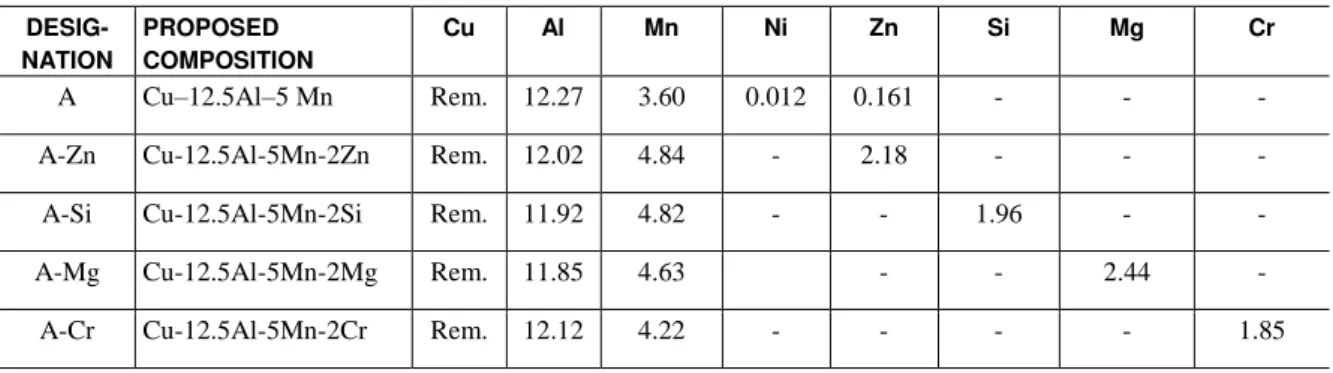
The chemical composition of the samples is tabulated in Table 1; it shows no much variation in composition from the proposed compositions. The base alloy is Cu–12.5Al–5 Mn [marked A] and with additions marked A-Zn, A-Si… and the like depending on additional the alloying element [X= Zn, Si, Mg and Cr].
Table 1: Chemical composition
The optical micrographs of the samples in the homogenised and quenched conditions are shown respectively in Figure 1. In alloys where the microstructure could not be resolved in the optical micrographs, FESEM micrographs have been given in an attempt to get better resolution.
DESIG-NATION
PROPOSED COMPOSITION
Cu Al Mn Ni Zn Si Mg Cr
A Cu–12.5Al–5 Mn Rem. 12.27 3.60 0.012 0.161 - - -
A-Zn Cu-12.5Al-5Mn-2Zn Rem. 12.02 4.84 - 2.18 - - -
A-Si Cu-12.5Al-5Mn-2Si Rem. 11.92 4.82 - - 1.96 - -
A-Mg Cu-12.5Al-5Mn-2Mg Rem. 11.85 4.63 - - 2.44 -
286 Grain structure with α+ phases is visible in the homogenised condition of all the alloys; which is a pre requisite for martensite formation on quenching [7]. This clearly indicates that all the alloys have potential to exhibit the shape memory behaviour. Precipitation in the grains typical of shape memory alloys is also seen in all the alloys including the base alloy. There is a large variation in the grain size; however, presence of any particular element cannot be said to affect the grain size. Uniformity in grain sizes has been brought about by homogenization as seen from the micrographs which show the variation in grain size is significantly less [mostly uniform] in the homogenised samples inspite of its variation between alloys.
Figure 1: Microstructure of Samples in [i] homogenised and [ii] quenched conditions
Quenching from high temperatures was carried out expecting to precipitate the martensitic phases. The martensite formation is not marked in all the quenched samples like addition of Zn and Cr, the granular structure is maintained even in the quenched condition; the microstructures of these samples are not well resolved even in the FESEM micrographs. Addition of Si and Mg though retains the granular structure on quenching but heavy precipitation is seen in the quenched samples indicating possible martensite formation. The plate- or spear-like martensite [the zig-zag ’ phase] is observed where the martensitic structures are observed.
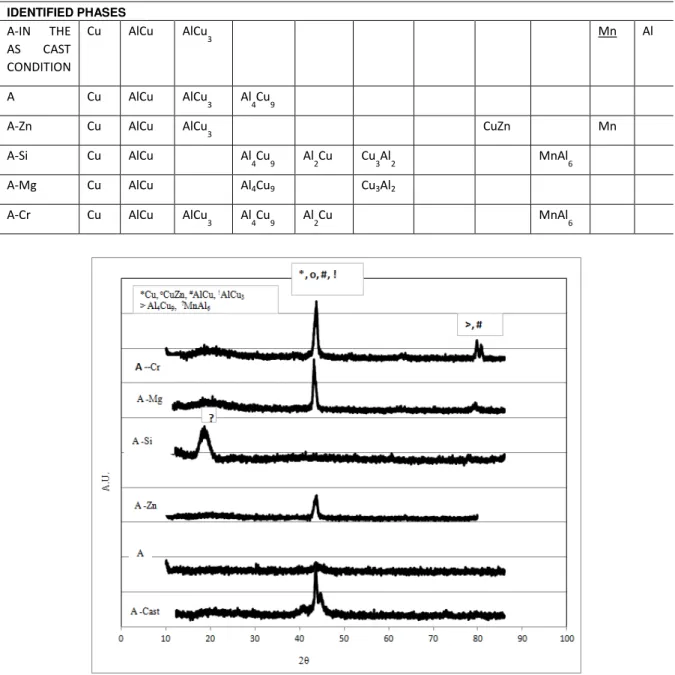
287 related to Al and Cu mainly. The martensitic phases of Al2Cu3 [ ’], Al4Cu9 [ ’] and Cu-Zn have been clearly identified. In some samples only martensitic phases have been identified in the quenched condition signifying perhaps completion to the martensitic phase. Addition of other alloying additions was not expected to affect the XRD peaks and the same has been reflected in the graphs.
Table 2: Identified XRD peaks in quenched samples
IDENTIFIED PHASES A-IN THE
AS CAST CONDITION
Cu AlCu AlCu
3 Mn Al
A Cu AlCu AlCu
3 Al4Cu9
A-Zn Cu AlCu AlCu
3 CuZn Mn
A-Si Cu AlCu Al
4Cu9 Al2Cu Cu3Al2 MnAl6
A-Mg Cu AlCu Al4Cu9 Cu3Al2
A-Cr Cu AlCu AlCu
3 Al4Cu9 Al2Cu MnAl6
Figure 2: XRD pattern of quenched samples
288 been recorded which could be designated to the martensitic-austenite transformations. The endoscopic transformation observed in the case of A-Mg is probably due to some other phase transformations; but these cannot be considered as martensitic-austenite transformations as the peak in the cooling cycle has been recorded at a higher temperature as compared to the peak in the heating cycle. The range of martensite retention is the maximum in ternary Cu-Al-Mn alloys [Sample A]; addition of quaternary elements decreases this range significantly. This means that whereas the alloys without quaternary additions would be better suited for its shape memory properties, ternary alloys would be better suited for higher transition temperatures.
Table 3: Transformation Temperatures of the alloys
Alloy As [ºC] Af [ºC] Ms [ºC] Mf [ºC]
A 490 520 510 460
A-Zn 480 510 500 460
A-Si 490 510 505 475
A-Mg 260 335 540 525
A-Cr 460 500 490 470
289
Figure 4: DSC of samples from room temperature
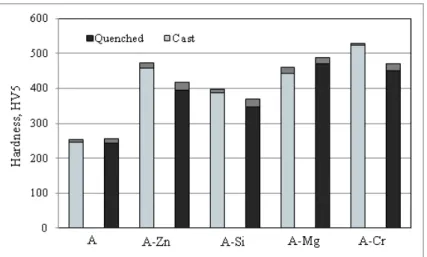
290 The hardness of the samples is plotted in Figure 5; it is seen that additions in general increase the hardness; maximum increase over the base alloy is on adding Cr and the minimum on adding Mg. further, quenching marginally decreases the hardness except for the base alloy where it remains stable. The decrease in hardness on quenching is attributed to the decreased hardness of the martensite phase.
Figure 5: Hardness of samples in different conditions
4. CONCLUSIONS
Grain structure with α+ phases is visible in the homogenised condition of all the alloys; which is a pre requisite for martensite formation on quenching indicating that all the alloys have potential to exhibit the shape memory behaviour. The martensite formation is observed in most of the quenched samples however with different morphologies. The precipitated martensite phase is the plate- or spear-like martensite [the zig-zag ’ phase] is observed.
The martensitic phases of Al2Cu3 [ ’], Al4Cu9 [ ’] and Cu-Zn have been clearly identified in the XRD patterns of the quenched samples. In some samples only martensitic phases have been identified in the quenched condition signifying perhaps completion to the martensitic phase.
The DSC studies for samples tested below room temperature upto -10ºC do not indicate any peaks; hence the possibility of lower transformation temperatures in this class of alloys is ruled out. However, when the tests were carried out from room temperature to 600ºC, the DSC results indicate clear transformation. Significantly high transformation temperatures have been recorded in the alloys. The range of martensite retention is the maximum in ternary Cu-Al-Mn alloys and addition of quaternary elements decreases this range significantly. This means that whereas the alloys without quaternary additions would be better suited for its shape memory properties, ternary alloys would be better suited for higher transition temperatures.
5. ACKNOWLEDGMENTS
291 6. BIBLIOGRAPHY
[1] MA, J., KARAMAN, I. and NOEBE, R. D., “High temperature shape memory alloys”, International Materials Reviews, v. 55, n.5, pp. 257-315, Sep. 2010.
[β] SARI, U. and KIRINDI, T., “Effects of deformation on microstructure and mechanical properties of a Cu -Al-Ni shape memory alloy”, Material Characterization, v. 59, n. 7, pp. 920–929, Jul. 2008.
[3] MIKI, M., MAESHIRO,N., and, OGINO, Y., “Effects of additional elements on the super plasticity of a Cu-14Al-γNi shape memory alloy”, Materials Transactions, JIM, v. 30, n. 12, pp. 999-1008, Dec. 1989. [4] ZENGIN,R., “Microstructure and oxidation properties of a neutron-irradiated Cu–13.5wt% Al–4wt% Ni shape memory alloy”, Physica B, v. 363, n. 1-4, pp. 110–114, Jan. 2005.
[5] STANCIU, S., BUJOREANU, L.G., ÖZKAL, B., LUTFI ÖVEÇOĞLU, M. and SANDU, A.V., “Study of precipitate formation in Cu–Al–Ni–Mn–Fe shape memory alloys”, Journal of Optoelectronics and Advanced Materials, v. 10, n. 6 pp. 1365-1369, Jun. 2008.
[6] MORRIS, M.A., “High temperature properties of ductile Cu-Al-Ni shape memory alloys with boron additions”, Acta Metall. V. 40, n. 7, pp. 1573-1586, Jul. 1992.
[7] ASANOVIC, V., DELIJIC K. and JAUKOVIC, N., “A study of transformations of -phase in Cu-Al-Ni shape memory alloys”, Scripta Materialia, v. 58, pp. 599–601, Apr. 2008.
[8] BAKR, M. R., EL BATANOUNY, M.M. and ALI E. EL ASHRAM, “Microstructural characterization and solid state processing of Cu-Zn-Al shape memory alloy in a metal matrix composite”, Canadian Journal on Mechanical Sciences and Engineering, v. 2, n. 2, pp. 11-18, Feb. 2011.
[9] MARUKAWA, K. and TSUCHIYA, K., “Two important aging effects on the martensite phase in Cu -Zn-Al alloys: Rubber effect and stabilization of martensite”, J. Phys. IV France, v. 11, pp. 8-39, Nov. 2001. [10] HOPULELE, I., ISTRATE, S., STANCIU, S. and CALUGARU, G., “Comparative Study Of Certain Cu-Zn-Al-Type Alloys Concerning Their Superelastic Behavior And Shape Memory”, Journal of Optoelectronics and Advanced Materials, v. 6, n. 1, pp. 277 – 282, Jan. 2004.
[11] BAI, Y., SHI, Q., GENG, G., SUN, D. and BIAN, X., “Formation mechanism of curved martensite structure in Cu based shape memory alloys”, Journal of Materials Science and Technology, v. 16, n. 1, pp. 78-81, Jan. 2000.
[12] SEGUI, C., CESARI, E. and VAN HUMBEECK, J., “Irreversibility in two stage martensitic transformation of Cu-Al-Ni and Cu-Zn-Mn alloys”, Materials Transactions, JIM, v. 31, n. 5, pp. 375-380, May 1990.
[1γ] SUTOU, Y., OMORI, T., KAINUMA, R. and ISHIDA, K., “Ductile Cu-Al-Mn based shape memory alloys: general properties and applications”, Materials Science and Technology, v. 24, n. 8, pp. 896-90, Aug. 2008.
[14] LING-FEI, C., MING-PU, W., ZHOU, L., BEN, X. and YU-CHANG, S., “Thermal cycling effect in Cu-11.9Al-2.5Mn shape memory alloy with high Ms temperature”, Transactions Nonferrous Society of China, v. 12, n. 4, pp. 716-719, Jul. 2002.
[15] CHEN, J., LIA, Z. and ZHAO, Y.Y., “A high-working-temperature CuAlMnZr shape memory alloy”, Journal of Alloys and Compounds, v. 480, n. 2, pp. 481–484, Jul. 2009.
[16] SUTOU, Y., KOEDA, N., OMORI, T., KAINUMA, R. and ISHIDA, K., “Effects of ageing on bainitic and thermally induced martensitic transformations in ductile Cu–Al–Mn-based shape memory alloys”, Acta Materialia, v. 57, n. 19, pp. 5748–5758, Nov. 2009.
[17] GUILEMANY, J. M., PEREGRÍN, F., LOVEY, F.C., LORCA, N. L. AND E. CESARI, “TEM study of and martensite in Cu-Al-Mn shape memory alloys”, Materials Characterization, v. 26, n. 1, pp. 23-28, Jan. 1991.
[18] MALLIK, U.S. AND SAMPATH, V., “Effect of alloying on microstructure and shape memory characteristics of Cu–Al–Mn shape memory alloys”, Materials Science and Engineering A, v. 481–482, pp. 680–683, May 2008.
[19] ZENGIN, R. AND CEYLAN, M., “The changes in transformation temperatures under stress of Cu -12.7Al-5Ni-βMn alloys”, Thermochimica Acta, v. 414, n. 2, pp. 155-158, May 2004.
292 [β1] WANG, Q., HAN, F., CUI, C., BU, S.and BAI, L., “Effect of aging on the reverse martensitic phase transformation behaviours of Cu-Al-Mn shape memory alloys”, Materials Letters, v. 61, n. 30, pp. 5185– 5187, Dec. 2007.
![Figure 1: Microstructure of Samples in [i] homogenised and [ii] quenched conditions](https://thumb-eu.123doks.com/thumbv2/123dok_br/18873921.420860/3.892.251.575.239.885/figure-microstructure-of-samples-homogenised-and-quenched-conditions.webp)