Autor para correspondência: Mónica L. Hernández, Grupo de Biomateriales, Centro Nacional de Investigaciones Científicas, CP 6412/6414, Playa, Habana, Cuba, e-mail: [email protected]
Introduction
The need for new materials, with properties resembling those of bone tissue has led many researchers to test new polymer blends and composites when looking for higher strength and biocompatibility. Among the new materials capable of simulating bone performance is the poly (methyl methacrylate) (PMMA). One of the most important applications of PMMA is as cement. Acrylic bone cements are constituted by two parts, (i) a liquid part composed by methyl methacrylate (MMA), N,N-dimethyl-p-toluidine (DMpT) as activator and hydroquinone (HQ) as inhibitor (optionally) and (ii) a solid part composed by acrylic beads, usually PMMA or their copolymers, benzoyl peroxide (BPO) to initiate the polymerization process. In addition, it is frequently included a radiopaque agent such as barium sulfate or zirconium oxide and drug as gentamicine sulfate[1]. Although the cements are used extensively, several disadvantages associated with them have been reported[2]. These include thermal necrosis of bone, chemical necrosis of bone due to the release of unreacted monomer in the polymerization shrinkage of cement during polymerization, poor distribution of cement around the implant and poor adhesion at the bone-cement, cement-prosthesis, among others. Despite these practical difficulties, such materials are still used in medical practice due to the excellent mechanical properties they exhibit[3].
Several natural and synthetic materials are designed to be slowly replaced by bone tissue that results in to the formation of new bones. Among the synthetic ones is hydroxyapatite (HA). Hydroxyapatite is the main inorganic bone component of living creatures. Hence, it is considered as a bioactive material. Among the advantages of hydroxyapatite, lies its stability in contact with aqueous media at human body temperature. Another important advantage is its osteoconductive capacity. As disadvantages of this material when it uses as granules or blocks, a low tensile strength, compression resistance and short fatigue life can be cited. However, is extensively reported that the presence of the HA as filler in the acrylic bone cements can increase the mechanical properties up to specific values. Marine coral’s skeletons are natural materials composed mainly of calcium carbonate, having porosity and interconnected channels. This is a decisive factor in the process of reabsorption, because they allow the growth of revascularized
tissue in its internal structure[4]. The addition of hydroxyapatite can promote bioactivity in those cements but its extension depends on the concentration of HA. Furthermore, at low concentrations of HA (approximately 17 wt. (%)), the bioactivity and preferential anchoring increase[4].
In this work, we analyze the influence of the inorganic loads additions such as hydroxyapatite (Coralina® HAP-200 or HA 3) and calcium carbonate from aragonite (natural source) on the hydrolytic properties (absorption, solubility and degradation) and bioactivity of the PMMA/Ca2+bone cements.
Material and Methods
Preparation of bone cements
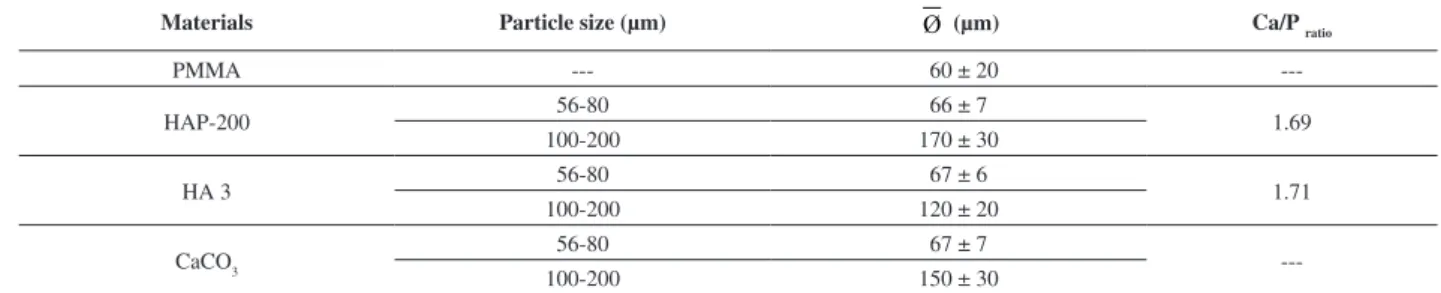
New formulations of bone cements were prepared from a solid and a liquid phase by free radical polymerization. The solid phase was constituted by a commercial PMMA beads with 1.2 wt. (%) of BPO as initiator (Autocril, FERSOdental, Cuba) and two types of hydroxyapatite obtained by own procedures. The former is known as Coralina® HAP-200[5], and is obtained from coral by hydrothermal process. The latter is named HA 3[6], and is synthesized by wet chemical precipitation method. Both materials were crushed, milled and classified by particle size; subsequently, they were characterized by Fourier transform infrared spectroscopy (FTIR) and X-ray diffraction (XRD). Besides, according to the experimental design, in some formulations was added calcium carbonate (aragonite variety from Porites porites coral), which was previously crushed, milled and classified by particle size. Table 1 shows a summary of raw materials characterization.
Methyl methacrylate monomer (Autocril, FERSOdental, Cuba) constituted the liquid phase with 0.4 wt. (%) of DMpT as activator and was used as received without further purification. The solid/liquid ratio in all cases was 2:1.
Eight different formulations of a new bone cement were developed according to an experimental design 24-1 = 23, varying load content (A), particle size (B), hydroxyapatite type (C) and the inclusion or not of calcium carbonate (D). In the experimental
Mónica L. Hernández, Jesús E. G. Ruiz, Adrián P. Ramos
Grupo de Biomateriales, Centro Nacional de Investigaciones Científicas - Cuba
Gastón F. Estévez
Centro de Biomateriales, Universidad de La Habana
Carlos A. T. Sánchez
Departamento de Microscopia, Laboratorio Central de Criminalística - Cuba
Abstract: Bone cements of poly (methyl methacrylate) (PMMA) have been used for about 40 years to fix artificial prosthesis to bone structure. The aim of this study was to evaluate the absorption, solubility, degradation and bioactivity of novel formulations of PMMA/Ca2+ bone cements. These properties were evaluated using a fractional experimental design. Hydrolytic parameters were determined, from which we found that 7/8 of the formulations for absorption and 6/8 for solubility fulfill the ISO 4049:2000 requirements. The final degradation values ranged between 1 and 5%, except for one of the formulations. Besides, some formulations showed bioactivity after seven days of immersion in SBF solution.
Keywords:PMMA cements, hydroxyapatite, calcium carbonate.
A
R
T
I
G
O
T
É
C
N
I
C
O
C
I
E
N
T
Í
F
I
C
rinsed with distilled water and weighed. After being removed from the solution, the specimens were dried, in an oven at 60 °C, to a constant weight in order to determine the eventual weight loss (an average value of three readings was used).
Three samples for each formulation, previously weighed, were employed to carry out all the experiments and the values of degradation were calculated as the percentage of weight loss using the Equation 3.
i 0
0
m – m D = × 100
m (3)
Where mi is the mass at time i and m0 is the initial mass of the specimen.
Bioactivity tests
Absorption and solubility test specimens of developed bone cement formulations were immersed in 20 mL (10 mL.cm–2) of simulated body fluid (SBF) solution. Polyethylene flasks containing the samples were placed in an incubator at 37 °C. The experiments were periodically programmed at times of 15 and 30 days. Surface samples after different periods were analyzed by scanning electron microscopy (SEM) in a Tescan TS 5130 SB microscope (Czech Republic) in order to identify a possible apatite formation.
Results and Discussions
Hydrolytic studies
Hydrolytic behavior is a very important condition in polymeric systems which be employed as implants, because the capacity to capture water or other fluids can influence in parameters such as mechanical properties and surface mobility[8]. Particularly, in case of acrylic bone cements, the polymerization reaction causes a volume reduction[9], which can be compensated with physiological fluids uptake, when the cement possesses a hydrophilic component. In this sense, the hydrophilic/hydrophobic balance is very important as it will be controlled by the bone cement composition in which PMMA give the hydrophobic character.
design, showed at Table 2, the variable D was selected as alias variable (D = A*B*C).
The preparation of specimens for subsequent test was carried out following the traditional method. Both phases were manually mixed and stirred until the mixture became a paste with a high viscosity and then were placed into a 316 L stainless steel alloy mould to allow them cure for 24 hours at 23 °C.
Hydrolytic studies
Water sorption and solubility tests were determined according to the method described in ISO 4049 standard[7]. Five cylindrical specimens (15 mm diameter × 1 mm thickness) were prepared into 316 L stainless steel mould and cure according to the procedure above described. After the cure, the specimens were removed from the molds and placed in a desiccators containing freshly dried silica gel. After 22 hours, they were stored in an incubator at 23 °C for one hour and weighted in analytical balance with a precision of 0.0001 g. This process was repeated until a constant mass (m1) is reached. The discs were immersed in distilled water at 37 °C for seven days, and then extracted from the liquid, blotted dried and weighted (m2). After this, specimens were reconditioned to the constant mass (m3) in an incubator using the above procedure. The thickness and diameters of the samples were measured accurately at five points with a micrometer and using this measurement to calculate the volume in mm3. The values of water absorption (A) and solubility (S) were calculated for each disc using the Equations 1 and 2 respectively.
2 3
m m A
V
−
= (1)
1 3
m – m S =
V (2)
The degradation of the prepared bone cement formulations (in the form absorption and solubility specimens) were studied over a period of 45 days. Materials were conditioned to minimum weight at 37 °C in an oven with a desiccant prior to being immersed in 10 mL of distilled water. The specimens were extracted at regular intervals of 7, 15, 30 and 45 days, being taken out of the solution, were dried with filter paper to remove surface solution and further
Table 1. Characterization summary of raw materials.
Materials Particle size (µm) Ø (µm) Ca/P ratio
PMMA --- 60 ± 20
---HAP-200 56-80 66 ± 7 1.69
100-200 170 ± 30
HA 3 56-80 67 ± 6 1.71
100-200 120 ± 20
CaCO3 56-80 67 ± 7
---100-200 150 ± 30
Table 2. Experimental design.
Formulations Load of hydroxyapatite (%) Particle size (µm) Hydroxyapatite type Load of calcium carbonate (%)
C1 10 56-80 HAP-200
-C2 30 56-80 HAP-200 30
C3 10 100-200 HAP-200 10
C4 30 100-200 HAP-200
-C5 10 56-80 HA 3 10
C6 30 56-80 HA 3
-C7 10 100-200 HA 3
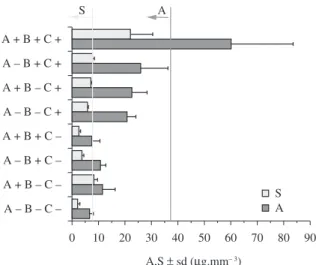
the limits of ISO 4049 standard for the solubility, although the latter fulfill the standard for the absorption.
The general results obtained for the C8 bone cement formulation with values which exceed the limits of ISO 4049 standard, A = 60 µg.mm–3 and S = 22 µg.mm–3, should be induced by the high load content. This formulation has 60% of load distributed in 30% of hydroxyapatite (HA 3 in this case, less soluble than HAP-200 and with more particle aggregate, Figure 2) and 30% of calcium carbonate[10]. Moreover, the contribution of the load-matrix interface cannot be discarded due to the loads were no treated superficially. The relation between mechanical properties and absorption and solubility is inverse, it means, when the mechanical properties is higher the absorption and solubility diminish, so the increment of load content (rise the mechanical properties) beyond certain limits cause a decrease in absorption and solubility. In certain time instant, the combined effect of the matrix-load interface cause a failure in the bone cement structure (the matrix no support more filler) and subsequently an increase of the absorption and solubility[11].
In case of solubility, besides C8, the sample C2 exceeds the limits of ISO 4049 standard. This phenomenon can be related with the high load content, because this formulation also presents a 60% of hydroxyapatite and calcium carbonate. It would be an important notice with respect to the matrix-load interface that a superficial treatment improves its adhesion, and subsequently the mechanical properties, which are the main characteristics of the bone cements.
The statistical results obtained for these studies support the discussion above. The equations obtained for both properties were:
A = 20 + 5 A + 5 B + 11 C + 5 D + 5 B *C (4)
S = 7.4 + 2.6 A + 3.2 C + 2.6 D + 2.6 B*C (5)
The R2 value for the absorption (A) was 90.58% and for solubility (S) was 81.40%, in both cases with α = 0.05.
The Equations 4 and 5 shows a good agreement with the chemical explanation of the phenomena that occurs during the polymerization process and considers the absorption and solubility capacity of the bone cements.
According to the equations above described, the most influent variable was C (hydroxyapatite type) as discussed previously, followed by the matrix composition, load content (A) and the inclusion or not of calcium carbonate (D).
Absorption and solubility
The water absorption (A) and solubility (S) are parameters that should be controlled in bone cements and in the composites in general. In the bone tissue environment, despite the low fluids circulation, bone cement may absorb water or those fluids and release unreacted monomers, initiator, catalysts, etc, soluble in the aqueous media.
The water sorption and solubility of bone cements are shown in the Figure 1. All the results were compared with the ISO 4049 standard, related with dental products. The latter is done because there are not regulation norms for bone cements and, in addition, because the similarity of the mechanical properties of dental products and bone cements.
The lower water absorptions and solubility of the bone cements is due mainly to the hydrophobic character of the polymer (PMMA) and to the lack of absorption capacity and insolubility of the loads content, especially hydroxyapatite, since the calcium carbonate is a little more soluble than this ceramic. According to the regulation (ISO 4049), as shown at Figure 1, in order to be suitable for clinical use, the formulations must absorb less than 40 µg.mm–3 of water and less than 7.5 µg.mm–3 in case of solubility.
All the formulations of bone cements studied fulfill this standard except for the sample C8. Besides, this formulation and C2 exceeds
Figure 1. Absorption and solubility for all prepared bone cement formulations.
the composition; rather than the most influent variable was the hydroxyapatite type, which establishes a difference between the four top curves (HAP-200) and the other four curves at the bottom (HA 3). The better packaging of the bone cements with HAP-200 loads is due to the better particle size distribution with a very low number of aggregates. This fact leads to the better manufacturing of cement paste and, finally, a best bone cement formulation.
The initial weight loss, in general, could be attached to the release of residual monomers in the surface of the specimens. It can be concluded that the degradation percentage do not exceed 5% (except C7 and C8 formulations) in the tested periods as we can see at Figure 4, which allows assuming that the developed bone cements will kept its support structure for a long period of time although enzymatic hydrolysis will contribute to accelerate the degradation process in the cements.
The statistical response obtained for degradation (R2 = 95.70%, α = 0.05) confirm the conclusions above. For this analyzing property the Eq. was as follows:
Deg = 4.1 + 1.8 C + 1.0 D + 1.3 B *C (6)
According to the coefficient value, the most influent variable was C (hydroxyapatite type) as discussed above, followed by the inclusion or not of calcium carbonate (D), due to its higher solubility in comparison with hydroxyapatite. The small particles aggregate of calcium carbonate can pass through the fluids and create porosity that influence in the degradation of the bone cement.
Bioactivity tests
The aim of this test is to verify the possible formation of an apatite layer on the surface of the new bone cement formulations, promoted by the presence of the hydroxyapatite and calcium carbonate particles inside the matrix[12].
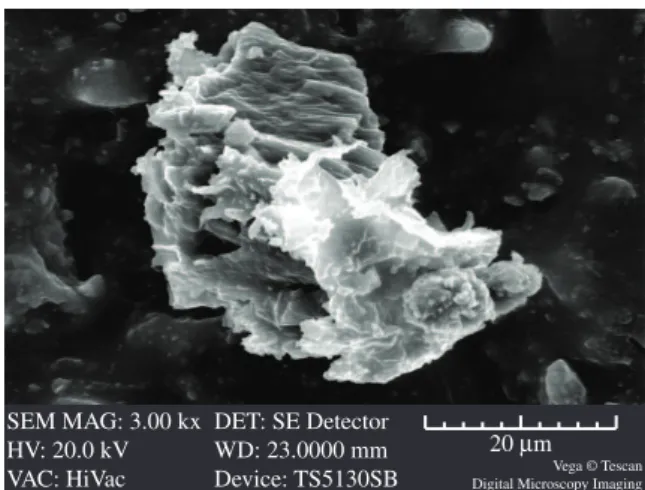
The eventual formation of a Ca-P layer will indicate that the material may present a bone-bonding behavior in-vivo. Figure 5 shows the SEM photograph of the C2 formulation used as control. White points can be observed from the hydroxyapatite and calcium carbonate employed as loads.
All the bone cements formulations exhibited a bioactive behavior according with the load composition. The bone cements with higher load content, C2 and C8, have coincidentally the worst formulations according to the absorption and solubility parameters, and also have the greatest bioactive behavior. The rest of the cements were also bioactive, but in less extension due to the low content of hydroxyapatite and/or calcium carbonate.
Figure 3. Percentage of weight loss versus time.
Figure 4. Final percentage of degradation.
Figure 5. Scanning electron micrograph of C2 bone cement formulation used as control; magnifications: ×1000.
Figure 6. Scanning electron micrograph of C2 bone cement formulation after 15 days of immersion in SBF solution; magnifications: ×3000.
Degradation
The degradation process should have a high importance in these formulations because it will be ideally associated with the formation of the new tissue. This should allow the cement to maintain the support structure of the cemented system, while occurs the growth of new tissue. In this sense, the incorporation of two calcium suppliers, the more soluble calcium carbonate and less soluble hydroxyapatite will be responsible for both processes to occur ideally at the same time.
The variables “type of hydroxypatite” and “inorganic load content”, as well as the interaction between “type of hydroxypatite” and “particles size”, presented the more significant influence on the absorption, solubility and degradation parameters.
The in vitro formation of apatite structure on the surface of the materials is an indication of the potential bone bonding ability of the developed bone cements.
References
1. Morejón, L.; Mendizábal, E.; Delgado, J. A.; Davidenko, N.; López, D. F.; Manríquez, R.; Ginebra, M. P.; Gil, F. J. & Planell, J. A. - Latin Am. Appl. Res.,35, p.175 (2005).
2. Virto, M.; Frutos, P.; Torrado, S. & Frutos, G. - Biomaterials, 24, p.79 (2003). http://dx.doi.org/10.1016/S0142-9612(02)00254-5
3. López, M. - Rev. CENIC Cienc. Quim., 37, p.77 (2006).
4. Silva, P.; Albano, C.; Perera, R. & Domínguez, N. - Radiat.
Phys. Chem., 79, p.358 (2010). http://dx.doi.org/10.1016/j.
radphyschem.2009.08.023
5. González, G. - “Procedimiento técnico PTPP.01” (2011).
6. González, R. & Melo, M.C.- “Procedimiento para la obtención de hidroxiapatita para uso cromatográfico”, Patente CU 22180 A1 (1996). 7. International Organization for Standardization. - “ISO 4049:
Dentistry - Polymer-based filling, restorative and luting materials, International Standard Organization”, 3rd ed, ISO (2000).
8. Mack, E. J.; Okano, T. & Kim, S. W. - “Hydrogels in medicine and
pharmacy-polymers”, Boca Raton, USA (1988).
9. Haas, S. S.; Brauer, G. M. & Dickson, M. A. - J. Bone Joint Surg., 57, p.380 (1975).
10. López, M.; Fuentes, G.; González, R.; González, J.; Peón, E. & Toledo, C. - Latin Am. Appl. Res., 38, p.228 (2008).
11. Veranes, Y.; Correa, D.; Martin, J. M.; Krael, R. & Alvarez, R. - Latin Am. Appl. Res., 36, p.1 (2006).
12. Espigares, I.; Elvira, C.; Mano, J.; Vazquéz, B.; San Román, J. & Reis, R. - Biomaterials, 23, p.1883 (2002). http://dx.doi.org/10.1016/S0142-9612(01)00315-5
13. Reis, R.L.; Cunha, A.M.; Fernandes, M.H. & Correia, R.N. – J. Mater. Sci.: Mater. Med., 8, p. 897 (1997).
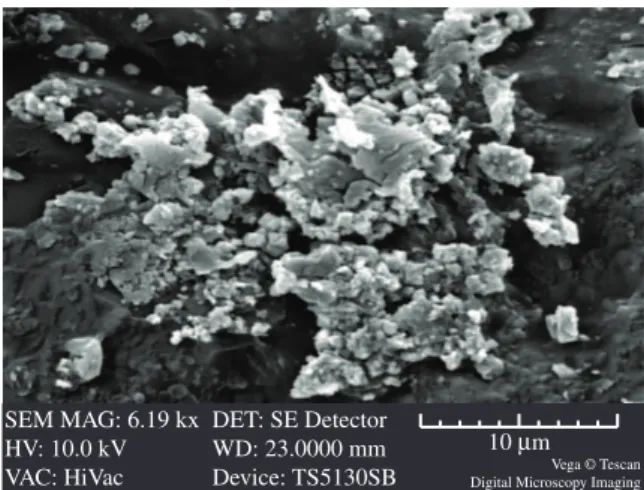
Enviado: 27/09/11 Reenviado: 08/12/11 Aceito: 10/12/11 Figure 6 shows a micrograph of C2 formulation at 15 days of
immersion in SBF. It can be observed the so called “cauliflower” morphology, formed by small needle-like Ca-P crystals[13]. These structures are typical of the bioactive surfaces after the mentioned period of soaking in this supersaturated solution. From the obtained results it can be concluded that the formulations with HA and calcium carbonate amounts of at least 30% allows to form an apatite layer on their surfaces and are expected to confirm an in vivo bone-bonding nature to the cements.
Figure 7 shows the formation of great apatite nucleation points which lead to think in layer deposition on the material surface. This formation can be clearly observed at 30 days of immersion. The observed behavior can be attributed to the particles near to the polymer surfaces, which creates nucleation sites for the formation of calcium phosphate layers.
Conclusions
The bone cement formulations developed in this paper fulfill the requirements of ISO 4049 standard for the absorption property (6.73-25.95 µg.mm–3), except for C8. In the case of solubility, formulations C2 and C8 do not comply with this requirement while the values of other composites range from 2.17 to 7.5 µg.mm–3. The final average value obtained for the degradation of the composites was 4.1 ± 0.6%, which suggests that the bone cements could maintain their structural support for a long period of time.