Abstract
This paper assesses the effectiveness of the NRM-20 as a guideline and a enforce-ment tool to mine closure in Brazil; assesses the analysis criteria and approval proce-dures adopted by DNPM to base their decisions on mine closure issues, and looks for gaps in the NRM-20 regarding technical, legal, environmental and socio-economic issues. The study was based on administrative mining proceedings deposed DNPM of Minas Gerais. Were assessed 32 mining proceedings. The study shows clear evidence that DNPM does not have speciic criteria to guide the technical analysis of the closure plans required for, which makes the analysis subject to a personal interpretation. This study supports the conclusion that after twelve years of its publication, the NRM-20 lacks in proper regulating and guiding mine closure in Brazil.
Keywords: mine closure; NRM-20; DNPM.
Resumo
Esse artigo avalia a eicácia da NRM-20 como uma diretriz e um instrumen-to de execução do fechameninstrumen-to de mina no Brasil. Avalia os critérios de análise e procedimentos de aprovação adotados pelo DNPM, para basear suas decisões so-bre questões de fechamento de minas, e procura por falhas na NRM-20, em relação a questões técnicas, legais, ambientais e socioeconômicas. O estudo baseou-se em processos administrativos de mineração depositados no DNPM de Minas Gerais. Foram analisados 32 processos de mineração. O estudo mostra que o DNPM não tem critérios especíicos para orientar a análise técnica dos planos de fechamento, o que torna o tema de análise uma interpretação pessoal. Esse estudo permite concluir que, após doze anos de sua publicação, a NRM-20 carece de protocolos de análises e de diretrizes que orientem o fechamento de minas no Brasil.
Palavras-chave: fechamento de mina; NRM-20; DNPM.
An assessment of NRM-20 as
a guideline and as an enforcement
tool to mine closure in Brazil
Avaliação da NRM-20 como diretriz e como
instrumento de implemento do fechamento
da mina no Brasil
Hernani Mota de Lima
Prof. Associado da Universidade Federal de Ouro Preto - Escola de Minas,
Departamento de Engenharia de Minas Ouro Preto - Minas Gerais - Brazil [email protected]
José Cruz do Carmo Flores
Prof. Adjunto da Universidade Federal de Ouro Preto - Escola de Minas - Departamento de Engenharia de Minas
Jardel Carvalho Dias
MSc. em Engenharia Mineral pela Universidade Federal de Ouro Preto. Departamento Mineral de Produção Mineral (DNPM/Brasília)
Brasília - Distrito Federal - Brazil [email protected]
Mining
Mineração
Mine closure characterizes the permanent cessation of operations by a company at a mine site after ore reserve depletion and encompasses the completion of the decommissioning and rehabilitation process. However, mine closure is also temporarily considered
with the suspension of mining opera-tions at an indeinite time in function of economic and environmental problems, among other reasons (RESENDE e LIMA, 2009; SÁNCHEZ, 2011).
Mine closure is seen as an inevi-table and problematic consequence of
the nature of the mining industry. The public image of mining is still one of abandoned mine sites and lasting envi-ronmental liabilities. In addition to this legacy, mine closure has caused social and economic disruption in mining regions. Responsible planning for mine
1. Introduction
closure and rehabilitation of mine sites are major on-going issues for the min-ing industry around the world. Many countries have developed regulatory systems and guidelines which now re-quire mining companies to deal with the challenge of controlling environmental and legal liabilities associated with clo-sure (AUSTRALIA, 2011; SÁNCHES
et al., 2013).
In Brazil, before 2001, the basic obligation imposed on the mining con-cession holder, related to mine closure, was to rehabilitate the mined area ac-cording to Plan for Rehabilitation of Degraded Areas (PRAD) approved by the competent environmental agency. Generally, statutory requirements are generic and narrow. Those required for a PRAD state: “the PRAD must consider the suitable technical solution visualized by the mining company to rehabilitate
the area, eventually degraded by mining activity, for future use” (LIMA et al.,
2006). However, the scope of issues that is being considered in mine closure has expanded beyond the more traditional view of site rehabilitation. A comprehen-sive programme for mine closure would address the following six major areas of mining impacts: on physical resources, on biological and ecological resources, on alternate use values, on quality of life, on social and cultural values, and on sustainable economic development.
The Brazilian Mining Code deines mining as the set of operations required for mining a mineral deposit. In order to obtain a Mining Permit, such operations should be presented in an Economic Exploitation Plan (PAE, Portuguese Acronym), which should demonstrate the technical and economic feasibility of mining a deposit. In the year 2001, the
DNPM's Director enacted the Mining Regulation Norms (NRM), which are called NRM-20, and deal with min-ing suspension and closure (FLORES e LIMA, 2007). Since 2002, the inclusion of a mine closure plan in the PAE has been a requirement, as the NRM-20.
The lack of government guidelines for the evaluation of PAE focused on a mine closure plan has been studied by (RESENDE et al., 2010).
The main purposes of this pa-per are: to present an assessment on the effectiveness of the NRM-20 as a guideline and a enforcement tool for mine closure in Brazil; to evaluate the analysis criteria and approval proce-dures adopted by DNPM to base their decisions on mine closure issues; and to look for gaps in the NRM-20 regard-ing technical, legal, environmental and socio-economic issues.
2. Methodology
In order to assess the compliance of the mine closure plans presented by mining companies to DNPM when
applying for mining rights and the procedures adopted by DNPM to base their decisions on mine closure issues, a
checklist was prepared based on NRM-20. The methodology used for this study comprised of creating a checklist based
Table 1
Ranking of the most important mining municipalities located in the Quadrilátero Ferrífero based on the mining royalties (CFEM) of 2011.
Municipality Total (100%)* Total (65%) NOVA LIMA 119,419,514.10 77,622,684.17
ITABIRA 118,150,100.79 76,797,565.51 MARIANA 98,812,313.42 64,228,003.72 SÃO GONÇALO DO RIO ABAIXO 90,828,126.72 59,038,282.37 ITABIRITO 59,489,357.32 38,668,082.26 BRUMADINHO 53,806,448.15 34,974,191.30 CONGONHAS 52,644,913.57 34,219,193.82 ITATIAIUÇU 24,690,096.78 16,048,562.91 OURO PRETO 22,238,936.23 14,455,308.55 BARÃO DE COCAIS 22,144,903.11 14,394,187.02 SANTA BÁRBARA 13,929,007.24 9,053,854.71 SABARÁ 8,768,162.93 5,699,305.90 CATAS ALTAS 8,655,719.30 5,626,217.55 SARZEDO 5,117,672.42 3,326,487.07 MATEUS LEME 4,563,053.86 2,965,985.01 ITAÚNA 3,178,799.79 2,066,219.86 SÃO JOAQUIM DE BICAS 3,152,046.59 2,048,830.28 IGARAPÉ 2,099,018.93 1,364,362.30 BELO VALE 746,409.06 485,165.89 CONSELHEIRO LAFAIETE 619,330.37 402,564.74 BETIM 418,401.64 271,961.07 IBIRITÉ 418,353.46 271,929.75 CAETÉ 374,934.91 243,707.69 RIO ACIMA 334,633.65 217,511.87 SANTA LUZIA 241,879.15 157,221.45 BELO HORIZONTE 181,818.70 118,182.16 ESMERALDAS 99,086.80 64,406.42 MÁRIO CAMPOS 40,323.95 26,210.57 RIO MANSO 705.57 458.62
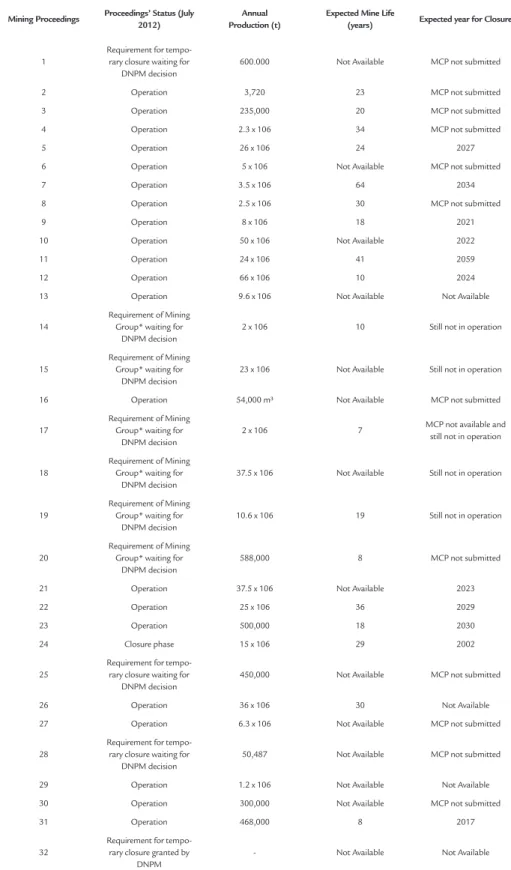
Table 2 Mining Proceedings’ Status in terms of the Mine Closure Plan
Mining Proceedings Proceedings’ Status (July 2012)
Annual Production (t)
Expected Mine Life
(years) Expected year for Closure
1
Requirement for tempo-rary closure waiting for
DNPM decision
600.000 Not Available MCP not submitted 2 Operation 3,720 23 MCP not submitted 3 Operation 235,000 20 MCP not submitted 4 Operation 2.3 x 10⁶ 34 MCP not submitted 5 Operation 26 x 106 24 2027 6 Operation 5 x 10⁶ Not Available MCP not submitted 7 Operation 3.5 x 10⁶ 64 2034 8 Operation 2.5 x 10⁶ 30 MCP not submitted 9 Operation 8 x 10⁶ 18 2021 10 Operation 50 x 106 Not Available 2022 11 Operation 24 x 106 41 2059 12 Operation 66 x 106 10 2024 13 Operation 9.6 x 10⁶ Not Available Not Available 14
Requirement of Mining Group* waiting for
DNPM decision
2 x 10⁶ 10 Still not in operation 15
Requirement of Mining Group* waiting for
DNPM decision
23 x 106 Not Available Still not in operation 16 Operation 54,000 m³ Not Available MCP not submitted 17
Requirement of Mining Group* waiting for
DNPM decision
2 x 10⁶ 7 MCP not available and still not in operation 18
Requirement of Mining Group* waiting for
DNPM decision
37.5 x 10⁶ Not Available Still not in operation 19
Requirement of Mining Group* waiting for
DNPM decision
10.6 x 10⁶ 19 Still not in operation 20
Requirement of Mining Group* waiting for
DNPM decision
588,000 8 MCP not submitted 21 Operation 37.5 x 10⁶ Not Available 2023 22 Operation 25 x 106 36 2029 23 Operation 500,000 18 2030 24 Closure phase 15 x 106 29 2002 25
Requirement for tempo-rary closure waiting for
DNPM decision
450,000 Not Available MCP not submitted 26 Operation 36 x 106 30 Not Available 27 Operation 6.3 x 10⁶ Not Available MCP not submitted 28
Requirement for tempo-rary closure waiting for
DNPM decision
50,487 Not Available MCP not submitted 29 Operation 1.2 x 10⁶ Not Available Not Available 30 Operation 300,000 Not Available MCP not submitted 31 Operation 468,000 8 2017 32
Requirement for tempo-rary closure granted by
DNPM
- Not Available Not Available MCP = Mine Closure Plan
on NRM-20 requirements and compare these with the information presented in the selected mine closure plans. This assessment considered technical, legal, environmental, social and economics issues regarding mine closure.
The study was conducted on ad-ministrative mining proceedings deposed in the 3rd District of National
Depart-ment of Mineral Production (DNPM)
located in the Minas Gerais State. To se-lect the mine closure plans for this study, a ranking of the most important mining municipalities located in the Quadri-látero Ferrífero based on the mining
royalties (CFEM) of 2011 was created (Table 1) and then the municipalities that had revenues over R$10 million in this year were selected. In these municipali-ties, the mines with the greatest
3. Results and discussions
The general characteristics of the presented mine closure plans were as-sessed by applying a checklist composed
of items such as cost estimates, updating the plan and socio-economic impacts of mine closure among others
require-ments of the NRM-20.
The following results were achieved:
Closure Plan Update
The NRM-20 states that the clo-sure plans should be updated periodical-ly, as appropriate, and be available for inspection at the mine sites. However, the standard does not set the deadline
for the review and the level of detail of these plans.
The update details of the plans and mine closure are at the discretion of the entrepreneur only. According to
the assessment, only 7 of the 19 clo-sure plans iled demonstrate an update schedule planning. Fourteen of the plans mentioned an update, without, however, presenting a schedule of periodicity.
Only 5 plans presented an estimate of mine closure costs.
They can be categorised as: Min-ing ProceedMin-ing number 5 (R$ 68 M),
number 7 (R$ 8 M for the last year of life of the mine), number 15 (US$ 78 M), number 21 (R$ 21 M) and number 24 (R$ 42 M).
None of the mine closure plans, as listed in the mining proceedings, in-clude the closure costs in the cash low of the project.
Does the plan include the socioeconomic impacts of mine closure?
Does the plan include the socioeconomic impacts of mine closure?
The NRM - 20 does not require studies of the socioeconomic impacts of mine closure. However, 5 of the assessed processes mentioned economic and social goals they hope to achieve at the end of the mine closure process. The remaining mining proceedings showed no consider-ation under the socioeconomic aspects of mine closure.
For the approved mine closure processes, has DNPM conducted on-site visits to check and monitor the implemen-tation of the closure plan?
From the 19 mining proceedings that contain a mine closure plan accord-ing to NRM-20, 11 had the closure plan assessed by DNPM. However, in only one area (number 24) has DNPM conducted an analysis for veriication of the compli-ance of the submitted closure plan. It also found occurrence of a DNPM survey at number 32. Nevertheless, the objective was to conduct a preliminary inspection for the issuance of temporary suspension of their mining activities. However, the closure plan for this Mining Proceeding (number 32) had not yet been approved. The lack of enforcement denotes the lack of DNPM infrastructure to fulil its responsibility as the agency responsible
for mining control in the country. As for the answers to the questions: Is the preparation of the inal design for the closure of the mine expected? And what is the expected time for the monitoring and maintenance work in the post-closure? The checklist allowed identifying gaps in NRM-20, which should be addressed in a future revision of the regulatory norm regarding mine closure that emanates from the Federal Government Agency.
a. The NRM–20 does not distin-guish between the conceptual closure plan – to be presented at the time of application for mining – and the inal closure plan to be submitted to DNPM near the end of the mine life.
b. The NRM–20 does not establish when the inal design for mine closure should be presented.
c. The NRM–20 does not establish a minimum time period for post-closure monitoring and maintenance activities nor does it present basic guidelines for such a procedure.
d. According to NRM–20, "every mine that does not have a mine closure plan contemplated in its PAE, at the dis-cretion of DNPM Director is required to
submit the plan ... ", together with a state-ment to DNPM advising the beginning of the mine decommissioning. As shown, NRM–20 places that requirement very generally. As a result, mining companies may be induced not to consider the mine closure planning in the medium and long term mine planning, which may lead to damaging results – not only for the en-vironment, but also for society and the sustainability of the mining industry.
Given the conceptual nature of the plans submitted, the analysis of processes allowed to observe that companies hold-ing mineral rights on several mines have adopted the same plan for over a mine, even though they are located in different sites, diverse ecosystems and distinct socioeconomic specificities. This fact was observed in the mining proceed-ings (5 and 21); (9, 11 and 13); and (23 and 29). Under the NRM-20 items that must be included in a mine closure plan are listed in Section 20.4.1, from point “a” to “o”. Following is presented a comparative summary of the 11 mine closure plans reviewed and approved by DNPM according to NRM–20 for the points considered by the authors as the most relevant to mine closure.
Report on mine closure activities performed (point a)
Tw o m i n i n g p r o c e e d i n g s whose mines are already in the clo-sure stage presented reports of the
activities performed.
If the mine closure should be understood as an integral phase of the
mine life information about closure activities, it should be part of routine reporting for the mine.
For this study, 32 mining proceed-ings from the Mining Register of DNPM/ MG were selected and analysed. Of these proceedings, only 19 iled the closure plan
as required by DNPM NRM-20. Table 2 summarizes the status of the proceedings/ mines at the time of this study regarding: the mine production, the expected life as
General map of the mine showing the reclaimed and to be reclaimed areas, disposal sites for organic soil, waste
dumps, tailings dams, roads and other mine components (point e)
The majority of submitted plans met this “point e”. This fact is justi-ied since this is a requirement of the Environmental Impact Control Plan. Also observed is a high rate of compli-ance for questions involving aspects of
environmental control in mining, such as monitoring programmes relating to drainage waters (point f, IV), plan to control the pollution of soil, air and water resources (point g), and control of efluent discharge (point h), among
others. This high rate of compliance relects the level of demand and the ac-tual practice of surveillance carried out by the environmental agency as well as the best available practices adopted by mining companies.
Measures to prevent access to the mine site of unauthorized people and barriers to restrict access to hazardous
areas (point i)
Among the 11 plans reviewed and approved by DNPM, only 2 met
this requirement.
This draws attention to the low
preoccupation with security issues in the stage of mine closure.
Aptitude and intention of future use of the mine site (point l)
Among the 19 cases that presented the Mine Closure Plan, 9 have proposals
for the post-closure use of the mined area. From the 11 cases reviewed and approved
by DNPM only four have submitted pro-posals for future use.
Physical and financial schedule of proposed mine closure programmes (point o).
Among the 19 cases iled in DNPM, only 3 presented the physical and inan-cial schedule of the mine closure plan, being part of the 11 that were reviewed and not yet approved. Even considering the dificulties of estimating and schedul-ing at the conceptual phase of a closure plan, a mine closure plan is required to demonstrate that it is technically and economic feasible (LIMA e WATHERN, 1999; AUSTRALIA, 2011).
Some aspects observed by this study of the technical criteria adopted by DNPM for assessing the 11 mine closure plans iled are highlighted:
1. In the mining proceedings of numbers 5 and 21, the technical analysis
states that the Mine Closure Plan just having been successfully submitted. However, they do not make a detailed analysis of the content of these plans.
2. In the mining proceedings 7, 9, 23 and 29, the technical analysis makes no reference to the Mine Closure Plan but recommends the approval of the Plan of Economic Exploitation – which implies the tacit approval of the mine closure plan in PAE.
3. In the numbers 10, 12 and 26, the technical analysis states only parts of the text of the closure plan and lists the process pages dealing with closure. However, there are no opinions about the quality of the plans submitted.
4. In the mining proceeding num-ber 11, a detailed technical analysis of the mine closure plan concerning the remaining ore reserve and the use of the pit for tailings disposal was made. However, an updated PAE was presented but not yet analysed.
5. In the mining proceeding 24, a detailed technical analysis of the Mine Closure Plan was made, and the techni-cal manager suggested the formulation of a demand to the company to improve the statement of the case. Such a require-ment, however, was not published for information of the company and the process was not running at the time of this study.
4. Final considerations and recommendations
The Regulatory Standard Min-ing (NRM-20) has the merit of beMin-ing a pioneer in the government's decision to regulate the mine closure at the Federal level. In addition, that decision is in line with the emerging trend in the major mining countries all over the world. Ac-cording to NRM–20, a mining company should communicate to the Ministry of Mines and Energy when a mine is about to enter the closure process, justifying the reasons of closure and presenting a clo-sure plan. Additionally, for new mines, a closure plan must be contemplated in the plan for economic exploitation (PAE) and must be presented along with the application for exploitation.
This study found that mining
companies are using plans drawn up for other mines to guide the development of plans for their mines. For the authors, the mining companies are looking for compli-ance with the obligation to submit their closure plan and since there is no techni-cal support for the DNPM staff to assess the submitted mine closure plans, these laws are not perceived and considered by DNPM.
The authors also observed that the assessment of the closure plans in DNPM is based on the discretionary nature of the technician in charge. This allows two interpretations. The irst is that, to date, DNPM does not have a qualiied and trained staff for assessment of mine closure plans submitted to it; to make
on-site inspection of the mines that are in the closure process, and after closure, to follow through with periodic reports and technical visits to closed sites, the evolu-tion of the reclamaevolu-tion measures and the monitoring and maintenance steps. The second is the absence of guidelines and protocols to guide the technical staff of the agency in analysing the mine closure plans iled. Therefore, the irst, or the second, or both interpretations make it dificult to substantiate statements like: “the closure plan has been prepared, submitted and approved successfully according to NRM-20”, or “the mine closure plan meets the basic requirements of the NRM-20”, or “the plan submit-ted to DNPM was not approved since it From the 19 mine closure plans iled
in DNPM, only 6 deal with the
decommis-sioning plan of facilities and equipment. From the 11 cases effectively analysed
and approved by DNPM, 9 showed no such plan.
does not meet the basic requirements set by DNPM”.
It was observed, in some cases, that the submission is enough to justify the continuity of a mine operation. Therefore, the NRM-20 is deicient and does not fully meet the current conception of what is understood as technically correct, envi-ronmentally safe, socially acceptable and
economically and inancially manageable by mining companies, for the time of closure of a mine.
The authors recommend that for the mine closure to be technically feasible, environmentally satisfactory, meeting the principles of sustainable development, and ensuring the sustainability of mining, DNPM needs to implement a policy that
includes the creation of a team dealing with mine closure issues, to adopt guide-lines and protocols for assessment mine closure plans. It is also recommended that an agreement between DNPM and the States Environmental Agencies be made in order to avoid duplication of requirement increase of bureaucracy and slowness of the assessment.
5. References
AUSTRALIA. Guidelines for Preparing Mine Closure Plans. DMP e EPA,2011. 78 p.
FLORES, J. C. C., LIMA, H. M. Mine closure: legal and socioeconomic issues in Brazil. Mine Closure Seminar, 2007, Santiago, Chile. ACG Australian Centre for Geomechanics, p.500-510.
LIMA, H. M, WATHERN, P. Mine closure: a conceptual review. Mining Enginee-ring, v. 51, n. 11, p. 41-45, 1999.
LIMA, H. M. D., FLORES, J. C. D. C., COSTA, F. L. Plano de recuperação de áreas degradadas versus plano de fechamento de mina: um estudo comparativo.
Rem:Revista Escola de Minas, v. 59, p. 397-402, 2006. ISSN 0370-4467.
Dis-ponível em: < http://www.scielo.br/scielo.php?script=sci_arttext&pid=S0370--44672006000400008&nrm=iso >.
RESENDE, A. G., LIMA, H. M. D. Análise das concessões de lavra quanto às suspensões temporárias de operação. Rem: Revista Escola de Minas, v. 62, p.
539-544, 2009. ISSN 0370-4467. Disponível em: < http://www.scielo.br/scielo. php?script=sci_arttext&pid=S0370-44672009000400019&nrm=iso >.
RESENDE, A. G., LIMA, H. M. D., FLÔRES, J. C. D. C. Análise do plano de fe-chamento de mina no plano de aproveitamento econômico de uma jazida - uma exigência da NRM-20. Rem: Revista Escola de Minas, v. 63, p. 685-690, 2010.
ISSN 0370-4467. Disponível em: < http://www.scielo.br/scielo.php?script=sci_ arttext&pid=S0370-44672010000400014&nrm=iso >.
SÁNCHES, L. E., SILVA-SÁNCHES, S. S., NERI, A. C. Guia para o planejamento do fechamento de mina. Brasília: Instituto Brasileiro de Mineração, 2013. 224 p.
Disponível em: < http://www.ibram.org.br >.
SÁNCHEZ, L. E. Planejamento para o fechamento prematuro de minas. Rem:
Revista Escola de Minas, v. 64, p. 117-124, 2011. ISSN 0370-4467.
Dispo-nível em: < http://www.scielo.br/scielo.php?script=sci_arttext&pid=S0370--44672011000100016&nrm=iso >.