Po lysilo xane /PVA-glutaralde hyde
hybrid co m po site as so lid phase fo r
im m uno de te ctio ns by ELISA
1Laboratório de Imunopatologia Keizo Asami and Departamento de Bioquímica,
Universidade Federal de Pernambuco, Recife, PE, Brasil
2Laboratório de Q uímica do Estado Sólido,Departamento de Q uímica Fundamental,
Universidade Federal de Pernambuco, Recife, PE, Brasil
3Centro de Pesquisas Aggeu Magalhães, FIO CRUZ, Recife, PE, Brasil
A.E. Lima Barros1,
A.M.P. Almeida3,
L.B. Carvalho Jr.1
and W.M. Azevedo2
Abstract
We developed an efficient method to prepare a hybrid inorganic-organic composite based on polyvinyl alcohol (PVA) and polysiloxane using the sol-gel disc technique. Antigen obtained from Yersinia pestis was covalently immobilized onto these discs with glutaralde-hyde and used as solid phase in ELISA for antibody detection in serum of rabbits experimentally immunized with plague. Using 1.25 µg antigen per disc, a peroxidase conjugate dilution of 1:4,000 and a serum dilution of 1:200 were adequate for the establishment of the procedure. These values are similar to those used for PVA-glutaralde-hyde discs, plasticized filter paper discs and the polyaniline-Dacron composite discs. This procedure is comparable to that which utilizes the adsorption of the antigen to conventional PVC plates, with the amount of antigen being one fourth that employed in conventional PVC plates (5 µg/well). In addition to the performance of the polysiloxane/PVA-glutaraldehyde disc as a matrix for immunodetec-tion, its easy synthesis and low cost are additional advantages for commercial application.
Co rre spo nde nce
L.B. Carvalho Jr.
Laboratório de Imunopatologia Keizo Asami, UFPE 50670-420 Recife, PE Brasil
Fax: + 55-81-271-8485 E-mail: lbcj@ npd.ufpe.br Research supported by CNPq/ CTPETRO (No. 463655/001) and the Japan International Cooperation Agency (JICA).
Received May 22, 2001 Accepted February 6, 2002
Ke y wo rds ·Polysiloxane ·Polyvinyl alcohol ·Solid phase
·Immunodetection
·Yersinia pestis
·ELISA
The alkoxide sol-gel process is an effi-cient method to prepare silica glass by the hydrolysis of alkoxysilane precursors and by subsequent condensation of the remaining silanols, followed by aging and drying under ambient atmospheres and sintering. The hy-drolysis and polycondensation of tetraethoxy-silane is as follows:
Si(OEt)4Hydrolysis n(EtO)xSi(OH)y-x
Polycondensation
(SiO2)n
The advantages of this technique are the homogeneity and purity of the gels and a relatively low sintering temperature. Such
an excellent optic, thermal, and chemical stability of the host silicon oxide matrices.
Hybrid inorganic-organic composites de-rived by sol-gel processing are materials that can potentially be designed for a wide range of applications. Structural diversity is achieved by controlling the relative ratio of organic versus inorganic content, the level of structural complexity of the organic com-ponent and its chemical nature, the chemical composition of the inorganic precursor mol-ecule, and the reaction condition used to synthesize the composite. Thus, this syn-thetic framework offers the promise of engi-neered multicomponent composite material designed for specific desired applications. Since the surprising discovery of Braun et al. (6) that active protein can be entrapped in a gel matrix without losing its activity, sol-gel-derived glass has emerged as a new class of material well suited for the immobiliza-tion of biomolecules. This inorganic mate-rial is particularly attractive for the fabrica-tion of biosensors since it possesses physical rigidity, chemical inertness and high photo-chemical and thermal stability and experi-ences negligible swelling in aqueous and organic solvents. However, the wettability of some glass materials is not high, and depends on the silica-forming monomers. It is well known that neither highly hydropho-bic nor totally hydrophilic matrices are de-sirable for sensing applications. In the former matrix, the analyte cannot approach the em-bedded enzyme, and the latter exhibits a large background current in amperometric biosensors. When chemical modifiers such as metal dispersion, water-soluble polymers, and proteins were added to the material, the resulting composite became more hydro-philic.
This paper describes the synthesis of small discs of a polysiloxane-polyvinyl alcohol (PVA) composite prepared by the sol-gel technique in order to provide a more bio-compatible microenvironment and a more suitable surface for covalent
immobiliza-tion. A chemical arm was later introduced through the glutaraldehyde molecule by acid catalysis (7). Free chemical groups were still available by which proteins could be
co-valently fixed. Antigen from Yersinia pestis
was used as a model to evaluate the biologi-cal properties of retention of these immobi-lized proteins. Therefore, this antigen-com-posite disc derivative was used in ELISA to detect anti-F1 IgG in serum from immunized rabbit.
Polysiloxane-PVA disc preparation. The hybrid composite was synthesized by pre-paring a mixture of 5 ml tetraethoxysilane (Aldrich, Milwaukee, WI, USA), 5 ml etha-nol (Aldrich) and 6 ml of a 2% (w/v) solution of PVA (MW 72,000, Reagen, Rio de Janeiro, RJ, Brazil). The reagents were carefully added and two or three drops of concentrated HCl were added in order to catalyze the reaction. The solution was stirred for 5 min at 60ºC and aliquots (10 µl) of the mixture were then transferred to microwells of tissue culture plates (disc shape) to complete the reaction. The molds remained closed for 10 days and were then opened until they no longer exhib-ited weight loss due to evaporation of re-sidual water and solvent. The polysiloxane-PVA discs were then kept in 0.067 M so-dium phosphate buffer, pH 7.2, at 4-10ºC until use.
Polysiloxane-PVA sensitization. The polysiloxane-PVA discs were introduced into microwells of tissue culture plates and treated with 2.5% (w/v) glutaraldehyde (Riedel) and
10 mM H2SO4 at 28°C for 1 h and washed
thrice with deionized water.
Antigen immobilization. The polysilox-ane-PVA-sensitized discs were incubated
with 100 µl of F1 antigen (5 µg) from Y.
(Sigma, St. Louis, MO, USA), blocked with 3% (w/v) skim milk (Molico milk, Nestle) in PBS at 4ºC for 12 h, and washed once with PBS/Tween.
ELISA. The blocked antigen disc was incubated at 37ºC for 1 h in 100 µl of PBS-diluted serum (1:200) from immunized and
non-immunized rabbits against Y. pestis
pro-duced at the Centro de Pesquisas Aggeu Magalhães, FIOCRUZ. The preparation was then washed 5 times with PBS/Tween and incubated in 100 µl of goat anti-rabbit IgG conjugated with horseradish peroxidase (Sigma), diluted 4,000 times in PBS at 37ºC for 1 h. Five washings with PBS/Tween were then carried out. The substrate solution (200 µl), consisting of 0.325% (w/v) orthophe-nylenediamine dihydrochloride (OPD,
Sigma) and 0.085% (v/v) H2O2 in 0.3 M
Tris-citrate buffer, pH 6.0, was added and incubated at room temperature (28ºC) for 15 min in the dark. The reaction was stopped
with 2.5 M H2SO4 (25 µl). The discs were
removed and the absorbance of the superna-tant was read at 492 nm with a Microplate reader (model 550; BioRad Laboratories, Hercules, CA, USA). The above procedure was previously standardized by determining optimal conditions with respect to antigen, serum and second antibody conjugate con-centrations. Samples (100 µl) of antigenic solution containing 0.6 to 5.0 µg protein were incubated with the activated discs and the antigen discs obtained were incubated with immunized and non-immunized serum (100 µl) diluted 100 to 800 times. ELISA was then applied to these discs containing increasing amounts of antigen and serum and using conjugate diluted 1:4,000. ELISA using 1.25 µg antigen and serum dilutions of 1:200 established the optimum dilution of goat anti-rabbit IgG conjugated with horse-radish peroxidase.
Titration of goat anti-rabbit IgG conju-gated with horseradish peroxidase using 1.25 µg of F1 antigen, immunized and non-immu-nized sera diluted 1:200 times and PBS as
control, showed that the best dilution was attained at serum dilution 1:4,000.
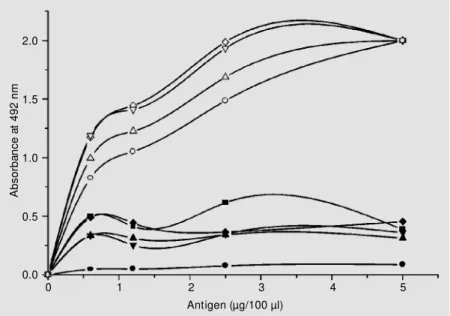
Figure 1 shows the relationship between
the concentration of F1 antigen from Y.
pes-tis immobilized onto the
polysiloxane-PVA-glutaraldehyde composite discs using differ-ent serum dilutions and the absorbance ob-tained with ELISA, using goat anti-rabbit IgG conjugated with horseradish peroxidase diluted 1:4,000 times. Hyperbolic curves were obtained as expected by the nature of antigen-antibody complex formation, which follows the Michaelis-Menten equation for enzyme-substrate complex formation (9). Also, a significant difference in absorbance values was observed when comparing im-munized and non-imim-munized serum, while values close to zero were detected for the control (PBS). From these results one can conclude that 1.25 µg of antigen per com-posite disc is sufficient to standardize the methodology.
Therefore, ELISA using this matrix can be set up as follows: 1.25 µg of F1 antigen
Figure 1. Relation betw een F1 antigen and titration of immune and non-immune rabbit serum in ELISA using polysiloxane-PVA-glutaraldehyde discs. Titration of immune serum diluted 1:100 (open lozenges), 1:200 (open inverted triangles), 1:400 (open triangles), and 1:800 (open circles). Titration of non-immune serum diluted 1:100 (filled squares), 1:200 (filled lozenges), 1:400 (filled inverted triangles), and 1:800 (filled triangles). Control - PBS (filled circles).
A
b
s
o
rb
a
n
c
e
a
t
4
9
2
n
m
1.0 2.0
1.5
0.5
0.0
0 1 2 3 4 5
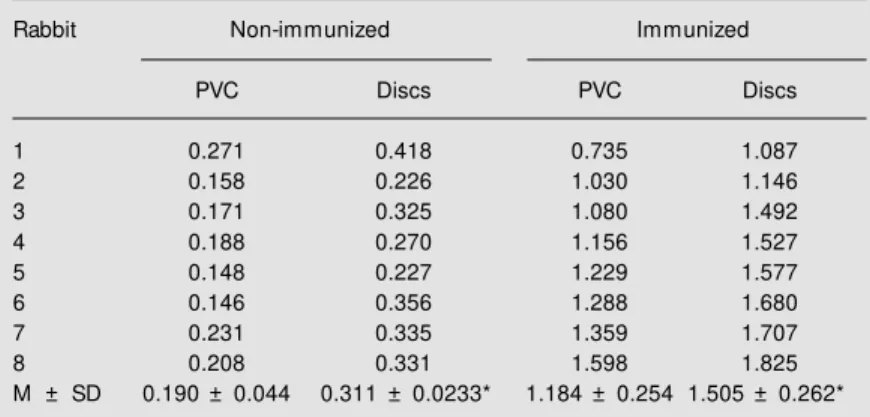
for each composite-glutaraldehyde disc, 1:4,000 conjugate dilution, and 1:200 serum dilution. A comparison between this method and conventional ELISA, based on antigen adsorption onto polyvinyl chloride (PVC) plates, is shown in Table 1. Firstly, regarding the sera collected from immunized rabbits (N = 8), mean values (± SD) of 1.505 ± 0.262 and 1.184 ± 0.254 were calculated for ELISA absorbance using the composite discs and the conventional procedure, respectively. The
independent t-test applied to these mean
val-ues showed no significant difference at the 0.05 level. A linear correlation was observed when the absorbance values for ELISA us-ing composite discs were plotted against those obtained for the conventional proce-dure (r = 0.92662 and P = 0.00093). For the sera collected from non-immunized rabbits (N = 8) mean values of 0.311 ± 0.023 and 0.190 ± 0.044 were estimated for the com-posite discs and conventional ELISA proce-dures, respectively. Briefly, the performance of ELISA with F1 antigen covalently fixed on the polysiloxane-PVA-glutaraldehyde composite discs is comparable to that based on the adsorption of the antigen on PVC plates in the conventional procedure. Fur-thermore, the amount of antigen is one fourth that employed in the conventional PVC plates
(5 µg/well).
Lehtonen and Viljanen (10), studying the concentration of antigen in ELISA for the detection of chicken anti-bovine serum albu-min, used three polymers as solid phase and two immobilization procedures: polystyrene and nylon (adsorption) and cyanogen bro-mide-activated paper (covalent link). There was a noticeable release of the adsorbed antigen during the assay from both polysty-rene (30%) and nylon (60%). Desorption of antigen from activated paper during the assay was lower than with polystyrene or nylon. It is well known that protein release is more likely to occur from adsorbed anti-gens than from covalently linked prepara-tions, particularly under extreme conditions of pH, ionic strength and temperature.
In our laboratories other procedures for antigen covalent immobilization on supports have been proposed such as Dacron (11), ferromagnetic Dacron (12,13), interpen-etrated network of PVA-glutaraldehyde (14-17), filter paper plasticized with PVA-glut-araldehyde (18), and a polyaniline-Dacron composite (19). The optimal values of F1 antigen amount, conjugate dilution and se-rum titer established for the present method (1.25 µg/disc; 1:4,000 and 3,200, respec-tively) can be compared to those found for PVA-glutaraldehyde (1.3 µg/disc; 1:6,000 and 1:12,600), plasticized filter paper (1.25 µg/disc; 1:12,000 and 1:6,400), and poly-aniline-Dacron (2 µg/disc; 1:4,000 and 1:800). Higher values for the plasticized fil-ter paper conjugate dilution and PVA-glu-taraldehyde serum dilution were due to the use of a particular second antibody prepara-tion and immunized rabbit serum, respec-tively.
In addition, the performance of the poly-siloxane-PVA-glutaraldehyde disc as a ma-trix for immunodetection, its easy synthesis and the low cost are additional advantages for commercial application. More than 1,000 discs can be synthesized at a cost of US$ 0.50. The preservation of the biological properties
Table 1. Comparison of ELISA using polysiloxane/polyvinyl alcohol-glutaraldehyde discs and polyvinyl chloride (PVC) as solid phases.
Rabbit Non-immunized Immunized
PVC Discs PVC Discs
1 0.271 0.418 0.735 1.087
2 0.158 0.226 1.030 1.146
3 0.171 0.325 1.080 1.492
4 0.188 0.270 1.156 1.527
5 0.148 0.227 1.229 1.577
6 0.146 0.356 1.288 1.680
7 0.231 0.335 1.359 1.707
8 0.208 0.331 1.598 1.825
M ± SD 0.190 ± 0.044 0.311 ± 0.0233* 1.184 ± 0.254 1.505 ± 0.262*
of this immobilized antigenic preparation, employing the sol-gel discs as the solid phase, presents promising applications to other pro-teins such as enzymes, hormones and recep-tors. This further use of the present support is currently under investigation in our labo-ratories.
Ackno wle dgm e nts
The authors are deeply grateful to Aureci Maria de Araujo and Raquel de Andrade Lima Coêlho for support and encourage-ment.
Re fe re nce s
1. Hench LL & Ulrich DR (1984). Ultrastruc-tureProcessing of Ceramics, Glasses and Composite. John Wiley and Sons, New York, NY, USA.
2. Klein LC (1988). Sol-gel Technology for Thin Films, Fibers, Preforms, Electronics and Specialty Shapes. Noyes, Park Ridge, NJ, USA.
3. Schmidt H (1988). Chemistry of material preparation by the sol-gel process. Jour-nal of Non-Crystalline Solids, 100: 51-64. 4. Boonstra AH & Bernardes JNM (1988).
The dependence of the gelation time on the hydrolysis time in a 2-step SiO2 sol-gel process. Journal of Non-Crystalline Solids, 105: 207-213.
5. Boonstra AH & Baken JM E (1989). Hy-drolysis-condensation reactions of silica gels during autoclave drying. Journal of Non-Crystalline Solids, 109: 1-8. 6. Braun S, Rappoport S, Zusman R, Avnir D
& Ottolenghi M (1990). Biochemically ac-tive sol-gel glasses: the trapping of en-zymes. M aterials Letters, 10: 1-3. 7. Araujo AM , Neves Jr M T, Azevedo WM ,
Oliveira GG, Ferreira Jr DL, Coelho RAL, Figueiredo EAP & Carvalho Jr LB (1997). Polyvinyl alcohol-glutaraldehyde netw ork as a support for protein immobilisation. Biotechnology Techniques, 11: 67-70. 8. Baker EE, Sommer H, Foster LE, M eyer E
& M eyer KF (1952). Studies on
immuniza-tion against plague. I. The isolaimmuniza-tion and characterization of the soluble antigen of Pasteurella pestis. Journal of Immunol-ogy, 68: 131-140.
9. Heyningen V, Brock DJ & van-Heyningen S (1983). A simple method for ranking the affinities of monoclonal anti-bodies. Journal of Immunological M eth-ods, 62: 147-153.
10. Lehtonen OP & Viljanen M KJ (1980). Anti-gen attachment in ELISA. Journal of Im-munological M ethods, 34: 61-70. 11. M ontenegro SM L, Silva JDB, Brito M EF
& Carvalho Jr LB (1999). Dot enzyme-linked immunosorbent assay (dot-ELISA) f or schist osom iasis diagnosis using Dacron as solid-phase. Revista da Socie-dade Brasileira de M edicina Tropical, 32: 139-143.
12. Carneiro Leão AM A, Carvalho Jr LB & M alagueño E (1994). The use of ferro-magnetic Dacron as solid-phase in en-zyme immunoassays. M emórias do Insti-tuto Osw aldo Cruz, 89: 189-193. 13. Pinheiro SM P, Carvalho Jr LB & Chaves
M EC (1999). The use of ferromagnetic Dacron as solid-phase in chemilumines-cent assays. Biotechnology Techniques, 13: 919-922.
14. Araujo AM , Petribú ATS, Barbosa GHTS, Diniz JRP, Almeida AM P, Azevedo WM , M alagueño E & Carvalho Jr LB (1996).
The use of polyvinyl alcohol glutaralde-hyde as solid-phase in ELISA for plague. M emórias do Instituto Osw aldo Cruz, 91: 195-198.
15. Araujo AM , Barbosa GHTS, Diniz JRP, M alagueño E, Azevedo WM & Carvalho Jr LB (1997). Polyvinyl alcohol glutaralde-hyde as solid-phase in ELISA for schisto-somiasis. Revista do Instituto de M edicina Tropical de São Paulo, 39: 155-158. 16. Araujo AM , Petribu ATS, Barbosa GHTS,
Diniz JRP, Almeida AM P & Carvalho Jr LB (1998). Rapid ELISA for plague. M emórias do Instituto Osw aldo Cruz, 93: 111-112. 17. Carvalho Jr LB, Araujo AM , Almeida AM P
& Azevedo WM (1996). The use of polyvi-nyl alcohol glutaraldehyde antigen coated discs for laser induced fluorescence de-tection of plague. Sensors and Actuators B: Chemical, 35-36: 427-430.