Article
J. Braz. Chem. Soc., Vol. 22, No. 1, 86-91, 2011. Printed in Brazil - ©2011 Sociedade Brasileira de Química 0103 - 5053 $6.00+0.00
A
*e-mail: [email protected]
Synthesis and Characterization of a Linker for Primary Amines used in the Solid
Phase Organic Synthesis of Spermidine
Emerson T. da Silva,
aRosane A. S. San Gil,*
,aStefano Caldarelli,
bFabio Ziarelli
cand
Edson L. S. Lima
aa
Instituto de Química, Universidade Federal do Rio de Janeiro, CP 068556 (Ed.CT),
21945-970 Rio de Janeiro-RJ, Brazil
b
Aix-Marseille Université ISm2 UMR 6263 Campus de Saint Jérôme, 13397 Cedex 20,
Marseille, France
c
Aix-Marseille Université Spectropôle - Fédération de Sciences Chimiques de Marseille,
FR 1739 Campus de Saint Jérôme, 13397 Cedex 20, Marseille, France
Neste trabalho é descrita a preparação de uma resina modiicada, empregada como linker para a preparação de espermidina funcionalizada, em bom rendimento, assim como sua caracterização por infravermelho (IV), ressonância magnética nuclear de 13C no estado sólido com polarização
cruzada e rotação no ângulo mágico (RMN-CPMAS de 13C) e ressonância magnética nuclear de 1H de alta resolução com rotação no ângulo mágico (RMN-MAS de 1H de alta resolução). O linker
foi regenerado após clivagem da espermidina e reutilizado sem perda de eiciência.
A linker resin for the synthesis of functionalized spermidine in good yield is described, along with its characterization by infrared (IR), 13C solid-state nuclear magnetic resonance with cross
polarization and magic angle spinning (13C CPMAS NMR) and 1H high resolution magic angle
spinning nuclear magnetic resonance (1H HRMAS NMR. This linker has been regenerated after
cleavage of spermidine and re-used without loss of eficiency.
Keywords: polyamines, 13C CPMAS NMR, HRMAS NMR, solid phase organic synthesis,
spermidine
Introduction
Spermidine is a naturally occurring polyamine, which
like other amines as spermine and putrescine, is a growth
regulator, besides possessing other unknown biological
functions.
1In the last years a great deal of attention has
been given to naturally occurring polyamines, especially
because of their involvement in the regulation of cellular
functions such as cell proliferation and differentiation.
Antiangiogenic, anticancer, and neurotoxins are some
biological activities associated with polyamines and
derivatives.
2-4The inhibition of enzymes involved in the
metabolism of parasitic protozoa has been recognized
as a promising strategy for the chemotherapy of tropical
diseases.
5,6Trypanothione, structurally characterized
as
N
1,
N
8-bis(glutathionyl)spermidine, is a polyamine
derivative used by trypanosomatids as a defense against
reactive oxygen species during their infective cycle. The
metabolism of trypanothione is a potential target for drug
development against trypanosomiases and leishmanioses.
7,8As part of a research program aiming at the synthesis
of polyamine derivatives, we became interested in the
preparation of selectively protected spermidines.
9There
are however many synthetic problems associated with
polyamine chemistry, such as the amine differentiation and
the ability to handle these exceptionally polar compounds.
To overcome these obstacles we decided to explore
polyamine spermidine synthesis on a solid support with
the use of a linker derived from dimethyl-barbituric acid.
Solid phase organic synthesis, SPOS, present established
advantages over organic reactions in solution,
10-15notably
Various examples exist of the solid phase synthesis of
polyamine conjugates for different purposes.
16-19A previous
paper
20described the synthesis of an orthogonally protected
spermidine, using the Merriield resin.
21In the present paper
a linker resin prepared from dimethyl-barbituric acid and
the glutaric anhydride was successfully used in the
solid-phase synthesis of a selectively protected spermidine.
Results and Discussion
Dimethyl-barbituric acid was transformed into
1,3-dimethyl-5-glutaryl-barbituric acid
1
by reaction
with glutaric anhydride in THF at 81% of yield.
22This intermediate was linked to the polymeric resin
using standard solid phase conditions by use of the
diisopropylcarbodiimide (DIC) and dimethylamine pyridine
(DMAP) to produce the linker resin
2
(Scheme 1).
23The
aminomethyl resin was prepared from Merriield resin,
purchased from Aldrich, as previously described,
24and
Fmoc loading assay
25showed a loading of 0.64 mmol g
−1.
Most compounds in Scheme 1 can be characterized
by standard liquid-state methods, while for functionalized
resins, as
2
, adapted analytical techniques must be used to
follow the reaction in the solid phase. Typically infrared
spectroscopy
26-29and solid state NMR techniques
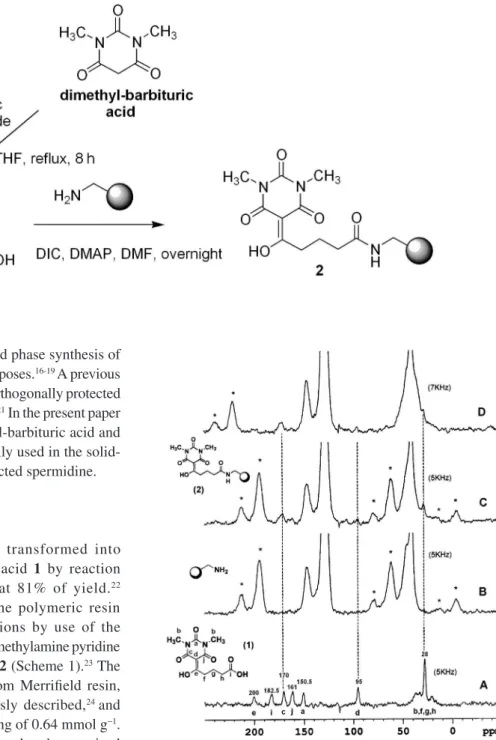
10, 30-32are proper to the task. Figure 1 illustrates the solid-state
13
C cross polarization magic angle spinning (CP/MAS)
spectra
33of compounds
1
and
2
. The signal corresponding to
COOH (at 182.5 ppm) is not present in the spectra of resin
2
. Conversely, the formation of the N
−
C=O bond caused
the broadening of the signal at
d
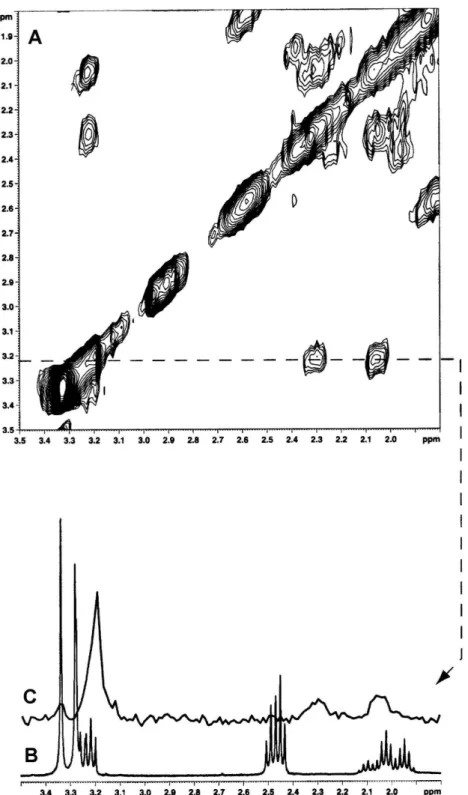
170. 2D TOCSY (total
correlation spectroscopy) HR-MAS NMR
33also conirmed
the amide linkage (Figure 2).
The resin
2
was then used in the synthesis of spermidine
as demonstrated in Scheme 2. In order to initiate the
preparation the 2-nitrossulfonamide was anchored on the
resin
2
by reaction in THF under relux.
34The resulting resin
3
then reacted with 4-bromobutylphthalimide in acetonitrile
in the presence of Cs
2CO
3as base, generating the resin
4
.
35Protected spermidine
5
36was cleaved from resin
4
after
treatment with hydrate hydrazine at room temperature.
Scheme 1. Synthesis of the linker resin.
Figure 1. 13C CPMAS solid-state NMR of the products in Scheme 1:
Synthesis and Characterization of a Linker for Primary Amines J. Braz. Chem. Soc.
88
Figure 2. High resolution solid state NMR spectra of the new linker (A) 2D TOCSY; (B) 1H HRMAS; (C) 1D slice of 2D TOCSY spectrum showing the
connection between the resin and the linker moiety.
Spermidine
5
was previously prepared by our group in
solution system utilizing Fukuyama’s sulfonamide.
37Resin
2
was then reconstituted (Scheme 3) by
treatment of resin
4
, after cleavage of spermidine, with
isopropyl nitrite in presence of H
2O/AcOH in THF at room
temperature overnight (Scheme 3).
Conclusion
in phase solid proving the eficiency of this method. This
linker was regenerated after cleavage of spermidine and
re-used without loss of eficiency. It can be used similarly
to other primary amines.
Acknowledgements
The authors would like to thank CAPES-COFECUB
for support (grant No. 436/03), FAPERJ for schollarship
(E. T. da Silva) and CAPES for a visiting professor grant
(grant No. 014/2008, S. Caldarelli).
References
1. Ramya, T. N. C.; Surolia, N.; Surolia, A.; Biochem. Biophys. Res. Commun. 2006, 348, 579.
2. Wallace, H. M.; Niiranen, K.; Amino Acids2007, 33, 261.
Scheme 2. Synthesis of spermidine 5 on a solid support.
Scheme 3. Reconstitution of resin 2.
3. Montanez, R.; Sanchez-Jimenez, F.; Aldana-Montes, J. F.; Medina, M. A.; Amino Acids2007, 33, 283; Cunha, A. S.; Lima, E. L. S.; Pinto, A. C.; Esteves-Souza, A.; Echevarria, A.; Camara, C. A.; Vargas, M. D.; Torres, J. C.; J. Braz. Chem. Soc. 2006, 17, 439.
4. Saunders, F. R.; Wallace, H. M.; Biochem. Soc. Trans.2007,
35, 364.
5. Hasne, M. P.; Ullman, B.; J. Biol. Chem. 2005, 280, 15188.
6. Nozaki, T.; Ali, V.; Tokoro, M.; Adv. Parasitol.2005, 60, 1. 7. Hamilton, C. J.; Saravanamuthu, A.; Fairlamb, A. H.; Eggleston,
I. M. ; Bioorg. Med. Chem. 2003, 11, 3683.
8. Krauth-Siegel, R. L.; Inhoff, O.; Parasitol. Res.2003, 90, Suppl. 2, S77.
9. da Silva, E. T.; Lima, E. L. S.; Tetrahedron Lett. 2003, 44, 3621. 10. Pop, I. E.; Dhalluin, C. F.; Déprez, B. P.; Melnyk, P. C.; Lippens,
Synthesis and Characterization of a Linker for Primary Amines J. Braz. Chem. Soc.
90
11. Seneci, P.; Sizemore, C.; Islam, K.; Kocis, P.; Tetrahedron Lett.
1996, 37, 6319.
12. Rousselot-Pailley, P.; Maux, D.; Wieruszeski, J. M.; Aubagnac, J. L.; Martinez, J.; Lippens, G.; Tetrahedron 2000, 56, 5163. 13. Speicher, A.; Backes, T.; Grosse, S.; Tetrahedron2005, 61,
11692.
14. Blackburn, C.; Tetrahedron Lett. 2005, 46, 1405.
15. Seneci, P.; Combinatorial Chemistry in Comprehensive Medicinal Chemistry II, vol. 3, 1st ed., Elsevier: London, 2007. 16. Vassis, S.; Karigiannis, G., Balayiannis, G.; Militsopoulou, M.; Mamos, P.; Franis, G. W.; Papaloannou, D.; Tetrahedron Lett.
2001, 42, 1579.
17. De Luca, S.; Ulhaq, S.; Dixon, M. J.; Essex, J.; Bradley, M.;
Tetrahedron Lett. 2003, 44, 3195.
18. Nagata, K.; Fukunaga, T.; Kato, S.; Jyo, A.; React. Funct. Polym.
2008, 68, 1127.
19. Iijima, Y.; Munakata, A.; Shin-ya, K.; Ganesan, A.; Doi, T.; Takahashi, T.; Tetrahedron Lett. 2009, 50, 2970.
20. da Silva, E. T.; Cunha, A. S.; Lima, E. L. S.; Bioorg. Med. Chem. Lett. 2002, 12, 3207.
21. Chhabra, S. R.; Khan, A. N.; Bycroft. B. W.; Tetrahedron Lett.
1998, 39, 3585.
22. Compound 1 (5-(4-carboxybutyryl)-1,3-dimethyl-2,4,6-pyrimidinetrione): to a solution of dimethylbarbituric acid (500 mg, 3.21 mmol) in dry THF (15 mL) was added glutaric anhydride (366 mg, 3.21 mmol) and a few crystals of DMAP. The mixture was stirred at relux during 8 h under nitrogen, after which the solvent was removd in the rotovap. The residue was puriied by column chromatography on silica gel (230-400 mesh, AcOEt/hexane 50%) to afford the desired product as a pale white solid, mp 84-86 °C. Rf = 0.58 (AcOEt/hexane 50%); 1H NMR (CDCl
3, 200 MHz): d 17.59 (1H, s, OH), 3.30 (3H, s, N-CH3), 3.25 (3H, s, N-CH3), 3.16 (2H, t, Csp2-CH
2,
J 7.5 Hz); 2.42 (2H, t, -CH2-CO2H, J 7.5 Hz) 2.0 (2H, qui, -CH2-CH2-CH2-); 13C NMR (CDCl
3, 50 MHz): d 20.44, 28.06, 28.21, 96.02, 150.57, 161.28, 169.60; IR ν
max/cm
−1: 3432, 3007, 2962, 1724, 1705, 1669, 1552, 1489, 1264, 1169, 1017, 800, 754, 424 (KBr). Elemental anal. calc. for C11H14N2O6: C, 48.89; H, 5.22; N, 10.37; found: C, 48.86; H, 5.16; N, 10.67%. 23. Resin 2: aminomethyl resin (1 g; load 0.64 mmol g−1) was swelled with DMF (15 mL), then were added 457 mg (1.8 mmol; 2.8 equiv.) of compound 1, a few crystals of DMAP and DIC (1.8 mol; 2.8 equiv.) and the mixture gently agitated overnight when ninhydrin test indicated the total consumption of free amino group. The resin was iltered and washed with DMF (3 × 15 mL), THF (3 × 15 mL), EtOH (3 × 15 mL), CH2Cl2 (3 ×15 mL). Then the resin was dried under vacuum. IR ν
max/cm
−1: 3412, 3326, 3058, 3023, 2916, 2848, 1723, 1668, 1557, 1490, 1450, 1353, 1026, 1269, 754, 535 (KBr). 1H HRMAS NMR TOCSY correlation peaks of the (XC=OCH2CH2CH2COH=) spin system: 3.2 (CH2COH=); 2.3 (-CH2-CO2H); 2.05 ppm (-CH2-CH2-CH2-).
24. Weinshenker, N. M.; Shen, C. M.; Tetrahedron Lett.1972, 32, 3281.
25. Atherton, E.; Benoiton, N. L.; Brown, E.; Sheppard, R. C.; Williams, B. J.; Chem. Commun.1981, 7, 336.
26. Huber, W.; Bubendorf, A.; Grieder, A.; Obrecht, D.; Anal. Chim. Acta1999, 393, 213.
27. Drewry, D. H.; Ghiron, C.; Tetrahedron Lett.2000, 41, 6989. 28. Volonterio, A.; Chiva, G.; Fustero, S.; Piera, J.; Rosello, M. S.;
Sani, M.; Zanda, M.; Tetrahedron Lett. 2003, 44, 7019. 29. Sreejalekshmi, K. G.; Devi, S. K. C.; Rajasekharan, K. N.;
Tetrahedron Lett. 2006, 47, 6179.
30. Arai, T.; Fujiwara, A.; Watanabe, M.; Yokoyama, T. F.; Deguchi, K.; Yanagisawa, A.; Tetrahedron Lett.2006, 47, 1673. 31. Anderson, R. C.; Stokes, J. P.; Shapiro, M. J.; Tetrahedron Lett.
1995, 36, 5311.
32. Lin, M. F.; Shapiro, M. J.; J. Org. Chem. 1996, 61, 7617. 33. Solid state 13C CPMAS spectra were acquired on a Bruker
DRX300 spectrometer (7.05 T), operating at 75.4 MHz, using a 4 mm Bruker CPMAS probehead and 4 mm ZrO2 rotor with Kel-F stoppers, spinning at 5 and 7 kHz. Acquis. parameters: P1 5 µs, contact time (optimized) of 3 ms, recycle time 2 s, number of scans 1000. Hexamethyl benzene was used as external reference (CH3 at 17.3 ppm). 1H HRMAS NMR spectra were obtained on a Bruker DSX400 instrument, equipped with a 4 mm dual 1H/13C high resolution MAS probehead, using 1 to 2.5 mg of sample swollen in 12 to 50 µL CD2Cl2, pulse delay 10 s, 256 scans and spinning rate of 4000 Hz. 2D-TOCSY spectra were recorded with a mixing time of 85 ms, 16 transients and 3500 Hz of rotation frequency. Chemical shifts (d) for 1H MAS NMR are reported in ppm relative to residual signal of CD2Cl2.
34. Resin 3:Resin 2 (500 mg; load: 0.55 mmol g−1) was swelled with dry THF (10 mL) and submitted to reaction with 2-nitrosulfonamidopropylamine (616 mg; 10 equiv.) under relux for 20 h. After this time the resin was iltered and washed with THF (3 × 10 mL), isopropanol (3 × 10 mL), MeOH (3 × 10 mL), CH2Cl2 (3 × 10 mL). The resin was dried under vacuum. IR ν
max/cm
−1: 3415, 3024, 2921, 1706, 1672, 1643, 1590, 1492, 1451, 1348, 1166, 758, 700, 539 (KBr).
35. Resin 4: To a suspension of resin 3 (500 mg; load 0.49 mmol g−1) swelled with dry DMF was added 798 mg (2.45 mmol; 10 equiv.) of cesium carbonate and 346 mg (1.22 mmol; 5 equiv.) of N-(4-bromobutyl)phthalimide. Ther reaction was gently stirred at 80 °C for 26 h. Then, the resin was iltered and washed with DMF (3 × 10 mL), isopropanol (3 × 10 mL), MeOH (3 × 10 mL), H2O (3 × 10 mL), MeOH (3 × 10 mL), CH2Cl2 (3 × 10 mL). The resin was dried under vacuum. IR ν
max/ cm−1: 3409, 3024, 292, 1704, 1640, 1584, 1492, 1451, 1372, 1272, 1166, 758, 700, 541(KBr).