229
Article
Alternative Communication Program Readapted to a Kaingang Adolescent
Lúcia Gouvêa Buratto 1
Maria Amelia de Almeida Maria da Piedade Resende da Costa
Universidade Federal de São Carlos, São Carlos-SP, Brasil
Abstract: The present study aimed to determine whether the use of the Picture Exchange Communication System - PECS favored the communication of an adolescent from the Kaingang indigenous population with intellectual disabilities and language disorders. To verify the effects of the independent variable a single subject design was performed, which involved two phases: baseline and intervention. The system was readapted considering the social, cultural, moral and religious values as well as the habits and customs of that ethnic group. The results showed that the use of the readapted alternative communication system helped to improve the non-verbal communication of the indigenous adolescent and increased her vocabulary, previously considered very restricted and unintelligible.
Keywords: indians, non verbal communication, language disorders
Programa de Comunicação Alternativa Readaptado para uma Adolescente Kaingang
Resumo: Trata-se de um estudo de caso que teve por objetivo descrever a implementação do Sistema de Comunicação por Troca de Figuras (The Picture Exchange Communication System - PECS) em uma adolescente da população indígena Kaingang que apresentava defi ciência intelectual e transtornos de linguagem. Para verifi car os efeitos da variável independente foi realizado um delineamento experimental de sujeito único que envolveu duas fases: linha de base e intervenção. O sistema foi readaptado levando em consideração os valores sociais, culturais, morais e religiosos, bem como os hábitos e costumes da etnia. Os resultados evidenciam que o uso do sistema de comunicação alternativa readaptado contribuiu para melhorar a comunicação não verbal e aumentar o vocabulário, antes muito restrito e ininteligível da adolescente indígena.Palavras-chave: índios, comunicação não verbal, distúrbios da linguagem
Programa de Comunicación Alternativa Readaptado para una Adolescente Kaingang
Resumen: Se trata de un estudio de caso que tuvo como objetivo describir la implementación del Sistema de Comunicación por Intercambio de Imágenes (Picture Exchange Communication System - PECS) en una adolescente perteneciente a la población indígena Kaingang que presentaba discapacidad intelectual y trastornos de lenguaje. Para verifi car los efectos de la variable independiente, fue empleado el diseño experimental de un sólo sujeto, conforme dos condiciones: línea de base e intervención. El instrumento fue reajustado teniendo en cuenta los aspectos sociales, culturales, morales y religiosos, así como los hábitos y costumbres de la etnia. Los resultados de este estudio evidencian que el uso del sistema de comunicación alternativo readaptado, contribuyó para mejorar la comunicación no-verbal y aumentar el vocabulario, anteriormente muy estrecho e ininteligible de la adolescente indígena.Palabras clave: indios, comunicación no verbal, trastornos del lenguaje
1 Correspondence address:
Lúcia Gouvêa Buratto. Rua Diva Proença, 1.380. CEP 86.870.000. Ivaiporã-PR, Brasil. E-mail: [email protected]
Many people with communication diffi culties, not only have their development impaired, but also present aggressive and inappropriate behavior, which is attributed to the diffi culty of communicating and interacting with others in the envi-ronment in which they live. Children with communication disorders who present problems related to speech or to lan-guage will have diffi culty achieving the same development as their colleagues of the same age (Coll, Marchesi, & Pala-cios, 2004).
Environmental factors can reduce or enhance the pos-sibilities of communication through speech. When children have a disability, they are often kept in isolation, excluded from having contact or socializing with others of their age, further impairing the development of speech, because it is within the group that they are encouraged and stimulated to develop their communication. Given the above: what is the language development situation of an indigenous student with below average intellectual performance and unintelli-gible speech in both languages spoken by her community? The importance of communication from the early
When the child presents a language disorder, diffi culties can be observed in using vocabulary, formulating more elaborate phrases, describing actions, as well as memorizing and re-calling words. The disturbance in receptive and expressive language may occur simultaneously and, as a consequence, the child may present diffi culties in the comprehension and expression of the language. In all cases where students have diffi culty in the comprehension and expression of language, there are probably learning problems, which may lead them to face diffi culties in socialization, as well as impairments in their overall behavior. In this sense, according to Deliberato & Alves (2007), alternative communication has value as it gives voice to people who have disorders in oral language, so that they can express their will, thoughts and feelings.
Focusing particularly on nonverbal children with intel-lectual disabilities, there is a need for specifi c intervention and stimulation to initiate or develop their communication because, according to Silva (2006), they present diffi culties in relation to the acquisition of rules, norms, behaviors, and self-control, among the skills to be learned through social in-teraction. These diffi culties can be alleviated when the child with communication problems and below average intellectual performance receives adequate care to overcome the obstacles inherent to their condition. It is believed that the greatest limi-tations of the intellectual disabilities are not related to the disa-bility itself, but to the credidisa-bility and the opportunities offered to people with intellectual disabilities (Tessaro, 2005).
The individual who, as well as having below average intellectual functioning and severe communication diffi cul-ties, lives in a bilingual context due to belonging to a diffe-rent ethnic group, may have their communication diffi culties enhanced, mainly because they have not acquired a mastery of their mother tongue (Cambruzzi & Costa, 2007). F o r example, in the Ivaí Indigenous Land, where this study was conducted, until they reach school age, the children speak only their mother tongue, Kaingang, which is maintained in the community. However, upon entering school, faced with monolingual teachers who do not speak their native langua-ge, they are often unprepared to deal with the ethnic cultural differences (Buratto, 2010).
Due to the natural diffi culty of acquiring a second lan-guage, these indigenous people have diffi culties in the lear-ning process, since learlear-ning occurs in a linguistic universe different to their own, in which they have restricted command of the concepts. According to Buratto (2010) in addition to the social, cultural and linguistic differences, the situation of the education of the indigenous population is more diffi cult when considering people in disability situations, a topic little discussed in Brazil. The specialized educational service is paramount in meeting the specifi cities of people in a disabi-lity situation who, in order to develop themselves, depend on the educational experiences, opportunities and possibilities available to them.
Law No. 7853, of October 24, 1989, states, in Arti-cle 17, the mandatory inclusion in the national censuses of
people with disabilities. In the demographic census carried out in 2000 a survey was conducted regarding disabled in-digenous people, the data showed that the number of di-sabled among this population was 17.1%, a fi gure higher than in the general population (Brazilian Institute of Geo-graphy and Statistics [IBGE], 2005). These indices are of more concern in the South and Southeast of Brazil, where the rate increases to 19.5% and 21.7%, respectively. These numbers must be considered in the development of public policies, as indigenous people are more marginalized. The main characteristic of the indigenous populations is their invisibility, the result of centuries of misguided policies to which they have been submitted, which according to Lima and Almeida (2010), culminated in a process of domina-tion that led to a forced cultural assimiladomina-tion and even the expropriation of their lands with violence. Besides this exclusion, the lack of prospects, the misinformation and the changes brought about and infl uenced by contact with the non-indigenous society may have collaborated in pro-moting the situation of discrimination and vulnerability to which they are exposed.Belonging to an ethnic minority, coupled with other diffi culties common to the Brazilian population which is characterized by low school perfor-mance, is further aggravated when viewed from the pers-pective of the specialized educational services. Indigenous people with disabilities, especially children and teenagers, are doubly discriminated against: on one hand they belong to a minority ethnic group, on the other, they have disabi-lities, which puts them in a second disadvantaged group. This double marginalization deprives them of fundamental rights that guarantee their full development. The National Policy on Special Education document from the perspec-tive of inclusive education, of the Ministry of Education (2008, p. 16), guarantees that: “the interface of special education with indigenous, rural and quilombola education should ensure that the resources, services and specialized educational services are present in the pedagogical projects constructed based on the sociocultural differences of the-se groups”. Indigenous people, as Brazilian citizens, are also supported by general legislation such as the Child and Adolescent Statute (CAS) (Law No. 8,069, 1990). Howe-ver, these rights are neglected and the CAS is one more law among many, which needs actions and partnerships to be effective in practice. The guarantee of these rights en-compasses the continued formation of educators and pro-fessionals capable of providing information and knowledge so that society can act, be mobilized, demand and fi ght to guarantee their application.
many behavioral problems present could be minimized (Walter, 2006).
Augmentative and Alternative Communication (AAC) is gaining increasing importance as a strategy to minimize se-vere communication diffi culties. For Castrogiovanni (2008), the system of Augmentative and Alternative Communication is formed by various components that include symbols, aids, strategies and techniques used for people with serious spe-ech and language problems with the aim of increasing the communicative potential. Currently, there are a number of resources that can facilitate the communication of these peo-ple. We can highlight some considered low technology, such as graphic symbols, real objects, miniatures, photographs, communication boards (with symbols, letters, words, sen-tences), the Eye-gaze, which is a board that should be placed vertically in which the person point to the response with the eyes; as well as the apron, made of fabric with Velcro, in which words or symbols are fi xed by the interlocutor. There are also high-tech resources such as computers and commu-nicators with recorded and synthesized voices.
The PECS (Picture Exchange Communication System) consists of the exchange of pictures and was developed by Andrew Bondy and Lory Frost, in 1994 in Delaware, in the USA. According to Walter (2006), it “allows many young autistic children to acquire the ability to communicate wi-thin the social context” (p. 15). The system, in its original form, consisted of seven phases: phase 1 - instruction with maximum assistance, phase 2 - increased spontaneity, phase 3 - breakdown of pictures, phase 4 - structuring of senten-ces, phase 5 - response to the question “What do you want?” phase 6 - spontaneous responses and comments, phase 7 – increase of the vocabulary. In Brazil, in 1998, Walter (1998) adapted the system and synthesized phases 4, 5 and 6 con-densing them into phase 4. Thus the Brazilian version was reduced to fi ve phases. The author not only used and adapted the PECS to the Natural Functional Curriculum, in which the goal is to teach knowledge and skills that can be used by the student in different environments (LeBlanc, 1991), but also reduced the number of phases and added some alterations in the environmental arrangement, such as the use of a pouch with the communication album. This procedure was applied by the author with three young people with autism and po-sitive results were obtained, such as the acquisition of a few words or gestures and also the spontaneity to request the de-sired item in the different practical life situations.
Piza (2002) used the alternative PECS method adap-ted by Walter (1998) to enhance communication skills in nonverbal people with cerebral palsy and concluded that this system can be used to enhance the communication of individuals with cerebral palsy in various situations. Chil-dren with cerebral palsy exposed to such a resource as a facilitator for their communication process started to emit sounds, calling attention to themselves, they initiated com-municative interactions, they began to ask for the desired items and started to maintain simple dialogs and to transmit
messages. Charlop-Christy, Carpenter, Le, LeBlanc and Kellet (2002), in California, United States, applied the PECS with three boys diagnosed with autism. The study demonstrated the effi cacy of the program with the three individuals and resulted in a reduction in their behavioral problems. Based on the work and on the success achieved by Charlop-Christy et al. (2002), Piza (2002) and Walter (1998, 2000), chose, in the present study, to readapt and reapply the system, in order to check whether it could pro-mote changes in regard to the effi cacy in communication and independence, as well as in reducing the aggressivity displayed, in the family, school and community contexts in a non-verbal, indigenous, ethnic Kaingang, adolescent diagnosed with intellectual disabilities.
This study was proposed after verifying the communi-cation diffi culties of the Kaingang adolescent in expressing what she wanted and not being understood in the family and school environments, and also after observing that the tea-cher expressed the desire to fi nd an alternative way to com-municate and interact with the participant. This case study aims to describe the implementation of the Picture Exchange Communication System - PECS with an adolescent of the indigenous Kaingang population who presented intellectual disabilities and language disorders.
Method
Participants and Location
One indigenous adolescent 13 years of age at the time of the study. She could not communicate in either of the languages (Portuguese and Kaingang) spoken by the com-munity. When she tried to communicate and was not un-derstood, she would become very agitated and aggressive with family members, peers and teachers. She had been enrolled in grade 1 of the indigenous school for six years, without showing any progress in learning and in commu-nication. She was the fourth daughter of a couple, having three older and two younger siblings. All of whom studied and spoke the Kaingang and Portuguese languages fl uently. Furthermore, a teacher participated the study who specia-lized in special education, had a municipal employment contract, and had worked in indigenous school for more than six years. First, she taught indigenous kindergarten education, then 1st grade and by the time the study was
con-ducted, taught in the 2nd grade. She showed much interest
in developing the communication of the student and, under the guidance of the researcher, applied phases 1, 2 and 3 of the readapted system, as will be described below. The tea-cher who performed phases 4 and 5 of the Program served as the teacher of the 1st to 4th grades in the municipal school
region of the state of Paraná, where about 1,200 indige-nous people live. The study was fi rst scheduled to be held in three of the school environments (classroom, cafeteria and schoolyard), however, as the student refused to remain in the classroom, the study was restricted to the cafeteria and schoolyard environments, locations preferred by her.
The cafeteria where children receive meals is an an-nex of the kitchen, measuring 9.3 meters long by 5.2 meters wide, with a table, chairs, a TV and a VCR. The environment is small to accommodate all the students of each class. The cafeteria space is also used for the projection of videos and TV program activities. The main schoolyard has a grassy area 51.6 meters long by 11.1 meters wide and is located between the two buildings, where the classrooms are. The-se classrooms are attended by students from kindergarten through to high school level, distributed in morning, afterno-on and evening classes.
Instrument
The Picture Exchange Communication System (PECS) adapted by Walter (1998). Originally the instrument contai-ned a wooden panel and board and an album of photos with Velcro. Noting that the material would not be appropriate for the context of the study, due to its fragility, we opted for making a more resilient version that could be washed. Thus, the material was readapted to be applied with the indigenous adolescent, with a metallic panel and board and all pictures being made 5 x 5 cm, colored and laminated. The illustrations were selected with the support of the family and received a magnetized base, to be placed in a wallet used for credit car-ds, organized in seven categories. The selection of 35 items was carried out, fi ve for each of the seven categories, which were organized with different and attractive colors in order to encourage memorization and to make them easier to visu-alize at the moment of fi nding the desired picture.
In the readaption of the PECS, the culture and language of the ethnic Kaingang were considered, with elements of the ethnic language, and also of the Portuguese language, so that the pictures were bilingual, i.e. with the words in Portu-guese and Kaingang. In addition to this instrument a camcor-der and camera were used.
Procedure
Data collection. Data were collected and documented
on a record sheet according to the model of Walter (2000), specially adapted for this study. Included on the record sheet were: name of the student, sheet number, date, number of at-tempts to request something, picture requested and form used to communicate (board or wallet with the pictures). The score regarding the support received to request something was from 0 to 3 points: (a) does not use Augmentative and Alternative Communication (AAC) score = 0; (b) physical assistance – taking the adolescent to the panel and pointing at the picture,
score = 1; (c) verbal assistance – asking the adolescent to go to the panel and fi nd the desired picture, score = 2; (d) indepen-dence - the student takes the picture without being asked, and uses AAC spontaneously, score = 3.
A formative evaluation was continuously performed throughout all the recording sessions to verify the applica-bility of the instrument and the need for possible changes in the readaption of the intervention program, as well as the in-terest and independence of the adolescent in communicating via the readapted PECS. The number of pictures and com-municative emissions used by the girl were also recorded on a separate sheet. Given the interest of the teacher and the agreement of the parents regarding the participation of the girl in the research, the teacher underwent training through theoretical and practical lessons. She received the materials and the sheets upon which the performance data of the girl during the intervention sessions were recorded.
The study is based on an AB type design with a single subject, which involves two phases, the baseline and inter-vention (Almeida, 2003). In the step referred to as the base-line a picture of something much desired by the participant was placed in front of her, then the researcher presented the object of desire and waited for the request of the adolescent, observing how she related to the picture. At this moment no physical or verbal help and no social reinforcement was offered. The whole baseline procedure was fi lmed on VHS tape. Once the baseline was stabilized, the intervention was started. The recording sessions were performed twice per week, and occurred primarily during the lunch period with an approximate duration of 20 minutes. We chose to carry out the recording in writing, as it was noticed that the camera bothered the student. The criterion for passing to the next phase was the same used in the original and adapted PECS, which is the performance of independence above 80% in two consecutive sessions.
In phase 1, as determined in the PECS system, only one picture at a time was used, not necessarily the same one. The aim was that the participant realized that the picture could be exchanged for something of interest to her. It was explained to the participant how she could communicate through the exchange of pictures and how she could benefi t by using the alternative communication. In this phase the presence of two people was necessary. One was positioned behind and the other in front of the adolescent who was sitting at the table where the picture was placed which corresponded to the pre-ferred item that was also on the table, however, out of her reach. When the participant was trying to reach the desired object, the person behind helped her take the picture and put it into the hand of the person who sat in front of her with an open hand. As in the adaptations made by Walter (1998), verbal stimulation - given by phrases such as “Good”, “I un-derstand you!” and questions such as “What do you want?”, “Can I help you?” - was used in this fi rst phase of the study.
the picture, choose the interlocutor and make the exchange of the illustration for the desired item. The verbal enticements used in phase 1 continued to be used. The adolescent was instructed to take the picture of the desired item from the magnetized base and give it to the teacher or researcher or the other person to obtain what was being asking for. The participant was encoura-ged to repeat the name of the desired item in the two languages spoken by the community: Portuguese and Kaingang.
In phase 3, besides the metallic board, the participant received the wallet with magnetized pictures which were gradually being added to. She began to discriminate and to choose, among various relevant and irrelevant pictures, that which represented the desired item, and to perform the ex-change and then to return the picture to the board or to the wallet. When she could discriminate more than eight pictu-res the size of images was reduced. The discontent of the participant with the reduction of the pictures led the teacher and researcher to opt for maintaining their initial size.
In phase 4, the participant had to structure sentences using a small metallic board on which was fi xed the picture--phrase “I want” after which was placed the picture of the desired item, which should be given to the interlocutor. The adolescent structured the phrase after the instigation “what do you want?”. After making the exchange, the participant should store the pictures in the wallet closing the dialog. In the second moment, so that the adolescent could express her feelings, the picture-phrase “I am” was introduced. Verbal reinforcement continued to be used as in the previous phases.
In phase 5, the participant began to communicate using the pictures in various situations of daily life, forming phra-ses with them, as well as concepts that were being gradually added to. The verbal reinforcement was maintained, as well as the emission of sounds referring to the pictures, as initia-ted in phase 2.
Regarding the teacher training, The readapted PECS was fi rst applied by a teacher who worked in the Indigenous Land school where the participant was enrolled and who agreed to participate in the study and also to the terms pro-posed. The teacher received training through a short course lasting two hours, and was supplied with all materials and instruments that were necessary for the application of the re-adapted PECS. Slides of the results of studies that prove the effi cacy of the system developed by Brazilian and foreign researchers were also presented.
The intervention had to be discontinued in phase 3 as the teacher responsible for the application began teaching in the indigenous school for only one period. The speech the-rapist of the special school was then trained to continue the work with the participant, however, some days after the re-sumption of the interventions, the student moved with her family to another Indigenous Land. With the return of the family, another teacher received the training to continue the intervention from phase 4. The second teacher, in the same way as the fi rst, participated in a short course of the same duration, taught by the researcher, in which she was given a handout on Augmentative and Alternative Communication and also all the material used up to phase 3, as well as the material to be used in stages 4 and 5. Throughout the period of the intervention the researcher supervised the work of the teachers in the intervention process and offered advice.
Data analysis. Data were analyzed through the results
obtained at each phase and recorded by the teacher and by the researcher. The total points obtained and recorded in each session were calculated and transformed into graphs to verify the performance of the indigenous student in each interven-tion session. Qualitative analysis was carried out considering the observations of the teacher and of the researcher who had recorded the changes that had occurred in the behavior, in the communication and in the independence of the adolescent, in the family and school environments.
During the performance of the research, interobser-ver evaluation took place in 25% of the sessions of each phase of the study in order to measure the level of con-cordance between observers. The adolescent participated in 38 sessions in total and at the baseline two of the three sessions performed were evaluated. The number of ses-sions evaluated during the intervention was as follows: phase 1 - 2/4, phase 2 - 2/5, phase 3 - 4/11, phase 4 - 4/10, and phase 5 - 2/5. The records of each were made by each teacher and researcher, and analyzed by checking the scores of the attempts for the session observed. The reliability calculation was made by dividing the number of concordances by the number of concordances plus the number of disconcordances and multiplying the result by 100, according to the formula of Hersen and Barlow (1977). The mean percentage of the reliability indices of the recordings was 97%, with a variation between 93% and 100%, as shown in Table 1.
Table 1
Concordance between the Teacher and the Researcher during the Baseline and Intervention Sessions
Baseline Intervention
Phases Phase 1 Phase 2 Phase 3 Phase 4 Phase 5
Sessions 1 3 5 7 8 11 13 16 19 23 25 27 30 33 34 36
Teacher 0 0 29 41 25 43 16 36 22 44 37 49 42 50 49 52
Observer 0 0 27 40 24 41 16 37 22 43 36 49 41 49 48 51
Confidence (%) 100 100 93 97 96 95 100 97 100 97 97 100 97 98 97 98
Ethical Considerations
The project was submitted to the Human Research Ethics Committee of the Federal University of São Carlos (CAAE 1287.0.000.135-06). After approval and, as the participant came from an indigenous group, considered vulnerable, the project was sent to the National Research Ethics Committee (CONEP), where it was registered and approved (Protocol No. 13502). The participation of the adolescent was authorized by her parents via them signing the Terms of Free Prior Informed Consent.
Results
The performance of the participant was analyzed in each session of each phase of intervention in terms of percentage, fre-quency of responses in relation to the level of support received, and variation in the number of attempts obtained in the sessions.
Baseline
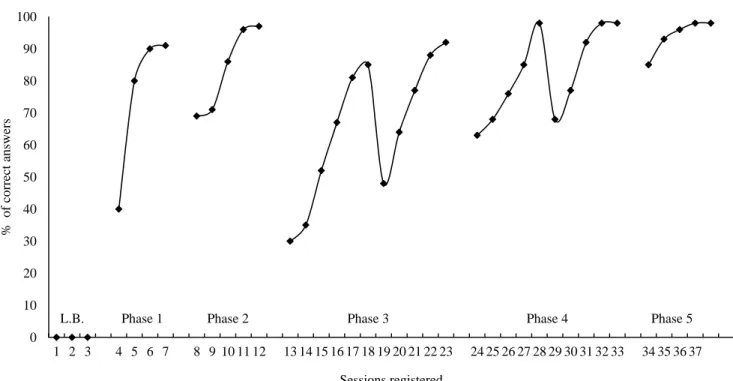
During the baseline sessions, in accordance with Figure 1, the performance of the participant was zero (0%
correct). The observation records obtained as fi lm footage showed that in the three baseline sessions the student was unsuccessful, i.e. in all the attempts she failed to ask for so-mething of interest to her.
In the fi rst baseline session, in all attempts, the student looked at the item of interest to her and also at the picture, without touching or making sounds or gestures. In the se-cond, she was irritated, she did not touch the object or the picture, she cried out and ran away. In the third she looked at the food and the picture and left the place. After several at-tempts, she came over, took the food and ingested it without interest in the illustration. In view of the stability of the base line, the intervention phase was initiated.
Intervention
Figure 1 shows the evolution of the performance of the participant during the application of the PECS readapted to the indigenous culture during the study phases, i.e. during the baseline and intervention.
Phase 1
When initiating the fi rst phase of the intervention the par-ticipant was instructed on how to proceed to make the exchan-ge, i.e. to take the card and give it to the teacher who had her hand extended. The results presented in Figures 1 and 2 show
that the intervention period was initiated in the 4th session, and
that phase 1 ended in the 7th session. As shown in Figure 2, in
the fourth session 10 attempts were carried out. The partici-pant was unsuccessful in three and was physically helped by the teacher on two occasions, becoming irritated with the phy-sical contact, and received verbal assistance in fi ve attempts.
Figure 1. Performance of the participant during the application of the PECS readapted to the indigenous culture in each of the
study phases.
0 10 20 30 40 50 60 70 80 90 100
1 2 3 4 5 6 7 8 9 10 11 12 13 14 15 16 17 18 19 20 21 22 23 24 25 26 27 28 29 30 31 32 33 34 35 36 37
% of correct answers
Sessions registered
Evolution of the development of the participants graph
In the 5th session, she showed that she better comprehen-ded how to make requests. In 12 attempts she did not require physical assistance, she needed verbal assistance (Figure 2) in seven attempts and managed to perform fi ve exchanges inde-pendently. It the 6th session she further improved her perfor-mance, achieving 90%, requiring only verbal assistance in four attempts and managed to request the desired item independently in ten of the fourteen attempts. In the 7th and fi nal session of phase 1 the rate remained virtually the same, demonstrating in-dependence in 11 of the 15 attempts, requiring verbal assistance on four occasions at the beginning of the session.
Phase 2
With the attainment of stability of over 80% in two consecutive sessions, phase 2 of the readapted PECS was initiated in the 8th session, which consisted of increased
spontaneity and the search for a teacher, researcher or other person to request the desired item from. Faced with the new situation, that is, to remove the magnetized pic-ture from the metallic board and to search for the teacher or researcher to effect the exchange of the picture for a desired item, the performance of the girl declined and the value obtained was 69%, needing physical assistance in the two fi rst attempts and verbal assistance in seven attempts. The participant demonstrated independence in only three of twelve attempts. She showed a slight im-provement in the 9th session, achieving 71%. In the three
subsequent sessions, she did not need any more physical assistance, only verbal assistance and the spontaneity and
independence index gradually increased to 86% (10th
ses-sion), 95% (11th session) and 97% (12th session).
Phase 3
With the gradual improvement and the performance above 80% achieved in three consecutive sessions, phase 3 of the readapted PECS was initiated in the 13th session,
which was to discriminate desired pictures from those unwanted, irrelevant and unknown. The participant must fi rst choose between two pictures, one being much desired and the other irrelevant. Besides choosing the illustration of the desired item, she should also make the exchange and return the picture to the metallic board. When presented with improved performance other pictures were gradually added. Thus, in the 13th session, the participant was
unsuc-cessful in ten of the eighteen attempts. In the fi rst four at-tempts she left the room, she needed physical assistance in two and verbal assistance in four and made two exchanges, totaling 30% success. In three subsequent sessions, the per-formance was 35%, 52% and 62%, respectively. The par-ticipant achieved 81% in the 17th session, requiring only
verbal assistance in ten attempts and performing indepen-dently in eight. In the 18th session she managed to make her
request spontaneously and independently in eleven out of twenty attempts, achieving 85%.
In the phase called 3B, there was a decrease in the per-formance of the participant to 48% and 64%, because she did not like the pictures reduced in size, presented in the 19th
and 20th sessions; she refused to make exchanges in fi ve of Figure 2. Performance of the participant in relation to the level of support received from the teacher in each session of each phase
of the study.
Frequency and attempts
Sessions registered
Baseline Phase 1 Phase 2 Phase 3 Phase 4 Phase 5
Unsuccessful Physical Assistance Verbal Assistance Independence
0 5 10 15 20
the fi fteen attempts in the 19th session, required physical and
verbal assistance in sessions 20 and 21 and showed discon-tent with the smaller pictures. This led the researcher and the teacher to opt for continuing the intervention with the 5 x 5 cm pictures used from the beginning. The participant returned to making exchanges independently in the majority of attempts, achieving rates of 88% and 92% in the 22nd and
23rd sessions, respectively. At the end of the third stage the
family moved to another Indigenous Land. This fact meant that the sessions were interrupted for six months.
Phase 4
With the return of the family, it was necessary to train another teacher and provide all the material again. Phase 4, in which the participant should make sentences using fi rst the picture-phrase “I want” and give the picture of the desired item, was then started. The performance of the student was 63% in the 24th session and 68% in the 25th. She insisted on
giving the picture as she did in other phases, needing some physical, but mainly verbal assistance in order to perform the exchange. In the 26th session she obtained 76%, not needing
any more physical assistance and achieved 85% in the 27th
session. In the 28th session she performed the exchanges
in-dependently in 17 of the 18 attempts.
The performance of the participant dropped to 68% in the 29th session with the introduction of the picture-phrase “I
feel”, so that the participant could express what she was fe-eling, needing physical and verbal assistance to express her-self through the pictures. In the 30th session her performance
was 77%, however, she still needed physical and verbal as-sistance to fi nd the picture-phrase, but showed independence in seven of the eighteen attempts made. She achieved 92% in the 31st session, requiring verbal assistance in only four
of the seventeen attempts made. In the two subsequent ses-sions, 32 and 33, the value obtained was 98% in both.
Phase 5
In this phase, the participant should use a wide variety of pictures, with concepts of size, color, fl avor and shape, in various situations of daily life. In the 34th session physical
assistance was needed in two attempts and verbal assistan-ce in four, showing independenassistan-ce in thirteen of the nineteen attempts, achieving a rate of 85%. The performance rose to 93% in the 35th session and reached 96% in the 36th. The
par-ticipant only needed verbal assistance once in the following 37th and 38th sessions, totaling 98% in these two sessions.
Given the stability of the results the intervention ended.
Discussion
In each historical moment, men survive in a given way, have habits, purposes and customs that are particular to the time, the material conditions and the culture to which they belong.
Knowing these ideas is also to comprehend more about mental disability, providing greater clarity on this concept, which, in turn, constitutes the fi rst step towards the imple-mentation of healthcare services to this clientele and rese-arch projects in the area (Dessen & Silva, 2000, p. 12).
Although there are very few studies about indigenous people with disabilities it is not diffi cult to conclude that this is a situation of double discrimination: to be indige-nous and to have disabilities. The results showed that the use of the PECS provoked signifi cant changes in relation to the communication of the indigenous adolescent with her interlocutors, which contributed toward her inclusion in the community. The role of the interlocutor is to ensure that these people are included so they can exercise their role of subject in society (Deliberato & Alves, 2007). Other studies have demonstrated the effi cacy of the system when applied to people with various disabilities and with expres-sive language diffi culties. According to Paula and Enumo (2007), the fact of not managing to be understood causes many frustrating experiences for people with expressive language defi cits.
Walter (2004), who evaluated the effects of the adapta-tion of the Picture Exchange Communicaadapta-tion System with four boys diagnosed with infantile autism, revealed that: “The use of the adapted PECS was peculiar due to the fact that the exchange of a piece of paper, was quickly transfor-med into a much desired item” (p. 75). Piza (2002), in Bra-zil, when applying the adapted PECS to three individuals with cerebral palsy, and Charlop-Chrity et al. (2002) in the United States, when conducting the study with three autis-tic people, highlighted the effi cacy of the PECS as alter-native communication, used by people with cerebral palsy and autism, respectively.
Before the start of the application of the Program the participant presented great diffi culty in communicating, exacerbated by aggressivity when she was not understood. From the replication of the readapted and bilingual PECS, it was found that when using this type of alternative com-munication the adolescent achieved greater independence in the act of communicating with her interlocutors and increased her vocabulary. According to Deliberato, Paura and Pereira Neta (2007), the use of different systems of augmentative and alternative communication in functional contexts can effectively serve a wide number of people with diverse needs.
diffi culties and their communicative partners, observed ex-pansion in the vocalizations and the emergence of autonomy in the subjects, as well as increased actions related to respon-siveness in the interlocutors.
Before the intervention, the participant’s gaze was fi -xed on the people, lingeringly, seeming to expect them to guess her desires. Regarding the individuals with whom she had most contact, she did not hesitate to attack them when she asked for something that interested her and it was not provided, often due to not being understood. After the intervention her aggressiveness reduced considerably. At the end of phase 3, when the study had to be interrup-ted due to the movement of the participant and her family to another Indigenous Land, the pronunciation of some simple words was already noticed, as well as the attempt to issue phrases, still not very intelligible, but with the intention to communicate.
At the end of the intervention, it was noticed that the PECS program encouraged the participant to express her desires and needs, and the pictures began to serve as an aid to make choices, and to support and encourage the emission of words and gradually short phrases. Although using the two languages at the same time, pronouncing Kaingang and Portuguese words in the same sentence, she managed to maintain short dialogues. There was an appre-ciable reduction in her aggressiveness and inappropriate behaviors, observed by the family, teachers and researcher. The changes can also be attributed to increased possibili-ties for communication, benefi ting the interaction between the family members, colleagues and community. It must be highlighted that, until the end of 2007, the indigenous ado-lescent had no diagnosis because, according to the profes-sionals consulted, in Brazil there is no validated evaluation that can be applied with this ethnic group. Therefore, these specialists refuse to perform the diagnosis. However, at the end of the semester, during the intervention, the adolescent was sent to be evaluated by a psychologist, a neurologist and a speech therapist, so that, at the beginning of 2008, she was analyzed by diverse professionals, whose diag-nosis registered below average general intellectual func-tioning, at the request of the parents, the student was then enrolled in a special school.
Final Considerations
To promote real conditions for effective care to indige-nous people with any disability is a great challenge, above all when they have their communication restricted and are obliged to coexist with two very different languages, as was the case for the adolescent who participated in this study.
As is known, Brazil is home to more than two hundred different ethnic peoples, speaking over 180 languages. Di-sability among the indigenous people is a reality revealed by the 2000 Census conducted by the Brazilian Institute of Geography and Statistics (IBGE, 2005), which showed the
existence of indigenous people with disabilities in all the regions of Brazil. However, the diffi culties are numerous, mainly due to the lack of public policies to serve this popu-lational contingent.
Intellectual disability occurs in all ethnic groups, thus, there are diffi culties in validating tests applicable to the different ethnicities. However, the bureaucracy requi-res that in order to receive specialized care, it is necessa-ry to have a report attesting to the disability. The results obtained in this study have shown that the use of the low technology, alternative communication readapted PECS contributed so that the participant emitted words and sim-ple phrases in the two used languages of the community, which would occur before in a very restricted form, being diffi cult to understand.
Besides enhancing the communication of the indige-nous adolescent, this study offered her inclusion, making coexistence possible, in a more harmonic way, in the edu-cational and social environment of the community. The indigenous teachers, although sensitized to the issue, do not possess training to provide specialized educational services to those who need them. However, recognizing the importance of the interaction between those different, they demonstrate interest in furthering their knowledge, but encounter diffi culties, as there are few studies in the literature, particularly with indigenous populations, whi-ch are practically nonexistent. Moreover, the implemen-tation of public policies to serve ethnic groups is still incipient. The historic moment in which we live requires that the work of inclusion is not an option, but a require-ment, making the articulation of interinstitutional actions essential aiming for care for indigenous students with spe-cial educational needs.
References
Almeida, M. A. (2003). Metodologia de delineamentos de pesquisa experimental intra-sujeitos: Relato de alguns estudos conduzidos no Brasil. In M. C. Marquezine, M. A. Almeida, & S. Omote (Orgs.), Colóquios sobre
pesquisa em educação especial (pp. 63- 99). Londrina,
PR: Ed. UEL.
Buratto, L. G. (2010). Prevenção de defi ciência: Programa de
formação para professores Kaingang na terra indígena Ivaí-Paraná. Unpublished Ph.D. thesis, Universidade
Federal de São Carlos, São Carlos, SP.
Cambruzzi, R. C. S., & Costa, M. P. R. (2007). Análise dos níveis de comunicação do aluno com surdocegueira.
Temas em Psicologia, 15(2), 249-268.
Castrogiovanni, A. (Comp.). (2008). Communication
facts: Special populations: Augmentative and alternative communication - 2008 edition. Retrieved
on Feb. 08th 2010, from http://www.asha.org/research/
Charlop-Christy, M. H., Carpenter, M., Le, L., LeBlanc, L. A., & Kellet, K. (2002). Using the Picture Exchange Communication System PECS with children with autism: Assessment of PECS acquisition, speech, social-communicative behavior, and problem behavior. Journal
of Applied Behavior Analysis, 35(3), 213-231. doi:
10.1901/jaba.2002.35-213
Coll, C., Marchesi, A., & Palacios, J. (2004).
Desenvolvimento psicológico e educação: Vol. 3. Transtornos do desenvolvimento e necessidades educativas especiais (F. Murad, Trad., 2a ed.). Porto
Alegre: Artmed.
Danelon, M. C. T. M. (2009). As interações sociais de
alunos com difi culdade de comunicação oral a partir da inserção de recursos da comunicação alternativa e ampliada associada aos procedimentos do ensino naturalístico. Unpublished Ph.D. thesis, Universidade
do Estado do Rio de Janeiro, Rio de Janeiro.
Deliberato, D., Paura, A. C., & Pereira Neta, D. (2007). Comunicação suplementar e/ ou alternativa no contexto da música: Procedimentos para favorecer o processo de aprendizagem de alunos de classes especiais. In L. R. O. P. Nunes, M. B. Pelosi, & M. R. Gomes (Orgs.),
Um retrato da comunicação alternativa no Brasil: Relatos de pesquisas e experiências (Vol. 1, pp.
77-81). Rio de Janeiro: Quatro Pontos/FINEP.
Deliberato, D., & Alves, V. A. (2007). Habilidades expressivas de um aluno não falante com diferentes interlocutores. In L. R. O. P. Nunes, M. B. Pelosi, & M. R. Gomes (Orgs.), Um retrato da comunicação
alternativa no Brasil: Relatos de pesquisas e experiências (Vol. 1, pp. 137-142). Rio de Janeiro:
Quatro Pontos/FINEP.
Dessen, M. A., & Silva, N. L. P. (2000). Defi ciência mental e família: Uma análise da produção científi ca.
Paidéia (Ribeirão Preto), 10(19), 12-23. doi: 10.1590/
S0103-863X2000000200003
Hersen, M., & Barlow, D. H. (1977). Single case
experimental designs: Strategies for studying behavior change. New York: Pergamon.
Instituto Brasileiro de Geografia e Estatística. (2005).
Tendências demográficas: Uma análise dos indígenas com base nos resultados da amostra dos censos demográficos 1991 e 2000. Rio de Janeiro:
IBGE.
Lei No. 8.069, de 13 de julho de 1990 (1990, 16 de julho). Dispõe sobre o Estatuto da Criança e do Adolescente e dá outras providências. Diário Ofi cial da União, seção 1, p. 13.563.
LeBlanc, J. M. (1991, setembro) Curriculum funcional
en la educación de la persona con retardo mental.
Trabalho apresentado na Conferência da ASPENDEM, Mallaga, Espanha.
Lima, M. E. O., & Almeida, A. M. M. (2010). Representações sociais construídas sobre os índios em Sergipe: Ausência e invisibilização. Paidéia
(Ribeirão Preto), 20(45), 17-27. doi:
10.1590/S0103-863X2010000100004
Ministério da Educação. Secretaria de Educação Especial. (2008). Política nacional de educação especial na perspectiva da educação inclusiva. Inclusão: Revista
de Educação Especial, 4(1), 7-17.
Moreschi, C.L., & Almeida, M. A. (2009). Efi cácia de um programa de comunicação alternativa aplicado a grupos de escolares com defi ciência intelectual. In D. Deliberato, M. J. Gonçalves, & E. C. Macedo. (Orgs.), Comunicação
alternativa: Teoria, prática, tecnologias e pesquisa (pp.
206-215). São Paulo: Mennon.
Paula, K. L. M., & Enumo, S. R. F. (2007). Avaliação cognitiva assistida em crianças na situação de intervenção com sistemas de CAA. In L. R. O. P. Nunes, M. B. Pelosi, & M. R. Gomes (Orgs.), Um retrato da
comunicação alternativa no Brasil: Relatos de pesquisas e experiências (Vol. 1, pp. 148-159). Rio de Janeiro:
Quatro Pontos/FINEP.
Piza, M. H. M. (2002). O uso dos métodos alternativos
PECS-adaptado e PECS para aumentar habilidades comunicativas em paralíticos cerebrais, não verbais.
Unpublished Master’s dissertation, Universidade Federal de São Carlos, São Carlos, SP.
Silva, M. B. S. (2006). Aprendizagem, desenvolvimento
humano e defi ciência mental. Unpublished Master’s
dissertation, Universidade Estadual de Maringá, Maringá, PR.
Tessaro, N. S. (2005). Inclusão escolar: Concepção de
professores e alunos da educação regular e especial. São
Paulo: Casa do Psicólogo.
Walter, C. C. F. (1998). A adaptação do sistema PECS de comunicação para o Brasil: Uma comunicação alternativa para pessoas com autismo infantil. In M. C. Marquezini, M. A. Almeida, E. D. O. Tanaka, N. N. R. Mori, & E. M. Shimazaki (Orgs.), Perspectivas multidisciplinares em
educação especial (pp. 277-280). Londrina, PR: Ed. UEL.
Walter, C. C. F. (2000). Os efeitos da adaptação do PECS
associada ao curriculum funcional natural em pessoas com autismo infantil. Unpublished Master’s dissertation,
Universidade Federal de São Carlos, São Carlos, SP. Walter, C. C. F., Almeida, M. A. (2004). Os efeitos da
adaptação do PECS associada ao curriculum funcional natural em pessoas com autismo. Encontro de Pesquisa
em Educação da Região Sudeste: Política, Conhecimento e Cidadania, 6, 1-16.
Walter, C. C. F. (2006). Avaliação de um programa de
comunicação alternativa e ampliada aplicado por mães de adolescentes com autismo. Unpublished Ph.D. thesis,
Lucia Gouvêa Buratto holds a Ph.D. in Special Education
from the Universidade Federal de São Carlos.
Maria Amelia Almeida is an Associate Professor of the De-partamento de Psicologia do Centro de Educação e Ciências Humanas of the Universidade Federal de São Carlos. Maria da Piedade Resende Costa is a Professor Supervisor of the Post-graduate Program in Special Education of the Centro de Educação e Ciências Humanas of the Universida-de FeUniversida-deral Universida-de São Carlos.
Received: Nov. 25th 2010 1st revision: Apr. 03rd 2011 2nd revision: Sep. 24th 2011 Approved: Dec. 12th 2011
How to cite this article: