online | memorias.ioc.fiocruz.br
Epidermal growth factor receptors, testosterone levels and parotid
gland changes in rats infected with
Trypanosoma cruzi
Kezia LH Aguirre1, José B Alves1,4/+, Gerluza AB Silva1, Jarbas E Cardoso2, Silvane MF Murta3,
Anderson J Ferreira1
1Departamento de Morfologia, Instituto de Ciências Biológicas 2Departamento de Análises Clínicas e Toxicológicas, Faculdade de Farmácia,
Universidade Federal de Minas Gerais, Av. Antônio Carlos 6627, 31270-010 Belo Horizonte, MG, Brasil 3Instituto de Pesquisa René
Rachou-Fiocruz, Belo Horizonte, MG, Brasil 4Laboratório de Biopatologia e Biologia Molecular, Universidade de Uberaba, Uberaba, MG, Brasil
It has been demonstrated that parotid glands of rats infected with Trypanosoma cruzi present severe histologi-cal alterations; changes include reduction in density and volume of the acini and duct systems and an increase in connective tissue. We evaluated the association between morphological changes in parotid glands, circulating tes-tosterone levels and epidermal growth factor receptor (EGF-R) expression in experimental Chagas disease in rats. Animals at 18 days of infection (acute phase) showed a significant decrease in body weight, serum testosterone levels and EGF-R expression in the parotid gland compared with a control group. Since decreases in body weight could lead to a reduction in circulating testosterone concentration, we believe that the reduction in EGF-R expression in parotid glands of infected rats is due to alterations in testosterone levels and atrophy of parotid glands is caused by changes in EGF-R expression. Additionally, at 50 days (chronic phase) of infection parotid glands showed a normal histological aspect likely due to the normalization of the body weight. These findings suggest that the testosterone-EGF-R axis is involved in the histological changes.
Key words: parotid glands - histological alterations - Chagas disease - testosterone - EGF-receptor
Financial support: FAPEMIG, PAPE + Corresponding author: [email protected] Received 21 January 2009
Accepted 7 July 2009
Chagas disease (South American trypanosomia-sis), caused by the hemoflagellate Trypanosoma cruzi (Chagas 1909), is one of the most prevalent and serious diseases in South America (WHO 2000). The parasites can infect, in particular, the heart, esophagus and intes-tine (Vieira 1961, Koberle 1968, Pereira et al. 2006). We have previously reported that submandibular salivary glands from rats infected with T. cruzi demonstrate ac-celerated acinar development and delayed ductal matu-ration, characteristics more evident in developing gran-ular ducts (Alves & Machado 1980); these changes may be explained by a lower expression of DNA synthesis genes (Alves et al. 2008).
Recently we found morphological alterations in gran-ular convoluted tubule cells and lower epidermal growth factor (EGF) in immunolabelled cells in submandibular glands of infected rats (Moreira et al. 2008). In contrast, studies with parotid glands reveal a significant reduction of density and volume of the acini and duct systems, as well as a significant increase in the amount of connec-tive tissue present after 18 days of infection (Silva et al. 2000). However, the mechanisms involved in these al-terations are still unclear.
It has been proposed that retarded sexual maturity, characterized by lower circulating testosterone levels due
to the lower body weight of these animals (Courout et al. 1970), could contribute to the morphological changes observed in infected rats’ glands (Silva et al. 2000), as testosterone can regulate the expression and synthesis of EGF (Kasayama et al. 1990). Further, decreased EGF ex-pression and receptors driven by the lack of testosterone may contribute to atrophy of the parotid gland and prolif-eration of connective tissue (Silva et al. 2000).
The current study was performed to verify the mech-anisms underlying histological changes observed in parotid glands in experimental Chagas disease in rats. Specifically, we measured circulating testosterone levels and quantified the amount of EGF receptors (EGF-R) in these glands along with those of non-infected rats.
MATERIALS AND METHODS
Experimental development of Chagas disease - Holtzman male rats, aged 27-29 days, with an average weight of 90 g were used (n = 6 for each group). To duce experimental Chagas disease, the animals were in-oculated intraperitoneally (i.p.) with 0.15 mL of mouse blood containing approximately 300,000 trypomastig-otes (Y strain) of T. cruzi. This strain was previously isolated from a patient with Chagas disease (Silva & Nussenzweig 1953) and has been maintained in mice by repeated blood passages every seven days. Infection of rats was confirmed by the presence of living trypomas-tigotes in the blood of all animals 10 days after inocula-tion as previously described by Brener (1962). Twelve animals were used as controls and received 0.15 mL of 0.9% NaCl i.p. The rats were weighed and killed at 18 and 50 days after inoculation.
Health Council 1996) and the protocol was approved by the Research Ethical Committee of Federal University of Minas Gerais (protocol 141/07).
Histological and histoquantitative study - Infected and control rats were anesthetized with 10 mg/Kg xyla-zine (Bayer, Istanbul, Turkey) and 60 mg/Kg ketamine hydrochloride (Parker Davis, Istanbul, Turkey). The right and left parotid glands were removed, weighed and immersed in buffered neutral formalin for 48 h. After a brief washing in running tap water, the glands were de-hydrated, embedded in paraffin and sectioned at 6 µm. The sections were stained with hematoxylin and eosin. The gland images were obtained using a capture plate and light microscope (Olympus BX 50).
Serum testosterone levels - After parotid glands re-moval, blood samples was collected by cardiac puncture from the left ventricle in eppendorf tubes. The serum was separated by centrifugation and stored at -20ºC. Serum testosterone levels were measured using a com-mercially available radioimmunoassay kit (Testosterone Maia Kit/Biochem Immunosystems Italia SPA) accord-ing to the manufacturer’s protocol. The minimum sensi-tivity of this kit is 0.064 ng/L.
Quantification of EGF-R - The glands were dissect-ed free from connective tissue, mincdissect-ed with razor blades into small fragments and homogenized in a 5% (w/v) suspension in a Potter glass (Thomas, Philadelphia, PA, B38263) with a fitted Teflon pestle turning at 1,500 rpm using a stirring apparatus (Mod. 4201, Dormeyer Corp Chicago, IL) for three strokes with intervals of 1 min in the ice bath. The homogenizing medium consisted of 340 mM sucrose and 0.5 mM ethylenediaminetetraa-cetic acid in 10 mM HEPES buffer, pH 7.4. The homo-genate was filtered to remove fibrous connective tissue and insoluble particles. Total protein concentration of each sample was measured according to the Bradford method (Bradford 1976). The samples (100 µg total pro-tein/20 µL) were boiled for 5 min at 100ºC and loaded onto an 8% SDS-PAGE gel for electrophoresis. After electrophoresis, gels were stained with Coomassie Blue. Proteins were transferred to a nitrocellulose membrane, blocked with TBST buffer (10 mM Tris base, 150 mM NaCl, 0.05% Tween 20, pH 7.4) containing 1.6% casein at 4°C and under agitation. Blots were then incubated overnight with a polyclonal sheep rat EGF-R anti-body (1:2,000; Sigma-Aldrich) at 4ºC. Membranes were washed three times in TBST buffer and exposed to the secondary antibody (donkey anti-sheep IgG conjugat-ed with alkaline phosphatase at 1:10,000 dilution) for 1 h at RT under agitation. Finally, blots were revealed by chemiluminescence with an ECL kit (Western Blot Chemiluminescence Reagent Plus - NEN Life Science Products), scanned and quantified by densitometry.
Statistical analysis - The difference between evalu-ated parameters in the groups was tested by using the ANOVA test followed by Tukey’s test. The data distribu-tion of all groups passed the Kolmogorov-Smirnov test of normality. All analyses were carried out in triplicate and significance was accepted when p < 0.05.
RESULTS
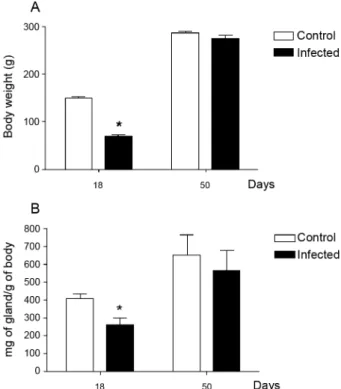
In accordance with previous studies, parotid glands from infected rats with T. cruzi (acute phase) showed a reduced density and volume of acini, as well as an in-crease in connective tissue (Fig. 1A, B). However, after 50 days of infection no histological differences were observed between infected and control groups (Fig. 1C, D). In addition, at 18 days of infection, infected rats showed a significant decrease in both body weight (150.1 ± 2.97 v.s. 68.5 ± 5.12 g in infected rats, p < 0.05) (Fig. 2A) and relative parotid gland weight (408.3 ± 26.5 v.s. 265.0 ± 36.7 mg of gland/g of body in infected rats, p < 0.05) (Fig. 2B) compared with non-infected rats. No significant changes in these parameters were observed at 50 days of infection (287.0 ± 3.41 v.s. 275.6 ± 5.52 g of body weight in infected rats and 655.0 ± 113.2 v.s. 566.7 ± 113.9 mg of gland/g of body) of glan-dular weight in infected rats).
To investigate the relationship between histological alterations in parotid glands and testosterone and EGF-R levels in rats with experimental Chagas disease, we measured circulating testosterone concentration and EGF-R expression in the glands. Serum testosterone levels in animals at 18 days of infection were signifi-cantly lower than in the control group (0.532 ± 0.152 v.s. 0.030 ± 0.008 ng/mL in infected rats, p < 0.05) (Table). After 50 days of infection, no significant difference in
testosterone levels was observed between control (4.740 ± 0.607 ng/mL) and infected groups (3.800 ± 0.491 ng/ mL). Furthermore, western blotting analysis revealed that EGF-R levels in infected rats at 18 days of infection were statistically different than observed in control rats. However, at 50 days of infection no significant changes were viewed between infected and control rats regarding EGF-R levels (Figs 3, 4).
DISCUSSION
The most significant finding in the present study is that infection with T. cruzi is associated with a sig-nificant decrease in both plasma testosterone levels and EGF-R expression in parotid glands of rats during the acute phase (at 18 days of infection) of experimental Chagas disease. It has been previously demonstrated that parotid glands of rats at 18 days of infection show a significant reduction in the volume of acini with a concomitant increase in the volume of stroma and con-nective tissue (Silva et al. 2000). Similar histological changes were observed in parotid glands of rats after orchiectomy (Jezek et al. 1996), suggesting that testos-terone is involved in the development and maintenance of parotid gland structure in rats.
Body weight plays an important role in sexual matu-rity (Courout et al. 1970). A delay in developing testis is reflected in circulating testosterone levels. Accordingly, our results show a significant decrease in body weight of rats after 18 days of infection with concomitant re-duction in plasma testosterone levels. These findings are in accordance with those of Tavares et al. (1994) and Moreira et al. (2008).
According to some investigations, more testoster-one is bound in the parotid gland than in the prostate or seminal vesicles, which largely depend on this
hor-TABLE
Circulating testosterone levels in control and infected rats after 18 or 50 days of infection
Infection period
Days 18 50
Control 0.325 ± 0.1527a 4.740 ± 0.6076
Infected 0.0300 ± 0.0083 3.800 ± 0.4916
a: p = 0.0036 compared with control group at the same period of infec-tion (Student’s t-test).
Fig. 2: body weight (A) in control and infected rats (asterisks mean p < 0.0001, Student’s t-test). Relative parotid gland weight (B) in con-trol and infected rats after 18 or 50 days of infection (asterisks mean p < 0.005, Student’s t-test).
Fig. 3: epidermal growth factor receptors (EGF-R) levels in parotid gland extract of control and infected rats after 18 or 50 days of infec-tion. Representative electrophoresis of total proteins (A) and of west-ern blotting membrane (B) using an antibody against EGF-R. The arrow points to 170 KDa bands that correspond to EGF-R. Lane 1: marker; 2: control (18 days); 3: infected (18 days); 4: control (50 days); 5: infected (50 days).
mone (Di Mangoni & Stefano 1976). Importantly, tes-tosterone stimulates the acini and salivary gland ducts to secrete growth factors such as EGF (Xu 2003) and neural growth factor (NGF) (Schneyer & Humphreys-Beher 1990). EGF binds to its receptor and activates an intrinsic tyrosine phosphorylation cascade leading to
in-creased activity of phospholipase Cγ and augmentation
of intracellular Ca2+ levels due to the action of IP3 and
PKC (Carpenter & Cohen 1990). Furthermore, salivary
gland cells are influenced by both EGF and TGF-α bind -ing to a shared EGF-R. This shared EGF-R is a trans-membrane protein with tyrosine kinase activity and it exerts trophic effects on salivary acinar, ductal and mu-cosal epithelial cells (Koski et al. 1997).
EGF influences the renewal and the growth of the acinar and ducts cells (Barthe et al. 1974, Walker et al. 1981). According to Barka et al. (2005), the gland cells express EGF and its receptors and EGF acts as an auto-crine regulator in promoting growth and branching
mor-phogenesis. Diminished expression of EGF and TGF-α
in Sjogren’s syndrome indicates a failure of this trophic system, which may contribute to the acinar atrophy and secondary changes, including atrophy of the oral mucosa (Koski et al. 1997).
Castration appears to influence the synthesis and dis-tribution of androgen receptors in salivary glands that could further affect the function of the gland, diminish-ing secreted EGF levels (Li et al. 2005). There has been demonstration of this relationship working in the opposite direction. EGF also plays a physiological role in repro-duction. Removal of the salivary gland in rodents reduces circulating EGF and the spermatogenesis process, which can be restored by EGF replacement (Wong et al. 2000).
In the present study we observed a significant reduc-tion in EGF-R levels in the acute phase of Chagas dis-ease as well as atrophy of acinar cells. Thus, it is possible that a decrease in EGF-R levels may be sufficient to in-duce histological and biochemical changes in the parotid gland during the acute phase of experimental Chagas disease. Interestingly, at 50 days of infection (chronic phase) body weight, testosterone levels and EGF-R ex-pression returned to normal levels. In addition, no sig-nificant changes were observed in the histological aspect of parotid glands of infected rats. These results further suggest that morphological alterations in parotid glands are dependent on the testosterone-EGF-R axis. Future experiments using EGF-R antagonists are necessary to address this issue. Of note, normal rats treated with an EGF-R antibody presented a dose-dependent retardation of parotid gland proliferation (Purushotham et al. 1992).
In summary, these findings suggest that the testos-terone-EGF-R axis is involved in morphological changes observed in parotid glands of rats with acute experimen-tal Chagas disease. In addition, parotid glands show a normal histological aspect in the chronic phase, prob-ably due to normalization of plasma testosterone levels, as this hormone is directly influenced by body weight.
REFERENCES
Alves JB, Machado CRS 1980. Histological and histoquantitative study of the rat submandibular gland in Chagas’ disease. Arch Oral Biol 25: 437-443.
Alves JB, Napimoga MH, Araújo MS, Silva GAB 2008. Delay in maturation of the submandibular gland in Chagas disease cor-relates with lower DNA synthesis. Mem Inst Oswaldo Cruz 103: 585-590.
Barka T, Gresik ES, Miyazaki Y 2005. Differentiation of a mouse submandibular gland-derived cell line (SCA) grown on matrigel.
Exp Cell Res 308: 394-406.
Barthe PL, Bullock LP, Nowsszowics I, Bardin CW, Orth DN 1974. Submaxillary gland epidermal growth factor: a sensitive index of biologic androgen activity. Endocrinology 95: 1019-1025.
Bradford MM 1976. A rapid and sensitive method for the quantifica-tion of microgram quantities of proteins utilizing the principle of protein dye binding. Anal Biochem 72: 248-254.
Brener Z 1962. Therapeutic activity and criterion of cure on mice experimentally infected with Trypanosoma cruzi. Rev Inst Med Trop Sao Paulo 4: 389-396.
Carpenter G, Cohen S 1990. Epidermal growth factor. J Biol Chem 265: 7709-7712.
Chagas C 1909. Nova tripanosomíase humana. Estudos sobre a mor-fologia e o ciclo evolutivo do Schizotrypanum cruzi n.g., n.s.p., agente etiológico de nova entidade mórbida no homem. Mem Inst Oswaldo Cruz 1: 159-218.
Courout M, Hochereau-de Reviers MT, Ortavant TR 1970. Spermato-genesis. In AD Johnson, WR Gomes, NL Van Denmark, The tes-tis, Academic Press, New York, p. 339-431.
Di Mangoni S, Stefano C 1976. Le parotidi di ratto organo bersaglio per il testosterone. Boll Soc Ital Biol Sper 52: 397-403.
Jezek D, Banek L, Banek T 1996. Effects of orchiectomy on the rat parotid gland - an ultrastructural and stereological study. Acta Anat 155: 172-183.
Kasayama S, Ohba Y, Oka T 1990. Expression of epidermal growth factor gene in mouse lacrimal gland: comparison with that in the submandibular gland and kidney. J Mol Endocrinol 4: 31-36.
Köberle F 1968. Chagas disease and Chagas syndromes: the pathol-ogy of American trypanosomiasis. Adv Parasitol 6: 63-116.
Koski H, Konttinen YT, Hietanen J, Tervo T, Malmstrom M 1997. Epidermal growth factor, transforming growth factor - alpha and epidermal growth factor receptor in labial salivary glands in Sjogren’s syndrome. J Rheumatol 24: 1930-1935.
Li HJ, Yao B, Liang W, Wang YM, Xu QL, Huang YF 2005. Localiza-tion and potential funcLocaliza-tion of androgens receptor in rat salivary gland. Asian J Androl 7: 295-301.
Moreira A, Napimoga MH, Benatti BB, Silva GAB, Rocha-Rodrigues DB, Clemente-Napimoga JT, Vieira GA, Alves JB 2008. Mor-phological changes and EGF expression in the granular convolut-ed tubules cells of submandibular glands of Trypanosoma cruzi
infected rats. Tissue Cell 40: 293-298.
Pereira SAL, Rodrigues DB, Ferraz MLF, Castro ECC, Reis MA, Paula ATV 2006. Inflammation and glandular duct dilatation of the tongue from patients with chronic Chagas disease. Parasitol Res 98: 153-156.
Purushotham KR, Dunn WA Jr, Schneyer CA, Humphreys-Beher MG 1992. A novel mechanism for isoprenaline-stimulated prolif-eration of rat parotid acinar cells involving the epidermal growth factor receptor and cell surface galactosyltransferase. Biochem J 284: 767-776.
propranolol or partial sialoadenectomy. Biochem Pharmacol 39: 1679-1686.
Silva LHP, Nussenzweig V 1953. Sobre uma cepa de Trypanosoma cruzi altamente virulenta para o camundongo branco. Folia Clin Biol 20: 191-208.
Silva RC, Cardoso JE, Silva GAB, Moreira A, Alves JB 2000. Histo-logical and histoquantitative study of the rat parotid gland after
Trypanosoma cruzi infection. Parasite 7: 109-113.
Tavares MCH, Carraro AA, Vianna Favaretto AL, Petenusci SO, Lopes RA, Ribeiro RD, Lamano Carvalho TL 1994. The male reproductive organs in experimental Chagas’ disease. III. Plasma testosterone and accessory sex glands in the acute phase of the disease. Exp Toxicol Pathol 46: 243-246.
Vieira CB 1961. Hyperamylasemia and hyperactivity of salivary
glands associated with megaesophagus. Am J Dig Dis 6: 727-741.
Xu QL 2003. The localization and potential function of androgen receptor mRNA in rat submaxillary. Zhonghua Nan Ke Xue 9: 681-683.
Walker P, Eichsel ME, Hoath SB, Poland RE, Fisher DA 1981. Effect of thyroxine testosterone and corticosterone on NGF and EGF con-centrations in adult female mouse submaxillary gland: dissocia-tion of NGF and EGF responses. Endocrinology 109: 582-587.
WHO - World Health Organization 2000. Who’s certified. [database on the Internet]. Weekly Epidemiology Records c2000 [cited 2009 Feb 18]. Available from: http://www.who.int/wer/archives/en/.