Phylogenetic relationships and the evolution of mimicry in the
Chauliognathus
yellow-black species complex (Coleoptera: Cantharidae) inferred from
mitochondrial COI sequences
Vilmar Machado
1, Aldo M. Araujo
2, José Serrano
3and José Galián
31
Universidade do Vale do Rio dos Sinos - UNISINOS, Laboratório de Biologia Molecular,
São Leopoldo, RS, Brazil.
2
Universidade Federal do Rio Grande do Sul, Instituto de Biociências, Departamento de Genética,
Porto Alegre, RS, Brazil.
3
Universidad de Murcia, 3ª Planta Facultad de Veterinaria, Departamento de Zoología y Antropología
Física, Área de Biología Animal, Murcia, Spain.
Abstract
The phylogenetic relationships of twelve species ofChauliognathuswere investigated by studying the mitochondrial cytochrome oxidase I gene. A 678 bp fragment of the COI gene was sequenced to test the hypothesis that the Müllerian mimicry species of the “yellow-black” complex make up a monophyletic clade, separated from species with other colour patterns. The data set was analysed by neighbour-joining, maximum parsimony and maximum likelihood procedures.
The results support a single origin of the yellow-black colour pattern during the evolution of the genus, with one main clade formed byChauliognathus lineatus,C. tetrapunctatus,C. riograndensis,C. flavipes, C. octomaculatus,C. fallax,and another one formed by two species,C. expansusandCsp 1, plus an orange-black-coloured species. The nucleotide divergences found betweenC.sp 3 (black) and the other species studied fall within the level expected for species from different genera. The similarity of colour patterns of the yellow-black species has been considered an example of Müllerian mimicry by conservation of the ancestral state with some minor modifications.
Key words:Cantharidae,Chauliognathus, COI, Coleoptera, Müllerian mimicry, phylogeny, yellow-black complex. Received: January 14, 2003; Accepted: August 15, 2003.
Introduction
The genus Chauliognathus is distributed over the Americas and Australia, with more than 250 described spe-cies (Delkeskamp, 1939), but, despite its wide geographical distribution, only few studies have addressed its assortative mating features (references in McLain, 1982, 1985, and Bernstein and Bernstein, 1998), allozyme variability (Howard and Shields, 1990), colour polymorphism and mating systems (Machado and Araújo, 1995, 1998, 1999, 2001), and cytogenetics (Machadoet al., 2001). Taxonomy at the species level has been poorly studied, since a system-atic revision was carried out only in U.S. species (Fender, 1964), whereas the fauna of Mexico and the rest of the Neo-tropical region remains to be revised.
The present work is part of a long-term study of col-our polymorphism inChauliognathus,along with its mor-phology, cytogenetics, and molecular variability. Our study was focused on the species of the “yellow-black” complex. The similarity in colour pattern in these species, as well as that shown by morphometric analysis, together with eco-logical data suggest that they form a Müllerian-type mim-icry ring. The existence of colour polymorphism and the factors which maintain this polymorphism in Müllerian mi-metic organisms have recently generated much debate, re-newing the interest in mimicry (Turneret al., 1984; Speed, 1993; MacDougall and Dawkins, 1998; Joron and Mallet, 1998; Mallet and Joron, 1999; Edmunds and Golding, 1999). InChauliognathus, this polymorphism could have evolved as a response to visually oriented predators and, on theoretical grounds, it could be a case of classic Müllerian mimicry, made up by species of different intrageneric lin-eages (Machadoet al., 2001). Alternatively, the
morpho-www.sbg.org.br
Send correspondence to Vilmar Machado. Universidade do Vale do Rio dos Sinos - UNISINOS, Laboratório de Biologia Molecular, Caixa Postal 275, 93001-970 São Leopoldo, RS, Brazil. E-mail: [email protected].
logical similarity shown by species of the “yellow-black” complex could be explained by common ancestry.
Molecular phylogenetic studies have been used for generating and testing evolutionary hypotheses in beetles, such as the reconstruction of the history of host plant use by Ophraella(Futuyma and McCafferty, 1990; Futuyma et al., 1993, 1994), the origin of defensive strategies in Cicindela (Vogler and Kelley, 1998), colonisation pro-cesses (Juanet al.,1995, 1996, 1998; Emersonet al., 1999, 2000; Rees, 2001), and chromosome evolution (Galiánet al., 2002).
This study includes 12 species ofChauliognathusand is the first attempt to generate a phylogenetic hypothesis for the evolution of beetles belonging to the family Cantharidae. The aim of the work was to test the hypothesis that the species of the “yellow-black” species complex make up a monophyletic clade, separated from species with other colour patterns. Therefore, it could be inferred that this colour pattern is due to common ancestry. According to the classical Müllerian mimicry theory, the pattern should be the result of parallel or convergent evolution.
A 678 bp fragment of the mitochondrial cytochrome oxidase I (COI) gene was sequenced. This approach offers an independent phylogenetic framework, based on charac-ters which are unrelated to colour polymorphism. This gene region has also been used for reconstructing phylogenies of low-ranked taxa, including some Coleopteran groups (Juan et al.,1995, 1996; Galiánet al.,1999). Furthermore, this gene has been used to address the evolution of mimicry in butterflies of the genusHeliconius(Brower, 1996).
Material and Methods
Material
Twelve species ofChauliognathuswere included in the study. Sampling localities are shown in Table 1. Eight of these species belong to the “yellow-black” complex (C. flavipes, C. fallax, C. octomaculatus, C. lineatus, C. tetrapunctatus, C. riograndensis, C. expansus,andC.sp 1).
Their main colour patterns are illustrated in Figure 1. The other four species show other colour patterns, namely, grey and black (C. morios), orange (C.sp 2), different stripped combinations of brown and grey (C.sp 4), and black (C.sp 3). This material was identified by one of the authors (VM), based on characters of the external genitalia, following the criteria used by Fender (1964) for the North American spe-cies of the same genus. The new spespe-cies will be described elsewhere; voucher genitalia preparations and remnants of investigated beetles are deposited in the Molecular Biology Laboratory of the Universidade do Vale do Rio dos Sinos, São Leopoldo, Brazil, and can be requested from VM. Se-quence data were obtained from single individuals of each species, after an initial estimation of intraspecific sequence variation between 0.3 and 0.6 % inC. flavipes.
DNA amplification and sequencing
Total genomic DNA was isolated by grinding the head, thorax and legs of each specimen (one individual/spe-cies) in liquid nitrogen and resuspending the homogenate in buffer (20 mM Tris, 10 mM EDTA, 0.5% SDS) containing proteinase-K at a concentration of 50 mg/L. The mixture was incubated overnight at 56 °C, then the DNA was puri-fied with phenol-chloroform and precipitated with ethanol (Sambrooket al.,1989). The mtDNA template for sequenc-ing was produced by polymerase chain reaction (PCR) with the primers 5’CAACATTTATTTTGATTTTTTGG3’ (at 715 bp upstream of the COI gene, corresponding to position 2183 of the mtDNA genome ofDrosophila yakuba) and 5’TCAATTGCACTAATCTGCCATATT3’ (correspond-ing to position 3014 of the mtDNA genome located in the tRNAleu). These primers produced a 831 bp fragment at the 3’ end of the COI gene in all analysed species. Each PCR cycle was set to 94 °C for 30 s, 1 min at 50 °C, and 1 min at 72 °C. This cycle was repeated 34 times. PCR products were sequenced with the Big Dye Terminator Cy-cle Sequencing Ready Reaction Kit using Ampli Taq DNA Polymerase, FS, in an ABI PRISM Tm 377 DNA Se-quencer.
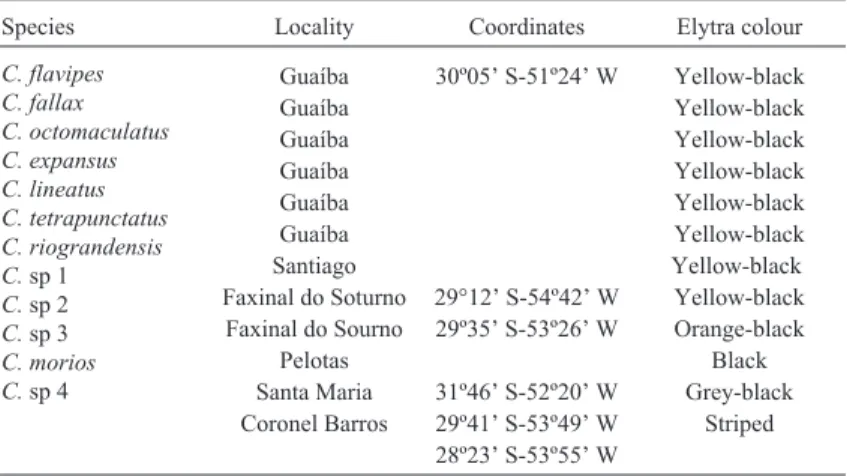
Table 1-Chauliognathusspecies, locality of collection, and elytra colour pattern.
Species Locality Coordinates Elytra colour
C. flavipes C. fallax C. octomaculatus C. expansus C. lineatus C. tetrapunctatus C. riograndensis C.sp 1
C.sp 2
C.sp 3
C. morios C.sp 4
Guaíba Guaíba Guaíba Guaíba Guaíba Guaíba Santiago Faxinal do Soturno
Faxinal do Sourno Pelotas Santa Maria Coronel Barros
30º05’ S-51º24’ W
29°12’ S-54º42’ W 29º35’ S-53º26’ W
31º46’ S-52º20’ W 29º41’ S-53º49’ W 28º23’ S-53º55’ W
Yellow-black Yellow-black Yellow-black Yellow-black Yellow-black Yellow-black Yellow-black Yellow-black Orange-black
Black Grey-black
Phylogenetic analysis
Phylogenetic reconstruction was performed by apply-ing the maximum parsimony (MP), maximum likelihood (ML) and neighbour-joining (NJ; Saitou and Nei, 1987) methods, using the PAUP*4.0b package (Swofford, 1998).
Maximum parsimony and maximum likelihood anal-yses were conducted using the branch swapping heuristic algorithm tree bisection-reconnection with random addi-tion of taxa.
Phenograms based on sequence distances were con-structed using the neighbour-joining analysis, with the dis-tances corrected by Kimura’s two-parameter model (Kimura, 1980) with gamma distribution of rates.
For the parsimony analysis, bootstrap tests (Felsenstein, 1985) based on 500 replications were used to assess support of the various phyletic groups. Bootstrap fre-quencies were interpreted as heuristic levels of support rather than statistical significance levels. Trees were rooted with the sequence of the ground beetle species of the genus Scarites (Carabidae), described by Galián et al. (1999), plus an additional fragment (Galián, unpubl. res).
Results
A fragment of 830 bp was amplified with the chosen primers in all species. Neither insertions nor deletions were found in this region. Within this gene segment, 338 positions were variable (including the outgroup species), and 170 of them were parsimony-informative. The third codon position was the most variable, while the second codon position was the most constant in this region. Across all sequences there was an excess of A (33.4%)
and T (36.7%) over G (15.0%) and C (14.9%) (Table 2). The proportion of A-T (70.7%) was high, falling between those found for Drosophila yakuba (78.6%, Clary and Wolstenholme, 1985) and for the genus Pimelia(64%, Juanet al., 1995).
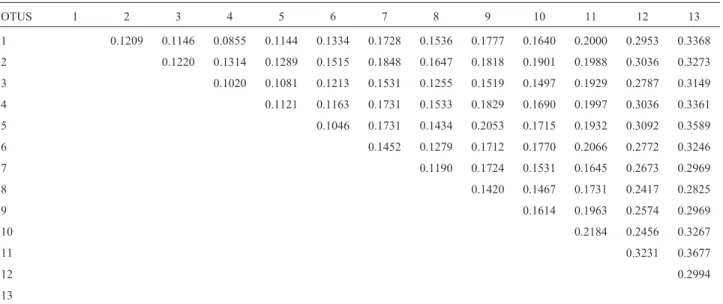
Pairwise distances for the Kimura two-parameter model corrected for rate heterogeneity with the gamma dis-tribution were calculated between sequences, using the pairwise-deletion option of the MEGA computed distances menu (Table 3). The divergence observed between Chauliognathussp 3 (black) and the other species of the ge-nus was high, between 24% and 32%. For the other Chauliognathusspecies, the levels of divergence were be-tween 8% and 21%. The smallest divergence value was ob-served betweenC. octomaculatusandC. fallax(8%).
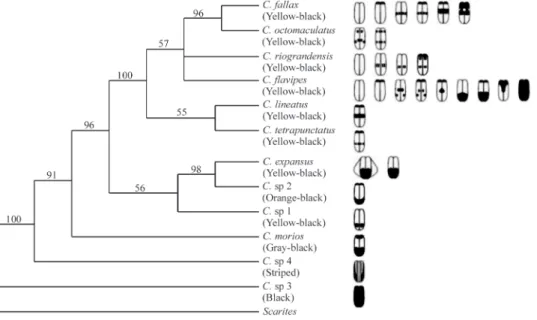
A heuristic search with uniform weighting generated two MP trees of step length 680, with CI 0.613 and RI 0.395. Then, the characters were re-weighted by maximum value of re-scaled consistency indices, producing a single tree (Figure 1). That tree was similar to the neighbour-joining tree (not shown). These trees support monophyly for the “yellow-black” complex, with slight differences. An interesting aspect of these trees is thatChauliognathussp 2
Figure 1- Single most parsimonious tree obtained with heuristic search re-weighted by maximum value of re-scaled consistency index for the twelve species ofChauliognathus. Bootstrap values for 500 replicates are given at the nodes. Pattern of variation found in the elytra colour for the 12 species ana-lysed of the genusChauliognathusare figured to the right.
Table 2- Proportion of each nucleotide by codon position in the region of COI gene analysed.
position
base First Second Third Total
A T G C
33.8 28.7 24.3 13.2
19.5 43.9 16.5 20.0
46.8 37.3 4.3 11.5
(orange pattern) is included in the yellow-black clade. On the other hand,Chauliognathussp3 (black pattern) is situ-ated in all analyses in a separsitu-ated group, basal to the re-maining species.
Heuristic maximum likelihood searches using the Hasegawa-Kishino-Yano (1985) model (not shown) did not agree with the previous analysis, since they showed some differences, especially in the position of Chauliognathus.sp 4, that is clustered together within the “yellow-black” species.
In order to correct possible “evolutionary noise” caused by the more variable nucleotide positions,i.e.the first and third codon positions, a weighting of 2:5:1 to the first, second and third codon positions, respectively, was carried out. The branch and bound search produced two most parsimonious trees, similar to the heuristic search with a uniform weighting.
Bootstrap analysis yielded strong support for certain groups, for example, all analyses separated the yel-low-black species into two clades, one with six species (bootstrap value 100) and the other with two species plus the orange speciesC.sp 2 (bootstrap value 84). These val-ues were produced after re-weighting by maximum value of re-scaled consistency indices tree (Figure 1).
In all analyses, the species of the yellow-black com-plex make up two separated clades; one clade formed by six species of the “yellow-black” complex, Chauliognathus lineatus, C. tetrapunctatus, C. riograndensis, C. flavipes, C. octomaculatus, andC. fallax(bootstrap value 100) and the other clade formed by two species of the “yel-low-black” complex,C. expansusandCsp 1, plusC.sp 2, an orange-black species (bootstrap value 56).
Discussion
The results show that the region of the COI gene se-quenced inChauliognathus(corresponding to the 3’ end) has the adequate level of divergence for assessing phylo-genetic relationships among species of the same genus, as found in other animal groups (Luntet al., 1996). It has been postulated that the level of divergence for this gene ranges from 1% to 6% among populations within a species, and from 12.6% to 25% among species within a genus (Gallego and Galián, 2001; Simonet al., 1994). The level of diver-gence calculated betweenChauliognathusspecies falls, for most of them, within the range of distinct species, with the exception ofC.sp 3. The lowest genetic distance value was found betweenC. fallaxandC. octomaculatus(8%). How-ever, this value of divergence was slightly higher than the one expected between populations within a species. Similar levels of divergence have been found in the Polyphagan beetle generaPimelia(Juanet al., 1995),Hegeter(Juanet al., 1996), andOphraella(Funket al., 1995), and in the Adephagan genusScarites(Galiánet al., 1999). The level of divergence found betweenChauliognathussp 3 (black) and each of the other species falls into that expected for spe-cies of different genera.
According to the trees obtained after re-weighting by maximum value of re-scaled consistency indices, giving equal values to all codon positions, the “yellow-black” spe-cies have a common ancestor and form two clades. This grouping is consistent across different analytical methods (MP, NJ). In all analyses,Chauliognathussp 3 is placed in a separated lineage, basal to all of the other species. The great genetic distance between this species and all the oth-ers suggests that a more comprehensive study, taking into
Table 3- Matrix of interspecific distance (Gamma distance for the Kimura two-parameter model) in the mitochondrial COI fragment among twelve
Chauliognathusspecies.
OTUS 1 2 3 4 5 6 7 8 9 10 11 12 13
1 0.1209 0.1146 0.0855 0.1144 0.1334 0.1728 0.1536 0.1777 0.1640 0.2000 0.2953 0.3368
2 0.1220 0.1314 0.1289 0.1515 0.1848 0.1647 0.1818 0.1901 0.1988 0.3036 0.3273
3 0.1020 0.1081 0.1213 0.1531 0.1255 0.1519 0.1497 0.1929 0.2787 0.3149
4 0.1121 0.1163 0.1731 0.1533 0.1829 0.1690 0.1997 0.3036 0.3361
5 0.1046 0.1731 0.1434 0.2053 0.1715 0.1932 0.3092 0.3589
6 0.1452 0.1279 0.1712 0.1770 0.2066 0.2772 0.3246
7 0.1190 0.1724 0.1531 0.1645 0.2673 0.2969
8 0.1420 0.1467 0.1731 0.2417 0.2825
9 0.1614 0.1963 0.2574 0.2969
10 0.2184 0.2456 0.3267
11 0.3231 0.3677
12 0.2994
13
account the overall data (morphological and genetic), needs to be made in order to assess the taxonomic status of this species.
These results indicate that the colour pattern of the “yellow-black” complex is due to a common ancestry. The polymorphism in the elytral coloration in four out of the eight species of the complex (Diehl-Fleig and Araújo, 1991; Machado and Araújo, 1995; 1998; 1999) suggests that it (polymorphism) is also an ancestral feature of this genus. However, it is unclear whether the ancestor had a monomorphic yellow or black elytron, or a yellow elytron with black spots varying in size and location. Models for the evolution of colour patterns in heliconiine butterflies have hypothesised changes in regulatory genes (Gilbert, 2002; Jiggins and McMillan, 1997). This hypothesis may well be applied to the Chauliognathus “yellow-black” complex.
In any case, the colour pattern of the “yellow-black” complex is possibly a true case of Müllerian mimicry, as stated by Machado and Araújo (2001), with conservation of the ancestral state with some small modifications. This is in accordance with Brower et al. (1963), who stated that Müllerian relationships should not be excluded within closely related species, as the selective process that pre-vents divergence in colour pattern may be basically the same as those bringing about convergence in distantly re-lated organisms. The study of the occurrence and mainte-nance of this variety of colour patterns inChauliognathus offers a model to understand the mechanisms involved in the evolution of the polymorphism of Müllerian mimicry that is different from those applied to butterfly species. Fur-thermore, this species complex is a good study case for the species/population interface, through a phylogeographic approach. According to Templeton (1998), this approach is important for the study of the process involved in the origin of new species.
The nucleotide sequences of the 12Chauliognathus taxa determined here were deposited in the GenBank Data-base under Accession Nos. from AY095214 to AY095225.
Acknowledgments
We thank Ricardo C. Fernandes and Lenise P. Palma for their help in collecting specimens and Elena Martínez-Navarro and Diego Gallego, for useful discussion and tech-nical assistance; Pilar De la Rúa, Carlos Juan and Jesús Gómez-Zurita for helping with the phylogenetic analyses. Many thanks are also due to D. Swofford for permission to use test versions of PAUP*. V. Machado and J. Galián ac-knowledge the financial support for mutual visits received from Unisinos (Brazil) and from the University of Murcia (Spain), through the “Programa de Cooperación Universi-taria” (AL.E 2000 and E.AL 2000) between the Spanish “Agencia Española de Cooperación Internacional” and Latin American Universities. Thanks are further due to the Brazilian “Conselho Nacional de Desenvolvimento
Cientí-fico e Tecnológico” (CNPq) for financial support to VM, and to the Spanish Ministry of Science and Technology Project No. BOS2002-02870 of the DGI for support granted to JG.
References
Bernstein R and Bernstein S (1998) Assortative mating by size in two species ofChauliognathus(Coleoptera: Cantharidae). Southwest Nat 4:62-69.
Brower LP, Brower JV and Collins CT (1963) Experimental stud-ies of mimicry. 7. Relative palatability and Müllerian mim-icry among Neotropical butterflies of the subfamily Heliconiinae. Zoologica 48:65-84.
Brower AVZ (1996) Parallel race formation and the evolution of mimicry inHeliconiusbutterflies: a phylogenetic hypothesis from mitochondrial DNA sequences. Evolution 50:195-221. Clary DO and Wolstenholme DR (1985) The mitochondrial DNA molecule ofDrosophila yakuba: nucleotide sequence, gene organization, and genetic code. J Mol Evol 22:252-271. Delkeskamp K (1939 Pars 165) Cantharidae. In: Junk W (ed)
Coleopterorum Catalogus. Verlag für Naturwissenschaften, Gravenhage, 356 pp.
Diehl-Fleig E and Araújo AM (1991) O polimorfismo cromático em uma população natural de Chauliognathus fallax (Coleoptera: Cantharidae) do Rio Grande do Sul. Rev Bras Biol 51:515-520.
Edmunds M and Golding YC (1999) Diversity in mimicry. Trends Ecol Evol 14:150-151.
Emerson BC, Oromí P and Hewitt GM (1999) MtDNA phylo-geography and recent intra-island diversification among Ca-nary IslandCalathusbeetles. J Mol Evol 13:149-158. Emerson BC, Oromí P and Hewitt GM (2000) Colonization and
diversification of the species Brachyderus rugatus
(Coleoptera) on the Canary Islands: evidence from mtDNA
COIIgene sequences. Evolution 54:911-923.
Felsenstein J (1985) Confidence limits on phylogenies: an ap-proach using the bootstrap. Evolution 39:783-791. Fender KM (1964) The Chauliognathini of America North of
Mexico (Coleoptera: Cantharidae). Northwest Sci 38:95-105.
Funk DJ, Futuyma DJ, Ortí G and Meyer A (1995) Mitochondrial DNA sequences and multiple data sets: a phylogenetic study of phytophagous beetles (Chrysomelidae:Ophraella). Mol Biol Evol 12:627-640.
Futuyma DJ and McCafferty SS (1990) Phylogeny and the evolu-tion of the host plant associaevolu-tions in the leaf beetle genus
Ophraella (Coleoptera: Chrysomelidae). Evolution 44:1885-1913.
Futuyma DJ, Keese MC and Scheffer SJ (1993) Genetic con-straints and the phylogeny of insect-plant associations: responses ofOphraella communa(Coleoptera: Chrysome-lidae) to host plants of its congeners. Evolution 47:888-905. Futuyma DJ, Walsh J, Morton T, Funk DJ and Keese MC (1994)
Genetic variation in a phylogenetic context: responses of two specialized leaf beetles (Coleoptera: Chrysomelidae) to host plants of their congeners. J Evol Biol 7:127-146. Gallego D and Galián J (2001) The internal transcribed spacers
Galián J, De la Rúa P, Serrano J, Juan C and Hewitt M (1999) Phylogenetic relationships in West Mediterranean Scaritina (Coleoptera, Carabidae) inferred from mitochondrial COI sequences and karyotype analysis. J Zool Syst Evol Res 37:85-92.
Galián J, Hogan JE and Vogler AP (2002) The origin of multiple sex chromosomes in tiger beetles. Mol Biol Evol 19:1792-1796
Gilbert LE (2002) Adaptive novelty through introgression in
Heliconiuswing patterns: evidence for shared genetic “tool box” from synthetic hybrid zones and a theory of diversifi-cation. In: Boggs CL, Watt WB and Ehrlich PR (eds) Evolu-tion and ecology taking flight: butterflies as model systems. Rocky mountain biological lab symposium series, Univer-sity of Chicago Press.
Hasegawa M, Kishino H and Yano T (1985) Dating of the hu-man-ape splitting by a molecular clock of mitochondrial DNA. J Mol Evol 22:160-174.
Howard DJ and Shields WM (1990) Patterns of genetic variation within and among species ofChauliognathus(Coleoptera: Cantharidae). Ann Entomol Soc Am 83:326-334.
Jiggins CD and McMillan WO (1997) The genetic basis of an adaptive radiation: warning colour in twoHeliconius spe-cies. Proc R Soc Lond 264:1167-1175.
Joron M and Mallet JLB (1998) Diversity in mimicry: paradox or paradigm? Trends Ecol Evol 13:461-466.
Juan C, Oromi P and Hewitt GM (1995) Mitochondrial DNA phy-logeny and sequential colonization of Canary Islands by darkling beetles of the genusPimelia(Tenebrionidae). Proc R Soc Lond (series B) 261:173-180.
Juan C, Oromi P and Hewitt GM (1996) Phylogeny of the genus
Hegeter(Tenebrionidae: Coleoptera) and its colonization of the Canary Islands deduced from cytochrome oxidase I mi-tochondrial DNA sequences. Heredity 77:392-403. Juan C, Ibrahim KM, Oromi P and Hewitt GM (1998) The
phylogeography of the darkling beetle,Hegeter politus, in the eastern Canary Islands. Proc R Soc Lond (series B) 265:135-140.
Kimura M (1980) A simple method for estimating evolutionary rates of base substitution through comparative studies of nu-cleotide sequences. J Mol Evol 16:111-120.
Kumar S, Tamura K and Nei M (1993) MEGA: molecular evolu-tionary genetics analysis, version 1.01.University Park, The Pennsylvania State University, PA.
Lunt DH, Zhang DX, Szymura JM and Hewitt GM (1996) The in-sect cytochrome oxidase I gene: evolutionary patterns and conserved primers for phylogenetic studies. Insect Mol Biol 5:153-165.
MacDougall A and Dawkins MS (1998) Predator discrimination error and the benefits of Müllerian mimicry. Anim Behav 55:1281-1288.
Machado V and Araújo AM (1995) The colour polymorphism in
Chauliognathus flavipes(Coleoptera; Cantharidae). I. Geo-graphic and temporal variation. Evolución Biologica 8/9:127-139.
Machado V and Araújo AM (1998) Padrões de emergência em populações naturais de duas espécies de Chauliognathus
(Coleoptera; Cantharidae). Rev Bras Entomol 41:235-238. Machado V and Araújo AM (1999) Colour polymorphism in
Chauliognathus flavipes Fab. 1781, (Coleoptera;
Cantharidae). II. Patterns of emergence of morphs and mat-ing systems. Rev Bras Zool 16:441-446.
Machado V, Araújo AM and Mosmann CS (2001) Morphometric analysis, mimicry, and colour polymorphism in five species of the genus Chauliognathus Hentz, 1830, (Coleoptera; Cantharidae). Rev Bras Zool 18:711-718.
Machado V and Araújo AM (2001) The aggregation of
Chauliognathus species (Coleoptera: Cantharidae) and its possible role for coexistence and mimicry. Iheringia Ser Zool 91:29-32.
Machado V, Valente VG, Araújo AM and Galian J (1991) Cytogenetics of eight neotropical species ofChauliognathus Henzt, 1830: implications on the ancestral karyotype in Cantharidae (Coleoptera). Hereditas 34:121-124.
Mallet J and Joron M (1999) Evolution of diversity in warning color and mimicry: polymorphism, shifting balance and speciation. Ann Rev Ecol Syst 30:201-233.
Mccauley DE and Wade MJ (1978) Female choice and the mating structure of a natural population of the soldier beetle,
Chauliognathus pennsylvanicus. Evolution 32:771-775. McLain DK (1982) Density dependent sexual selection and
posi-tive phenotypic assortaposi-tive mating in natural population of the soldier beetle,Chauliognathus pennsylvanicus. Evolu-tion 36:1227-1235.
McLain DK (1985) Clinal variation in morphology and assortative mating in the soldier beetle, Chauliognathus pennsylvanicus(Coleoptera: Cantharidae). Biol J Linn Soc 25:105-117.
Rees DJ, Emerson BC, Oromí P and Hewitt GM (2001) Mito-chondrial DNA, ecology and morphology: interpreting the phylogeography of theNesotes(Coleoptera: Tenebrionidae) of Gran Canaria (Canary Islands). Mol Ecol 10:427-434. Sambrook J, Fritsch E and Maniatis T (1989) Molecular cloning.
A laboratory manual. Cold Spring Harbour Laboratory Press, New York.
Saitou N and Nei M (1987) The Neighbor-Joining method: a new method for reconstructing phylogenetic tree. Mol Biol Evol 4:406-425.
Simon C, Frati F, Beckenbach A, Crespi B, Liu H and Flook P (1994) Evolution, weighting and phylogenetic utility of mi-tochondrial gene sequences, and a compilation of conserved polymerase chain reaction primers. Ann Entomol Soc Am 87:651-701.
Speed MP (1993) Muellerian mimicry and the psychology of pre-dation. Anim Behav 45:571-580.
Swofford DL (1998) PAUP*. Phylogenetic analysis using parsi-mony (*and other methods), v. 4. Sinauer, Sunderland, Mass. Templeton AR (1998) The role of molecular genetics in
speciation studies. In: De Salle R and Schierwater B (eds) Molecular approaches to ecology and evolution. Birkhäusel Verlag, Basel.
Turner JRG, Kearney EP and Exton LS (1984) Mimicry and the Monte Carlo predator: the palatability spectrum and the ori-gins of mimicry. Biol J Linn Soc 23:247-268.
Vogler AP, Kelley CK (1998) Covariation of defensive traits in Cicindela tiger beetles: a phylogenetic approach using mtDNA. Evolution 52:357-366.