Revista Brasileira de Entomologia 47 (3), 2003
Vilmar Machado
1Aldo Mellender de Araújo
2ABSTRACT. Beetles of the species Chauliognathus fallax Germar 1824 are polymorphic for elytron colouration with six
morphs distinguished on the basis of black pigmentation on a yellow background. We investigated samples of C. fallax
taken in eight consecutive weeks aiming to determine the frequency of the morphs which were grouped, for statistical analysis, into three classes according to elytra pigmentation as well as the possible occurrence of assortative mating. Our results showed a variation in the frequency of the classes throughout the season, both in males and females, with the maximum frequency of each class at the fourth and fifth week. The three classes (A, B, C) showed the same pattern of variation, and class B was always the more frequent. To test randomness of matings two approaches were taken: in the first, we compared the frequency of each class in copulating and non-copulating insects. In the second, the frequency of each class in the whole sample was taken as the probability of occurrence of the respective class; then, using the criterion of the probability of independent events we calculated the expected proportion of copulating insects for each pair of events. Both methods gave non-significant differences, suggesting that the matings were random.
KEYWORDS. Assortative mating; Chauliognathus; Coleoptera; colour polymorphism.
INTRODUCTION
The maintenance of genetic polymorphism is considered one of the central problems in population genetics. However, the emphasis in the last decades on molecular polymorphisms
has displaced studies on colour polymorphism (HOFFMANNet
al. 1995). On the other hand, animal colours have been strongly
discussed under the heading of evolutionary ecology, exemplifying mainly the communication between prey and
predator as well as that between the sexes (ENDLER 1978, 1993
a, b).
Beetles of the genus Chauliognathus Hentz, 1930
(Coleoptera, Cantharidae) show several features that make them highly suitable for studies both in population genetics and evolutionary ecology. Some species are polymorphic for
colour pattern of elytra and/or pronotum, such as C. flavipes
Fabricius, 1781 from the State of Rio Grande do Sul, Brazil, where the extensive geographical variation contrasts with the
temporal stability of the polymorphism (MACHADO & ARAÚJO
1995). Also for the North American species C. basalis
Lacordaire, 1837, it has been reported a high degree of
polymorphism for pronotum colouration in populations from Colorado, USA (BERNSTEIN & BERNSTEIN 1996).
The phenomenon of assortative mating has already been described in species of that genus. MCCAULEY & WADE (1978)
and MCLAIN (1982), showed the occurrence of preferential
mating related to size in the species C. pennsylvanicus De
Geer, 1774, which is however a monomorphic species for colour. BERNSTEIN & BERNSTEIN (1998) also ascertained
size-related assortative mating in C. basalis and C. deceptus
Fender, 1964. Southern Brazilian populations of the
polymorphic species C. flavipes have been studied by
DIEHL-FLEIG & ARAÚJO (1991) and by MACHADO & ARAÚJO
(1999), using elytra colour pattern as the variable involved in the preference with contradictory results. The first authors found positive assortative mating, while this was not found by MACHADO & ARAÚJO, which explain the possible causes for the
different results.
1. Laboratório de Genética, Universidade do Vale do Rio dos Sinos, UNISINOS. Caixa Postal: 275, 93022-000 São Leopoldo-RS, Brazil. E-mail: [email protected]
2. Departamento de Genética, Universidade Federal do Rio Grande do Sul. Caixa Postal 15053, 91501-970 Porto Alegre-RS, Brazil. E-mail: [email protected]
Elytra colour polymorphism and randomness of matings in
Here we studied the frequency of different colour morphs in Chauliognathus fallax Germar, 1824 throughout the season
and analysed whether there is random or assortative mating in order to find out one of the possible causes in the maintenance of the elytra polymorphism.
MATERIAL AND METHODS
Study sites. Beetles were collected at Fazenda Santa Isabel, municipality of Guaíba, RS, Brazil. Two natural fields (0.5 ha each) were examined for the presence of the beetles between October 17th, 1996 and January 2nd, 1997; they appeared only
on November 7th, being absent from December 26th on, which
represents the first and the last of the eight weeks referred latter. The fields were about 100 m apart from each other and were separated by a small wood. The vegetation consisted
predominantly of grasses and Eryngium sp. (Tourn.) L.
(Apiaceae). Beetles on flowers were sampled one day per week (between 10h and 12h); the insects were captured by hand, scored for the type of morph and then stored in glasses to be later released (pairs in copulation were stored in individual glasses). Although always feeding on pollen they changed hosts, first using Myrceugenia campestris (DC.) Legr. et Kaus.
(Myrtaceae) and Struthantus polyrhizus Mart. (Loranthaceae)
in the first week and then Eryngium sp. until the last week. For
statistical analyses, we used contingency or heterogeneity chi-square (Sokal & Rohlf 1995). A sample comprising all the phenotypes found were deposited in the Cantharidae collection of the Laboratório de Genética from UNISINOS.
Colour polymorphism and matings. Colour patterns of C.
fallax were classified basically by the presence of black spots
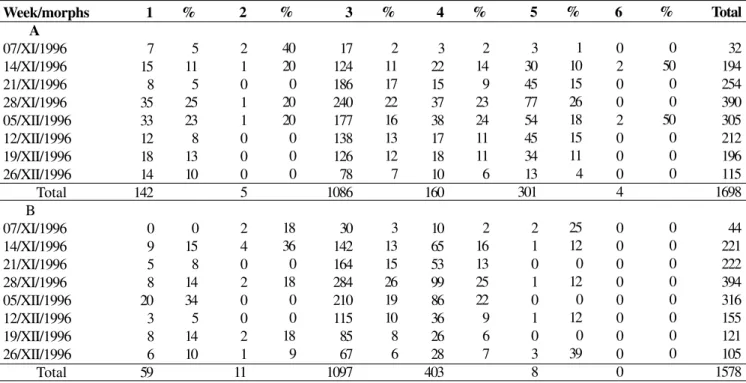
or stripes on the elytra; six morphs were recognized and numbered 1 through 6 (Table I; Fig. 1). For the analysis we joined morphs according to the increased degree of melanization of elytra. In accordance with this criterion, morphs 1 and 2 form class A; class B consisted only of morph 3, and morphs 4 and 5 formed class C. Morph 6 (the more pigmented) appeared in only four individuals, and so was excluded from the analysis. To analyse the randomness of matings, the morphs of both partners of copulating pairs were recorded and compared with non-copulating individuals. Moreover, the overall frequency of each class (A, B, C) was used as the probability of finding
Table I. Number and percentage for each morph and sex of Chauliognathus fallax at every week of sampling. A - males; B - females.
Week/morphs A 07/XI/1996 14/XI/1996 21/XI/1996 28/XI/1996 05/XII/1996 12/XII/1996 19/XII/1996 26/XII/1996 Total B 07/XI/1996 14/XI/1996 21/XI/1996 28/XI/1996 05/XII/1996 12/XII/1996 19/XII/1996 26/XII/1996 Total 1 7 15 8 35 33 12 18 14 142 0 9 5 8 20 3 8 6 59 % 5 11 5 25 23 8 13 10 0 15 8 14 34 5 14 10 2 2 1 0 1 1 0 0 0 5 2 4 0 2 0 0 2 1 11 % 40 20 0 20 20 0 0 0 18 36 0 18 0 0 18 9 3 17 124 186 240 177 138 126 78 1086 30 142 164 284 210 115 85 67 1097 % 2 11 17 22 16 13 12 7 3 13 15 26 19 10 8 6 4 3 22 15 37 38 17 18 10 160 10 65 53 99 86 36 26 28 403 % 2 14 9 23 24 11 11 6 2 16 13 25 22 9 6 7 5 3 30 45 77 54 45 34 13 301 2 1 0 1 0 1 0 3 8 % 1 10 15 26 18 15 11 4 25 12 0 12 0 12 0 39 6 0 2 0 0 2 0 0 0 4 0 0 0 0 0 0 0 0 0 % 0 50 0 0 50 0 0 0 0 0 0 0 0 0 0 0 Total 32 194 254 390 305 212 196 115 1698 44 221 222 394 316 155 121 105 1578
A B C D
1 2 3 4 5 6
Fig. 1. Elytra of the six morphs found in Chauliognathus fallax grouped into four classes. Class D was excluded of the analysis due to the small number of individuals (only 4).
Classes
such class to estimate the expected frequency of each mating.
RESULTS
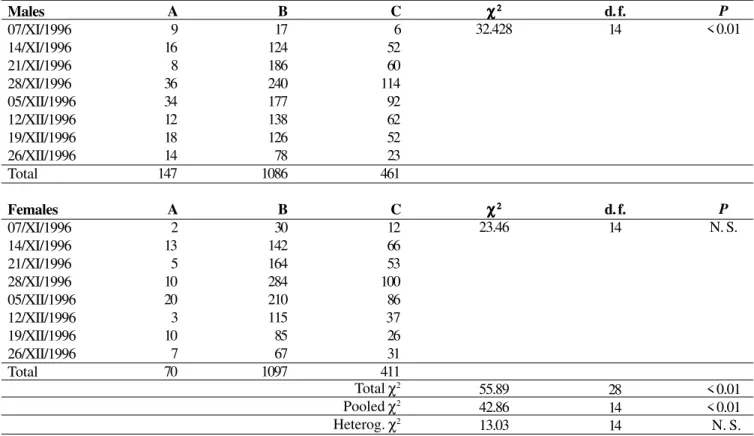
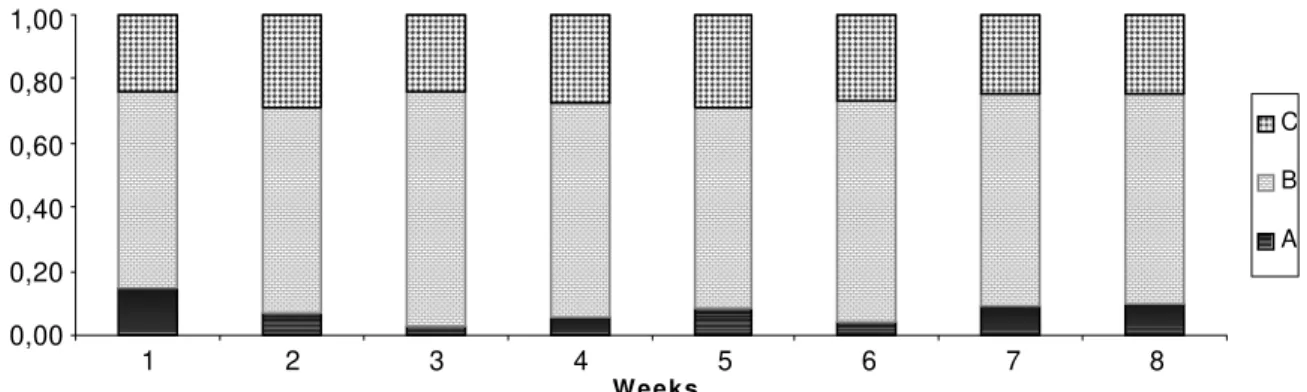
Colour polymorphism. The data were analysed in two complementary ways: first taking into account each sample (week) separately to estimate the frequency of the classes for each sex (per week); this is showed in Table II, for absolute numbers. These numbers were used as entries in a contingency table (8 x 3) to test for an association between week and class. Males showed highly significant differences in the frequency of classes A, B, and C per week (χ2 = 32.43; 14
d.f.; P < 0.01). Females, on the other hand, are close to statistical significance (χ2 = 23.46; 14 d.f.; 0.05<P<0.10). Both
sexes, however, showed the same pattern, as suggested by the non-significant heterogeneity chi-square (χ2 = 13.03; 14 d.f.; P
> 0.50). Due to this reason they are pooled in Fig. 2; the range of variation for each class was, respectively for class A, B, and C, 62-74%, 24-29 % and 3-14 %.
For descriptive purposes, we also considered the number of beetles in each class and week in relation to the total number caught in the respective class; these frequencies can be considered an estimate of the recruitment rate per class (Table III, Fig. 3). There is a peak of recruitment at the fourth/fifth week of sampling.
Randomness of matings. To test for randomness of matings
two approaches were taken: in the first we tested for an association between the frequency of the respective class in copulating and non-copulating beetles (Table IV); no association was detected. A second test consisted in comparing the expected frequency of each pair in copulation with the observed one (see Materials and Methods for details); again, a non-significant result was obtained (Table V). In order to eliminate the effects of a biased sex ratio for each class of morphs, chi-square statistics were applied each week to test for sex ratio proportions. Only in the sixth and seventh week of sampling there was a significant departure from the expected 1 male :1 female (χ2 = 8.85; 1 d.f.; P < 0,01).
DISCUSSION
Soldier beetles had been used to study the process and consequences of assortative mating. The variables employed
in these studies are the spot length (Chauliognathus
pennsylvanicus see MASON 1972), spot width, dry weight and
antennal scape diameter (C. pennsylvanicus see MCLAIN 1982,
1985), polymorphism of elytra colour in C. fallax and C. flavipes
(DIEHL-FLEIG & ARAÚJO 1991; MACHADO & ARAÚJO 1995, 1999),
and elytra length (C. basalis and C. deceptus) (BERNSTEIN &
BERNSTEIN 1998). Whichever the variables used to evaluate the
occurrence of assortative mating, the findings of positive assortative mating reported in the above papers are inconsistent. It seems that the detection of non-random
Table II. Test of independence between the number of C. fallax for each phenotypic class and week (morphs 1,2, class A; morph 3, class B; morphs
4, 5, class C; morph 6 discarded due to small number of individuals – see Table I). Heterogeneity χ2 between the sexes not significant. Males
07/XI/1996 14/XI/1996 21/XI/1996 28/XI/1996 05/XII/1996 12/XII/1996 19/XII/1996 26/XII/1996 Total
Females 07/XI/1996 14/XI/1996 21/XI/1996 28/XI/1996 05/XII/1996 12/XII/1996 19/XII/1996 26/XII/1996 Total
A 9 16 8 36 34 12 18 14 147
A 2 13 5 10 20 3 10 7 70
B 17 124 186 240 177 138 126 78 1086
B 30 142 164 284 210 115 85 67 1097
C 6 52 60 114 92 62 52 23 461
C 12 66 53 100 86 37 26 31 411
χχχχχ22222 32.428
χχχχχ22222 23.46
55.89 42.86 13.03
d. f. 14
d. f. 14
28 14 14
P
< 0.01
P
N. S.
< 0.01 < 0.01 N. S. Total χ2
mating in some populations but not in others, is related to other variables, as, for instance, the density of individuals or the presence/absence of a sympatric species.
This report deals with a single population, which could be a disadvantage as compared to other studies; however the fact that the population was followed during eight consecutive weeks is relevant (this procedure was already used in our previous papers, MACHADO & ARAÚJO 1998, 1999). In those
species studied so far in the State of Rio Grande do Sul,
Southern Brazil, recruitment rates of the phenotypic classes are different between the sexes, implying that at a given time the frequency of a copulating pair (as far as colour is concerned) could be over/underestimated. So, the occurrence of nonrandom mating could be only an artifact. We think even that this could explain some of the inconsistencies reported in the literature. It is relevant to this matter the following remark by BERNSTEIN & BERNSTEIN (1998): “Temporal covariation may
cause positive assortative mating if the sizes of males and
Table III. Number of individuals for each phenotypic class (A, B, C) every week. M= males; F=females. Percentages were estimated for each week considering males plus females (T), in relation to the total number of beetles during the eight weeks (here defined as recruitment).
Week/morphs
M 9 16 8 36 34 12 18 14 147
F 2 13 5 10 20 3 10 7 70
T 11 29 13 46 54 15 28 21 217
% 5 13 6 21 25 7 13 10 1
2 3 4 5 6 7 8 Total
A
M 17 124 186 240 177 138 126 78 1086
F 30 142 164 284 210 115 85 67 1097
T 47 266 350 524 387 253 211 145 2183
% 2 12 16 24 18 12 10 7 B
M 6 52 60 114 92 62 52 23 461
F 12 66 53 100 86 37 26 31 411
T 18 120 113 214 180 99 78 54 876
% 2 14 13 24 21 11 9 6 C
Table IV. Test of the association between the number of males (a) and females (b) for each phenotypic class and copulating / non-copulating individuals of C. fallax.
Class Copulating Non-copulating
Copulating Non-copulating
A 49 57
29 22
B 419 446
451 464
C 167 217
155 187
χχχχχ2
2.635
3.040
d. f.
2
2
P
N. S.
N. S. (a)
(b)
Table V. Test of randomness of matings by comparing observed and expected number of copulating C. fallax according to the phenotypic class.
A x A 4.0 2.3
A x B 57.0
5.1
A x C 13.0 20.6
χχχχχ2
7.787
d. f. 5
P
N. S. Observed
Expected
B x B 303.0 286.1
B x C 209.0 229.7
C x C 49.0 46.3
C
B
A
Fig. 2. Relative frequencies of individuals (%) of each colour class of Chauliognathus fallax, per sample.
1,00
0,80
0,60
0,40
0,20
0,00
females vary in a similar way over time, and pairs remain coupled for periods of time that are relatively long compared to emergence time (or if samples taken at different times are pooled). Thus we reasoned that if the beetles that breed earlier are larger or smaller than the beetles that breed later, then a sample taken midway through the season may include pairs that have been mated for a relatively long time (the early breeders, of a similar size) as well as pairs that have just begun to mate (the late breeders, of a similar size but larger or smaller than the beetles that began mating earlier). This particular sample would show positive assortative mating whereas a sample taken earlier or later in the season may not” (p. 63). They discussed for size what we are discussing for colour pattern.
In the present paper we approached the question of randomness of matings in two ways. Both analyses showed no evidence of preferential mating (Tables IV and V). Moreover, as what might be seen as a third way to analyse the data (not showed here), each week was independently analysed; applying the same procedure as before, again no significant results were obtained. It seems then that C. fallax
mates at random as far as colour of the morphs is concerned, as does C. flavipes (MACHADO & ARAÚJO 1999).
The results reported here, as well as others from the literature, seem to indicate the necessity to study different
aspects of the biology of Chauliognathus spp. For instance,
how does the male courtship behaviour differ from species to species? Does female behaviour change in response to feeding conditions? (RAUSHER & FOWLER 1979, for instance,
found a positive association for the latter question). Could female sexual maturity determine the acceptance or rejection of a male? If so, the acceptance of a given male would be independent of his colour morph.
The reason for the maintenance of the polymorphism for elytra colour (if caused by assortative mating, natural selection or another agent) still remains to be explained satisfactorily. It is remarkable that several species of the genus
Chauliognathus show polymorphism for elytra and/or
pronotum colour pattern. In the State of Rio Grande do Sul, for example, 5 out of 9 species already identified are polymorphic for elytra colour (Machado, unpublished). A survey of the literature showed that C. pennsylvanicus, C. basalis, and C. deceptus are also polymorphic for colour pattern (MCLAIN 1982,
1985; BERNSTEIN & BERNSTEIN 1996, 1998). Could be there a
common denominator for all these findings? Much remains to be done in order to provide an adequate answer to this question.
REFERENCES
BERNSTEIN, R. & S. BERNSTEIN 1996. Color polymorphism and body size in males and females of Chauliognathus basalis (LeConte) (Coleoptera: Cantharidae). Coleopterists Bulletin 50: 297-300.
BERNSTEIN, R. & S. BERNSTEIN 1998. Assortative mating by size in two species of Chauliognathus (Coleoptera:Cantharidae). Southwestern Naturalist 4: 62-69.
DIEHL-FLEIG, E. & A. M. ARAÚJO 1991. O polimorfismo cromático em uma população natural de Chauliognathus fallax (Coleoptera:
Cantharidae) do Rio Grande do Sul. Revista Brasileira de Biologia 51: 515-520.
ENDLER, J. A. 1978. A predator view of animals color patterns.
Evolutionary Biology 11: 19-64.
ENDLER, J. A. 1993a. Some general comments on the evolution and design of animal communication systems. Philosophical Transactions of tha Royal Society of London B 340: 215-225. ENDLER, J. A. 1993b. The color of light in forests and its implications.
Ecological Monographs 63: 1-27.
HOFFMANN, A. A.; C. M. SGRÓ & L. H. LAWLER 1995. Ecological population genetics: the interface between genes and environment. Annual Review of Genetics 29: 349-370.
MACHADO, V. & A. M. ARAÚJO 1995. The colour polymorphism in
Chauliognathus flavipes (Coleoptera:Cantharidae) I. Geographic and temporal variation. Evolución Biológica 8/9: 127-139. MACHADO, V. & A. M. ARAÚJO 1998. Padrões de emergência em populações
naturais de duas espécies de Chauliognathus (Coleoptera: Cantharidae). Revista Brasileira de Entomologia 41(2-4): 235-238.
MACHADO, V. & A. M. ARAÚJO 1999. Color polymorphism in
Chauliognathus flavipes Fab. 1781 (Coleoptera:Cantharidae) II.
Patterns of emergence of morphs and mating systems. Revista Brasileira de Zoologia 16: 441-446.
MASON, L. G. 1972. Natural insect populations and assortative mating.
American Midland Naturalist 88: 150-157.
MCCAULEY, D. E. & M. J. WADE 1978. Female choice and mating structure of a natural population of the soldier beetle, Chauliognathus pennsylvanicus. Evolution 32: 771-775.
MCLAIN, D. K. 1982. Density dependent sexual selection and positive phenotipic assortative mating in natural population of the soldier beetle, Chauliognathus pennsylvanicus. Evolution 36: 1227-1235. MCLAIN, D. K. 1985. Clinal variation in morphology and assortative mating in the soldier beetle, Chauliognathus pennsylvanicus
(Coleoptera: Cantharidae). Biological Journal of the Linnean Society 25: 105-117.
RAUSHER, M. D. & N. L. FOWLER. 1979. Intersexual aggression and nectar defense in Chauliognathus distinguendus (Coleoptera:Cantharidae).
Biotropica 11: 96-100.
Sokal, R. R. & J. Rohlf 1995. Biometry. New York, W.H. Freeman and Company, 887 p.
Received 20.VIII.2002; accepted 30.VII.2003