PHOSPHATE SOLUBILIZATION POTENTIAL AND PHOSPHATASE ACTIVITY OF RHIZOSPHERIC TRICHODERMA SPP.
Anil Kapri; Lakshmi Tewari*
Department of Microbiology, G.B. Pant University of Agriculture & Technology, Pantnagar-263145, Uttarakhand, India.
Submitted: April 30, 2009; Returned to authors for corrections: September 18, 2009; Approved: February 18, 2010.
ABSTRACT
Trichoderma sp., a well known biological control agent against several phytopathogens, was tested for its
phosphate (P) solubilizing potential. Fourteen strains of Trichoderma sp. were isolated from the forest tree
rhizospheres of pinus, deodar, bamboo, guava and oak on Trichoderma selective medium. The isolates
were tested for their in-vitro P-solubilizing potential using National Botanical Research Institute Phosphate
(NBRIP) broth containing tricalcium phosphate (TCP) as the sole P source, and compared with a standard
culture of T. harzianum. All the cultures were found to solubilize TCP but with varying potential. The
isolate DRT-1 showed maximum amount of soluble phosphate (404.07 µg.ml-1), followed by the standard
culture of T. harzianum (386.42 µg.ml-1) after 96 h of incubation at 30+10C. Extra-cellular acid and
alkaline phosphatases of the fungus were induced only in the presence of insoluble phosphorus source
(TCP). High extra-cellular alkaline phosphatase activity was recorded for the isolate DRT-1 (14.50 U.ml-1)
followed by the standard culture (13.41 U.ml-1) at 72h. The cultures showed much lesser acid phosphatase
activities. Under glasshouse conditions, Trichoderma sp. inoculation increased chickpea (Cicer arietinum)
growth parameters including shoot length, root length, fresh and dry weight of shoot as well as roots, in
P-deficient soil containing only bound phosphate (TCP). Shoot weight was increased by 23% and 33% by
inoculation with the isolate DRT-1 in the soil amended with 100 and 200 mg TCP kg-1 soil, respectively,
after 60 d of sowing. The study explores high P-solubilizing potential of Trichoderma sp., which can be
exploited for the solubilization of fixed phosphates present in the soil, thereby enhancing soil fertility and
plant growth.
Key words:Phosphate solubilization, Trichoderma, Acid phosphatase, Alkaline phosphatase, Chickpea.
INTRODUCTION
Phosphorus (P) is second only to Nitrogen (N) as the most
limiting element for plant growth (3,18), making up about
0.2% of a plant’s dry weight (25). The concentration of soluble
P in soil ranges from 0.05 to 10 ppm (4) and in soil, more than
80% of P becomes immobile and unavailable for plant uptake
because of adsorption, precipitation or conversion to organic
form (12). The fixed form in alkaline soil is tri-calcium
phosphate, Ca3(PO4)2, while in acidic soil, it is mainly FePO4
and AlPO4 (26).
It has been observed by many investigators that a high
proportion of P solubilizing microorganisms (PSMs) especially
bacteria, fungi and actinomycetes reside in the rhizosphere of
plants and play an important role in solubilization of bound
phosphates, making them available to plants (9,27,29).
Fungi have been reported to possess greater ability to
solubilize rock-phosphate than bacteria (17). The fungi, and
probably all living organisms, synthesize a number of
phosphatases which are necessary to scavenge phosphates (Pi)
from medium containing bound phosphorus. Both acid and
alkaline phosphatases exist in soil and are distinguished on the
basis of pH ranges at which they are active. These are secreted
in response to signals of the absence of Pi (19). Seed or soil
inoculation with PSMs is known to improve solubilization of
fixed soil P and applied phosphates, resulting in higher crop
yields (1,7,14,23).
Considering the lower fertility level of soil, the study was
primarily planned to evaluate the in-vitro phosphate
solubilizing potential of rhizospheric Trichoderma spp. using
National Botanical Research Institute Phosphate (NBRIP)
medium and to investigate the induction of phosphatase
(acid/alkaline) enzyme during the process in the culture
medium. Based on these preliminary studies, superior isolates
were selected for application in plant growth trials. The
selected Trichoderma sp. isolates having high P-solubilizing
potential were tested for influencing the growth of chickpea
(Cicer arietinum) as a function of ‘P’ application under
glasshouse conditions.
MATERIALS AND METHODS
Screening of Trichoderma spp. for in-vitro P-solubilization One standard culture of Trichoderma harzianum Rifai,
MTCC792 (Th-Std) and fourteen isolates of Trichoderma spp.
isolated from the forest tree rhizospheres of pinus (Pinus
roxburghii: PRT-1, PRT-2, PRT-3), deodar (Cedrus deodara:
DRT-1, DRT-2), bamboo (Bambusa bambos: BRP-2, BRH-2,
BRH-3, BRH-4), guava (Psidium guajava: GRT-1, GRT-2),
and oak (Quercus sp.: ORT-1, ORT-2 and ORT-4) were used
in the present investigation. These cultures were taken from the
departmental culture collection, Department of Microbiology,
CBSH, G.B. Pant University of Agriculture and Technology,
Pantnagar, India. The cultures were isolated on Trichoderma
Selective Medium (TSM), grown on potato dextrose agar
(PDA) at 280C and maintained at 40C. The cultures were
screened for their in-vitro phosphate solubilizing potential in
NBRIP medium (18) which contained the following
ingredients (g.l-1): glucose, 10.0; tricalcium phosphate (TCP),
10.0; MgCl2.6 H2O, 5.0; MgSO4.7H2O, 0.25; KCl, 0.2;
(NH4)2SO4, 0.1.
Quantitative estimation of phosphate solubilization was
carried out using Erlenmeyer flasks (100 ml) containing 45 ml
of medium inoculated in triplicate with four discs (5 mm
diameter) of active cultures of each Trichoderma sp. strain.
Incubation was done at 28+10 C in an incubator shaker (Sanco,
India) at 120 rpm for 5 d. An aliquot of 5 ml was withdrawn
periodically from each culture flask at 24 h interval. The
samples were then centrifuged (Sigma, Germany) at 5,000 rpm
for 10 min and supernatant of each culture was analyzed for pH
(pH meter, Systronics) and phosphate concentration. Phosphate
in culture supernatant was estimated using the Fiske and
Subbarow method (1925) (8), and expressed as equivalent
phosphate (µ g.ml-1). The experiments were conducted in
triplicates and values were expressed as their mean.
Determination of Phosphatase enzyme activity
Based on the P-solubilization studies, two isolates of
Trichoderma sp. (DRT-1 and PRT-1) showing maximum
P-solubilizing potential were selected for phosphatase enzyme
induction studies using Pikovskaya’s broth medium amended
with three different combinations of bound phosphate (TCP)
and available phosphates (KH2PO4): (1) TCP @ 10 g.l-1, but no
KH2PO4; (2) TCP @ 10 g.l-1 + KH2PO4 @ 0.5 g.l-1 and (3)
KH2PO4 @ g.l-1, but no TCP.
The supernatant (as obtained earlier) was used as crude
enzyme extract for determining extracellular phosphatase
enzyme activity spectrophotometrically (Beckmann DU, USA)
at 405 nm, using the method described by Lowry et al. (1951)
culture filtrate was estimated according to the method
described by Bradford (1976) (5) using Coomassie Brilliant
Blue G-250 (CBBG-250). The experiment was conducted in
triplicates and values were expressed as their mean.
Soil characteristics and treatment
A 1:1 mixture of soil:sand with available P-content as 8.44
kg P.ha-1 (P-deficient) was autoclaved at 1210C and 15 psi for
15 min. This processed P-deficient soil was supplemented with
three different levels of tricalcium phosphate (TCP) and two
levels of single super-phosphate (SSP) as insoluble (bound)
and soluble phosphate sources, respectively, in six different
combinations as: TCP0, SSP0; TCP0, SSP1; TCP1, SSP0; TCP1,
SSP1; TCP2, SSP0 and TCP2, SSP1, where TCP0 = no TCP;
TCP1 = 100 mg.kg-1 soil (50.38 kg P2O5/ha); TCP2 = 200
mg.kg-1 soil (100.76 kg P2O5 ha-1) (19); SSP0 = no SSP; SSP1
[recommended dose of SSP i.e. 165 mg.kg-1 soil (60 kg P2O5
ha-1)] (20).
Development of inoculum for glasshouse trial
Th-Std and the isolate DRT-1 were inoculated on Roux
bottles containing PDA and incubated for 5 d at 28+10 C. The
greenish spores were harvested aseptically using autoclaved
water and spore-count (cfu.ml-1) was determined by serial
dilution plate count method (6).
Treatment of chickpea with Trichoderma isolates
For pot-culture experiments, a late sown variety of
chickpea (Cicer arietinum), Pant G-186 (Germination % -
83.3%, 100 seed wt. – 18.02 g, Maturation – 140 to 145 d) was
used. Trichoderma inoculation was done by two methods: (i)
soil treatment and (ii) seed treatment. For soil treatment, 1 ml
of spore suspension of each culture containing 5.25 x 10⁸
cfu.ml-1 (Th-Std) and 4.09 x 10⁸ cfu.ml-1 (DRT-1) was mixed
thoroughly with soil in each pot. For seed treatment,
carrier-based inoculum was prepared by mixing pre-sterilized talc
powder (HiMedia, India) with the spore suspension of each
culture in 1:1 (w/v) ratio. Surface-sterilized seeds (20 g)
(sterilized using 0.1% HgCl2 and 70% alcohol followed by
thorough washing with sterile distilled water) were thoroughly
mixed with the carrier based inoculum and left for 1 h before
sowing.
A total of eighteen different treatments including six
combinations of phosphate sources (TCP and SSP) and three
levels of Trichoderma treatments [T0 (no inoculation), Th-Std
and DRT-1] with five replications of each were used for
conducting the glasshouse studies on plant growth
enhancement of chickpea. The values were expressed as their
mean.
Statistical analysis
Completely randomized design (CRD) was followed for
the designing of the experiments and the data was analyzed by
ANOVA (analysis of variance). The common difference (CD)
of the treatments was considered to be significant at the 5%
level (P= 0.05).
RESULTS
Solubilization of bound phosphorus (TCP) by Trichoderma isolates
All the cultures invariably showed very good mycelial
growth in NBRIP broth, with simultaneous disappearance of
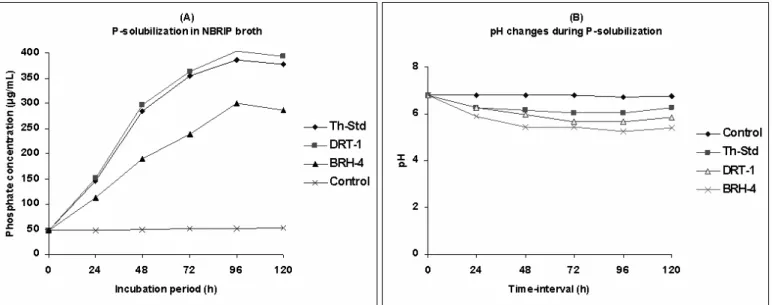
TCP within 72 h in most of the cases. Concentration of
solubilized phosphate gradually increased from 24 to 96 h, and
decreased thereafter (at 120 h) invariably in the culture-filtrates
of all the isolates (Table 1). Phosphate concentration varied
from 111.5 µg.ml-1 to 404.07 µg.ml-1 in the culture filtrates of
various Trichoderma cultures. Among all the cultures
evaluated, the isolate DRT-1 showed significantly higher
phosphate concentrations in the culture filtrate at all the time
intervals as compared to the standard culture of T. harzianum
and other isolates, while BRH-4 was the weakest P-solubilizer
(Fig. 1A). Further, a gradual decrease in pH values was
recorded in all the cases differentially. The pH values
decreased to variable levels from neutral to those between 5.0
to 6.0 depending on the culture and later became nearly
phosphate concentration (µ g.ml-1) of 404.07 at 96 h, followed
by Th-Std (386.42) and PRT-1(377.44) in the culture filtrate.
Comparatively, a significantly lower phosphate concentrations
were recorded in the culture filtrates of BRH-4 (300.06),
ORT-4 (303.22), ORT-1 (30ORT-4.66) and GRT-1 (306.88) at 96 h.
Table 1. Solubilization of Tricalcium phosphate (10 g l-1) in NBRIP broth by various Trichoderma isolates
Concentration of solubilized phosphate ( g.ml-1) at different time-intervals (h) Isolates
24 48 72 96 120
% P-solubilized w.r.t. Th-Std after 96 h
Th-Std 145.55 284.52 354.52 386.42 376.6 100.00
PRT-1 142.60 270.6 342.6 377.44 367.5 97.67
PRT-2 130.72 242.96 322.64 354.22 348.6 91.66
PRT-3 111.15 211.43 292.44 326.45 320.62 84.48
DRT-1 150.02 296.32 363.22 404.07 392.96 104.56
DRT-2 122.24 225.44 312.47 338.98 328.24 87.72
BRP-2 136.39 256.53 333.55 365.6 358.32 94.61
BRH-2 118.75 218.63 302.92 335.44 328.82 86.80
BRH-3 114.65 202.44 265.26 310.53 298.95 80.36
BRH-4 112.76 190.06 238.38 300.06 286.67 77.65
GRT-1 106.82 197.63 252.47 306.88 295.65 79.41
GRT-2 126.75 236.63 316.67 340.44 332.92 88.10
ORT-1 121.76 192.74 248.93 304.66 282.55 78.84
ORT-2 126.75 208.8 277.56 315.45 306.62 81.63
ORT-4 115.67 191.1 245.26 303.22 281.97 78.46
Control 48.20 49.50 50.20 51.30 52.40 -
CD (P=0.05): Isolate (a) = 6.64; Time interval = 3.83; a*b = 14.85
Figure 1. Concentration of phosphate solubilized (A) byTh-Std, DRT-1 & BRH-4 along with pH changes (B) during incubation
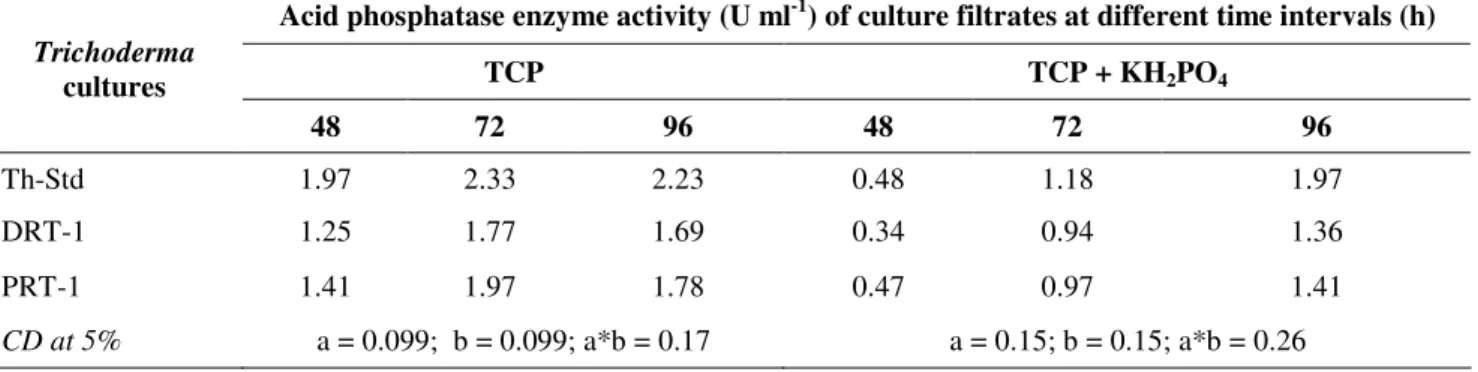
Extra cellular Acid phosphatase (AcP) enzyme activity AcP enzyme was induced by TCP (10 g.l-1) in the PVK
medium inoculated with Trichoderma sp. cultures as indicated
by their enzyme activities (Fig. 2a). The activities reached
maximum at 72 h interval for all the cultures and decreased
upon further incubation at 96 h. Maximum enzyme activity
(2.33 U.ml-1) and specific activity (94.71 U.ml-1) were recorded
by the standard culture of T. harzianum, which was
significantly higher than the enzyme activity for other isolates.
In the medium containing both available P, KH2PO4 (0.5 g.l-1)
and bound P, TCP (10 g.l-1), a minimal enzyme activity was
observed initially (at 48 h) which gradually increased from 48
to 96 h (Table 2). The TCP0 treatment did not record any
enzyme activity.
Extra cellular Alkaline Phosphatase (ALP) enzyme activity Likely to AcPs, maximal extra cellular AlP activities were
also recorded at 72 h interval invariably for all Trichoderma
cultures in PVK media containing only bound phosphate i.e.
TCP (10g.l-1) (Fig. 2b). DRT-1 reported highest enzyme
activity (14.50 U.ml-1) and specific activity (658.62 U.mg-1) at
72 h which was significantly higher than the activities recorded
for Th-Std and PRT-1 cultures. In broth cultures amended with
soluble phosphate at low concentration (KH2PO4 @ 0.5 g.l-1)
along with TCP at high concentration (10 g.l-1), the cultures
invariably showed a minimal activity during initial growth
phase (at 48 h) followed by a gradual increase, reaching
maximum and significantly higher values at 96 h (Table 3). At
96 h, DRT-1 reported highest enzyme and specific activities
followed by Th-Std and PRT-1 cultures. Moreover, no enzyme
activity could be detected in the TCP0 treatment.
Glasshouse experiment
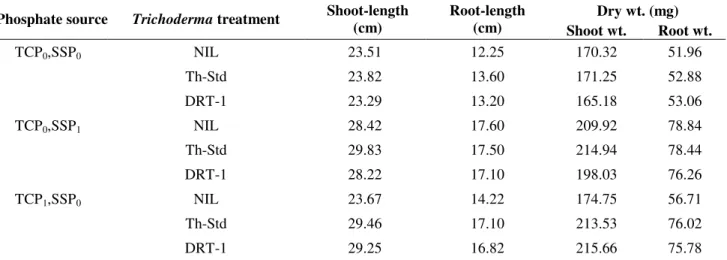
The influence of Trichoderma inoculation on chickpea
was determined after 60 d of sowing by measuring different
growth parameters viz. lengths of shoots and roots, along with
their fresh and dry weights (Table 4). It was evident that
growth of plants was not only enhanced in presence of
available phosphorus (SSP) in comparison to plants growing in
P-deficient soil, but it was also significantly stimulated by
Trichoderma inoculation at both the levels of TCP viz. 100 and
200 mg.kg-1 soil.
As compared to the treatments lacking any form of
phosphorous source in the soil, a significant increase in all the
growth parameters was observed in the presence of
recommended dose of SSP i.e., 165 mg.kg-1 soil. With the
further addition of Trichoderma cultures, a variable increase in
the parameters was observed. However, when only TCP was
provided as the phosphate source at a concentration of 100
mg.kg-1 soil, the chickpea plants recorded a significant increase
in growth parameters which was comparable with the SSP1
treatments. Further, at a higher concentration of TCP i.e., 200
mg.kg-1 soil, a slight increase in all the parameters was
observed. Furthermore, both the Trichoderma cultures (Th-Std
and DRT-1) were more or less equally potential in enhancing
the growth parameters of chickpea.
Table 2. Influence of different phosphorus sources on extracellular acid phosphatase enzyme activity of Trichoderma cultures grown in Pikovskaya’s medium containing TCP and/or KH2PO4 at different time intervals
Acid phosphatase enzyme activity (U ml-1) of culture filtrates at different time intervals (h)
TCP TCP + KH2PO4
Trichoderma cultures
48 72 96 48 72 96
Th-Std 1.97 2.33 2.23 0.48 1.18 1.97
DRT-1 1.25 1.77 1.69 0.34 0.94 1.36
PRT-1 1.41 1.97 1.78 0.47 0.97 1.41
Figure 2. Comparative evaluation of Trichoderma cultures for induction of acid (A) and alkaline (B) phosphatase enzymes in the presence and absence of available phosphorus sources in Pikovskaya’s medium at 72 h.
Table 3. Influence of different phosphorus sources on extracellular alkaline phosphatase enzyme activity of Trichoderma cultures grown in Pikovskaya’s medium containing TCP and/or KH2PO4 at different time intervals
Alkaline phosphatase enzyme activity (U.mL-1) of culture filtrates at different time intervals (h)
TCP TCP + KH2PO4
Trichoderma cultures
48 72 96 48 72 96
Th-Std 12.50 13.41 12.75 2.58 7.08 9.66
DRT-1 14.16 14.50 14.41 2.66 6.91 13.50
PRT-1 11.83 12.69 12.41 1.83 5.00 9.16
CD at 5% a = 0.34; b = 0.34; a*b = 0.60 a = 0.29; b = 0.29; a*b = 0.51
Table 4. Influence of Trichoderma inoculation on the growth of chickpea in the presence of different phosphorus sources* in P-deficient soil under glasshouse conditions after 60 d of sowing
Dry wt. (mg) Phosphate source Trichoderma treatment Shoot-length
(cm)
Root-length
(cm) Shoot wt. Root wt.
TCP0,SSP0 NIL 23.51 12.25 170.32 51.96
Th-Std 23.82 13.60 171.25 52.88
DRT-1 23.29 13.20 165.18 53.06
TCP0,SSP1 NIL 28.42 17.60 209.92 78.84
Th-Std 29.83 17.50 214.94 78.44
DRT-1 28.22 17.10 198.03 76.26
TCP1,SSP0 NIL 23.67 14.22 174.75 56.71
Th-Std 29.46 17.10 213.53 76.02
TCP1,SSP1 NIL 29.28 16.80 209.78 75.61
Th-Std 31.22 17.81 216.45 82.15
DRT-1 30.24 17.16 221.56 78.88
TCP2,SSP0 NIL 23.86 14.56 162.8 51.03
Th-Std 30.61 18.25 216.02 83.04
DRT-1 31.20 17.83 217.84 79.66
TCP2,SSP1 NIL 30.10 17.21 213.62 76.19
Th-Std 32.94 18.46 235.72 84.48
DRT-1 33.34 18.05 236.24 85.20
CD at 5% a (phosphate source) 1.91 0.76 10.99 7.17
b (Trichoderma treatment) 1.35 0.54 7.77 5.07
a*b 3.31 1.32 19.04 12.41
* TCP (tri-calcium phosphate), SSP (single superphosphate); Subscripts 0, 1 and 2 for TCP indicate concentrations of 0, 100 and 200 mg kg-1 soil, respectively. Subscripts 0 and 1 for SSP indicate concentrations of 0 and 165 mg kg-1 soil, respectively.
DISCUSSION
Phosphate solubilization by Trichoderma cultures
Disappearance of TCP within 72 h indicates the high
potential of Trichoderma for solubilization of inorganic bound
phosphate (TCP), which might have been subsequently taken
up by the fungus for cellular processes. All the rhizospheric
isolates of Trichoderma showed variable phosphate
solubilizing potential with Th-Std and DRT-1 being the best
P-solubilizers (Table 1). Further, a gradual decrease in pH values
is in agreement with the findings of Illmer and Schinner (1992)
(13), who have also reported a decrease in pH upto four days
followed by a gradual rise during P-solubilization by
Penicillium and Pseudomonas in liquid cultures. It has been
suggested that microorganisms which tend to decrease the pH
of the medium during growth are efficient P-solubilizers (15).
Contrary to the decreasing pH for individual cultures upto 48 h
and then acquiring constancy, the soluble phosphate
concentrations continue to increase after 48 h. This clearly
suggests that pH drop is not the sole factor for P-solubilization.
An initial increase in phosphate concentration followed by a
gradual decrease in culture filtrate as observed by us has also
been well documented by other workers (18). Decrease in
phosphate concentration at 120 h might be correlated with its
sequestration in Trichoderma mycelium, to be released in a
readily available form in close proximity to the roots after lysis
of mycelium with age.
In the natural habitats, the phytopathogenic fungi like
Pythium and Rhizoctonia are unable to solubilize phosphates
and can be suppressed easily by the high competitive efficiency
of T. harzianum through uptake (2). Apart from
P-solubilization, simultaneous synthesis and release of
pathogen-suppressing metabolites like siderophores, phytohormones and
lytic enzymes, by PSMs can prove to be useful (28).
Extra cellular AcP enzyme activity
The decrease in AcP activity of all the cultures after
reaching a maximum at 72h might be due to the repression of
AcP by available phosphates released upon complete
dissolution of TCP from the culture broths after 72 h interval.
Enzyme activities in the range of 0.20 to 2.05 units have been
reported in the case of Aspergillus caespitosus (10) while A.
niger reported AcP specific activities of 64+ 8U.g-1 and 99+ 11
U.g-1 at pH 6.3 and 2.8, respectively (11).
Further, in the medium containing both available P,
KH2PO4 (0.5 g.l-1) and bound P, TCP (10 g.l-1), a minimal
enzyme activity was observed up to 48 h. This is obviously due
to the presence of readily available phosphate which represses
AcP enzyme, as TCP solubilization is not needed. After the
enzyme is induced again by TCP and hence activity increases
from 48 to 96 h. Th-Std showed superior enzyme activity (1.97
U.ml-1) and specific activity (93.80 U.mg-1) than other cultures.
Further, in the medium containing only KH2PO4 (5 g.l-1) as the
phosphorus source, no enzyme activity could be detected
recorded, which clearly proves the need of an insoluble
phosphate source (TCP) in the medium for the production of
AcPs (19).
Extra cellular ALP enzyme activity
The high phosphatase activity of DRT-1 (14.50 U.ml-1)
and specific activity (658.62 U.mg-1) at 72 h would be
responsible for its higher P-solubilizing potential in
comparison to other cultures. The activities decreased slightly
at 96 h interval, which might be due to the complete
disappearance of TCP from the medium after 72 h of
incubation. It is noteworthy that much higher ALP activities
were recorded for Trichoderma sp. cultures than their AcP
activities, which clearly indicates that the alkaline conditions
are more favorable for the solubilization of phosphates. No
ALP activity could be recorded by any of the cultures in broth
containing higher concentration of available phosphate
KH2PO4 (5 g.l-1)as the sole phosphorus source, which again
proved the need of an insoluble phosphate source for the
secretion of phosphatases (19).
The above findings on phosphatase enzyme induction are
in accordance with the P-solubilizing potential of the three
cultures, proving DRT-1 and Th-Std as the best P-solubilizing
potential Trichoderma sp.
Glasshouse studies using chickpea
About 22% and 33% increase in dry shoot weight, and
about 35% and 60% increase in dry root weight was observed
for 100 mg and 200 mg TCP application/kg soil respectively.
However, significant difference between Th-Std and DRT-1
isolates with regards to growth parameters could not be well
established, but both the isolates proved to be directly involved
in promoting chickpea growth, probably by the dissolution of
insoluble tri-calcium phosphate amended in the soil, as
compared to uninoculated controls. Reyes et al., (2002) (22)
reported phosphate solubilizing Penicillium to be able to
stimulate the growth of maize plants as indicated by 3.6 to
28.6% increase in dry matter yields under greenhouse trials.
Increase in growth and yield parameters of chickpea grown in
P-deficient soil amended with insoluble rock phosphate due to
Trichoderma inoculation, as compared to uninoculated controls
under both glass house and field conditions has been reported
by Rudresh et al, 2005 (23).
CONCLUSION
This study highlights the comparative phosphate
solubilizing potential of Trichoderma sp. isolated from
different tree rhizospheres. It was found that all the isolates
were capable of differentially utilizing 10 g.l-1 TCP in NBRIP
broth. This was indicated by the soluble phosphate
concentrations (µg.ml-1) and increase in acidity (decrease in
pH) of the growth medium. However, the P-solubilizing
efficiency was found higher in case of the isolates, DRT-1 and
Th-Std. This was further confirmed by their high AcP and ALP
enzyme activities. Moreover, these isolates brought about
significant increase in the growth parameters of chickpea under
glasshouse trials, suggesting their applicability for crop
improvement.
REFERENCES
1. Abd-Alla, M.H. (1994). Phosphates and the utilization of organic phosphorus by Rhizobium leguminosarum biovar. viceae. Lett. Appl. Microbiol. 18, 294-296.
2. Altomare, C.; Norvell, W.A.; Bjorkman, T.; Harman, G.E. (1999). Solubilization of phosphates & micronutrients by the plant growth promoting & biocontrol fungus Trichoderma harzianum Rifai 1295-22. Appl. Environ. Microbiol. 65, 2926-2933.
3. Beileski, R.L. (1973). Phosphate pools, phosphate transport and phosphate availability. Annu. Rev. Plant Phys. 24, 225-252.
4. Bhattacharya, P.; Jain, R.K. (2000). Phosphorus solubilizing biofertilizers in whirlpool of rock phosphate-challenges & opportunities. Fertil. News 45(10), 45-72.
protein-dye binding. Anal. Biochem. 72, 248-254.
6. Cappuccino, J.G.; Sherman, N. (1996). Microbiology, A laboratory manual, 4th Ed. The Benjamin/Cummings publishing company Inc. California.
7. El-Komy, H.M.A. (2005). Coimmobilization of Azospirillum lipoferum and Bcillus megaterium for successful phosphorus and nitrogen nutrition of wheat plants. Food Technol. Biotechnol. 43, 19-27.
8. Fiske, C.H.; Subbarow, Y. (1925). A colorimetric determination of phosphorus. J. Biol. Chem. 66, 375-400.
9. Gaur, A.C. (1990). Phosphate solubilizing Microorganisms as Biofertilizers. Omega Scientific publishers, New Delhi. pp. 176. 10. Guimaraes, L.H.; Terenzi, H.F.; Jorge, J.A.; Leone, F.A.; Polizeli, M.L.
(2004). Characterization and properties of acid phosphatases with phytase activity produced by Aspergillus caespitosus. Biotechnol. Appl. Bioc. 40(2), 201-207.
11. Hidayat, B.J.; Eriksen, N.T.; Wiebe, M.G. (2006). Acid phosphatase production by Aspergillus niger N402A in continuous flow culture. FEMS Microbiol. Lett. 254, 324-331.
12. Holford, I.C.R. (1997). Soil phosphorus: its measurement, and its uptake by plants. Aust. J. Soil Res. 35, 227-239.
13. Illmer, P.; Schinner, F. (1992). Solubilization of inorganic phosphates by microorganisms isolated from forest soils. Soil Biol. Biochem. 24, 389-395.
14. Illmer, P.; Barbato, A.; Schinner, F. (1995). Solubilization of hardly-soluble AlPO4 with P-solubilizing microorganisms. Soil Biol. Biochem. 27(3), 265-270.
15. Kpomblekou, A.K.; Tabatabai, M.A. (1994). Effect of organic acids on the release of phosphorus from phosphate rocks. Soil Sci. 158, 112-118. 16. Lowry, O.H.; Rosebrough, N.J.; Farr, A.L.; Randall, R.J. (1951). Protein
measurement with the folin phenol reagent. J. Biol. Chem. 193:265-75. 17. Nahas, E. (1999). In: Inter-relacao fertilidale, biologia de solo e nutricae
de plantas. Vicosa:SECS, Lairas: UFLA/DCS, pp. 467-468.
18. Nautiyal, C.S. (1999). An efficient microbiological growth medium for screening phosphorus solubilizing microorganisms. FEMS Microbiol. Lett. 170, 2017-2021.
19. Peleg. Y.; Addison, R.; Aramaya, R.; Metzenberg, R.L. (1996). Translocation of Neurospora crassa transcription factor NUC-1 into the nucleus is induced by phosphate limitation. Fungal Genet. Biol. 20, 185-191.
20. Pillai, K.G.; Varmadevan, V.K. (1978). Studies on integrated nutrient supply system for rice. Fertil. News 23(3): 11-14.
21. Ratti, N.; Kumar, S.; Verma, H.N.; Gautam, S.P. (2001). Improvement in bioavailability of tricalcium phosphate to Cymbopogon mortii var. motia by rhizobacteria, AMF and Azospirillum inoculation. Microbiol. Res. 156(2), 145-149.
22. Reyes, I.; Bernier, L.; Antoun, H. (2002). Rock phosphate solubilization and colonization of maize rhizosphere by wild and genetically modified strains of Penicillium rugulosum. Microbial Ecol. 44(1), 39-48. 23. Rudresh, D.L.; Shivaprakash, M.K.; Prasad, R.D. (2005). Tricalcium
phosphate solubilizing abilities of Trichoderma spp. In relation to P- uptake & growth yield parameters of chickpea (Cicer arietinum L.). Can. J. of Microbiol. 51, 217-226.
24. Sadasivam, S.; Manickam, A. (1998). Biochemical methods. 2nd edition. New age international (p) Imt. Publishers and TamilNadu Agricultural University.
25. Schachtman, D.P.; Reid, R.J.; Ayling, S.M. (1998). Phosphate uptake by plants from soil to cell. Plant Physiol. 116, 447-453.
26. Subba Rao, N. S. (1999). In Soil Microbiology. Fourth Edition of Soil Microorganisms and Plant Growth. Oxford & IBH Publishing Co. Pvt.
Ltd., New Delhi.
27. Sujatha, S.; Sirisham, S.; Reddy, S.M. (2004). Phosphate solubilization by thermophilic microorganisms Indian J. Microbiol. 44(2), 101-104. 28. Vassilev, N.; Vasileva, M.A.; Nikolaeva, L. (2006). Simultaneous
P-solubilizing and biocontrol activity of microorganisms: potentials and future trends. Appl. Microbiol. Biotechnol. 71(2), 137-144.