ISSN 1549-3652
© 2007 Science Publications
Corresponding Author: Behshid Garrusi .MD., Assistant Professor of Psychiatry, Department of Community Medicine,
How do Teachers Diagnosis and Percept Child Maltreatment?
1
Behshid Garrusi, 2Hossein Safizadeh, 3Azadeh Arabnejad and 3Mohaddese Vesal 1
Department of Community Medicine, Neurosciences Research Center 2
Department of Community Medicine, Medical School, Kerman University of Medical Sciences 3
Kerman University of Medical Sciences, Islamic Republic of Iran
Abstract: Child abuse is a complex problem and its prevention requires action on many fronts. Teachers do spend many hours a day with children and they are likely to be concerned about the possible abuse or neglect of a child or young person at some time during their career This study seeks to determine teacher knowledge and teachers'conceptions of what is and what is not abuse. The study was done in Iran (I.R.). Questionnaire were used on a randomly selectedsample of 1200 teachers. Data analysis showed a significant difference knowledge based on educational level. Knowledge score of participants had positive direct relation with their job experience. In regard to the attitude, there was no significant difference in attitude score based on various features of participants. Result from this study indicate that teachers do not have adequate knowledge and proper attitude regarding child maltreatment. Advocating of educational program about child maltreatment is necessary.
Key words: Child maltreatment, teacher, Iran (I.R.)
INTRODUCTION
Child abuse is a global problem and all communities are faced with various forms of it. This phenomenon can be investigated from physical, psychological and sexual aspects[1,2]. In many cases, the victims of child abuse cannot reveal the event due to various reasons. Since in most of the cases child abusers are among family members or close friends of the victim[3], the event can remain as a secret and consequently leads to serious injuries in both childhood and adulthood that are difficult to be compensated[4]. Schools are important organizations for applying preventive interventions in regard to psychological health problems of children and teachers because of spending several hours with children and having close contact with them are among the most important sources for diagnosis, treatment and prevention of child abuse[5,6]. On the other hand, this close teacher- student relationship may cause students to feel more comfortable revealing their personal problems to their teachers. In different performed studies about teachers’ capability in diagnosis and reporting this problem, it has been observed that in spite of higher rate of reporting child abuse cases by schools comparing to other institutions, only 84% of child abuse cases have been reported by schools[6,7]. Other studies have
reported different rates in this regard. Various factors have been contributed to the insufficient rate of child abuse reporting by teachers, among them the most important is lack of related training courses for teachers in both their academic and on-job training programs[8,2]. In most cases of child abuse, teachers potentially can act differently from others[9] and are capable of diagnosing both behavioral and physical signs of the event, while other involved groups such as physicians mostly can diagnose physical signs[2,10,11]. The victims of child abuse have lower rate of self-confidence, social skills and educational success as well as more disciplinary problems that all these aspects can be detected by teachers better[12].
In Iran, from 2001, child abuse has changed from a personal crime to a public crime and all people can report child abuse cases to legal organizations. Since in Iran the reporting sources are not known well, the rate of child abuse reporting by teachers is not clear. But a few studies showed the rate of child maltreatment is high[13]. The present study was carried out with the following aims:
• To determine the rate of knowledge and capability
of teachers in diagnosing signs of child abuse
MATERIALS AND METHODS
The study was done in Kerman, the center of the largest province in Iran with a variety of ethnic populations. Participants were 1200 teachers of primary, secondary and high school levels. It should be mentioned that in Iran, the pre university educational system contains three levels of primary, secondary and high school. All schools are divided into private/state and females/males types. Sampling was done by multistage sampling method. First formal consent was taken from all participants. Data gathering was done by a questionnaire consisted of three parts:
• Demographic features (to keep the privacy, the
identity features were decreased to as less as possible.)
• Items related to attitude towards child abuse were
designed in the form of 5-score Likert scale and based on valid sources.
• Items related to the knowledge about risk factors
and signs of child abuse
The validity of questionnaire was determined by content validity. The reliability and stability were determined by pre-test. Data analysis was done through descriptive and inferential statistics and using SPSS-12 software package. In order to determine the relationship between knowledge/attitude and the intervening variables, Chi-square, t-test, Mann-withney, Kruskall wallis and Pearson Coefficient of Correlation were used.
Most of the participants disagreed with physical punishment, unless in the case of cigarette smoking and obscenity. The older participants and those who had child showed the less rate of agreement with physical
punishment, while younger participants were more in agreement with physical punishment. About 75% of the teachers believed that the reaction of teachers against students in many cases is a kind of child abuse.
RESULTS AND DISCUSSION
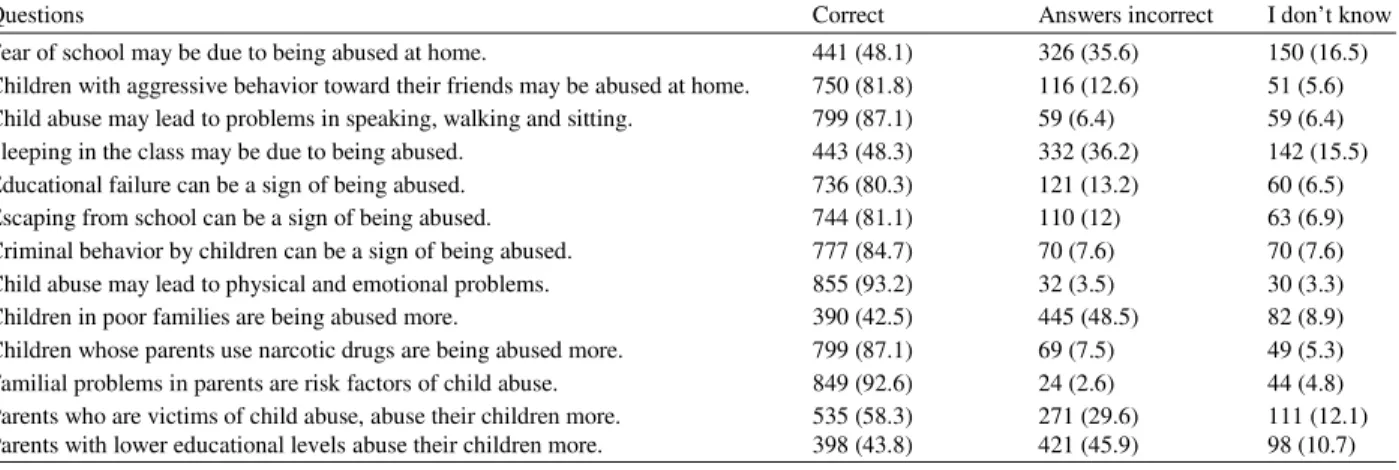
From 1200 distributed questionnaires, 917 ones were completed (rate of responding: 76%). Mean age of participants was 36.6±7.34 years and mean job experience was 15.44±7.67 years. Other features are presented in Table 1. Mean knowledge score of participants was 9.29±2.06 with 0 as the minimum score and 13 as the maximum. The knowledge score of half of the participants was 9 or less. Mean attitude score was 29.88±4.35 with 9 as the minimum score and 45 as the maximum score. The attitude score of half of the participants was 30 or less (Table 2).
Table 1: Characteristics of respondents
N (%) Sex
393 (42.7%) Male
524 (57.1) Female
Marital status (n = 915)
141 (15.4) Single
774 (84.6) Married
No of children (n = 787)
631(80.2) 3
112 (14.2) 3<
44 (5.6) Unknown
Education (n = 916)
117 (12.8) Diploma
358 (39.1) Kardani
405 (44.2) B.S.
36 (3.9) M.S.
Kind of School (n = 917)
246 (37.7) Primary
352 (38.4) Rahnamaee
219 (23.9) High school
Table 2: The frequency distribution of responses to knowledge-testing questions
Questions Correct Answers incorrect I don’t know
Fear of school may be due to being abused at home. 441 (48.1) 326 (35.6) 150 (16.5)
Children with aggressive behavior toward their friends may be abused at home. 750 (81.8) 116 (12.6) 51 (5.6) Child abuse may lead to problems in speaking, walking and sitting. 799 (87.1) 59 (6.4) 59 (6.4)
Sleeping in the class may be due to being abused. 443 (48.3) 332 (36.2) 142 (15.5)
Educational failure can be a sign of being abused. 736 (80.3) 121 (13.2) 60 (6.5)
Escaping from school can be a sign of being abused. 744 (81.1) 110 (12) 63 (6.9)
Criminal behavior by children can be a sign of being abused. 777 (84.7) 70 (7.6) 70 (7.6) Child abuse may lead to physical and emotional problems. 855 (93.2) 32 (3.5) 30 (3.3)
Children in poor families are being abused more. 390 (42.5) 445 (48.5) 82 (8.9)
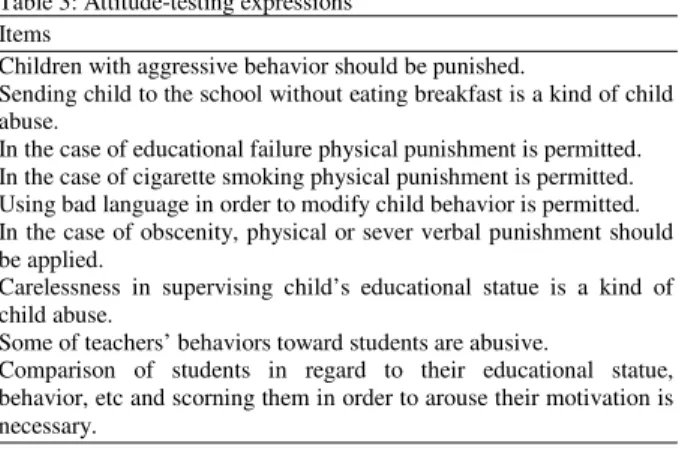
Table 3: Attitude-testing expressions Items
Children with aggressive behavior should be punished.
Sending child to the school without eating breakfast is a kind of child abuse.
In the case of educational failure physical punishment is permitted. In the case of cigarette smoking physical punishment is permitted. Using bad language in order to modify child behavior is permitted. In the case of obscenity, physical or sever verbal punishment should be applied.
Carelessness in supervising child’s educational statue is a kind of child abuse.
Some of teachers’ behaviors toward students are abusive.
Comparison of students in regard to their educational statue, behavior, etc and scorning them in order to arouse their motivation is necessary.
Data analysis showed no significant difference in knowledge score based on the variables of sex and marital statues, but a significant difference based on educational level. Teachers with M.A degree showed the highest rate of knowledge and those with KARDANI degree (a two-year university program in Iran educational system) had the lowest (p = 0.014). Teachers knowledge showed significant difference based on the level of teaching (p<0.002). The maximum knowledge score (9.7±2.08) was obtained by high school teachers, while the minimum knowledge score (9.08±2.12) was obtained by guidance school teachers. Knowledge score of participants had positive direct relation with their job experience (p<0.001, r = 0.145).
In regard to the attitude (Table 3), there was no significant difference in attitude score based on various features of participants.
In the present study, the focus is on teachers as a group that has close relation with children but has been disregarded in most studies about child abuse.
Since teachers are not isolated from the society, their beliefs and attitudes are affected by the attitudes governing the whole society[14], but considering their special job field, they are expected to have a better knowledge in aspects related to the children health.
In the present study, teachers showed a moderate knowledge about risk factors and signs of child abuse and this insufficient amount of knowledge, like what have been found in other performed studies, had been the main cause of low rate of child abuse diagnosis and reporting by teachers[15]. Lack of academic and on-job trainings about child abuse are the most important causes affecting teachers’ knowledge and their capability in regard to the diagnosis of child abuse. In McIntyre[16]study, most of the studied teachers asserted that they had never suspected to a child abuse case among their students. Considering the high rate of child
abuse (1,000,000 children in the world), it seems that these victims are present in the classes but they are not seen.
Most of the participants disagreed with physical punishment, unless in the case of cigarette smoking and obscenity. The older participants and those who had child showed the less rate of agreement with physical punishment, while younger participants were more in agreement with physical punishment. About 75% of the teachers believed that the reaction of teachers against students in many cases is a kind of child abuse.
In the present study, most participants did not know how to behave in the case of observing a child abuse case. Since in Iran child abuse has been announced as a public crime in the recent years, peoples’ awareness about the related laws seems to be necessary. In spite of the results of child abuse studies emphasizing on the role of poverty and low educational level, these factors have not been seriously considered as risk factors of child abuse yet[17] .
The rate of teachers’ knowledge has a direct relation with their educational level and since teachers with higher educational levels are usually teaching in high schools and on the other hand the risk of child abuse is more in younger ages, this gap in relation to children studying in primary schools requires special attention. The higher risk of child abuse and its more serious physical and psychological effects in lower educational levels in one hand and more on-job training courses for teachers in these educational levels on the other hand, shows the special importance of planning for related on-job training programs in regard to child abuse and its related laws.
In the present study, teachers with more job experience had higher rate of knowledge about signs and risk factors of child abuse that may be due to experiencing more cases of child abuse during their work period.
In this study, most teachers did not agree with physical punishment and emphasized on disciplinary methods rather than physical punishment. However in some other studies, teachers believed that punishment is necessary for controlling students[8]. The rate of diagnosis and reporting was affected by sex.
As women are traditionally more involved with children, This difference could be due to the their role and status of women in the Iranian society.
Although in Iran the disciplinary aspects in the family are under the control of fathers, there was no significant difference in attitude between male and female teachers. However, in abusive behaviors, male teachers apply physical punishment more than female teachers[5].
The attitudes of teachers in the present study showed that teachers do not take the harmful effects of their inappropriate behavior toward their students[21], especially in regard to emotional aspects, so serious and in most cases they consider their abusive behavior as a kind of applying disciplinary regulations[22].
According to the previous studies, most cases of abusive behavior by teachers have been scorning and using bad language[12]. Inappropriate attitudes and behaviors by teachers especially in relation to emotional aspects are definitely examples of misbehavior[23].
Due to the lack of scientific studies[24,25], there is no exact information about abusive behavior by Iranian teachers. According to the results of the present study, in addition to emphasizing on planning training programs related to the child abuse for teachers, special attention should be paid to making them familiar with current laws of child abuse and factors affecting their attitudes toward this important social problem.
REFERENCES
1. Schnitzer, P., P. Slusher and M.V. Tuinen, 2004. Child maltreatment in Missouri, combining Data for Public Health Surveillan. Amr. J. Prev. Med., 27 (5): 379-384.
2. Theodor, A.D., J.J. Change, D.K. Runyan, W.M. Hunter, S.I. Bangdiwalla, R. Agams, 2005. Epidemiologic Features of physical and sexual Maltreatment of children in Carolina. Pediatrics., 115: 331-337.
3. Bernet, W., 2000. Child maltreatment. In: Kaplan B. Comprehensive textbook of psychiatry, 7th Edn., New York. Lippincot Williams and Wilkins, pp: 1185-90.
4. Edwards, V.S., G.W. Holden, V.J. Felitti and R.F. Anda, 2003. Relation ship Between Multiple Forms of childhood Maltreatment and Adult Mental Health in community Respondents. Amr. J. Psychiatry, 160: 1453-1460.
5. O`Toole, R., S.W. Webster, A.W. O`Toole and B. Lucal, 1999. Teacher Recognition and Reporting of child abuse: A factorial Survey. Child Abuse and Neglect, 23 (11): 1083-1101.
6. Sedlak, A.J. and D. Broadhurst, 1995. The thierd national incidence study of child abuse and neglect. Washington DC: US. Department of Health and Human Services.
7. Webster, S.W., R. O`Toole, A.W. O`Toole and B. Lucal, 2004. Overreporting and underreporting of child abuse. Teachers` use of professional discretion.., 24: 1281-1296.
8. Kenny, M.C., 2001. Child abuse reporting: teachers `perceived deterrents. Child Abuse and Neglect., 25: 81-92.
9. Bolhm, A. and H. Itzhaky, 2004. The social marketing approach a way to increase reporting and treatment of sexual assault. Child Abuse and Neglect., 28: 253-265.
10. Bullock, K., 2000. Child abuse, the physicians` role in alleviating a growing problem. American Family Physician., 15: 1-4.
11. O`Toole, A.W., R. OToole, S. Webster and S. Local, 1993. Nurse `recognition and reporting of child abuse: A factorial survey. Deviant Behavior., 14: 341-363.
12. Shumba, A., 2002. The nature, extent and effects of emotional abuse on primacy. school pupils by teacher in Zimbabwe. Child Abuse and Neglect., 26: 783-791.
13. Stephenson, R., P. Sheikhattari, N. Assasi, H. Eftekhar, Z. Qasem, B. Maleki and H. Kiabayan, 2006. Child maltreatment among school children in the Kurdistan Province, Iran. Child Abuse and Neglect., 30: 231-245.
14. Ferrari, A.M., 2002. The impact of culture upon child rearing practices and definitions of maltreatment. Child Abuse and Neglect., 26: 793-813.
15. Yanowitz, K.I. and J.R. Tribble, 2003. Teachers` Beliefs about the effects of child abuse and neglect. Child Abuse and Neglect., 27: 483-488. 16. McIntyre, T., 1990. The Teacher's Role in Cases of
Suspected Child Abuse. Education and Urban Society., 22 (3): 300-306 .
17. Dwyer, S.B., J.M. Nicholson, D. Batyisttatla and B. Oldenberg, 2005. Teachers `Knowledge of childrens exposure to family h.s.R factors: accuracy and usefulness. J. of School Psycho., 43: 23-28.
19. Al-Moosa, A., j. Al-Shaiji, A. Al-Fadhli, K. Al bayed and S.M. Adib, 2003. Pediatrician's knowledge, attitude and experience regarding child maltreatment in Kuwait. Child Abuse and Neglect., 27: 1161-1178.
20. Dyer, O., 2004. Doctors reluctant to work on child protection Committees, survey shows. BMJ, 7 February: 328-307.
21. Tite, R., 1993. How teachers define and respond of child abuse: the distinction between Theoretical and reportable cases. Child Abuse and Neglect., 17: 591-603.
22. Shumba, A., 2001. Epidemiology and Etiology of reported. Cases of child psychology abuse in Zimbabwean primary school. Child Abuse and Neglect., 25: 265-271.
23. PIekarska, A., 2000. School Stress, Teachers `Abusive behaviors and children` Copying Strategies. Child Abuse and Neglect., 24 (11): 1443 -1449.
24. Ashton, V., 2001. The relationship between attitudes toward corporal punishment and the perception and reporting. Child Maltreatment, 25: 389-399.