DIEL FLUCTUATIONS OF A SANDY BEACH FISH ASSEMBLAGE AT PORT0
PIM, FAIAL ISLAND, AZORES
RICHARD D.M. NASH, RICARDO S E ~ SANTOS & STEPHEN O J HAWKINS
NASH, RICHARD D M . , RICARDO S. SANTOS & STEPHEN J. HAWKINS 1994. Die1 fluctuations of a sandy beach fish assemblage a t Porto Pim, Faial Island, Azores. Arquipe'lago. Life a n d Marine Sciences 12A:75-86. Ponta Delgada. ISSN 0870- 6% 1.
The shallow-water fish assemblage at Porto Pim, Azores was sampled with a beach seine at three hour intervals over 24 h periods in August, September and October 1989. The fish assemblage was dominated by three to four species in each month (90-97% of numbers). Most species were present as juveniles. The variation in diel patterns between months could primarily be explained by changes in the pattern of abundance of dominant species. Over the three months seasonal changes in the assemblage structure caused changes in the diel pattern. Many of the species present had a definite pattern to their abundance being either primarily diurnal or nocturnal. There was also a tidal pattern to the assemb!age structure which had a higher diversity at low water.
NASH, RICHARD D.M., RICARDO S. SANTOS & STEPHEN J. HAWKINS 1994. FlutuaqBes di6rias n a associaq50 d e peixes d a praia d e areia d e Porto Pim, ilha d e Faial, Aqores. Arquipe'lago. Cisncias Biol6gicas e Marinhas 12A:75-86. Ponta Dclgada. ISSW 0870-658 1.
0 s peixes da praia de areia de Porto Pim, &ores foram amostrados atravts de arrastos de rede (chinchorro) a intervalos de tr&s horas durante um period0 de 24 horas nos meses de Agosto, Seternbro e Outubro de 1989. A associa@o de peixes era dominada, em cada urn dos meses, por trCs a quatro esptcies (90-97% dos individuos). A maioria das esptcies estavam representadas por formas juvenis. A varia@o entre meses do pad60 diirio pode explicar-se primariamente pelas mudan~as no padrPo de abundfincia das esptcies dorninantes. Ao longo dos trCs meses as varia~8es na estrutura da associa@o implicaram mudan~as no padrZo diirio. Muitas das espicies tinham um padriio de abundhncia definido, primariamente por ser ou diurno ou nocturno. Encontrou-se tambim um padrgo de mart na estrutura da associaqZo de peixes caracterizado por uma maior diversidade na mart baixa.
Richard D.M. Nash & Stephen J Hawkins. Port Erin Marine Laboratory, Port Erin, Isle of Man IM9 6JA, British Isles.
-
Ricardo S. Santos. Departamento de Oceanografia e Pescas, Universidade dos Agores, PT-9900 Horta, Agores, Portugal, and IMAWAgores,Unidade de Estudos Ocerinicos, Sta. Cruz, PT-9900 Horta, Agores, Portugal.
INTRODUCTION seine nets change over die1 periods (HORN, 1980;
ALLEN & DEMARTINI 1983; NASH 1986; WRIGHT Inshore shallow areas a r e important fish feeding 1989)- I n Part this reflects net avoidance, a s t h e a n d nursery grounds (MCERLEAN e t al. 1973). fish see t h e net'during daytime and c a n avoid it Considerable attention has therefore focused o n (HOESE e t al. 1968; BLAXTER 1970; MCCLEAVE t h e composition of fish assemblages i n bays a n d & FRIED 1975). I t is also d u e t o real changes i n estuaries. I t has been shown that catches using abundance of individuals and the structure of the
Contribution No. 18 from the "Expedition Azores 1989".
75
DIEL FLUCTUATIONS OF A
SANDY
BEACH FISH ASSEMBLAGE AT
PORTO
PIM, FAIAL I
SLAND,
AZORES
RICHARD D.M. NAS H, RICARDO SERRÃO SANTOS & STEPHEN J HA WKINS
INTRODUCTION
NASH, RICHARD D.M., RICARDO S. SANTOS & STEPHEN 1. HAwKINS 1994. Diel f1uctuations of a sandy beach fish assemblage at Porto Pim, Faial Island, Azores.
Arquipélago. Life and Marine Sciences 12A:75-86. Ponta Delgada. ISSN 0870-6581.
The shallow-water fish assemblage at Porto Pim, Azores was sampled with a beach seine at three hour intervals over 24 h periods in August, September and October 1989. The fish
assemblage was dominated by three to four species in each month (90-97% of numbers).
Most species were present as juveniles. The variation in diel patterns between months
could primarily be explained by changes in the pattern of abundance of dominant species.
Over lhe three months seasonal changes in the assemblage structure caused changes in the diel pattem. Many of the species present had a definite pattern to their abundance being
either primarily diurnal or nocturnal. There was also a tidal pattern to the assemb!age
structure which had a higher diversity at low water.
NASH, RICHARD D.M., RICARDO S. SANTOS & STEPHEN J. HAwKINS 1994.
Flutuações diárias na associação de peixes da praia de areia de Porto Pim, ilha de Faial, Açores. Arquipélago. Ciências Biológicas e Marinhas 12A:75-86. Ponta
Delgada. ISSN 0870-6581.
Os peixes da praia de areia de Porto Pim, Açores foram amostrados através de arrastos de
rede (chinchorro) a intervalos de três horas durante um período de 24 horas nos meses de
Agosto, Setembro e Outubro de 1989. A associação de peixes era dominada, em cada um
dos meses, por três a quatro espécies (90-97% dos indivíduos). A maioria das espécies
estavam representadas por formas juvenis. A variação entre meses do padrão diário pode
explicar-se primariamente pelas mudanças no padrão de abundância das espécies
dominantes. Ao longo dos três meses as variações na estrutura da associação implicaram
mudanças no padrão diário. Muitas das espécies tinham um padrão de abundância
definido, primariamente por ser ou diurno ou nocturno. Encontrou-se também um padrão
de maré na estrutura da associação de peixes caracterizado por uma maior diversidade na
maré baixa.
Richard D.M. Nash & Stephen J Hawkins. Port Erin Marine Laboratory, Port Erin, Isle
of Man IM9 6JA, British Isles. - Ricardo S. Santos. Departamento de Oceanografia e Pescas, Universidade dos Açores, PT-9900 Horta, Açores, Portugal, and IMAR/Açores,
Unidade de Estudos Oceânicos, Sta. Cruz, PT-9900 Horta, Açores, Portugal.
Inshore shallow are as are important fish feeding and nursery grounds (McERLEAN et a!. 1973). Considerable attention has therefore focused on the composition of fish assemblages in bays and
estuaries. It has been shown that catches using
seine nets change over diel periods (HORN, 1980;
ALLEN & DEMARTlNI 1983; NAS H 1986; WRIGHT 1989). ln part this reflects net avoidance, as the fish see the net during daytime and cari avoid it
(HOESE et a!. 1968; BLAXTER 1970; MCCLEAVE
& FRIED 1975). It is also due to real changes in
abundance of individuais and the structure of the
Contribution No. 18 from the "Expedition Azores 1989".
fish assemblage (EEVLERY 1973; KEAST et al. 1978; LASIAK 1984; NASH et al. 1994). Changes in assemblage structure over either diel or tidal cycles which are then superimposed on seasonal changes could have a profound effect on the perception of a fish assemblage. We are uncertain as to the extent and periodicity of these changes on soft sediment shallow water fish assemblages.
Although sandy bays are common features of coastlines with extensive continental shelves, the sandy beach area of Porto Pim is unique for the area as it is the only relatively sheltered sandy beach on Faial, Azores. It is therefore also a rare mid-Atlantic habitat. This makes comparisons ' with studies on continental seaboards (e.g. Europe and North America) particularly interesting. In this paper we describe a shallow- water, sandy beach fish assemblage on Faial, Azores over tidal and diel cycles. To provide a complete description of the fish assemblage ih the area it was necessary to sample regularly over at least a 24h period (see comments in NASH, 1986). Our specific objectives were to describe the summer/auturnn fish assemblage and the population structure of its important elements, and to describe diel patterns of assemblage structure during this period of high numbers of juvenile fish.
MATERIAL AND METHODS
Study site
Porto Pim is a small (approximately 280m) south-west facing sand beach on the south-east coast of Faial (Azores) (Fig. 1). The beach is bordered to the North and South by a rocky coastline. The maximum tidal range in the area is 1 m and the maximum horizontal extent of the beach at Porto Pim at low tide is approximately 30 m. The beach is the prime bathing beach for the island during the summer months. The southern border of the embayment is the Monte da Guia protected area.
Collection and evaluation of data
Samples of fish were collected with a 20 m beach seine (32 mm mesh in the wings to 15 mm mesh and 8 mm mesh in the centre) at approximately 3 hour intervals between i0.00h and 07.00h on 17th to 18th August, 11.00h to 08.00h on 26th to 27th September and 10.00h ta 07.00h on 30th to 31st October 1989. Two sets were made sequentially along the beach at each sampling time. Each haul swept an area of approximately
2
291 m
(as
calculated using the procedure given by KUBECKA & BOHM 1991). The sampling strategy was designed to give samples at high, mid and low water for both a day and night tide cycle. Where the sun was below the horizon samples were classified as night-time. All fish were identified to species according to WHITEHEAD et al. (1986). However, some of the species noted in this study are not recorded by WHITEHEAD et al. (1986) as being part of the Azorean fauna. The total number of individuals and total weight were obtained for each species and haul. In general, all individuals of each species or a sub-sample of at least 100 randomly chosen individuals were weighed and measured, prior to any preservation, from each sample. All length measurements were to the nearest 1 mm for total length or in the case of Dasyatis pastinaca (common stingray) the disc diameter. All individual weights were to the nearest 0.1 g.Similarity between species lists of paired samples was compared by Jaccard's coefficient (for details and formulae see NASH & GIBSON, 1982). Since the calculated similarities between duplicate samples at a particular time were generally relatively low (range 0.14 to 0.80) and hence variance was very high, the samples were summed to give the total caught per time period. The prime reason for the differences in catches between samples was that many of the species form schools, therefore catches were predominantly one species or another. Species diversity (Shannon-Wiener diversity index
- H')
and Margalefs species richness(D)
were calculated in logarithms to base 10 using the formulas given in PIELOU (1977) and NASH &GIBSON
(1982). Percentage similarity (using both abundance and biomass) was calculated using the formula from WHITTAKER & FAIRBANKS (1958). Spearman Rank correlations (r,) were undertaken using the formulas laid out in SIEGEL (1956).RESULTS
Over the three months a total of 16 573 individuals and 363 kg of fish comprising 20 species were caught (Table 1). The dominant species in all three months with respect to both weight and numbers of individuals was Chelon
labrosus. In August Chelon labrosus and Trachinotus ovatus were dominant by both numbers and weight, with Bothus podas being third dominant by numbers and Sardina pilchardus with respect to weight. In September the catches were dominated by Chelon labrosus, Pagellus bogaraveo and Sardina pilchardus with repect to numbers and C. labrosus, P. bogaraveo and Trachinotus ovatus by weight. In October the catches were dominated by Chelon labrosus with Trachinotus ovatus and Sardina pilchardus by numbers and with Sardina pilchardus and Dasyatis pastinaca by weight.
NORTH
t
Table 1
Fish species caught at Porto Pim, Azores between August and October 1989 by a beach seine. The classification of the species follows Whitehead et al. (1986), except for the case of Sphoeroides marmoratus.
+
= not weighed.Scientific n a m e Common n a m e August S e p t e m b e r October
English Portuguese N W(g) N W(g) N W ( d Dasyatidae Dasyaris pastinaca (L.) Clupeidae Sardina pilchardus (Walbaurn) Synodontidae Synodus saurus (L.) Belonidae
Belone belone gracilis
Lowe Congridae Conger conger (L.) Caproidae Capros aper (L.) Pornatomidae Potnarornus salruror (L) Carangidae Trachrcrus picfuratus (Bowdich) Pseudocaranx dentex
(Bloch & Schnieder)
Trcicltinotus ovatus (L.) Mullidae Mullus sunnuletus L Sparidae Boops boops (L.) Diplodus surgus cadenati de la Paz,
Bauchot & Daget
Pagellus ucarne (Risso)
Pugellus bogaraveo
(Briinnich)
Sarpa salpa (L.) Mugilidm
Chelon labrosus (R~sso) Trachinidae Echiichthys vipera (Cuvier) Bothidae Borhus podas (Delaroche) Tetrodontidae S~hoeroides Common stingray Pilchard Adantic Ezard fish Garfish Conger eel Boarfish Bluefish Blue jack mackerel Guelly jack Pompano Striped red mullet Bogue White sea bream Auxiliary sea bream Red sea bream Salema Thicklipped grey mullet Lesser weever Wide-eyed flounder Guinean puffer Raia Sardinha Peixe- lagano Peixe- agulha Congo Peixe-pau Anchova Chicharro Enchadu Plombeta Salmonete Boga Sargo Besugo Carapau. Goraz Salema Tainha, Muja Peixe- aranha Solha Sopapo. rnarrnora~us (Lowe)
Total number of species 14 16 14
There were variations in species composition over the three month period with some species absent from some monthly samples. There were also variations in the numbers of individuals caught during each monthly sampling indicating the dynamic nature of these fish assemblages. The progression towards a lower abundance winter assemblage is indicated by the progressive reduction in numbers of individuals and biomass from August to October (Table 1). Similarity among sample months using Jaccard's coefficient was 0.58 to 0.67. Percentage similarity in numbers of individuals caught between months was 59.6 to 74.0% with August/October having the highest value. Percentage similarity in biomass distributions ranged from 45.9 to 74.5% with AugustJSeptember showing the greatest similarity.
Population structure
The Porto Pim fish assemblage, sampled with a relatively small beach seine, had fish ranging in length from 23 to 439 mm total length between August and October 1989. The largest fish, both in respect to length and weight were Dasyatis pastinaca, their maximum disc length was 420 mm and maximum weight per individual 985 g.
Changes in community structure, especially in relation to numbers of individuals and biomass are to a certain extent driven by the dominant species. For this reason only the dominant species are considered here with respect to overall monthly length frequencies and monthly individual mean weight. All lengths and weights were pooled for a month to give the mean weights and lengths per month. A seasonal change in length frequency occurred for Sardina pilchardus (Fig. 2a). In August there was one mode in the length frequency with the majority of the larger fish being absent in subsequent months. This change was reflected in the mean weight of individuals (18.3 g to 6.3 g). Between September and October there was growth of the smaller individuals which appeared as an increase in mean weight (10.7 g). A similar pattern occurred in Trachinotus ovatus (Fig. 2b)
except here the increase was approximately one month later than Sardina pilchardus (mean weight per individual: August 29.58, September 28.2 and October 1.4 g). It was not until October that the larger individuals were not caught in the area swept by the beach seine. In both cases there were two size classes present in August with the smaller remaining into October. In all cases these were juvenile fish. Only one size class of Pagellus bogaraveo was present (Fig. 2c) in August which grew through September and had left the area by October. The situation with Chelon labrosus was a little more complex (Fig. 2d). In this species there was a wide range in lengths (the largest fish in September were 430 mm total length). In August fish 100-150mm were numerically dominant. By September smaller fish (50-100mm) dominated the length frequencies, hence the reduction in individual mean weight (August 48.0 g, September 15.6 g). Growth of this group explains the increase in mean weight to ~ c t o b e r (19.0 g). The dynamics of Bothus podas are more difficult to interpret (Fig. 2e). In August there was a predominance of small fish which may have appeared as the modal group in September. This could explain the increase in mean weight (August 5.8 g and September 12.9 g). By October the length frequencies were similar to those of September, however, there was a reduction in individual mean weight (10.7 g).
Fish community fluctuations
In general, all species varied in the number of individuals caught over a diel cycle in all three months. The number of species caught per time period varied from 3 to 9 in August, 4 to 10 in September, and 5 to 10 in October. Likewise, there was considerable variation in the total number of individuals caught (81-2 117, 94-2 649 and 48-1 .I32 respectively) and total biomass (0.48-98.70, 4.01-30.50 and 0.71-12.89 kg respectively) per time period over these three months.
Changes in the community structure over diel periods are largely linked to the diel patterns in
the dominant species. Sardina pilchardus had a fairly stable bimodal die1 catch pattern over all three months (Fig. 3a), however, the highest catches occurred around dawn and during the morning. The pattern in Trachinotus ovatus (Fig. 3b) was similar between August and September with elevated catches at night, but switched to more being caught during daytime in October. Pagellus bogaraveo (Fig. 3c) switched from night to day between August and September. A consistent pattern in catch rate for Chelon labrosus (Fig. 3d) was seen for August and October but not for September. Bothus podas catches varied between months but generally remained highest during daytime (Fig 3e).
Over the whole time period there was a tendency for a greater number of species at low
a) Sardina b) Trachinotus c) Page&
pilchardus OVPTU~ bogaraveo
water than at high water (rs = -0.458; n = 24: critical value of rs, at P=0.05, for n = 24 is 0.42) (Fig. 4a). This trend was not apparent in the number of individuals (Fig. 4b) (rs = 0.089; n = 24) or total weight (rs = -0.029; n = 24). Species diversity (H') was lower at low water (rs =
-
0.474; n024) whereas species richness (D) did not show a significant trend (rs = -0.396;n
= 24). Part of the variation was caused by variability in relationships between community parameters and tidal height in each monthly period (Table 2). In September, not only was biomass greater during the day than at night (the reverse situation to August and October) but there was a reversal of the relationship between tidal height and total biomass with more occurring at high tide.TOTAL LENGTH tmm,
n.,,
Fig. 2. Length frequency distributions of dominant fish species caught in a beach seine at Porto Pim, Azores between August and October 1989.
August 800. so
-
0 . , , , , , , , ,.
.. . .
14 16 1820 22 00 02 04 06 08 10 1E 14 16 T i m e T i m eFig. 3. Fluctuations in abundance of dominant fish species through diel cycles at Porto Pim, Azores for August (night time: 19h 47m
-
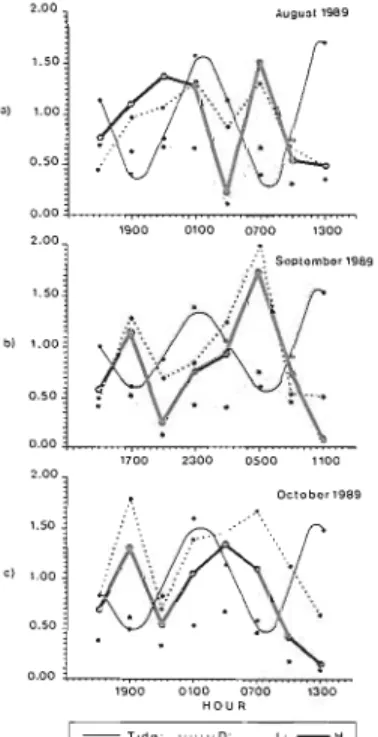
06h lorn), September (night time: 18h 46m- 06h 46m) and October (night time: 16h 57m- 06h 20m) 1989. a) Sardina pilchardus b). Trachinorus ovatus c) Pagellus bogaraveo d) Chelon labrosus e) Bothus podas. The numbers of individuals is the sum of two hauls taken at each sampling time.Variation in H' and D (based on numbers of individuals) over diel cycles in August to October indicated some similarities (Fig. 5). The most striking similarity was the elevated H' and D at low water between 0500 and 0700h (the period around dawn). With respect to species richness (D) there always appeared to be a double peak, each centred around low water. A similar pattern in H' was seen for September and October. Other than these there was relatively little pattern to
any of the community parameters. There was a greater number of species caught at night compared to day in August and September (Table 3). In October the same number of species was caught in both periods. The total catch of individuals was always greater during the day. Catches in biomass were greater in the day for August and October but not in September. This was primarily caused by a change in the pattern of Chelon labrosus catch (see Fig. 3).
Table 2
Relationships between tidal height and community parameters for Porto Pim between August and October 1989. Values given in the table are Spearman Rank correlation coefficients (rs) N is always equal to 8. Significant correlations at the 0.05 level: ~ 0 . 7 4 .
Number Number Total H
'
Dspecies individuals weight
August -0.310 -0.054 -0.018 -0.506 -0.232
September -0.375 0.423 0.851 -0.554 -0.554
October -0.452 0.214 -0.595 -0.262 -0.476
Overall there were daylnight differences in average weight for the dominant species but the changes were not consistent. Trachinotus ovatus were always larger at night (Table 4) but average weight of Bothus podas was usually greater during day. Average weight of Chelon labrosus switched from being greater during day in August to greater at night in October. Chelon labrosus was not the only species to show
significant change from day to night predominance (Table 3) (e.g. Trachinotus ovatus,
Pagellus bogaraveo and Sphoeroides
marmoratus) but not always in the same direction. Species which remain predominantly
0.50
0.00
1800 0100 0700 1300 H O U R
Fig. 4. Variation in community parameters of the Porto Pim fish assemblage in relation to tidal height between August and October 1989. a) number of species to tidal height b) number of individuals to tidal height.
TIDAL HEIGHT (rn)
0
0.0 0 5 1.0 1.5 2D
TIDAL HEIGHT (m)
Fig. 5. Fluctuations in tidal level and fish community parameters (H', J' and D) over a die1 cycles at Porto Pirn, Azores. a) August 1989 b) September 1989 c) October 1989.
diurnal over the three months included Sardina predominantly nocturnal included Dasyatis pilchardus, Belone belone, Pomatomus saltator pastinaca, Mullus surmuletus, Diplodus sargus and Bothus podas. Species which remained and to a certain extent Echiichthys vipera.
Table 3
Day-night differences in catches of individuals and biomass for August, September and October 1989 at Porto Pim, Azores over 24 h periods. Biomass is given in parentheses.
*
= significant difference between day and night catch (based on the assumption of equal catches in day and night) at 0.05 for X2.+
= not weighed.Species August September October
Day Night Day Night Day Night
Dasyatis pastinaca Sardina pilchardus Synodus saurus Belone belone gracilis Conger conger Capros aper Pomatomus saltator Trachurus picturatus Pseudocaranx dentex Trachinotus ouatus Mullus surmuletus Boops boops Diplodus sargus Pagellus acarne Pagellus bogaraveo Sarpa salpa Chelon labrosus Echiichthys vipera Bothus podas Sphoeroides marmoratus (19) (5.3) (3.1) (0) (68) (0.7) Number of species 9 12 11 14 11 11
Number of individuals 2 a93 2 323 5 264 3 292 2 342 465 Total weight (g) 123 354 62 875 57 448 72 231 26 078 18 675
Table 4
Day-night differences in average weight (g) per individual of dominant species caught in August, September and October 1989 at Porto Pim, Azores over 24 h periods.
August September October
Day
NightDay
NightDay
Night
Dasyatis 0 266.8 0 482.0 pastinaca Sardina 16.8 20.3 6.3 6.5 pilchardus Trachinotus 24.2 29.9 0.9 28.8 ovatus Pagellus 0 8.6 11.5 67.6 bogaraveo Chelon labrosus 51.6 24.3 13.3 17.0 13.0 47.8 Bothus podas 5.9 5.5 14.5 5.2 11.2 0.7 DISCUSSION
The Porto Pim fish assemblage is typical of many marine fish assemblages with relatively few (3-4) species constituting the majority of individuals and biomass (see NASH & GIBSON, 1982; LASIAK
1984). The dominant species were either primarily diurnal or nocturnal and it is the relative abundance of these species in each period which determines the assemblage structure during day or night. The greater number of species caught at night was similar to the observation by WRIGHT (1989) for an intertidal fish assemblage off Kuwait. However, the greater number of individuals and biomass caught during the day in the Azores differs from the observations on the fish assemblage off Kuwait. There was also a tidal cycle influence on the community parameters whereby most tended to be highest at low water. This was overlaid by diel variations. LASIAK (1984) also comments on the inter-relationship between the sampling times within the tidal and photoperiod cycles and how the two factors affect the catch abundance and composition. Increased diversity at low water was not surprising since the sampling equipment could reach the sub-tidal levels therefore the possibility of capturing a greater range of species. Changes in dominance, size classes within a species and possibly seasonal behaviour patterns
can have a profound effect on the assemblage structure over diel and tidal cycles. This effect is seen in the September samples where not only is there a switch from higher biomass catches during night to day but there is also a reversal of the relationship with tidal height. As seen here, community changes both on a seasonal basis and on a diel basis, occur over a relatively short time (i.e. three months). To look at short term stability (i.e less than 1 month) it is necessary to undertake a considerable amount of destructive fishing. This i n itself will cause changes in the community. When considering shallow water areas which are quite extensive it may be possible to undertake such a survey, but in small areas like Porto Pim this is not possible without the sampling disrupting the assemblage.
The occurrence of larger fish at night' could be explained as either an increased catchability at night or a movement of these individuals into the area at dusk and leaving at dawn or some combination of both. In the case of Dasyatis
pastinaca we could argue that there was a
movement of this species into shallow water probably to feed at night. This is consistent with other observations of predators moving into shallow-water at around dusk and leaving around dawn (HOBSON et al. 1981). If we hypothesise an increase in predators in the shallow-water at night there is the possibility of large increases in
biomass at night. The addition of large predators would not cause significant changes in the number of individuals. This is primarily because prey tend to be smaller than the predators and usually in greater numbers. However, if the prey leave the beach area at night (HOBSON 1979) we would expect to see significant changes in numbers of individuals. A compounding problem is the possibility of an increased catch rate of larger individuals at night. Lower net avoidance of larger individuals of a particular species at night would cause an apparent increase in mean weight. The data indicate that for some species this may be true, but not for others and in some species it varied between sampling dates. This suggests that in August and October there was a real reduction in numbers of individuals and biomass at night. Why the reverse is true in September is uncertain but it is linked to behavioral changes in the dominant species e.g. Chelon labrosus
.
The pattern of die1 catch of Sardina pilchardus was similar to the related Sprattus sprattus in the Oslofjord (NASH 1986) with the majority of the catch occurring around dawn and dusk. There is very little information on the other dominant species or families caught in this study. In general, the fish at Porto Pim, sampled with the beach seine, were relatively small, many being juveniles. One might expect that an assemblage with such a high proportion of juveniles may be a nursery area (MCERLEAN et al. 1973 ). Shallow water areas are often utilised as nursery areas (BLABER & BLABER 1980) as they afford a certain degree of protection from predators (e.g. large fish) due to the shallow depth, however, they may be areas where predation from birds is increased for the same reason (THORMAN & WEDERHOLM, 1986). These areas are also usually relatively productive (see MCERLEAN et al. 1973 ). It should also be pointed out that many of the species (e.g. Chelon labrosus) are found in large numbers, as juveniles, in other relatively sheltered areas such as Horta harbour and the shallow water over rocky substrata.
Part of the problem with an analysis of shallow water fish assemblages comes from the presence of schooling fish. This makes it extremely difficult to calculate fish densities. At Porto Pim there was a predominance of schooling fish which was manifested in the similarities between samples at a particular sampling time. The low similarities between hauls during the day were probably primarily caused by schooling of fish resulting in the tendency to catch one species or another. This assumes schools tend to be discrete species units. At night the increase in similarity can be explained by the nocturnal dispersal of schools and the individuals having a more random distribution. While it may be tempting to suggest that assessment should be undertaken at night, to give a lower variance between sampling events, it should be made clear that not all species occur at night. It should also be noted that the assemblage changes over the tidal cycle thus providing another complicating factor in the assessment of fish assemblages. The pattern in change of catches even within the day or night period means that any average will have a high variance associated with it. But the variance will be relativeIy low compared to the much greater difference between times and the clear patterns of individual species.
ACKNOWLEDGEMENTS
This paper is dedicated to the memory of the late Olavo Amaral. He was a great inspiration to this work and his good humour always kept us going even after 24 h. The start of this project formed part of the University of Azores-University of Liverpool (Port Erin Marine Laboratory) expedition to the Azores in 1989. The authors gratefully acknowledge the varied financial support given for that expedition. RDMN and SJH are also grateful for funding from the British Council and INIC (Portugal) for a later visits to the Azores and for the facilities provided by the University of the Azores at Horta. RSS is grateful for funding from the British Council and INIC (Portugal). The authors are also grateful for assistance in the field and laboratory by Vitor Rosa, Norberto Serpa, Fatima Serpa and Debbie Neves. Dr Robin Gibson kindly made valuable comments on the manuscript.
Serpa and Debbie Neves. Dr Robin Gibson kindly made valuable comments on the manuscript.
REFERENCES
ALLEN, L.G. & E.E. DEMARTINI 1983. Temporal and spatial patterns of nearshore distribution and abundance of the pelagic fishes of San Onofre- Oceanside, California. Fishery Bulletin US. 81569-586.
BLABER, S.J.M. & T.G. BLABER 1980. Factors affecting the distribution of juvenile estuarine and inshore fish. Journal of Fish Biology 17: 143-162. BLAXTER, J.H.S. 1970. Light; Fishes. Pp. 213-320 in:
0 . KINNE (Ed.), Marine Ecology, Vol. 1. J. Wiley and Sons, London.
EMERY. E.A. 1973. Preliminary comparisons of day and night habits of freshwater fish in Ontario lakes. Journal of the Fisheries Research Board of Canada 30:76 1-774.
HOBSON, E.S. 1979. Interactions between piscivorous fishes and their prey. Pp. 231-242 in: H. CLEPPER (Ed). Predator-prey Systems in Fisheries Management. Sport Fishing Institute, Washington D.C.
HOBSON, E.S., W.N. MCFARLAND & J.R. CHESS 198 1. Crepuscular and nocturnal activities of California nearshore fishes, with consideration of their scotopic visual pigments and the photic environment. Fishery Bulletin US. 79: 1-30. HOESE, H.D., B.J. COPELAND, F.N. MOSELY & E.D.
LANE 1968. Fauna of the Aransas Pass Inlet, Texas. 111. Diel and seasonal variations in trawlable organisms of the adjacent area. Texas Journal of Science 20:33-60.
HORN, M.H. 1980. Diel and seasonal variation in abundance and diversity of shallow-water fish populations in Morro Bay, California. Fishery Bulletin US. 78:759-770.
KEAST, A,, J. HARRER & D. TUNBULL 1978. Nearshore fish habitat utilisation and species associations in Lake Opinicon (Ontario, Canada). Environmental Biology of Fishes 3: 173-184.
KUBECKA, J . & M. BOHM 1991. The fish fawa of the Jordan resevoir, one of the oldest man-made lakes in central Europe. Journal of Fish Biology 38:935-
950.
LASIAK, T. 1984. Structural aspects of the surf-zone fish assemblage at King's Beach, Algoa Bay, South Africa: Short-term fluctuations. Estuarine, Coastal and ShelfScience 18:347-360.
MCCLEAVE, J.D. & S.M. FRIED 1975. Nighttime catches of fishes in a tidal cove in Montsweag Bay near Wiscasset, Maine. Transactions of the American Fisheries Society 104:30-34.
MCERLEAN, A.J., S.G. O'CONNOR, J.A. MILHURSKY &
C.I. GLBSON 1973. Abundance, diversity and seasonal patterns of estuarine fish populations. Estuarine and Coastal Marine Science 1: 19-36. NASH, R.D.M. 1986: Diel fluctuations of a shallow
water fish community in the inner Oslofjord, Norway. Publicazioni della Stazione Zoologica di Napoli I: Marine Ecology 7 : 219-232.
NASH, R.D.M. & R.N. GIBSON 1982. Seasonal fluctuations and compositions of two populations of small demersal fishes on the west coast of Scotland. Estuarine, Coastal and Shelf Science 15:485-495.
PIELOU, E.C. 1977. Mathematical Ecology. Wiley, New York. 385 pp.
SIEGEL, S. 1956. Nonparametric Statistics for the Behavioural Sciences. McGraw-Hill, New York. xvii+3 12 pp.
THORMAN, S. & A.-M. WIEDERHOLM 1986. Food, habitat and time niches in a coastal fish species assemblage in a brackish water bay in the Bothnian Sea, Sweden. Journal of Experimental Marine Biology and Ecology 95:67-86.
WHITEHEAD, P.J.P., M.-L. BAUCHOT, J.-C. HURTEAU, J. NIELSEN & E. TORTONESE 1986. Fishes of the North-Eastern Atlantic and the Mediterranean. Unesco. Volumes 1-111 . 1473 pp.
WHITTAKER, R.H. & C.W. FAIRBANKS 1958. A study of plankton copepod communities in the Columbia Basin, south-eastern Washington. Ecology 39:46- 65.
WRIGHT, J.M. 1989. Diel variation and seasonal consistency in the fish assemblage of the non- estuarine Sulaibikhat Bay, Kuwait. Marine Biology 102: 135-142.