Foundat
ions
of
creat
iv
ity
in
the
workp
lace:
The
impact
of
cogn
it
ive
and
emot
iona
l
cu
lture
on
creat
iv
ity
F
i
l
ipa
Matos
Thesis written under thesupervision of Francesco Sguera
Dissertation submitted inpartial fulfilment of therequirements for theMSc inManagement with Specialization inStrategy and Entrepreneurship, at theUniversidade Católica Por
Abstract
Foundations of creativity in the workplace:
The impact of cognitive and emotional culture on creativity
Filipa Matos
Creativity plays a fundamental role in the current environment of global change and ever-advancing technologies, which continuously present new challenges to organizations. Despite its importance, there remains a gap in the literature regarding its drivers. The purpose of this thesis is therefore to identify the factors that can drive both personal and team creativity in the workplace. Specifically, this thesis investigates what kind of organizational culture is best to stimulate creativity—cognitive culture, namely through a culture of innovation, or emotional culture, namely through a culture of joy. To this end, this paper considers the organizational culture of a Portuguese industrial company that is a great advocate of creativity and innova-tion. The data was gathered through surveys, using a sample that covered 268 employees, 32 supervisors, 12 departments, and 32 teams. The results suggest that: a) an emotional culture of joy has a positive impact on personal creativity; b) an emotional culture of joy has a greater positive impact on personal creativity than does a cognitive culture of innovation; c) there is a statistically significant interaction between an emotional culture of joy and a cognitive culture of innovation; and d) such interaction translates to a relatively strong effect of a culture of joy on team creativity for teams possessing a weak culture of innovation and no effect on this pa-rameter for teams possessing a strong culture of innovation. This thesis contributes to the body of literature addressing the stimulation of creativity and the effect of positive emotions on creative behavior.
Abstrato
Fundações da criatividade no espaço de trabalho,
O impacto da cultura cognitiva e emocional na criatividade
Filipa Matos
A criatividade assume um papel extremamente importante no presente contexto de mudan-ça global e de novas tecnologias que são constantemente introduzidas. Ainda assim, existe uma falha na literatura no que toca à compreensão dos seus condutores. Esta tese pretende compreender quais os fatores que estimulam a criatividade pessoal e de equipa. Especifica-mente, pretende-se medir qual o tipo de cultura organizacional que mais impacta a criativida-de: a cultura cognitiva, nomeadamente através de uma cultura de inovação, ou a cultura emo-cional, nomeadamente através de uma cultura de alegria. Para tal, foi considerada uma empre-sa industrial Portugueempre-sa que advoga criatividade e inovação. Os dados foram recolhidos atra-vés de questionários e a amostra cobre 268 empregados, 32 supervisores, 12 departamentos e 32 equipas. Os resultados sugerem que: a) uma cultura emocional de alegria influencia positi-vamente a criatividade pessoal; b) uma cultura emocional de alegria tem um efeito positivo na criatividade pessoal maior do que uma cultura cognitiva de inovação; c) há uma interação es-tatisticamente significativa entre uma cultura de alegria e uma cultura de inovação; e d) esta interação traduz-se num efeito mais forte de uma cultura de alegria, na criatividade da equipa, nas equipas em que a cultura de inovação é fraca, e da inexistência de uma influência da cul-tura de alegria, na criatividade da equipa, em equipas que tenham uma forte culcul-tura de inova-ção. Esta tese contribui para o corpo de literatura que analisa a estimulação da criatividade e os efeitos de emoções positivas na mesma.
Acknowledgements
I would like to thank Amorim Cork Composites for its collaboration, and all of the support that was given, with whatever was needed for this thesis. I would also like to thank all em-ployees that took their time to participate in the survey, I am incredibly grateful to everyone and could not have finished this study without their help. I would especially like to thank Nanci Carvalho for all the care she had with me and for always finding a solution.
I would also like to thank my supervisor, Francesco Sguera, for all of the great feedback, support and patience shown and for keeping me motivated when obstacles were met.
Lastly, I would like to thank my parents, who have always shown me great support, my brother and sister, who always find a way to make me smile, and my friends for always en-couraging me, helping me, distracting me and making me laugh.
Table of Contents
Abstract 2 Abstrato 3 Acknowledgements 4 Table of Contents 5 Introduction 6 Literature Review 8 Cognitive culture 8 Culture of innovation 8 Emotional culture 10 Culture of joy 11 Personal creativity 12 Team creativity 13Research Questions and Hypotheses 15
Methods 20
Research Context: Amorim Cork Composites 20
Sample 22 Measures 23 Analytical Strategy 24 Results 26 Discussion 29 Conclusion 31 Bibliography 32 Appendix 37
Introduction
“The mere formulation of a problem is far more essential than its solu-tion, which may be merely a matter of mathematical or experimental skills. To raise new questions, new possibilities, to regard old problems from a new an-gle requires creative imagination and marks real advances in science.” – Al-bert Einstein
For many years, creativity has been considered extremely important for organizations. In fact, according to Sternberg (2007) and Mainemelis, Kark and Epitropaki (2015), creativity is an indispensable factor in propelling organizations into the future. Not only it is fundamen-tal to the design and development of new and valuable products and services, but it is also necessary for finding solutions to ever evolving problems that continue, in pace with the rapid advancement of industries, to raise greater and more complex challenges to companies (Ama-bile, 1997). Creativity is currently so highly valued that it was classified—in a study conduct-ed by IBM, surveying more than 1,500 CEO’s from 60 countries and 33 industries—as the most important quality for success in business (Nikravan, 2012, as cited in Mainemelis, Kark & Epitropaki, 2015). It is also ranked number three by the World Economic Forum among a set of top skills needed in 2020 (it had previously been designated as the 10th most needed skill in 2015). Consequently, creativity in organizations is a subject of rising interest for both researchers and managers, as awareness of its drivers can enable them to optimize the level of performance and innovation present in the workplace and possibly to offer a competitive ad-vantage to companies.
Having established its relevance, it is important to determine the factors that drive cre-ativity in the workplace, namely its foundations. To accomplish this, a key step is to identify the characteristics of teams, in terms of organizational culture, that make them and their members more creative than others.
Accordingly, this dissertation will look at the cognitive and emotional culture of an organization and test whether these influence creativity. It is predicted, in light of existing lit-erature, that certain types of both cognitive and emotional culture will have a positive effect on creativity. For example, previous research suggests that cognitive culture can affect crea-tivity by providing the necessary resources for employees to generate new ideas or products (Amabile, Conti, Coon, Lazenby & Herron, 1996). As such, cognitive cultures of innovation will be analyzed to test whether they can affect personal and team creativity.
In addition, although most literature has focused on the cognitive dimensions of or-ganizational culture, recent findings suggest that emotional culture might be equally important in fostering creativity. For example, in a recent study O’Neill and Rothbard (2017) found that an emotional culture of joviality increases risk taking, and this can eventually increase crea-tivity. As such, the aim of this work is to investigate the impact that a culture of innovation (a form of cognitive culture) and a culture of joy (a form of emotional culture) have on personal and team creativity.
This paper will focus on both personal and team creativity because creativity in the workplace can be viewed from different angles. It can be conceptualized as personal creativi-ty, which refers to the creative behavior of each individual, or as team creativicreativi-ty, which refers to the creative output of a team. In this thesis, both perspectives will be considered. Specifi-cally, in this work it will be investigated: (a) whether a culture of joy does in fact impact per-sonal creativity, (b) whether this impact is stronger than the one posed by a culture of innova-tion, and (c) in which kind of team (i.e., high versus low innovation) does a culture of joy im-pact team creativity.
The data used in this thesis was collected at Amorim Cork Composites (ACC), a com-pany chosen due to its being represented as extremely creative and constantly striving for in-novation. More importantly, this company has adopted an innovative approach to cork pro-duction by extending its use from cork stoppers to a huge number of new products, such as household products, civil construction products, urban transportation, and even insulation structures for NASA spaceships. The data collection methodology involved the use of sur-veys, which were distributed by hand to most employees and online to a few others. This study had a total of 268 team members and 32 team leaders, accounting for a total of 32 teams.
Analyses were conducted on the antecedents of “personal creativity” through hierar-chical linear modeling (HLM; level 2 team culture; level 1 personal creativity), while data were aggregated at team level—wherein OLS regressions were used—to test the effects of “team culture” on “team creativity”.
Literature Review
Cognitive culture
Organizational culture is often defined as a system of shared cognitions—such as as-sumptions, beliefs, and values—that dictate how organizational members should behave in the workplace (Schein, 2010). Up until recently, organizational culture and cognitive culture were indistinguishable: both referred to the shared beliefs of employees at a company. It was only when emotions were introduced in the literature that organizational culture became dis-tinct from cognitive culture, in that the former came to encompass both cognitive and emo-tional culture in its definition. For example, Martins and Terblanche (2003, p. 84) describe organizational culture as the following:
Organizational culture is manifested in the typical characteristics of the organization. It therefore refers to a set of basic assumptions that worked so well in the past that they are accepted as valid assumptions within the or-ganization. These assumptions are maintained in the continuous process of human interaction (which manifests itself in attitudes and behavior), in other words as the right way in which things are done or problems should be under-stood in the organization. The components of routine behavior, norms, values, philosophy, rules of the game and feelings all form part of organizational cul-ture (Hellriegel et al., 1998; Smit & Cronje, 1992). Organizational culcul-ture forms an integral part of the general functioning of an organization. A strong culture provides shared values that ensure that everyone in the organization is on the same track (Robbins, 1996).
The notion that feelings comprise part of organizational culture has already been in-troduced in the above definition. As such, this definition already considers organizational cul-ture as a junccul-ture of cognitive and emotional culcul-ture. Nonetheless, aside from the brief men-tion of feelings, this definimen-tion mainly describes cognitive culture and its effect on the way an organization works. In keeping with the above definition, cognitive culture does in fact have a strong influence on the general functioning of a company; as such, it is also believed that it will have an influence on the level of creativity present in the organization.
Culture of innovation
A culture of innovation is an important factor to consider when seeking to increase the level of creativity in an organization. In broader terms, innovation is described as having two
steps: the first is the generation of new and useful ideas (creativity), and the second is the im-plementation of those ideas. As such, if companies wish to stimulate creative behavior, foster-ing a culture that is conducive to innovation will create a positive impact on creativity.
Hurley and Hult (1998) describe innovativeness as an aspect of an organization’s cul-ture that represents its openness to new ideas, and also a measure of that organization’s orien-tation towards innovation. The authors further explain that antecedents to a culture of innova-tion at a company consist, in part, of an “emphasis on learning, participative decision making, support and collaboration, and power sharing” (p.44). All of the aforementioned characteris-tics refer to the first stage of innovation—the generation of new and useful ideas. Hurley and Hult also include the capacity to innovate in their research as part of a culture of innovation. This capacity refers to the ability of an organization to “adopt or implement new ideas, pro-cesses, or products successfully” (p. 44), and corresponds to the second stage of innovation. According to Ahmed (1998), to create a culture of innovation, several norms—which also in-clude Hurley and Hult’s (1998) antecedents—should be upheld and shared at the company. These norms include: challenge and belief in action (for example, cutting through bureaucra-cy, appreciating hard work, and being eager to get things done); freedom and risk-taking (hav-ing freedom to experiment, accept(hav-ing mistakes without punishment, and challeng(hav-ing the sta-tus quo); dynamism and future orientation (being willing to focus on the long term, having a positive attitude towards change, and empowerment of employees); external orientation (for example, by adopting the customer’s perspective); trust and openness (having open communi-cation, accepting criticism, being intellectually honest, and feeling emotionally safe); debates (feeling free to actively debate issues and to listen to minority views with an open mind); cross-functional interaction and freedom (moving people around, having flexibility on the job, and encouraging interaction across functions); myths and stories (celebrating success stories and myths); leadership commitment and involvement (leading by example, being truly com-mitted, and having a clear vision); awards and rewards (valuing ideas, providing attention and support, celebrating accomplishments, implementing suggestions, and encouraging employ-ees); innovation time and training (allocating time and training, in addition to infrastructure, tools, and opportunities, for employees to develop ideas); corporate identification and unity (identifying with the company’s philosophy, having a shared vision, having mutual respect and trust, and building consensus among employees); and organizational structure (having decentralized procedures, believing the individual can have an impact, being able to delegate, being free to act, and permitting lower levels to make decisions). As is evident from the
above, many of these norms suggest that a culture of innovation should play an important role in fostering personal and team creativity.
Emotional culture
So far, most of the literature has looked into organizational culture entirely from a cognitive perspective. By doing so, authors considered only employees’ shared cognitions as a component of organizational culture, ignoring the effect of employees’ feelings on creativi-ty. When focusing exclusively on cognitive culture, we are only considering a set of shared cognitions among employees within an organization. However, when we turn our focus to emotional culture, we begin taking into account other features, including physical artifacts and nonverbal behaviors such as facial expressions and tone (Mehrabian, 1972). These behav-iors influence how employees interact with each other and how they behave at work. After all, in their work environments, people are exposed not only to their co-workers’ values and be-liefs, but also to their emotions.
According to Barsade and O’Neill (2014, p. 552), most organizational culture theories do not consider “behavioral norms, values and deep underlying assumptions about the con-tent of the emotions themselves”, nor how these different aspects can influence the organiza-tion and its employees. As cogniorganiza-tion and emoorganiza-tion have different impacts, the failure to con-sider emotions represents a shortcoming of these theories. In fact, emotional culture has only started to gain traction amongst authors in recent years, at which point the effect of emotions on employee attitudes, interpersonal relations, and performance at work has been tested and found to be relevant. According to these authors, the emotional culture of a company can be manifested through outwardly visible nonverbal expressions of emotions, verbal expressions of emotions, and cultural artifacts (such as physical space, objects, artwork, and decorations), as well as through stories and group rituals, rites, and ceremonies, which incorporate emotions (Barsade & O’Neill, 2014).
Eventually, these emotions influence employees’ behaviors and define how group members work with each other. As such, when team members are exposed to others’ emo-tions, emotional contagion can infuse groups with positive or negative moods, and can even influence team members’ cognitions, behaviors, and attitudes.
Feeling positive has been shown to lead to more helpful and cooperative behavior; moreover, positive affect has been associated with greater cognitive effort, ability to engage
in more complex logical reasoning and problem solving, as well as higher self-efficacy in a variety of tasks. In organizations, both positive moods and dispositional positive affect have been found to be related to superior job performance in various occupations. In addition, dis-positional positive emotion was found to lead to better managerial decision making, leader-ship, and managerial potential ratings (Barsade, 2002).
In a paper written by Barsade and Gibson in 2007, it has been shown that positive af-fect, which falls into the emotional side of culture, influences creativity in organizations by leading workers to a state in which they consider additional elements in their processes. By doing so, positive affect leads to more complex and flexible thinking that increases the likeli-hood of putting all elements together (Barsade, & Gibson, 2007). Other studies have support-ed the view that, when workers are in more positive moods, they tend to be more creative. As already mentioned, one study identified a strong linear relationship between greater positive mood and creativity in organizations. In this study, the effect on creativity was so pronounced that it lasted for up to two days after the positive mood had been felt (Amabile, Barsade, Mueller & Staw, 2005).
Culture of joy
One common emotion within organizations and teams is joy. Joy is defined as a basic or primary emotion (Izard, 1977; Epstein, 1984 cited in Shaver, Schwartz, Kirson & O’Connor, 1987), and comprises feelings of cheerfulness, zest, contentment, pride, optimism, enthrall-ment, and relief (Shaver, Schwartz, Kirson & O’Connor, 1987). In the Oxford Dictionary, it is defined as a feeling of great pleasure and happiness. In organizations, joy has been shown to enhance employees’ motivation and productivity while reducing stress. Overall, joy can also increase an organization’s work-life quality, reputation, and financial performance (Karl, Peluchette, Hall-Indiana & Harland, 2005). There is also evidence showing that having an en-vironment high in joy has a positive impact on employee job satisfaction (Karl and Pelu-chette, 2006). In a study that involved the collection of almost 12,000 electronic diary entries from 238 employees in 26 project teams, which were part of seven different companies within three different industries, Amabile and Kramer (2011) found that employees were far more likely to have new ideas on days when they felt happier, or more joyous, than usual. As the authors put it, “If people are sad or angry about their work, they won’t care about doing it well. If they are happy and excited about it, they will leap to the task and put great effort be-hind it” (Amabile & Kramer; 2011; online article). The authors studied employee’s inner
work lives for a period of three years. This entailed investigating employees’ private percep-tions, the emotions that they experience as a result of such perceppercep-tions, and their motivation to perform. The most interesting finding was that positive emotions were related to higher creativity, while negative emotions were coupled with lower creativity: “Across all 26 teams, people were over 50% more likely to have creative ideas on the days they reported the most positive moods than they were on other days. This finding is based not on people’s self-ratings of creativity but on evidence in the diary narrative that they actually did creative thinking that day” (Amabile & Kramer; 2011; online article). This effect would also carry over to the next day, and to the day after that, even when taking into account the mood felt on those later days.
Personal creativity
Creativity is currently a subject of significant interest to organizations, and there are several ways that it can be looked at. On the one hand, it can be interpreted as the thought processes and intellectual activity through which an individual can generate new insights or solutions to problems. On the other hand, it can be understood as the personal characteristics and intellectual abilities of individuals. It can also be interpreted as the outcomes of creative attempts or the qualities of a product (Arad et al., 1997 and Udwadia, 1990, both cited in Mar-tins, & Terblanche, 2003). For the purpose of this dissertation, the definition of creativity to be adopted will be the one used by most researchers (e.g., Stein, 1974 cited in Amabile, 1988; Woodman, Swayer & Griffin, 1993), whereby creativity is considered to be the production of novel, good, and useful ideas in any domain (Sternberg & Lubart, 1995), ranging from any-thing between minor adaptations to major breakthroughs (Shalley, Gilson & Blum, 2000).
The importance of creativity is widely discussed, and it has been established as a fun-damental driver in the pursuit of innovation. Indeed, innovation is commonly defined as the implementation of an idea for a new project or service (Martins & Terblanche, 2003); as such, creativity is an essential first step to achieve innovation. Furthermore, innovation has been identified as crucial not only for improving performance but also to achieving a competitive advantage. It is also of great importance when considering the global environment of change and the fact that companies are continuously facing new adversities. The shift to a more inno-vation-driven economy implies the need for creativity in finding solutions to challenges never faced before. Consequently, stimulating creative behavior in the workplace becomes
para-mount. Yet, there remains a gap in the literature as regards the understanding of its drivers (Černe, Nerstad, Dysvik & Škerlavaj, 2014).
Creativity is important not only for organizations but for individuals as well. At an in-dividual level, it allows people to conceive new procedures and innovative ideas or to refigure existing approaches to new alternatives or applications. This is important for the con-tinuous improvement of existing processes (Perry-Smith & Shalley, 2003). Being creative might also help an employee stand out and get more recognition from their superiors, which might increase the employee’s self-esteem and satisfaction. At an organizational level, it con-tributes to organizational innovation, effectiveness, and survival (Zhang & Bartol, 2010). In fact, without the creative process of “identifying important problems and opportunities, gath-ering information, generating new ideas, and exploring the validity of those ideas”, there could be no innovation (Amabile, 2004, p.1).
Team creativity
Since it is common for employees to work in teams, it is also important to identify the factors that encourage team creative behavior. In order to accomplish this, one would need to identify employees with creative potential and then understand how working in a team influ-ences the overall creativity of teams with different characteristics (Hirst, Knippenberg & Zhou, 2009). As opposed to personal creativity, which focuses on the ability of each person to come up with novel and useful ideas (Sternberg & Lubart, 1995), team creativity is generally defined as the production of novel and useful ideas by a team of people working together (Shin & Zhou, 2007). So, while personal creativity focuses on the creativity of each individu-al separately, team creativity focuses on the creative outcome of a group of people working together. In fact, teams have been defined as groups of individuals in which “talent, energy and skills are integrated into a team”, and where the collective capacity to innovate becomes greater than the sum of each individual contribution (Chen, 2007 cited in Barczak, Lassk & Mulki, 2010, p. 332). Accordingly, team creativity has been defined as the ability of teams to produce novel ideas and solutions (Barczak, Lassk & Mulki, 2010).
Team creativity occurs as a result of the joint efforts of all team members working to-gether or by having each team member work individually on a task that contributes to the team project (Pirola-Merlo & Mann, 2004). One factor that has been found to influence team creativity is the presence, or absence, of a highly creative individual in the team. Having such an individual in a team will have a positive effect on the overall creativity of each of the other
team members, as they will be exposed to a more creative environment, thus resulting in a higher level of team creativity (Amabile, Conti, Coon, Lazenby & Herron, 1996; Perry-Smith & Shalley, 2003; Shalley, Zhou & Oldham, 2004; Bliese, 2000; Chen, Thomas & Wallace, 2005). In an environment where most organizations have their employees working in teams, analyzing the drivers of team creativity, as opposed to focusing on each individual separately, becomes increasingly important, as this allows organizations to identify the most pressing fac-tors that need improvement in order to stimulate creativity in the overall company.
Research Questions and Hypotheses
1. Does a culture of joy influence personal creativity over and above a
culture of innovation?
At an individual level, personal creativity has been found to be influenced by certain characteristics of the work environment, such as organizational motivation to innovate, avail-able resources, and management practices (Amabile, 1988, 1997). In this regard, the role of emotions within organizations has been overlooked. Yet, creativity and individuals’ emotions are two interconnected concepts.
As individuals often prefer to stick to what they know instead of exploring the unfa-miliar, and possibly risky, path that leads to creative outcomes (Staw, 1995), attempting to come up with something new may lead to feelings of uncertainty and anxiety (Zhou &
George, 2003). In fact, when an individual fails to see his new idea thrive, he will most likely experience “anxiety and despair”; conversely, when he achieves success, he will most likely experience “excitement and hope” (Csikszentmihalyi, 1996 cited in Zhou & George, 2003, p.546). Dealing with these emotions and identifying those that can lead individuals to engage more frequently in successful creative behavior can enable organizations to find a formula for the stimulation of such behavior.
Specifically on the topic of positive emotions, such as joy, studies have shown that, when experiencing positive emotions, people rank higher in tests that assess individual differ-ences in creativity, like the Mednick’s Remote Associates Test (Isen, Daubman & Nowicki, 1987). When people experience positive emotions, they broaden their mindsets and find more innovative solutions to problems—that is, their thinking becomes more creative, integrative, flexible, and open to information (Isen, Daubman & Nowicki, 1987). Accordingly, employees who rank higher in positive affect tend to receive better evaluations for creativity, among oth-er factors, from their supoth-ervisors (Staw, Sutton & Pelled, 1994).
Research has also been conducted on negotiations, showing how positive affect pro-motes creativity. In this case, people who were in good moods were shown to reach more in-tegrative and creative solutions that pleased both parties (Carnevale & Isen, 1986). As dis-cussed in an earlier section, studies have similarly found that, when employees are happier, they are far more likely to generate new ideas (Amabile & Kramer, 2007). The theory behind this finding is that people will work hard on a task if they are happy and excited, but will try
to avoid it if they are sad, angry, or scared. Therefore, by feeling happier, employees will have more positive perceptions about their work and a higher intrinsic motivation to perform well, which in turn will increase their joy, creating a positive cycle that enhances creativity and performance.
This type of emotional contagion will ultimately lead to higher employee creativity. Employees might come up with more novel ideas if they are overall exposed to a higher num-ber of ideas or if they feel comfortable in presenting their ideas freely. This would take place if they feel that they are in a safe environment where their ideas will not be immediately dis-carded or labeled as shameful contributions to the team. As such, a culture of joy at the work-place can have a positive impact on employee creativity by promoting communication and trust among employees and by creating positive synergies between different people and ideas. In this sense, it has also been argued that creativity is, in part, a social process, which is influ-enced by people’s social ties (Perry-Smith & Shalley, 2003). As a social process, creativity may also be influenced by joy, as this emotion tends to strengthen social ties among employ-ees.
When experiencing positive emotions, people tend to feel more confident and to expe-rience more divergent thinking (George & Zhou, 2007). They are therefore more likely to ex-periment with new things, to take more risks, and to engage in more creative behavior. As a positive emotion, joy is consequently expected to have a positive impact on personal creativi-ty. Thus, it is hypothesized:
• Hypothesis 1a: A culture of joy increases personal creativity
A cognitive culture of innovation is also expected to have an impact on creativity. Cog-nitive culture itself has been shown to affect creative behavior. In a study conducted by Ama-bile, Conti, Coon, Lazenby and Herron (1996), the authors devised a conceptual model called “KEYS to Creativity and Innovation”, which focuses on the perceptions of individuals as well as the influence of those perceptions on the creativity of their work. The authors developed the KEYS tool to measure the elements in the work environment that can have an impact on creativity. Specifically, the model was designed to “assess perceptions of all of the work envi-ronment dimensions that have been suggested as important in empirical research and theory on creativity in organizations” (p. 1155). The cultural dimensions that stimulate creative be-havior included: encouragement of creativity (organizational encouragement, supervisory en-couragement, and work group supports), a high level of autonomy/freedom, a good amount of
resources available, and slight pressure due to challenging work. As these dimensions are part of the organizational cognitive culture, the “KEYS to Creativity and Innovation” model im-plies that cognitive culture does in fact have an impact on creativity, and further suggests that the work environment plays a significant role in people’s ability to be creative.
The link between cognitive culture and creativity is also examined in a study by Mar-tins and Terblanche (2003). Here, the authors affirm that cognitive culture influences creativi-ty and innovation through socialization processes, in which employees learn and share what type of behaviors are acceptable and expected at the company, and through the values, as-sumptions, and beliefs that become the norm at the company and that reflect themselves in the behavior of employees and in management’s processes and practices. The former of these in-fluences creativity by making creative and innovative behavior the norm (or not), while the latter does so by providing support for the pursuit and development of new ideas. As such, in a workplace with a strong culture of innovation, the shared values of employees emphasize the importance of innovative behavior, and employees can count on their supervisors’ support in pursuing new ideas.
Being that a culture of innovation is conducive to creativity, it is therefore predicted that this type of culture will have a positive impact on personal creativity. Indeed, knowing that innovative behavior is the norm of a team will naturally increase that team’s creativity by leading employees to engage in more creative behavior.
Nonetheless, while a cognitive culture of innovation can support employees’ creativi-ty, employees still need to feel positive about their environment. For such, the emotional cul-ture of the company needs to be aligned with the objective of enhancing creativity—that is, it needs to create the right environment to stimulate this specific behavior.
Accordingly, having a team culture of joy should make employees more risk-prone, psychologically safe, and tolerant of mistakes. These factors, which come from having a cul-ture high in joy, are all expected to have a stronger impact on creativity than having a culcul-ture high in innovation, as they allow an employee to have the right mindset to actually engage in creative behavior. Thus, it is hypothesized:
• Hypothesis 1b: A culture of joy increases personal creativity over and above a cul-ture of innovation
In any team, a culture of joy is very important, as this can allow team members to feel more comfortable with each other. Thriving in joy, team members will feel they can trust their colleagues and thus become more open to taking risks without fearing the immediate rejection of their ideas. Additionally, when characterized by a high culture of joy, teams are more likely to show increased communication and cooperation among their members and to feel more motivated to engage in their work tasks. By doing so, each member will be engaging in more creative behavior and exposing other colleagues to more divergent ideas. In this way, they can influence the overall work environment of the team and consequently increase the level of creativity present (Pirola-Merlo & Mann, 2004).
Nonetheless, different teams tend to have different characteristics. While some may have a culture higher in joy, others may have a culture that is more prone to other types of emotion. Moreover, even when sharing similar types of emotional culture, for example a high culture of joy, different teams may still have dissimilar forms of cognitive culture. It is there-fore important to determine the characteristics that may make a team more creative than oth-ers that share a similar emotional culture. The focal point will hence be to undoth-erstand the types of teams for which a culture of joy affects team creativity.
When studying the impact of a culture of joy on team creativity, it is important to consider the culture of innovation in each team. This is because a culture of innovation, which represents the presence of norms that generate new and useful ideas (and the ability to put them into ac-tion), can provide some insight on the level of creativity already present in the team—that is, whether or not team members presently show a tendency to engage in creative behavior. Thus, if team members already show some propensity to align with cultural norms fostering innovation, they might not need joy to act as a motivator for creativity. In light of the above, it can be inferred that teams that already show higher creativity than usual might be able to skip the first step: the need to be in a happy environment to have new ideas.
This means that: 1) more innovative teams do not necessarily need to feel more joyful to be more creative, but 2) joy compensates for the missing innovativeness in teams by direct-ly affecting their overall creativity. The second conclusion can be justified by the fact that joy increases flexible and divergent thinking, risk taking, and engagement in creative behavior, all of which contribute to increasing the general creativity of a team.
As such, it is hypothesized that teams that are low in innovation will need joy to be more creative and that the resulting effect of joy on team creativity will be higher. On the
oth-er hand, teams that are high in innovation will not need an environment high in joy to be more creative, and therefore the effect of joy on team creativity will be lower.
• Hypothesis 2: A culture of joy and a culture of innovation interact to influence team creativity, such that the relationship between joy and creativity is higher for teams low in innovativeness
Methods
Research Context: Amorim Cork Composites
The company chosen for this thesis, Amorim Cork Composites (ACC), was founded with the purpose of putting to use the waste coming from the production of cork stoppers. Its parent company is Amorim Cork, which started in the cork business in 1870, and it is, as to-day, one of the largest Portuguese companies and a world leader in the sector. Throughout the years, the company grew and diversified into other areas such as real estate, finance, tele-communications and tourism, becoming the Amorim Group. Nonetheless, its main business is still in the cork industry and its biggest company is still Amorim Cork. Amorim Cork is di-vided into four areas: cork stoppers, floor and wall coverings, isolation, and cork composites (ACC). This is a company in which family members of the original founders are still in some of the highest management positions, as is the case of ACC’s CEO. The values of Amorim, according to the website, are “entrepreneurial vision, responsibility, diligence, creativity and innovation”. The mission of Amorim is to “distinguish itself for its excellence, both in terms of management and products or services”.
This company was chosen for this dissertation because, as mentioned previously, it presents itself as extremely creative and innovative, namely by using the leftovers of the pro-duction of cork stoppers to make new products that can benefit from the characteristics of cork. Some of these products include Thermal Protection Systems for space vehicles, with clients such as NASA and the European Space Agency, AluCORK flooring for land transport, such as the state of the art surface metro launched in Warsaw (Inspiro), Acousticork U90, for noise control on the IB Tower in Kuala Lumpur, a surf board made of cork to meet the needs of famous surfer Garret McNamarra and others. ACC produces a wide variety of products as it is always trying to come up with new ways to promote the use of cork. In fact, the company even states in its website that both innovation and the capability to generate new businesses are part of the DNA of their teams. As a way to find new uses for cork, ACC has partnerships with designers, scientists, architects and even Universities, such as the University of Porto. The company challenges its partners to explore the great potential of cork and come with new and useful ideas for the material. As such, this company strives to maintain a high level of creativity in its workplace and is therefore a viable company to study the drivers of creativity and whether the organizational culture (cognitive and emotional) of the company has an im-pact in the level of creativity or not.
Nonetheless, ACC is still an industrial company in which most of its employees are factory workers. Factory workers do not usually have the need to be creative as they simply follow the rules laid out by their supervisors. As such, for this group of employees, creativity is not expected to be as high as in other groups, such as employees working in services.
For some of the collections of the questionnaires, the researcher’s presence at the company was necessary and during those times it was possible to observe a bit of the cultural differences between groups within the company. In fact, it is possible to distinguish the com-pany’s culture between two big groups: factory workers and service workers. While at the factory, employees told the researcher that they did not feel like management listened to their ideas or even cared much about them. One employee said “Why should I give my ideas if no one will do anything with them?” and another mentioned that a lot of times they didn’t even see their supervisors. This became more obvious when some of the factory workers didn’t even know who their supervisor was. Employees, especially the ones that have been longer at the company, sometimes feel like they know more about their work than their supervisors as they have spent more years on the job. One in particular claimed “they come, they stay for a while and then they move on”. Furthermore, although employees have a lot of rules specify-ing how their work should be done, they often find themselves havspecify-ing to think on their feet when something unexpected happens. This would suggest that factory workers sometimes do need creativity to find solutions to unexpected problems.
Regarding the emotional culture of the teams in the factory workers group, at first glance employees seemed to be able to speak their mind, especially workers who have been at the company for longer, and the environment appeared to be a bit tense but laced with joviali-ty. This might be explained by the fact that this is a male dominated workplace. Lastly, facto-ry workers at ACC usually spend most of their lives in the company, considering that they tend to start working there when they are young and then remain at the company for several decades.
On the other hand, service workers need to engage in creative activities more often. In this group, there is a higher rotation of personnel and the workplace is not as male dominated. Teams also work more closely together. In fact, most of the departments are in the same building with all offices in the same area, right next to each other. This improves communica-tion between teams and departments. The innovacommunica-tion department is in a different building from all others, where they have a space for their own with a more open and relaxed environ-ment. Teams belonging to this department seem to get along and to communicate frequently. At a first glance, the culture of this group seems to be high on achievement, team orientation
and on joy, as employees seemed to work hard, help each other and work together in solving problems.
Sample
The data used for the analysis was collected from 268surveys to employees of the cork composites unit (ACC), corresponding to 65% of ACC’s workforce. In addition to these 268 employees, 32 team leaders were also surveyed. The sample covered 12 departments out of 14 (that worked in teams), and 32 teams out of 36, in the company. It should be noted that 19 of the 32 teams surveyed are factory workers. The team sizes ranged from 3 to 28 team members with an average of 8 team members.
Regarding the team members, 89.6% were male and 10.4% were female. This might be justified by the fact that the majority of respondents were factory workers. The age ranged from 18 to 64 years old with an average of 39 years old. Team tenure and job tenure for team members varied between 0 to 6 months and over 10 years, with an average of 2.5 years on both the same team and job. On the other hand, the average for work tenure at the company was 4 years.
Regarding the team leaders, 91% were male and 9% were female. This might be justi-fied by the fact that the majority of respondents were team leaders of factory workers. The age ranged from 25 to 64 years old with an average of 39 years old. Job tenure for supervisors varied between 0 to 6 months and over 10 years with an average of 4 years, team tenure and organization tenure at the company varied between 6 months to 1 year and over 10 years, with an average of 4 years at the same team and an average of 4 years spent at the organization.
Survey Methodology
The data was collected through surveys given in paper to ACC’s employees, as many of them did not have access to a computer. Subsequently, the data was manually inserted in the Qualtrics platform. There were two types of surveys: one for regular team members and one for team leaders. The purpose of this was to have a 360º analysis on most topics and see if all team members plus the team leader agreed on each one of these topics.
The first step for the creation of the surveys was defining the topics to be analyzed in both surveys. The analyzed topics for the team members were: Cognitive culture (O’Reilly,
Chatman, & Caldwell, 1991), Emotional culture (Barsade & O’Neill, 2014), Team creativity (Zhou & George, 2001), Individual Creativity (Zhou & George, 2001), and social desirability (Reynolds, 1982). The mean response time for the survey was 15 minutes. The analyzed topic for the team leaders was Team Creativity (Zhou & George, 2001). The estimated response time for this survey was 5 minutes.
In each of the surveys there was an introduction explaining the purpose of the study and ensuring anonymity and confidentiality of the results. The results were only used in an aggregated form and all department and supervisor names were substituted with codes. All questions had a rating scale (i.e., Likert scale) to make answers quick and easy. The surveys were distributed among the employees in meetings with each department, where they had to fill the survey at the time of delivery, or in hand, where the employees could take the survey home and the researcher would collect it later in the week. All the items included in the sur-vey are reported in the Appendix.
Measures
Culture of Innovativeness. Employees were asked to assess the culture of Innovative-ness of their unit by rating how characteristic were certain elements in the culture of their unit. The rating scale ranged from 1 (extremely uncharacteristic) to 7 (extremely characteris-tic) and the elements to evaluate were: being innovative, being quick to take advantage of new opportunities, having a willingness to experiment, and risk taking. This measure was adapted from O’Reilly, Chatman and Caldwell (1991). Cronbach’s alpha was 0.82.
Culture of Joy. Employees were asked to assess the culture of Joy of their unit by rat-ing how often they saw other employees in their unit showrat-ing a set of emotions. The ratrat-ing scale ranged from 1 (never) to 7 (very often) and the set of emotions were: joy, happiness, excitement, enthusiasm, fun, contentment, and interest. This measure was adapted from the prototype model of emotions proposed by Shaver, Schwartz, Kirson and O’Connor (1987) and O'Neill and Rothbard (2017). Cronbach’s alpha was 0.88.
Individual Creativity. Employees were asked to self-assess the extent to which each sentence described themselves in terms of creative behaviors in the workplace (Zhou & George, 2001). Respondents rated 13 items describing themselves. The rating scale ranged from 1 (does not describe me) to 7 (describes me perfectly). Sample items were: "I suggest
new ways to achieve goals or objectives," "I search out new technologies, processes, tech-niques, and/or product ideas," and "I suggest new ways to increase quality of our products." Cronbach’s alpha was 0.92.
Team Creativity. Supervisors assessed their team’s creativity, using the same scale of individual creativity measure but targeting the creativity of their subordinates (Zhou & George, 2001). Team members self-assessed their team’s creativity using the same scale as for individual creativity. This allowed for a 360º analysis of the level of creativity present at each team. The rating scale ranged from 1 (does not describe my team) to 7 (describes my team perfectly). Sample items were: "Team members come up with new and practical ideas to improve performance," "Team members exhibit creativity on the job when given the oppor-tunity to", and "Team members suggest new ways to increase quality of our products." Cronbach’s alpha was 0.94.
Social Desirability. Employees were asked to indicate whether 6 statements presented described attitudes and traits that they were likely to have. The rating scale ranged from 1 (not at all like me) to 7 (very much like me). Sample items were: "I have never intensely disliked anyone," "No matter who I’m talking to, I’m always a good listener," and "I am always cour-teous, even to people who are disagreeable." This measure was taken from Reynolds (1982). Cronbach’s alpha was 0.74.
Aggregation justification. In order to justify the aggregation of variables at the team
level (i.e., team culture of joy and team culture of innovation), it was calculated the R*wgj index of agreement. Specifically, this index tests if most members of a team are in agreement about the culture of the team, and, if in agreement, this index justifies the aggregation at a team level. The median r*WGj for the team culture of Joy was 0.81 and for the team culture of Innovation was 0.70, therefore justifying the aggregation of these variables (Lindell, Brandt, & Whitney, 1999).
Analytical Strategy
To test the hypotheses, the analyses were conducted in two stages. The first stage con-sidered how a culture of joy and a culture of innovation, both team level variables, affected personal creativity, an individual level variable. Because personal creativity was self-reported,
employees might have felt tempted to over-rate their personal creativity. In testing the effect of culture on personal creativity, it was therefore controlled for social desirability.
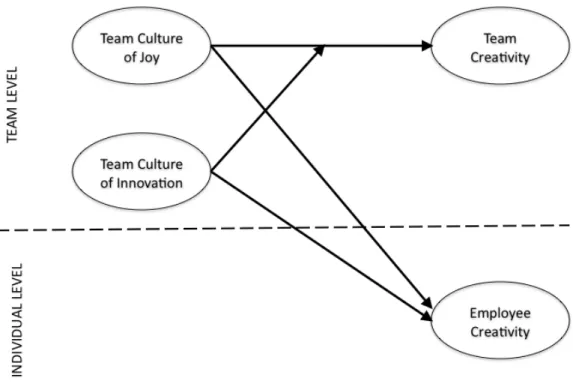
Because of the nesting nature of the data (employees nested in teams), the analyses were conducted through Hierarchical Linear Modeling (HLM), wherein the Level 2 variables (team culture of innovation and team culture of joy) affected the Level 1 variable (personal creativity of each employee). The second stage considered for which teams did a culture of joy have a more significant impact in achieving team creativity, while also taking into consid-eration the interaction between each team’s culture of joy and culture of innovation. To test this model, all variables were aggregated at the team level. The theoretical model is represent-ed in figure 1.
Figure 1. Theoretical Model
Results
In support of Hypothesis 1a, it was found that a team culture of joy does affect per-sonal creativity, as can be seen in Table 1 (b = 0.24; p < 0.05). In Table 1, it is also possible to notice that a culture of innovation does not have a significant effect on personal creativity (b = 0.13; p > 0.05). These results also support Hypothesis 1b, which states that a team culture of joy will have a stronger effect on personal creativity than a team culture of innovation.
Table 1. The effect of a team culture of joy on personal creativity
Additionally, these results were obtained while controlling for social desirability, as this might be a potential source of bias that could artificially influence the results. Social de-sirability bias deals with the fact that people sometimes strive to position themselves in a bet-ter light, or to show that they comply with what they believe others see as a good or betbet-ter. In this specific case, it means that employees could lie and portray themselves as being more creative than what they truly are. However, as the model is controlling for this type of atti-tude, this bias (although significant at p<.001) does not seem to influence the results (see bot-tom of Table 1).
In Hypothesis 2, it was hypothesized that there would be an interaction between a cul-ture of joy and a culcul-ture of innovation to influence team creativity, and that such interaction would show a stronger effect of a culture of joy on team creativity in teams that have a weak culture of innovation. This also means that teams that have a strong culture of innovation should present a lower effect of a culture of joy on team creativity. As it be seen in table 2, both a team culture of joy (b = 2.41; p < 0.05) and a team culture of innovation (b = 2.24; p < 0.01) have significant effects on team creativity.
More importantly, in Table 2 it is also possible to observe that the interaction of a cul-ture of joy and of a culcul-ture of innovation has a significant effect on team creativity (b = -0.47; p < 0.05). All of this supports the first part of Hypothesis 2.
Table 2. The interactive effect of a team culture of joy and innovation on team creativity
Finally, as there is a significant interaction between a team culture of joy and a team cul-ture of innovation, it is important to analyze the shape of this interaction.
Figure 2. The Interaction between a team culture of joy and team culture of innovation on
As it can be seen in Figure 2, when a team culture of innovation is low, there is a signifi-cant effect of a team culture of joy on team creativity (straight line in figure 2; b=0.57; p<0.05). In Figure 2, it is also possible to see that when a team culture of innovation is high, there is no effect of a team culture of joy on team creativity (dotted line in Figure 2 represents the fact that there is no significant effect of a team culture of joy on team creativity for team that have a strong culture of innovation; b=-0.15; non-significant). These findings support the second part of Hypothesis 2.
Discussion
This dissertation has investigated whether creative behaviors can be stimulated by the organization’s cognitive and emotional culture. It was concluded that 1) a team’s emotional culture of joy has a positive effect on personal creativity; 2) a team’s emotional culture of joy has a higher effect on personal creativity than does a cognitive culture of innovation; 3) there is a statistically significant interaction between an emotional culture of joy and a cognitive culture of innovation that influences team creativity; and 4) that interaction is such that, when a team has a weak culture of innovation, a culture of joy has a significant positive impact on team creativity. On the other hand, when a team has a strong culture of innovation, a culture of joy has no effect on team creativity.
The first finding, namely that a culture of joy has a positive effect on personal ty, supports previous research stating that positive emotions have a positive effect on creativi-ty (Isen, Daubman & Nowicki, 1987; Amabile & Kramer, 2007; George & Zhou, 2007). This is unsurprising, as feelings of joy will lead people to feel more at ease and confident in exper-imenting with new ideas.
The second finding, namely that a culture of joy has a higher impact on personal crea-tivity than a culture of innovation, may not be as intuitive as the previous one. In fact, while a culture of innovation should have a positive effect on employee creativity (as it already incor-porates norms enabling creativity), a culture of joy has shown benefits that surpassed those of a culture of innovation. One explanation is that joy can motivate employees to feel more con-fident in pursuing and presenting their ideas, as well as to have more flexible thinking. When these factors coexist, their impact is greater than that of a culture that merely promotes inno-vation.
In this thesis, it was further determined that a culture of joy and a culture of innovation interact with each other to influence team creativity. The results show that, when a team has a weak culture of innovation, joy becomes crucial in promoting team creativity. This can be at-tributed to the fact that a culture of joy provides a strong incentive for creativity that can, in itself, compensate for the lack of innovative team norms. On the other hand, when a team has a strong culture of innovation, joy no longer has an effect on team creativity. This can perhaps be explained by the fact that, when a team is already strong in innovative norms, it does not need joy to stimulate team creativity, as these existing norms enabling creativity are sufficient to foster creativity.
Limitations and future research
This study is subject to several limitations that should be acknowledged. The first of these deals with the fact that most of the data were gathered through self-reporting methods. Self-assessments rely upon the honesty and accuracy of participants’ statements, which might be affected by social desirability concerns. To mitigate this limitation, in this thesis, social desirability was controlled for. Controlling for social desirability attenuates the bias arising from participants’ provision of untruthful responses that are perceived to be better or more acceptable.
For team creativity, this limitation was not a problem. Team creativity was assessed by asking team leaders to evaluate their respective teams’ level of creativity, while emotional and cognitive culture were evaluated by team members- therefore eliminating possible com-mon-source biases.
In addition, as employees were asked about their department and tenure in the surveys, they may have felt a degree of concern regarding their anonymity. To moderate this limita-tion, the researcher assured all participants that the collected answers would not be shared with their employers, and that ID codes would be generated to avoid the inclusion of names of employees and departments in the data, so as to ensure confidentiality.
Further, the fact that this dissertation was conducted at an organization active in the cork industry sector might limit the generalizability of these findings to this specific setting. Accordingly, future research can investigate whether the findings of this study apply to organ-izations in other sectors, such as services companies, hospitals, or high-tech firms. Indeed, the majority of sectors in which many companies currently operate require constant creative be-haviors to thrive in their environment. As such, determining whether a culture of joy is as im-portant as it is for ACC could be very valuable for such companies.
This data set was also collected in an organization that has a more mechanistic struc-ture. It would be worthwhile to investigate whether these results remain valid in an organic organization (wherein flexibility can substitute the need of emotional culture). Additionally, the company under analysis was relatively small, so conducting a similar analysis at a larger organization should also produce valuable insights.
Lastly, future research could investigate other types of cognitive and emotional culture that can stimulate creativity. Even though literature in this field has been advancing rapidly in the past few years, there is still much to uncover when it comes to the specific variables that
directly affect creativity, as well as how these can be stimulated. It would also be noteworthy to investigate whether other types of emotional culture (e.g., hope, fear, etc.) complement other types of cognitive culture (e.g., attention to detail) in stimulating creativity, and to test which of the two is stronger: the heart or the brain. If, once again, feelings turn out to be more important in stimulating creative behaviors, organizations may need to change the way they do things in the workplace accordingly.
Conclusion
This thesis contributes to the body of literature addressing the stimulation of creativity in the workplace, and the effect of positive emotions on creativity, through the revelation that a team culture of joy can be more effective than a team culture of innovation in boosting per-sonal creativity; furthermore, this paper shows that, when a team has a weak culture of inno-vation, a team culture of joy can provide a considerable jumpstart to creative behavior. This dissertation therefore contributes significantly to the understanding of how joy can affect creativity. Nonetheless, more could be done to understand creativity in the workplace and the impact of a company’s emotional culture. Although this dissertation fills a gap in the litera-ture, specifically in relation to the impact of joy on creativity, there remain further aspects of this topic that require validation and further investigation in future research.
Bibliography
Ahmed, P. K. (1998). Culture and climate for innovation. European journal of innovation management, 1(1), 30-43.
Amabile, T. M. (1988). A model of creativity and innovation in organizations. Research in organizational behavior, 10(1), 123-167.
Amabile, T. M. (1997). Motivating creativity in organizations: On doing what you love and loving what you do. California management review, 40(1), 39-58.
Amabile, T. M., Schatzel, E. A., Moneta, G. B., & Kramer, S. J. (2004). Leader behaviors and the work environment for creativity: Perceived leader support. The Leadership Quarter-ly, 15(1), 5-32.
Amabile, T. M., Barsade, S. G., Mueller, J. S., & Staw, B. M. (2005). Affect and creativity at work. Administrative science quarterly, 50(3), 367-403.
Amabile, T. M., Conti, R., Coon, H., Lazenby, J., & Herron, M. (1996). Assessing the work environment for creativity. Academy of management journal, 39(5), 1154-1184.
Amabile, T., & Kramer, S. (2011). Do happier people work harder. New York Times, 4(7).
Amabile, T. M., & Kramer, S. J. (2007). Inner work life. Harvard Business Review, 85(5), 72-83.
Amabile, T., & Kramer, S. (2011). The progress principle: Using small wins to ignite joy, en-gagement, and creativity at work (pp. 113-122). Harvard Business Press.
Barczak, G., Lassk, F., & Mulki, J. (2010). Antecedents of team creativity: An examination of team emotional intelligence, team trust and collaborative culture. Creativity and Innovation Management, 19(4), 332-345.
Barsade, S. G. (2002). The ripple effect: Emotional contagion and its influence on group be-havior. Administrative Science Quarterly, 47(4), 644-675.
Barsade, S. G., & Gibson, D. E. (2007). Why does affect matter in organizations?. The Acad-emy of Management Perspectives, 21(1), 36-59.
Barsade, S. G., & O’Neill, O. A. (2014). What’s love got to do with it? A longitudinal study of the culture of companionate love and employee and client outcomes in a long-term care setting. Administrative Science Quarterly, 59(4), 551-598.
Bliese, P. D. (2000). Within-group agreement, non-independence, and reliability: Implications for data aggregation and analysis. In K. J. Klein and S. W. J. Kozlowski (Eds.), Multilevel Theory, Research, and Methods in Organizations (pp. 349-381). San Fran-cisco, CA: Jossey-Bass.
Carnevale, P. J., & Isen, A. M. (1986). The influence of positive affect and visual access on the discovery of integrative solutions in bilateral negotiation. Organizational behavior and human decision processes, 37(1), 1-13.
Černe, M., Nerstad, C. G., Dysvik, A., & Škerlavaj, M. (2014). What goes around comes around: Knowledge hiding, perceived motivational climate, and creativity. Academy of Man-agement Journal, 57(1), 172-192.
Chen, G., Thomas, B., & Wallace, J. C. (2005). A multilevel examination of the relationships among training outcomes, mediating regulatory processes, and adaptive performance. Journal of Applied Psychology, 90(5), 827.
Chua, R. Y., Morris, M. W., & Mor, S. (2012). Collaborating across cultures: Cultural meta-cognition and affect-based trust in creative collaboration. Organizational Behavior and Hu-man Decision Processes, 118(2), 116-131.
Csikszentmihalyi, M. (1996). Flow and the psychology of discovery and invention. New York: Harper Collins.
George, J. M., & Zhou, J. (2007). Dual tuning in a supportive context: Joint contributions of positive mood, negative mood, and supervisory behaviors to employee creativity. Academy of Management Journal, 50(3), 605-622.
Hirst, G., Van Knippenberg, D., & Zhou, J. (2009). A cross-level perspective on employee creativity: Goal orientation, team learning behavior, and individual creativity. Academy of management journal, 52(2), 280-293.
Hurley, R. F., & Hult, G. T. M. (1998). Innovation, market orientation, and organizational learning: an integration and empirical examination. The Journal of Marketing, 42-54.
Isen, A. M., Daubman, K. A., & Nowicki, G. P. (1987). Positive affect facilitates creative problem solving. Journal of personality and social psychology, 52(6), 1122.
Karl, K., & Peluchette, J. (2006). How does workplace fun impact employee perceptions of customer service quality?. Journal of Leadership & Organizational Studies, 13(2), 2-13.
Karl, K., Peluchette, J., Hall-Indiana, L., & Harland, L. (2005). Attitudes toward workplace fun: A three sector comparison. Journal of Leadership & Organizational Studies, 12(2), 1-17.
Lindell, M. K., Brandt, C. J., & Whitney, D. J. (1999). A revised index of interrater agreement for multi-item ratings of a single target. Applied Psychological Measurement, 23(2), 127-135.
Lundy, O., & Cowling, A. (1996). Strategic Human Resource Strategy. Routledge.
Mainemelis, C., Kark, R., & Epitropaki, O. (2015). Creative Leadership: A Multi-Context Conceptualization. The Academy of Management Annals, 9(1), 393-482.
Martins, E. C., & Terblanche, F. (2003). Building organisational culture that stimulates crea-tivity and innovation. European journal of innovation management, 6(1), 64-74.
O’Neill, O. A., & Rothbard, N. P. (2017). Is Love All You Need? The Effects of Emotional Culture, Suppression, and Work–family Conflict on Firefighter Risk-Taking and Health. Academy of Management Journal, 60(1), 78-108.
O'Reilly, C. A., Chatman, J., & Caldwell, D. F. (1991). People and organizational culture: A profile comparison approach to assessing person-organization fit. Academy of management journal, 34(3), 487-516.
Perry-Smith, J. E., & Shalley, C. E. (2003). The social side of creativity: A static and dynamic social network perspective. Academy of management review, 28(1), 89-106.
Pirola-Merlo, A., & Mann, L. (2004). The relationship between individual creativity and team creativity: Aggregating across people and time. Journal of Organizational Behavior, 25(2), 235-257.
Reynolds, W. M. (1982). Development of reliable and valid short forms of the Mar-lowe-Crowne Social Desirability Scale. Journal of clinical psychology, 38(1), 119-125.
Schein, E. H. (2010). Organizational culture and leadership (pp. 7-22), 4th ed. John Wiley & Sons.
Shalley, C. E., Gilson, L. L., & Blum, T. C. (2000). Matching creativity requirements and the work environment: Effects on satisfaction and intentions to leave. Academy of management journal, 43(2), 215-223.
Shalley, C. E., Zhou, J., & Oldham, G. R. (2004). The effects of personal and contextual characteristics on creativity: Where should we go from here?. Journal of management, 30(6), 933-958.
Shaver, P., Schwartz, J., Kirson, D., & O’Connor, C. 1987. Emotion knowledge: Further ex-ploration of a prototype approach. Journal of Personality and Social Psychology. 52(6): 1061–1086.
Shin, S. J., & Zhou, J. (2007). When is educational specialization heterogeneity related to cre-ativity in research and development teams? Transformational leadership as a modera-tor. Journal of applied Psychology, 92(6), 1709.
Staw, B. M. (1995). Why no one really wants creativity. In C. M. Ford, & D. A. Gioia (Eds.), Creative action in organizations (pp. 161–166). Thousand Oaks, CA: Sage
Staw, B. M., Sutton, R. I., & Pelled, L. H. (1994). Employee positive emotion and favorable outcomes at the workplace. Organization Science, 5(1), 51-71.
Sternberg, R. J., & Lubart, T. I. (1995). Defying the crowd: Cultivating creativity in a culture of conformity. Free Press.
Woodman, R. W., Sawyer, J. E., & Griffin, R. W. (1993). Toward a theory of organizational creativity. Academy of management review, 18(2), 293-321.
Zhang, X., & Bartol, K. M. (2010). Linking empowering leadership and employee creativity: The influence of psychological empowerment, intrinsic motivation, and creative process en-gagement. Academy of management journal, 53(1), 107-128.
Zhou, J., & George, J. M. (2001). When job dissatisfaction leads to creativity: Encouraging the expression of voice. Academy of Management journal, 44(4), 682-696.
Zhou, J., & George, J. M. (2003). Awakening employee creativity: The role of leader emo-tional intelligence. The leadership quarterly, 14(4), 545-568.
Appendix – Survey Items
Culture of InnovationEmployees were asked to assess the culture of Innovativeness of their unit by rating how characteristic were certain elements in the culture of their unit.
1. being innovative
2. being quick to take advantage of new opportunities 3. having a willingness to experiment
4. risk taking.
This measure was adapted from O’Reilly, Chatman and Caldwell (1991).
Culture of Joy
Employees were asked to assess the culture of Joy of their unit by rating how often they saw other employees in their unit showing a set of emotions. The set of emotions were:
1. joy 2. happiness 3. excitement 4. enthusiasm 5. fun 6. contentment 7. interest
This measure was adapted from the prototype model of emotions proposed by Shaver, Schwartz, Kirson and O’Connor (1987) and O'Neill and Rothbard (2017).
Individual Creativity
Employees were asked to self-assess the extent to which each sentence described themselves in terms of creative behaviors in the workplace (Zhou & George, 2001). Respondents rated 13 items describing themselves. The items were:
1. I suggest new ways to achieve goals or objectives
2. I come up with new and practical ideas to improve performance
3. I search out new technologies, processes, techniques, and/or product ideas 4. I suggest new ways to increase quality of our products
5. I am a good source of creative ideas 6. I am not afraid to take risks