Why the Banking Sector should
Take CSR seriously?
CSR effect on Trust and Marketing
Performance Indicators
Youssef Ben Ahmed
152118262
Dissertation written under the supervision of Professor Sérgio Moreira
Dissertation submitted in partial fulfilment of the requirements for the MSc in
Management with specialization in Strategic Marketing, at the Universidade
Abstract
Title: Why the Banking Sector should Take CSR seriously? CSR effect on Trust and Marketing Performance Indicators
Author: Youssef Ben Ahmed
Keywords: Corporate Social Responsibility, CSR, Trust, Banking Sector, Mediation
While considered as the pillar of our modern capitalistic societies (Decker & Sale, 2009), the banking sector is going through a rough period since the 2008 economic crisis. The decline of public trust in the financial services negatively impacted many of the banks marketing
performance indicators (Hurley et al., 2014; Järvinen, 2014. In order to tackle this problem and better engage in their social role as motor of all economic activities, banks are turning towards CSR as a potential solution.
The quantitative research will study the impact of banks' customer perception of CSR initiatives on Brand Affinity, Customer Satisfaction and likelihood to change providers as well as the mediation effect of Trust on this impact. A survey was used to collect data and the sample was chosen using simple random sampling. To study the impact of the perception of CSR initiatives on the different outcome variables, a Pearson correlation analysis was undertaken. The mediation effects were interpreted using a Path Analysis and the statistical significance of standardised paths. The results of the research showed that the perception of CSR activities positively impacts our outcome variables. Also, Trust is mediating the impact of the perception of Customer Oriented CSR, but not the perception of Community Oriented CSR (Philanthropy). The research helps close some knowledge gaps in CSR (Aguinis & Glavas, 2012) like the impact of CSR on the individual level, as well as the processes underlying the impact of the perception of CSR initiatives.
Abstrato
Titule: Why the Banking Sector should Take CSR seriously? CSR effect on Trust and Marketing Performance Indicators
Autor: Youssef Ben Ahmed
Palavras-chave: Responsabilidade social corporativa, RSC, confiança, Setor bancário, Mediação
Embora seja considerado o pilar das sociedades capitalistas modernas (Decker & Sale, 2009), o setor bancário tem atravessado um período conturbado desde a crise económica de 2008. O declínio da confiança pública nos serviços financeiros impactou negativamente muitos dos indicadores de desempenho de marketing dos bancos (Hurley et al., 2014; Järvinen, 2014. De modo a enfrentar este problema e melhorar o seu envolvimento em relação ao seu papel social enquanto motor de todas as atividades econômicas, os bancos começam a considerar a RSC como uma potencial solução.
A pesquisa quantitativa aborda o impacto da perceção dos clientes em relação às iniciativas de RSC dos bancos na afinidade com a marca, satisfação do consumidor e probabilidade de mudar de fornecedor, bem como o efeito mediador da confiança neste mesmo impacto. Um questionário foi usado para recolher dados e medir as diferentes dimensões necessárias, e a amostra foi escolhida usando amostra aleatória simples e uma amostra de conveniência. Os resultados da pesquisa demonstraram que a perceção das atividades de RSC afeta positivamente a afinidade da marca e a satisfação do. Além disso, a confiança medeia o impacto da perceção da RSC orientada para o cliente, mas não a perceção da RSC com foco na comunidade (filantropia). A pesquisa ajuda a preencher algumas lacunas no conhecimento relativamente à RSC (Aguinis & Glavas, 2012), como o impacto da RSC a nível individual, bem como o processo subjacente ao impacto da perceção das iniciativas de RSC.
Acknowledgments
When writing the last words of your thesis, you can’t help it but to think about everything you went through, thinking that you managed to do this all by yourself, only to find out that you would have never achieved what you did without the support of some people around you.
For this reason, I want to express my gratitude to my mother who has always been there for me, for the better and the worse, and carried me to be the person I am today. Second, to my
soulmate who pushed me to be my best in this harsh process and cheered me in the darkest
moments. Third, to my friends that were always there for me and never hesitated to help me with anything (Special Thanks to Titou, Weebo, and TT). Fourth, to my mentor and all the staff at the CTIE, who accepted me as one of them and helped me grow within their
organization. And finally, to my awesome supervisor, who was there in every step of this thesis, believed in my ideas and never gave up on me.
List of Abbreviations
CSR: Corporate Social Responsibility NGO: Non-Governmental Agency
Com CSR: Perception of Community Oriented CSR Cus CSR: Perception of Customer Oriented CSR Org Trust/T_O: Organizational Trust
Int Trust/T_I: Interpersonal Trust Bd Aff/B_A: Brand Affinity
L.C.B/L_C: Likelihood to Change Banks C.S: Customer Satisfaction
SD: Standard Deviation M: Mean
RMSEA: Root Mean Square Error of Approximation TLI: Tucker Lewis Index
CFI: Confirmatory Factor Analysis AIC: Akaike Information Criterion BIC: Bayesian Information Criterion EFP: Exploratory Factorial Analysis
Table of Content Abstract ... 2 Acknowledgments ... 3 Introduction ... 7 Research Questions: ... 9 Literature Review: ... 10
Corporate Social Responsibility ... 10
CSR and Banking ... 11
Recent interest of Banks for CSR ... 12
Trust in the banking sector ... 17
Research Design ... 18
Hypotheses... 22
Methodology ... 23
Survey Design ... 23
Sampling ... 23
Pre-test and Pilot ... 24
Analysis tools ... 24
Measures & Scale ... 24
Data ... 26
Results ... 29
Model Testing: ... 30
Discussion ... 33
Perception of customers towards their banks ... 33
Importance of CSR in the banking system ... 34
The Primacy of trust in CSR initiatives ... 35
Conclusions ... 37
Key Findings ... 37
Managerial Implications ... 38
Limitations ... 39
Future Research Recommendations ... 39
References ... 41
Introduction
Corporate Social Responsibility is a field that has been studied for a long time (e.g. Dodd, 1932) as an alternative to the classic way to do business in the 20th Century. The corporate world at that time was dominated by “the shareholder theory”. Friedman (1984) claimed that a company has no responsibility whatsoever towards the community or any other stakeholder besides its shareholders. The main purpose of any firm is to increase the wealth and profit of its shareholders and if the shareholders per say are concerned about any social cause, they can support it with their own private fund, and this action should not be associated with the company.
However, a recent interest in the field from both the managerial and the academic sides has emerged. According to Aguinis & Glavas (2012), 181 articles related to CSR were released from 1970 to 2011 in the top academic journals picked by them (excluding journals
specializing in CSR). Out of these 181 journals, 100 were released after 2000.
Issues of CSR has started receiving attention from the corporate world as well, as for example over 90% of Fortune 500 companies were running some sort of CSR program (Perez, 2009),
and this is due to many reasons mainly related to the rise of social awareness and a shift to the consumption habits of people. Driven by the Stakeholders and Institutional Theories (Frynas & Yamahaki, 2016), companies are now pressured from different parties to be socially responsible entities, especially from their customers. Also. Firms have the need to conform to the social norms in order to undertake its activities as it needs external approval (DiMaggio & Powell. 1983).
The financial sector is no exception to this, and is more than ever under societal pressure to change. For this reason, Banks were chosen to be the focus in this study.
While being the core of our capitalistic societies, people are losing trust towards their banks since the 2008 crisis (Hurley et al., 2014; Järvinen, 2014), but also, they see the banking sector as the cause to many modern financial problems (Gillespie and Hurley, 2013). The banking field is also facing some problems as it is now a stagnating sector (Reuters, 2017),
struggling to innovate and facing a lot of external threats like Blockchain, Big tech and online financial services, where each of them is taking big chunks of banks’ profits (World Retail Banking Report, 2018).
So, for the banks to tackle these problems, they are turning to CSR as a potential solution, but also to highlight their social role as a pillar of our capitalistic societies and motor of economic growth (Decker & Sale, 2009).
This research will study the impact of these CSR initiatives undertaken by banks on the Brand Affinity, Likelihood to change banks and Satisfaction of Customers. Also, another objective of the research is to study if CSR activities influence business performance because of Trust. More specifically, the specific effects of the different levels of trusts on the several CSR dimensions will be highlighted.
To do so, the research will use a quantitative analysis, based on a survey’s results using a simple random sampling and convenience sampling. The results will analyse the current perception of the sample about their banks CSR activities as well as different marketing performance indicators. A correlation analysis between the variables will indicate which initiatives impact which indicator and using the statistical significance of standardised paths, we can interpret the mediation effect of Trust on that impact.
This research direction was chosen in alignment with the recent calls by Aguinis & Glavas (2012) and Frynas & Yamahaki (2016) to tackle the knowledge gap present in the CSR literature. Both the individual level of analysis and the mediation effect are almost absent from CSR research (Individual level of analysis is present in only 5% of all CSR papers surveyed by Agunis and Glavas (2012) and Mediation research is present in only 7% of the CSR papers surveyed by Frynas & Yamahaki (2016)).
Research Questions:
Several Research Questions were developed for this study:
- What are the drivers of CSR for Businesses?
Before starting looking for the impact of CSR, trying to understand the causes to engage in CSR is mandatory step. Using the literature as base, several drivers may be highlighted and used for the research.
- What is the influence of CSR on the different marketing performances of banks? The research will look for the impact of CSR initiatives on several marketing performances, that will be chosen depending on their importance for the banking field, according the literature.
- Is Trust a Mediator in the CSR-Marketing Performances relationship?
If CSR has an impact on some marketing performance indicators for banks, the research will look for the mediation effect of trust and try to see if it's one of the causes of that impact.
- Are CSR initiatives important in the Banking Sector?
Depending on the impact of CSR initiatives, and the outcome variables impacted, the study will draw conclusions if it whether worth it or not to for banks to actually engage in socially responsible activities.
Literature Review:
Corporate Social Responsibility
The field of CSR kept evolving throughout the years, and many conceptualizations emerged trying to capture it, but this thesis will adopt, like many other articles (e.g. Aguinis & Glavas, 2012; Aguilera, 2011), the definition offered by Aguinis (2011) “context-specific
organizational actions and policies that take into account stakeholders’ expectations and the triple bottom line of economic, social, and environmental performance.”
CSR can be divided into 5 different dimensions (Wu & Wang, 2014): Customer Oriented which is “Providing customers high quality products and services to fulfil customer needs”, Employee Oriented which is “Providing fair evaluation, promotion and compensation for employees”, Environment Oriented which is “Supporting environmental activities, and incorporating environmental sustainability into business operations'', Economic Oriented which is “Offering products and services with reasonable pricing to meet social needs, and the sharing of profits with investors” and Community Oriented which is “Supporting charity institutions and sponsoring cultural, sporting and educational activities, to fulfil the
commitment of improving communities.”
Many studies showcase the importance of CSR in businesses and its benefits by giving the latter a competitive advantage based on non-economic factors, helping them distinguish themselves from the competition (e.g. Kramer & Porter, 2007) and creating positive employee attitude and consumer goodwill (Brammer, Milling, & Rayton, 2007).
This is gaining a lot of importance in the business world, due to the industrial development and social progress which gave social causes a lot of public attention (Wu & Wang, 2014). According to Lichtenstein & al (2004), the two main reasons why CSR is becoming important are the fact that companies now comprehend that CSR is one of the keys to success and that they need to help Non-Governmental Agencies (NGOs) achieve their goals. This will make a company more reputable and will help it build a better image due to their attention to social causes (Fombrun & Shanley, 1990; Giannarakis & Theotokas, 2011).
Also, according to the literature, the main drivers of CSR for corporates are built around the Stakeholder theory and the Institutional theory (Frynas & Yamahaki, 2016). In their review, out of the 462 peer-reviewed articles that they surveyed, 206 are applying the Stakeholders theory and 141 are applying the institutional theory while much less attention is given to the impact of CSR in Business through Agency theory, Legitimacy Theory, the Resource Based view, and Resource dependence theory. This is explained by the fact that companies engage mainly is CSR due the pressure from different stakeholders (Jawahar & McLAughlin, 2001) following the model of Mitchellet al. (1997), where the impact of the pressure of the
stakeholder is related to the power of that stakeholder to impose his/her will on the company, the legitimacy to use that power, and the and urgency of his/her call. Also, the institutional theory states that entities operating in one society must conform with its rules and get external approval in order to conduct business there.
CSR and Banking
Banks hold a very important role in society as they dictate the economic fortunes, stability and sustainability of modern economics (Decker & Sale. 2009), which gives them a higher social responsibility stake compared to other entities. The whole industry is seen as the pillar of modern Capitalism and motor of economic activities (Merton, 1995; Levine, 1997; 2005).
Carroll (1991) conceptualizes the social role of Banks into a four dimensions model that is more specific than the general 5 dimensions model of Wu & Wang (2014): Economic
Responsibility which is to increase the wealth of their customers and shareholders as well as
improve the economic situation of the society they operate in, Legal Responsibility which is to strictly comply with national regulations and international agreements, Ethical
Responsibility which is the expected behaviour of the bank towards its stakeholders, that may
differ from one society to another, because it is often based on a set of morals imposed by the culture (Deontological Ethics) and referred by Kant (1948) as social obligations or duties, and
Philanthropy which is the altruistic acts that are imposed by law and seen as an ethical
Recent interest of Banks for CSR
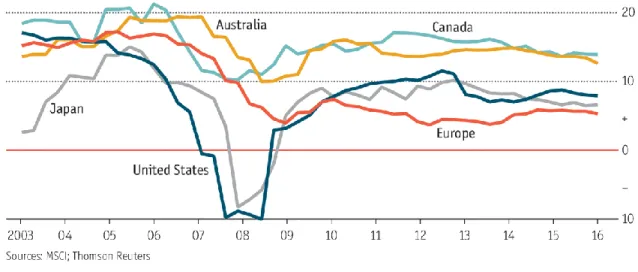
The Banking sector is facing a lot of challenges in the last decades. After the 2008 global crisis, all banks faced huge loss in their profits and return on equity as seen on the graph below (MSCI, Thomson Reuters, 2017) they are still stagnating to get any growth.
Figure 1. Return on Equity for Banks in different regions from 2003 to 2016
This is due to a lot of reasons on both internal and external levels. Thus, banks are turning to alternatives (e.g. CSR) to capture value and grow as an industry
Internal Threats
On the internal level, banks are facing low satisfaction level across many channels
(Capgemini Financial Services Analysis, 2018; Capgemini Voice of the Customer Survey, 2018) despite the fact that they are trying to update and improve their customer experience.
Banks are reinventing themselves by leveraging on Technology to close the gap with the other fields, as customers nowadays want a 24/7 customer service and service availability to fulfil their instant gratification thirst (O’Donoghue & Rabin, 2000), but Front-end digitization is not resulting in better satisfaction. According to Capgemini, a positive experience is what will drive customer loyalty and brand affinity. Another issue is the competition with other banks. Because of it, the number of Commercial banks is in decline globally. For instance, the number of commercial banks in the US went from 14.000 in 1978 to less than 6.000 in 2014 (Federal Deposit Insurance Corporation, 2014) and in France, from 326 in 2004 to 258 in 2017 (International Monetary Fund, 2017).
Figure 2. The decline of the Number of Commercial Banks in the US and in France
External Threats
Despite all the internal issues that the banking sector is facing, the external threats are the most problematic.
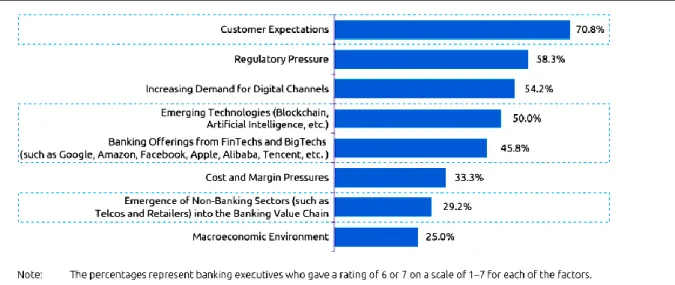
According to figure 3 below (World Retail Banking report, 2018), a half of banking
and the Banking offerings of FinTech and BigTech like Google or Tencent are causing disruption in the banking sector. (Capgemini Financial Services Analysis, 2018; Capgemini Voice of the Customer Survey, 2018).
Figure 3. Factors Causing Disruption in Banking (%), 2018
According to Forbes (2018), WeChat, a product of Tencent, has become the largest payment method in China, which is the biggest market in the world. Nearly a third of bank customers think that they might turn to BigTech for financial products and services (World Retail Banking Report, 2018). This estimate goes up to 43% among Millennials and 52% for Tech-Savvy customers. Another example of the BigTech offerings is Amazon with their
introduction of a credit card in January 2017 that makes it possible for customers to earn and accumulate points based on Amazon Purchases and are redeemable as Amazon Gift Cards. (Société Générale Securities Services, 2018).
Blockchain, which is essentially a distributed database of records, or public ledger of all transactions or digital events that have been executed and shared among participating parties (Johnsson & Trenck, 2018), is already being exploited by Financial firms for its potential. The
rise of Cryptocurrency is being captured by new digital banks like N26 or Revolut, as they made it possible to own, trade and pay with multiple cryptocurrencies, while traditional banks are falling behind and lagging to adopt this new feature and service to the small and yet rapidly rising segment of customers who are interested in the technology.
The digital-only banks mentioned above are also another challenger for incumbent traditional banks. Digital banks are the result of legacy banks no longer being able to adapt and provide a good experience to the customers. They are expected to grow multibillion-dollar balance sheets with a fraction of the costs of a traditional bank (Lipton, Pentland & Shrier, 2016). For instance, according to its CEO, Atom Bank in the UK intends to grow into a 5 Billion Pound balance sheet from 2016 to 2021 with just 340 full time staff, while the traditional bank Metro has the same size sheet with 2,200 People.
Competition is even rising from unexpected players. Many non-financial services firms coming from retail and telecom are showing rivalry to traditional banks. Orange Telecom, a French telecom giant, recently launched Orange Bank and is aiming to acquire 4 million customers within the next 5 years in its target markets (Spain, Poland, Slovakia and Belgium) (Reuters, 2018). The major threat that these non-financial companies are posing is offering financial services within their core products, thus eliminating the need for banks or other financial institutions. For all these reasons, nearly a third of bank executives surveyed by Gapmini consider the emergence of non-financial companies as financial services providers a disruption factor in the banking field.
However, banks are not facing competition in the Transactions/Payments and Current Accounts management alone, but in the lending activity as well, which constitutes their biggest activity in terms of Revenue as seen in figure 4 (Mckinsey, 2015).
Figure 4. Global Banking Revenue by activity
A new kind of lenders, “Challenger Lenders” are on the rise. In the UK alone, the industry grew to 6.1 Billion Pound in 2017. (Sifted, 2019). According to a study by the Cambridge Centre for Alternative Finance (CCAF), 29% of all new loans to SMEs came from challenger lenders in 2017. That figure will rise to 40% in the next decade (PwC, 2017). New comers will be cutting profits from banks in the consumer lending by 60% by 2025, and by 35% in the business lending (McKinsey, 2015). McKinsey explains this by the high adaptability of new lending start-ups while traditional banks are stuck in bureaucracy hell. This is already being proven right with SoFi, a new American personal lender, being valued at 4.5 Billion Dollars (CBS, 2019). A lot of other players are also popping out like Lendify in Sweden which already lent over 250 Million Euros as personal loans to local people, Paypal that lent over 10 billion dollars to SMEs globally (Sifted, 2019).
Trust in the banking sector
Trust is a very important factor in the customer-bank relationship as it facilitates transactions between both parties. Customers who trust their bank do not have to worry about their interests being taken care of, nor fear that they may lose their savings or balance (Chen, Saparito & Sapienza. 2004). Also, according to Capgemini (2018), Trust is the second most important factor for Customers when choosing a bank, and the second most important factor for staying with a bank, and it tops even Price/rate, service quality and ease of use of Website and Apps as seen in figure 5.
Figure 5. Factors Influencing Customer Stickiness
However, due to the financial Crisis, trust in banks and in the financial system has declined in various countries (Hurley et al., 2014; Järvinen, 2014), as banks are perceived as the cause of the crisis itself in the mind of people (Gillespie and Hurley, 2013). Thus, the crisis showed
Research Design
Despite the fact that a considerable amount of work on CSR has been done, it remains highly fragmented (Waddock, 2004). This is due to scholars studying the concept through different disciplinary and conceptual perspectives and lenses. Another reason is that CSR is usually studied from either the Organizational or Institutional levels while little to no research is
done on the Individual level (Agunis & Glavas, 2012). Finally, despite the known fact that
companies emgaging in CSR will tend to have higher brand affinity among its customers (Bhattacharya & Sen, 2004) or have higher marketing performances in general, the reason behind it remains unknown. As shown before, less than 7% of studies done on CSR study mediation effects (Agunis 2012), as the researchers are focused more on the outcome than trying to understand the processes underlying that impact.
So, in order to close some knowledge gaps in the Literature, this research aims to study the effect of CSR on an individual level by measuring the impact of CSR perception of bank customers on three major marketing performance indicators: Brand affinity , Customer Satisfaction and Likelihood to change providers. A mediation effect will be taken into
consideration, in this case Trust due to its critical importance in the banking industry as stated in the literature.
Research Framework
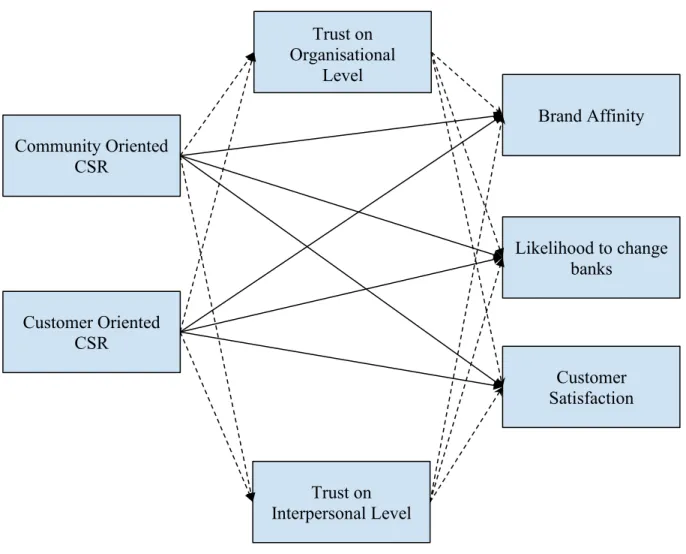
Using the literature and following previous research recommendations, a set of variables was defined to be studied and put in the model below in figure 6. They were chosen according to previously developed CSR models, and the mediators/outcome variables were set according to their importance for the current state of the banking sector.
Figure 6. Research Framework
Predictors/Independent Variables:
Using the model of Wu & Wang (2014), the perception of two out of the five dimensions set in that study were chosen to be studied in this research. They are the Perception of Customer
Oriented CSR and the Perception of Community Oriented CSR. As mentioned in the
Literature Review, they are defined as “Providing customers high quality products and services to fulfil customer needs” and “Supporting charity institutions and sponsoring cultural, sporting and educational activities, to fulfil the commitment of improving communities.” Community Oriented CSR Customer Oriented CSR Trust on Organisational Level Customer Satisfaction Brand Affinity Trust on Interpersonal Level Likelihood to change banks
Outcome Variables:
Three outcomes are measured in the research. Brand affinity, Customer Satisfaction, and
Likelihood to change banks.
Brand affinity: Oliver (1999) defines brand affinity as a deeply held commitment to rebuy or repatronize a preferred product/service consistently in the future, thereby causing repetitive same-brand or same brand-set purchasing, despite situational influences and marketing efforts having the potential to cause switching behaviour. This variable was selected for the study because despite banks efforts nearly a third of total banks customers might switch to BigTech for financial services including almost half of the younger generation and tech-savvy (Capgemini Financial Services Analysis, 2018).
Likelihood to change banks: This variable is an adapted version of the variable used by Blattberg & Neslin (1990), which is brand loyalty. In their paper, they use 4 dimensions to measure it, (1) repetitive buying; (2) expedited buying; (3) buying various products of the same brand; (4) limited changing to other brands. For this study, an updated form of this model for banking services with two dimensions will be adopted: Staying with the same bank (1), limited changing to other banks (2).
Customer Satisfaction: Kotler (1999) defines Satisfaction as the highs and lows of pleasures experienced by customers, which originates from a comparison of customers' cognition of the product performance against customers' anticipation toward the product. The choice of satisfaction as an outcome is due to the fact that it is a critical performance indicator nowadays for banks especially that low satisfaction remains a major issue in the banking sector (Capgemini Voice of Customer Survey, 2018)
Mediators:
Trust: This research will take into consideration the mediation effect of Trust, since it was clear in the literature that it is one of the most important factors for a strong bank-customer
relationship in the financial sector. Trust will be divided into its two known dimensions,
Competence Based Trust and Integrity based Trust (Ganesan & Hess, 1997). For each
dimension, the study will measure two levels, trust on Organizational level (the Perceived trust of the customer toward the bank), and trust on Interpersonal level (the perceived trust of the customer toward the bank representative).
Control Variables:
In order to study correlation effects and analyse in depth our sample as well as make sense to the findings, control variables were used in the study.
Demographics Variables: Age, Gender, Nationality, Country of Residence, Education
level, Marital Status and Employment Status were the Demographic Variables used in the
study.
Financial activities variables: The other control variables used in the study are related to the behaviour of customers with the banks and their financial activities which are: Number of
Bank accounts, Type of undergoing loans, Number of Active Credit cards, Frequency of Digital wallets use, use of Crypto-Currencies and Level of Dependency on banks.
Hypotheses
Impact of Consumer Perception of CSR on different Marketing Performance indicators
Companies that have CSR initiatives tend to have more loyal customers and are less likely to change for other brands (Bhattacharya & Sen, 2004). Also, when the firm cares about the customers and tries to meet their needs and behave ethically towards them, those same customers have a higher satisfaction (Fournier, 1998). Also, according to Brandt (1998), a company can combine non-functional features like CSR to their core functional activities to drive customer Brand Affinity. In line with this, the research predicts that both Community Oriented CSR and Customer Oriented CSR will have an effect on Brand Affinity, Customer Satisfaction, and Likelihood to Change Banks.
The mediation effect of Trust
Banks activities are characterized by information asymmetry and uncertainty (Decker & Sale. 2009), which makes trust a mandatory condition for the bank-customer relationship (Beck, 2006). So, the lack of trust may have a negative impact on this relationship and can affect the marketing performance of the bank. And as employees within the bank, bank representatives draw their morals and behaviour from both their personal ethics and the ethical code of conduct of the organization. Therefore, the effect of the perception of CSR initiatives occurs via changes in the level of trust and it explains partially the process underlying the impact these initiatives.
In line with this, the effects of Community and Customer Focused CSR on Brand Affinity, Customer Satisfaction and Likelihood to change are expected to be mediated by both, Organizational and Interpersonal Trust.
Methodology
This study is a quantitative research following a deduction approach. First, using the literature, a number of variables were selected to be studied as well as the level of analysis. Second, a set of hypotheses were built using the existing extracted knowledge from previous published articles, books, web articles, companies report and previous Masters Theses. A research framework (figure 6) was the result of this process, and the research is studying the relationship between these variables. So, in order to validate the hypotheses previously built, an empirical approach is needed. For this purpose, a survey was necessary.
Survey Design
The survey was built based on previous research, and each item used a previously tested scale. The questionnaire is composed of 6 parts. The first and last one is focused on the
demographics and behaviour. The other four use a 7-point Likert scale ranging from 1 “Highly Disagree’’ to 7 “Highly Agree” and are used to study the perception of customers of their banks aligned with the 7 variables in the model (more details in the Measures and Scale part). The software packages used to develop the survey were Microsoft Excel and Word for the draft, and Qualtrics for building the questionnaire.
Sampling
Two types of Sampling were used for the survey. The First one was the probability technique of “Simple Random Sampling”, using platforms like “SurveySwap” where random people answer your survey in exchange of Credits without any kind of criteria to choose the
respondents. The second one is the non-probability technique of “Convenience Sampling” where the survey was shared among peers, various Facebook and Reddit Groups and directly sent to acquaintances.
Pre-test and Pilot
To get effective results, the survey went through a pre-test phase. The first, a pilot was sent to 5 peers to check for grammatical and language errors as well as to get a feedback about the structure used. Then a second phase of the pre-test was undertaken by sending the survey was to 14 peers to gather feedback about the wording used, possible biased questions and unclear sentences. The tests showed that some items were too vague to properly put on a scale, some questions were duplicated and few suggestions about the structure were made.
Analysis tools
The analysis of the survey results was done using two software packages: IBM SPSS
Statistics 26 and R Studio. The first one was used to make the descriptive of the variables,
the factorial analysis, the creation of new variables, the correlations, and the characterizations of the factors. R studio was used to test the model and study the mediation effect of Trust.
Measures & Scale
The study uses a set of items for each variable. These items are adapted from previous studies and are using a 7-point Likert scale where the respondents indicate his perception according to the question asked with 1 being Completely Disagree and 7 completely agree. In the Table 1 below, all items used are listed with the references from which they were adapted.
Table 1. Items used to measure the research’s variables
Variable Items Used References Perception of
Community Oriented CSR
I have the impression that my bank … ... helps developing countries
... supports social and cultural activities (arts, culture, sports) in the regions where it operates
... develops projects in poor countries ... supports humanitarian cause(s)
(Swaen & Chumpitaz . 2008
Perception of Customer Oriented CSR
I have the impression that my bank …
…informs in a correct and truthful way about the characteristics/properties of its products
...is an innovator and launches new products into the market continuously
...its products always maintain good quality
... looks after consumers’ rights (in terms of after-sales service, guarantees, information)
… considers my interests when problems arise.
(Swaen &
Chumpitaz . 2008), (Kumar, Scheer & Steenkamp. 1995), (Singh, de los Salmones Sanchez & DEl Bosque. 2007)
Organization Trust My bank’s products give me a sense of security I trust the quality of my bank’s products
Going with my bank’s products is a quality guarantee Promises made by my bank(s) are reliable.
My bank(s) has been consistent in terms of their policies. My bank is honest with its customers
My bank treats customers fairly My bank cares for us.
(Swaen &
Chumpitaz . 2008), (Kumar, Scheer & Steenkamp. 1995)
Interpersonal Trust The bank’s representative is knowledgeable regarding his/her products. If problems such as transfer delays arise,
The bank representative is honest about the problems. The bank’s representative does not make false claims. The bank’s representative is not open in dealing with us. The bank’s representative cares for us
(Ganesan. 1994)
Brand Affinity I will recommend my bank to someone who seeks my advice I think my bank is superior to other competing banks
When considering opening an account, I would consider my current bank first
(Nam, Ekinci, & Whyatt. 2011), (Chang & Liu. 2009), (Blatterg & Neslin, 1990) Likelihood to
change banks
I will switch to other banks if I experience a problem with my current one
I am interested in trying other banks or financial services I intend to replace my service provider with other providers
(Nam, Ekinci, & Whyatt. 2011), (Chang & Liu. 2009) (Blatterg & Neslin, 1990)
Customer
Satisfaction I am satisfied with the personnel of my bank I am satisfied with the products and services of my bank My bank has a good image
I am satisfied with the provided ability to access my bank (stores, ATMs, Website, app...)
(Mihelis,
Grigoroudis, Siskos, Politis &
Data
Cleaning of the data:
A total of 177 responses were recorded. In order to get accurate results, an initial cleaning of the data was done. First, all incomplete answers were discarded. Second, people who don’t
have bank accounts, and never dealt with a bank before were removed because they are not
the audience studied. And finally, people who spent less than 3 minutes answering the survey and wrongly answered the attention check question were discarded as well. The final dataset is represented by 131 complete answers.
Sample Description and effect of control variables:
The final sample included 131 participants. It consisted of 58.5% females and 42% males, 58.8% are residing in Europe (Mainly Netherlands, Portugal and France), 19.8% in Africa (Mainly Tunisia), 9.9% in the Americas (Mainly US and Canada), 9.2% in Asia, and finally 2.3% from Australia. The age range goes from 20 to 53-year-old with a mean of 25.6 and a median of 24. The sample marital status was 73% Singles and 29% married or in a domestic relationship. The Employment status included 61.8% Students, 32.8% employed and the remaining are self-employed or unemployed. The highest level of education obtained was 43.5% of Bachelor's degrees, 41.2% of Masters Degrees, 11.5% of High School Diplomas and 1.5% of Ph.Ds. The average respondent took 7 minutes and 24 secs to complete the survey, with a minimum of 2 minutes and 9 secs and a maximum of 27 minutes and 30 secs, and a standard deviation of 5 minutes and 52 secs.
To test the effect of the control variables, the Pearson Correlation analysis with the different variables was conducted. The results show that Age, Gender, Education Level, Marital
Status, Number of Bank Account, Having or not a Long-Term Loan. number of active Credit cards, Frequency of Digital Wallets’ use and use of Crypto-Currencies have no
Occupation has a significant positive correlation with the Perception of Community Oriented
CSR ( r = .194, p<0.05) and Organizational Trust (r=.185, p<0.05), and a significant negative correlation with the Likelihood to change banks (r=-.271, p<0.01).Having a Short Term
Loan has a significant positive correlation with the perception of Community Oriented CSR
(r=.207, p<0.05). Having no loans has a significant negative correlation with the perception of Community Oriented CSR (r=-.271. , p<0.01). The perceived level of dependency on
banks has a significant positive correlation with the perception of Customer Oriented CSR
(r=.268, p<0.01), Organizational Trust (r=.305, p<0.01), Interpersonal Trust (r=.260, p<0.01), Brand Affinity (r=.301, p<0.01) and Customer Satisfaction (r=.302, p<0.01).
EFP and Reliability Analysis:
The variables studied in the research were used as combined factors of their items.
To evaluate the performance of our composite measures, an Exploratory Factorial Analysis (EFP) was undertaken. The Purpose of the factorial analysis was to check if the respondents differentiated the variables dimensions from one another. The validity of the combined variables was tested using the guidelines of Henson & Roberts (2006). A composite was valuable when the explained Variance level is above 30%, the factor loading is above 0.30 and exclusive to one factor, the eigenvalue is above 1.0 and the alpha is above 0.60.
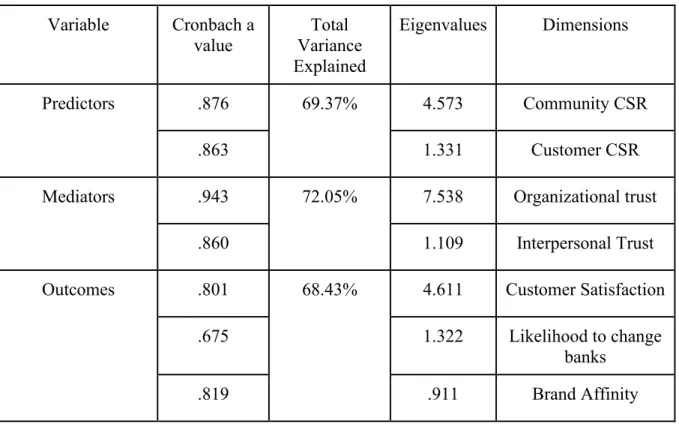
A summary of the results is shown in table 2 below and the full analysis in Appendices I, II and III.
Table 2. Summary of the tests on the variables Variable Cronbach a value Total Variance Explained Eigenvalues Dimensions Predictors .876 69.37% 4.573 Community CSR .863 1.331 Customer CSR
Mediators .943 72.05% 7.538 Organizational trust
.860 1.109 Interpersonal Trust
Outcomes .801 68.43% 4.611 Customer Satisfaction
.675 1.322 Likelihood to change
banks
.819 .911 Brand Affinity
For the predictors, both factors have an Eigenvalue greater than 1 (4.573 for Community Oriented CSR and 1.331 for Customer Oriented CSR) and all items had factor loadings superior to 0.5. The cumulative explained variance is 69.37%.
For the mediators, both factors have an Eigenvalue greater than 1 (7.538 for Organizational Trust and 1.109 for Interpersonal Trust) and all items had factor loadings superior to 0.5. The cumulative explained variance is 72.05%.
Finally, for the outcome variables, two factors have an Eigenvalue greater than 1 (1.322 for Likelihood to change banks and 4.611 for Customer Satisfaction) and Brand Affinity had a value of .911, a value close enough that’s why the factor was retained. All items had factor loadings superior to 0.5. The cumulative explained variance is 68.43%
Results
A descriptive Analysis of the model variables was done to assess the perception of our sample toward them. The analysis will show the areas that need to be improved and the importance of certain elements in the Bank-Customer relationship.
In order to test the associations between the different variables of our model as well as the control variables, a correlation test was undertaken on all of them. Some control variables were recoded into metric variables in order to fit into the test. The results of the descriptive Analysis and the correlation are shown in Table 3 below, and a more extensive correlation matrix with the control variables can be found in appendix IV.
TABLE 3. Descriptive Analysis and Correlation matrix Variable Mean SD N Com
CSR Cus CSR Org Trust Int Trust Bd Aff L.C.B C.S Com CSR 3.29 1.495 131 - .590** .425** .382** .294** -.128 .428** Cus CSR 4.56 1.295 131 .590** - .756** .600** .560** -.321** .660** Org Trust 4.94 1.161 131 .425** .756** - .713** .647** -.289** .628** Int Trust 5.04 1.119 131 .382** .600** .713** - .550** -.255** .628** Bd Affinity 4.87 1.411 131 .294** .560** .647** .550** - -.439** .677** L.C.B 4.39 1.309 131 -.128 -.321** -.289** -.255** -.439** - -.410** C.S 5.19 1.109 131 .428** .660** .656** .628** .677** -.410** -
The descriptive analysis showed that our sample didn’t perceive that their banks was doing enough Community Oriented CSR ( M=3.29, SD=1.495), however, they perceived that Customer Oriented CSR effort is slightly above the midpoint of the scale (M= 4.56, SD= 1.295). The analysis also showed that bank customers highly trust both their Banks as Organizations (M=4.94, SD=1.161) and the Bank representative (M=5.04, SD= 1.119). The sample also showed that they develop a high Brand Affinity towards their respective banks
(M=4.87, SD=1.411) and that they are highly satisfied (M=5.19, SD=1.109). However, despite that, they are very interested to change banks and try new providers (M=4.39, SD=1.309).
Results of the Pearson correlation indicated that there was a significant association between
all of our model variables (P<0.01). The only exception was Community Oriented CSR
perception and Likelihood to change banks.
Model Testing:
Model testing was performed using Path Analysis (Austin & Maccallum, 2000) in RStudio (RStudio Team, 2016) with the package Lavaan (Rosseel, 2012). Criteria for the analysis is the assessment of the statistical quality of the models resulting for the CFA using overall goodness of fit measures with the following guidelines (Brown, 2006): RMSEA lower or equal to 0.08, Comparative Fit Index (CFI) and Tucker-Lewis Index (TLI) higher or equal to 0.90.
The proposed model, with all 2 predictors, 3 outcomes and 2 mediators, was initially tested (identified as Model 1). The results in Table 4 show that Model 1 as a good fit except with the RMSEA value that is above the suggested criteria. The mediation effects were interpreted considering the statistical significance of the standardised paths: the standardised paths are partial correlation coefficients varying between -1 and 1, and the used guidelines for interpretation of the magnitude of the effects are taken from a previous research set
(Hemphill. 2003). The mediation effect was studied with effect of the two mediators, on the impact of the two predictors on the 3 outcomes.
The results of the Model 1 tested show that there is a mediated effect of Customer CSR on all three Brand Affinity, Likelihood to Change and Customer Satisfaction. The mediated effect occurs via both the Organizational Trust and the Interpersonal Trust for Brand Affinity and Customer Satisfaction but is stronger via Organizational Trust. The mediated effect occurs only via Organizational Trust for Likelihood to Change. There are no mediated effects of
Three alternative models were considered and chosen due to their small contribution (betas) in the proposed model. Model 2 is the same as model 1 without Community Oriented CSR because it is the weak predictor in Model 1. Model 3 is the same as Model 1 without Interpersonal Trust as it was the weakest moderator in the analysis. Finally, Model 4 is the same as Model 1 but without both Community Oriented CSR and Interpersonal Trust. The results of the analysis are shown in Table 4 Below. The alternative simpler models perform poorer or very closer to the proposed model.
Table 4: Goodness of fit of the models 1,2,3 and 4
Model Chi-Square P value RMSEA TLI CFI AIC BIC
Model 1 (20.000) 442.437 <0.00 0.118 0.974 0.914 1723.157 1777.785 Model 2 (15000) 438.571 <0.00 0.167 0.871 0.974 1720.031 1768.909 Model 3 (14000) 335.872 <0.00 0.131 0.902 0.958 1417.92 1452.422 Model 4 (10000) 332.301 <0.00 0.182 0.865 0.959 1416.121 1447.748
Figure 7. Proposed Model Paths (Model 1) Table 5. significance of the mediation effect of Trust
Predictor Mediator Outcome est.st
d SE Z P.Value Ci.Lower Ci.Upper Community CSR Organizational
trust Affinity Brand -.016 .037 -.450 .655 -.089 .056 Customer CSR Organizational
trust Affinity Brand .402 .073 5.49 .000 .259 .546 Community CSR Interpersonal
Trust Affinity Brand .008 .016 .470 .635 -.024 .038 Customer CSR Interpersonal
Trust Affinity Brand .103 .055 1.860 .062 -.005 .211 Community CSR Organizational
trust Change Banks .007 .016 .440 .663 -.024 .038 Customer CSR Organizational
trust Change Banks -.169 .092 -1.84 .066 -.349 .011 Community CSR Interpersonal
Trust Change Banks .008 .010 -.420 .673 -.024 .015 Customer CSR Interpersonal
Trust Change Banks -.057 .069 -.830 .406 -.192 .078 Community CSR Organizational trust Satisfaction -.013 .030 -.450 .655 -.072 .045 Customer CSR Organizational trust Satisfaction .328 .070 4.65 .000 .190 .466 Community CSR Interpersonal Trust Satisfaction .014 .028 .480 .627 -.042 .070 Customer CSR Interpersonal Trust Satisfaction .188 .056 3.35 .001 .078 .298
Discussion
Perception of customers towards their banks
The perception of the sample towards their banks was different from the literature. The results showed that generally customers are satisfied with their banks despite the report of Capgemini (2018) stating otherwise. Also, people highly trust both their bank and the bank’s
representative which was not the conclusion of both Hurley et al (2014) and Järvinen (2014). This may be explained by the fact that both articles justify the decline of trust due to the global crisis of 2008/2009, which was just 5 years before the release of both papers. Thus, with time, people may have started to forget what happened 10 years ago. Another possible explanation is that people perceive that they are highly dependent on their banks, and the results of the Pearson Correlation showed that the Perceived Level of Dependency highly correlates with all the variables in the study including trust. but no concrete conclusion drawn without further research. This can also explain why the perception of customer-oriented CSR was high, as the sample considered that the bank cared about their interest and treated them fairly.
However, the perception of the philanthropic efforts of the banks are very low, being aligned with the findings of Gillespie and Hurley (2013), as they concluded that people still think that banks do not operate for the benefit of society as a whole. Another finding that was aligned with the literature (Capgemini Voice of Customer Survey, 2018), is that despite all the efforts made by banks, bank customers are highly volatile and are likely to change banks if they find better offering despite their high brand affinity towards their current financial service
provider.
The results of the research were consistent across almost all demographic factors, with almost none of the control variables correlating with the test variables, which shows the homogeneity of the markets across all levels in the banking industry.
Importance of CSR in the banking system
The banking sector was no exception to the majority of academic papers on CSR, where it was concluded that being perceived as socially responsible has a lot of positive impact on the firm’s performance (e.g. Bhattacharya & Sen, 2004; Brandt, 1998). Almost all hypotheses built on that in this thesis were true (See table 6 below). Both dimensions of CSR (Customer Oriented and Community Oriented) were highly correlated with all the outcomes. So, for our sample, we can say that undertaking CSR initiatives matters for banks as it increases
brand affinity, customer satisfaction and reduce their likelihood to switch for other banks.
This finding is important for the banking sector, because as shown in the literature, the sector is suffering from some major issues in the last decade, and both acquiring customers, but also keeping them is a focus for banks. Because of the wide variety of alternatives nowadays, compared to a few decades before, banks are becoming less of an obligation and more of a choice for both consumers and businesses. The only exception found in the results is
Community Oriented CSR. While undertaking this type of CSR is positively correlated with Brand Affinity and Customer Satisfaction, it does not reduce the likelihood to change banks. It can be explained by the fact that while perceiving your bank as a philanthropic actor will improve your attitude towards it, it doesn’t really hold you from switching to other better alternatives as it doesn't really affect your personal experience with the service.
One other important aspect is that CSR is highly and positively correlated with both Organizational Trust and Interpersonal Trust. Trust is one of the most important factors because banking is filled with uncertainty (Decker & Sale, 2009). That was clear in the World Retail Banking report of 2018 when Trust was the second most important factor in the mind of consumers for both choosing and staying with the bank, which makes CSR an important tool for Banks to build a strong and sustainable relationship with their customers. This was also highlighted in this research as Trust and the different outcome marketing indicators were correlated. This correlation means that customers that trust banks and its representatives had higher brand affinity and customer satisfaction, and were less likely to change banks.
Table 6. Hypothesis Testing of the Impact of Consumer Perception of CSR on different Marketing Performance indicators
Hypothesis r P value result
Community CSR → Brand Affinity .294 <0.01 Confirmed Community CSR →Customer Satisfaction .428 <0.01 Confirmed Community CSR → Likelihood to change -.128 >0.05 Rejected
Customer CSR → Brand Affinity .560 <0.01 Confirmed Customer CSR → Customer Satisfaction .660 <0.01 Confirmed Customer CSR → Likelihood to change -.321 <0.01 Confirmed
The Primacy of trust in CSR initiatives
As mentioned before, CSR is important to improve a company’s marketing indicators, Trust is an important factor for the bank-customer relationship and the Perception of CSR improves trust level.
However, another objective of this research is to know whether or not trust is a mediator of the CSR impact on marketing indicators as many papers study the effects of CSR initiatives but few look for the processes underlying these initiatives (Agunis & Glavas, 2012). While all the variables of the model were correlated (except one), it did not fully explain the
relationship. One out of the 4 hypotheses built for mediation was true, and one was partially accepted while the other two were rejected (See table 7 below). Trust on both the
Organizational and interpersonal levels mediated to certain degree the impact of Customer Oriented CSR on Marketing Indicators. While the direct path of Customer CSR and
marketing indicators were already significant, going through Trust as a mediator improved the results even more. This shows that trust is indeed one of the factors that make Customer
Oriented CSR have an impact on the banks’ marketing performance. The results give
some explanations to the causes of the impact of CSR on banks performance.
However, even though Community Oriented CSR was significantly correlated with Brand Affinity Customer Satisfaction and Trust, the later did not mediate that relationship. Thus,
the process underlying the impact of Community Oriented CSR on the outcomes in this study are not known.
Despite that, we can conclude that indeed, Trust is an important factor for making CSR
relevant for banks and explains partially why Banks that undertake CSR initiatives have better marketing performance indicators.
Table 7. Hypothesis Testing of the mediation effect of Trust
Hypothesis est.std P
value result Community CSR → Organizational Trust → Outcomes -.016
.007 .030 .655 .663 .655 Rejected
Community CSR → interpersonal Trust → Outcomes .008 .008 .014 .635 .637 .627 Rejected
Customer CSR → Organizational Trust → Outcomes .402 -.169 .328 .000 .066 .000 Confirmed
Customer CSR → Interpersonal Trust → Outcomes .103 -.057 .188 .062 .406 0.01 Partially Confirmed
Conclusions
Key Findings
The research aimed to study the impact of the perception of Corporate Social Responsibility initiatives on various marketing performance indicators in the banking sector while addressing several knowledge gaps in the literature. It adapted previous recommendations by studying CSR on the individual level, and looking for a mediation effect, in this case, Trust.
Based on a quantitative analysis of the survey's results, many conclusions were drawn. The findings can be applied for both future research and managerial recommendations.
The first one is the general perceptions of customers towards their banks. While they don’t perceive their banks doing enough philanthropy, they do see that their banks are engaging in customer-oriented CSR. Also, customers trust both their banks and its representatives, and have high brand affinity and customer satisfaction. However, they are likely to change financial service providers if they find better opportunities or have a bad experience. Another point worth mentioning is that almost none of the results above change depending on both the demographic factors of the respondents, nor their financial activities and habits.
The second one is that, the more a customer feels dependent on a bank, the more he/she trusts it and its representative, has brand affinity, is satisfied, and perceives that the bank is
engaging in Customer Oriented CSR. So, the level of dependency highly affects the customer's perception of his/her bank.
The third finding is that both Customer Oriented CSR and Community Oriented CSR have a high positive impact on Customer Satisfaction and Brand Affinity, as well as they make customers trust their banks and its representatives. The perception of Customer Oriented CSR initiatives also makes customers less likely to change banks.
The fourth finding is that both Organizational Trust and Interpersonal Trust have a high positive impact on Brand Affinity and Customer Satisfaction. Also, customers who trust their banks and its representatives are less likely to switch providers.
The final Finding is that Trust is mediating the impact of Customer Oriented CSR on Banks marketing performances. Thus, it partially explains the process underlying the impact of CSR. However, no mediation effect was found for Trust as a mediator for the impact of Community Oriented CSR (Philanthropy) on the outcome variables.
Managerial Implications
Based on these findings, practitioners should consider several points:
The first one is that banks current efforts are not enough for keeping their customers. While customers are overall satisfied, they’ll also likely to change providers. However, the results showed that undertaking Customer Oriented CSR will reduce their likelihood to change, but also impact positively their satisfaction and brand affinity even more. So, banks should focus more on the personal side of the relationship rather than focusing on features or front-end digitalization. Their position as incumbent and their resources, especially the physical presence throughout the branches and the high number of employees, give them the possibility to undertake that and differentiate themselves from digital banks and BigTech Firms, who are more focused on digital.
The second point is that customers don’t perceive their banks doing enough Community Oriented CSR initiatives. Engaging in Philanthropic activities and communicating about it showed in this research that it will positively impact customer satisfaction and brand affinity towards their banks.
The third point is the importance of Trust. Its impact is huge on the different outcome indicators and as shown in the literature, it's one of the most important factors for consumers when choosing and staying with a bank. So, banks should find ways to increase Trust in their relationship with customers. This study showed that both Community Oriented and Customer Oriented CSR positively impact Trust perception, so engaging in CSR initiatives should be one of the ways.
The final point is the customers who feel more dependent on banks, are more satisfied, have higher brand affinity and are less likely to switch banks. They also trust their financial service providers and its representatives more. Thus, banks should make its customers more
dependent on them by engaging in a more personalized relationship with the clients.
Limitations
This study used a quantitative approach to address the research objectives. By doing so, some points should be kept in mind.
The sample studied was a very diversified one, and even though almost no correlations were found between the countries of residence and the outcome variables, the results could be different from one region to another. Thus, generalization of the study may not give accurate or desired results. Another point related to the sample is the age group. The Mean age of the sample was 24 years. This means that the majority of the respondents were from the younger generations, which means that results may not reflect the perception of the older ones. So, generalization of the study to all age groups can be misleading, even though no correlations between age and perceptions were found.
Another point is that, while the results show that undertaking CSR initiatives will improve different marketing indicators, we cannot draw a definitive causality path. The results could be imperfect due to the fact that people have different levels of importance regarding CSR and this could have impacted the study.
Finally, only one mediator was studied in this research. This can help understand the causes on the impact of CSR on customers perceptions, but not give a fully clear image of it.
Future Research Recommendations
Focusing on mediating effects can help researchers understand the causes of the importance of CSR, so undertaking mediation studying with multiple mediators is important.
To get more accurate results, segmenting the sample following their perceived level of importance to CSR is recommended. Further research on the Perceived Trust level will highlight the importance of that factor.
Other dimensions of CSR need to be studied as well as they may have an impact of the different Performance indicators of the Banking Sector.
Finally, adapting this research on local population will help banks know if the results are accurate enough to adapt the recommendations in their local markets.
References
Aguilera, R. (2011). Increasing Corporate Social Responsibility Through Stakeholder Value Internalization (and the Catalysing Effect of New Governance): An Application of
Organizational Justice, Self-Determination, and Social Influence Theories. In M. Schminke (Ed.), Managerial Ethics Managing the Psychology of Morality (p. 1). Canada:
Routledge/Psychology Press.
Aguinis, H., & Glavas, A. (2012). What We Know and Don’t Know About Corporate Social Responsibility. Journal of Management, 38(4), 932–968.
https://doi.org/10.1177/0149206311436079
Anneli Järvinen, R. (2014). Consumer trust in banking relationships in Europe. International Journal of Bank Marketing, 32(6), 551–566. https://doi.org/10.1108/ijbm-08-2013-0086 Arnold, M. (2015, September 29). McKinsey warns banks face wipeout in some financial services. Retrieved January 5, 2020, from https://www.ft.com/content/a5cafe92-66bf-11e5-97d0-1456a776a4f5
Beck, T. (2006) Creating an Efficient Financial System: Challenges in a Global Economy, WorldBank Policy Research paper WPS 3856.
Bhattacharya, C. B., & Sen, S. (2004). Doing Better at Doing Good: WHEN, WHY, AND HOW CONSUMERS RESPOND TO CORPORATE SOCIAL INITIATIVES. California Management Review, 47(1).
Blattberg, R., & Neslin, S. (in press). SALES PROMOTIONS. OXFORD HANDBOOK OF PRICING MANAGEMENT.
Brandt, M. (1998). Don't dis your brand. MC Technology Marketing Intelligence, 18(1), 46-47.
Brown, T. A. (2006). Confirmatory Factor Analysis for Applied Research. Guilford Press. Retrieved from http://books.google.pt/books?id=KZwDkH2G2PMC
Cambridge Centre for Alternative Finance. (2018). 5th UK Alternative Finance Industry Report. Retrieved from England, UK
Capgemini & Efma. (2019). World Retail banking report 2018. Retrieved from https://worldretailbankingreport.com/
Carroll, A. (1991). The Pyramid of Corporate Social Responsibiiity: Toward the Morai Management of Organizational Stakeholders. Business Horizons.
CBS. (n.d.). The Complete List of Unicorn Countries. Retrieved January 5, 2020, from https://www.cbinsights.com/research-unicorn-companies
Chang, H. H., & Liu, Y. M. (2009). The impact of brand equity on brand preference and purchase intentions in the service industries. The Service Industries Journal, 29(12), 1687– 1706. https://doi.org/10.1080/02642060902793557
Decker, S., & Sale, C. (2009). An Analysis of Corporate Social Responsibility, Trust and Reputation in the Banking Profession. Professionals’ Perspectives of Corporate Social Responsibility, 135–156. https://doi.org/10.1007/978-3-642-02630-0_8
DiMaggio, P. J., & Powell, W. W. (1983). The Iron Cage Revisited: Institutional
Isomorphism and Collective Rationality in Organizational Fields. American Sociological Review, 48(2), 147. https://doi.org/10.2307/2095101
Dodd, M. (1932). For Whom Are Corporate Managers Trustees? Harvard Law Review, 45(7), 1145–1163.
Fombrun, C., & Shanley, M. (1990). What’s in a Name? Reputation Building and Corporate Strategy. Academy of Management Journal, 33(2), 233–258. https://doi.org/10.5465/256324
Forbes, “How Tencent Is Using Closed-Loop Data To Drive Better Insight And Engagement,” Kimberly A. Whitler, January 9, 2018
https://www.forbes.com/sites/kimberlywhitler/2018/01/09/how-tencent-is-using-closed-loop-data-to-drive-better-insight-and- engagement/#1a3bc7211f0d)
Fournier, S. (1998). Consumers and Their Brands: Developing Relationship Theory in Consumer Research. Journal of Consumer Research, 24(4), 343–353.
https://doi.org/10.1086/209515
Friedman, M. (1962). capitalism and freedom (1st ed.). United States: University of Chicago Press.
Frynas, J. G., & Yamahaki, C. (2016). Corporate social responsibility: review and roadmap of theoretical perspectives. Business Ethics: A European Review, 25(3), 258–285.
Ganesan, S., & Hess, R. (1997). Dimensions and Levels of Trust: Implications for Commitment to a Relationship. Marketing Letters, 8(4), 439–448.
https://doi.org/10.1023/a:1007955514781
Giannarakis, G & Theotokas, I. (2011). “The Effect of Financial Crisis in Corporate Social Responsibility Performance”, International Journal of Marketing Studies, Vol. 3, No. 1; February 2011.
Gillespie, N., & Hurley, R. (2013). Trust and the global financial crisis. In R. Bachmann & A. Zaheer (Eds.), Handbook of Advances in Trust Research (pp. 177–197). Cheltenham, United Kingdom: Edward Elgar Publishing.
Hemphill, J. F. (2003). Interpreting the magnitudes of correlation coefficients. The American Psychologist, 58(1), 78<96>79. https://doi.org/10.1037/0003-066X.58.1.78
Henson, R. K., & Roberts, J. K. (2006). Use of Exploratory Factor Analysis in Published Research: Common Errors and Some Comment on Improved Practice. Educational and Pschological Measurement, 66(3), 11–14. https://doi.org/10.1177/0013164405282485
Hurley, R., Gong, X., & Waqar, A. (2014). Understanding the loss of trust in large banks. International Journal of Bank Marketing, 32(5), 348–366. https://doi.org/10.1108/ijbm-01-2014-0003
Jawahar, I. M., & Mclaughlin, G. L. (2001). Toward a Descriptive Stakeholder Theory: an Organizational Life Cycle Approach. Academy of Management Review, 26(3), 397–414. https://doi.org/10.5465/amr.2001.4845803
Johnsson, J., & Trenck, C. (2018). The link to lending: Blockchain Selecting what type of blockchain to deploy for a cooperative lending platform (2018:079). Retrieved from https://gupea.ub.gu.se/bitstream/2077/57019/1/gupea_2077_57019_1.pdf
Kotler, P., G., Armstrong, J. S., & Wing, V. (1999). Principals of Marketing (2nd European ed.). New York: Prentice Hall.
Kumar, N., Scheer, L. K., & Steenkamp, J.-B. E. M. (1995). The Effects of Perceived Interdependence on Dealer Attitudes. Journal of Marketing Research, 32(3), 348. https://doi.org/10.2307/3151986
Levine, R. (2005). Chapter 12 Finance and Growth: Theory and Evidence. Handbook of Economic Growth, 865–934. https://doi.org/10.1016/s1574-0684(05)01012-9
Lichtenstein, D. R., Drumwright, M. E., & Braig, B. M. (2004). The Effect of Corporate Social Responsibility on Customer Donations to Corporate-Supported Nonprofits. Journal of Marketing, 68(4), 16–32. https://doi.org/10.1509/jmkg.68.4.16.42726
Lipton, A., Shrier, D., & Pentland, A. (2016). Digital Banking Manifesto: The End of Banks? MIT Connection Science. Retrieved from
http://ftp.shujuju.cn/platform/file/2018-01-09/4ccfbef11b284e2e953c4c5dc651bd22.pdf
Maccallum, R. C., & Austin, J. T. (2000). Applicatiosn of structural equation modeling in psychological research. Annual Review of Psychology, 51, 201–226.
Merton, R. C. (1995). A Functional Perspective of Financial Intermediation. Financial Management, 24(2), 23. https://doi.org/10.2307/3665532
Mihelis, G., Grigoroudis, E., Siskos, Y., Politis, Y., & Malandrakis, Y. (2001). Customer satisfaction measurement in the private bank sector. European Journal of Operational Research, 130(2), 347–360. https://doi.org/10.1016/s0377-2217(00)00036-9
Mitchell, R. K., Agle, B. R., & Wood, D. J. (1997). Toward a Theory of Stakeholder
Identification and Salience: Defining the Principle of who and What Really Counts. Academy of Management Review, 22(4), 853–886. https://doi.org/10.5465/amr.1997.9711022105