Un
learn
ing
w
i
th
in
Acce
lera
tors
:
How
and
wha
t
nascen
t
ven
tures
un
learn
and
why
Jasm
in
S
te
inhard
t
D
isser
ta
t
ion
wr
i
t
ten
under
the
superv
is
ion
of
Professor
C
láud
ia
Cos
ta
D
isser
ta
t
ion
subm
i
t
ted
in
par
t
ia
l
fu
lf
i
lmen
t
of
requ
iremen
ts
for
the
MSc
in
Managemen
t
w
i
th
Spec
ia
l
iza
t
ion
in
S
tra
tegy
and
En
trepreneursh
ip
,
a
t
the
Abstract
O estudo investiga startups que participaram em programas de aceleração e olha para fatores que afetam o sucesso da startup. Especificamente, este trabalho apurou que a desaprendizagem que ocorre dentro das aceleradoras é crucial para a aprendizagem do empreendedor. Os resultados negativos de empreendedores anteriores não mostraram um impacto significativo na desaprendizagem.
Além disso, analisou que o empreendimento pode aumentar sua tecnologia, mercado e especificamente no conhecimento empresarial. A tecnologia e o conhecimento empresarial foram identificados para melhorar os resultados dos empreendimentos de forma notável. Por isso, foram estabelecidas duas amostras investigadas dentro de um estudo empírico qualitativo e um quantitativo que derivam da aceleradora Building Global Innovators e de diversos aceleradores de startups da Websummit.
The study investigates startups that participated in acceleration programs and looks at factors that affect the startup success. Specifically, this work investigated that unlearning takes place within accelerators and it is crucial for the entrepreneur’s learning. Negative prior venture outcomes did not show to significantly impact unlearning. Moreover, it analysed that the venture can increase its technology, market and specifically in business knowledge. Technology and Business knowledge was identified to improve outcomes of ventures in a remarkable way. For this sake, two samples investigated within a qualitative and within a quantitative empirical study were established who stem from the Building Global Innovators accelerator and diverse accelerators from startups from the Websummit.
Keywords: Accelerator, unlearning, learning, technology knowledge, business knowledge, market knowledge, outcomes
Acknowledgements
I would like to thank Pofessor Cláudia Costa for helping with diverse aspects of this work. Also I want to thank the other students of the seminar “The entrepreneurial opportunity”. Moreover, a great thank you to all the correction readers, Julia Kruslin, Nanxi Wang and Marco Steinhardt. Of course I also want to thank my parents for supporting me throughout this work and my whole Master’s degree. Furthermore, I would like to thank BGI for connecting with their alumni startups, the BGI startups themselves and as well all the ventures from the Websummit for contributing to my research.
ABSTRACT ... 2 ACKNOWLEDGEMENTS ... 3 TABLE OF CONTENTS ... 4 FIGURES INDEX ... 6 TABLES INDEX ... 6 1. INTRODUCTION ... 1 2. LITERATURE REVIEW ... 3 2.1ENTREPRENEURIAL LEARNING ... 3
Definition of Entrepreneurial Learning ... 3
Definition of Higher Order Learning ... 4
Entrepreneurial preparedness ... 5
2.2UNLEARNING ... 5
Definition of Unlearning ... 5
Triggers of Unlearning ... 6
Outcomes for firms from unlearning ... 7
2.3ACCELERATORS ... 7
Definition of Accelerators ... 7
Unlearning facilitators within Accelerators ... 8
The Unlearning Content ... 9
Outcomes for firms from unlearning within accelerators ... 9
3. EMPIRICAL STUDY ... 11 3.1METHODOLOGY ... 11 Qualitative study ... 12 Quantitative study ... 12 3.2SAMPLES ... 12 Exploratory interviews ... 12 Questionnaire ... 13
3.3METHOD AND MEASURES ... 13
Interview and questionnaire ... 13
4. RESULTS ANALYSIS ... 16
4.1.FINDINGS QUALITATIVE STUDY ... 16
Outcomes of Prior ventures influencing Unlearning ... 17
Unlearning influencing Amount learned ... 17
Unlearning influencing Knowledge types ... 18
Knowledge types influencing Business outcomes ... 18
4.2FINDINGS QUANTITATIVE STUDY ... 18
4.3DISCUSSION ... 28
Factors influencing unlearning ... 28
Unlearning influencing amount learned ... 29
Unlearning influencing knowledge types ... 29
Knowledge types influencing Business Outcomes ... 30
5 CONCLUSION AND IMPLICATIONS... 30
5.1IMPLICATIONS FOR RESEARCH ... 31
5.2IMPLICATIONS FOR PRACTICE ... 31
5.3LIMITATIONS... 32
5.4FUTURE RESEARCH ... 33
REFERENCE LIST ... 33
APPENDIX ... 43
FIGURE 1 SIMPLIFIED UNLEARNING PROCESS WITHIN ACCELERATORS ... 11
FIGURE 2 DISTRIBUTION OF PRODUCT STAGES ... 18
FIGURE 3 INDUSTRIES, FROM HTTP://WWW.WORTWOLKEN.COM/ ... 19
FIGURE 4 ACCELERATOR FEATURES ... 19
FIGURE 5 SUCCESS AFTER TWO YEARS ... 21
Tables index TABLE 1 DESCRIPTIVES ENTREPRENEURIAL PREPAREDNESS ... 19
TABLE 2 DESCRIPTIVES OUTCOME VARIABLES ... 20
TABLE 3 DESCRIPTIVES UNLEARNING ... 22
TABLE 4 DESCRIPTIVES KNOWLEDGE TYPES ... 23
Startups have increased in the past years and so have startup accelerators. Indeed, at the end of 2016 there are aggregated 187 programs worldwide who accelerated roughly 6495 companies, led to 869 exits for found $ 5 billion and got funding for round $ 22 billion (Christiansen, 2016; Mian, Lamine and Fayolle, 2016; Regmi, Ahmed, and Quinn, 2015). An accelerator by definition is an institution helping newly created businesses by providing education and mentorship in cohorts of founders for a limited period (Cohen and Hochberg, 2014) and is addressing the life support of ventures (Mian et al., 2016). The rise in accelerators might be because the startup failure rate is still high (Laitinen, 1992; Shepherd et al. 2000). Reasons for these failures can be for example inadequate funding or no efficient marketing (Storey, 1994). Because of that, businesses used to rely on support programs like Venture Capital firms (investors funding startups when they emerged from early stages of the venture (Dempwolf, Auer, and D’Ippolito, 2014)), Angel investors (individual investors providing seed capital and varying amount of advice for young ventures (Cohen, 2013)), Bootstrapping (funding from own sources, relatives and friends (Salamzadeh and Kawamorita, 2015)) or incubators (co-working spaces sharing resources and ad hoc mentorship at best in exchange for fees Cohen and Hochberg, 2014)). Since 2005 a new business model emerged to increases the performance of emerging businesses, the so-called accelerators (Hellen, Bingham, and Cohen, 2016).
Ventures that come to an accelerator often have derived some fundamental assumptions for their businesses and normally designed a business plan which defines the strategy of their future growth. They create a mental framework of how the environment is working to have a common language and an understanding of the environmental task as well as a means to interpret events (Hellen, et al., 2016; Hill and Levenhagen, 1995; Morgan and Berthon, 2008; Salamzadeh and Kawamorita Kesim, 2015; Tsang and Zahra, 2008). When joining the accelerator programs though, ventures often find out, that their information was wrong or that their assumptions were unrealistic because they have lacked knowledge, or did not assess the market properly to proof validity of their startup (Hellen, et al, 2016; Morgan and Berthon, 2008; Salamzadeh and Kawamorita Kesim, 2015; Van Weele and Van Rijnsoever, 2015). So, they might need to engage in the process of unlearning while talking to others and gaining support (Hill and Levenhagen, 1995; Van Weele and Van Rijnsoever, 2015), to get the most out of their venture while participating in an accelerator program (Sweet, 2012). Despite this reasoning for accelerators, the study of Hellen et al. (2016) reveals that not all accelerators are effective yet and entrepreneurs should investigate with caution before
considering a participation. This ambiguity of the contribution of accelerators to startups together with a lack of extensive research makes clear that accelerators still need to be investigated in more detail (Cohen and Hochberg, 2014; Regmi, et al., 2015). Programs are very heterogeneous in objectives and outcomes and there is not much research about which ones are more effective and why (Cohen and Hochberg, 2014). Research on accelerators has not focused either on the unlearning process and contents of accelerators clearly yet. Research until now is mostly descriptive and sometimes the institution is confused with different incubation models (e.g. incubators) and generally focuses around the role and efficacy of the programs (Cohen and Hochberg, 2014; Hochberg, 2015; Mian et al., 2016). Unlearning literature mostly concerns around how organizations can change their existing organizational patterns to leverage their performance (Tsang and Zahra, 2008). Within this literature it is argued that unlearning leverages business innovation and business performance (Morgan and Berthon, 2008; Sherwood, 2000, Sweet, 2012). Nevertheless, unlearning has not been researched extensively despite being a valuable entrepreneurial learning concept (Akgün, Lynn and Reilly, 2002; Cope, 2005;Lane, White and Djurfeldt, 1995; Tsang and Zahra, 2008). Also, it is not clear if unlearning is a precondition for learning (Nystrom and Starbuck, 2015; Tsang and Zahra, 2008). Wang et al. (2014), who elaborated on entrepreneurial learning, highlighted that the future research question should understand, how and what entrepreneurs unlearn, since it contributes to opportunity exploration and exploitation of startups. Literature applying learning theories within accelerators is furthermore hard to find and startups are researched specifically sparsely within organizational learning (Franco and Haase 2009; Wang et al., 2014).
Since accelerators are not overall facilitating the venture progress (Hellen et al., 2016) it seems like there is still room for improvement. Research also still is not elaborated around the field of accelerators (Dempwolf, Auer and D’Ippolito). The unlearning process and content of entrepreneurs especially within accelerators is not given enough attention to so far either (Akgün, Lynn and Reilly, 2002; Lane, White and Djurfeldt, 1995). It would nevertheless be interesting for members of entrepreneurial ventures to know how they need to adopt within accelerator programs in order to fully take advantage of the support offered. Also, studies prove that this unlearning behavior leads to better firm performance (Morgan and Berthon, 2008; Baker and Sinkular, 1999; Cope, 2011), what speaks for a high relevance for startups. The nascent ventures might further leverage principles of how best to unlearn during their venture development process, because this involves redesigning the minimum viable product according to market needs (Parker, 2006). Therefore, the questions arise,
How and what do entrepreneurial firms unlearn within Accelerator programs and what are the outcomes?
How do entrepreneurs or entrepreneurial firms learn and unlearn? Do ventures unlearn within accelerators?
Are previous venture failures critical triggers for unlearning?
Which characteristics do accelerators have and why do startups participate within those? How does the unlearning process look like for a startup within an accelerator?
What knowledge is likely to be unlearned during the accelerator process? Did unlearning contribute to learning and outcomes?
To analyze these issues, the following work will proceed with a literature review, investigating entrepreneurial learning and unlearning as well as accelerators. In the next section, a qualitative and quantitative study will be provided analyzing the unlearning behavior of startups participating in an accelerator. Afterwards, results are being analyzed, and limitations and a conclusions will be drawn.
2. Literature Review
2.1 Entrepreneurial Learning
Definition of Entrepreneurial Learning
Since the importance of entrepreneurship is rising, so is entrepreneurial opportunity exploration and exploitation and therefore also entrepreneurial learning (EL) to successfully develop ventures (Regmi, et al., 2015; Wang et al., 2014). Through learning entrepreneurs are able to develop and grow their businesses and eventually become successful business owners (Rae and Carswell, 2000). EL leads to increased opportunity recognition, in that entrepreneurs will have more relevant information to identify opportunities and will better develop cognitive abilities to value it (Shane and Venkataraman, 2000). Also, EL leverages the effectiveness of coping with liabilities of newness like access to financial facilities, social networks and legitimacy (Politis, 2005).
“‘learning that ‘informs the entrepreneur’s quest for new opportunity’ (Franco and Haase 2009, p. 634) or ‘how entrepreneurs accumulate and update knowledge’ (Minniti and Bygrave 2001, p. 8) (Wang and Chugh, p. 30, 2014).
According to Wang et al. (2014) the key learning types, corresponding to three key challenges in EL research, belongs exploratory and exploitative learning. Exploratory learning is focused on information seeking and the discovery of new knowledge through enactment and interpretation (Wang et al., 2014). It relies on “’search, variation, risk taking, experimentation, play, flexibility, [and] discovery’” (March, 1991, p.71). Exploitative learning often builds upon leveraging existing knowledge and means “’refinement, choice, production, efficiency, selection, implementation [and] execution; March, 1991, p.71, Wang et al., 2014).
Definition of Higher Order Learning
Human knowledge can be described as assumptions, generalizations, pictures and images that serve as basis for our understanding of the world and how we interact in it (Senge, 1990) or as a context for understanding and relating new material (Kim, 1993). If a company needs to reorient human capital, they need to combine existing capabilities with newly acquired knowledge and to unlearn non-relevant knowledge (Holan and Philips, 2004). The systems perspective of Senge (1990) claims that concepts of learning and unlearning rely on notions of how people use information flows and feedback in organizations (mental frameworks) to build and understanding of the world’s existence and its mechanisms.
Within previous research most studies refer with organizational learning to the acquisition of new knowledge, as opposed to higher order learning (HOL), where previous knowledge is present (Nystrom and Starbuck, 2015; Tsang and Zahra, 2008). It is emphasized by Tsang and Zahra (2008) that the importance of the interplay of individual and organizational unlearning. The authors state that unlearning at the individual level is a precondition for organizational unlearning.
Wang et al. (2014) highlighted that the future research question should understand, how and what entrepreneurs unlearn. HOL could be assigned to the exploratory learning form (Morgan and Berthon, 2008). It can either happen adaptive (cumulative learning from experiences) or proactive (learning to be sensitized to prevent future critical events) (Cope, 2001). Organizations need to engage in HOL when existing frames of reference are not able to reflect the needs of the environment anymore (Cope 2003; Fiol and Lyles 1985). Authors
claim that HOL is contributing to unlearning (Hedberg 1981; Zahra, Abdelgawad, and Tsang 2011; Wang et al., 2014). It might be important in the entrepreneurial learning process, since entrepreneurs are surrounded by a highly uncertain environment in which unlearning is being an integrative precondition for it (Nystrom and Starbuck, 2015; Wang et al., 2014).
Entrepreneurial preparedness
According to Reuber and Fischer (1999) every prospective entrepreneur has a certain preparedness when entering a startup. Each individual has inherent certain personal attributes and has learnt along personal life cycles and career paths, has a skill assessment inventory and has a varying motivation to become an entrepreneur (Harvey and Evans, 1995). This set of experience, knowledge and personal attitudes shape the individuals beliefs and abilities (Starr and Fondas, 1992). EL is thus highly affected by prior learning and the product of ones learning during the past (Boud, Cohen and Walker, 1993; Mezirow, 1991) which in turn influences the entrepreneur’s future behaviour (Minniti and Bygrave, 2001). Harvey and Evans (1995) stress that prospective entrepreneurs should actively assess learned skills and abilities before entering in a new business. For this sake, they should reflect on the relevance on past experiences, think about if they are ready to engage in a new venture and should also assess if the social groups around them help in developing the business and if the given environment and opportunity is a comfortable one (Cope, 2005; Harvey and Evans, 1995).
For total preparedness prospective entrepreneurs need to look outward in order to interact with and learn from the environment to be able to explore opportunities. Furthermore, they need to look forward for developing their business successfully. Moreover, they should look inside and backwards, reflecting on past experiences and looking into themselves how ready they are to start a business again (Cope, 2005; Harvey and Evans, 1995).
2.2 Unlearning
Definition of Unlearning
Defining unlearning has been a complex process with various outcomes. Most of the definitions refer to a process of losing organizational patterns. Some include that something in the organization is being discarded when firms unlearn and some definitions give a value judgement on these discarded items saying they were obsolete, misleading, redundant or unsuccessful. This could lead to the inference that unlearning is a process of improving.
Considering that the research context of this work are accelerators, it can be assumed that the discarded will improve situations since accelerator members are a network of experts. Also considering the most cited authors when describing unlearning, the definitions fitting the best in this context are (Tsang and Zahra, 2008):
“discarding obsolete or misleading knowledge” (Hedberg, 1981 p. 3), “discovering (old ideas’) inadequacies and then discarding them” (Nystrom and Starbuck, 2015, p. 53)
Unlearning is the precondition to involve into HOL (Sweet 2012; Hedberg 1981; Zahra et al., 2011). Here it clearly comes out that unlearning within the entrepreneurial venture creation has not seen lots of research yet, which might also be the case since startups have only come up increasingly around the late 90ies with the Internet Boom (Miller and Bound, 2011; Tsang and Zahra, 2008).
Comparing the above derived definition of unlearning with the one from HOL, it becomes clear that these concepts are intertwined. This unlearning definition however leaves out the organizational context, which might be slightly different to a startups’ one.
Triggers of Unlearning
Cope (2005) argues that significant opportunities and problems (e.g. failures during the entrepreneurial process) can create HOL outcomes. This involves radical change and can result in a transformation of previous held assumptions and values that serve as a guiding principle [mental frameworks] (Argyris and Schön, 1978; Cope, 2005; Mezirow, 1991). As a result of these events, organizational processes and strategies might be reviewed (Cope, 2003). The critical situations are very valuable as well for gaining confidence and knowledge, for reflecting on the consequences of one’s own actions and to actively prevent the repetition of made mistakes (Cope, 2001). Nevertheless, they can also be traumatic and stressful for the entrepreneur’s ongoing career as they question deeply held individual values and the senses of oneself (Cope, 2001; Mezirow, 1991). Fiol and Lyles (1985) argue that this kind of crisis is even a prerequisite for an individual in order to engage in unlearning. Therefore it is hypothesized:
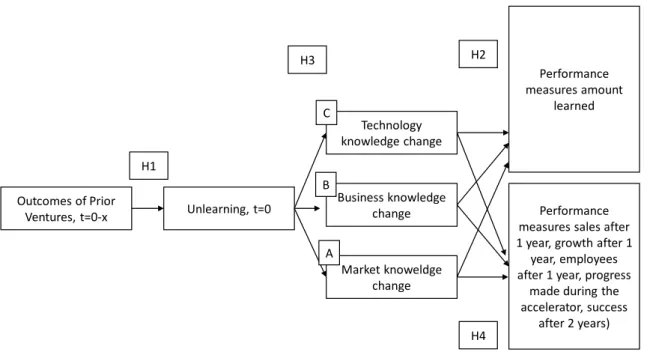
H1: Entrepreneurs that experienced previous failures will unlearn more than entrepreneurs who have not had venture failures.
Outcomes for firms from unlearning
Unlearning leverages business innovation and thus business performance (Baker and Sinkular, 1999; Cope, 2011 Morgan and Berthon, 2008; Sherwood, 2000, Sweet, 2012). This
is due to the fact that this learning type is engaging the organization in idea generation and risk taking, which increases innovations by firms as they explore. These generated innovations in turn affect business performance (Morgan and Berthon, 2008).
Unlearning is specifically crucial for relational capital (relationships and knowledge gained from those) that leads to a higher competitive advantage. Behaviors and attitudes on these relationships may need to be challenged as the environment, customer needs, vendor needs, partner and investor needs or market conditions change (Sweet, 2012).
Additionally, entrepreneurial ventures are gaining a capacity to do things differently (Cope, 2011), which is crucial since they are facing highly dynamic environments (Wang et al., 2014). Similarly, Sweet (2012) claims that unlearning further fosters organizational change and the ability to absorb knowledge. Startups will know in future that they should not take their knowledge for granted and also studies prove that unlearning is positively correlated with opportunity recognition, which is a key challenge for entrepreneurs (Sweet, 2012).
2.3 Accelerators
Definition of Accelerators
Accelerators are quite recent with the first accelerator, Y Combinator, being established in 2005 (Cohen and Hochberg, 2014; Hellen, Bingham, and Cohen, 2016).
According to Cohen and Hochberg (2014) seed accelerators are:
“A fixed-term, cohort-based program, including mentorship and educational components that culminates in a public pitch event or demo-day.” (Cohen and Hochberg, 2014, P. 4).
Ventures participating in accelerator programs are normally early‐stage companies seeking support and going through a highly selective application process. (McHugh, Whipple and Yang, 2013; Regmi, Ahmed, and Quinn, 2015; Cohen and Hochberg, 2014). Accelerators can have either a for-profit or a non-profit aim, a differing strategic focus (industry or geographical), vary in the amount of money given and equity taken as well as the duration. Moreover, they have specific themes: ecosystem-builder, deal-flow maker or welfare stimulator (Pauwels, Clarysse, Wright, and Van Hove, 2016). A co-working space might be offered, too. Furthermore, a venture capital firm or angel group affiliation, a link to a
corporation, university, non-governmental or governmental institution is possible mostly for the sake of funding, promotion and welfare or in case of corporates internal development. The managers of accelerators have much experience normally, as they have been entrepreneurs or angel investors before (Carvalho, Camacho, Amorim and Esperança, 2015; Cohen, 2013; Cohen and Hochberg, 2014; Pauwels, et al., 2016).
Unlearning facilitators within Accelerators
Learning within the accelerator might happen through the various activities (workshop/seminars/trainings, networking, mentoring, alumni service), conditions (investment and co-working space) and due to the actors within the process. Those actors are likely to be mentors, directors, cohort members, alumnis, investors and experts (Cohen, 2013; Cohen and Bingham, 2013). Deakins, O’Neil and Mileham (2000) claim that trust, respect and shared experience affect the quality of the learning. Hellen, Bingham and Cohen (2016) stress that accelerators add value through learning from the experience of others. According to Akgün, Lynn and Byme (2006), it is useful to have an outsider on your side to break established frameworks. So, they could engage in the process of unlearning while talking to others and gaining support (Hill and Levenhagen, 1995), to get the most out of their venture while participating in an accelerator program (Sweet, 2012).
In educational seminars wide topics around entrepreneurship are covered. These seminars are thought to round out limited experience and to connect participants with knowledge experts. The learning by doing act, emphasized as being crucial for the entrepreneurial learning process, could be identified by the workshops or seminars accelerators are likely to give (Pauwels et al., 2015). Additionally, managing directors of accelerators are helping the portfolio companies to absorb and apply the gained knowledge throughout all activities (Cohen, 2013; Pauwels, et al., 2016). Moreover, co-working spaces open opportunities for startups to learn from each other and collaborate (Pauwels, et al., 2016). It might happen even, that startup participants merge (Oliveira, 2016).
Also, as Tsang and Zahra (2008) state that unlearning is a precondition for organizational unlearning the hypothesis arises:
H2: The more entrepreneurs unlearn within accelerators the higher the learnings from the program
The Unlearning Content
First of all, one would assume the activities of the accelerator to influence unlearning with the various actors they meet. Likewise, the composition, education and experience of the directors and mentors of the accelerator program can influence what entrepreneurial founders learn (Cohen and Bingham, 2013).
Considering the content that can be unlearned, Van Weele and Van Rijnsoever (2015) provide a suitable concept for technology-based startups that enter incubators. Knowledge categories span over technology, market and business. Technological knowledge is based on technologies, products and processes according to the authors. It includes information on product design or manufacturing. Market knowledge concerns around customer needs and market operations (Van Weele and Van Rijnsoever, 2015). The distinction between those two knowledge types is further stressed by Agarwal et al. (2004) and Marvel and Lumpkin (2007). According to these authors and Sullivan and Marvel (2011) these knowledge types are important for explaining the firm outcomes product/service innovativeness. These outcomes will be further enhanced through reliance on networks as accelerators normally have (Sullivan and Marvel, 2011).
Business or organizational knowledge, which is further important for startups is about the starting, managing and growing procedure of a startup. This knowledge sets standards for entrepreneurs how to hire employees, raise capital, define a business plan and how to draft a contract (Becker and Gassmann, 2006; Hellen, Bingham and Cohen, 2016; Van Weele and Van Rijnsoever, 2015). However, it might be context specific (here e.g. through the product stage) and industry specific how to define relevant knowledge (Cope, 2005; Sexton, Upton, Wacholtz, and McDougall, 1997).
Hence:
H3: Unlearning within accelerators increases a) market knowledge, b) business knowledge and c) technology knowledge.
Outcomes for firms from unlearning within accelerators
Startups can build more investor ties and thus are able to survive longer and raise more capital (Mejia and Gopal, 2015). Hellen, Bingham, and Cohen (2016) further identified three key milestones reached by accelerated ventures sooner than by non-participants: funding, revenue and customer traction. According to Miller and Bound (2011) further reasons for
accelerator participation for start-ups are a peer support group, pressure and discipline pushing the business, business and product advice as well as validation for the start-up. Ventures also gain positive reputation, which increases their dissemination (Mindruta Moeen, and Agarwal 2016; Sørensen 2007; Spence 1973).
Through mentorship events startups can faster generate prototypes and revenue and gain in alternative strategies (Cohen, 2013; Mejia and Gopal, 2015). Seminars provide startups with specific knowledge (Cohen, 2013; Pauwels, Clarysse, Wright, and Van Hove, 2016). Co-working spaces further help startups receiving feedback (Pauwels, et al., 2016) and even can lead to a business merger (Oliveira, 2016).
Also, accelerators facilitate the unlearning process. The accelerator for example can show them possible positive outcomes based on the vast experience they are likely to have. The is an expert on the startup’s side when going through the emotional complex unlearning process (Cope, 2001; Mezirow, 1991).
Considering all this, to participate within accelerators is a great chance for young ventures. The participation and followed validation of their mental frameworks is an opportunity for new ventures to assess their idea before going to the market (Carvalho, Camacho, Amorim and Esperança, 2015). And if this were assumptions that derived significantly from reality or feasibility they have a chance to restructure and rethink and thus have a kind of pre-assessment for their business before engaging into figures. Thus, it is a way for a startup to prevent failure which is very likely for those kind of businesses nowadays (Laitinen, 1992; Shepherd et al. 2000). To unlearn is on the other hand a general beneficial experience for entrepreneurs (Sweet, 2012). They ideally will learn that they should not rely on their personal mental frameworks also and in future eventually rethink twice (Harvey and Evans, 1995).
Therefore, the hypothesis arises:
H4: Changes in a) market knowledge, b) business knowledge and technology knowledge are positively related to sales, number of employess, faced growth success level two years after the program
For the following analysis we propose the following conceptual framework to analyze the research questions.
Figure 1 Simplified Unlearning process within accelerators Outcomes of Prior Ventures, t=0-x Unlearning, t=0 Technology knowledge change Business knowledge change Market knoweldge change Performance measures sales after 1 year, growth after 1
year, employees after 1 year, progress
made during the accelerator, success after 2 years) H1 H2 H3 H4 Performance measures amount learned B A C 3. Empirical study 3.1 Methodology
The methodology of this work is a mixed method. This method was chosen as it enriches data and is the seen as the best way to achieve an answer to the research question. Both, observable factors (e.g. outcomes from ventures like sales) and subjective meanings (e.g. when a learning is considered a learning or which learning increase which knowledge types) can provide acceptable knowledge (Wahyuni, 2012). As the matter of studying is a quite recent subject (Hellen, et al., 2016) the study started with exploratory interviews helping to understand whether the unlearning phenomena is present. This phenomena was then assessed within a quantitative study with the research method of a further interviews and surveys for bringing additional insights. For both types of studies the in the literature derived unlearning process, including the knowledge types and the outcomes shall guide the understanding.
Qualitative study
BGI was contacted by an E-mail asking for alumnis to participate in the study. Then exploratory interviews were conducted. All information gathered should help to draw certain conclusions about if and how the small business has discarded knowledge within the accelerator by an open way of asking questions. To analyze results, answers were reviewed for commonalities or reasoning behind answers within the BGI interviews expressed through words (White, 2000).
Quantitative study
The quantitative analysis was enriched by a closed question questionnaire. Data was collected at the Websummit and the questionnaire was administered both face to face and through an online survey described in chapter 3.3. The meanings are derived from numbers and the data is thus nominal, ordinal and in scales. Statistical models are used to analyse the results afterwards (White, 2000). For analysis, SPSS and Partial Leas Squares Software Smart (PLS) is used to test the hypotheses. PLS was chosen as only had 55 observations were collected and sample size is normally not a problem with PLS (Ringle, Wende and Will, 2005). PLS modelling is a variance-based structural equation modelling technique relying on the partial least squares algorithm (PLS school, 2016). It uses an algorithm to relate one or more dependent variables to two or more independent ones (Lorber, Wangen and Kowalski, 1987), which is the case in this study. PLS SEM uses bootstrapping to analyse significant relationships as the data is not normally distributed (Efron and Tibshirani, 1986; Davison and Hinkley, 1997). With this bootstrapping, subsamples are created randomly from the original sample. The PLS path model or structural model then relies on this subsample. This is a repeated process, until a large number of random subsamples are created (Smartpls, 2016).
3.2 Samples
Exploratory interviews
The main unit of analysis are Building Global Innovators (BGI) alumni ventures. BGI is an innovation global accelerator based in Lisbon and Boston and founded in 2010. It was established from a partnership between the Portuguese government and the Massachusetts Institute for Technology (MIT). The accelerator is driven to create new local
technology-based ventures and foster recently incorporated companies. (Building global innovators, 2016B; Carvalho, Camacho, Amorim and Esperança, 2015).
Unit of analysis
Startup 1 is an Italian wearable technology company for high tech designer swim hardware (Startup 1, 2016). Startup 2 is company founded in the Lisbon instituto medicina molecular that established an immunization strategy to increase efficacy of medication for malaria (Startup 2, 2016). Startup 3 is an innovative and new product from London based company empowering people to control their health (Startup 3, 2016A; Startup 3, 2016B). Startup 4 enables charity auctions, charitable shopping, supportive sales and donations (Startup 4, 2016). Startup 5 is a platform for processing payments for B2B transportation services (Building global innovators, 2016B).
Questionnaire
For the Quantitative analysis, Websummit startup founders have been interviewed. The Websummit is a technology conference of startups of alpha and betta stages, investors several companies and interested people learning about hardware, software and media (Websummit, 2016).
Unit of analysis
The Websummit startups are working within the high technology sector of 23 different kinds. A list of the number of each startup in each industry category can be found in the appendix. Those were randomly selected in advance, driven from an online research that they participated in an accelerator conducted before the actual event.
3.3 Method and Measures Interview and questionnaire
For the qualitative study an interview guided by a questionnaire was conducted with the BGI sample. They are divided into three categories: demographics, organizational factors gathering the participation within the accelerator, questions on the interaction between the startup and the accelerator and between the startups. Semi-structured interviews were conducted as a first step for the interviewees to share their perspectives and experiences of the social phenomena of unlearning. It provided with predetermined themes but also left room for free talking as the questions were open (Wahyuni, 2012). At the beginning
interviewees were provided with the interview flow, a rough understanding of the research purpose and the further process. Interviews were video recorded and took between 37 to 71 minutes. Interviews were ended when the input of the respondent was exhausted and no new question could lead to a valuable result anymore. They were transcribed in a denaturalized transcription method, concentrating more on content than on actual expressions (Oliver, Serovich and Mason 2005) shortly after.
The questions were gathered from previous research from Cohen and Bingham (2013) and Cohen (2013). For the control variables, Politis (2005) and Cegarra-Navarro, Sánchez-Vidal, and Cegarra-Leiva (2011) were reviewed.
Online survey and questionnaire
After the interview with BGI candidates, they were sent a closed question online survey for the quantitative study assessing unlearning and the content of knowledge that was changed as well as performance questions, whose measures will be described in the next section. The survey was done with Qualtrics, which on average took 20 minutes.
With the Websummit candidates interviews were taken and additionally an online survey. Both were based on the same questionnaire as the closed questions online survey for BGI including demographic questions. The survey was sent to previously researched Websummit startups that could not be reached at the actual event. These methods were used to gather as much data as possible for the quantitative study of this research. The Websummit interviews took between eight and 17 minutes and some follow on emails were written. The questions on demographics were based on Cohen and Bingham (2013) and Cohen (2013) as well. The unlearning, knowledge type and outcome questions were replicated from the closed survey questionnaire for BGI candidates. The questionnaire measures will be described in the next section.
Measures
The unlearning scale for this study is taken from Cegarra-Navarro and Sanchez-Polo (2008) and Cepeda-Carrion, Cegarra-Navarro and Jimenez-Jimenez (2012). This is a psychometrically sound scale and has been tested before. It focuses on the individual unlearning process (Sweet, 2012). This scale was measured by Kurt Lewin’s unfreeze-move-refreeze model that appropriately interconnects learning and change (Akgün, Byrne, Lynn,
and Keskin, 2007). It measures questions assessing the support of policies, rules, reporting, structures and decision-making practices to foster problem identification, making mistakes and new ways of doing something. Also, it includes questions around individual’s awareness of own mistakes, ways of thinking, and consciousness of erroneous behaviours directing day-to-day attitudes. Further it covered then questions that evaluate how an individual receives change, and implements it within the organization, collaborates with other members of the organization, and values risk-involvement and receiving new information. All these questions are assessed by an individuals’ evaluation on a Likert scale measuring his or her high disagreement (1) to high agreement (7). The to this study adapted unlearning scale from Cegarra-Navarro and Sanchez-Polo (2008) and Cepeda-Carrion, Cegarra-Navarro and Jimenez-Jimenez (2012) can be seen in the table 3 in Chapter 4.2.
Reagarding the type of knowledge this study was influenced by previous research that assessed for technology, market and business knowledge within incubators Agarwal et al., 2004; Marvel and Lumpkin, 2007; Van Weele and Rijnsoever, 2015). Technology knowledge questions were derived into the subgroups: products, technologies and processes. The Business knowledge was researched by the sub-questions: knowledge of how to start a business and how to manage and how to grow a business. Finally, the Market knowledge was adapted from Van Weele and Rijnsoever (2015). Questions considered knowledge of customers need and market operations. These knowledge type questions were then divided into radical or incremental knowledge type questions, as previous research indicated these learning types within incubators. Radical knowledge change would mean unlearning (there was knowledge before that is left behind) whereas incremental change refers to optimization (it is completely new knowledge that enriches current knowledge base). The learning types are assumed to be either radical changes or optimizations thus to get the real effect of unlearning, only the radical knowledge changes were considered. The unlearning variable represents the independent variable of the structural model established later (Van Weele and Rijnsoever, 2015).
Important mediating variables are the knowledge types: technology knowledge, business knowledge and market knowledge. They are assumed to be the relevant knowledge types based on previous literature (Van Weele and Van Rijnsoever, 2015; Agarwal et al., 2004). Performance measures were adapted from Cohen and Bingham (2013). Cohen’s and Bingham’s (2013) measures assess the progress the firm has made and how much it has learnt from the program, the amount learnt from different actors and events (Cohen and Bingham, 2013). Furthermore, to assess the business performance the measures “sales before
the accelerator” and “sales one year after the accelerator” (Gruber, MacMillan and Thompson, 2016; Sullivan and Marvel, 2011) as well as “growth before the accelerator” and “growth one year after the accelerator”, “success beyond two years” (Regmi, Ahmed and Quinn, 2015) and employees before and after the accelerator, amount learned and progress made (Cohen and Bingham, 2013). The knowledge type variables were supposed to mediate unlearning and then affecting the outcome variables.
Control variables
Factors influencing how entrepreneurial founders unlearn within accelerators and what they (un)learn can be of diverse sources. The age of the founder(s) might influence how unlearning takes place. Research shows that older entrepreneurs are more likely to stick to set ways and to resist changing past practice (Cegarra-Navarro et al., 2011; Nystrom and Starbuck, 2015). Furthermore, the industry of the startup might influence how they unlearn. Stable environments will be more in need for lower level learning and optimizing existing practices (Uotila and Maula 2009; Van Rijnsoever, Meeus and Donders, 2012; Van Weele and Van Rijnsoever, 2015). Moreover, outcomes of potential prior ventures might influence how and what is being unlearned (Politis, 2005). Additionally the length of the program could be another influencer of what and how something is learned (Cohen, 2013). Furthermore affecting what and how unlearning is experienced might be the background and the amount of the other ventures of the cohort and their experience with prior ventures (Cohen and Bingham, 2013).
4. Results Analysis
The data collected aims to answer the research question of how nascent ventures unlearn within accelerators and if so, which contents.
4.1. Findings qualitative study
The five startups introduced in chapter 3 have different contexts and are operating in different industries within the high-tech field. The founders are between 28 to 40 years old. The degrees of the founders ranged from Bachelors to PhD’s and were mostly in Business and sometimes in Natural sciences, thus was always related. Startup 4 and 5 had prior ventures, whereas Startup 5 had a previous failure. The number of co-founders ranged from two to five, they were around 30 to 40 years old and had backgrounds related to the current
small businesses. Sometimes their backgrounds were similar to the founder ones (thus related), sometimes they had a complement related degree to the respective business. The product stages of all startups were mostly idea stage, only Startup 1 has been in the prototype stage.
Outcomes of Prior ventures influencing Unlearning
Startup 1, 2, 4 and 5 have unlearned. From these Startup 4 and 5 prior ventures where one has failed and one was successful. Therefore there is no clear evidence for a relationship of the outcomes of prior ventures to unlearning.
Unlearning influencing Amount learned
Unlearning could be identified for Startup 1, since the founder said they went through the program and found out that previous knowledge (focusing on an assumed customer without market research) was not efficient and discarded it. Accelerator personnel as well as cohorts advised to think of the whole potential market and to exploit the full business potential. The startup has identified this as an important learning.
The founder of startup 2 claimed the firm changed their previous knowledge of how to aggregate technologies. They were advised they should not rely on the technology but also to have other accessories technology with a faster time to market allowing to guarantee that the venture is generating cash for investors. The founder claimed it was an important input but did not highlight it.
Startup 4 unlearned about their product and its value proposition, as it was too competitive before. Also, the business plan was redesigned. This was an emotional and difficult process as they had already customers engaged who needed to adopt to new circumstances as well. Furthermore, they had developed the product for two years and then were advised to restructure a lot. The founder of startup 4 identified that this learning was crucial.
Startup 5 refocused from starting with the product to first address a market need. The product was changed significantly as the payment system was connected to a combined transportation card for public transport. This one could consider a radical change where startup 5 engaged in unlearning. The founder did not highlight the unlearning as an important learning for his personal development.
Three cases highlight the importance of unlearing for learning and one not, this relationship seems to be significant.
Unlearning influencing Knowledge types
The unlearning content of startup 1 can clearly be directed towards market knowledge. The founder of Startup 1 changed market knowledge radically, venture 2 changed radically their market and technology knowledge and venture 4 gained in market knowledge. The venture 5 has increased its business and market knowledge through the accelerator in a considerable way. Therefore, there is a significant relationship to market knowledge, and in some cases also business and technology knowledge.
Knowledge types influencing Business outcomes
Startup 1 was not stressing the technology knowledge for the outcomes. Startup 2 named the market knowledge gained through unlearning as a major growth contributor. Venture 4 was stressed the importance of the unlearning for the outcomes, although one could assume it to be highly relevant. Venture 5 hasn’t gone ahead after participating in the accelerator due to high barrier to entry. So, outcomes on average radical knowledge changes did not contribute to higher outcomes (apart from learning).
4.2 Findings quantitative study Descriptive Statistics
Industry Product stage
Figure 3 Industries, from http://www.wortwolken.com/
The high technology industries range from Travel, Health Tech, Virtual Reality to Social Media. The most observed is HealthTech (0,18%); then Social media (0,09%) and FinTech (0,09%); then Travel, Internet of Things, eCommerce, Content and Media and Software as a Service with each 0,05% and the rest of the industries with 39% all together. 54 out of 55 observations are high technology firms whose industry is very fast changing and hence one could assume that unlearning is crucial for their development (Van Rijnsoever et al., 2015). The product stage of the startups is mostly idea stage but also there is a considerable amount of revenue stage startups.
Education, Experience, Prior ventures, Outcomes of prior ventures and age
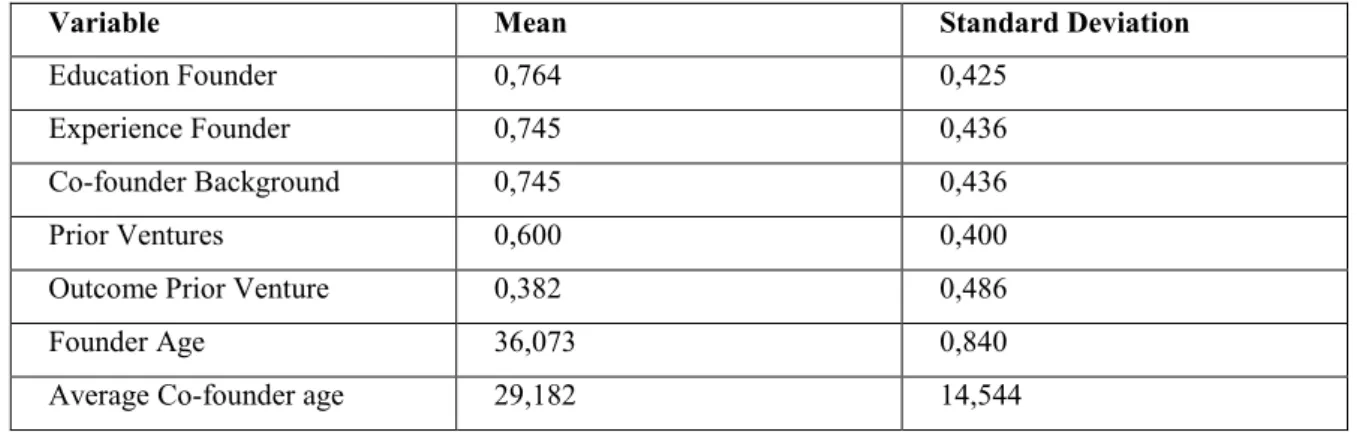
Table 1 Descriptives Entrepreneurial preparedness
Variable Mean Standard Deviation
Education Founder 0,764 0,425
Experience Founder 0,745 0,436
Co-founder Background 0,745 0,436
Prior Ventures 0,600 0,400
Outcome Prior Venture 0,382 0,486
Founder Age 36,073 0,840
Average Co-founder age 29,182 14,544
The relatedness variables are binary variables thus 1 if related and 0 otherwise. Education and experience from all founders are on average almost the same and around 0,75 so it is more likely that
previous gained
experience and education are related. Co-founders backgrounds (education and practice wise) were on average about the same so very likely to be related to the current venture. If founders had previous ventures, they were on average likely to be related to the current one. The outcomes of previous ventures were then on average less likely to be positive (1= successful, 0=failed). Age of founders was on average 36 and co-founders 29 years.
Accelerator features and program duration
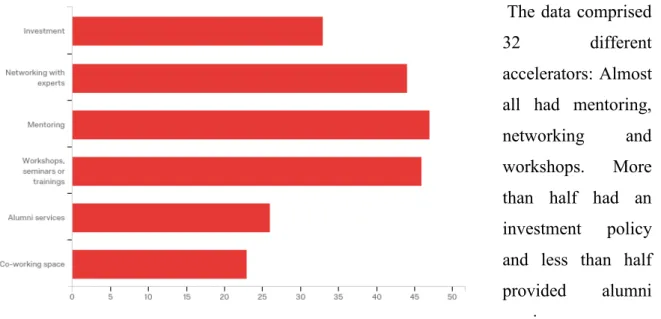
The data comprised
32 different
accelerators: Almost all had mentoring,
networking and
workshops. More than half had an investment policy and less than half
provided alumni
services or co-working space. The accelerator length was on average 6 months, the shortest 2 months the longest 36 months.
Outcome variables
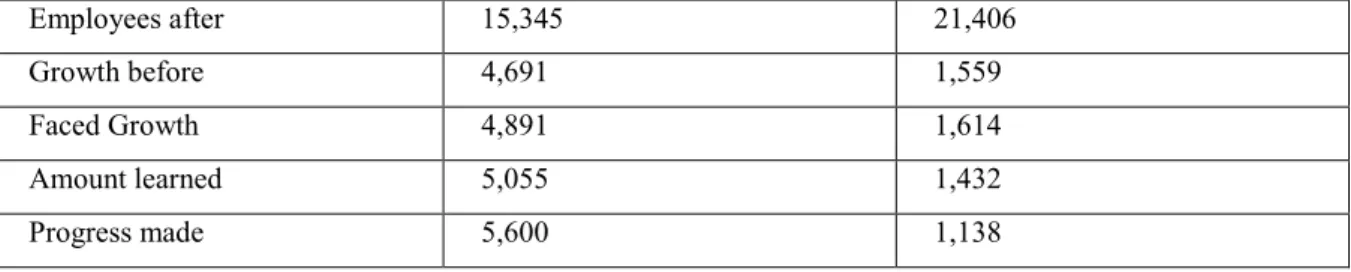
We collected two variables before and after the accelerator. We assessed success throughout the accelerator process. Table 2 shows a small increase in sales and growth through the program. The number of employees almost doubled after the accelerator. Success after two years was collected to measure performance with some time lag. The amount learnt and the progress made during the time in the accelerator indicated that participants agreed to have learnt and to have made progress.
Table 2 Descriptives Outcome variables
Variable Mean Standard Deviation
Sales before 4,055 1,656
Sales after 4,855 1,531
Employees after 15,345 21,406
Growth before 4,691 1,559
Faced Growth 4,891 1,614
Amount learned 5,055 1,432
Progress made 5,600 1,138
The success after two years of the accelerator was then mostly that the venture was currently still operating:
Figure 5 Success after two years
The current funding round on average was the first round (seed funding), three were exiting, one was dead and four were younger than two years.
Measurement model
To test the measurement of the model the following correlations were tested (Costa, Lages and Hortinha, 2015):
Individual item Reliability
As a first step, the knowledge type questions were assessed with a reliability test. Cronbach alphas were higher than 0,8 to be considered as good and inter-item-correlations were sought to have a high value as well (Gliem, and Gliem, 2003). If this was not the case, then the respective item was cut from the measure, see the values not market with a * (See table 3 and 4). The same procedure was done for the unlearning and knowledge type scale.
Unlearning
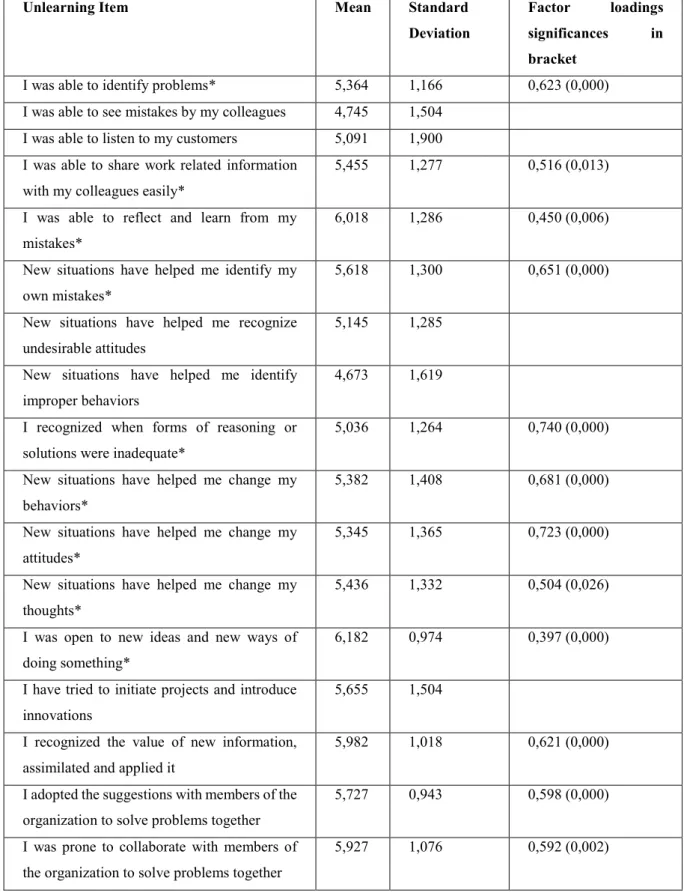
Table 3 Descriptives Unlearning
Unlearning Item Mean Standard
Deviation
Factor loadings significances in bracket
I was able to identify problems* 5,364 1,166 0,623 (0,000) I was able to see mistakes by my colleagues 4,745 1,504
I was able to listen to my customers 5,091 1,900 I was able to share work related information
with my colleagues easily*
5,455 1,277 0,516 (0,013) I was able to reflect and learn from my
mistakes*
6,018 1,286 0,450 (0,006) New situations have helped me identify my
own mistakes*
5,618 1,300 0,651 (0,000) New situations have helped me recognize
undesirable attitudes
5,145 1,285 New situations have helped me identify
improper behaviors
4,673 1,619 I recognized when forms of reasoning or
solutions were inadequate*
5,036 1,264 0,740 (0,000) New situations have helped me change my
behaviors*
5,382 1,408 0,681 (0,000) New situations have helped me change my
attitudes*
5,345 1,365 0,723 (0,000) New situations have helped me change my
thoughts*
5,436 1,332 0,504 (0,026) I was open to new ideas and new ways of
doing something*
6,182 0,974 0,397 (0,000) I have tried to initiate projects and introduce
innovations
5,655 1,504 I recognized the value of new information,
assimilated and applied it
5,982 1,018 0,621 (0,000) I adopted the suggestions with members of the
organization to solve problems together
5,727 0,943 0,598 (0,000) I was prone to collaborate with members of
the organization to solve problems together
I was concerned with the fact that the manner of answering before unforeseen circumstances will be known by all
3,909 1,842
Cronbach alpha for items indicated with *: 0,860
Knowledge types
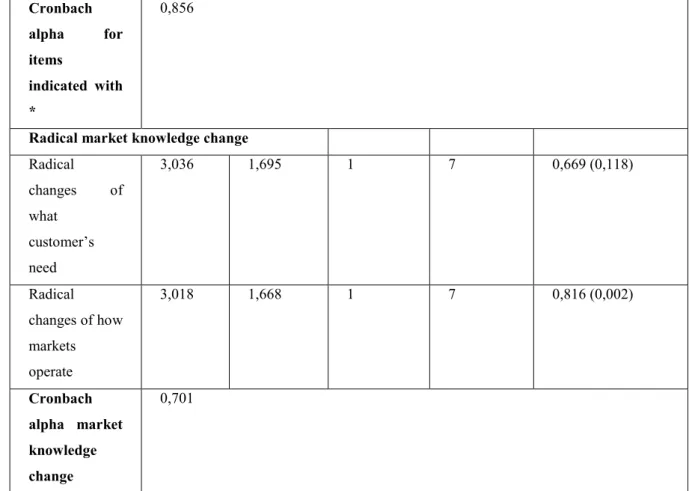
Table 4 Descriptives Knowledge types
Item Mean Standard
Deviation Minimum Value Maximum value Factor Loadings and significances in brackets Radical Technology knowledge change
Radical changes of products* 3,073 1,828 1 7 0,783 (0,003) Radical changes of technologies* 2,691 1,559 1 7 0,814 (0,001) Radical changes of processes 3,127 1,738 1 Cronbach alpha for items indicated with * 0,741
Radical Business knowledge change
Radical changes of how to start a business* 3,200 1,882 1 7 0,950 (0,000) Radical changes of how to manage a business* 2,800 1,656 1 7 0,911 (0,000) Radical changes of how to grow a business 3,618 1,892 1 7
Cronbach alpha for items indicated with * 0,856
Radical market knowledge change
Radical changes of what customer’s need 3,036 1,695 1 7 0,669 (0,118) Radical changes of how markets operate 3,018 1,668 1 7 0,816 (0,002) Cronbach alpha market knowledge change 0,701 Convergent Validity
Convergent validity, is proven with the Cronbach alphas just presented and construct reliability coefficients (Costa et al., 2015). Convergent validity takes two measures which are supposed to measure the same construct and proofs their relationship. Convergent validity can be assumed as the factor loadings of the variables are significant, which can be taken from the table 3 and table 4 (Bagozzi, 1980).
Also, the average variance extracted (AVE) of each variable is greater than 0,5 (Fornell and Larcker, 1981). This is can be seen in the Table 5.
Table 5 AVE mean and Square root AVE
Co n-stru ct AV E mea n Std. dev. Am oun t lear ned Bus . Kno wl. Em p-loye es afte r Fac ed Gro wth Mar ket kno wl. Out com es Prio r Ven t. Pro gres s Sale s Suc cess afte r 2 Tec hn. Kno wl. Unl earn ing
Am oun t lear ned 1 0 1 Bus ines s kno wle dge 0,84 4 0,05 5 0,30 5 Em p-loye es afte r 1 0 0,06 7 0,15 5 1 Fac ed Gro wth 1 0 0,45 1 0,25 7 -0,04 9 1 Mar ket kno wle dge 0,73 6 0,12 6 0,11 9 0,63 0 0,19 1 0,04 7 0,86 Out com es Prio r Ven t. 1 0 0,01 3 -0,06 6 0,08 3 0,12 3 0,14 6 1 Pro gres s 1 0 0,46 0 0,30 7 0,00 4 0,45 9 0,19 7 -0,00 4 1 Sale s 1 0 0,20 7 0,23 4 0,01 5 0,59 0 -0,00 6 0,12 4 0,43 5 1 Suc cess afte r 2 1 0 0,07 0 -0,01 4 0,32 2 0,12 0 -0,07 9 0,08 1 0,05 0 0,12 3 1 Tec h. kno wle dge 0,79 3 0,11 2 -0,05 3 0,21 3 0,10 9 0,02 9 0,49 0 -0,09 9 -0,00 1 -0,06 6 0,23 2 0,89 Unl earn ing 0,38 1 0,08 0 0,38 7 0,13 1 -0,16 6 0,23 1 0,08 9 -0,21 6 0,43 4 0,08 6 -0,08 2 0,26 2 0,62
Discriminant Validity
Discriminant validity investigates if two measures that should not be related are indeed not related (Carlson and Herdman, 2012). For this measurement the correlation between each pair of constructs with the root of AVE among those constructs is analysed (see in the table below) (Fornell and Larcker, 1981). Also, cross-loadings between items and constructs were reviewed (Chin, 1998).
The table shows that the square root of AVE between all combined constructs (on the diagonal) is greater than their respective correlation except for market knowledge on business knowledge (Costa et al. 2015). Items further proofed to have a high and significant relationship to the variables assigned to (see table 5). Thus discriminant validity can be assumed.
Structural model
In order to test our hypotheses we are going to analyse the structural model. The first hypothesis derived is the following:
Outcomes of prior ventures influencing Unlearning
It became clear that outcomes of prior ventures is correlated negatively (beta=-0.216). This would mean that if the venture has had success in the past, it is likely to be accompanied by less unlearning within the new venture, as assumed. However, the relationship is not significant (P>0,11). H1 must therefore be rejected
Unlearning influencing Amount learned
The analysis made obvious that unlearning has a positive and significant relationship to the amount the venture has learned within the accelerator (beta=0.396, P=0,023). This would mean, that the unlearning increased the amount learned in a significant way. Thus, H2 is proven and the accelerator increased the amount of learning through unlearning.
Unlearning influencing Knowledge type changes
When looking at the relationship of unlearning to each knowledge type change, one can see that overall the relationship correlate positively. Market knowledge hereby shows the least
strong effect (beta=0.115, P>0,1), then comes technology knowledge (beta=0.253, P>0,1) and then business knowledge (beta=0.134, P>0,1) Thus H3 must first be rejected.
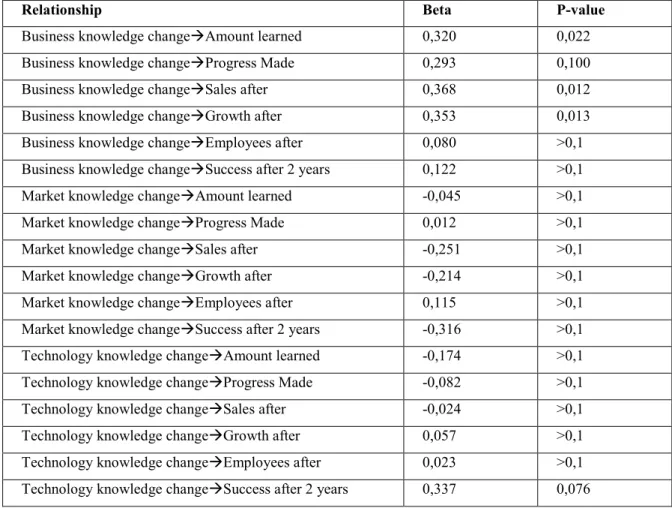
Knowledge types influencing Business outcomes The betas and p-values can be taken from table 6.
Table 6 Relationships from knowledge types to outcome variables
Relationship Beta P-value
Business knowledge changeAmount learned 0,320 0,022 Business knowledge changeProgress Made 0,293 0,100 Business knowledge changeSales after 0,368 0,012 Business knowledge changeGrowth after 0,353 0,013 Business knowledge changeEmployees after 0,080 >0,1 Business knowledge changeSuccess after 2 years 0,122 >0,1 Market knowledge changeAmount learned -0,045 >0,1 Market knowledge changeProgress Made 0,012 >0,1 Market knowledge changeSales after -0,251 >0,1 Market knowledge changeGrowth after -0,214 >0,1 Market knowledge changeEmployees after 0,115 >0,1 Market knowledge changeSuccess after 2 years -0,316 >0,1 Technology knowledge changeAmount learned -0,174 >0,1 Technology knowledge changeProgress Made -0,082 >0,1 Technology knowledge changeSales after -0,024 >0,1 Technology knowledge changeGrowth after 0,057 >0,1 Technology knowledge changeEmployees after 0,023 >0,1 Technology knowledge changeSuccess after 2 years 0,337 0,076
Overall, business knowledge changes have a positive relationship to the outcome variables particularly in the current period. Furthermore, it affects the level of learning, progress made and growth faced by the startup. Only success after two years is not affected significantly. Therefore, H4A can be accepted.
Market knowledge proves to be negatively correlated to the outcome variables of different times on average. Only employees after is increased, however not significantly. Therefore, H4B must be rejected.
Technology knowledge then has varying positive and negative correlations to the outcome variables of different types. Here, a significant and positive relationship of the technology knowledge change to success after two years can be established. Therefore H4C can be accepted and thus H4 is partially confirmed.
One could think the knowledge types to be a mediator between unlearning and the outcome variables as the knowledge questions were separating between radical and incremental knowledge. However, this should be investigated in more detail.
Control Variables
The startup specific context was analysed to influence unlearning. The Industry did not influence unlearning and product stage of the ventures also failed to reach significant levels (β=0.058, p > 0,10).
Entrepreneurial Preparedness variables were assessed: founder experience (β=0,014,p > 0.10 ) , founder education (β=-0,141, p > 0.10), prior ventures (β=-0.116, p > 0.10) and founder age (β=-0.331, p = 0.015). Also the co-founders background (β=-0.004, p > 0.10) and average co-founder age (β=-0.032, p > 0.10) was included. From the analysis only founder age had a significant but negative relationship to unlearning
Accelerator learning enhancers are the accelerator features mentoring, networking, co-working, and workshops and also investment which can affect the unlearning behavior. None of these factors had a significant relationship to unlearning: investment β =0.054, Networking β= -0,021, Mentoring β= 0.037, Workshops β= -0,307 and Co-working β= 0.051 all with p > 0,10.
The length of the program had no influence on the entrepreneurs ability to unlearn (β=0.055, p > 0.10;)
4.3 Discussion
Factors influencing unlearning
Our study indicates that unlearning is partly experienced within the accelerator. The majority of startups interviewed showed some indication they were able to challenge basic beliefs, and were willing to rethink business and market approach in the hope of a more successful stance in the future.
The ability to challenge the current knowledge basis is independent of the product stage. This indicates that startups in the revenue stage can engage in unlearning. Interestingly our findings show that unlearning is not dependent on the industry the startup is based in. Although our sample is in the fast paced industry two startups of the same industry experienced opposite levels of unlearning.
Entrepreneurial preparedness factors had no influence with the exception of founder’s age. Age should be correlated with experience and the amount learned in the past, so these relationships should be investigated with more detail. Furthermore, the accelerator activities did not affect unlearning significantly which we believe to be a puzzling result. Nevertheless this points to previous findings were the effects were found to be small (Cohen, 2013; Pauwels, et al., 2016). The program duration we unveiled a negative effect meaning the shorter the program the more unlearned, as assumed, however not significantly influencing unlearning (Cohen, 2013).
Surprisingly we could not find an effect about having previous ventures and unlearning. Both the exploratory interviews and the survey failed to show such relationship. Although we found a positive effect meaning that if the venture has had success in the past, it is likely to unlearn within the new venture, we have not reached significant levels.
Unlearning influencing amount learned
Interestingly startups recognized that when long held beliefs are questioned the perceived learning increases. Our interviews clearly show this positive relationships as three of the four interviews were convinced of their contribution to learning. This finding was further supported by the quantitative study where respondents reported high levels of learning when they experienced unlearning.
Unlearning influencing knowledge types
When investigating where the questioning about assumptions was more likely to happen during the exploratory interviews we found evidence of market knowledge and technology knowledge. Nevertheless we were not able to replicate these findings in our quantitative study. Unlearning is more likely to be related to radical changes as they require new knowledge (March, 1991) where a time lag might be involved in order to materialize those changes.
Knowledge types influencing Business Outcomes
Finally, startups within exploratory interviews could not express what exactly contributed to growth. Particularly how unlearning allowed them to change their knowledge basis and as such grow.
Interestingly, quantitative findings showed a positive and significant relationship from Business knowledge to amount learned, to progress made, to sales after one year and to growth after one year. Thus this knowledge types is beneficial to startups sustainability although we need caution about the high-tech industry participants.
Technology knowledge does not affect results but it relates to positive success two years after the program. A reason is that technology needs time to develop and to materialize. For example, getting a patent takes time and does not increase sales or growth immediately. Market knowledge, although non-significant showed a negative coefficient to all outcome variables but progress made and employees after one year. Non significance might be related to some confusion about the difference between business and market knowledge, thus it might have been assessed with business knowledge. Radical market knowledge might harms current sales. During the interviews one founder explained they were in business for two years and unlearned within the accelerator in market knowledge. The program advised to change the value proposition which could have harmed sales. Success after two years is correlated negatively to market knowledge. This would mean if you change market knowledge it impacts even negatively after two years. Radical market knowledge further shows a positive effect to employees after. An interpretation for this could be that the value proposition was changed and thus now more customers are addressed, so the customer support team must increase. Therefore radical market knowledge change is overall rather detrimental in the short run to the venture cash flow, as ventures need to radically change customers and therefore the fundamentals of the baseline.
5 Conclusion and implications
The aim of this work was to assess what and how startups who go through accelerators change their knowledge basis. The unlearning process within accelerators was theoretically established through a framework and later on tested through an emprical study.
The theory suggests that entrepreneurial preparedness and especially failures with previous ventures were directing the unlearning behavior of entrepreneurs when they engage in EL again. The assumed relationship was proven overall by the quantitative study but not in a significant way.
The ventures unlearned according to this work overall, increasing the amount learned within the accelerator and the progress made, as theory was suggesting.
From previous studies it was also assumed that unlearning increased the business, technology and market knowledge by ventures. Maybe because the startup’s background was within high technology, their unlearning content was more explained by business knowledge, how to start and manage a business. Market knowledge might have been mistaken by business knowledge and was not showing a significant radical change. The qualitative findings were stressing all three knowledge types but significantly only market knowledge.
Theory was further assuming a positive relationship of the learning contents to the business outcomes. The business leanings did indeed prove to contribute to the small firm’s business outcomes. The technology learning materalized after two years, perhaps as enduring intellectual property rights need to be get by startups. Qualitative results stressed the unlearned business and market knowledge as crucial growth contributions. Overall, the study shows that the gained knowledge types show a significant relationship to the outcomes of firms.
5.1 Implications for Research
This study increased the research done on accelerators and it contributed to EL literature by investigating the ventures unlearning process and content. Furthermore, it analyzes the role of accelerators as triggers for unlearning and in that it supports that unlearning increases EL. Moreover, findings enriched insights on exploratory learning that contributes to the key challenge opportunity exploration (Morgan and Berthon, 2008; Wang et al., 2014).
5.2 Implications for Practice
The above conducted analysis has several advantages for accelerators and startups.
For Entrepreneurs it is especially important to gain knowledge about how their team can unlearn and what assumptions are likely to be unlearnt (so they will understand what are the skills and knowledge they are lacking) in order for them to stay flexible and gain in