Avoiding False Positive Antigen Detection by
Flow Cytometry on Blood Cell Derived
Microparticles: The Importance of an
Appropriate Negative Control
Emerence Crompot1*, Michael Van Damme1, Hugues Duvillier2, Karlien Pieters1, Marjorie Vermeesch3, David Perez-Morga3, Nathalie Meuleman2, Philippe Mineur4, Dominique Bron2, Laurence Lagneaux1, Basile Stamatopoulos1*
1Laboratory of Clinical Cell Therapy, Université Libre de Bruxelles (ULB), Jules Bordet Institute, Brussels, Belgium,2Hematology Department, Jules Bordet Institute, Brussels, Belgium,3Laboratory of Molecular Parasitology, IBMM, Université Libre de Bruxelles (ULB), Gosselies, Belgium,4Department of Hemato-Oncology, Grand Hôpital de Charleroi, Gilly, Belgium
*[email protected](BS); [email protected](EC)
Abstract
Background
Microparticles (MPs), also called microvesicles (MVs) are plasma membrane-derived frag-ments with sizes ranging from 0.1 to 1μm. Characterization of these MPs is often performed
by flow cytometry but there is no consensus on the appropriate negative control to use that can lead to false positive results.
Materials and Methods
We analyzed MPs from platelets, B-cells, T-cells, NK-cells, monocytes, and chronic lym-phocytic leukemia (CLL) B-cells. Cells were purified by positive magnetic-separation and cultured for 48h. Cells and MPs were characterized using the following monoclonal antibod-ies (CD19,20 for B-cells, CD3,8,5,27 for T-cells, CD16,56 for NK-cells, CD14,11c for mono-cytes, CD41,61 for platelets). Isolated MPs were stained with annexin-V-FITC and gated between 300nm and 900nm. The latex bead technique was then performed for easy detec-tion of MPs. Samples were analyzed by Transmission (TEM) and Scanning Electron mi-croscopy (SEM).
Results
Annexin-V positive events within a gate of 300-900nm were detected and defined as MPs. Our results confirmed that the characteristic antigens CD41/CD61 were found on platelet-derived-MPs validating our technique. However, for MPs derived from other cell types, we were unable to detect any antigen, although they were clearly expressed on the MP-produc-ing cells in the contrary of several data published in the literature. UsMP-produc-ing the latex bead tech-nique, we confirmed detection of CD41,61. However, the apparent expression of other
OPEN ACCESS
Citation:Crompot E, Van Damme M, Duvillier H, Pieters K, Vermeesch M, Perez-Morga D, et al. (2015) Avoiding False Positive Antigen Detection by Flow Cytometry on Blood Cell Derived Microparticles: The Importance of an Appropriate Negative Control. PLoS ONE 10(5): e0127209. doi:10.1371/journal. pone.0127209
Academic Editor:Alain Haziot, INSERM, FRANCE
Received:September 2, 2014
Accepted:April 13, 2015
Published:May 15, 2015
Copyright:© 2015 Crompot et al. This is an open access article distributed under the terms of the Creative Commons Attribution License, which permits unrestricted use, distribution, and reproduction in any medium, provided the original author and source are credited.
Data Availability Statement:All relevant data are within the paper and its Supporting Information files.
Funding:This research was supported by a Télévie and a FRSM (Fonds de la Recherche Scientifique Médicale) grant, both affiliated to the“Fonds National de la Recherche Scientifique–FNRS”(F.R.S-F.N.R. S.).
antigens (already deemed positive in several studies) was determined to be false positive, indicated by negative controls (same labeling was used on MPs from different origins).
Conclusion
We observed that mother cell antigens were not always detected on corresponding MPs by direct flow cytometry or latex bead cytometry. Our data highlighted that false positive results could be generated due to antibody aspecificity and that phenotypic characterization of MPs is a difficult field requiring the use of several negative controls.
Introduction
In recent years, a large number of publications have established that cells are able to produce
‘‘extracellular vesicles”(EVs), which are important mediators of physiological processes in nor-mal and pathological cells (e.g., cell growth, activation, proliferation, apoptosis, senescence) [1;2]. EVs principally include three populations distinguishable by size, composition and bio-genesis: exosomes (50–100 nm in diameter), microparticles (100 nm to 1μm) and apoptotic
bodies (AB; 1μm to 4μm) [3]. In this study, we focused on microparticles (MPs), also called
microvesicles (MVs) by some authors. These particles are released into the extracellular space by outward budding and fission of the plasma membrane [4–6]. The release of vesicles is effi-ciently induced upon cellular activation or apoptosis and the subsequent increase of intracellu-lar Ca2+. These MPs contain proteins and nucleic acids, including cytoplasmic and membrane proteins [7], mRNAs [8;9], microRNAs (miRNAs) [10–12], non-coding RNAs (ncRNAs) [13], and DNA [14–17]. All of these elements can be delivered to other cells by different mechanisms [4;18]. MPs normally feature antigens from parental cells and phosphatidylserine (PS), which can be detected by annexin-V staining [19;20]. However, some observations also suggest the existence of MPs without PS externalization [21–25].
The characterization of MPs is most often performed by flow cytometry, which is consid-ered the gold standard technique used in 75% of MP publications. Lacroix et al defined an ac-curate MP gate between 0.3 and 1μm as the best compromise between good resolution and a
level of background noise that does not impede cytometer performance [26]. Over the years, other techniques have been applied to improve the study of MPs such as electron microscopy, ELISA, nanoparticle tracking analysis, and atomic force microscopy [27].
The field of MP study is rapidly expanding. It has been already shown that MPs in body flu-ids could be used as prognostic markers for pathologies that include cardiovascular diseases, inflammation, sepsis, lupus, HIV, and several cancers [28–31]. MPs also have significant po-tential for clinical applications, especially in brain cancer, where EVs have been used as delivery vehicle to transport therapeutic molecules [32–34].
and thus false positive results. In the present paper, we demonstrated that several results pub-lished in the literature are more than probably wrong due to the use of inappropriate controls. The purpose of this study was thus to clarify antigen detection on MPs from blood cells and to propose new negative control in MP analysis by flow cytometry to avoid false positive results.
Materials and Methods
Ethics statement
This study has been approved by the Bordet Institute Ethics Committee and conducted accord-ing to the principles expressed in the Declaration of Helsinki. All samples were collected after written informed consent.
Biological samples and cell culture
Peripheral blood mononuclear cells (PBMC) were obtained from healthy donor buffy coat (provided by the“service francophone du sang de la croix rouge de Belgique”). PBMC were iso-lated by Ficoll-Hypaque gradient centrifugation as previously described [41]. B-cells, T-cells, NK-cells, and monocytes were purified by positive selection, using CD19, CD3, CD56, and CD14 microbeads, respectively (Macs Miltenyi Biotec, Leiden, the Netherlands). The purity of cells was from 97.46 to 99% after immune magnetic enrichment (data not shown). Platelets were obtained from expired single-donor platelet apheresis units. They were collected by the
“service francophone du sang de la croix rouge de Belgique”. Chronic Lymphocytic Leukemia (CLL) samples were obtained from CLL patients with informed written consent. The normal purified cells and CLL B-cells were cultured at densities between 4–70 x 106cells/ml (according
to cell type) in 0.2μm filtered RPMI 1640 (Lonza, Basel, Switzerland). A serum-free medium
was used to avoid contamination by Fetal Bovine Serum (FBS)-derived vesicles [42]. We also used bone marrow mesenchymal stromal cells (BM-MSCs) to include a non-hematopoietic negative control. BM-MSCs were harvested from the sternum or iliac crest of healthy volun-teers and were isolated by the classical adhesion method, as previously described [43].
BM-MSCs were plated at 1000 cells/cm2and cultures were used at a subconfluent state (2 x 10⁶
cells). BM-MSCs were cultured in a T-175 flask with serum-free DMEM (Dulbecco’s modified Eagle medium-low glucose) filtered through a 0.2μm filter. Cells were incubated at 37°C in a
5% CO2humidified atmosphere. With the exception of platelets, all samples were cultured for
2 days prior to MP isolation. Cell viability was analyzed by Trypan blue exclusion assay and confirmed by Annexin V/7AAD labeling (S1 Table).
Microparticle isolation
MPs were prepared from the supernatant of several cell cultures (healthy purified cells, CLL cells, and BM-MSCs). Although a standardized centrifugation protocol has not been estab-lished, a majority of authors have used a 20,000 x g centrifugation for MP recovery, while a 100,000 to 200,000 x g centrifugation is generally necessary to isolate exosomes [26;44–46]. Cell-free supernatant (1ml of blood cell culture and 50ml of MSC culture) was obtained by 2 successive centrifugations at 300 x g for 10 minutes (for platelet samples, centrifugation at 450 x g for 15 minutes was used to remove a majority of platelets). The supernatants were then sub-jected to 20,000 x g centrifugation for 1 h at 4°C (Ultracentrifuge MX 120+, Swinging Bucket rotor S50-ST, k-factor 77). The MP pellet was washed using 0.2μm filtered phosphate buffered
the labeling results, we performed a staining comparison between the samples, before and after the congelation (data not shown).
Antibodies and other reagents
Because unfiltered buffers and antibodies have been shown to contain interfering elements that can give false positive signals in cytometry [47–51], all products used here were filtered through 0.2μm filters (VWR, Leuven, Belgium). The following monoclonal antibodies were used:
CD19-PE (LT19), CD3-PE(BW264/56), and CD14-PE(TÜK4), CD61-PE(Y2/51) (Macs Milte-nyi). CD19-PC5(HIB19), CD20-PE(2H7), CD11c-PE(B-ly6) (BD Pharmingen, Erembodegen, Belgium), CD16-PE(3G8), CD41-PE(P2), CD56-PC5(HLDA6), CD5-PE(BL1a)(Beckman Coulter, Marseille, France), CD8-PC5(DK25) (Dako, Heverlee, Belgium) and CD27-Percp (0323) (Biolegend, San Diego, CA, USA). Annexin-V (Invitrogen) and 7-AAD (BD Pharmin-gen) were applied to detect apoptotic bodies. Appropriate PE, PE-Cy5, APC isotypes were used as negative controls, all from BD Pharmingen. All the concentrations/clones/origins were re-ported inS2 Table. Each couple of antibodies were tested in PBS alone to prove their perfect matching, the geometric means were similar between specific antibodies and their isotype con-trol, for all the tested antibodies (data not shown).
Cell and MP flow cytometry analysis
All analyses were performed on a Navios cytometer (Beckman Coulter). The MP gate was es-tablished based on light scattering and size properties (Forward scatter- FSC W2), using Mega-mix Plus-FSC beads of 0.1, 0.3, 0.5, and 0.9μm (Biocytex, Marseille, France) and defining MPs
as events<1μm. The lower detection limit was defined as a threshold above the electronic
noise of the flow cytometer (0.3μm). Annexin-V-FITC was used as a general marker for MPs
[25;52]. Both annexin-V positive and negative MPs were analyzed in all experiments. Cells and MPs were characterized for the expression of following antigens: CD19 and 20 for B-cells, CD3, 8, 5, and 27 for T-cells, CD16 and 56 for NK-cells, CD14 and 11c for monocytes, CD41 and 61 for platelets. A total of 10μl of isolated MPs were stained for 15 minutes at room
tem-perature in the dark with 10μl of annexin-V-FITC and 10μl of specific antibody. The samples
were previously diluted with 20μl of PBS and 50μl specific buffer for annexin-V binding
(Invi-trogen). We performed serial dilutions of antibodies to determine the optimal antibody dilu-tion and to optimize the separadilu-tion of positive and negative signals. We also used different fluorochromes and isotype controls to confirm our previous results (S3andS4Tables). The CD3 titration on T-cells and T-cell derived MPs and CD41 on platelet derived MPs are shown onS1andS2Figs.
Events were acquired during 2 minutes of medium flow. Lysis with 0.05% triton was used to monitor false positive signals caused by protein complex (PC); MPs, but not PCs, have been shown to be lysed by triton [53]. To ensure that we analyzed MPs only, we labeled samples with annexin-V and 7-AAD to detect the possible presence of AB. The same labeling was real-ized without Ca2+binding and without 7AAD as a negative control.
For cell immunophenotypic analysis, all cells were washed in PBS, suspended in 100μl and
labeled with a cell-specific antibody (10μl) for 15 minutes in the dark. Cells were washed with
PBS and a minimum of 20,000 cells were acquired. Data collected from all experiments were analyzed using FSC 3.0 (De novo analysis software, Los Angeles, CA, USA).
Characterization of MPs by the latex bead technique
results when MP-coated beads were incubated with antibodies despite the use of a blocking so-lution such as Bovine Serum Albumin (BSA), Fetal Calf Serum (FCS) or glycine soso-lution, con-firming the observations made by Oksvold et al. [56]. Protein concentration was determined with a Nanodrop (Thermo scientific, Nanodrop 2000c)[57]. A total of 15μg (60μg for
plate-lets) of MPs in 100μl of PBS were incubated with 10μl of antibody for 15 minutes in the dark.
Samples were washed with PBS and centrifuged at 20,000 x g for 1 hour at 4°C. Labeled MPs were resuspended in 1 ml of PBS and 1μl of beads (aldehyde sulfate latex beads 4μ
m-Invitro-gen) was added. Samples were incubated overnight at 4°C under gentle agitation, followed by a wash step with centrifugation at 300 x g for 10 minutes. Beads were also incubated with the an-tibody‘‘washed at 20,000 x g”(without MPs) as the negative control. Labeling of MPs with a negative marker (a marker that is not present on the cells from which the MPs were derived; for example, CD19 for CD3-derived MPs) before incubation with beads was used as a second negative control. The coated beads were resuspended in PBS before reading with a MACS-Quant analyzer (Miltenyi Biotec). All data were analyzed using FSC 3.0 (De novo analysis soft-ware, Los Angeles, CA, USA).
Transmission and scanning electron microscopy
Electron microscopy was used to study the morphology of MPs. The MP pellets obtained by centrifugation were submitted for TEM (transmission electron microscopy) and SEM (scan-ning electron microscopy). For TEM, 40μl of vesicle suspension were placed on a
carbon-coat-ed EM grid, and 0.4μl of 25% glutaraldehyde was added. Vesicles were then allowed to settle
onto the grid overnight at 4°C. Grids were then blotted on filter paper and stained for 30 sec-onds with 2% uranyl acetate. After further blotting and drying, samples were directly observed on a Tecnai 10 TEM (FEI). Images were captured with a Veleta camera and processed with iTEM and Adobe Photoshop software. For SEM, samples were fixed overnight at 4°C in 2.5% glutaraldehyde, 0.1 M cacodylate buffer (pH 7.2); placed on a glass coverslip; and incubated overnight at 4°C to allow the vesicles to settle. Samples were then rinsed and post-fixed in 2% OsO4for 1 h. After serial dehydration in ethanol, the samples were critical-point dried and
coated with platinum according to standard procedures. Imaging was carried out on a Tecnai FEG ESEM Quanta 200 (FEI), and images were processed with iTEM and Adobe Photoshop. We also performed immunogold labeling to confirm our data with a more sensitive technique to detect antigen on MPs. For this assays, purified MPs were fixed in paraformaldehyde 2% as previously described by C. Thery et al. [58]. Grids containing the samples were blocked with PBS with 10% FBS (previously ultracentrifuged during 18h [59]). Each antibody was diluted in PBS with 5% FBS to obtain a concentration of 5μg/ml. Antibody (CD5) was incubated with
MPs during 30 minutes before 3 washing. The grids were then incubated with gold-labeled sec-ondary antibodies (goat secsec-ondary antibody to mouse IgG 10nm gold /Abcam, Cambridge, En-gland) diluted in PBS with 2% FBS for 30 min, and then washed 3 times. The grids were then observed under electron microscope. These data were added inS3 Fig.
Results
Detection of MPs by flow cytometry and electron microscopy
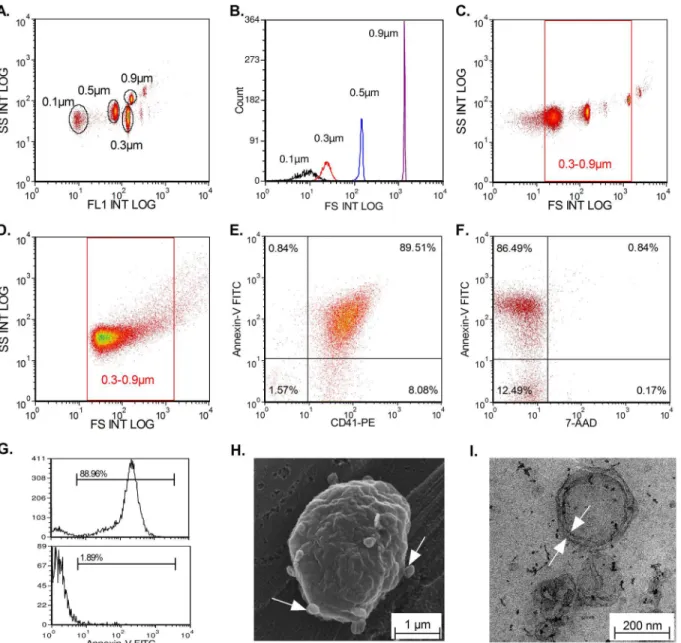
To characterize MPs, a Navios cytometer (Beckman Coulter, Marseille, France), an FSC opti-mized instrument, was used. As shown inFig 1, the cytometer was calibrated using a standard-ized protocol from Biocytex. Briefly, 0.1μm, 0.3μm, 0.5μm, and 0.9μm Megamix beads-FCS
representative scatter plot of an MP population from PBMC. We also observed that the popula-tion of smaller MPs was more significant than the populapopula-tion of larger MPs. Double labeling with annexin-V-FITC and CD41-PE allowed targeting of platelet derived-MPs (Fig 1E). Al-though apoptotic bodies (AB) were excluded by size criteria, we monitored for their possible presence by double staining with annexin V and 7AAD. As shown inFig 1F, AB were not de-tected in our samples. The presence of protein complex (PC) can also interfere with MP analy-sis; therefore, we used lysis with 0.05% triton to evaluate the proportion of PC, which we found was<2% in all analyzed samples (Fig 1G). Finally, MPs were analyzed by electron microscopy. Fig 1. MP analysis by flow cytometry and electron microscopy.Calibration of Navios cytometer using 0.1, 0.3, 0.5, and 0.9μm beads (Biocytex). The
cytometer is able to differentiate the 4 different populations of beads (A-B). We can delimit the gate in accordance with size to study MPs (0.3–0.9μm) (C).
Characteristic elongated shape of MPs repartition limited in a gate of 0.3–0.9μm. (D). Labeling of platelet derived-MPs with CD41 and annexin-V revealed a
double positive population for these markers (E). Example of 7-AAD/annexin V labeling to detect the presence of apoptotic bodies (AB). (F). Absence of contamination with AB. To monitor the presence of protein complexes (PC), lysis with 0.05% triton was used. After lysis, the positive signal disappeared (G). Scanning Electron Microscopy (SEM) shows the production of MPs by B-lymphocytes (white arrows) (H). Transmission electron microscopy (TEM) shows the structure of one MP with a characteristic lipid bilayer (white arrows) (I).
Fig 1Hshows the production of MPs by B-lymphocytes by scanning electron microscopy. Fur-thermore, the presence of MPs in our culture supernatant was demonstrated using TEM, which revealed the characteristic spherical vesicle with a lipid bilayer (Fig 1I).
Immunophenotypic characterization of blood cells and blood cell-derived
MPs by direct flow cytometry
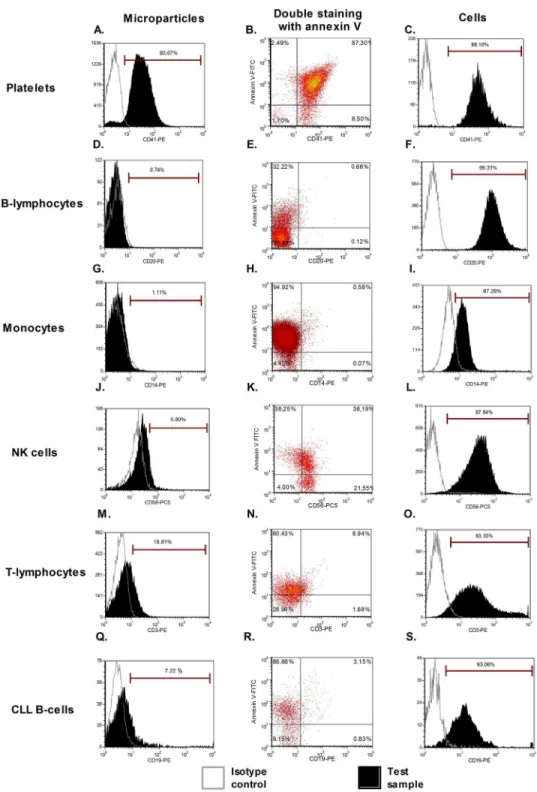
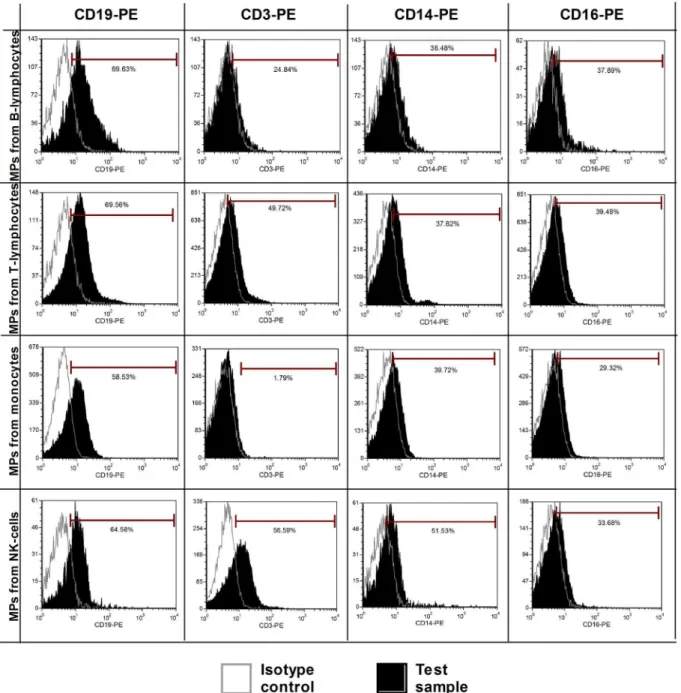
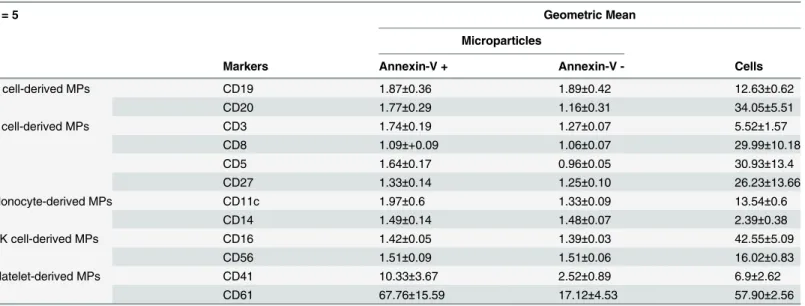
We first investigated the expression of several antigens on the cell surface and cell-derived MPs by direct flow cytometry (n = 5). Signals from platelet markers (CD41 and CD61) were clearly positive on both platelet-derived MPs and platelets (Fig 2A–2C). These initial results indicated that we were able to detect annexin V+/marker+ MPs. These first 2 antigens were largely de-scribed in the MP literature and were used as positive controls to initialize the setup of our ex-periments. However, for all other cell-derived MPs (from B-cells, T-cells, NK cells, monocytes, and CLL B-cells), the markers used were not detected, despite the fact that these antigens were highly expressed by the source cells. A representative example of some of these markers is pro-vided inFig 2. For CD56, CD3, and CD19 staining, a weak positive signal was observed com-pared to the isotopic control (Fig2J,2Mand2Q). However, this signal was a false positive, shown by using the same antibodies to label MPs from different origins (Fig 3). It should be noted that CD14 labeling on monocytes was quite weak, most likely due to the positive selec-tion with anti-CD14 beads (Fig 2I). Heterogeneous expression of phosphatidylserine depen-dent on the cellular source of MPs was also observed. Double staining with annexin-V-FITC and specific markers was applied on four MP types (B-lymphocytes, T-lymphocytes, mono-cytes, NK-cells) with cross-labeling different MPs to detect false positive expression (Fig 3). Histograms of these cell derived-MPs stained with CD19-PE, CD3-PE, CD14-PE, and CD16-PE showed that non-specific labeling occurred in a majority of samples. Means of the Mean Fluorescence Intensity Ratio (MFIR) for all antibodies (studied on both annexin-V posi-tive and negaposi-tive MPs, as well as cell populations) are provided inTable 1. This study demon-strated that all antigens were clearly detected on cells but not on their corresponding MPs, with the exceptions of CD41 and CD61 for platelet-derived MPs. We confirmed the detection of CD41 on platelet derived MPs and the‘‘non detection‘‘of CD5 on CLL B-cell derived MPs by immunogold labeling (S3 Fig).
Immunophenotypic characterization by latex bead flow cytometry
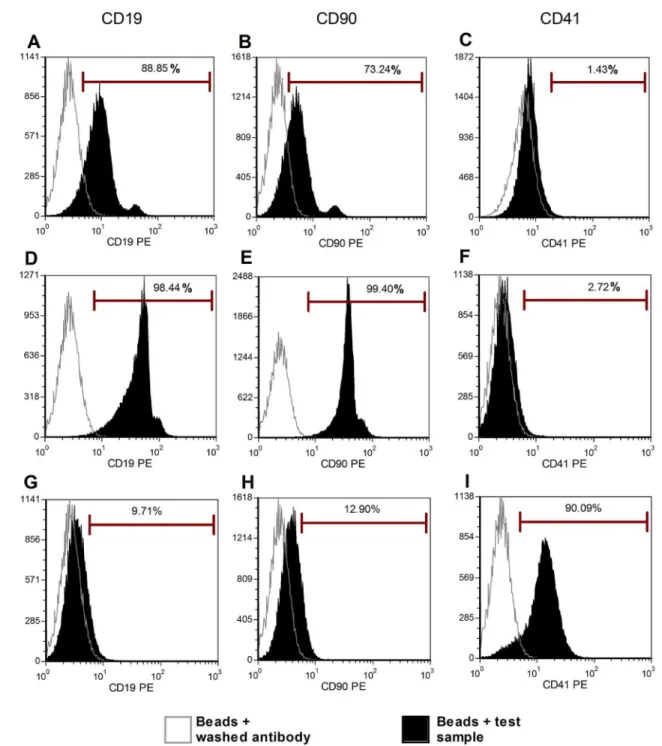
To confirm the results obtained by direct flow cytometry, we studied MPs derived from three cell types (platelets, BM-MSC, and B-cells) with an optimized latex bead technique. Three dif-ferent labels were applied to these MPs (Fig 4). Using this method, as previously described, we confirmed the expression of CD41, a platelet marker, on platelet-derived MPs (Fig 4I). This an-tigen was not found on the 2 other populations of MPs (Fig4Cand4F), validating our protocol. Regarding the direct flow cytometry, positive signals were observed for some markers
(CD19-PE on B cell-derived MPs, CD90 on MSC-derived MPs). However, when the different MPs were cross-labeled for these markers (CD19 on MSC-derived MPs and CD90 on B-cell-de-rived MPs), a positive signal was also observed, indicating that the signals were false positives.
Discussion
Fig 2. MP characterization by direct flow cytometry.A representative case for each staining is provided: for platelet-derived MPs, CD41 (A) associated with annexin-V labeling (B), similar to that found in the original cells (C). For MPs derived from other cellular sources, no antigen was detected (CD20 and CD14) (D/G) despite the expression of these markers on cells (F/I). An annexin-V positive population is present for all samples (ranging from 32% to 94%). For NK-cells, T-lymphocytes, and CLL B-cells, we observed a weak positive signal with CD56, CD3, and CD19, respectively. These signals were thus false positives, demonstrated by the use of other negative controls (Fig 3). Isotypes were used as negative controls (open line) and the tests are presented by filled histogram.
expressing their own panel of proteins [56]. In the present study, we attempted to clarify the differences found in the literature about the phenotype of several blood cell-derived MPs and we proposed a new negative control to avoid false positive detection. The expression of differ-ent antigens (CD3, 5, 8, 11c, 14, 16, 19, 20, 27, 41, 56, and 61) was investigated on B-lympho-cytes, T-lymphoB-lympho-cytes, monoB-lympho-cytes, NK-cells, platelets, CLL B-cells and their derived MPs by two different flow cytometry techniques.
We used Megamix PLUS-beads to calibrate the Navios cytometer, several authors discussed about the impact of the refractive index difference between the beads and the MPs (n = 1.6/
Fig 3. Cross-labeling MPs from different cell types: non-specific labeling.Double staining with annexin-V and specific markers was applied to four MP types (B-lymphocytes, T-lymphocytes, monocytes and NK-cells). Isotypes were used as negative controls (open line) and the tests are presented by filled histogram. Histograms of cell-derived MPs stained with CD19, CD3, CD14, and CD16 showed that non-specific labeling occurs for the majority of samples.
1.4). This point was clarified and well-argued by Robert et al, they performed differential filtra-tions using specific filters and proved that platelet MPs enumerated in the MP gate (0.3–1μm)
were not affected by 1μm filtration, but completely depleted by 0.2μm filtration. They
conclud-ed that difference of index doesn’t affect extensively the flow cytometry forward scatter (FCM FS) results [52;60]. However, it should be noted that this subject is still under debate: some au-thors highlighted that flow cytometry with polystyrene/latex bead calibration can lead to an un-derestimation of the vesicle sizes. It should be interesting to use silica beads that have refractive index much closer than biological MVs. Even if the NAVIOS cytometer is currently one of the best cytometers [52] current flow cytometers have some limitations and are only capable to measure the‘‘top of the iceberg”. The vesicle sizes must be considered with caution [61–65] To keep MPs as close to their native state as possible, we did not use any activator to in-crease MP production, in contrast to previous work that used products such as calcium iono-phore 23187, LPS and collagen [66]. Connor et al and Sims et al demonstrated that the phenotype of platelet-derived MPs can vary depending on the nature of activator used to in-duce their formation; notably collagen, thrombin, ADP or calcium ionophore [21;67]. Similar observations were reported by Jimenez et al for endothelial-cell-derived MPs [68] and by de Jong et al for exosomes [45]. In our study, MPs were isolated by ultracentrifugation, while fil-tration steps were avoided as recommended by Macey et al [36].
We considered MPs as all events within the MP gate and positive for annexin-V labeling. Although this marker is widely used in the MP field [35;52;69], the subject remains under de-bate. Indeed, the use of phosphatidylserine (PS) staining is not always applied to define MP populations [21;22;24;25;28]. Therefore, we analyzed both populations of MPs (annexin-V positive and negative).
Our study confirmed that CD41/CD61 expression on platelet-derived MPs can be detected by direct and latex bead flow cytometry as it was largely described in the literature [5;6]. Sur-prisingly, we obtained a weak positive signal for specific markers such as CD3, CD19, and
Table 1. Mean fluorescence intensity ratio (MFIR) analysis on MPs by direct flow cytometry.
n = 5 Geometric Mean
Microparticles
Markers Annexin-V + Annexin-V - Cells
B cell-derived MPs CD19 1.87±0.36 1.89±0.42 12.63±0.62
CD20 1.77±0.29 1.16±0.31 34.05±5.51
T cell-derived MPs CD3 1.74±0.19 1.27±0.07 5.52±1.57
CD8 1.09±+0.09 1.06±0.07 29.99±10.18
CD5 1.64±0.17 0.96±0.05 30.93±13.4
CD27 1.33±0.14 1.25±0.10 26.23±13.66
Monocyte-derived MPs CD11c 1.97±0.6 1.33±0.09 13.54±0.6
CD14 1.49±0.14 1.48±0.07 2.39±0.38
NK cell-derived MPs CD16 1.42±0.05 1.39±0.03 42.55±5.09
CD56 1.51±0.09 1.51±0.06 16.02±0.83
Platelet-derived MPs CD41 10.33±3.67 2.52±0.89 6.9±2.62
CD61 67.76±15.59 17.12±4.53 57.90±2.56
We calculated the mean of the MFIR±SEM (Meanfluorescence intensity ratio±standard error of the mean) for all used antibodies (n = 5). The expression of all antibodies was evaluated on 5 cell type-derived MPs, both annexin-V + and—populations and also on the original cells. These numbers demonstrated that antigens are clearly expressed on the cells but not necessary on the MPs.
CD56 for T-lymphocytes, B-lymphocytes and NK-cell-derived MPs, respectively. This labeling was shown to be a false positive using the same markers on MPs derived from different cell types (Fig 3). Moreover no other specific antigens were detected on MPs while these antigens were significantly found on the source cells. This was also confirmed with a different and more sensitive technique (immunogold labeling). We were able to detect CD41 on platelet derived
Fig 4. MP characterization by latex bead technique.We studied three types of cell-derived MPs with the latex bead technique: platelet-, BM-MSC- and B-cell-derived MPs. Beads with‘‘washing antibody”were used as negative controls. Three different labels were applied to these MPs. (I) We confirmed the expression of CD41 on platelet-derived MPs, (G-H) and negative signal for CD90 and CD19. (C/F) Although CD41 expression was negative for B-cell and BM-MSC-derived MPs, (A-B, D-E) we observed CD90 and CD19 expression on both B-cells and BM-MSC-derived MPs, confirming false positive labeling.
MPs but no CD19/CD5 on CLL B-cells derived MPs, confirming our cytometry results (S3 Fig). Interestingly, our study showed that the expression profiles of CD41/CD61 are clearly dif-ferent between annexin-V positive and negative populations. This observation was also made for other antigens by Nielsen et al and Connor et al in 2010 [21;70]. Further investigation is needed to better understand this difference.
A recent report suggested that there is a major decrease in antigen expression between cells and EVs [71]. Moreover, it has already been shown that MPs are derived from lipid rafts and we can thus hypothesize that these parts of the membrane can be characterized by differential partitioning of antigens [72–75]. Miguet et al observed by a proteomic study that while some antigens are detected on MPs, CD3, 5, and 8 for T-cells and CD19 for B-cells are not found on MPs despite being highly expressed on the original cells [76]. Our results conflict with those of authors who report detection by direct flow cytometry of CD105, CD90, and CXCR4 on MPs from mesenchymal stem cells [77] and CD3, CD14 and CD19 on MPs from the plasma of polymyositis/dermatomyositis patients [78]. In addition, Ghosh et al and Macey et al detected annexin-V-CD19+ [35] and CD15+ MPs [36], respectively. These discrepancies with our study could be explained by several factors: speed of centrifugation, choice of specific negative con-trols and antibodies, MP origin and the presence of specific activators in culture. Indeed, these authors analyzed MPs from cell culture or directly from plasma and they either applied centri-fugation forces of 16,000 x g to 19,800 x g for 10 min to 1 h or they did not use centricentri-fugation at all. More importantly, all of these groups used different negative controls. Baka et al used un-stained samples and Kim et al, Ghosh et al, Macey et al used isotype controls. Trummer and colleagues demonstrated that using isotype negative controls can induce errors: they concluded that using flow cytometry to discriminate between positive and negative populations of MPs la-beled with several antibodies could be an obstacle for their characterization [79]. All of these differences could explain the variation in results between several groups. The study of MPs is complicated by their limited surface area and relatively small number of proteins available for antibody binding. Thus, the latex bead technique has been used by several groups to facilitate the characterization of MPs by flow cytometry. Different protocols have been published [37;54;55], but we adapted the protocols of Wu et al and Mokarizadeh et al with minor modifi-cations [39;40]. Since no significant difference was observed by using blocking reagent, we re-moved this step, as previously described by Oksvold et al [56]. Three different negative controls were used: beads alone without any staining, beads with MPs and isotype control and beads with MPs and a negative marker (one not present on the original cells). Isotype controls were removed from our study because they resulted in some false positive results (data not shown). Szczepanski et al, Wu et al and Mokarizadeh et al presented positive results from the first protocol, notably for CD9, CD33, CD63, CD73, and CD90 [39;40;54]. However, in our study, we demonstrated that this protocol is associated with non-specific labeling due to anti-body affinity for latex beads. Indeed incubating beads with antianti-body in the absence of MPs re-sulted in an increase of background noise (data not shown). Thereafter, we designed our own protocol, by directly incubating the beads with previously labeled MPs. In this way, we avoided an increase in background signals due to non-specific binding of antibodies to beads. Using this protocol we were able to detect specific markers on platelet-derived MPs. Together, our re-sults indicated that several previously published data sets using the latex bead technique in-clude false positive results due to the use of inappropriate protocols or negative controls.
types (i.e. CD5 could be found on T or B cells), several negative controls should be tested for a specific MV staining.
In conclusion, the characterization of MPs is still a challenging field requiring lot of precau-tions in the interpretation of the fluorescence signal. We demonstrated that isotype controls and unstained samples are not suitable for MP characterization. Therefore, we proposed using other negative markers (marker not found on the original cell) by cross-staining MPs to dem-onstrate the true positive labeling. We want to underline the fact that this method is applicable on cell culture supernatants specifically but not on body fluids (like urine or plasma), which are more complex samples. By this manner, non-specific antibody labeling could be subtracted out, and reliable results could be obtained.
Supporting Information
S1 Fig. CD3 titration on T cells and T cell derived MPs.
(DOCX)
S2 Fig. CD41 titration on platelet derived MPs.
(DOCX)
S3 Fig. Immunogold labeling on CLL B-cell derived and platelet derived MPs with CD5 and CD41 antibodies.
(DOCX)
S1 Table. Viability of cells by Trypan blue assay.
(DOCX)
S2 Table. All the Concentrations/Clones/Origins of antibodies used in experiments.
(DOCX)
S3 Table. Mean Fluorescence Intensity (MFI) and MFI Ratio (MFIR) of the CD3 labeling on T cells.These numbers demonstrated that CD3 antigen is clearly expressed on T-cells. (DOCX)
S4 Table. Mean Fluorescence Intensity (MFI) and MFI Ratio (MFIR) of the CD3 labeling on T cell derived MPs.These numbers demonstrated that CD3 antigen is not necessary ex-pressed on T cell derived MPs.
(DOCX)
Author Contributions
Conceived and designed the experiments: EC LL BS. Performed the experiments: EC HD KP MVD. Analyzed the data: EC MVD BS. Contributed reagents/materials/analysis tools: EC HD KP MV DP NM PM DB LL BS. Wrote the paper: EC MVD LL BS.
References
1. Gyorgy B, Szabo TG, Pasztoi M, Pal Z, Misjak P, Aradi B et al. Membrane vesicles, current state-of-the-art: emerging role of extracellular vesicles. Cell Mol Life Sci 2011; 68(16):2667–2688. doi:10. 1007/s00018-011-0689-3PMID:21560073
2. Raposo G, Stoorvogel W. Extracellular vesicles: exosomes, microvesicles, and friends. J Cell Biol 2013; 200(4):373–383. doi:10.1083/jcb.201211138PMID:23420871
4. Cocucci E, Racchetti G, Meldolesi J. Shedding microvesicles: artefacts no more. Trends Cell Biol 2009; 19(2):43–51. doi:10.1016/j.tcb.2008.11.003PMID:19144520
5. Piccin A, Murphy WG, Smith OP. Circulating microparticles: pathophysiology and clinical implications. Blood Rev 2007; 21(3):157–171. PMID:17118501
6. Burnier L, Fontana P, Kwak BR, Angelillo-Scherrer A. Cell-derived microparticles in haemostasis and vascular medicine. Thromb Haemost 2009; 101(3):439–451. PMID:19277403
7. Choi DS, Kim DK, Kim YK, Gho YS. Proteomics, transcriptomics and lipidomics of exosomes and ecto-somes. Proteomics 2013; 13(10–11):1554–1571. doi:10.1002/pmic.201300131PMID:24150872
8. Laffont B, Corduan A, Ple H, Duchez AC, Cloutier N, Boilard E et al. Activated platelets can deliver mRNA regulatory Ago2*microRNA complexes to endothelial cells via microparticles. Blood 2013; 122 (2):253–261. doi:10.1182/blood-2013-03-492801PMID:23652806
9. Patz S, Trattnig C, Grunbacher G, Ebner B, Gully C, Novak A et al. More than cell dust: microparticles isolated from cerebrospinal fluid of brain injured patients are messengers carrying mRNAs, miRNAs, and proteins. J Neurotrauma 2013; 30(14):1232–1242. doi:10.1089/neu.2012.2596PMID:23360174
10. Hunter MP, Ismail N, Zhang X, Aguda BD, Lee EJ, Yu L et al. Detection of microRNA expression in human peripheral blood microvesicles. PLoS ONE 2008; 3(11):e3694. doi:10.1371/journal.pone. 0003694PMID:19002258
11. Fonsato V, Collino F, Herrera MB, Cavallari C, Deregibus MC, Cisterna B et al. Human liver stem cell-derived microvesicles inhibit hepatoma growth in SCID mice by delivering antitumor microRNAs. Stem Cells 2012; 30(9):1985–1998. doi:10.1002/stem.1161PMID:22736596
12. Moldovan L, Batte K, Wang Y, Wisler J, Piper M. Analyzing the circulating microRNAs in exosomes/ex-tracellular vesicles from serum or plasma by qRT-PCR. Methods Mol Biol 2013; 1024:129–145. doi: 10.1007/978-1-62703-453-1_10PMID:23719947
13. Lee Y, El Andaloussi S, Wood MJA. Exosomes and microvesicles: extracellular vesicles for genetic in-formation transfer and gene therapy. Hum Mol Genet 2012; 21(R1):R125–R134. PMID:22872698
14. Pisetsky DS, Gauley J, Ullal AJ. Microparticles as a source of extracellular DNA. Immunol Res 2011; 49(1–3):227–234. doi:10.1007/s12026-010-8177-7PMID:21170741
15. Balaj L, Lessard R, Dai L, Cho YJ, Pomeroy SL, Breakefield XO et al. Tumour microvesicles contain ret-rotransposon elements and amplified oncogene sequences. Nat Commun 2011; 2:180. doi:10.1038/ ncomms1180PMID:21285958
16. Waldenstrom A, Genneback N, Hellman U, Ronquist G. Cardiomyocyte microvesicles contain DNA/ RNA and convey biological messages to target cells. PLoS ONE 2012; 7(4):e34653. doi:10.1371/ journal.pone.0034653PMID:22506041
17. D'Souza-Schorey C, Clancy JW. Tumor-derived microvesicles: shedding light on novel microenviron-ment modulators and prospective cancer biomarkers. Genes Dev 2012; 26(12):1287–1299. doi:10. 1101/gad.192351.112PMID:22713869
18. Mause SF, Weber C. Microparticles: protagonists of a novel communication network for intercellular in-formation exchange. Circ Res 2010; 107(9):1047–1057. doi:10.1161/CIRCRESAHA.110.226456 PMID:21030722
19. Heijnen HF, Schiel AE, Fijnheer R, Geuze HJ, Sixma JJ. Activated platelets release two types of mem-brane vesicles: microvesicles by surface shedding and exosomes derived from exocytosis of multivesi-cular bodies and alpha-granules. Blood 1999; 94(11):3791–3799. PMID:10572093
20. van Doormaal FF, Kleinjan A, Di Nisio M, Buller HR, Nieuwland R. Cell-derived microvesicles and can-cer. Neth J Med 2009; 67(7):266–273. PMID:19687520
21. Connor DE, Exner T, Ma DDF, Joseph JE. The majority of circulating platelet-derived microparticles fail to bind annexin V, lack phospholipid-dependent procoagulant activity and demonstrate greater expres-sion of glycoprotein Ib. Thromb Haemost 2010; 103(5):1044–1052. doi:10.1160/TH09-09-0644PMID: 20390225
22. Ayers L, Kohler M, Harrison P, Sargent I, Dragovic R, Schaap M et al. Measurement of circulating cell-derived microparticles by flow cytometry: sources of variability within the assay. Thromb Res 2011; 127(4):370–377. doi:10.1016/j.thromres.2010.12.014PMID:21257195
23. Boulanger CM, Amabile N, Tedgui A. Circulating microparticles: a potential prognostic marker for ath-erosclerotic vascular disease. Hypertension 2006; 48(2):180–186. PMID:16801490
24. Amabile N, Guerin AP, Leroyer A, Mallat Z, Nguyen C, Boddaert J et al. Circulating endothelial micro-particles are associated with vascular dysfunction in patients with end-stage renal failure. J Am Soc Nephrol 2005; 16(11):3381–3388. PMID:16192427
26. Lacroix R, Plawinski L, Robert S, Doeuvre L, Sabatier F, Martinez de Lizarrondo S et al. Leukocyte-and endothelial-derived microparticles: a circulating source for fibrinolysis. Haematologica 2012; 97 (12):1864–1872. doi:10.3324/haematol.2012.066167PMID:22733025
27. Tissot JD, Rubin O, Canellini G. Analysis and clinical relevance of microparticles from red blood cells. Curr Opin Hematol 2010; 17(6):571–577. PMID:20960973
28. Boulanger CM, Amabile N, Tedgui A. Circulating microparticles: a potential prognostic marker for ath-erosclerotic vascular disease. Hypertension 2006; 48(2):180–186. PMID:16801490
29. Soriano AO, Jy W, Chirinos JA, Valdivia MA, Velasquez HS, Jimenez JJ et al. Levels of endothelial and platelet microparticles and their interactions with leukocytes negatively correlate with organ dysfunction and predict mortality in severe sepsis. Crit Care Med 2005; 33(11):2540–2546. PMID:16276178
30. Galindo-Hernandez O, Villegas-Comonfort S, Candanedo F, Gonzalez-Vazquez MC, Chavez-Ocana S, Jimenez-Villanueva X et al. Elevated concentration of microvesicles isolated from peripheral blood in breast cancer patients. Arch Med Res 2013; 44(3):208–214. doi:10.1016/j.arcmed.2013.03.002 PMID:23506723
31. Nielsen CT. Circulating microparticles in systemic Lupus Erythematosus. Dan Med J 2012; 59(11): B4548. PMID:23171755
32. Munoz JL, Bliss SA, Greco SJ, Ramkissoon SH, Ligon KL, Rameshwar P. Delivery of Functional Anti-miR-9 by Mesenchymal Stem Cell-derived Exosomes to Glioblastoma Multiforme Cells Conferred Che-mosensitivity. Mol Ther Nucleic Acids 2013; 2:e126. doi:10.1038/mtna.2013.60PMID:24084846
33. Nakamizo A, Marini F, Amano T, Khan A, Studeny M, Gumin J et al. Human bone marrow-derived mes-enchymal stem cells in the treatment of gliomas. Cancer Res 2005; 65(8):3307–3318. PMID:
15833864
34. Akao Y, Iio A, Itoh T, Noguchi S, Itoh Y, Ohtsuki Y et al. Microvesicle-mediated RNA molecule delivery system using monocytes/macrophages. Mol Ther 2011; 19(2):395–399. doi:10.1038/mt.2010.254 PMID:21102562
35. Ghosh AK, Secreto CR, Knox TR, Ding W, Mukhopadhyay D, Kay NE. Circulating microvesicles in B-cell chronic lymphocytic leukemia can stimulate marrow stromal B-cells: implications for disease progres-sion. Blood 2010; 115(9):1755–1764. doi:10.1182/blood-2009-09-242719PMID:20018914
36. Macey MG, Enniks N, Bevan S. Flow cytometric analysis of microparticle phenotype and their role in thrombin generation. Cytometry B Clin Cytom 2011; 80(1):57–63. doi:10.1002/cyto.b.20551PMID: 20632415
37. Blanchard N, Lankar D, Faure F, Regnault A, Dumont C, Raposo G et al. TCR activation of human T cells induces the production of exosomes bearing the TCR/CD3/zeta complex. J Immunol 2002; 168 (7):3235–3241. PMID:11907077
38. Miguet L, Bechade G, Fornecker L, Zink E, Felden C, Gervais C et al. Proteomic analysis of malignant B-cell derived microparticles reveals CD148 as a potentially useful antigenic biomarker for mantle cell lymphoma diagnosis. J Proteome Res 2009; 8(7):3346–3354. doi:10.1021/pr801102cPMID: 19413345
39. Mokarizadeh A, Delirezh N, Morshedi A, Mosayebi G, Farshid AA, Mardani K. Microvesicles derived from mesenchymal stem cells: potent organelles for induction of tolerogenic signaling. Immunol Lett 2012; 147(1–2):47–54. doi:10.1016/j.imlet.2012.07.003PMID:22841963
40. Wu S, Ju GQ, Du T, Zhu YJ, Liu GH. Microvesicles derived from human umbilical cord Wharton's jelly mesenchymal stem cells attenuate bladder tumor cell growth in vitro and in vivo. PLoS ONE 2013; 8 (4):e61366. doi:10.1371/journal.pone.0061366PMID:23593475
41. Van Damme M, Crompot E, Meuleman N, Mineur P, Bron D, Lagneaux L et al. HDAC isoenzyme ex-pression is deregulated in chronic lymphocytic leukemia B-cells and has a complex prognostic signifi-cance. Epigenetics 2012; 7(12):1403–1412. doi:10.4161/epi.22674PMID:23108383
42. Witwer KW, Buzas EI, Bemis LT, Bora A, Lasser C, Lotvall J et al. Standardization of sample collection, isolation and analysis methods in extracellular vesicle research. J Extracell Vesicles 2013; 2.
43. Najar M, Rouas R, Raicevic G, Boufker HI, Lewalle P, Meuleman N et al. Mesenchymal stromal cells promote or suppress the proliferation of T lymphocytes from cord blood and peripheral blood: the impor-tance of low cell ratio and role of interleukin-6. Cytotherapy 2009; 11(5):570–583. doi:10.1080/ 14653240903079377PMID:19565371
44. Mahaweni NM, Kaijen-Lambers MEH, Dekkers J, Aerts JGJV, Hegmans JPJJ. Tumour-derived exo-somes as antigen delivery carriers in dendritic cell-based immunotherapy for malignant mesothelioma. J Extracell Vesicles 2013; 2.
46. Sabatier F, Roux V, Anfosso F, Camoin L, Sampol J, Dignat-George F. Interaction of endothelial micro-particles with monocytic cells in vitro induces tissue factor-dependent procoagulant activity. Blood 2002; 99(11):3962–3970. PMID:12010795
47. Jayachandran M, Miller VM, Heit JA, Owen WG. Methodology for isolation, identification and character-ization of microvesicles in peripheral blood. J Immunol Methods 2012; 375(1–2):207–214. doi:10. 1016/j.jim.2011.10.010PMID:22301270
48. Dey-Hazra E, Hertel B, Kirsch T, Woywodt A, Lovric S, Haller H et al. Detection of circulating microparti-cles by flow cytometry: influence of centrifugation, filtration of buffer, and freezing. Vasc Health Risk Manag 2010; 6:1125–1133. doi:10.2147/VHRM.S13236PMID:21191433
49. Gyorgy B, Modos K, Pallinger E, Paloczi K, Pasztoi M, Misjak P et al. Detection and isolation of cell-de-rived microparticles are compromised by protein complexes resulting from shared biophysical parame-ters. Blood 2011; 117(4):e39–e48. doi:10.1182/blood-2010-09-307595PMID:21041717
50. Gyorgy B, Szabo TG, Turiak L, Wright M, Herczeg P, Ledeczi Z et al. Improved flow cytometric assess-ment reveals distinct microvesicle (cell-derived microparticle) signatures in joint diseases. PLoS ONE 2012; 7(11):e49726. doi:10.1371/journal.pone.0049726PMID:23185418
51. Aass HC, Ovstebo R, Troseid AM, Kierulf P, Berg JP, Henriksson CE. Fluorescent particles in the anti-body solution result in false TF- and CD14-positive microparticles in flow cytometric analysis. Cytome-try A 2011; 79(12):990–999. doi:10.1002/cyto.a.21147PMID:21990118
52. Robert S, Lacroix R, Poncelet P, Harhouri K, Bouriche T, Judicone C et al. High-sensitivity flow cytome-try provides access to standardized measurement of small-size microparticles—brief report. Arterios-cler Thromb Vasc Biol 2012; 32(4):1054–1058. doi:10.1161/ATVBAHA.111.244616PMID:22328775
53. Gyorgy B, Szabo TG, Turiak L, Wright M, Herczeg P, Ledeczi Z et al. Improved flow cytometric assess-ment reveals distinct microvesicle (cell-derived microparticle) signatures in joint diseases. PLoS ONE 2012; 7(11):e49726. doi:10.1371/journal.pone.0049726PMID:23185418
54. Szczepanski MJ, Szajnik M, Welsh A, Whiteside TL, Boyiadzis M. Blast-derived microvesicles in sera from patients with acute myeloid leukemia suppress natural killer cell function via membrane-associat-ed transforming growth factor-beta1. Haematologica 2011; 96(9):1302–1309. doi:10.3324/haematol. 2010.039743PMID:21606166
55. Caby MP, Lankar D, Vincendeau-Scherrer C, Raposo G, Bonnerot C. Exosomal-like vesicles are pres-ent in human blood plasma. Int Immunol 2005; 17(7):879–887. PMID:15908444
56. Oksvold MP, Kullmann A, Forfang L, Kierulf B, Li M, Brech A et al. Expression of B-cell surface antigens in subpopulations of exosomes released from B-cell lymphoma cells. Clin Ther 2014; 36(6):847–862. doi:10.1016/j.clinthera.2014.05.010PMID:24952935
57. Shefler I, Salamon P, Reshef T, Mor A, Mekori YA. T cell-induced mast cell activation: a role for micro-particles released from activated T cells. J Immunol 2010; 185(7):4206–4212. doi:10.4049/jimmunol. 1000409PMID:20810987
58. Thery C, Amigorena S, Raposo G, Clayton A. Isolation and characterization of exosomes from cell cul-ture supernatants and biological fluids. Curr Protoc Cell Biol 2006; Chapter 3:Unit. doi:10.1002/ 0471143030.cb0324s31PMID:18228492
59. Shelke GV, Lasser C, Gho YS, Lotvall J. Importance of exosome depletion protocols to eliminate func-tional and RNA-containing extracellular vesicles from fetal bovine serum. J Extracell Vesicles 2014; 3.
60. Robert S, Poncelet P, Lacroix R, Raoult D, Dignat-George F. More on: calibration for the measurement of microparticles: value of calibrated polystyrene beads for flow cytometry-based sizing of biological mi-croparticles. J Thromb Haemost 2011; 9(8):1676–1678. doi:10.1111/j.1538-7836.2011.04387.x PMID:21645234
61. Chandler WL, Yeung W, Tait JF. A new microparticle size calibration standard for use in measuring smaller microparticles using a new flow cytometer. J Thromb Haemost 2011; 9(6):1216–1224. doi:10. 1111/j.1538-7836.2011.04283.xPMID:21481178
62. Ayers L, Harrison P, Kohler M, Ferry B. Procoagulant and platelet-derived microvesicle absolute counts determined by flow cytometry correlates with a measurement of their functional capacity. J Extracell Vesicles 2014; 3.
63. Dragovic RA, Gardiner C, Brooks AS, Tannetta DS, Ferguson DJP, Hole P et al. Sizing and phenotyp-ing of cellular vesicles usphenotyp-ing Nanoparticle Trackphenotyp-ing Analysis. Nanomedicine 2011; 7(6):780–788. doi: 10.1016/j.nano.2011.04.003PMID:21601655
64. van der Pol E, Coumans F, Varga Z, Krumrey M, Nieuwland R. Innovation in detection of microparticles and exosomes. J Thromb Haemost 2013; 11 Suppl 1:36–45. doi:10.1111/jth.12254PMID:23809109
66. Burger D, Schock S, Thompson CS, Montezano AC, Hakim AM, Touyz RM. Microparticles: biomarkers and beyond. Clin Sci (Lond) 2013; 124(7):423–441. doi:10.1042/CS20120309PMID:23249271
67. Sims PJ, Wiedmer T, Esmon CT, Weiss HJ, Shattil SJ. Assembly of the platelet prothrombinase com-plex is linked to vesiculation of the platelet plasma membrane. Studies in Scott syndrome: an isolated defect in platelet procoagulant activity. J Biol Chem 1989; 264(29):17049–17057. PMID:2793843
68. Jimenez JJ, Jy W, Mauro LM, Soderland C, Horstman LL, Ahn YS. Endothelial cells release phenotypi-cally and quantitatively distinct microparticles in activation and apoptosis. Thromb Res 2003; 109 (4):175–180. PMID:12757771
69. Liu R, Klich I, Ratajczak J, Ratajczak MZ, Zuba-Surma EK. Erythrocyte-derived microvesicles may transfer phosphatidylserine to the surface of nucleated cells and falsely 'mark' them as apoptotic. Eur J Haematol 2009; 83(3):220–229. doi:10.1111/j.1600-0609.2009.01271.xPMID:19456851
70. Nielsen MH, Beck-Nielsen H, Andersen MN, Handberg A. A flow cytometric method for characterization of circulating cell-derived microparticles in plasma. J Extracell Vesicles 2014; 3.
71. Gheldof D, Hardij J, Cecchet F, Chatelain B, Dogne JM, Mullier F. Thrombin generation assay and transmission electron microscopy: a useful combination to study tissue factor-bearing microvesicles. J Extracell Vesicles 2013; 2.
72. Davizon P, Munday AD, Lopez JA. Tissue factor, lipid rafts, and microparticles. Semin Thromb Hemost 2010; 36(8):857–864. doi:10.1055/s-0030-1267039PMID:21049386
73. Del Conde I, Shrimpton CN, Thiagarajan P, Lopez JA. Tissue-factor-bearing microvesicles arise from lipid rafts and fuse with activated platelets to initiate coagulation. Blood 2005; 106(5):1604–1611. PMID:15741221
74. Biro E, Akkerman JWN, Hoek FJ, Gorter G, Pronk LM, Sturk A et al. The phospholipid composition and cholesterol content of platelet-derived microparticles: a comparison with platelet membrane fractions. J Thromb Haemost 2005; 3(12):2754–2763. PMID:16359513
75. Tan SS, Yin Y, Lee T, Lai RC, Yeo RWY, Zhang B et al. Therapeutic MSC exosomes are derived from lipid raft microdomains in the plasma membrane. J Extracell Vesicles 2013; 2.
76. Miguet L, Pacaud K, Felden C, Hugel B, Martinez MC, Freyssinet JM et al. Proteomic analysis of malig-nant lymphocyte membrane microparticles using double ionization coverage optimization. Proteomics 2006; 6(1):153–171. PMID:16342139
77. Kim SJ, Moon GJ, Cho YH, Kang HY, Hyung NK, Kim D et al. Circulating mesenchymal stem cells mi-croparticles in patients with cerebrovascular disease. PLoS ONE 2012; 7(5):e37036. doi:10.1371/ journal.pone.0037036PMID:22615882
78. Baka Z, Senolt L, Vencovsky J, Mann H, Simon PS, Kittel A et al. Increased serum concentration of im-mune cell derived microparticles in polymyositis/dermatomyositis. Immunol Lett 2010; 128(2):124– 130. doi:10.1016/j.imlet.2009.12.018PMID:20043950