_______________________________________________________________________________________________________________
Implementation of “PLST” Assessment Model to Detect
Development of Language Skill in Early Childhood (Phase II)
NELVA ROLINA, APRILIA TINA LIDYASARI, EVA IMANIA ELIASA
Yogyakarta State University
[email protected] or [email protected]
Date Received: January 2, 2015; Date Revised: March 4, 2015
Abstract – This research will be done for 3 years (3 phases). The first year had been done on 2013 ago. 2014 is the second year of research (phase II). Research phase of this study (second year), namely development phase: the prototype of model is developed to be a model. The activities carried out in phase II include: expert validation test, readability test, revision, kindergarten teacher training, limited trial, and the trial was extended to find models that fit between the theoretical concepts with empirical data in the field. And finally (second year), from all kindergarten which be the sample study, it was found that all kindergarten were using the general assessment without special assessment for development of children’s language, so it is necessary to create assessment “PLST” to detect the development of language skill for early childhood (kindergarten student). It has to continue in second to third year. The final research, which is at the end of the third year (phase III) is expected to match model assessment “PLST” as well as the guidance in learning in kindergarten, which can be used by teachers to detect and monitor the development of language skills, identifying the amount of vocabulary and sentences are mastered children, and the stages of language development next. To achieve these objectives, the researcher adopted a model of research, development, and diffusion by Hopkins & Clark (Havelock, 1976).
Keywords–Implementation of PLST Assessment Model, Language Skill, Early Childhood.
INTRODUCTION
Products developed in Phase II (second year) is a product of the results of the first phase of the study (first year), ie obtaining the early prototype model of assessment "PLST" to detect the development of language skills of young children. The resulting initial prototype in Phase I (first year) is still a model assessment "PLST" to detect the development of early childhood language skills are still rough, in the sense of not having usage guidelines. Assessment model consists of only one book, without the use of manual.
Using questionnaires product feasibility, assessment "PLST" model to detect the development of early childhood language skills gets feedback from the experts using the Delphi method. The assessment "PLST" model to detect the development of language skills of early childhood that had only consisted of one book, turned into two books, namely the book model assessment "PLST" to detect the development of language skills of young children and their use manual (a model that has received input from experts attached). The first book contains everything about
assessment "PLST" model to detect the development of language skills of early childhood, and the second book contains guidelines for the use complete with application examples.
MATERIALS AND METHODS
Assessment of Early Childhood Development
Preschool and early childhood education is the place where they are supported and encouraged and induce multi potential to develop optimally. Assistance, encouragement, and stimulation was provided by tutors, counselors, and teachers of early childhood and kindergarten through fun play, relax, and encouraging children. Which can foster the ability to play multi-potential in children, especially the development of language skills requires assessment of
its design models. Assessment of language
development that will be developed is PLST model assessment (Preschool Language Screening Test).
2
enter further education. Readiness to enter school readiness can be seen from them when they are in early childhood education and preschool or kindergarten (Clifford & Maxwell, 2004) such as the purpose, limitations, accuracy drills, and equipment types are conditioned to it. In addition, National Education Goals Panel (NEGP, 1997; Kagan, Moore & Bredekamp, 1995) still in Clifford & Maxwell (2004), said that there are five important in assessing the readiness of children to enter school, namely: physical wellbeing and the motor development; social and emotional development; language development; approaches toward learning; cognitive and general knowledge. Five things above can be seen and perceived when they enter kindergarten.
Physical and motor development of the child will be met properly and optimally when they are familiar with a variety of play activities freely and unimpeded movement made in kindergarten. Playing motion that requires the involvement of physical and motor development of children playing can be done through model mimicking animal behavior. For example, how cats fighting fellow cat food, cat catch mice and cats fighting. In order for the potential physical and psychological development of children can be identified and detected the progress and condition of the block early, intensive screening required. In this regard, Gabel & Erickson (1980: 85) recommends screening specifically in terms of: the problem of the eye and vision; Kesu-diffi- hearing; the development of a whole; The problem of learning, school readiness, communication difficulties; behavioral and emotional problems of children.
Social and emotional development, can also be prepared and socialized from early childhood through the various activities of cooperative play and collaborative play is performed in kindergartens. For example, imitating playing cat fighting, cat fighting over food, will foster a sense of togetherness and emotional stability exercises. Playing cooking will also establish social and emotional development of children. Thus, the child's social-emotional readiness can be assessed from the model of play that aims to build and develop their social-emotional.
Developmental approach to learning, can also be viewed and assessed readiness when they had entered kindergarten. Because in kindergarten has been trained to learn about things through play activities. They learn to recognize letters, numbers, environment, animals, pick and choose the shape, color, size and other things that are around them. They have become familiar with the voice of an animal, and people
talking. Therefore, all activities can be considered as child development assessment program widely (Gabel & Erickson, 1980: 86), as long as they enroll in kindergarten (Depdiknas, 2005).
Language skills in children kindergarten and early childhood, is also an important part of the socialized and trained in kindergarten. This can be done through habituation to hear the story told by the teacher, letter recognition, practice saying the words and short sentences, even storytelling exercise. Language skills can also be assessed through play activities that contain enrichment of vocabulary, letters, words, and words are easy, and the words naming the objects in the surrounding environment of their lives. As said (Clifton Pye, 2005) that children aged 3 to 5 years are capable of learning new words directly or indirectly with the environment. For example, the names of the objects in the living room, bedroom, kitchen, study room, and a relaxing lounge. Preschol program must supply experiences to build this basic knowledge (Paynter, 1999).
It is no less important in assessing the preparation of the child to enter the world of schooling and the next is the ability to think in general cognitive ability. Cognitive skills and general knowledge children will thrive when they have terbiasakan and terlatihkan from an early age and kindergarten. General cognitive ability and the ability of the child can be seen from a working knowledge of the various letters and words. As said Paynter (1999) that prior to entering school have had ... "abbout knowledge of letters and sounds, print and picture, and word and setences is a prerequisite for learning to read and write". These capabilities will be obtained through the play by introducing letters and words, introducing the sound of the consonant letters correctly, free storytelling, listening to tales and history to children in kindergarten.
_______________________________________________________________________________________________________________
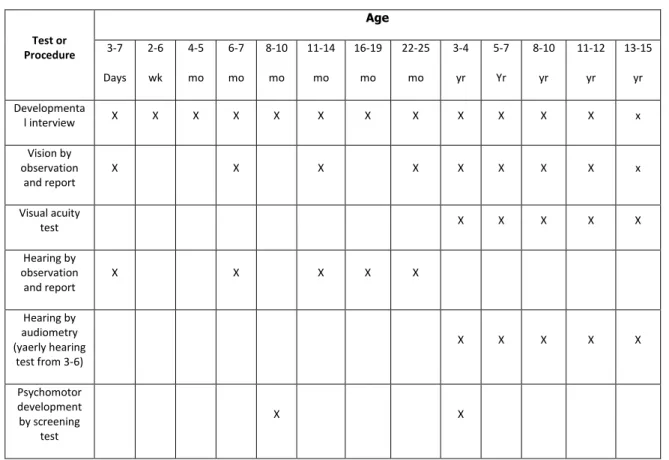
Table 1. Screening guidelines for EPSDT Program
Test or Procedure
Age
3-7
Days 2-6
wk 4-5
mo 6-7
mo 8-10
mo 11-14
mo
16-19
mo
22-25
mo 3-4
yr 5-7
Yr 8-10
yr
11-12
yr
13-15
yr
Developmenta
l interview X X X X X X X X X X X X x
Vision by observation
and report
X X X X X X X X x
Visual acuity
test X X X X X
Hearing by observation
and report
X X X X X
Hearing by audiometry (yaerly hearing
test from 3-6)
X X X X X
Psychomotor development by screening
test
X X
Source: Adapted from Gabel (1980: 88). Screening Procedures (in Child Development and Developmental Disabilities).
Design Research
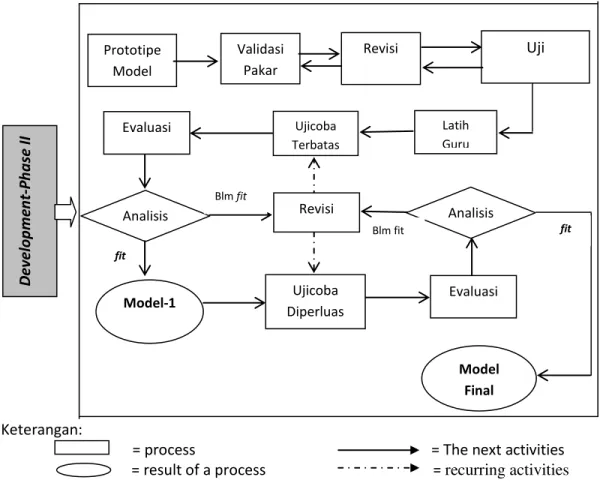
In the phase II study (second year), the development stage, the initial prototype model was developed into a model assessment "PLST". Activities undertaken in the second stage (second year) include expert validation test, readability test, revision, train kindergarten teachers, limited trial, and the trial was extended to find models that fit between the theoretical concepts with empirical data in the field.
Validation of expert assessment of the prototype models "PLST" performed by Delphi method, which collects data from respondents in the domain of research, designed as a group communication process that aims to achieve a convergence of opinion about model assessment "PLST" which has been designed researchers.
The results of the Delphi method, conducted trials legibility to the kindergarten teacher as a model user. After the revised results of legibility, then do the training for kindergarten teachers who will use the model assessment "PLST" in limited trials and trials
expanded. Researchers trained 30 teachers in kindergarten. Limited test is planned at 6 Kindergarten (3 classes, group A, group B class 3) and 16 trials planned expanded kindergarten (grade 8 group A and group B grade 8). With a breakdown of each class taught by two (2) kindergarten teachers, one teacher and one person as a person as an observer.
In the phase II study (second year), data were collected by questionnaire, demonstration, direct observation and interviews. Product eligibility questionnaire, interview and observation guide developed the research team before plunging spaciousness, as a guide in collecting the required information.
4 Model-1
Prototipe Model
Validasi Pakar
Keterangan:
= = process = The next activities = result of a process = recurring activities
RESULTS AND DISCUSSION
Test Result
Limited testing done at 6 Kindergarten (3 groups of 3 groups A and B), which is 3 kindergartens in the district of Gunung Kidul for group A and 3 kindergartens in Bantul for group B. Before conducting limited testing and trials expanded, conducted workshops application model assessment "PLST" to detect the development of language skills of early childhood for 4 days (20, 21, 27, and 28 September 2014) @ 4,5 hours duration with the material:
Table 1. Materials with Corresponding Number of Hours
No. Material Time
(hours)
1. Early Childhood (AUD) 4,5
2. Assessment of Early Childhood Development
4,5
3. How to Use the Assessment PLST 4,5 4. How to Report the Assessment PLST 4,5
Total of Time 18
The workshop application model assessment "PLST" to detect the development of language skills of early childhood carried out for 4 days and done with a short duration of time each day (4.5 hours) due to sync time with the kindergarten teachers who cannot leave the learning activities in TK respectively. This limited testing indicates that the language used in products such as model assessment "PLST" to detect the development of language skills of early childhood, is too complex and difficult to understand by teachers use. For that, it needs to be revised, which is to simplify the use of language that can be used easily stake holders.
Expanded trials conducted in 16 kindergartens in Prop. DI.Yogyakarta (consisting of 4 districts and 1 municipality, each 3 plus 1 TK TK taken at random, then there are 16 test sites in Yogyakarta). TK for each district / city taken based on the criteria of: 1 large kindergarten (consisting of 6-8 number of classes), 1 TK medium (consisting of 4-6 number of classes), and one kindergarten small (less than 4 classes). Kindergartens are as follows:
Dev
elo
p
me
n
t-P
h
a
se
I
I
Uji
Keterbacaan
Revisi
Model
Final Latih Guru Ujicoba
Terbatas
Revisi Evaluasi
Analisis
Ujicoba
Diperluas
Evaluasi Analisis Blm fit
fit
_______________________________________________________________________________________________________________
Table 2. Name of Schools and District/ Regency/ City
District/ Regency/ City Name of School
Gunung Kidul TK IT Tunas Mulia Wonosari, TK Masyithoh Ngunut I, TK Negeri 1 Maret
Kulon Progo TK IT Ibnu Mas’ud, TK ABA Kasatriyan, TK Negeri Pembina Wates
Sleman TK Negeri 1 Sleman, TK ABA Sleman Kota, TK An-Nur
Bantul TK Negeri Pembina Bantul, TK Masyithoh Dukuh, TK Masyithoh
Kembang Songo I, TK Primagama Bantul
Kodya Yogyakarta TK Negeri Pembina Kota Yogyakarta, TK ABA Kauman, TK Pedagogia
The results of the test can be seen in the extended exposure below:
1. District of Gunung Kidul The results of the exposure tests: Format Development Assessment
Day, Date : -
Theme/ Sub theme : My need/ Food and Drink (Rice)
Indicator : a. to reveal the origin of the occurrence of something (k. 5) b. tracing letters (b. 41)
c. to link images / objects with the symbol letters(k. 26)
No Language
Maturity
Tania Jessy Alingka Akif I’am
Ada Tdk Ada Tdk Ada Tdk Ada Tdk Ada Tdk
a. From the assessment, the assessment format for PLST more simple, more easily, more quickly, but the difficulty in providing a narrative for the development of different children. In putting developments in the field teacher difficulty in explaining the narrative. If a child development "no" teachers have difficulty in providing the narration.
b. Of assessment for one day, for example to Nayla, able to answer, to know and be able to read and understand but in stating the idea / ideas are only able to 5 words. Teachers assess their difficulties for a case like this.
c. Sometimes the indicators contained in this guide is not in the RKH so do not / have not used. There are indicators that are too broad if the third syllable, eg "expressed the idea / ideas in the sentence". If for children according to the teacher too perfect. Mention the phrase, mentions various types of noise, to name objects and their functions, there is no learning. d. Once synchronized with RKH not all be filled.
In one RKH not all include the 9 items. In group B are complete so RKH could be included in one language although not in the
field of language development. To mention the function entry to the field of cognitive development. For group A vacant lot.
2. District of Kulon Progo
The results of the exposure tests:
a. The format of language assessment for one child one sheet and teacher trying to make 1 child 2 sheets for 5 days or 1 week (scaled down in order to save paper).
b. In making the description to be moved very hassle because many of the words are the same. Indicator 1-9 there are 3 of the same.
c. For daily valuation models (daily) are hassles in making narrative. Suggestion: the narrative on the last day. If more than 5 children teachers have difficulty in making the narrative.
d. To format yesterday was no day and date. So the teacher adds the child's name, day, date, etc. 3. District of Bantul
The results of the exposure tests:
6
words, when children are only 8 words included "no".
b. Conclusion in the daily record was placed under to make it more practical.
c. Written at the conclusion how? In conclusion the teacher does not make use of maturation. Teachers create a formula for the numbers 1-3 different substance, so the teacher only by the substance.
d. Example:
Reihan: “Dalam kematangan artikulasi berbahasa ada, namun artikulasi tidak ada..”. e. Daily records are summarized in the monthly
record.
f. More practical if typed (not written) because menyapekkan.
g. In writing teacher reflection is still confusion/ difficult to apply.
h. To score if there is no number 18, there should be improvement and has not reached 9 how? i. Class A and B cannot be mixed. A new
kindergarten for distinguishing types of sounds, distinguishing function, know each typeface, observe and execute 3 commands, to full sentences only subject and predicate.
j. For group B in stating the idea / ideas in a complex sentence if 10 cannot be said that teachers should provoke / stimulate them. In answering the question of teachers should also be fishing, the mention of 10 words, to distinguish the type of sound, said there were already able to function there as yet, understand and are able to execute 3 commands.
k. For exposure in reading skills, objection to filling teacher experience, teachers can assess within 1 week.
l. To recognize each letter sounds Iqro’ smoothly, but the introduction of the Latin alphabet is difficult, to declare the child storytelling idea, for 10 words children cannot except a series of stories, to answer depending on the mood of the child, for group A only a few letters for a new beginning entry so only the introduction, for most of the 3 orders already.
m. For group B had already implemented all of the commands in the language, but did not refer to the maturity of the RKH but the indicator in the 9 items, menyatak idea / ideas children cannot/ still clumsy.
4. District of Sleman
The results of the exposure tests:
a. Teacher have not understood about model of assessment PLST.
b. Word “ada” and “tidak ada”, are more precisely “belum muncul, belum nampak, belum berkembang”.
c. For 1 day and 1 child, the teacher felt strongly objected, and the paper used much less effective and economical.
d. 9 indicators in the form of teachers believe there are sub themes therefore only parent. When assessed by these items become no. So, the more observant teachers in assessing their subject. Should poured sub subject matters. e. Teacher summarizes one sheet for 1 week. In
any of the above comes the name of the child, etc. In assessing teachers use letters only, A: Ada, T: Tidak Ada.
f. Teachers do not make a description of a day, after the daily record of the description are not made anymore because it was recorded at weekly record.
Examples:
-The child's language ability in distinguishing different types of sounds familiar sound of each letter can be read not appear or appear in
this meeting because children lack
concentration.
-Language skills of children in 10 words, distinguish between various types of sounds, not ready to be able to read, understand and distinguish children because children do not understand the lack of interest in learning. g. In writing the weekly record count if more "A"
it means that the child is growing, and vice versa.
h. Should be streamlined and made more economical because the teacher is the principal subject of child development.
i. it confused for mengkomparasikan with curriculum.
j. Indicators included/ integrated in the format of the item.
k. More effective are only 9 items.
l. Preferably in the enrichment column was added section / stimulation.
m. If possible one day for one child is not one sheet, preferably one class on one page to make it more effective.
_______________________________________________________________________________________________________________
5. District of Yogyakarta
The results of the exposure tests: a. Making column, 1 day 1 sheet.
b. The format is added Day and Date, Semester/ Week/ Day, Theme and Subtheme Group. c. Code of language maturity is written with
numbers.
d. From the observation of the observed, the children's language abilities maturity there is a number 1, 2, 3, 9, and so on.
e. For weekly record: the one on in the daily record was moved, and so on.
f. Teachers suffer from too much which was considered, but on the other hand there are still some things that do not exist.
g. To answer with complete sentences on average children are still not appeared.
h. For a weekly record, the teacher should see his progress.
i. There is a wrong perception of the teacher, the application records daily for one week.
j. For the basic development of the group A and group B should be distinguished.
Exposure results above indicate that the product needs to be revised to make it more perfect and can be immediately utilized by kindergarten teachers.
DISCUSSION
Assessment "PLST" to detect the development of language skills of early childhood (kindergarten) is intended for kindergarten teachers make it easier to detect the development of children's language abilities and plan the next stimulation. Learning is promoted by using assessment "PLST" This is Mastery Learning (ML). That is, each child strive to fulfill the tasks of development or developmental stage with a perfect pass (in this case language skills). To achieve ML requires proper stimulation. Assessment "PLST" can be used as a reference for children to reach the ML.
The technique can be used in the assessment is the observation and documentation PLST during the learning activity by recording, record, and document the development of children's language abilities. For documentation, the teacher can record descriptive language development of children in the available space in the daily language record. Of course teachers should not forget to record or document the activities carried children.
At the time of observation, the teacher should refer to the following lattice:
Substance Development
Language Maturity Criteria
Delivering the desire, the idea / ideas, or messages (expression language skills)
Answer with complete sentences If the child can answer with complete sentences as desired from the question and the sentence is the subject and predicate are minimal
Stating the idea / ideas in complex sentences (more than 10 words)
If the child can express an idea / ideas / opinions in complex sentences (there are at least a subject and a predicate) and more than 10 words. If less than 10 words, it should be noted
Asking and answering questions with complex sentences
If the child can ask and answer questions with a minimum sentence has a subject and a predicate Vocabulary
development of both input and expression (as seen from the child's age)
Mention 6 to 10 words in a sentence If the child can name 6-10 words in a sentence Distinguish different kinds of sounds If the child can identify the type of sound that
distinguishes different types of sound Mention the name and nature of
objects and functions
If the child is able to name objects with a function and its complete
Articulation
language (academic language skills)
Getting to know each vowel If the child can recognize the sound of the letter by mentioning the sounds of the letters
designated teacher
Can be read when the child is ready If the child can read the word or sentence (if the child is ready)
Understand and execute 3 commands
8
Nine of language maturity contained in the lattice can be achieved over attempted child when they graduate from kindergarten, so ready to enter elementary school (SD). By using the model assessment "PLST" consisting of daily record, weekly records, and monthly record, expected to be detected where the children's language ability that cannot be achieved, so it can be planned/ defined language skills further stimulation. Thus, the child can develop language skills perfectly.
Results of a pilot expanded, it was found that the model assessment "PLST" to detect the development of language skills of early childhood needs to be improved, namely:
1. The use of simpler language to be able to understand/ understood kindergarten teachers who will be using.
2. It should be a distinction between reporting of assessment for children in group A and group B children
3. A simplification of form, especially the columns on the daily record.
4. Presentation on mastery learning should be delivered in the early part of the model assessment "PLST".
5. Do not use the word "ada" and "tidak ada", but "ada" and "belum ada".
Use simple language should be considered given the kindergarten teachers who will be using is the practitioners who think practical and easier to use if the language used is simple and easy to understand. The use simpler language also makes the product look more simple making it easier for stakeholders to apply.
Assessment reporting distinction between group A and group B must also be considered for children in group A and group B have different characteristics and different levels of developmental achievement. These differences would have to be accommodated in order to maximize results and plan further stimulation of the development of language skills can be more effective.
Simplifying the form on the daily record will allow users to assess their child's development of language skills. There is some input from the teachers who apply model assessment "PLST" so we concluded repair as described below (for daily records):
No Child’s Name
KB-1 KB-2 KB-3 KB-4 KB-5 KB-6 KB-7 KB-8 KB-9
A BA A BA A BA A BA A BA A BA A BA A BA A BA
1
2
dst
Ket:
KB = Language Maturity (KB-1 to KB-9 are the item as the blueprint) A = Ada
BA = Belum Ada
Exposure of mastery learning in the early part of the model assessment "PLST" should be taken to ensure that users can understand the importance of assessment conducted for the stimulation of the development of abilities related to planning the next child. This corresponds well with the use of the word "no" and "no" because the word "no" implies that the child is capable and just need further stimulation. If using the word "no", then the claim that the ability of the child as it was stuck to the stage.
CONCLUSION AND RECOMMENDATION
Through limited testing and trials expanded, the result that has been found to model assessment "PLST" to detect the development of language skills of early childhood (kindergarten) that fit and can be
used by kindergarten teachers. Limited trial conducted in six kindergarten and expanded trials conducted in 16 kindergartens scattered Prop.DI.Yogyakarta which consists of 4 districts and 1 city. Model assessment "PLST" to detect the development of language skills that fit the early childhood consisting of two bundle, in the form of model assessment "PLST" to detect the development of language skills and guidelines for early childhood use.
_______________________________________________________________________________________________________________
expected to be developed by other researchers about the model assessment on the ability of the other aspects of development in children.
REFERENCES
Clifford, M. Richard; Maxwell, L. Kelly. (2004). Schools readiness assessment. YC. Young children, Woshington: Jan.Vol.59, Iss.1;pg.46, 2 pgs.
Download 23 Mei 2006.
http://www.proquest.umi.com/pqdweb.
Depdiknas. (2005). Pedoman penilaian di Taman kanak-kanak. Jakarta: Ditjen. Manajemen Pendidikan Dasar dan Menengah.
Gabel, Stewart & Erickson, T. Marilyn. (1980). Child development and develop-mental diasbilities. Boston: Litle, Brown and Company.
Havelock, G. Ronald. (1976). Planning for Innovation through Dissemination and Utilization of Knowledge, Michigan, Institute for Social Research.
Paynter E. Diane; Leong J. Deborah; Bodrove Elena. (1999). Literacy atandards for preschool leaners. Education Leadership Journal. Elexandria: October, Vol.57,Iss.2; pg.42, 5 pgs. http://www.theatlantic.com/issues. Akses,8/8/06 Pye Clifton, Brackenbury Tim. (2005). Semantic