INTRODUCTION
The common bean (Phaseolus vulgaris L.) is the main source of vegetable protein in most Latin American and Af-rican countries. The Brazilian population is the world’s larg-est consumer, with an annual average intake of 22-23 kg/ person (Ventura and Costa, 1992).
Fungal diseases drastically affect common bean yield, and anthracnose, caused by the fungus Colletotrichum lindemuthianum (Sacc. & Magn.) Scrib., is among the main diseases of the common bean in Brazil and in other bean-growing regions of the world (Pastor-Corrales, 1985). This disease may cause yield losses of up to 100% when infected seeds are sown in areas with high relative humidity and mild temperatures (Peloso, 1992).
Although breeding the common bean for resistance to anthracnose by traditional methods has created several resistant cultivars (Singh et al., 1992; Vieira, 1983), new varieties have to be continually developed due to the high pathogenic variability of the fungus (Rava et al., 1994). Gene pyramiding is an alternative strategy for the development of varieties with durable resistance, but traditional breed-ing procedures are inefficient for such purpose due to the difficulties brought about by the need for multiple inocula-tions (Michelmore, 1995). Pyramiding of resistance genes
assisted by molecular markers has been proposed as an al-ternative solution for this type of problem (Haley et al., 1993, 1994; Johnson and Gepts, 1994; Johnson et al., 1995; Young and Kelly, 1996a).
A number of common bean lines have been evaluated for resistance to many pathotypes of anthracnose at the Centro Internacional de Agricultura Tropical (CIAT, Cali, Colombia), and among them, cultivar AB 136, selected as one of the 12 international differential cultivars for anthrac-nose, is one of the most resistant (Pastor-Corrales, 1992). Cultivar AB 136 showed resistance to 25 pathotypes of C. lindemuthianum collected in several common bean-grow-ing regions in Brazil (Rava et al., 1994).
Random amplified polymorphic DNA (RAPD) mark-ers (Williams et al., 1990) have been successfully used in common bean breeding programs to tag resistance genes for several important diseases (Haley et al., 1993, 1994; Johnson and Gepts, 1994; Johnson et al., 1995; Young and Kelly, 1996a; Alzate-Marin et al., 1999a). This technique is being used in our common bean breeding program to facilitate the development of isolines containing disease resistance genes of interest.
The main aim of this work was to define the inherit-ance pattern of resistinherit-ance present in cultivar AB 136 in seg-regating populations derived from crosses with cultivar Rudá
Identification of a RAPD marker linked to the
Co-6
anthracnose resistant
gene in common bean cultivar AB 136
Ana Lilia Alzate-Marin1, Henrique Menarim1,
José Mauro Chagas2, Everaldo Gonçalves de Barros1,3 and Maurilio Alves Moreira1,4
Abstract
The pathogenic variability of the fungus Colletotrichum lindemuthianum represents an obstacle for the creation of resistant common bean (Phaseolus vulgaris L.) varieties. Gene pyramiding is an alternative strategy for the development of varieties with durable resis-tance. RAPD markers have been proposed as a means to facilitate pyramiding of resistance genes without the need for multiple inocula-tions of the pathogens. The main aims of this work were to define the inheritance pattern of resistance present in common bean cultivar AB 136 in segregating populations derived from crosses with cultivar Rudá (susceptible to most C. lindemuthianum races) and to identify RAPD markers linked to anthracnose resistance. The two progenitors, populations F1 and F2, F2:3 families and
backcross-derived plants were inoculated with race 89 of C. lindemuthianum under environmentally controlled greenhouse conditions. The results indicate that a single dominant gene, Co-6, controls common bean resistance to this race, giving a segregation ratio between resistant and susceptible plants of 3:1 in the F2, 1:0 in the backcrosses to AB 136 and 1:1 in the backcross to Rudá. The segregation ratio of F2:3
families derived from F2 resistant plants was 1:2 (homozygous to heterozygous resistant). Molecular marker analyses in the F2
popu-lation identified a DNA band of approximately 940 base pairs (OPAZ20940), linked in coupling phase at 7.1 cM of the Co-6 gene.
This marker is being used in our backcross breeding program to develop Rudá-derived common bean cultivars resistant to anthrac-nose and adapted to central Brazil.
1Instituto de Biotecnologia Aplicada à Agropecuária (BIOAGRO), Universidade Federal de Viçosa (UFV), 36571-000 Viçosa, MG, Brasil.
Send correspondence to A.L.A.M. E-mail: [email protected].
(susceptible to most C. lindemuthianum races) and to iden-tify RAPD markers linked to the resistance gene (Co-6) present in this cultivar.
MATERIAL AND METHODS
Source of C. lindemuthianum isolates and culture conditions
Race 89 of C. lindemuthianum was collected in Minas Gerais State (Brazil) and corresponds to race al-pha-Brazil (group alpha), part of a group of 25 races col-lected in different regions of Brazil and identified by Rava et al. (1994). The original inoculum was kindly pro-vided by Dr. Carlos A. Rava and Dr. Aloisio Sartorato (CNPAF/EMBRAPA, Goiânia, GO, Brazil). To increase the amount of spores the isolates were cultivated for ap-proximately 10 days in sterile medium containing com-mon bean green pods. To confirm the identity of the iso-lates, they were inoculated on the 12 bean anthracnose differentials according to the method of Pastor-Corrales (1992).
Genetic material
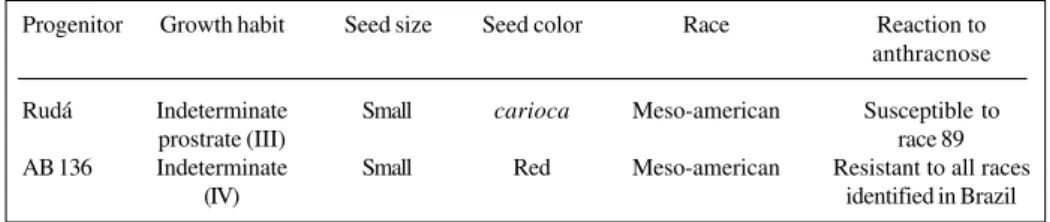
Seeds from differential cultivar AB 136 and “carioca type” cultivar Rudá were provided by CNPAF/EMBRAPA (Goiânia, GO, Brazil) (Table I). Cultivar AB 136 was used as male progenitor and crossed in a greenhouse with culti-var Rudá. The populations were maintained in the green-house.
Genetic analyses and evaluation of disease symptoms
Spores of C. lindemuthianum race 89 were inocu-lated onto plants derived from the cross Rudá x AB 136. The following number of seeds were sowed in the green-house in a completely randomized design: 30 seeds from each progenitor, 30 F1 seeds, 256 F2 seeds and 60 seeds
from each backcross (BCrand BCs). Fourteen days after
sowing the first expanded trifoliate leaf from each of the 466 plants was inoculated on the lower and upper leaf sur-faces with spore suspensions (1.2 x 10⁶ spores/ml), applied
with a horse-hair paint brush. The plants were then
incu-bated for seven days in a mist chamber, which was main-tained at 20-22o
C and 100% relative humidity, after which the plants were evaluated using a 1- to 9-symptom scale (Rava et al., 1993). Resistant (R) phenotype was assigned to plants with no or limited symptoms (grades 1 to 3), whereas plants graded 4 or greater were considered to be susceptible (S). Before inoculation, primary leaves from all plants were collected and kept at -80o
C for DNA ex-traction. The phenotypic class frequencies obtained were tested for goodness-of-fit to theorical ratios with chi-square tests.
One hundred and eighty-eight F2:3 families derived
from F2 resistant plants of cross Rudá x AB 136, consisting
of 12 plants each, were evaluated for resistance/suscepti-bility to C. lindemuthianum race 89. Inoculation conditions and symptom evaluation were performed as before except that in this case spores were sprayed onto the plants with the aid of a De Vilbiss apparatus.
DNA bulks
DNA from homozygous F2 resistant individuals was
used to make two contrasting bulks (resistant/susceptible) according to Michelmore et al. (1991). Two hundred and ten primers (Operon Technologies, Alameda, CA, USA) were used to test the bulks.
DNA extraction and amplification
DNA extraction was according to Doyle and Doyle (1990). Amplification reactions were performed in a thermocycler model 9600 (Perkin-Elmer, Norwalk, CT, USA). Each reaction (25 µl) contained: 25 ng DNA, 0.1 mM of each dNTP, 2.0 mM MgCl2, 10 mM Tris-HCl, pH
8.3, 50 mM KCl, 0.4 µM of one primer decamer (Operon Technologies, Alameda, CA, USA) and one unit of Taq DNA polymerase.
Each amplification cycle consisted of one denatur-ation step at 94o
C for 15 s, one annealing step at 35o
C for 30 s and one extension step at 72o
C for 1 min. After 40 cycles an extra extension step was performed for 7 min at 72o
C. Amplification products were analyzed on 1.2% aga-rose gels immersed in TBE buffer (90 mM Tris-borate, 1 mM EDTA, pH 8.0) containing 10 mg/ml ethidium bro-mide. DNA bands were visualized under UV light and
pho-Table I - Phenotypic characteristics of common bean progenitors Rudá and AB 136. Progenitor Growth habit Seed size Seed color Race Reaction to
anthracnose Rudá Indeterminate Small carioca Meso-american Susceptible to
prostrate (III) race 89
AB 136 Indeterminate Small Red Meso-american Resistant to all races
tographed with the aid of an Eagle Eye II photosystem (Stratagene, La Jolla, CA, USA).
Linkage analyses
Chi-square analysis was used to test the phenotypic segregation of the F1, F2, F2:3, BCs and BCr populations. To
determine the genetic distance between the RAPD marker and the resistance gene, 239 F2 plants were used. The
ge-netic distance between the marker and the resistance gene was determined with the aid of MAP-MAKER III (Lander et al., 1987) using a LOD score minimum of 3.0.
RESULTS AND DISCUSSION
Segregation analyses
Results of inoculations confirmed that cultivar AB 136 is resistant and that cultivar Rudá is susceptible to C. lindemuthianum race 89 (Table II) under greenhouse con-ditions. Rava et al. (1994) demonstrated that cultivar AB 136 is resistant to 25 C. lindemuthianum races detected in Brazil.
The segregation ratio (resistant:susceptible) of 3:1 in the F2 and the good fit to the expected
(homozygote:het-erozygote) ratio in the F2:3 families derived from F2 plants
(Table II) indicate that resistance of AB 136 to race 89 is controlled by a single dominant gene. This gene was identi-fied in cultivar Catrachita, a breeding line derived from AB 136 and named Co-6 (Young and Kelly, 1996b). Similar re-sults were reported in previous work using the same resis-tance source (Vidigal, 1994; Alzate-Marin et al., 1999a).
Identification of RAPD markers
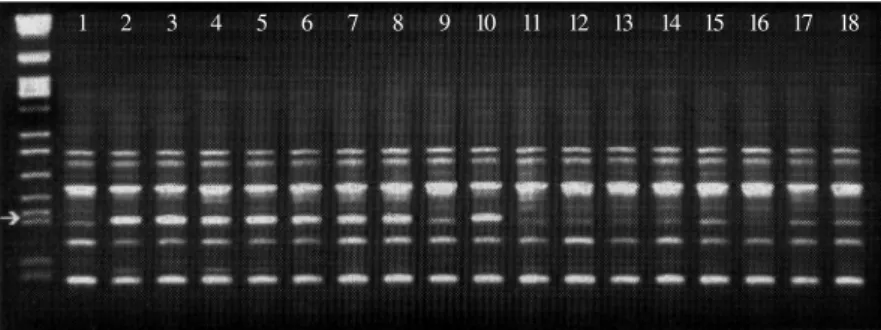
Co-6 has proven to be effective against a large num-ber of Latin American isolates of C. lindemuthianum and it is an important resistance source used by breeding pro-grams in Central America (Pastor-Corrales, 1985, 1992; Young and Kelly, 1996b; Rava et al., 1994). Young and Kelly (1997) identified two RAPD markers linked to, and flanking, the Co-6 locus in cultivar Catrachita: marker OPAH1780 is linked in coupling-phase at 12.3 cM of the
gene and marker OPAK20890 is linked in repulsion phase
at 7.1 cM of the gene. The band produced by OPAH1780 is
polymorphic between Rudá and AB 136, but in co-segre-gation analyses in the F2 population it mapped at 23.7 cM
of Co-6 (Table III, Figure 1).
We previously identified another marker (OPZ04560)
tightly linked in coupling to Co-6 (Alzate-Marin et al., 1999a). Using this marker it was possible to confirm that a single gene or a complex locus of tightly linked resistance genes present in cultivar AB 136 confers resistance to C. lindemuthianum pathotypes 73, 81, 89, and 64. The OPZ04560 marker could be used in a marker-assisted
breed-ing program to pyramid different resistance genes usbreed-ing cultivar AB 136 as a source for anthracnose resistance. In the case of the cross between cultivars Rudá and AB 136, however, OPZ04560 was not polymorphic between the
pro-genitors. For this reason it cannot be used in our breeding program aimed at the development of Rudá-derived bean varieties resistant to anthracnose.
One RAPD marker (OPAZ20940) was identified in the
F2 plants inoculated with race 89. This marker, a 940-bp
DNA band, is linked in coupling phase to the resistance gene
Table III - Linkage analysis between molecular markers and resistance genes in crosses involving cultivar AB 136.
Locus tested Expected ratio Observed ratio χ2 P cMa Rudá x AB 136 Co-6b/OPAZ20
940 9:3:3:1 176:13:2:48 149.57 0.00 7.1 Rudá x AB 136 Co-6/OPAH1780 9:3:3:1 155:34:8:42 84.77 0.00 23.7 aDistance in centimorgans in relation to Co-6.bResistance gene present in cultivar AB 136.
Table II - Segregation for resistance to race
89 of Colletotrichum lindemuthianum in the cross Rudá x AB 136.
Pedigree Generation No. of Plants Expected χ2 P
ratio Resistant Susceptible
Rudá P1 0 29 - -
-AB 136 P2 30 0 - -
-Rudá x AB 136 F1 29 0 - -
-Rudá x AB 136 F2 206 50 3:1 3.79 0.10-0.05
F1 x Rudá BCs 17 43 1:1 10.42 0.01-0.00
F1 x AB 136 BCr 60 0 1:0 0.00 1.00
Figure 1 - Electrophoretic analysis of amplification products obtained with primer OPAH1. The first lane corresponds to lambda DNA cut with EcoRI, BamHIand HindIII (size markers). Lanes 1 to 18 are as follows: 1, Rudá; 2, AB 136; 3-10, F2 plants resistant to race 89; 11-18, F2 plants susceptible to race 89. The arrow indicates a DNA band of 780 bp linked in coupling phase to the resistance gene.
1 2 3 4 5 6 7 8 9 10 11 12 13 14 15 16 17 18
Figure 3 - Electrophoretic analysis of amplification prod-ucts obtained with primer OPAZ20. Lanes are as fol-lows: 1, lambda DNA cut with EcoRI, BamHIand HindIII (size markers); 2, Rudá; 3, AB 136, and 4, Catrachita. The arrow indicates a DNA band of 940 bp linked in cou-pling phase to the resistance gene (Co-6).
1 2 3 4
(Co-6) (Figure 2). Co-segregation analyses in the F2
popu-lation revealed that marker OPAZ20940 was located 7.1 cM
from the resistance gene (Table III). The presence of this marker in cultivar Catrachita (Figure 3) strongly supports the idea that the gene studied in this work is the same (Co-6) as that reported by Young and Kelly (1996b).
To determine if the other 11 differential cultivars carry the molecular marker OPAZ20 linked to the Co-6 gene in cultivar AB 136, the DNA of these cultivars was extracted and amplified with the appropriate primers. Only differen-tial cultivar AB 136 possessed the band OPAZ20940. The
al-lelism studies conducted so far do not indicate the pres-ence of alternative alleles for Co-6 in other differential cultivars for anthracnose (Young and Kelly, 1996b).
Marker OPAZ20940 is being used to facilitate the
de-velopment of Rudá-derived isolines containing the gene Co-6 (Alzate-Marin et al., 1999b), as well as to pyramid dif-ferent resistance genes in common bean varieties as part of our breeding program toward the creation of commercial cultivars with long-lasting resistance to anthracnose.
ACKNOWLEDGMENTS
Research supported by grants from FAPEMIG (Brazilian
Government). A. Alzate-Marin was the recipient of a post-doc-toral fellowship from FAPEMIG and H. Menarim a fellowship from CNPq.
RESUMO
A antracnose do feijoeiro, causada por Colletotrichum lindemuthianum, é uma doença que ocasiona severas perdas, estando amplamente distribuída no Brasil. Trabalhos anteriores têm demonstrado que o cultivar AB 136, possuidor do gene Co-6, é uma importante fonte de resistência à antracnose no Brasil, uma vez que todos os patótipos identificados no país até o momento são incompatíveis com esse cultivar. O objetivo deste trabalho foi identificar um marcador RAPD ligado ao gene de resistência Co-6 presente no cultivar AB 136. Para este fim, foi utilizada uma população do cruzamento entre o progenitor Rudá, suscetível à raça 89 de C. lindemuthianum, e o cultivar AB 136. Nas populações F2 e F3 deste cruzamento observou-se uma
segregação de 3 plantas resistentes para 1 suscetível, e 1 planta homozigota para 2 heterozigotas, respectivamente, sugerindo que a resistência é determinada pela ação de um único gene. Na popu-lação F2, foi identificado um marcador, de aproximadamente 940
pb (OPAZ20), ligado em fase de acoplamento a 7,1 cM do gene
Co-6. Este marcador está sendo utilizado em nosso programa de melhoramento para desenvolver cultivares de feijoeiro derivados de Rudá resistentes à antracnose e adaptados ao Brasil Central. 1 2 3 4 5 6 7 8 9 10 11 12 13 14 15 16 17 18
REFERENCES
Alzate-Marin, A.L., Menarim, H., Carvalho, G.A., Paula, J.T., Barros, E.G.
and Moreira, M. (1999a). A single gene or complex locus of linked resis-tance genes confer resisresis-tance to four pathotypes of Colletotrichum lindemuthianum in common bean.Phytopathology 89: 281-285.
Alzate-Marin, A.L., Menarim, H., Cardoso de Arruda, M.C., Chagas, J.M., Barros, E.G. and Moreira, M.(1999b). Backcross assisted by RAPD mark-ers for the introgression of Co-4 and Co-6 anthracnose resistant genes in common bean cultivars.Ann. Rpt. Bean Improv. Coop. 42: 15-16.
Doyle, J.J. and Doyle, J.L. (1990). Isolation of plant DNA from fresh tissue.
Focus 12: 13-15.
Haley, S.D., Miklas, P.N., Stavely, J.R., Byrum, J. and Kelly, J.D. (1993). Identification de RAPD markers linked to a major rust resistance gene block in common bean. Theor. Appl. Genet. 86: 505-512.
Haley, S.D., Afanador, L.K. and Kelly, J.D. (1994). Selection for monogenic resistance traits with coupling and repulsion-phase RAPD markers. Crop Sci. 34: 1061-1066.
Johnson, E., Miklas, P.N., Stavely, J.R. and Martinez-Cruzado, J.C. (1995). Coupling- and repulsion-phase RAPDs for marker-assisted selection of PI 181996 rust resistance in common bean. Theor. Appl. Genet. 90: 659-664.
Johnson, W.C. and Gepts, P. (1994). Two new molecular markers linked to
bc-3. Ann. Rpt. Bean Improv. Coop. 37: 206-207.
Lander, E.S., Green, P., Abrahamson, J., Barlow, A., Daly, M.J., Lincon, S.E.
and Newburgh, L. (1987). MAPMAKER: An interactive computer pack-age for constructing primary genetic linkpack-age maps of experimental and natural populations. Genomics 1: 174-181.
Michelmore, R. (1995). Molecular approaches to manipulation of disease resistance genes. Annu. Rev. Phytopathol. 15: 393-427.
Michelmore, R., Paran, I. and Keselli, V. (1991). Identification of markers linked to disease-resistance genes by bulked segregant analysis: A rapid method to detect markers in specific genomic regions by using segregating populations. Proc. Natl. Acad. Sci. USA 88: 9828-9832.
Pastor-Corrales, M.A. (1985). Enfermedades del frijol causadas por hongos. In: FRIJOL: Investigación y Producción (López, M., Fernández, F. and Schoonhoven, A., eds.). PNUD-CIAT, Cali, pp. 172-180.
Pastor-Corrales, M.A. (1992). Recomendaciones y acuerdos del primer taller de antracnosis en América Latina. In: La Antracnosis del Frijol Común,
Phaseolus vulgaris, en América Latina (Pastor-Corrales, M., ed.). Doc. de trabajo No. 113. CIAT, Cali, pp. 240-250.
Peloso, M.J. Del (1992). Antracnose do feijoeiro no Estado de Minas Gerais-Brasil. In: La Antracnosis del Frijol Común, Phaseolus vulgaris, en América Latina (Pastor-Corrales, M., ed.). Doc. de trabajo No. 113. CIAT, Cali, pp. 86-108.
Rava, C., Molina, J., Kauffmann, M. and Briones, I. (1993). Determinación de razas fisiológicas de Colletotrichum lindemuthianum en Nicarágua.
Fitopatol. Bras. 18: 388-391.
Rava, C., Purchio, A. and Sartorato, A. (1994). Caracterização de patótipos de Colletotrichum lindemuthianum que ocorrem em algumas regiões produtoras de feijoeiro comum. Fitopatol. Bras. 19: 167-172.
Singh, S., Pastor-Corrales, M.A., Molina, A. and Otoya, M. (1992). Breed-ing common bean for resistance to anthracnose. In: La Antracnosis del Frijol Común, Phaseolus vulgaris, en América Latina (Pastor-Corrales, M., ed.). Doc. de trabajo No. 113. CIAT, Cali, pp. 198-211.
Ventura, J. and Costa, H. (1992). Situação atual do feijoeiro e da antracnose no Estado do Espírito Santo, Brasil. In: La Antracnosis del Frijol Común, Phaseolus vulgaris, en América Latina (Pastor- Corrales, M., ed.).Doc. de trabajo No. 113. CIAT, Cali, pp. 69-85.
Vidigal, C.G. (1994). Herança da resistência às raças Alfa, Delta e Capa de
Colletotrichum lindemuthianum (Sacc. et Magn.) Scrib. no feijoeiro (Phaseolus vulgaris L.). PhD thesis, Federal University of Viçosa, Univ. Press, Viçosa, MG, Brazil.
Vieira, C. (1983). Doenças e Pragas do Feijoeiro. UFV, Impr. Univ., Viçosa, pp. 231.
Williams, J., Kubelik, A., Livak, K., Rafalski, A. and Tingey, S. (1990). DNA polymorphisms amplified by arbitrary primers are useful as ge-netic markers. Nucleic Acids Res. 18: 6531-6535.
Young, R. and Kelly, J.D. (1996a). RAPD markers flanking the Are gene for anthracnose resistance in common bean. J. Am. Soc. Hort. Sci. 121: 37-41.
Young, R. and Kelly, J.D. (1996b). Characterization of the genetic resistance to Colletotrichum lindemuthianum in common bean differential culti-vars. Plant Dis. 80: 650-654.
Young, R. and Kelly, J.D. (1997). RAPD markers linked to three major anthrac-nose resistance genes in common bean. Crop Sci. 37: 940-946.